Marketing quality assurance checks involve more than making sure your marketing emails look good. QA is an essential step in maintaining brand integrity and improving the user experience. Marketers cannot afford to cut corners in quality assurance.
But one thing that’s easy to forget is that QA doesn’t start when the email is finished. Effective quality assurance begins along with the campaign design itself to catch any errors before they can cause trouble. From template reviews to link-checking and more, every step of the process requires a level of QA. Watch as Dharam Singh explains why these checks matter and how to take your QA to the next level in your future campaigns.
Ready to elevate your marketing efforts? With our dedicated quality testing, we’ll help ensure every detail aligns with your brand’s standards. Discover the impact of precision and let’s make your next campaign shine.
Disasters come in all shapes and sizes. Some originate at the heart of a company, while others affect a part of the world’s population at large. How a company handles a crisis can make a world of difference. However, not all circumstances can be mitigated by using lighthearted humor, as KFC did in 2018. Sometimes, pausing a marketing campaign is the most appropriate response. Today, we’re looking at a few examples of these circumstances.
Natural Disasters and Health Crises
Natural disasters like floods, wildfires, hurricanes, and earthquakes are all too common. Although natural disasters are typically localized events, many still receive extensive media coverage around the world. Particularly devastating storms or disasters can dominate headlines for weeks. Pausing a campaign during such times is common practice.
Civil Unrest, War, & Terrorist Attacks
Marketers need a large amount of optimism. However, uncertain times often mean taking a hard look at your campaigns and evaluating how they can affect your brand’s image. A little bit of homework may reveal that you need to hit pause. Pepsi discovered this the hard way in 2017, when the company released an ad that many viewers felt trivialized the ongoing Black Lives Matter protests.
Death of A Prominent Personality
The death of a leader can deeply affect the public. Pausing marketing campaigns to the affected community displays respect and empathy.
One excellent example comes from Planters. In early 2020, the company planned to “kill off” its mascot, Mr. Peanut. But when news broke of Kobe Bryant’s death, Planters immediately stopped sharing the ad in paid social media posts, saying they wanted to respect “those impacted by this tragedy”. (The planned TV spot still aired once during the Super Bowl.)
Business Scandals & Brand Crises
When bad press surrounds your business, all marketing needs to stop immediately until the issue has been addressed. And for a recent example of bad press, look no further than Kellogg’s, whose CEO suggested in early 2024 that low-income families could handle rising food costs by just buying more cereal. Unsurprisingly, the backlash was sharp and immediate.
A 2019 study by Crisp Thinking found that 53% of customers expected businesses to respond to a crisis within an hour and 59% stated that they wanted the response to come from the CEO. Following a corporate misstep, hitting the pause button on your marketing campaigns can give you some breathing space to fix your mistake. Additionally, it can reduce opportunities for customers to spread negativity via social media and unsubscribe from your mailing list.
The Decision-Making Process: To Pause Completely or Change Your Tone
The scenarios described above certainly warrant a pause to your planned marketing campaigns. However, they may not necessarily mean stopping all communication with your clientele either. These few questions can help you decide which path to choose:
Do you need to send update messages? For example, are there changes to your operational hours or delivery times because of the crisis?
Can you build brand awareness while helping your customers? Although regular marketing campaigns may be paused, you can still communicate with your customers by letting them know you’re here to help. For example, if your brand is actively involved with relief efforts in the area, you can direct customers to resources where they can get help or encourage them to donate to the efforts.
Does your copy resonate? The last thing you want is for your brand to come across as insensitive or tone-deaf. Any messaging during a crisis needs to be thoughtful and sensitive. (Quite a few companies learned this the hard way during the infamous era of COVID-themed commercials.)
Is it easier to let your customers choose to take a break? Consider giving your customers the power to hit the snooze button on your marketing campaigns. This allows you to give them a highly personalized experience without your customers unsubscribing due to frustration.
In a surprising move, Google recently announced its decision to delay the elimination of third-party cookies in its Chrome browser. This represents a significant pivot from its previous stance. This shift has created a buzz in the marketing world, where anticipation of a cookie-less future has driven many recent strategies. Now, Google’s decision to maintain these tracking tools for the foreseeable future is causing marketers to once again reassess their approaches.
A Brief Recap: The Journey to a Cookieless World
For years, third-party cookies have been a cornerstone of digital marketing, enabling advertisers to track user behavior across multiple websites and deliver highly targeted ads. However, rising concerns over privacy have led to increased scrutiny of these practices. In response, Google initially announced plans to phase out third-party cookies in Chrome, joining other major browsers like Safari and Firefox, which had already moved in that direction.
Google’s proposed solution was the Privacy Sandbox, a set of technologies designed to protect user privacy while allowing targeted advertising. The phaseout of third-party cookies was slated for 2022 but was delayed to 2024. Now, Google has pushed the timeline even further, leaving marketers in limbo.
Why the Delay?
According to Google, the decision to delay the phaseout of third-party cookies was driven by the need for more time to refine and test Privacy Sandbox technologies. The company aims to strike a balance between user privacy and the needs of the advertising industry—a complex challenge that requires extensive collaboration and testing.
Google’s recent statement emphasized the importance of a gradual transition to ensure that the ecosystem can adapt effectively. The company highlighted its commitment to a privacy-first web but acknowledged that more time is needed to develop viable alternatives to third-party cookies that don’t compromise the internet’s economic foundations.
Implications for Marketers
For marketers, this delay presents both challenges and opportunities. The additional time provides a buffer to adapt and prepare for the eventual shift to a cookieless world, but it also raises questions about how to proceed in the interim.
In the meantime, what should marketers consider?
1. Don’t Abandon Preparations for a Cookieless Future
While the timeline has been extended, the end of third-party cookies is still on the horizon. Marketers should continue to invest in first-party data strategies. Developing strong relationships with customers and gathering data directly through interactions on your own platforms will become even more valuable in a cookieless world.
2. Explore Privacy Sandbox Tools
Google’s Privacy Sandbox may eventually replace third-party cookies, so it’s essential to stay informed about its developments. Begin experimenting with Privacy Sandbox tools as they become available to understand how they can fit into your marketing strategy. This proactive approach will give you a competitive edge when the transition finally occurs.
3. Diversify Your Data Sources
In light of ongoing changes, diversifying data sources is more crucial than ever. Leverage a mix of first-party data, contextual targeting, and partnerships to reduce reliance on third-party cookies. This will not only help future-proof your marketing efforts but also improve your resilience against any sudden changes in the digital advertising landscape.
4. Enhance Transparency & Build Trust
Consumer trust is paramount, especially as privacy concerns continue to grow. Be transparent about your data collection practices and prioritize user consent. Building a reputation as a brand that respects privacy can differentiate you from competitors and foster long-term customer loyalty.
Conclusion
Google’s decision to delay the elimination of third-party cookies offers marketers a reprieve, but it’s not an invitation to become complacent. The digital marketing landscape is evolving, and the eventual phaseout of cookies is inevitable. By continuing to innovate, focusing on first-party data, and staying ahead of emerging technologies, marketers can navigate this transition smoothly and position themselves for success in a privacy-centric world.
Need help getting ready for a marketing future without third-party cookies? Contact our team today.
In the world of advertising and marketing, you create campaigns to produce positive outcomes. Unfortunately, this isn’t always how things work out. The severity of these backfires can range from minor to major and can significantly impact the perception of a brand or message.
To avoid these pitfalls, marketers need to really get to know their target audience and design campaigns that resonate with them. In this article, we’ll look at the factors contributing to marketing backfires and strategies to avoid them.
Understanding Backfires
A marketing backfire occurs when a campaign fails to reach its intended audience effectively or generates unintended consequences. It can happen when the marketing team works with inaccurate data or misjudges what their target audience would appreciate.
Let’s look at a real-world example of this. In 2012, Illumination Entertainment released The Lorax, an animated film based on the Dr. Suess story of the same name. The story famously depicts the negative impact of its antagonists’ business ventures vs the protagonist’s priorities. That’s why many people were unpleasantly surprised when Illumination loaned the movie’s branding to a newly aired commercial for the Mazda CX-5, a car not known for being environmentally friendly. The backlash forced Mazda to cut the campaign short.
In this case, Illumination’s marketing team missed the mark in two significant ways. First, they didn’t consider that the target audience of a movie like The Lorax probably wouldn’t be thrilled about a car with less-than-stellar environmental impact ratings. Second, the choice to partner with Mazda signals that Illumination either didn’t know about the car’s environmental impact or didn’t care—neither of which is a good look.
So what’s the secret to avoiding marketing backfires like this one? A holistic approach, collecting accurate data, understanding your target audience, and considering potential risks can make your campaigns more effective (and more positively received).
A Holistic Approach to Marketing Campaigns
Balancing Data and Creativity
Marketing teams should find effective ways to balance their creativity with the data they’ve collected on their target audience. Data and creativity are not mutually exclusive. Instead, they are two essential components of successful marketing campaigns. Data provides valuable insights into target parameters, while creative thinking fills the gaps and stimulates interest. By leveraging data alongside imaginative strategies, marketers can effectively tailor their messages and minimize the risk of backfires.
The Role of Office Culture
Your marketing team should also be free to learn from their own mistakes. In environments where mistakes are stigmatized or concealed, valuable lessons never see the light of day. Conversely, fostering an office culture that encourages open communication enables your marketing team to identify marketing backfires and develop strategies to avoid them in future efforts. Diversity within teams, both in terms of perspectives and predispositions, further enhances the ability to identify potential pitfalls.
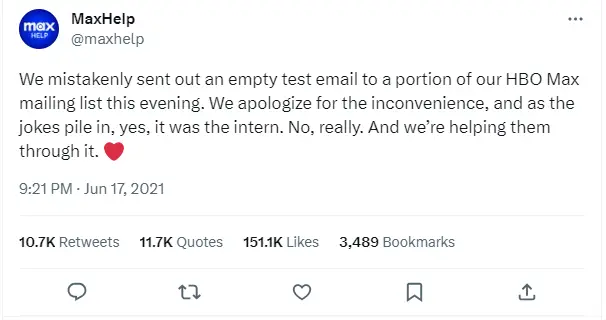
For a fantastic example of positive culture, look no further than HBO’s 2021 incident. In June of that year, a large portion of HBO’s streaming subscribers received an empty email with the subject line “Integration Test Email #1”. This obviously caused a lot of confusion and made users wonder if the email was a phishing scam using HBO’s branding. The answer came in the form of a tweet from HBO shortly after the email was discovered:
The “blame the intern” joke quickly turned into a trend under the hashtag #DearIntern, as people around the internet chimed in to tell the intern in question that it was okay, everyone makes mistakes. Many users also shared their own slip-ups. The result was a flood of heartwarming and hilarious social media posts that both eased the pressure on HBO and provided everyone involved with a good laugh. This whole scenario demonstrates how important a positive response and determination to learn from your mistakes can be.
Keeping Marketing Backfires to a Minimum
While completely eliminating backfires may not be possible, marketers can take proactive measures to minimize their occurrence. These measures may include:
Encouraging a culture of communication within the team, enabling individuals to voice concerns and provide feedback without fear of repercussions.
Conducting after-the-fact campaign analyses to identify improvement areas and openly discuss backfires. This allows teams to refine their approach and build upon successes.
Developing hypotheses and testing them with data. This approach fosters a data-driven decision-making process.
Being willing to pivot when necessary. If an approach is not yielding the desired results, adapt and explore alternative strategies without stigmatization.
Don’t Let Marketing Backfires Hold You Back
Marketing backfires can have far-reaching consequences for brands and campaigns. Understanding the target audience, interpreting messages correctly, and fostering a supportive office culture are all crucial in mitigating the risks associated with backfires. Ultimately, the path to successful marketing lies in embracing a data-driven and creative approach and a willingness to adapt in the face of unexpected outcomes. Contact us today for more information on running successful marketing campaigns.
March 30, 2026 | Page 1 of 1 | https://4thoughtmarketing.com/articles/tag/digital-marketing/