Key Takeaways
- Behavioral data shows what happened, not what customer preferences actually are.
- Most unsubscribes are a customer preference failure, not a list problem.
- Customers want control over topic, frequency, channel, and snooze.
- Declared preference data is more accurate than any inferred signal.
- Collecting customer preferences without the right infrastructure is just noise.
Here’s the uncomfortable truth most marketing teams won’t say out loud: the data you’re using to understand your customers is telling you what they did — not what they want.
Click-through rates. Purchase history. Time on page. These are the signals most B2B marketing teams rely on to infer customer preferences. And on the surface, that approach sounds reasonable. After all, behavior doesn’t lie, right? Except it does. Or at the very least, it misleads. A customer who opened your last three emails isn’t necessarily telling you they want more of the same. They may have opened out of habit, curiosity, or because your subject line was unusually good that week.
A contact who clicked a product page six months ago isn’t signaling that they want weekly follow-up emails on that topic today. And a prospect who went quiet after downloading your whitepaper almost certainly didn’t unsubscribe because they lost interest — they left because you kept sending the wrong things at the wrong time or frequency.
The gap between what your behavioral data suggests and what your customer preferences actually are is where email engagement goes to die. And most marketing teams are operating squarely in that gap.
Why Is the Guessing Problem Getting More Expensive?
Sending the wrong content to the wrong people at the wrong time has always been a problem. But recently, the cost of getting it wrong has compounded significantly.
On the engagement side, inboxes are more crowded than ever. Attention is scarcer. Customers disengage faster — and once they’re gone, re-engagement is an uphill battle that most nurture programs lose. Unsubscribe rates are rising across nearly every B2B vertical, and the primary driver isn’t list hygiene or deliverability. It’s a customer preferences mismatch — a relevance failure at the individual level.
On the compliance side, the regulatory environment has expanded dramatically. Data privacy laws now cover a significant majority of the world’s population, and the penalties for mishandling customer communication preferences — including sending communications to people who’ve signaled they don’t want them — have moved from theoretical to very real. A compliance failure isn’t just a legal expense anymore. It’s a brand event.
And here’s what makes this particularly frustrating: most of the customers who disengage didn’t want to leave permanently. They needed a break. They wanted fewer emails. They cared more about a different topic. They wanted to hear from you on their terms, not yours. But because you didn’t give them a structured way to express their customer preferences, the easiest option was the unsubscribe button — and they used it.
The guessing problem isn’t just inefficient. It’s actively destroying relationships you could have kept.
What Do Customers Actually Want to Control?
Before you can build a better customer preferences discovery system, it’s worth being specific about what “preferences” actually mean. Most marketing teams think of it narrowly — opt in or opt out, subscribed or unsubscribed. That binary thinking is exactly the problem. Customer preferences are multi-dimensional.
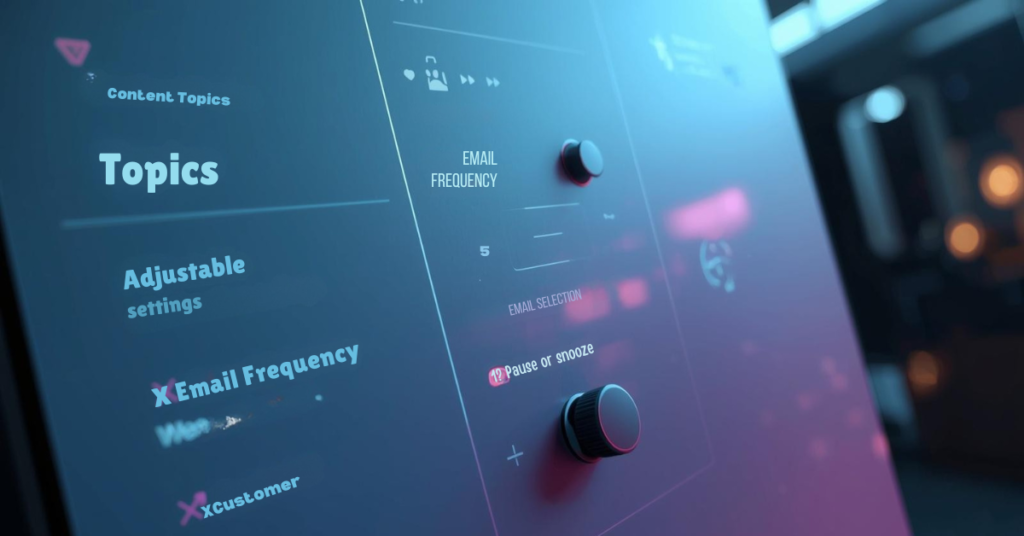
When you give customers a real opportunity to tell you what they want, they want to control:
Topics and content categories. Not every customer wants everything you produce. A CFO at a mid-market manufacturer doesn’t want your product release notes. A marketing director doesn’t need your supply chain updates. Customers want to select the content streams that are actually relevant to their role and their current priorities — and filter out the noise.
Frequency. This is arguably the single biggest driver of unsubscribes, and it’s almost entirely preventable. Some customers are happy hearing from you weekly. Others want a monthly digest at most. The problem isn’t that you’re emailing too much in absolute terms — it’s that you’re emailing too much for that specific customer. Frequency tolerance varies enormously, and the only way to know where any individual sits is to ask them.
Channel and format. Email is still the dominant channel for B2B communication, but it’s not the only one, and it’s not always the right one. Some customers prefer SMS alerts for time-sensitive updates. Others want long-form content delivered differently from short-form. Format matters too — HTML-rich emails don’t render well in every environment, and some customers actively prefer plain text.
Timing and snooze. This is the most underutilized customer preferences lever in B2B marketing. A customer who is heads-down in a product implementation, dealing with a budget cycle, or simply overloaded for a quarter doesn’t want to unsubscribe from your brand — they want to pause. The ability to “snooze” communications for 30, 60, or 90 days converts what would have been a permanent exit into a temporary break. Brands that offer this functionality retain a meaningful share of contacts who would otherwise be gone.
The pattern here is clear: customers don’t want less communication, they want better-fit communication. And they’re willing to tell you exactly what that looks like — if you give them the infrastructure to do it.
Why Behavioral Data Alone Will Always Fall Short
There’s a reason customer preferences discovery conversations keep circling back to analytics. Behavioral data is abundant, it’s already being collected, and it feels objective. It’s also deeply incomplete as a preference signal.
Behavioral data is retrospective. It tells you what a customer responded to under specific conditions that may no longer apply. The campaign that drove high open rates last quarter was shaped by timing, subject line, competitive context, and a dozen other variables that have since changed. Using last quarter’s behavior to predict this quarter’s customer preferences is like navigating with last year’s map.
Behavioral data is aggregated by default. When you look at segment-level engagement metrics, you’re looking at an average — and averages hide the individual. The segment that shows 30% open rates includes customers who opened every email and those who opened none. Treating them identically, based on the segment average, guarantees you’re wrong for most of them.
Most importantly, behavioral data is indirect. It measures response, not intent. A customer who didn’t open your last email didn’t necessarily signal disinterest — they may have been traveling, slammed with a deadline, or simply missed it in a crowded inbox. A customer who did open it may have done so by accident. Neither action tells you what the customer wants to receive next.
Surveys and focus groups get you closer to stated intent, but they’re expensive, slow, and don’t scale. By the time survey data feeds back into your campaign strategy, the preferences you captured are already drifting. The best data source that reliably tells you what a customer wants is the customer telling you directly — in a structured, actionable format that your systems can actually use.
Why Should You Prioritize Declared Preference Data?
Zero-party data — information that customers proactively and intentionally share with you — is the most accurate customer preferences signal available. It’s not inferred. It’s not averaged. It’s not retrospective. It’s a direct declaration of intent from the person who knows best what they want: the customer themselves.
When a customer tells you they want weekly product updates via email, no case studies, and they’d like to pause communications for the next 60 days — that’s not a data point you could have derived from any behavioral dataset. It’s a precise, actionable instruction. And the marketing team that acts on it correctly will retain that customer. The team that ignores it — or worse, never collects it — will lose them.
The shift from inferred to declared customer preferences isn’t just about data quality. It changes the relationship dynamic. Customers who are given genuine control over how a brand communicates with them feel a fundamentally different level of trust toward that brand. They’re less likely to disengage, more likely to engage with the communications they do receive, and more likely to view the brand as a partner rather than an intruder in their inbox.
This is the distinction the industry is increasingly calling the shift from Customer Experience Management to the Customer Managed Experience. Brands no longer impose their communication cadence on customers. Customers define it. The brands that enable this shift are building a structural advantage. The brands that don’t are managing a slow erosion.
What Is the Right Way to Ask for Preferences?
One of the most common objections to declared customer preferences collection is the cold-start problem: how do you collect meaningful preferences from a new contact without overwhelming them upfront?
The answer is progressive collection — gathering customer preferences incrementally across touchpoints rather than front-loading a lengthy preference form at first contact. When a new contact lands in your database, you know very little about them. Presenting them with a 20-field preference center at that moment creates friction and drives abandonment. But every subsequent interaction is an opportunity to learn one or two more things. A content download can prompt a single question about topic preferences. A webinar registration can surface a frequency preference. An account anniversary touchpoint can invite a full preference review.
Done well, progressive collection builds a rich, accurate customer preferences profile over time — with far less abandonment and far more completion than traditional front-loaded approaches. It also keeps preference data current, which matters because preferences change. The customer who wanted weekly updates six months ago may want monthly ones now. Progressive collection creates natural moments to refresh the data rather than letting it go stale.
The infrastructure requirement here is important: progressive collection only works if your systems can track what’s already been collected, prioritize what’s still missing, and suppress questions that have already been answered. Without that capability, you end up asking customers the same questions repeatedly — which is exactly the kind of experience that erodes trust.
Where Does Preference Discovery Actually Break Down?
Here’s where most preference management conversations stop short. Teams acknowledge that declared customer preferences data is superior. They agree that progressive collection is smarter than front-loaded forms. They understand that customers want more control. And then they go back to relying on behavioral inference — because their systems can’t operationalize anything better.
Preference discovery without the infrastructure to store, update, and act on customer preferences in real time is just noise. It’s the organizational equivalent of asking customers what they want and then ignoring the answer.
A centralized preference management system — one that maintains a live, unified record of each customer’s declared preferences and makes that data available across your marketing automation, CRM, and communication channels — is the missing piece in most B2B marketing stacks. Without it, preference data collected in one channel doesn’t inform another. Updates made today may not propagate to active campaigns for days. And the customer who carefully set their preferences last month receives a campaign that ignores every choice they made.
The brands getting this right aren’t just collecting better data. They’re building a communication infrastructure that gets smarter with every customer interaction — and more resistant to churn with every preference declared.
Stop Guessing. Start Asking.
The path forward isn’t complicated, but it does require a deliberate choice. You can continue optimizing around behavioral signals — refining subject lines, testing send times, adjusting cadence based on engagement quartiles — and continue watching unsubscribe rates climb and engagement rates drift. Or you can make the structural shift: build the infrastructure that lets customers tell you what they want, collect customer preferences progressively across every touchpoint, keep that data current, and let it drive every communication decision you make. That’s not just a better marketing strategy. It’s a better customer relationship.
The customers are ready to have this conversation. The question is whether your systems are ready to hear them. Ready to move from guessing to knowing? Explore the full framework in our Preference Management Framework, or see how a centralized preference management platform makes declared customer preferences collection operational at scale. Request a 4Preferences Demo