CNIL privacy compliance, GDPR compliance steps, French data protection regulations, privacy compliance checklist CNIL, data protection CNIL guidelines, CNIL compliance requirements, privacy law compliance France, how to comply with CNIL privacy rules, CNIL data protection impact assessment, CNIL privacy audit process, French CNIL enforcement actions, privacy compliance best practices France, CNIL consent requirements, data breach notification CNIL,
Key Takeaways
  • Appoint a DPO to own privacy accountability.
  • Build a living data map across systems and flows.
  • Prioritize least‑privilege access and data minimization.
  • Run DPIAs for high‑risk uses (e.g., AI, biometrics).
  • Document policies, training, and audits to prove compliance.

CNIL privacy compliance is not just a French regulatory requirement—it offers practical lessons for any organization handling personal data. With GDPR compliance steps forming the foundation, CNIL adds its own data protection guidelines that emphasize transparency, accountability, and user rights. Companies that align with French data protection regulations strengthen their overall privacy governance, reduce risk, and build trust with stakeholders. In today’s environment, where data breaches and enforcement actions are increasingly common, building programs around CNIL compliance requirements provides a competitive edge.

Why CNIL Privacy Compliance Matters

The Commission Nationale de l’Informatique et des Libertés (CNIL) serves as France’s data protection authority, enforcing privacy law compliance in France. For businesses, CNIL compliance requirements extend beyond theory. They include concrete expectations like lawful processing, data minimization, and clarity in user consent. Non-compliance often leads to fines and reputational damage, as seen in French CNIL enforcement actions. Companies that proactively implement measures can transform compliance from a burden into a driver of customer trust and operational excellence.

GDPR Compliance Steps with French Regulations

CNIL operates within the broader GDPR framework but tailors enforcement to local contexts. Practical GDPR compliance steps for France include:

  • Maintaining records of processing activities (ROPA).
  • Ensuring explicit consent aligned with CNIL consent requirements.
  • Implementing strong data breach notification CNIL processes.
  • Conducting a CNIL privacy audit process at regular intervals.
  • Embedding data minimization principles into all data flows.
  • Regularly updating privacy notices to reflect CNIL data protection guidelines.

By adopting these steps, companies meet both EU and national privacy law standards while demonstrating accountability to regulators and customers.

Using a CNIL Privacy Compliance Checklist

A privacy compliance checklist CNIL ensures organizations do not overlook critical elements. Effective checklists often include:

  • Identifying lawful basis for processing and documenting justification.
  • Appointing a Data Protection Officer (DPO) with clear responsibilities.
  • Mapping data flows across systems and third-party vendors.
  • Conducting CNIL data protection impact assessments before launching projects.
  • Establishing a CNIL privacy audit process for continuous improvement.
  • Training staff on CNIL privacy compliance rules and their role in implementation.

This systematic approach helps maintain accountability while aligning with French data protection regulations.

High-Risk Processing and DPIAs

CNIL emphasizes the importance of a data protection impact assessment when handling high-risk processing activities like biometrics, AI, or geolocation. Performing a CNIL data protection impact assessment ensures risks are mitigated before deployment. Companies should also document their risk-mitigation measures and establish regular review points. This proactive approach demonstrates commitment to privacy compliance best practices in France and prepares businesses for potential inspections.

Enforcement and Lessons from CNIL

French CNIL enforcement actions highlight that organizations must move beyond policies to active implementation. Key lessons include:

  • Prioritize user rights and transparency in every interaction.
  • Provide clear consent flows and options for withdrawal.
  • Prepare for inspections and audits with up-to-date documentation.
  • Address vendor and cross-border transfer risks with contractual safeguards.

Learning from these enforcement cases strengthens corporate privacy strategies and reduces exposure to regulatory sanctions.

Building a Culture of Privacy Compliance

Compliance is not static—it requires continuous monitoring, updates, and staff training. Embedding privacy governance into corporate culture ensures CNIL privacy compliance becomes second nature. Organizations should:

  • Document processes, maintain audit trails, and schedule periodic reviews.
  • Establish privacy committees to oversee implementation.
  • Integrate compliance objectives into corporate performance metrics.
  • Run awareness campaigns that reinforce data protection responsibilities.

By treating CNIL privacy compliance as a cultural commitment rather than a checkbox exercise, companies can adapt quickly to evolving regulations.

Technology and Tools for Compliance

Leveraging the right tools can streamline privacy compliance. Data mapping software, consent management platforms, and automated reporting dashboards help organizations implement CNIL compliance requirements more efficiently. Automation reduces manual errors while providing regulators with clear evidence of compliance efforts. For multinational companies, these tools also simplify aligning French data protection regulations with other jurisdictions.

Conclusion

Privacy obligations in France demand rigor, but they also offer organizations a roadmap for stronger governance. CNIL privacy compliance integrates GDPR compliance steps with national enforcement lessons, creating a model for sustainable data protection. Companies that adopt CNIL compliance requirements not only reduce risk but also build trust and resilience. If your business is looking to strengthen privacy programs or align with French data protection regulations, 4Thought Marketing can help you navigate CNIL guidelines and implement best practices with confidence.


Frequently Asked Questions (FAQs)

What is CNIL privacy compliance?
CNIL privacy compliance refers to aligning with French data protection regulations under CNIL, ensuring organizations follow GDPR compliance steps with national enforcement requirements.
What are the main CNIL compliance requirements?
These include appointing a Data Protection Officer, maintaining processing records, conducting CNIL data protection impact assessments, and adhering to CNIL consent requirements.
How can companies comply with CNIL privacy rules?
Organizations should follow a privacy compliance checklist CNIL, including lawful processing, audits, training, and clear data breach notification CNIL procedures.
Why are DPIAs important?
They identify and mitigate risks in higher‑risk processing, protecting people’s rights while supporting compliant innovation.
What happens if businesses fall short?
Enforcement can result in fines, reputational harm, and mandatory remediation steps, so preparation matters.
What are privacy best practices in France?
Embed governance structures, run periodic audits, train employees, and communicate transparently with users.
What role does technology play?
Automation supports consent capture, audit preparation, and reporting, making it easier to keep programs consistent across systems and regions.

data minimization in marketing, marketing data minimization, privacy-first marketing, customer trust in data privacy, data collection practices, personalization and privacy, marketing compliance strategy, GDPR data minimization requirement, CCPA data minimization compliance,
Key Takeaways
  • Data minimization in marketing balances personalization and compliance.
  • Strategic minimization reduces breach risks and legal exposure.
  • Practical steps include streamlined forms, profiling, and retention rules.
  • Privacy-first marketing strengthens customer trust and engagement.
  • Marketing and compliance leaders must align to embed minimization.

Customers want experiences that feel relevant and respectful of their privacy—clear choices, minimal friction, and confidence their data isn’t over-collected. In that context, data minimization in marketing defines a practical promise: collect only what serves a purpose, use it transparently, and retire it on schedule. Many teams still default to “more data” habits that add risk without improving outcomes; a minimization approach aligns personalization with trust, keeps programs audit-ready, and builds stronger relationships over time.

What does data minimization in marketing and compliance mean?

At its core, data minimization means collecting, storing, and processing only the information that is directly relevant and necessary for a specific purpose. From a compliance standpoint, regulations like GDPR and CCPA explicitly require organizations to justify every piece of personal data they handle. For marketing teams, this principle translates into being intentional about what information is asked for on forms, how long it is retained, and whether it genuinely serves personalization or customer engagement goals.

Instead of assuming “more data equals better insights,” marketers adopting marketing data minimization focus on fewer, high-value attributes that can still enable segmentation, scoring, and personalization. Compliance officers, on the other hand, see minimization as a safeguard that reduces liability in case of breaches or audits. Together, both perspectives highlight that data minimization is not about restricting opportunities but about ensuring relevance, trust, and accountability.

Why should businesses prioritize data minimization today?

There are compelling reasons why businesses must embed privacy-first marketing principles and make minimization a strategic priority:

  • Reduced breach impact: Fewer data points stored means less exposure in case of a cyberattack.
  • Lower liability and costs: Limiting collection reduces the volume of data subject to regulations and decreases compliance burdens.
  • Simplified audits: Regulators find it easier to assess streamlined datasets tied to clear purposes.
  • Customer trust: Transparency about restrained data use strengthens long-term loyalty.
  • Operational efficiency: Smaller datasets reduce storage, integration, and processing overheads.
  • Future adaptability: Minimization prepares companies to pivot as new privacy laws and technologies emerge.
  • Competitive advantage: Brands that can show a customer trust in data privacy posture stand out in the market.

For marketing and compliance leaders, these reasons demonstrate that minimization is not only a defensive compliance measure but also a proactive trust-building strategy.

How can marketers apply data minimization in daily operations?

Implementing data minimization in marketing requires embedding practical steps across the customer journey and technology stack:

  • Forms and lead capture: Use progressive profiling to capture essential data gradually instead of lengthy, intrusive forms.
  • Marketing automation platforms: Regularly audit custom fields, workflows, and scoring models to eliminate unnecessary data.
  • Segmentation and targeting: Focus on behavioral data signals—such as engagement patterns—over excessive demographic collection.
  • Data lifecycle management: Apply retention schedules and deletion policies that align with GDPR data minimization requirements and CCPA data minimization compliance.
  • Vendor and martech integrations: Limit data sharing to only the fields required for execution and reporting.

Through these practices, marketers can show they are attentive to data collection practices without compromising personalization opportunities.

Can personalization thrive with less customer data?

A common myth in marketing is that the more customer data you collect, the better your personalization. In reality, personalization thrives when data is purposeful, accurate, and relevant. Collecting excessive details that are rarely used creates noise and compliance risks without adding real value.

By focusing on personalization and privacy together, marketers can design campaigns that respect boundaries while delivering relevance. For example, understanding customer browsing behavior or recent interactions often provides richer insights than requesting sensitive personal identifiers. This approach builds personalization that is dynamic and responsive, rather than invasive. The result is stronger engagement rooted in trust, rather than short-term gains from intrusive data collection.

How can leaders build a culture of privacy first marketing?

Sustainable success requires going beyond policies to create a culture where marketing compliance strategy and innovation align. This begins with collaboration between marketing leaders and compliance teams to define shared goals. Together, they should:

  • Develop training programs to help marketers understand privacy requirements.
  • Establish cross-functional governance committees to oversee data practices.
  • Integrate consent management tools into the marketing technology stack.
  • Regularly audit campaigns for alignment with data minimization principles.

By embedding privacy first marketing in strategy, not just execution, businesses can elevate both compliance posture and customer experience. Leadership buy-in ensures that minimization is viewed as a growth enabler, not a barrier.

Conclusion

Customers expect relevance without surrendering control of their information—strong brands meet that standard by making data minimization in marketing an operating habit: purposeful collection, transparent use, disciplined retention. Excess data adds complexity and exposure without improving outcomes; focused data improves trust, audit readiness, and campaign performance. Treat minimization as a design choice across forms, MAPs, and vendor flows to align personalization with privacy and sustain growth.

If you’re ready to explore how to implement these strategies, 4Thought Marketing with 4Comply can help you design, operationalize, and scale a data minimization framework that protects your business and builds lasting customer trust.

Frequently Asked Questions (FAQs)

What does data minimization in marketing mean?
It means collecting and using only the customer information that is necessary for a specific purpose, ensuring campaigns are effective while protecting privacy and reducing compliance risks.
How can data minimization improve customer trust?
By being transparent about limited data collection practices, businesses show they respect privacy boundaries. This builds long-term customer trust in data privacy and strengthens brand loyalty.
Does limiting data collection hurt personalization?
No. When designed well, personalization and privacy go hand in hand. Purposeful data, such as engagement signals, often enables better personalization than storing excessive, rarely used information.
What privacy laws require data minimization?
Regulations like GDPR and CCPA include explicit data minimization requirements. Aligning marketing activities with these rules reduces regulatory risk and improves overall marketing compliance strategy.
How can marketing and compliance teams collaborate on data minimization?
They can create shared governance frameworks, establish retention policies, and use consent management tools to embed privacy first marketing practices across campaigns, platforms, and customer journeys.
What are examples of data minimization in lead generation?
Examples include shorter signup forms, progressive profiling, and retention policies that delete unused data. These steps reduce liability while still capturing insights needed for relevant campaigns.

4 Comply, privacy first marketing, privacy-first marketing
Key Takeaways
  • Consent management ensures compliance and builds trust.
  • 4 Comply simplifies global privacy regulation adherence.
  • Data minimization reduces breach risks and boosts confidence.
  • Consumers gain control with transparent data rights tools.
  • Privacy-first practices drive lasting business success.

Consumers and businesses alike understand the importance of data privacy. Consumers want their information to stay private and be shared only with a small audience. Meanwhile, companies see data as a valuable asset that helps drive marketing activities—but they also want to prioritize customer trust by granting them control over their data and reducing the impact of a potential data breach. What’s a solution that can make both sides happy?

We understand these challenges and offer reliable marketing consent solution to help businesses navigate the complexities of data privacy and consumer trust. Here’s how 4 Comply can help you create privacy-first consumer experiences and why it’s essential for your business.

Transparency & Consent Management

In marketing, consent refers to a customer explicitly stating that a company can use the data they provide, and how it can be used, which may include continuing to communicate with them. Most privacy laws require some degree of consent before data processing can occur. 4 Comply’s advanced consent management tools streamline consent tracking, giving customers a clear choice and the clearance they need for data processing. Not only does this help keep you in compliance with consent requirements, but it also helps increase customer confidence in your brand. Consumers appreciate the knowledge that their data will only be used for marketing if they allow it.

Ensuring Compliance with Privacy Regulations

Worldwide, there are so many differences in privacy laws that businesses must ensure they comply to avoid hefty fines and reputational damage. 4 Comply helps businesses stay compliant with a range of privacy regulations. Our tools manage marketing consent, handle data subject requests efficiently, and ensure that your data handling practices are up-to-date with current laws. This reduces the risk of non-compliance and helps build a trustworthy brand.

Data Security & Minimization

Data breaches are a significant concern; consumers are increasingly wary of how their data is stored and used. Data minimization helps to address the potential impact of a breach. Our platform promotes data minimization by ensuring businesses collect only the data they need. This approach not only complies with legal requirements but also enhances consumer confidence in your brand.

Data Access and Rights Fulfillment

A cornerstone of modern data privacy is granting customers control over their data and ensuring transparent data sharing. 4 Comply empowers consumers to control their personal information. Users can manage their consent preferences and understand who can access their data, ensuring transparency and fostering trust. This comprehensive approach to data access requests and rights fulfillment is essential for building strong, trust-based customer relationships.

Why Choose 4 Comply?

With 4 Comply’s privacy solutions, your business can:

  • Build consumer trust: Transparent data practices build and maintain consumer trust.
  • Ensure regulatory compliance: Stay ahead of privacy regulations and avoid legal pitfalls.
  • Enhance data security: Protect consumer data with robust security measures.
  • Empower consumers: Give consumers control over their data, fostering a positive and transparent relationship.

4 Comply aligns perfectly with privacy-first marketing. Our solutions help businesses address privacy challenges, build consumer trust, and achieve long-term success in a data-conscious market.

For more information on how 4 Comply can help your business thrive, get in touch with us today.

Frequently Asked Questions (FAQs)

What is a marketing consent solution?
A marketing consent solution helps businesses manage customer permissions for data use, ensuring transparency, compliance with privacy laws, and trust in marketing communications.
Why is consent management important for businesses?
Consent management keeps businesses compliant with global privacy regulations, reduces legal risks, and builds stronger consumer trust through transparent data practices.
How does 4 Comply help with privacy regulations?
4 Comply streamlines compliance by managing consent, processing data subject requests, and aligning practices with global privacy laws, reducing fines and protecting brand reputation.
What role does data minimization play in data privacy?
Data minimization ensures businesses only collect essential data, reducing risks from breaches, meeting regulatory requirements, and strengthening consumer trust.
How does 4 Comply empower consumers?
4 Comply gives consumers visibility and control over their personal information, letting them manage consent preferences and understand data access, enhancing transparency and trust.
Why should companies choose 4 Comply for privacy-first marketing?
4 Comply offers advanced consent tools, ensures compliance, enhances data security, and empowers consumers, making it the ideal choice for building trust in today’s privacy-first market.

privacy mistakes (primary focus), data privacy risks, privacy policy compliance, data breach prevention, sending private files, ignoring data security, encryption mistakes, data hoarding, access controls, privacy breach, mandatory data breach notifications, privacy experts, privacy program, data privacy impact assessment, data minimization, privacy training, employee privacy training, ongoing privacy training, privacy optimization, preventive measures in privacy.
Key Takeaways
  • Privacy mistakes expose sensitive data and increase legal risks.
  • Data privacy risks often result from weak security or bad habits.
  • Policy compliance and breach prevention protect long-term trust.
  • Employee privacy training reduces errors and strengthens defenses.
  • Preventive privacy measures create a stronger overall program.

People slip up—it happens. But when the slip involves customer data, the fallout can be bigger than a missed email or a typo. The upside: with a few steady practices, you can reduce privacy mistakes, lower data privacy risks, and show customers you take protection seriously. This refreshed guide walks through the most common errors, why they snowball, and how to build day-to-day habits—policy compliance, encryption, access controls, and privacy training—that prevent problems before they start.

What Are the Most Common Privacy Mistakes?

Privacy mistakes rarely look dramatic in the moment; they’re usually small oversights that stack up. A few we see all the time:

  • Sending private files to the wrong person. A stale address in your CRM, a rushed “reply all,” or a copy-paste slip can expose personal details.
  • Ignoring data security basics. If encryption feels clunky, people skip it. That creates a clear path for interception.
  • Data hoarding. Keeping everything “just in case” turns one dataset into many attack surfaces—and increases the harm of any privacy breach.
  • Too many tabs, too little focus. Multitasking leads to records updated in the wrong system or exported to the wrong folder.
  • Being too helpful. Sharing customer info with a partner “just this once” can trigger mandatory data breach notifications if they weren’t authorized.
  • Not following the privacy policy. A great policy isn’t enough; you need the muscle memory to live it.

These sound ordinary, but together they create sustained data privacy risks.

Why Do Privacy Mistakes Lead to Data Privacy Risks?

Because each mistake opens a door. One misaddressed attachment can expose identity details. One unencrypted export can travel further than intended. One unchecked system permission can give access to people who don’t need it. Multiply those by a busy week, and the chance of a privacy breach climbs. The result: regulatory headaches, customer anxiety, and time spent on cleanup instead of growth. The fix isn’t heroics—it’s routine: privacy policy compliance, documented workflows, and small guardrails that remove guesswork.

How Can Businesses Ensure Privacy Policy Compliance?

Think of your privacy program as the “operating system” for handling data. Compliance sticks when it’s simple, visible, and owned:

  • Make the policy usable. Keep it short, searchable, and mapped to common tasks (collect, store, share, delete).
  • Assign ownership. Privacy experts or a DPO should review changes to tools or processes and keep the policy current.
  • Control access. Grant the minimum permissions people need, then review regularly. Strong access controls prevent casual snooping and accidental exposure.
  • Close the loop. When something changes—new form, new vendor, new field—update the policy and training.
  • Track exceptions. A lightweight log helps you learn from edge cases instead of repeating them.

When daily work matches the words in your policy, compliance becomes a habit, not a hurdle.

What Steps Improve Data Breach Prevention?

Breach prevention is about shrinking opportunity and impact:

  • Encrypt by default. In transit and at rest. If encryption is painful, fix the workflow so people don’t have to think about it.
  • Practice data minimization. Collect less, retain less, and know why you have each field. The less you hold, the less you can lose.
  • Run a data privacy impact assessment (DPIA) for changes. New software, new data types, or new sharing patterns deserve a quick DPIA. Document what you changed and why.
  • Monitor and alert. Basic logging plus meaningful alerts will catch odd behavior early.
  • Test your response. Tabletop a scenario: mis-sent file, suspicious download, or vendor incident. Who does what in the first hour?

These steps won’t just block incidents—they’ll also make any post-incident review faster and calmer.

Why Is Privacy Training Essential for Employees?

People want to do the right thing; training shows them how. A good program makes privacy practical:

  • Make it role-based. What a marketer needs (e.g., consent handling) differs from what support needs (e.g., identity verification).
  • Keep it short and regular. Micro-lessons beat annual marathons. Ongoing privacy training reinforces the right habits.
  • Show real examples. A redacted email thread or anonymized ticket gets the point across quicker than a slide of definitions.
  • Reward the catch. Celebrate someone who flags an odd data request or spots an access gap.

Employee privacy training turns policies into muscle memory.

How to Build a Long-Term Privacy Program

You don’t need a giant overhaul—just consistent, visible practices:

  • Empower privacy experts. Give them time and authority to tune processes, not just approve documents.
  • Keep tech simple. Fewer tools, clearer handoffs, and sane defaults prevent mistakes at 4:57 p.m. on a Friday.
  • Codify preventive measures in privacy workflows. Pre-approved language, locked templates, and automated retention rules remove ambiguity.
  • Measure what matters. Track a handful of signals: mis-sent files, permission changes, DPIAs completed, and training completion.

Over time, your privacy program becomes a quiet advantage—steady, predictable, and trustworthy.

Preventing Privacy Mistakes Before They Happen

Long-term privacy optimization demands time, dedication, and teamwork. But the first few steps—particularly preventive measures—are fairly straightforward to implement. This is an excellent place for your business to start. Know what privacy mistakes you’re most likely to face, determine how to prevent them, and put your plan into action. But if you aren’t quite sure where to start, that’s fine—we can help. Give us a call today to learn more.

Conclusion

Privacy mistakes aren’t a sign you’re careless; they’re a sign your systems need smoothing. With clear policy compliance, sensible access controls, encryption that “just works,” and ongoing training, you’ll cut data privacy risks and earn durable trust. If you’d like help tightening the process or running a fresh DPIA, 4Thought Marketing can walk you through it—practical steps, no drama.

Frequently Asked Questions (FAQs)

What are the most common privacy mistakes businesses make?
Some of the most common privacy mistakes include sending private files to the wrong person, ignoring data security, data hoarding, and not following the company’s privacy policy.
How do privacy mistakes increase data privacy risks?
Privacy mistakes expose sensitive information, leading to unauthorized access, compliance violations, and mandatory data breach notifications. These risks damage customer trust and may result in financial penalties.
How can businesses ensure privacy policy compliance?
To maintain compliance, businesses must align practices with their privacy policy, conduct data privacy impact assessments, enforce access controls, and provide employee privacy training.
What steps help with data breach prevention?
Data breach prevention includes encryption, data minimization, employee awareness, ongoing privacy training, and monitoring systems for suspicious activity that could indicate a privacy breach.
Why is ongoing privacy training important?
Ongoing privacy training ensures employees remain aware of new threats, compliance changes, and best practices. It reduces errors, strengthens preventive measures in privacy, and supports the overall privacy program.
How can a privacy program improve long-term compliance?
A privacy program led by privacy experts, supported by training, and built on preventive measures helps businesses stay compliant, reduce risks, and avoid repeating costly privacy mistakes.

GDPR compliant data storage, GDPR data storage
Key Takeaways
  • GDPR compliant data storage starts with a living, end‑to‑end data map.
  • Lock down access: encryption, RBAC, MFA, and privileged‑access monitoring.
  • Make retention and RTBF deletions reach vendors and backup copies.
  • Count analytics IDs/IPs as personal; include in DSAR discovery.
  • Operationalize GDPR data storage evidence and workflows with 4Comply.

As most privacy experts will know, the GDPR deals with how you collect, process, and store customer data. Most practical GDPR tips focus on data collection and processing. For instance, it’s always important to collect consent immediately, and then to ensure that you honor that consent during your marketing efforts. But it’s easy to overlook that the GDPR also dictates how you store that data—and you store data in more places than you may realize at first. Maintaining GDPR compliant data storage is absolutely critical.

GDPR Compliant Data Storage Methods to Audit

Wherever your customers’ data ends up, if it falls under GDPR jurisdiction, you have to make sure that you handle it legally. Where does your company store collected customer data? A few examples include:

  1. Marketing automation platforms: This one is obvious. Marketing software such as Oracle Eloqua, Marketo, or Marketing Cloud contains customer information by necessity to execute marketing campaigns.
  2. Customer relationship management database: Your CRM database will obviously contain a massive amount of customer data. However, with features that allow you to search by contact, it should be easier to locate a particular customer’s information for GDPR purposes.
  3. Company data backups: This one is also obvious. More than likely, your company’s data backups contain some customer data. The trick here is to develop a data retention policy that follows GDPR requirements and honors your customers’ wishes.
  4. Customer service databases: While not directly related to marketing, you’ll pull information from this database if a customer submits a DSAR.
  5. Third party service providers: Any third parties involved in your marketing process will almost certainly hold some of your customers’ data. Take the time to review your agreements with third parties to see if they must be edited to comply with the GDPR.
  6. Website analytics: Your analytics may not capture information like names or addresses. However, even otherwise anonymous information such as IP addresses can be used to identify a person if paired with even a small amount of other data. This anonymous data is thus technically covered by GDPR requirements.
  7. Chatbot logs: If your website uses a chatbot, AI assistant, or similar tools, its conversation logs almost certainly have private data from customer discussions. Sometimes a customer will even use a chatbot to do the equivalent of filling out a form. Make sure to encrypt your chatbot records and treat them with as much care as you would any other form of private data.

Why This Matters

One of the privacy rights enshrined in the GDPR is the right to be forgotten. On hopefully rare occasions, customers will request that you delete any and all data you’ve collected from them. That requires a significant amount of searching. Overlooking any data could subject you to significant fines if the customer challenges you or learns you’re still holding onto their information. The GDPR doesn’t care if you made a mistake or not. You’ll still be fined.

Knowing exactly where to find all GDPR-relevant customer data can reduce your risk of fines. Start with the most obvious places to look, like your marketing automation software setups. But don’t stop there. Anywhere you could find customer data—even theoretically anonymized data—should be on your checklist.

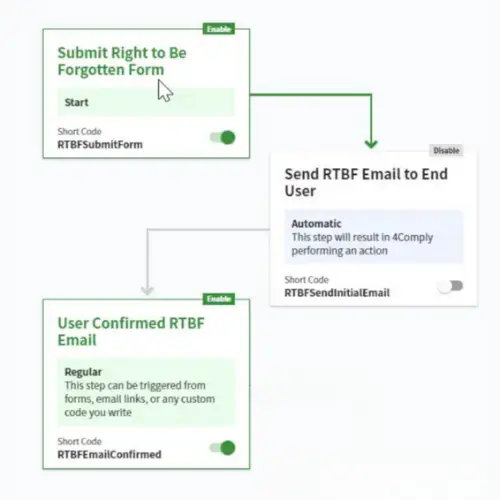
The only possible exception is if you’re keeping a record of customers who had submitted right-to-be-forgotten requests. 4Comply’s legal activities record has a section dedicated to this. However, this record of forgotten customers must follow several common-sense measures:

  • It must contain only the minimum amount of data required to identify the person in question.
  • It must be accessible only to authorized viewers (i.e., the Data Privacy Officer or legal team).
  • It must exist solely for the purpose of proving that you’ve forgotten a customer in the event of a legal challenge. Lifting data from this record for marketing purposes is disrespectful to your customers and unlawful.

Make Data Tracking Easy

A data audit is a massive project for any company. Why tackle it alone? Our expert team is ready to help you bring your data management game up to speed with privacy laws. And once your audit is complete, keep your momentum going with 4Comply to stay up-to-date with changing requirements and streamline your long-term data management. Make it easy to maintain GDPR compliant data storage.

Interested? Get in touch with us to schedule an audit or request a free demo of 4Comply today.

Frequently Asked Questions (FAQs)

What is GDPR compliant data storage?
It means every place you store personal data—apps, exports, BI files, logs, backups, vendor systems—follows GDPR rules for security, access control, purpose limitation, and defined retention/deletion.
Which data types are in scope for GDPR data storage?
Anything that can directly or indirectly identify a person: names, emails, customer IDs, IP addresses, device IDs, cookie IDs, chat transcripts, support tickets, and marketing-automation/CRM records.
Do backups fall under GDPR and the right to be forgotten (RTBF)?
Yes. Backups are storage. Your policy should explain how deletions flow to backup sets—e.g., purge on restore or scheduled re-writes—so RTBF is honored across all copies.
How do we start an audit of GDPR data storage locations?
Build a data map. Include MAPs (Eloqua/Marketo/etc.), CRM, data lakes/warehouses, analytics tools, chatbot logs, helpdesk systems, vendor/processor platforms, and any CSV/Excel/BI exports.
What controls demonstrate truly GDPR compliant data storage?
Encryption at rest/in transit, role-based access/least privilege, MFA, privileged-access monitoring, change logs, and documented retention schedules that include vendors and backups.
Are IP addresses and analytics IDs personal data for storage purposes?
Treat them as personal data when reasonably linkable to a person. Include analytics platforms and logging systems in your DSAR search and retention/deletion workflows.
How long can we keep customer data?
Only as long as needed for the stated purpose. Define retention by purpose and system, automate deletions, and document exceptions (e.g., legal holds) with clear end dates.
How should we manage third-party processors in GDPR data storage?
Use a DPA, confirm technical and organizational measures (encryption, access controls), align retention/RTBF paths, and maintain audit evidence that processors actually execute deletions.
How do we prove deletion without re-storing personal data?
Maintain a minimal, access-controlled RTBF proof record (purpose: legal defense only). Store just enough to verify the subject and the deletion event—never reuse it for marketing.
How can 4Comply help operationalize GDPR data storage?
4Comply centralizes consent and DSAR workflows, tracks system-wide actions (including vendor calls and backup notes), and generates audit-ready evidence for GDPR data storage programs.

privacy software, data privacy, privacy compliance software, privacy laws,
Key Takeaways – Privacy Software
  • Balances marketing ambition with legal risk by design.
  • Centralized DSAR intake with “you are here” progress.
  • Consent captured once; permissions computed per law and policy.
  • Enforces least‑risk outreach automatically across channels.
  • Immutable log of consent, permissions, DSARs, and refusals.
  • Audit‑ready, regulator‑ready evidence available in a click.
  • Speeds compliant campaigns without blocking revenue goals.
  • Configurable for jurisdictions and evolving privacy policies.

At 4Thought Marketing, when we think about privacy compliance, we have two primary concerns. The first is ensuring that customers’ rights to proper data handling are always respected. The second is empowering companies to handle customer data in a legal manner without hindering their marketing efforts. Our privacy compliance software, 4Comply, was born out of these two concerns. We carefully designed this privacy software to help companies strike the proper balance between enthusiastic marketing and overly cautious data handling.

The 3 Pillars of 4Comply

Everyone has their own idea of the proper way to handle customer data privacy, in large part because everyone has different plans for using the data. Marketers are focused on lead generation, and so want to collect as much data as possible, keep it as long as possible, and squeeze every last drop of marketing potential out of it. They see customer data as a resource to harvest.

On the other hand, a company’s legal department is focused on keeping unhappy customers from suing. They work hard not only to be ready for any legal threats, but to lower the risks on their end as much as possible. Strict privacy laws like the GDPR inflict serious penalties for mishandling data, so from an attorney’s perspective, it’s better to be safe than sorry when dealing with customer information. If your legal department had their way, your company would collect as little data as possible, get rid of it the moment it’s no longer needed, and use it as cautiously as possible to avoid upsetting anyone.

Of course, both perspectives are flawed. Overly enthusiastic marketing can drive away customers. On the other hand, overly cautious marketing means attracting fewer customers in the first place. The proper balance falls somewhere between these two extremes. Our privacy software, 4Comply, is designed not only to help your company find the proper balance for your needs, but to keep careful track of your decisions and apply them to company-wide marketing choices. The three pillars of 4Comply are:

  • Citizen rights fulfillment
  • Consent/permissions distribution
  • Legal activities vault

Citizen Rights Fulfillment

Many privacy laws (most famously the GDPR) allow customers to request access to data a company holds on them. These requests are known as data subject access requests, or DSARs. Customers may ask simply to view their data, update any wrong or outdated information, transfer their information to a different company, or for their data to be purged entirely.

Refusing DSARs or failing to answer them in the required time frame can cost a company a small fortune in fines. 4Comply makes the process easier by storing all these requests centrally and displaying them in a single dashboard. A secondary dashboard provides a streamlined view of each process with a “you are here” indicator.

Consent & Permission Distribution

In marketing, consent refers to a customer explicitly stating that a company can communicate with them. For marketers, consent is a much stronger signal of interest and opens the door for a variety of marketing activities.

Permission is a 4Comply-specific term configured by the algorithm. When a user submits information to your company through what we refer to as a “consent input”, 4Comply analyzes the information provided. Our software algorithm considers relevant privacy laws, the user’s consent or lack thereof, and your company’s own privacy policy. The result of this calculation is permission—the practical extent to which you are allowed to contact the user for marketing purposes.

Legal Activities Vault

With laws like the GDPR ready to penalize any company that mishandles information, business leaders need a reliable way to keep a detailed record of legal activities that can’t get lost in the filing cabinet. Fortunately, 4Comply users are ready for an examination of their privacy-related legal activities.

The legal activities vault automatically records a detailed log of every legal action regarding consent activities, permissions activities, rights fulfillment, any (very rare) DSAR refusals, and forgotten customers. Both your company’s actions and the customer’s actions are recorded. No one can edit the stored information, not even 4Comply itself, so you can be confident that your records will never change. A detailed, unchangeable privacy software record is truly a lifesaver.

A Reliable Privacy Software

4Comply is a revolutionary privacy software designed not only to make your marketing experts’ job easier, but also to give your legal department peace of mind regarding how you handle customer data. It gives legal and marketing teams precise control over how laws and privacy policies are applied to customer actions. Companies in an increasingly privacy-conscious world need this balance desperately. Why wait? Give your company the boost it needs today! Contact us to get started with 4Comply.

Frequently Asked Questions (FAQs)

What is privacy software and how does it work?
Privacy software helps organizations govern personal data responsibly and legally. It centralizes consent and preferences, applies relevant privacy laws to each interaction, automates DSAR workflows, and preserves audit-ready evidence so teams can prove compliance.
Do I need privacy software to comply with GDPR, CCPA/CPRA, and other privacy laws?
Regulations don’t mandate a specific tool, but they require consistent, documented processes. Privacy software makes compliance repeatable at scale—standardizing notices, consent, DSAR handling, retention, and reporting—so you meet deadlines and reduce audit risk.
How is privacy software different from a consent management platform (CMP)?
A CMP focuses on banners and preference capture on web or apps. Privacy software goes further: it computes permissible outreach, orchestrates DSARs, enforces retention and deletion, tracks processing activities, and maintains a tamper-evident compliance record across systems.
How does privacy compliance software handle DSARs (data subject access requests)?
It centralizes intake, verifies identity, routes tasks to systems of record, tracks statutory timelines, and compiles a complete response package. It also logs every action to create an immutable trail that’s easy to present to regulators or auditors.
Can privacy software improve marketing performance without risking data privacy?
Yes. By computing permissions from consent, policy, and applicable privacy laws, privacy software guides marketers to contact only permissible audiences—protecting data privacy while maintaining campaign velocity and conversion quality.
What features should I look for in privacy compliance software?
Look for: consent and preference management, computed permissions, DSAR orchestration with deadline tracking, immutable audit logs, data retention and deletion workflows, integrations with CRM/MAP/CDP/CMP, and a rules engine that adapts to changing privacy laws.

privacy evidence software, audit‑ready privacy records, tamper‑evident compliance logs, consent management evidence, legal activities vault, immutable audit log, privacy compliance proof, regulator‑ready documentation, data minimization proof,
Key Takeaways
  • Build audit‑ready privacy records with trusted privacy evidence software.
  • Capture a complete DSAR audit trail from intake to export.
  • Maintain tamper‑evident compliance logs and an immutable audit log.
  • Centralize consent management evidence in a secure legal activities vault.
  • Keep a unified consent and permissions log across systems.
  • Produce regulator‑ready documentation in minutes, not months.
  • Demonstrate credible privacy compliance proof without manual stitching.
  • Apply privacy by design and show data minimization proof throughout.

When privacy complaints or regulatory audits arrive, the challenge isn’t what you did—it’s proving it. Teams that adopt privacy evidence software avoid the scramble of siloed emails and screenshots by maintaining audit‑ready documentation from day one. With frameworks like GDPR, CPRA, and LGPD imposing significant penalties, organizations need a record that is complete, readable, and tamper‑evident—so the proof is as strong as the process.

Why does evidence readiness matter?

Regulators and plaintiff attorneys look for two things: substantive compliance (did you do the right thing?) and procedural compliance (can you prove it quickly and defensibly?). Evidence‑ready teams close investigations faster, reduce legal exposure, and avoid reputational damage. In short, reliable privacy compliance proof shortens audit cycles and builds trust.

Typical pain points without an evidence system:

  • Scattered artifacts (ticket logs, CRM notes, email chains) with no unified timeline
  • Unclear chain of custody—who acted, when, and under which policy
  • Difficulty proving erasure (you’re asked to prove a negative)
  • Missed deadlines due to manual stitching of proof instead of audit‑ready privacy records

What is 4Comply’s Legal Activities Vault—and how does it work?

4Comply automatically builds a time‑stamped DSAR audit trail for every action your team takes to fulfill data‑subject rights, manage consent, and honor permissions—alongside key subject interactions (for example, identity verification or viewing a response). The result is a single source of truth for privacy events in a secure legal activities vault.

What the Vault Captures

  • Event metadata: request type (access, erasure, rectification, restriction), requestor identifiers, verification steps, timestamps
  • Action details: data collection sources, systems queried, exports delivered, redactions performed, communications sent
  • Consent/permission changes: opt‑in/opt‑out events, purpose updates, channel preferences, proof of notice—forming consent management evidence and a durable consent and permissions log
  • Delivery confirmations: when a subject viewed or downloaded their response package—easily referenced in your DSAR audit trail
Security & Integrity by Design

  • Tamper‑evident compliance logs: Immutable, append‑only architecture creating an immutable audit log
  • Role‑based access controls protect sensitive cases while enabling auditor views
  • Granular redaction: Mask sensitive fields while preserving integrity and chain of custody records
  • Retention rules: Align evidence retention to policy with a clear evidence retention policy
  • Built on privacy by design, so safeguards are enforced across the lifecycle
Audit‑Ready Exports

Filter by individual, request, time window, or regulation and export a clean evidence packet. Standard audit export packets include a cover summary, chronological timeline, and references to underlying system events—delivering regulator‑ready documentation and, when needed, a DSAR export for outside counsel.

Auditor view in four steps: Open the legal activities vault → Filter to the subject/request → Preview the timeline → Export the evidence package.

Note: Regulations and deadlines vary by jurisdiction. This content is for general information only and not legal advice.

How should you document DSAR refusals (exceptions)?

Most DSARs must be fulfilled. In rare cases, refusing may be lawful—for example when identity cannot be verified, the request is manifestly unfounded or excessive, disclosure would infringe others’ rights/freedoms, or a statutory exemption applies. Use structured DSAR refusal documentation so every reviewer sees what was requested, what you did, and why the refusal was justified.

4Comply dedicates a section of the legal vault to legal activity exceptions, recording:

  • The exact request and requestor identity checks completed
  • The customer’s location (for regulatory scoping)
  • Applicable regulations (e.g., GDPR, state/provincial laws)
  • A traceable summary of steps taken to fulfill the request
  • The specific refusal rationale, response communication, and escalation trail

This structure helps demonstrate good‑faith handling and defensible reasoning if your decision is later scrutinized.

How do you prove erasure with the “Erasure Evidence Vault”?

A “right to be forgotten” request seems simple—until you’re asked to prove deletion. Proving a negative is difficult, and you can’t expose your entire database to make your case.

4Comply’s Erasure Evidence Vault stores erasure evidence and the absolute minimum data necessary to demonstrate that an individual’s personal data was purged and is no longer used for marketing or processing:

  • Data minimization proof: Only minimal identifiers (for example, hashed/contact token and timestamps) required for right to be forgotten verification
  • Purpose limitation: Retained solely to evidence compliance with the erasure request
  • Role‑based access controls restrict visibility to legal/compliance; not available to marketing or analytics
  • Retention controls: Kept only as long as required to evidence compliance, then purged per policy

This balances “prove it” requirements with privacy by design—and provides additional privacy compliance proof without re‑creating risk.

What does an end‑to‑end DSAR & consent workflow look like?

  • Intake: Route requests from web forms, email, or service desk; auto‑classify by jurisdiction and set the SLA for DSAR
  • Verify: Identity checks with recorded artifacts and data‑subject rights tracking
  • Locate: Query connected systems (CRM, MA, data warehouse) and log sources searched
  • Prepare: Package data, apply redactions, record approvals, and lock the audit timeline
  • Deliver: Secure portal delivery with view/download confirmations and regulator‑ready documentation
  • Archive: Append the complete timeline to the legal activities vault with retention tag for ongoing compliance reporting

Which integrations support Marketing Ops & IT?

4Comply connects with the tools your teams already use to reduce swivel‑chair work and capture complete evidence:

  • Marketing automation: Adobe Marketo Engage, Oracle Eloqua—log consent and subscription changes; capture fulfillment proofs as consent management evidence
  • CRM & service desk: Salesforce, HubSpot, Zendesk—associate DSAR tickets with the DSAR audit trail and audit export packets
  • Identity & access: Okta/Azure AD—verify requestors and record verifier identity under role‑based access controls
  • Data platforms: S3/Data Lake/ETL—record sources queried and extracts generated for compliance reporting
privacy evidence software, audit‑ready privacy records, tamper‑evident compliance logs, consent management evidence, legal activities vault, immutable audit log, privacy compliance proof, regulator‑ready documentation, data minimization proof,

How does this align with Governance, Risk & Compliance (GRC)?

  • Policies → Controls → Evidence: Map vault events to control IDs and attach policy references—supporting regulator‑ready documentation
  • Review workflows: Legal sign‑off steps logged as part of the chain of custody records
  • Reporting: Time‑to‑fulfill DSAR, percentage within SLA, refusal rate by rationale, evidence export cycle time—rolled into executive compliance reporting

What’s the 30‑60‑90 day implementation plan?

Days 1–30: Connect intake channels; configure jurisdictions and SLAs; set RBAC; pilot with DSAR‑Access—baseline audit‑ready privacy records

Days 31–60: Add consent change logging from MA platforms; enable templates for audit export packets; train service desk/legal teams

Days 61–90: Roll out erasure workflows; activate the Erasure Evidence Vault; finalize retention schedules and evidence retention policy

Which KPIs should you track?

  • DSAR cycle time (median, p90) and on‑time rate against your SLA for DSAR
  • Evidence completeness score (required artifacts present in the immutable audit log)
  • Refusal documentation completeness (rationale, notices, escalations) via DSAR refusal documentation
  • Erasure proof rate (erasure cases with vault entry and retention tag)

When does the vault really pay off?

  • Cross‑border audits: Produce jurisdiction‑specific regulator‑ready documentation fast
  • Vendor incident inquiries: Show which data was shared, under what basis, and when consents changed within your DSAR audit trail
  • Customer disputes: Demonstrate delivery, view/download confirmations, and timelines of actions taken preserved in tamper‑evident compliance logs

Why do teams choose 4Comply?

  • Zero manual stitching: Evidence is captured at the moment actions occur into audit‑ready privacy records
  • Consistent, readable output: One place to see the full story, from request to resolution, with a maintained audit timeline
  • Faster legal response: Reduce review cycles with exportable, case‑ready audit export packets
  • Defense you can stand behind: Tamper‑evident compliance logs and role‑based access controls designed for scrutiny

What’s the next step?

Privacy compliance is serious business, and proof is everything. As privacy evidence software, 4Comply helps you follow the rules and present privacy compliance proof clearly, quickly, and credibly. Request an “evidence export” demo and we’ll walk you through a real DSAR case from intake to export.

FAQs

How do tamper‑evident records work in 4Comply?
4Comply maintains an append‑only, time‑stamped event log. Authorized users can view, filter, and export evidence, but the underlying record cannot be overwritten. Any administrative changes (for example, access and retention) are logged as events, preserving chain of custody records.
How quickly can we produce an auditor‑ready DSAR evidence packet?
Teams typically filter to a subject and export within minutes because artifacts (verification, collection, redaction, delivery confirmations) are captured in the legal activities vault. Standard audit export packets and regulator‑ready documentation reduce review cycles.
Does an Erasure Evidence Vault conflict with the “right to be forgotten”?
No. The vault keeps only the minimum data necessary to prove deletion and prevent re‑ingestion—retained solely for compliance proof, access‑restricted to legal/compliance via role‑based access controls, and purged per policy. This supports right to be forgotten verification and data minimization proof.
Which systems can we connect to build a complete trail?
Out of the box, 4Comply supports common marketing and GTM stacks (Adobe Marketo Engage, Oracle Eloqua), CRM/service desk (Salesforce, HubSpot, Zendesk), identity (Okta/Azure AD), and data platforms (S3/data lakes/ETL). These connections enrich consent management evidence, the consent and permissions log, and your DSAR audit trail.
How should we document DSAR refusals so they are defensible?
Record the request exactly as received, verification attempts, jurisdiction, applicable regulation, steps taken, and the specific refusal rationale (for example, identity not verified, manifestly unfounded/excessive, rights of others, statutory exemption). Attach notices sent to the requestor. Use the vault’s structured DSAR refusal documentation to standardize reviews.
Where do regional differences (GDPR/CPRA/LGPD) get handled?
Use jurisdiction templates to set deadlines, notice language, and data‑set scopes per region. The vault tags each case with location and regulation so reviewers can filter and produce regulator‑ready documentation quickly.

trust center, brand credibility, customer trust, data privacy, data handling practices
Key Takeaways
  • Centralize policies, certifications, and system status.
  • Data transparency boosts credibility and customer trust.
  • Compliance hub speeds security reviews and sales cycles.
  • Prioritize UX: clear IA, plain language, accessible.
  • Govern updates: owners, cadence, monitoring, feedback.

Trust is no longer optional — it has become the cornerstone of every modern business relationship. Customers today are highly informed, cautious, and empowered. They know their data is valuable and will not entrust it to brands that cannot demonstrate accountability. And while companies often make promises of strong privacy and security practices, customers increasingly expect tangible proof. This is where a trust center bridges the gap. By centralizing policies, certifications, compliance documents, and transparency resources, a transparency hub helps organizations demonstrate credibility, integrity, and accountability. Beyond serving as a compliance tool, it reassures customers, accelerates business decisions, and strengthens brand credibility in a competitive, compliance‑driven marketplace.

What Is a Trust Center?

A trust center is an online hub dedicated to transparency. Instead of scattering privacy notices, compliance documents, and certifications across multiple pages, the transparency hub consolidates them in one easy‑to‑navigate location. Typically, this hub includes information about security certifications, privacy policies, compliance frameworks, and data handling practices. The goal is to provide customers, partners, and even regulators with a reliable single source of truth about how your organization safeguards data. By presenting information in an accessible and structured way, a transparency hub communicates accountability and demonstrates that your business treats data stewardship as a strategic priority, not an afterthought.

Why does a Trust Center Matters?

Customer trust is a form of currency. Organizations that lack transparency often face setbacks that go beyond reputational harm. Key risks include:

  • Lost deals: Procurement teams now require visibility into data protection measures before signing contracts. If this information is absent or scattered, deals can be delayed or lost altogether.
  • Compliance fines: Regulations such as GDPR, CCPA, and other global frameworks impose heavy penalties for non‑compliance. Without centralized information, companies risk missteps that result in costly fines.
  • Customer churn: Customers who sense weak governance or vague privacy practices are likely to abandon your brand in favor of competitors that demonstrate transparency and accountability.

A trust center mitigates these risks by making privacy, security, and compliance information easily available. In doing so, it improves customer confidence, accelerates partner reviews, and builds long‑term loyalty.

Types of Trust Centers

Not every organization needs the same type of trust center. Depending on your industry, regulatory environment, and business goals, different models may apply:

  • Security centers — Focused on data protection, these hubs showcase certifications, policies, vulnerability management practices, and incident response readiness. They are common in SaaS and technology companies where security is paramount.
  • Privacy centers — Designed to empower customers, these hubs outline data privacy rights, opt‑out mechanisms, and data request tools. They are especially important for businesses handling sensitive or regulated customer data.
  • Legal centers — These hubs clarify contractual obligations and terms of service. By translating complex legal jargon into accessible language, they demystify user rights and ensure transparency around compliance.
  • Homegrown centers — Fully customized hubs created to fit an organization’s unique brand identity and industry requirements. While resource‑intensive, they allow complete flexibility and differentiation.
  • Unified trust center — A comprehensive approach that integrates all the above. By combining privacy, security, legal, and compliance information into one portal, the unified transparency hub serves as a holistic source of truth.

The unified model is particularly powerful because it ensures that all stakeholders — customers, partners, and regulators — can access accurate and complete information in one place, without confusion or fragmentation.

Benefits of a Trust Center

trust center, brand credibility, customer trust, data privacy, data handling practices

While compliance may be the initial motivation for creating a transparency hub, the benefits extend much further:

  • Empowering customers — A well‑designed transparency hub allows customers to access and manage their data preferences, understand how their information is processed, and exercise their rights without friction. This empowerment reinforces your brand’s transparency and customer‑centric approach.
  • Boosting trust perception — When organizations openly display certifications, policies, and system statuses, customers perceive them as more reliable. This perception can translate into stronger relationships and improved retention.
  • Streamlining the sales cycle — Sales teams often spend time addressing security questionnaires and compliance concerns. A centralized hub reduces these delays, enabling prospects to self‑serve critical information and move through the evaluation process faster.
  • Reinforcing brand differentiation — Transparency itself can be a competitive advantage. In industries where competitors hide behind vague assurances, a robust trust center sets your organization apart as a leader in governance and accountability.

How to Build a Trust Center

Building a trust center requires more than uploading documents. It involves careful planning and cross‑functional collaboration. Five critical steps include:

  1. Stakeholder alignment — Start by involving privacy, legal, security, compliance, marketing, and IT teams. Each group ensures the content is accurate, comprehensive, and aligned with business goals.
  2. Information architecture — Organize your content thoughtfully. Group policies, certifications, and FAQs into clear categories. Prioritize intuitive navigation to help users find information quickly.
  3. Design & UX — A transparency hub must be user‑friendly. Avoid legal jargon where possible, use plain language explanations, ensure mobile responsiveness, and follow accessibility standards for inclusive design.
  4. Update protocols — A transparency hub is only credible if information remains current. Establish protocols to update content whenever certifications are renewed, policies change, or new compliance standards are introduced.
  5. Monitoring & feedback — Track visitor behavior to understand what customers search for most. Solicit feedback to refine content, layout, and usability continuously.

Best Practices for Running a Trust Center

Even the most well‑built transparency hub can fail if it is not actively maintained. Consider these best practices:

  • Do: keep content updated, especially when policies or compliance statuses change.
  • Do: use plain, customer‑friendly language rather than dense legal text.
  • Do: assign ownership across teams so every area of content has a responsible maintainer.
  • Do: monitor visitor metrics to identify which sections are most useful.
  • Don’t: hide critical documents behind confusing menus or PDFs buried deep in the site.
  • Don’t: treat the transparency hub as a one‑time project. Continuous updates and oversight are required to maintain credibility.

Adopting these practices ensures your trust center remains credible, usable, and aligned with both customer expectations and regulatory requirements.

Conclusion

Trust centers are not just repositories of compliance paperwork — they are strategic assets that improve brand perception and accelerate business outcomes. And while regulations and customer expectations evolve faster than ever, many companies still operate with scattered or outdated transparency practices. Therefore, establishing a unified transparency hub is no longer optional; it is essential for maintaining credibility, winning customer trust, and reducing operational risk.

At 4Thought Marketing, our privacy and compliance experts can help your organization design, build, and optimize a transparency hub tailored to your industry. By working with us, you not only meet regulatory obligations but also turn transparency into a true competitive advantage.

Frequently Asked Questions (FAQs)

How does a trust center accelerate the sales cycle?
By centralizing certifications, policies, and compliance documents, prospects can self‑serve answers to common security and privacy questions. This reduces delays caused by lengthy questionnaires and back‑and‑forth inquiries.
What industries benefit most from a transparency hub?
Industries handling sensitive data — such as SaaS, fintech, healthcare, and e‑commerce — gain the most. However, any business seeking to improve transparency and customer confidence can benefit.
How often should a trust center be updated?
Updates should occur whenever certifications renew, regulations change, or new policies are introduced. As a best practice, assign ownership and review content at least quarterly.
Can a trust center help with global compliance requirements?
Yes. A transparency hub can showcase adherence to GDPR, CCPA, ISO, NIST, and other international standards. This helps organizations demonstrate compliance across multiple jurisdictions in one place.
What features make a trust center user‑friendly?
Clear navigation, plain language explanations, mobile‑responsive design, accessibility compliance, and a search function all make a trust center easier for customers and partners to use.
Is building a unified trust center worth the investment?
Yes. Though it requires upfront planning and resources, a unified trust center enhances brand credibility, reduces compliance risk, and improves customer trust — providing long‑term ROI.

data protection program, beyond compliance, data inventory, data minimization, data governance,
Key Takeaways — Data Protection Program
  • Compliance is only the baseline.
  • Keep data inventories current.
  • Collect only what’s necessary.
  • Strong governance builds alignment.
  • Use automation with oversight.
  • Offer transparent data options.
  • Audit policies and vendors.
  • Track trust and incident metrics.

Achieving privacy compliance is a non-negotiable first step for any business. But it’s just the beginning. Businesses building trust with customers and partners must go beyond simple legal compliance. A more comprehensive data protection program provides extra layers of security and shows potential contacts that you take privacy very seriously. With customers listing trust as a critical factor in who they choose to do business with, showing everyone that you can be trusted will go a long way.

The Shift from Compliance to Privacy-Centric Business Practices

So, how do you shift from checking things off a legal list to a broader, more respectful approach to handling personal data? The fine details will vary depending on the exact nature of your business and the data you use. However, regardless of your industry, there are a few tasks you can prioritize to take your data protection program to the next level.

1. Maintain an Up-to-Date Data Inventory

Businesses that comply with data regulations typically maintain some form of data inventory to track how and where personal information is collected, stored, and used. However, data processes evolve, and so must your data inventory.

A well-managed data inventory helps businesses keep track of their data sources, usage, and flows. It should include all data types collected, where they are stored, who has access to them (including third-party vendors), and how they are shared. Updating your data inventory frequently allows you to reduce unnecessary duplication, streamline information flows, and simplify data management processes.

For simpler updates, automation can save your company a lot of time and help to identify potential risks. More detailed updates will likely require human involvement. But regardless of your preferred method, reviewing and updating your data inventory regularly is a must.

2. Prioritize Data Minimization

With the role data plays in modern marketing, it’s all too easy to focus on collecting more data than is necessary.  Customers don’t appreciate that, and they demonstrate this by abandoning forms that feel invasive. Demanding too much data feels intrusive to consumers, and places them at a higher potential risk in the event of a data breach. Privacy-conscious businesses should instead practice data minimization and only collect what is necessary.

Simply defined, data minimization is the practice of collecting only what data you need for a particular task. (For example, a promotion for birthday bonuses will obviously require a customer’s birthdate, but not their shirt size.) This might sound restrictive until you realize that most companies only use about half the customer data they collect and retain. That unused data occupies valuable space in your records—space that could go toward data that actively contributes to marketing plans. Data minimization also helps build trust with customers who may be wary about handing over too much personal information.

3. Take Advantage of Automation

As your company grows, so does the complexity of complying with privacy regulations and responding to data subject requests. You could hire twice as many employees to handle every minute detail. Or you could automate the less important tasks.

Automated workflows can streamline the finer details of privacy audits, DSARs, and similar processes. The potential for improving response times is obvious. But automation doesn’t just make tasks go faster. Automation enables continuous monitoring and instant access to information at every step of the process. Not only does this let you keep up with how things are going, but it also significantly reduces your risk of errors.

4. Give Consumers Control Over Their Own Data

Today’s consumers are inundated with marketing messages from multiple brands across various platforms. The oversaturation of marketing content has led to what is known as “marketing fatigue,” causing many customers to disengage or block communications altogether.

To avoid alienating your audience, give consumers more control over how their data is used and how they receive communications. Implementing a customer-facing preference center can be a game-changer for building trust. Rather than presenting a simple “unsubscribe” option, a preference center allows users to select what kinds of messages they want to receive and how frequently they prefer to be contacted. This ensures that the communications they receive are relevant and welcomed, and builds trust with your customers.

5. Develop a Comprehensive Privacy Training Program

Privacy and data protection are not just the responsibility of the legal or IT department—they must be part of the company culture. Ongoing privacy training needs to include all your employees. But as important as formal training is, don’t stop there. Encourage a culture of privacy through informal channels like privacy-focused chat groups or newsletters. You can also consider attending a privacy conference as a company. Whatever you choose, ensure that your team is aware of and passionate about data protection.

Conclusion: Building Trust Through Data Protection

Maximizing your data protection program means going beyond compliance and embedding privacy into your organization’s DNA. By maintaining an up-to-date data inventory, embracing data minimization, automating busywork, giving consumers control over their data, and providing continuous privacy education, your business can become a leader in data protection.

Ready to improve your approach to data privacy? Contact us today to get started.

Frequently Asked Questions (FAQs)

What is a data protection program?
A data protection program is the framework an organization uses to manage, secure, and govern personal data in line with global regulations such as GDPR, CCPA, and LGPD.
How does a data protection program go beyond compliance?
Going beyond compliance means not only meeting laws but also building trust through transparency, data minimization, and customer‑first governance practices across regions.
Why is a data inventory important for privacy laws worldwide?
A data inventory ensures visibility of where personal data is stored, processed, and transferred—critical for meeting country‑specific regulations and cross‑border data transfer rules.
How does data minimization support global privacy compliance?
Minimizing collected data lowers the risk of breaches and helps align with strict data protection requirements in regions like the EU, Canada, and Asia‑Pacific.
What role does data governance play in multinational organizations?
Data governance establishes consistent policies across markets, ensuring compliance with regional standards while enabling scalable, transparent data practices.
How can businesses prepare for evolving data privacy regulations?
Organizations should adopt flexible governance models, conduct regular audits, and implement tools that adapt quickly to new regional laws and international compliance frameworks.

Data privacy vs data security, AI data privacy and security, Zero trust architecture, Security by design, Privacy by design, Data minimization, Data breach prevention, Data governance framework
Key Takeaways
  • Privacy governs lawful use; security defends systems and data.
  • Unify programs with zero trust across identities and data.
  • Design controls in early: security by design, privacy by design.
  • Minimize data collected; limit purpose, retention, and sharing.
  • Prove governance with maps, consent logs, and audits.
Data Privacy vs Data Security: Looking to the Future

Data fuels every product release, campaign, and customer interaction, and leaders are expected to move faster with sharper insights. At the same time, stakeholders expect provable stewardship of personal information. That’s why data privacy & data security isn’t a semantic debate—it’s the foundation of trustworthy operations in an AI-driven world, where AI data privacy and security concerns now shape product decisions, procurement, and reputation.

Yet the reality is messy: sprawling datasets, shadow AI usage, and overlapping regulations make it easy to over-collect, under-govern, and misconfigure controls. Security tools alone don’t guarantee lawful, ethical use; privacy policies alone don’t stop breaches. The practical path forward is a governance-first operating model that unites zero trust architecture, security by design, and privacy by design, reinforced by data minimization and a living data governance framework. Do this well, and you reduce risk and friction, accelerate approvals, and earn durable digital trust—without slowing the business.

What: Defining the Line & the Link

Data privacy manages lawful, transparent, and purpose-bound use of personal data—consent, notices, rights, retention. Data security prevents unauthorized access, alteration, or loss through controls like encryption, IAM, logging, and incident response. In practice, they’re interdependent: without strong security, privacy commitments fail; without privacy governance, secure systems may still misuse data.

Why Now: AI Raises the Stakes

  • AI workloads expand data collection and sharing, increasing exposure.
  • Model inputs/outputs can leak sensitive information without tight controls.
  • Regulators expect demonstrable accountability, not policies on paper.
    The upshot: operate privacy and security as one program anchored in AI data privacy and security guardrails, not parallel checklists.

How: Build One Operating Model (Governance First)

  1. Security by design
    Embed controls in architecture and pipelines: encryption at rest/in transit, key management, secrets hygiene, hardened baselines, least privilege, continuous monitoring.
  2. Privacy by design
    Specify purposes up front, capture and honor consent, document data flows, set retention defaults, and ensure purpose limitation in analytics and product features.
  3. Zero trust architecture
    Assume breach. Verify every identity and device, segment networks, enforce MFA and conditional access, and apply just-in-time, least-privilege permissions for data stores and AI services.
  4. Data minimization
    Collect only what’s necessary; prefer pseudonymization or aggregation; reduce identifiers in training sets; de-scope where feasible to lower risk and cost.
  5. Incident readiness
    Link privacy and security playbooks: detection, containment, communication, and post-incident remedies that consider both breach obligations and individual impact.
  6. Data governance framework
    Define owners, RACI, approval checkpoints, model/data lineage, and audit trails. Make evidence generation (logs, DPIA/PIA summaries, access reviews) part of the workflow—not an afterthought.

Best Practices: Make It Real in 90 Days

Days 0–30

  • Inventory personal data and high-risk flows; tag purposes and retention.
  • Close obvious IAM gaps; enforce MFA; baseline logging.
  • Stand up a governance board that approves AI use of personal data.

Days 31–60

  • Roll out security by design patterns to top-risk systems.
  • Implement privacy by design defaults in forms, SDKs, and analytics.
  • Begin zero trust architecture segmentation for crown-jewel data stores.

Days 61–90

  • Operationalize data minimization in ETL/ELT and model training.
  • Test joint incident response with privacy/security scenarios.
  • Publish data governance framework artifacts: data maps, access reviews, evidence packs.

Program KPIs

  • Systems with least-privilege access and MFA
  • Records aligned to stated purpose and retention
  • Mean time to detect/contain incidents
  • High-risk features approved via governance checks

Conclusion

Data powers products and relationships, and teams are judged by how well they turn it into value while respecting people. Yet the landscape keeps shifting—threats evolve, rules multiply, and shortcuts creep into workflows. So the path forward is discipline plus empathy: purpose defined up front, lean collection, clear ownership, and evidence that controls actually work. It’s tempting to treat safeguards as paperwork or a late-stage gate, which invites surprises and erodes trust. A better approach makes proof routine—logs, reviews, drills—and bakes accountability into everyday decisions.

Do this consistently, and you’ll move faster with fewer crises, protect the people behind the data, and remain worthy of the confidence you ask from customers. Need a practical blueprint to align data privacy vs data security with AI-ready controls? We can help you operationalize zero trust, design-time safeguards, minimization, and governance across teams and tech. Let’s talk.


Rights Fulfillment Workflows, DSAR automation, data subject rights, privacy compliance, GDPR compliance, CCPA rights, manage DSARs, data privacy workflow, customer data requests, 4Comply
Key Takeaways
  • Automate DSARs → ensure timely and accurate compliance.
  • Centralize requests → create a single source of truth.
  • Customize workflows → fit your unique business processes.
  • Verify identities → prevent unauthorized data access securely.
  • Build customer trust → handle data requests transparently.
Mastering rights fulfillment workflows through DSAR automation

Every business strives to build lasting customer trust, and handling personal data with care is a critical part of that promise. When you respect data subject rights, you show customers you value them, strengthening loyalty and brand reputation. Yet, the reality of managing each data request manually is complex and risky. Juggling spreadsheets and emails often leads to missed deadlines and human error, putting both your compliance status and customer relationships on the line. This is why a streamlined approach is essential. Mastering rights fulfillment workflows through DSAR automation transforms this challenge from a resource drain into a powerful tool for building brand integrity.

What Are Rights Fulfillment Workflows?

At its core, a rights fulfillment workflow is the end-to-end process a company uses to respond to a Data Subject Access Request (DSAR). When a customer asks to see, correct, or delete their personal data, it triggers a legal obligation for you to act. An effective workflow ensures these requests are received, verified, tracked, and fulfilled accurately and on time. While this can be done manually, modern privacy compliance demands a more robust solution. DSAR automation systematizes these steps, creating a seamless, auditable, and efficient process that minimizes risk and ensures nothing falls through the cracks.

Why Are They Critical for Your Business?

Beyond simple compliance, a well-managed rights fulfillment workflow is a cornerstone of customer trust. In an era where data privacy is a primary concern for consumers, demonstrating a commitment to protecting their rights is a powerful differentiator. Efficiently handling customer data requests shows that you are a responsible steward of their information, which builds brand loyalty. Conversely, a clunky or slow process can lead to customer frustration, brand damage, and severe penalties under regulations like GDPR and CCPA. A streamlined workflow isn’t just a legal shield; it’s a business asset that reinforces your reputation for integrity.

How to Implement an Effective DSAR Workflow

Implementing a structured workflow transforms how you manage DSARs, turning a potential compliance headache into a streamlined operation. The process generally involves four key stages:

Rights Fulfillment Workflows, DSAR automation, data subject rights, privacy compliance, GDPR compliance, CCPA rights, manage DSARs, data privacy workflow, customer data requests, 4Comply

  1. Intake: It starts with a centralized and easily accessible portal or form where users can submit their requests. This avoids the chaos of requests coming through various channels like emails or support tickets.
  2. Verification: Before providing any data, you must securely verify the identity of the person making the request. This crucial step prevents unauthorized access and potential data breaches.
  3. Data Discovery: Once verified, the next step is to locate and gather all the relevant personal information from your various systems. This is often the most time-consuming part of the manual process.
  4. Fulfillment: Finally, the collected information is delivered securely to the user in a clear and understandable format. For deletion requests, this stage involves ensuring the data is permanently removed from your systems.

Best Practices for Managing Data Subject Rights

To truly excel at privacy compliance, consider these best practices:

  • Automate Where Possible: Leverage DSAR automation tools like 4Comply to handle the repetitive, time-consuming tasks of verification, data discovery, and tracking.
  • Maintain a Clear Audit Trail: Keep detailed records of every request, action taken, and communication. This is essential for demonstrating compliance if an audit occurs.
  • Train Your Team: Ensure everyone who handles personal data understands the importance of data subject rights and knows the correct procedures to follow.
  • Be Transparent: Clearly communicate your data privacy policies to users and keep them informed about the status of their requests throughout the fulfillment process.

Build Customer Trust with 4Comply

Navigating the complexities of privacy compliance and rights fulfillment can be daunting, but you don’t have to do it alone. The right tools can transform your workflow from a manual burden into a seamless, automated process that builds customer trust and ensures you meet your legal obligations.

If you’re ready to take control of your DSAR automation, 4Comply offers a robust solution designed to manage the entire lifecycle of data subject requests.

Ready to see how it works? Request a personalized demo of 4Comply today!

Frequently Asked Questions (FAQs)

A user emailed asking for their data. What’s the absolute first step?
Verify the user’s identity. Before you access, send, or delete any information, you must have a secure process to confirm the person is who they say they are. This prevents a potential data breach.
How long do you have to respond to a data request under GDPR?
A month. Under GDPR, you have one calendar month from the date you receive the request to provide a response. This timeframe can be extended by up to two additional months for complex requests, but you must inform the user of the extension within the first month.
Why is just emailing data back to a user a security risk?
Email is not an inherently secure channel for transferring sensitive personal data. It can be intercepted, sent to the wrong address, or accessed on an insecure device. Fulfilling a data request requires a secure delivery method to protect the user’s privacy and your business from liability.
How do data rights differ between major privacy laws like GDPR and CCPA?
While core principles like the right to access and delete data are similar, the specifics vary greatly. Major laws like Europe’s GDPR and California’s CCPA have different response timelines, user verification standards, and penalties. This makes a flexible, region-aware compliance strategy essential for global businesses.
Does the ‘right to be forgotten’ apply to data in backups?
This is a complex area, but generally, yes. While you may not need to immediately erase data from disaster recovery backups, you must ensure the data is quarantined and not restored into your live systems. Eventually, it must be permanently deleted as the backup lifecycle expires.
How can you prove you have complied with a deletion request?
The only way to prove compliance is by maintaining a secure, unalterable audit trail. This log should record the initial request, the identity verification steps, the actions taken to delete the data, and the final confirmation sent to the user. This trail is your essential legal record.

dark patterns in data collection, privacy compliance automation, GDPR consent compliance, CCPA data compliance, ethical automation, data privacy best practices,
Key Takeaways
  • Dark patterns in data collection are manipulative design tactics or hidden AI-discovered correlations that can lead to non-compliant data use.
  • GDPR consent compliance requires explicit opt-in consent, while CCPA data compliance requires transparent, simple opt-outs.
  • Privacy compliance automation helps ensure discovered patterns are acted on legally and ethically.
  • Ethical automation builds customer trust by aligning AI use with clear data privacy best practices.
  • Companies can avoid dark patterns by auditing touchpoints, validating insights with consent records, and automating governance.

Companies today are racing to collect more customer data, and AI-powered marketing automation makes it easier than ever to uncover hidden behavioral patterns that humans might miss. And while these insights can drive personalization and growth, they often come at a cost when businesses rely on manipulative UX or act on AI-discovered correlations without clear permissions. But these dark patterns in data collection put organizations at risk of privacy violations, regulatory fines, and customer backlash. Therefore, the real opportunity is not in how much data can be captured, but in how responsibly it is used—with automation ethics ensuring GDPR compliance, CCPA compliance, and lasting customer trust.

What are Dark Patterns in Data Collection?

Dark patterns in data collection are tactics or processes that trick or pressure users into sharing data they might not have freely chosen to provide. Examples include pre-ticked consent boxes, confirmshaming (“No thanks, I don’t care about my privacy”), and hidden or hard-to-find unsubscribe links.

Today, the concept also covers hidden or invisible data correlations discovered by AI, such as customers who only engage with offers on paydays, audiences clicking more frequently at certain times of day, and links between webinar attendance and high-value purchase intent. These patterns aren’t inherently negative—the risk lies in how organizations act on them without a clear compliance framework.

Why Do Dark Patterns Clash with GDPR and CCPA Compliance?

Dark patterns undermine user autonomy and directly conflict with global privacy laws. GDPR consent compliance requires explicit, informed, and freely given consent; pre-checked boxes and bundled permissions violate this principle. CCPA compliance demands transparency and easy opt-outs; burying an unsubscribe link or complicating an opt-out flow obstructs user choice. Even if AI uncovers a valid behavioral correlation, using it without explicit consent can fall outside lawful processing rules. Regulators are increasingly cracking down on such practices, issuing fines for misleading consent mechanisms and reinforcing user awareness of how data is handled.

How Do AI and Automation Tools Uncover These Patterns?

Modern AI tools process massive volumes of engagement data—clicks, opens, site visits, timing, and device type—and can uncover correlations no human team could easily detect. Examples include discovering that webinar attendees prefer shorter nurture sequences, or that early-morning engagement predicts higher likelihood of event sign-ups. The real question isn’t just what AI can find, but how it is used; responsible use requires privacy compliance automation to ensure every pattern is checked against permissions before being acted on.

What are Best Practices for Ethical Automation in Data Use?

  1. Audit every touchpoint and remove manipulative consent designs (confirmshaming, bundled consent, hidden opt-outs).
  2. Validate insights with consent; just because a pattern exists doesn’t mean you can act on it.
  3. Communicate transparently; frame personalization as a benefit, not surveillance (“We thought this might interest you”).
  4. Automate governance so privacy rules are embedded in workflows and violations can’t happen.
  5. Apply global standards across GDPR, CCPA, LGPD, PDPA and beyond; customers everywhere expect a privacy-first approach guided by best practices.

How 4Thought Provides the Solution?

Marketers don’t have to choose between powerful AI insights and privacy compliance. 4Thought Marketing makes both possible. 4thoughtCX uncovers the hidden patterns that drive engagement and ROI, while 4Comply ensures each insight is filtered through compliance rules, validated against consent, and documented with audit trails. Together, they enable ethical automation, transparent campaigns, and globally compliant marketing strategies. Don’t let dark patterns in data collection turn into compliance risks—use discovery responsibly and build brand trust that lasts.

Conclusion

AI and automation can reveal powerful, previously hidden data patterns, and these discoveries can transform customer engagement when applied responsibly. But when they are used without transparency or consent, they shift quickly from opportunity to liability, undermining both compliance and brand credibility. Therefore, companies that embrace automation ethics, leverage privacy compliance automation, and follow global best practices for data privacy not only avoid dark patterns in data collection but also build sustainable customer relationships and long-term brand authority.

Frequently Asked Questions (FAQs)

What are dark patterns in GDPR and CCPA data collection?

Dark patterns in GDPR and CCPA compliance are manipulative UX or automation practices, such as hidden opt-outs or pre-ticked consent boxes, that trick users into sharing data. They violate explicit consent requirements and increase compliance risks.

Why do dark patterns create risks for privacy compliance automation?

Dark patterns undermine the purpose of privacy compliance automation by bypassing transparency and consent. Even if AI uncovers hidden behavioral correlations, acting on them without permission violates GDPR consent compliance and CCPA data compliance.

How can AI tools like 4thoughtCX uncover hidden data patterns ethically?

AI tools such as 4thoughtCX analyze large datasets to reveal patterns humans miss. To stay ethical, businesses must align these discoveries with GDPR and CCPA compliance rules and use automation tools like 4Comply to enforce customer consent before applying insights.

What are the best practices to avoid dark patterns in data collection?

Businesses should:
1. Audit forms and flows to remove manipulative tactics.
2. Align AI insights with explicit user permissions.
3. Use privacy compliance automation to enforce GDPR consent compliance and CCPA opt-out rules.
4. Communicate data use transparently with customers.

How does 4Thought Marketing build trust through ethical automation?

4thoughtCX uncovers engagement-driving patterns, while 4Comply ensures insights are applied lawfully. This balance enables marketers to leverage AI for growth without violating privacy laws, creating trust and sustainable customer relationships.

4Thought Marketing Logo   March 31, 2026 | Page 1 of 1 | https://4thoughtmarketing.com/data-privacy/page/3/