data privacy automation, marketing automation compliance, Eloqua data privacy integration, Marketo data privacy integration, 4Comply, consent management automation, marketing data compliance
From Big Data to Big Responsibility

We’re generating more data than ever in history, and marketing automation thrives on this abundance — powering personalization, segmentation, and campaign optimization at scale. With every customer interaction, there’s an opportunity to deliver more relevant, timely, and engaging experiences.

Yet, the same explosion of data brings increasing privacy risks, stricter global regulations, and rising expectations for transparency. Manual compliance processes can’t keep pace without slowing campaigns or introducing costly errors. Integrating data privacy automation into your marketing operations — especially within platforms like Eloqua and Marketo — ensures every campaign is driven by accurate, compliant, and up-to-date customer data, safeguarding trust and growth while supporting privacy best practices.

What is Data Privacy Automation?

Data privacy automation uses advanced technology to streamline consent managementand data subject request handling. For marketing operations, this means:

  • Consistent compliance without slowing campaign velocity.
  • Real-time data accuracy across all integrated platforms.
  • Reduced manual work so marketing teams can focus on strategy instead of repetitive admin.

Privacy automation becomes the invisible infrastructure that keeps marketing automation running smoothly — without introducing compliance risks. For organizations that prioritize marketing data compliance, this approach ensures campaigns remain impactful while adhering to regulatory requirements.

Where Privacy Automation Meets Marketing Automation

Marketing automation thrives on accurate, permission-based data. But without a robust privacy backbone, even the most advanced campaigns risk delays, data gaps, or regulatory violations. Here’s where automation bridges the gap:

1. Consent Management

  • Automated consent management ensures every marketing list, campaign, and personalization rule uses data with clear permission to proceed.
  • Real-time updates flow directly into marketing automation platforms like Eloqua or Marketo.
  • Customers feel in control, which strengthens trust and engagement rates.

2. DSAR Fulfillment

When a data subject request comes in, privacy automation tools can locate, compile, and process the required data without derailing campaign schedules.

  • Reduced legal exposure and faster turnaround times.
  • Seamless documentation for audit readiness.

The Role of 4Comply in Data Privacy Automation

4Comply is more than just a compliance tool — it’s a privacy intelligence engine that integrates seamlessly with marketing automation systems, including Eloqua, Marketo, and others.

With 4Comply, you can:

  • Centralize Consent & Preference Data – Synchronize permissions across platforms so every campaign is compliant by design.
  • Automate DSAR Workflows – Ensure rapid, accurate responses without burdening your marketing or IT teams.
  • Enable Privacy-by-Design Marketing – Bake privacy compliance into every automation rule, segmentation, and personalization logic.

By bridging the gap between privacy compliance and marketing execution, 4Comply allows marketing teams to scale outreach without risking regulatory missteps.

Scaling for the Future

Marketing and compliance don’t exist in separate silos — they evolve together. As organizations expand into new regions, add more products, and engage with diverse audiences, the complexity of managing privacy preferences and fulfilling requests multiplies.

Scaling without automation often means hiring more staff, building manual workarounds, and relying on error-prone processes that slow down campaigns. But with privacy automation integrated directly into your marketing stack, scaling becomes frictionless.

With 4Comply connected to Eloqua or Marketo, your systems can:

  • Adapt to regional privacy rules automatically, applying the correct consent model based on the customer’s location.
  • Synchronize permissions across channels in real time, so whether the customer opts out via an email preference center or a landing page form, the change is instantly reflected across your campaigns.
  • Handle higher DSAR volumes without pulling marketing staff away from campaign execution.
  • Easily extend compliance workflows to new tools, data sources, or market segments as your marketing automation grows.

This integration ensures that your privacy program isn’t just keeping pace with growth — it’s enabling it.

Why This Matters Now

The marketing landscape is in a state of constant acceleration. Campaign velocity, personalization depth, and data-driven targeting are only as strong as the trust customers place in your brand. And trust is fragile.

Without automated privacy safeguards:

  • Your Eloqua or Marketo campaigns could accidentally email unsubscribed contacts.
  • Segmentations may include customers who opted out, risking regulatory penalties.
  • DSAR fulfillment could delay time-sensitive campaign launches.

By contrast, 4Comply ensures that your marketing automation is always working with verified, compliant data. Every list pull, every segmentation rule, and every personalization token is powered by live consent data, eliminating the lag between customer preference changes and campaign execution.

In a world where regulations like GDPR, CCPA, and emerging privacy laws shift frequently, automation is the most reliable way to keep marketing agile, accurate, and compliant.

Your Next Step

If your marketing automation runs on Eloqua or Marketo, integrating 4Comply is the fastest way to ensure every campaign is compliant from the moment it launches. Our platform is built to:

  • Plug directly into your existing marketing workflows without disrupting campaign schedules.
  • Automate privacy compliance tasks so your team can focus on creativity and strategy, not data policing.
  • Give compliance and marketing leaders a shared view of customer consent, DSAR status, and data handling practices.

Conclusion

Marketing automation delivers speed, precision, and scalability, but it can only perform at its best when fueled by compliant, consent-driven data. Without privacy automation, permissions may lag behind, DSAR requests can disrupt schedules, and regulatory risks can creep in — eroding both performance and trust.

By integrating 4Comply into Eloqua or Marketo, you can streamline consent management, automate DSAR fulfillment, and scale compliance seamlessly alongside your campaigns. It’s a smarter, faster way to protect your brand while accelerating results. Contact us today to see how 4Comply can help you turn privacy compliance into a strategic advantage for your marketing operations.



COPPA Compliance
Why Do We Need COPPA Compliance?

The recent surge of data privacy laws shows an increased awareness of online privacy risks. But the conversation about children’s online privacy long predates even the GDPR. The Children’s Online Privacy Protection Act (COPPA) was passed in 1998 and entered full effect in 2000. The law requires businesses to adhere to very strict and specific rules when collecting, using, or disclosing personal information from children under the age of 13. Non-compliance with COPPA can lead to substantial fines and legal repercussions. Much like the GDPR, enforcement of these requirements is taken very seriously. Marketing professionals absolutely need to understand the law’s implications and how to navigate them effectively.

What Is COPPA & Why Is It Important?

Simply put, COPPA was designed to give parents more direct control over what information companies can collect about their children online. It applies to websites, mobile apps, online services, and other digital platforms that target children under 13 or have actual knowledge that they collect information from children. The Federal Trade Commission enforces this law, and failure to comply can result in hefty fines.

For marketers, understanding COPPA compliance is crucial, especially if your target audience includes children or if you operate on platforms where children may be present. Compliance is not just a legal obligation. It’s a matter of ethical responsibility to protect vulnerable users.

Key Requirements of COPPA

COPPA sets out a clear framework for businesses to follow:

  • Notice and disclosure: Organizations must provide a clear and comprehensive privacy policy describing their information practices regarding children’s data. This policy must outline what data is collected, how it’s used, and with whom it’s shared.
  • Parental consent: Before collecting personal information from children under 13, businesses must obtain verifiable parental consent. This might involve requiring parents to sign a consent form, use a credit card, or verify their identity through various secure means.
  • Data minimization: Only collect the data necessary for the activity or service being provided. Avoid collecting extraneous information, as it increases risk and could lead to compliance issues.
  • Access and deletion rights: Parents have the right to review the information collected from their children, request changes, or ask for the data to be deleted. Businesses must provide a mechanism for parents to exercise these rights.
  • Confidentiality and security: Implement robust measures to protect the collected data. This includes maintaining the confidentiality, security, and integrity of personal information.
  • Data retention and deletion: Retain children’s data only as long as necessary for the purpose for which it was collected and securely delete it afterward.

6 Steps to COPPA Compliance

To help marketing professionals navigate COPPA Compliance requirements effectively, the FTC offers a 6-step compliance plan:

  • Determine if your business is covered by COPPA: Review your audience and data collection practices. If your website, app, or service is directed toward children under 13, or you have actual knowledge of collecting data from this age group, COPPA applies to you.
  • Post a comprehensive privacy policy: Ensure your privacy policy is prominently displayed and clearly describes your data collection, usage, and disclosure practices. This policy should be easily understandable to both children and parents.
  • Notify parents before collecting data: Before collecting any personal information on users under 13, inform their parents that you will be doing so. Explain how you collect the data, what you’re collecting, and how you’ll use it.
  • Obtain verifiable parental consent: This step may involve sending parents a direct notice explaining your data practices and requiring a consent form, credit card verification, or other approved methods. 4Thought Marketing streamlined consent management system makes this easy.
  • Honor parents’ ongoing rights: Once a parent has provided consent, they must have the ability to review, change, or delete their child’s personal information. Create a straightforward process for parents to exercise these rights. Using 4Comply to manage ongoing DSARs will ensure that parents can access their child’s data at any time.
  • Implement security measures: Protect children’s personal information using secure data storage methods, encryption, and regular security audits. Ensuring confidentiality and data integrity is non-negotiable.

COPPA compliance is subject to regulatory changes, so it’s important to regularly review your policies and practices to ensure ongoing compliance. Stay informed about updates to COPPA requirements and adjust your strategies accordingly. 4Thought Marketing will help you stay up to date on anything new. Our specific compliance products are built to ease it.

Best Practices for Marketing Professionals

Maintaining COPPA compliance requires vigilance and a commitment to ethical data handling. For your marketing team, the most important things to remember include:

  • Practice data minimization: Collect only the information that is necessary for your service or product. Avoid gathering sensitive data that isn’t essential, as this can minimize risk and make compliance easier.
  • Use age-screening mechanisms: Implement age-gating techniques, such as asking for a date of birth before collecting any data. This can help prevent inadvertent data collection from children under 13. Never encourage children to lie about their age online.
  • Train your team: Educate your marketing, customer service, and IT teams on COPPA’s requirements. Regular training ensures that everyone understands their role in protecting children’s privacy.
  • Regularly audit data practices: Conduct periodic reviews of your data collection and usage practices to ensure they align with COPPA requirements. Address any issues promptly to maintain compliance.
  • Partner with COPPA-compliant service providers: If you rely on third-party service providers or platforms, ensure they also comply with COPPA regulations. This includes advertising networks, data analytics providers, and customer engagement tools. Track all your activities and theirs in a secure record (like 4Comply’s legal activity vault) so you can prove compliance if challenged.

Keeping Kids’ Privacy in Mind

Ultimately, COPPA compliance is not just about following legal requirements—it’s about building trust with your audience. By demonstrating a commitment to protecting children’s privacy, you establish credibility and foster a positive brand reputation. This trust can translate into long-term customer loyalty and a competitive edge in the market.

To find out more about how 4Comply simplifies every step of COPPA compliance, get in touch with our team today.


baseline privacy program, data privacy program, data privacy compliance, privacy impact assessment,

Establishing a data baseline privacy program is crucial, but there’s no need to feel overwhelmed by the challenges it may present. If you start with realistic expectations, you can establish a framework for success.

Building your data privacy program is more of a marathon than a sprint. Instead of aiming for perfection right from the start, focus on setting up a solid foundation that meets the current legal requirements. This approach helps you avoid immediate penalties while giving you time to learn and improve. Once you’ve covered the basics, you can start fine-tuning your program, expanding your efforts, and training employees as needed. Continuous improvement is key, so as privacy laws evolve, your program can grow and adapt to meet new standards.

The Journey to Data Privacy Compliance

Data privacy and compliance demand a lot of time, money, and manpower. This makes aiming to get each component of a program perfect a non-viable task. Instead, businesses trying to prioritize privacy should focus on simply establishing a baseline privacy program—making sure they’re in compliance, but not worrying about the details just yet. This gives the organization time to learn what works. More importantly, it brings the business into legal compliance to avoid immediate penalties.

Once these minimum standards are in place, it’s time to fine-tune and scale up as necessary. For example, a long-term privacy plan requires extensive training for your employees. But not all of them need this training right away. Those who don’t directly work with data can wait a little longer while the critical employees get the training they need. Whatever your approach, continuous improvement is vital.

Steps to Create a Baseline Privacy Program

Baseline privacy standards will look different from company to company, but the steps required to create these standards are fairly universal. Let’s take a quick look at what the process includes.

Evaluate In-House Capabilities

What can your in-house team do for your privacy program? You may need to set up an internal team and a leader to spearhead the program. Carefully evaluate your required technical, budgetary, legal, and operational investments to determine what might need to be outsourced.

Conduct a Privacy Impact Assessment

Privacy impact assessments will identify every potential point of contact with customer data. Any policy or procedure that deals with collecting, storing, processing, distributing, or deleting customer information needs to be examined so you can address any problems immediately.

Conduct Risk Assessments

Identify and assess risks from a variety of perspectives via various data privacy assessments. For example, an assessment of the geographies of customers and operations will help determine which privacy regulations need to be adhered to. A risk assessment will also help classify risks from high threat levels to the lowest, so your newly formed privacy team knows what to prioritize.

Regulation Planning

Conducting business in multiple regions means having to comply with multiple data privacy regulations. Once these regulations have been identified, start looking at them with a unified lens, finding commonalities, and singling out the most stringent aspects.

In practice, this might mean comparing the GDPR and CCPA and noting that both emphasize data minimization. Adopting the most stringent aspects of data minimization rules from each law can mean that your program meets the compliance requirements for both while saving time and resources.

Documentation

Document every single step. It will demonstrate compliance during audits and identify any gaps and areas that require improvement.

Ask for Help

Establishing baseline privacy standards is an ongoing process that needs to be given the space to grow into a full-fledged, sustainable data privacy and compliance program. Engage with your legal team when required and ask for technical assistance from experts to ensure your new privacy program is starting on the right foot.

Our signature solution, 4Comply, can help you go beyond the minimum by making adding or updating privacy laws easy while maximizing your marketing potential. Contact us today to get started.


global consent orchestration, cross-border privacy management, global resource consent, Eloqua consent management, Marketo consent management

Privacy compliance is no longer a looming obligation; it is a global operational challenge. With more than 140 countries and over 20 U.S. states actively enforcing data protection laws, organizations today face increasing pressure to align with diverse and complex regulatory requirements.

What’s needed is not just compliance, but global consent orchestration. Consent orchestration is a strategic approach to managing user permissions across channels, regions, and regulations for companies operating in multiple jurisdictions. This means going beyond local solutions and building a framework that respects consent at every interaction point.

Yet many teams continue to manage consent through disconnected systems. Data is collected through multiple channels without a cohesive structure for global consent documentation or governance. This fragmented process creates inconsistencies and limits a company’s ability to scale trust and operate with agility in a privacy-first world.

Global consent orchestration is the solution, integrating consent capture into business-critical touchpoints and ensuring that compliance logic adapts dynamically to each user’s regional context. This is where 4Comply plays a vital role. Built to assist organizations in maintaining consistent, cross-border privacy practices, 4Comply enables centralized consent orchestration.

The Case for Global Consent Orchestration

Collecting consent is no longer enough. With new laws emerging across countries and U.S. states, businesses must manage how consent is captured, what is collected and stored, and applied across regions and systems.

This shift demands a smarter approach: global consent orchestration that supports consistent policies, adapts to jurisdictional requirements, and ensures consent is valid across systems. From contact form submissions to event registrations and beyond.

By moving toward cross-border privacy management, companies reduce complexity, improve data accuracy, and position themselves for scalable, regulation-ready growth.

Introducing 4Comply as the Consent Orchestration Engine

4Comply is purpose-built for organizations managing consent at scale. It goes beyond surface-level tools by capturing consent directly at the data entry points, whether through contact forms, event signups, contact list uploads, or data integrations.

Using location-aware logic, 4Comply applies the correct regional compliance standards, allows collecting policy context, and stores a full audit trail; automatically. It ensures that consent is both compliant and actionable from the moment it’s collected. By centralizing how consent is captured and applied, 4Comply supports true global resource consent and simplifies cross-border privacy management; all from a single, scalable platform.

Real-World Use Case: Capturing Consent in Motion

Consider a company expanding its digital footprint across North America, Europe, and Southeast Asia. Its marketing strategy includes gated content downloads, webinar registrations, demo requests, and newsletter subscriptions. Each of these interactions requires capturing and documenting consent—differently, depending on where the user is based.

When a prospect in California requests a product demo, 4Comply ensures CPRA requirements are applied. A user in Germany signing up for a webinar is processed under GDPR rules. In Singapore, PDPA governs how a newsletter signup is handled.

4Comply applies the correct regional compliance framework, and logs consent along with key metadata such as timestamp, purpose, and legal basis. This consent record is instantly synced with platforms like Eloqua, Marketo, etc. ensuring campaigns respect the permissions granted by their consent activity without any manual handoffs.

By handling consent data at the point of entry, 4Comply eliminates fragmented workflows and replaces them with a unified model for global consent orchestration; one that supports both agility and accountability across markets.

Conclusion: Turning Compliance into Confidence

Privacy expectations are only growing, both from regulators and from the individuals whose data you collect. Earning and maintaining trust now depends not only on meeting legal obligations, but on demonstrating that consent is captured, understood, and honored in every region where you operate.

Yet managing consent across jurisdictions, platforms, and business units remains a major operational challenge. Manual workarounds, siloed tools, and regulation-specific workflows may keep you compliant today, but they don’t scale. What organizations need is a smarter foundation: a way to embed privacy governance into the core of their data operations.

That’s the purpose behind 4Comply. Developed by the team at 4Thought Marketing, it offers a scalable model for global consent orchestration to simplify cross-border privacy management, ensure audit readiness, and align with the marketing systems already in place.

Whether you’re managing Eloqua consent management, Marketo consent management, or broader data compliance strategies, 4Comply helps you replace uncertainty with clarity and transforms compliance from a bottleneck into a business advantage. If your organization is ready to take a more strategic approach to consent, 4Thought Marketing can help you put the right framework in place with 4Comply at the center of it.


Privacy compliance, Marketing privacy compliance solutions, B2B marketing compliance, GDPR for marketers, CCPA compliance marketing, Data flow mapping marketing, Consent management B2B, Marketing privacy audit, Privacy compliance solutions, Marketing compliance best practices,

B2B marketing teams handle large volumes of customer and prospect data across many channels and systems. Staying compliant with privacy regulations such as GDPR, CCPA, and others is essential to reduce legal risks, preserve trust, and keep campaigns running smoothly. This checklist provides an easy-to-follow framework to help you review your own processes, identify compliance gaps, and take concrete action toward stronger privacy practices.

Understanding Privacy Compliance in B2B Marketing

Today’s B2B marketing teams handle a large amount of personal data across digital channels. Privacy compliance refers to following laws and regulations that protect this data—such as GDPR, CCPA, and others relevant to your audience. These rules cover how personal details are collected, stored, processed, shared, and even deleted. Marketing teams are directly responsible for maintaining these protections because most customer and prospect interactions begin with them.

Why Compliance Matters for B2B Marketers

  • Avoiding Fines: Non-compliance with privacy regulations often results in heavy financial penalties and legal risks.
  • Building Trust: Transparent data practices show prospects and customers their privacy is valued.
  • Safeguarding Reputation: Mishandling data can damage trust and reputation with clients or partners.

Risks also include disruptions to campaigns, negative press, and possible loss of business partnerships. Proactive compliance protects both the team and the organization.

Assess and Map Your Data Flows

Before teams can manage privacy compliance, they need a clear picture of how personal data moves through their marketing ecosystem. This step uncovers hidden data touchpoints and identifies risks that might go unnoticed.

Regulations like GDPR and CCPA require organizations to know what data they collect, how they use it, and who they share it with. Missing even small data flows can result in exposure to compliance violations or data breaches. Accurate mapping forms the foundation for every other privacy task, from risk assessment to audit readiness.

Checklist: Data Flow Assessment

  • List all data collection points – Include webforms, landing pages, CRM integrations, live chat, advertising pixels, and email sign-up flows.
  • Document data types – Identify exactly what personal information is collected at each point (e.g., email addresses, job titles, browser cookies).
  • Track processing and storage locations – Note every platform or system involved (such as marketing automation systems, CRM databases, and third-party platforms).
  • Identify sharing and transfers – Detail all instances where data is shared internally, sent to vendors, or processed by outside partners.
  • Update a visual data map regularly – Create and maintain a diagram to keep the team aligned and help external auditors or consultants quickly assess your privacy posture.

Sync MOPS with CRM

Connecting your marketing platforms with CRM and other systems is common, but it increases the risk of privacy compliance gaps if privacy rules are not applied consistently across every integration point. Even small misalignments can result in personal data moving between platforms without proper controls.

Ensuring Consistent Privacy Controls Across Systems

  • Review Data Sync Settings: Check how marketing, CRM, and automation platforms exchange data. Confirm sync options respect consent preferences, deletions, and data minimization rules.
  • Standardize Consent Management: Use a single source of truth for consent status. Train teams to update and reference this record, reducing the chance of conflicting or outdated preferences.
  • Monitor Custom Integrations: Document all custom APIs or middleware. Make sure they log when data moves or changes, and that they apply privacy settings in line with regulatory needs.
  • Audit User Roles and Access: Limit access to personal data based on roles—especially between systems. Ensure each user only sees what is essential for their job.
  • Align Data Retention Policies: Apply the same retention and deletion schedules across all connected systems. Regularly check for outdated records, especially in backup tables and automation caches.

To cut audit time and reduce manual work, marketing teams use software like 4Thought Marketing’s 4Comply. Tools specifically designed for system integration help enforce privacy controls and keep records of all settings—improving accuracy while saving time.

Conduct Regular Privacy Audits

Keeping privacy compliance up to date requires more than a one-time review. Marketing teams should schedule and execute regular privacy audits to check that processes and systems align with current legal requirements and organizational policies. These audits help teams identify hidden risks, fix inconsistencies, and strengthen their data protection practices.

Checklist

  • Set an audit schedule – Plan audits at least once a year, or more often if launching new campaigns, adopting new technology, or responding to changes in privacy laws.
  • Review data collection practices – Confirm that all form fields, cookies, and tracking tools are documented and compliant with requirements for consent and transparency.
  • Check data processing activities – Verify that marketing automation, CRM, and email platforms handle personal data as described in your privacy policies.
  • Validate vendor and partner compliance – Ensure any third parties processing your data meet privacy standards and have up-to-date agreements in place.
  • Spot-check data access controls – Monitor who has access to sensitive information and restrict it to only those who need it for their work.
  • Document audit findings and follow-up actions – Keep clear records of issues found and steps taken so the team can demonstrate accountability if asked by regulators or clients.

Leverage Marketing Privacy Compliance Solutions

Manual privacy compliance can slow down campaigns and cause errors. Marketing privacy compliance solutions help automate key requirements, reduce admin work, and improve accuracy. By using dedicated technology, marketing teams can focus on strategy instead of repetitive compliance checks.

Key Features

  • Consent and Preference Management: Automatically track, log, and honor user consent and privacy choices across platforms, ensuring every communication meets regulatory requirements.
  • Automated Data Deletion and Access Requests: Respond swiftly to data subject requests (such as access or deletion under GDPR and CCPA) by integrating these tasks into your workflow.
  • Centralized Record-Keeping: Store audit trails and user data access logs in a single location, simplifying regulatory audits and investigations.
  • System Integration: Sync with CRM, marketing automation, and content management systems so privacy rules apply uniformly throughout your data stack.
  • Real-Time Policy Updates: Seamlessly update forms, landing pages, and communications when consent policies change, cutting out manual revisions.

Some leading solutions include OneTrust, TrustArc, and cloud apps like 4Comply from 4Thought Marketing. These tools are built for marketing teams and offer features such as visual consent management, automated workflow controls, and easy integration with marketing automation platforms.

Integrate Compliance Best Practices into Everyday Workflows

Making privacy compliance part of daily marketing routines is more effective than relying on infrequent audits or manual catch-ups. Consistency helps reduce risks and build a culture of responsibility across the team. By embedding clear steps and reminders into standard workflows, B2B marketers can meet legal requirements with less disruption.

Best Practices

  • Ongoing Team Training: Schedule regular privacy training. Make sure new hires, contractors, and agency partners complete this training before they access marketing systems.
  • Use Standardized Forms and Templates: Create approved forms and templates that meet compliance rules for consent, data collection, and privacy notices. Require these for all new campaigns.
  • Automate Consent Tracking: Deploy systems that record and update user consent across platforms. Tools that sync with email, CRM, and website data help ensure no interaction is missed.
  • Centralize Documentation: Store policies, procedures, and training records in a shared, access-controlled location. This makes it easy to demonstrate compliance if asked by auditors.
  • Flag New Initiatives for Review: Require a privacy impact check before launching new data integrations, third-party tools, or campaign tactics. Route these requests through managers or an assigned compliance contact.
Privacy compliance, Marketing privacy compliance solutions, B2B marketing compliance, GDPR for marketers, CCPA compliance marketing, Data flow mapping marketing, Consent management B2B, Marketing privacy audit, Privacy compliance solutions, Marketing compliance best practices,

How 4Thought Marketing Simplifies Privacy Compliance

As privacy compliance obligations shift and team workloads grow, many B2B marketers look for ways to reduce manual effort without sacrificing accuracy or security. 4TM offers a dedicated approach that combines consulting, technology, and ongoing support—removing much of the complexity from everyday compliance management.

The consulting team evaluates your current data flows, system connections, and privacy processes. They deliver clear, actionable plans to align marketing, CRM, and automation tools with privacy regulations. These services cut down the time required for reviews, help prevent common errors, and provide confidence that your processes meet legal requirements.

Compliance for Everyday Use

4Thought Marketing provides cloud apps and integration tools specifically created for marketing privacy compliance. Solutions like 4Comply simplify key tasks for B2B teams:

  • Automatically manage and log consent across all marketing channels
  • Handle rights requests (access, update, delete) without manual tracking
  • Unify privacy settings and records between Eloqua, Marketo, CRM, and other marketing stacks
  • Maintain centralized audit trails to support quick, accurate reporting for regs like GDPR or CCPA

Support and Updates as Regulations Change

With privacy rules evolving, 4Thought Marketing monitors new regulations and updates clients on required changes. Their consultants work as an extension of in-house teams—helping you roll out new processes, update consent language, or integrate with new platforms whenever needed. This approach ensures teams always have reliable, current privacy compliance workflows supporting their marketing operations.

Frequently Asked Questions

Many marketing teams share the same questions about how to achieve privacy compliance and keep processes efficient. The answers below clarify some typical concerns and highlight practical steps for marketing operations teams.

What regulations should B2B marketers prioritize?

Focus on frameworks like the GDPR (EU), CCPA (California), and any industry-specific rules that apply to your business or customers. If you market to international audiences, be aware that data protection regulations may vary by country.

How often should privacy audits take place?

Schedule a formal privacy audit at least once a year. Also trigger reviews when adopting new platforms, integrating new systems, or after significant regulatory updates.

Which tools help with marketing privacy compliance?

Consider software that centralizes consent management, automates responses to data requests, and synchronizes privacy rules across systems. Tools like OneTrust, TrustArc, and 4Comply from 4Thought Marketing are commonly used by B2B marketers.

What’s a good first step if we have not started a privacy program?

Begin by mapping your current data flows—document what data is collected, where, and how it’s shared. This inventory forms the baseline for spotting compliance gaps and setting priorities. If internal resources are limited, consultants such as 4Thought Marketing can conduct this analysis and advise on next steps.

How can we train our team on privacy compliance?

Offer tailored privacy training as part of onboarding and regular refreshers for all team members. Use real campaign examples and checklist-driven routines to reinforce best practices. Documentation and process templates also help keep training consistent.

Do we need legal counsel to stay compliant?

Legal counsel helps for interpreting regulations and major changes. Daily compliance activities are best managed by the operations team, supported by well-defined processes, checklists, and specialized software.

How do we respond to data subject requests?

Prepare standardized workflows to handle access, deletion, or correction requests quickly. Automate where possible to reduce manual workload and errors, using solutions built for marketing teams.

Staying organized and proactive makes privacy compliance more manageable. B2B marketing teams that leverage expert guidance, automation, and clear processes reduce risks and maintain campaign momentum while building customer trust.

Contact Us


Launch the campaign—skip the compliance panic. Get seamless Oracle Eloqua Consent Management.

Oracle Eloqua consent management, consent management for Eloqua, Eloqua GDPR compliance, 4Comply, consent governance, GDPR, CCPA, LGPD

You’re seconds from activating a global nurture in Oracle Eloqua when the “Wait — do we really have permission to email everyone?” alarm sounds. That single doubt can freeze an otherwise perfect program. 4Comply erases the uncertainty. By layering consent management for Eloqua on top of your existing marketing stack, it turns compliance into a silent safety net and eliminates those frantic, last-minute list scrambles.

Why Consent Matters—and Why Compliance Is Hard

Over the last decade, regulations such as GDPR, CCPA, LGPD and a widening patchwork of regional rules have shifted “tick-the-box” consent into a rigorous legal requirement. In 2024 alone, GDPR fines exceeded €1.6 billion, underscoring the cost of non-compliance. Mailbox providers compound the risk: senders with weak trust signals see their messages filtered to spam, throttling engagement before prospects even open an email. Meanwhile, the data reality inside an Eloqua database is messy. A single contact may submit multiple forms, change preferences more than once, or revoke consent altogether. Keeping each of those decisions stitched together for airtight Eloqua GDPR compliance is nearly impossible without purpose-built help—and that is precisely where 4Comply excels.

What a Consent Input Really Is

Every time someone submits an Eloqua form, tweaks a preference center, or registers for a webinar, 4Comply quietly inserts a hidden packet of fields—called a Consent Input—into the payload. Think of it as a digital receipt recording exactly who gave consent, what they agreed to receive, and when and where they agreed to it. 4Comply stores every receipt indefinitely. Moments before Eloqua sends a message, 4Comply reviews the entire history and returns a one-word verdict: Yes or No. That verdict, known as a Permission, is calculated in real time from the freshest data and ensures your campaign respects the contact’s latest choice.

A Day in the Life of an Eloqua Campaign

Picture the journey. A prospect downloads your newest white paper through a familiar Eloqua form. Alongside first name, last name and email address, the form quietly passes the hidden Consent Input fields that 4Comply requires. The submission lands inside 4Comply exactly as received—timestamp, IP address, the language version of your privacy notice—creating an immutable audit trail your legal team will love.

Later, on the Eloqua campaign canvas, a 4Comply Decision step pings the service just before the next email goes out. If the Permission response is “Yes,” the contact glides down the green path and receives Email #2. If the answer is “No,” Eloqua automatically diverts the record into a suppression or re-permission branch, removing guesswork and manual cleanup. Each additional form fills or preference update adds a fresh Consent Input, so the next enforcement check always reflects current reality.

How Marketing Wins

With 4Comply governing Oracle Eloqua consent management, teams gain the confidence to scale campaigns quickly because every send respect global law and each contact’s most recent preference. Engagement metrics suddenly tell the truth; when unpermitted addresses never receive messages, opens and clicks represent genuinely interested readers. Legal reviews accelerate as well, because privacy safeguards are baked into the workflow, reducing project sign-offs from days to hours. Finally, the platform evolves with new regulations, future-proofing your Eloqua GDPR compliance program and freeing marketing to innovate without legal anxiety.

Ready to See 4Comply and Oracle Eloqua Working Together?

Privacy should empower marketing, not slow it down. Book a 20-minute demo with 4Thought Marketing and discover how effortlessly regulation-ready, respectful campaigns can launch when consent management for Eloqua is handled behind the scenes.


Privacy laws continue to evolve rapidly, with consumer expectations reaching new heights, making data privacy marketing a vital focus for businesses moving forward. As marketers navigate this shifting landscape, balancing personalization with compliance has become even more critical for maintaining brand integrity. Privacy isn’t just a consideration—it’s a cornerstone of successful marketing. Marketing privacy efforts play a significant role in building and retaining customer trust, ensuring that marketing strategies align with consumer expectations. Here’s a look at the latest challenges and actionable solutions to help marketers stay ahead.

Privacy as a Competitive Edge in Data Privacy Marketing

The misconception that privacy regulations stifle creativity persists, but forward-thinking marketers know better. Privacy is a competitive edge that can set your brand apart, especially when it comes to data privacy marketing approaches that foster strong customer relationships. With regulations like the Digital Markets Act (DMA) in the EU and expanded provisions under CCPA 2.0, transparency and robust data protection are more crucial than ever. Start by embedding privacy into your strategy from the get-go. Use it as a marketing differentiator—highlight your brand’s commitment to protecting customer data in your messaging to build trust and loyalty. By positioning marketing privacy compliance at the heart of your efforts, you can showcase your dedication to ethical data practices while still innovating.

Addressing Resistance to Privacy Innovation and Data Privacy Regulations

Resistance to privacy-driven changes remains a hurdle, especially as newer regulations like India’s DPDP Act and stricter enforcement of global data privacy regulations come into play. To overcome this, focus on fostering a mindset shift that emphasizes marketing privacy initiatives as a catalyst for growth. Organize hands-on workshops that demonstrate how privacy tools and practices can streamline workflows rather than disrupt them. Share updated case studies, like Meta’s multimillion-dollar penalties in 2024, to illustrate the financial and reputational consequences of non-compliance. Emphasizing the benefits of data privacy marketing can help teams see privacy as a way to add value for customers and drive loyalty.

Navigating Expanding Global Data Privacy Regulations

The privacy landscape includes more stringent global laws, including updates to GDPR and new regional frameworks in Asia and South America. For marketers handling multi-jurisdictional campaigns, staying compliant is becoming increasingly complex. Use AI-powered compliance platforms to monitor data privacy regulations across borders in real-time, a strategy that aligns well with progressive marketing privacy objectives. Regularly collaborate with legal and privacy teams to ensure your campaigns are built with a global perspective, avoiding costly mistakes. By proactively integrating data privacy marketing tactics, you can address each market’s unique requirements while building a consistent, trustworthy brand image.

Strengthening Cross-Departmental Privacy Collaboration

Marketing teams rely heavily on data from IT, analytics, and external vendors. Ensuring privacy compliance across these touchpoints is non-negotiable, which underscores the importance of data privacy marketing at every level. Build a culture of accountability by establishing privacy champions in every department. Update your workflows to include regular cross-departmental check-ins and shared dashboards for tracking compliance metrics. Simplify processes like DSARs and vendor assessments by leveraging collaborative tools that integrate privacy management across departments. By championing marketing privacy goals internally, each team can align on the importance of safeguarding customer information and maintaining consistent data practices. Understanding the impact of data privacy in marketing is crucial for this collaboration.

Overcoming Limited Resources Amid Growing Expectations

Privacy teams still face resource challenges, but the demand for comprehensive privacy measures has never been higher. Marketers can make a stronger case for increased investment by quantifying the ROI of privacy initiatives, positioning this as part of a broader data privacy marketing strategy. Highlight how improved customer trust leads to higher retention rates and how risk mitigation saves on potential legal costs. Look into blockchain-based tools for enhanced transparency and automation, which can stretch limited resources further. Incorporating marketing privacy solutions into budget proposals can also help leadership understand the long-term financial and reputational benefits. Recognizing the impact of data privacy in marketing helps to quantify this ROI.

Scaling Privacy Programs for Future Growth and Data Privacy Regulations

As businesses expand, their data ecosystems grow more complex. Scalability is a top priority for privacy programs, especially when factoring in global data privacy regulations and multi-platform campaigns. Marketers should partner with privacy experts to adopt modular tools that can grow alongside organizational needs and support marketing privacy frameworks. Focus on building flexible processes that allow for quick adaptation to new regulations or business models. For instance, consider using decentralized data storage solutions that align with stricter privacy laws while supporting scalability. By planning for future growth, your data privacy marketing initiatives remain resilient and ready to adapt.

Simplifying Privacy Technology for Effective Data Privacy

The privacy tech landscape is evolving rapidly, with smarter and more intuitive tools emerging. Marketers must prioritize solutions that integrate seamlessly into existing workflows without sacrificing functionality, aligning with data privacy marketing goals. Opt for platforms that use machine learning to automate consent tracking, data audits, and compliance checks. By simplifying these processes, your team can focus on crafting impactful campaigns while maintaining regulatory compliance. Embracing marketing privacy solutions that are easy to integrate can ultimately enhance efficiency and reduce the risk of privacy missteps.

Understanding the Impact of Data Privacy in Marketing

Privacy isn’t just a regulatory necessity—it’s a chance to strengthen your brand and build deeper connections with your audience. Success lies in embracing privacy as a core element of your marketing strategy, leveraging data privacy marketing insights to drive brand differentiation. And you don’t have to navigate this alone. Our team of privacy experts is here to help you implement the latest solutions and tools, tailored to your unique needs. Let’s turn privacy challenges into opportunities for growth. Contact us today to get started, and discover how marketing privacy innovations can position your brand for long-term success.


Data is a critical asset for marketing professionals in today’s marketing environment. The imperative lies in effectively utilizing personal information for targeted campaigns while adhering to stringent privacy regulations. This necessity extends beyond legal compliance; it encompasses cultivating trust and respect with clients. Establishing a robust privacy first marketing approach is essential for fostering enduring client relationships and maintaining brand integrity in an increasingly data-conscious market.

GDPR, CCPA, and Beyond in Privacy First Marketing

Imagine you’re navigating a whitewater rafting course. That’s what dealing with regulations like GDPR and CCPA feels like. One wrong move, and you’re capsized.

  • GDPR (General Data Protection Regulation): This European titan demands explicit consent, data minimization, and the “right to be forgotten.” For instance, a UK-based e-commerce site must now ensure that customers can easily access, modify, or delete their personal data. Failure to comply can result in fines exceeding 4% of annual global turnover.
  • CCPA (California Consumer Privacy Act): Across the pond, the CCPA grants California residents the right to know what data is collected, to opt out of sales, and to request deletion. A marketing agency running targeted ads in California must be transparent about its data collection practices and provide clear opt-out options.

The real struggle is juggling these diverse regulations while maintaining a seamless customer experience. As governments worldwide grapple with ethical data use, we should expect more stringent regulations regarding AI-driven marketing, further emphasizing the need for privacy first marketing.

The Value Exchange in Privacy First Marketing

Think of data as a gift, not a commodity. Users give it willingly when they see the value. To illustrate, consider how Netflix suggests shows based on your viewing history; that’s a value exchange where they use your data to enhance your entertainment experience. Similarly, a fitness app offering premium workout routines in exchange for tracking your activity benefits both parties. Loyalty programs, too, offering personalized discounts based on purchase history, build customer loyalty. The key to successful value exchange? Transparency is paramount. Clearly communicate what data you collect and how it’s used, a core principle of privacy first marketing.

Building Brand Loyalty through Privacy First Marketing

Imagine a customer who receives a personalized email, not because their data was scraped from some shady source, but because they opted in. They feel valued, respected. That’s the power of privacy first marketing. A recent study by Pew Research Center found that 81% of Americans say they are concerned about the data collected by companies. A small business, initially struggling with customer trust, implemented a transparent data policy and saw a 30% increase in customer retention within six months. When brands respect user privacy, they build lasting relationships.

Technology and Privacy: A Dynamic Duo in Privacy First Marketing

Privacy-Enhancing Technologies (PETs), such as differential privacy, minimize the risk of re-identification while still allowing for data analysis. Robust encryption and access controls are essential to protect sensitive data from breaches. The era of third-party cookies is fading. First-party data, collected with user consent, is the new gold. Brands must focus on building direct relationships with their customers, a key element of privacy first marketing.

Privacy Compliance Checklist:

  • Obtain explicit consent for data collection.
  • Clearly communicate data usage and storage practices.
  • Implement data minimization: collect only necessary data.
  • Provide easy opt-out options.
  • Ensure secure data storage and transmission.
  • Regularly update privacy policies to reflect regulatory changes.
  • Train marketing personnel on privacy best practices.
  • Audit marketing activities for compliance.
  • Utilize privacy enhancing technologies.
  • Prioritize first party data collection.

4thought Marketing: Your Privacy Compass in Privacy First Marketing

Marketers are constantly challenged by the increasing complexity of privacy regulations and the growing demand for personalized experiences. Because consumers are more aware of their data rights and increasingly choose brands that prioritize privacy. 4thought Marketing provides expert guidance and support to help businesses build privacy first marketing strategies that foster trust and drive sustainable growth. Our services are designed to navigate this complex landscape. With 4Comply, we can integrate privacy compliance into your marketing workflows, ensuring privacy is built into every process step. Finally, we conduct thorough audits of your current marketing practices to identify potential risks and ensure compliance.

Conclusion

By embracing a privacy first marketing mindset, you’re not just complying with regulations; you’re building a brand that customers trust and respect. Contact 4thought Marketing to learn how we can help you navigate the privacy landscape and build a sustainable, ethical marketing strategy.


privacy fatigue

There has been a blitz of data privacy laws being put into effect over the past few years – from the GDPR and CCPA to demographic-specific ones like COPPA. Businesses have no choice but to keep up or face the consequences of non-compliance. Whether a company is setting up a baseline privacy program or needs to update an existing one, it’s easy to feel inundated by the sheer number of laws that need to be addressed. This challenge is contributing to a phenomenon known as “privacy fatigue,” which reflects the overwhelming nature of these regulations.

The Impact of Privacy Fatigue on Business Operations

Understanding the impact of privacy fatigue is crucial for marketers aiming to maintain compliance while effectively communicating with their audiences.

The burden of constantly remaining relevant and compliant can manifest in many ways:

  • Less diligent compliance: As detailed privacy compliance procedures become more detailed and complex, it’s tempting to cut corners. This leads to compliance gaps and easily preventable mistakes.
  • Operational efficiency: The constantly evolving nature of privacy laws can mean that employees spend a disproportionate amount of their time on compliance-related tasks, rather than on their actual jobs.
  • Organizational morale: Employee morale can suffer due to the constant pressure of staying on top of the compliance game.
  • Financial implications: Implementing compliance-related training programs and new technologies and hiring compliance officers can cut into the budget for other company functions.

How Organizations Can Combat Privacy Fatigue

A company can take several steps to alleviate the symptoms of the privacy doldrums. Putting a future-proof compliance strategy in place can shape a healthy approach to compliance and streamline processes to reduce privacy fatigue. Today, we’re looking at a few actionable strategies for this.

Remove Distractions by Defining Organizational Risk

It can be easy to get carried away when a new privacy law is announced worldwide. However, not all of them may be relevant to your company.

Evaluate each new privacy law to determine if it applies to your business. For instance, an American-based B2B company that manufactures and sells industrial parts only to other American companies is unlikely to be affected by an EU law like the GDPR. But American laws like the CPRA, TDPSA, and more likely apply. Know whose data your company handles, and how. When a new privacy law hits the headlines, it’ll be easier to determine if you need to update your compliance system or not.

Reduce Duplication of Effort

Comparing privacy laws is often like comparing oranges and tangerines—they are ever so slightly different.

Don’t start over each time a new privacy law passes. Streamline your processes by grouping similar laws together while designing your program and applying the most stringent tenets. This will reduce the amount of effort needed to build, maintain, and update your program and avoid the duplication of work. It also provides an additional layer of protection for any contacts living in a region with no privacy laws.

privacy fatigue

Have A Collaborative Approach

Clear lines of communication between various teams directly involved in the design and implementation of privacy programs can help prevent compliance gaps and breaches. This will also help create a proactive atmosphere that integrates compliance into daily operations. While involving individuals and teams like the information security officer and IT is critical, it’s also a great idea to involve teams that handle or use customer data to ensure overall compliance. It also helps privacy teams understand how data is being used to pinpoint specific areas of concern.

Consider Bite-Sized Compliance Training

Frequently attending training sessions that require employees to digest large amounts of information can be overwhelming. Consider regular compliance training for employees delivered in smaller, more manageable segments. Doing so will also help them stay updated as regulations change.

Build a Trust Center

A trust center collates all your privacy policies, security certifications, data handling practices, and more in one accessible space. It will help your employees find the compliance information they need quickly, foster a sense of ownership in compliance efforts, and mitigate privacy fatigue.

Leverage Technology to Automate Tasks

Consider investing in automated compliance management systems to streamline tasks, reduce manual errors, and easily integrate new regulations into your existing privacy program. Automated reports and data analytics can provide insights into compliance performance and help privacy teams identify gaps and potential risks and implement swift corrective actions. Our team can help you with all things privacy, from providing privacy software solutions to implementing highly complex compliance projects from start to finish. Contact us using the form below to learn more.


google third party cookies

In a surprising move, Google recently announced its decision to delay the elimination of third-party cookies in its Chrome browser. This represents a significant pivot from its previous stance. This shift has created a buzz in the marketing world, where anticipation of a cookie-less future has driven many recent strategies. Now, Google’s decision to maintain these tracking tools for the foreseeable future is causing marketers to once again reassess their approaches.

A Brief Recap: The Journey to a Cookieless World

For years, third-party cookies have been a cornerstone of digital marketing, enabling advertisers to track user behavior across multiple websites and deliver highly targeted ads. However, rising concerns over privacy have led to increased scrutiny of these practices. In response, Google initially announced plans to phase out third-party cookies in Chrome, joining other major browsers like Safari and Firefox, which had already moved in that direction.

Google’s proposed solution was the Privacy Sandbox, a set of technologies designed to protect user privacy while allowing targeted advertising. The phaseout of third-party cookies was slated for 2022 but was delayed to 2024. Now, Google has pushed the timeline even further, leaving marketers in limbo.

Why the Delay?

According to Google, the decision to delay the phaseout of third-party cookies was driven by the need for more time to refine and test Privacy Sandbox technologies. The company aims to strike a balance between user privacy and the needs of the advertising industry—a complex challenge that requires extensive collaboration and testing.

Google’s recent statement emphasized the importance of a gradual transition to ensure that the ecosystem can adapt effectively. The company highlighted its commitment to a privacy-first web but acknowledged that more time is needed to develop viable alternatives to third-party cookies that don’t compromise the internet’s economic foundations.

Implications for Marketers

For marketers, this delay presents both challenges and opportunities. The additional time provides a buffer to adapt and prepare for the eventual shift to a cookieless world, but it also raises questions about how to proceed in the interim.

In the meantime, what should marketers consider?

google third party cookies

1. Don’t Abandon Preparations for a Cookieless Future

While the timeline has been extended, the end of third-party cookies is still on the horizon. Marketers should continue to invest in first-party data strategies. Developing strong relationships with customers and gathering data directly through interactions on your own platforms will become even more valuable in a cookieless world.

2. Explore Privacy Sandbox Tools

Google’s Privacy Sandbox may eventually replace third-party cookies, so it’s essential to stay informed about its developments. Begin experimenting with Privacy Sandbox tools as they become available to understand how they can fit into your marketing strategy. This proactive approach will give you a competitive edge when the transition finally occurs.

3. Diversify Your Data Sources

In light of ongoing changes, diversifying data sources is more crucial than ever. Leverage a mix of first-party data, contextual targeting, and partnerships to reduce reliance on third-party cookies. This will not only help future-proof your marketing efforts but also improve your resilience against any sudden changes in the digital advertising landscape.

4. Enhance Transparency & Build Trust

Consumer trust is paramount, especially as privacy concerns continue to grow. Be transparent about your data collection practices and prioritize user consent. Building a reputation as a brand that respects privacy can differentiate you from competitors and foster long-term customer loyalty.

Conclusion

Google’s decision to delay the elimination of third-party cookies offers marketers a reprieve, but it’s not an invitation to become complacent. The digital marketing landscape is evolving, and the eventual phaseout of cookies is inevitable. By continuing to innovate, focusing on first-party data, and staying ahead of emerging technologies, marketers can navigate this transition smoothly and position themselves for success in a privacy-centric world.

Need help getting ready for a marketing future without third-party cookies? Contact our team today.


As consumers become increasingly aware of their data privacy rights and the options available to them, businesses need to adjust accordingly. Personalized marketing materials still work wonders, but how can your company collect enough data for personalization without violating privacy laws? What’s the balance between respecting user privacy and effectively using data?

The Evolution of Preference Management

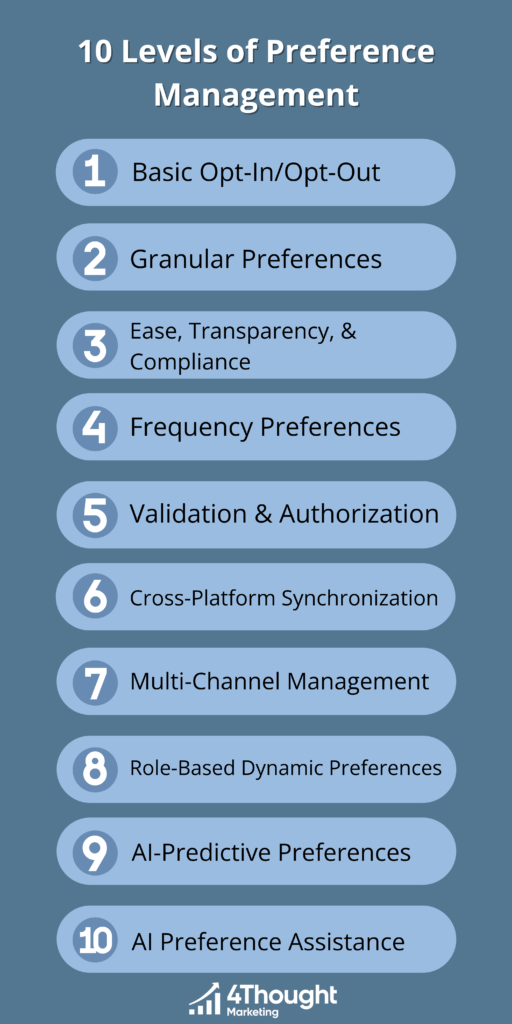
In short, the answer lies in a practice called preference management. This allows customers to control exactly what data they provide to your company and how they allow your company to use the collected data. There are multiple ways to approach this. Today, we’ll be looking at ten levels of preference management, each building on the previous one.

Level 1: Basic Opt-In/Opt-Out

At the most fundamental level, preference management begins with the ability for customers to opt in or opt out of communications. While this may seem elementary, providing a balanced choice like this goes a long way. A well-designed preference center not only offers an opt-out option but also encourages customers to opt back in by explaining exactly how and when their data will be used. This keeps contacts informed and ensures they feel in control of their choices.

Level 2: Granular Preferences

Granular preferences allow customers who have opted in to specify the types of communications they wish to receive. This can be segmented by product lines, content types, business units, or any number of other relevant categories. This choice assures customers that the communications they’ll receive will be both relevant and not overwhelming.

Level 3: Ease, Transparency, & Compliance

This level of preference management has three distinct levels of its own.

First, ease of use. Preference centers should be intuitive and straightforward. Too many options will overwhelm users and make them more likely to opt out of everything. Keep your dashboards scannable and simple.

Second, transparency. Being honest about your data collection and usage is crucial at this stage. Don’t ask for more data than you need. Explain how and when you’ll use the data you ask for, and stick to it. Make your privacy policy easily available for customers to review.

Third, legal compliance. It’s essential to prove that you’re honoring your customers’ requests. A customer’s preference submission is already connected to their email address. To be truly compliant, you must gather additional identifying data such as date, time, and form location, that show when and how the request was made. Returning only the most recent opt in or out state, if it’s a checked or unchecked box, is insufficient evidence if your compliance is ever challenged. You must provide a history of changes.

preference management

Level 4: Frequency Preferences

Some visitors who ask to unsubscribe might not want to completely stop communications—they may just want a break. Providing an ability to control how often they receive things -frequency preferences, makes this easy for both them and you.

Depending on your company’s exact marketing approach, frequency preference management can take different forms, such as:

  • You may give visitors the option to pause all communications for a period.
  • Alternatively, you may want to give them to control, for each preference they opt into a frequency option. For example they may want to get newsletters only quarterly, but product support information immediately.
  • Finally, you may want to consider “fatigue analysis”, which slows down communications to customers who aren’t actively engaging with your messages anymore. Communications will pick back up when their participation does. This keeps messaging frequency at the customers’ comfort level without costing you a contact.

Level 5: Validation & Authorization

This level is fairly straightforward: making sure the customer is who they say they are. This can be accomplished with something as simple as an identity verification email. This adds an extra layer of security to the preference management process, ensuring that no one else can sign up a customer for unwanted communications or change their set preferences.

Level 6: Cross-Platform Synchronization

In large organizations, recorded customer preferences may be scattered across various systems and departments. This obviously makes managing these preferences harder for internal marketing and privacy professionals that must deal with making multiple systems legally compliant. It also makes submitting those preferences in the first place harder, as customers have to navigate multiple menus and webpages. Consolidating them into a single, unified view through cross-platform synchronization makes things far easier for the customer and for you. Some jurisdictions even legally mandate this.

Level 7: Multi-Channel Management

Email marketing may be the most lucrative form of online advertising, but it’s far from the only one. SMS, push notifications, and other communication channels are still effective ways to reach your audience. And different demographics will prefer different channels. For example, one age group may prefer SMS messages over email, while another group wants email communication and nothing else. This is another layer of choice that your preference center needs to offer.

preference management

Level 8: Role-Based Dynamic Preferences

Prospects, customers, and company partners will have different areas of focus when it comes to receiving communication from you. Offering a universal preference center can make those areas of focus harder to track. Consider creating one preference center for prospects, one for current customers, one for company partners, and others as required so you can offer each group a relevant set of choices. (You’ll also need to remember the validation step of level 5 as you do this.) This makes things easier for the users and, by extension, increases their engagement.

Level 9: AI-Predictive Preferences

This level uses artificial intelligence to predict and then pre-set customer preference settings based on historical data, behavior, and other inputs. Many companies do this with an algorithm today, but enabling an AI to set these is typically far more capable when preferences are many and complex.

While AI-predictive preferences should not replace customer-set preferences, they can provide a valuable starting point, especially for new customers or prospects.

Level 10: AI Preference Assistance

The most advanced level of consent management involves AI-powered systems that interact directly with customers to understand their preferences. Imagine typing into a preference page:

“Every two months, send me an update with hyperlinks for all content on everything happening regarding home appliances from this company only. However, I’d like product announcements to be sent to me immediately.”

“I’ve turned on the three preferences below that pertain to home appliances with a frequency of every two months, and also the preferences for product announcements to come as soon as available.”

These systems look and behave like your typical chatbot, except they are intentionally focused and pre-prompted to understand all the content a company creates and the concept of preferences.  This futuristic approach can simplify the preference management process, making it more even intuitive and user-friendly.

Implementing Effective Preference Management

While understanding these levels is crucial, implementing them effectively requires strategic planning and execution. As you begin:

  • Assess your current state: Identify which level your organization currently operates at. Are you still at basic opt-in/opt-out, or have you moved towards AI-predictive preferences?
  • Prioritize ease and transparency: Regardless of the level, ensure your preference center is easy to navigate and transparent about what each option means. Use clear language and, where possible, visual aids.
  • Take advantage of technology: Use technology to automate and streamline preference management. This includes using AI for predictive preferences and cross-platform synchronization to consolidate data from different systems.
  • Focus on compliance: Stay up-to-date with legal requirements and ensure your preference management practices comply with relevant laws. This not only protects your organization from legal risks but also builds trust with your customers.
  • Customize and personalize: Tailor your preference management to different user groups. Use role-based dynamic preferences to provide relevant options to prospects, customers, and partners.
  • Stay flexible and adaptive: As new technologies and customer expectations evolve, be prepared to adapt your preference management strategies. Regularly review and update your practices to stay ahead of the curve.

Conclusion

Effective preference management is a dynamic and evolving process that requires a thoughtful approach and the right blend of technology and strategy. By understanding the different levels of preference management and implementing best practices, marketers can offer personalized experiences while maintaining compliance and building customer trust. The journey from basic opt-in/opt-out to AI-driven preference assistance is not just a technological upgrade. Rather, it is a strategic evolution that can significantly enhance customer engagement and satisfaction.

To take the next step in customer preference management and data privacy, contact 4Thought Marketing today.

preference management

AI has certainly made its mark. Many companies jumped on board early, eager to take advantage of AI-powered tools’ extra capabilities. Marketers, in particular, were intrigued by this shiny new toy. And with good reason—AI-powered marketing efforts offer increased efficiency, help eliminate busywork, and can improve customer relations.

But this shiny new toy comes with inherent risks still being uncovered. Companies that choose to take advantage of AI need to understand the impact it can truly have, both now and as the technology continues to evolve. One excellent way to start is an AI audit.

What are AI Audits?

An AI audit assesses how AI is used in your organization and the impact it has. The audit also ensures that your AI tools comply with ethical standards and legal requirements for privacy, security, and transparency.

This audit also covers every area where your company uses AI. This goes beyond your website chatbot. AI may be more visible now, but marketers have been using it in some fashion in marketing automation for years. No matter how insignificant, every AI tool needs to be a part of this audit.

Why AI Audits Matter

An AI audit gives you a clear picture of who uses AI in your company, how they use it, and how often. It also helps identify potential problems. AI audits specifically look for:

  • Biases in the algorithm
  • Compromised data integrity
  • Unintended data disclosure
  • Legal non-compliance
  • Poor-quality, unvetted AI-hallucinated content
  • Ethical problems
  • Potential vulnerabilities

Not only will an AI audit will help you catch problems early on, but it will also demonstrate your company’s commitment to ethics and transparency.

ai audit

Best Practices for Effective AI Audits

AI audits function much like any other type of audit in your company. As you prepare, keep these best practices in mind:

  • Define clear objectives: Before starting an AI audit, define what you aim to achieve. Whether it’s compliance verification, performance assessment, or risk identification, clear objectives will guide the audit process and ensure it focuses on your concerns.
  • Involve cross-functional teams: AI audits should involve collaboration between various departments, including IT, legal, compliance, and marketing.
  • Use standardized tools and frameworks: Tools such as AI impact assessments and algorithmic audits can provide a structured approach and make things simpler.
  • Conduct continuous audits: AI systems evolve, and so should the auditing processes. Regular audits allow for continuous oversight and the ability to address new challenges as they arise.
  • Focus on transparency and documentation: Maintaining transparency through comprehensive documentation of AI systems and audit processes is vital. This transparency not only supports regulatory compliance but also builds trust with consumers.
  • Engage external experts: Sometimes, the complexity of AI systems can benefit from external expertise. Third-party auditors with specialized knowledge in AI can provide an unbiased view and help uncover issues that internal teams might overlook.

AI Audits in Your Company

At the end of the day, AI is simply another tool at marketers’ disposal. This new tool has to follow the same rules and adhere to the same standards as any other system. By prioritizing AI audits, you demonstrate your commitment to keeping marketing ethical and legally compliant even as technology evolves.

How else can you incorporate AI into your marketing strategies? Do your existing AI systems need a checkup? Contact our team today to discuss all your marketing needs.


4Thought Marketing Logo   March 31, 2026 | Page 1 of 1 | https://4thoughtmarketing.com/data-privacy/page/4/