Your retargeting campaigns are running, budgets are being spent, and ads are being served. But are they working as hard as they could be? Many marketers are starting to notice a plateau. Traditional retargeting still works—but it works the same for everyone, often treating a casual visitor the same as someone ready to buy. That’s beginning to change. Smarter, AI-driven approaches to retargeting (AI-Optimized retargeting) are making it easier to prioritize the people most likely to convert—without completely overhauling your strategy. It’s not about replacing what works, but improving how it works.
Instead of reacting to every site visit the same way, AI-optimized retargeting lets you shift toward more precise, more timely engagement—helping you spend more efficiently and connect when it counts. It’s not the future; it’s starting to happen now.
The Limitations of Traditional Retargeting Logic
For years, retargeting has operated on a simple quid pro quo: a user visits a page, they see an ad. This rule-based approach was effective, but it’s a blunt instrument in a world that demands precision. The limitations, highlight why AI-optimized retargeting is climbing up as the need of the hour; as its core limitations are now a significant drag on performance and budget:
Uniform Messaging: It treats a user who spent 10 minutes comparing product features the same as someone who bounced in seconds.
Static Timing: It serves ads for a fixed duration (e.g., 30 days) without knowing if the user is even in a buying mindset.
Manual Optimization: It relies on marketing teams to manually analyze data, segment audiences, and A/B test creatives—a slow process that can’t keep pace with real-time user behavior.
This inefficiency leads to ad fatigue, wasted spend on low-intent users, and missed opportunities with high-value prospects.
How AI Transforms Re-engagement into a Science
AI-optimized retargeting dismantles the old rule-based framework and replaces it with a dynamic, learning system. By analyzing vast datasets, machine learning models don’t just see what a user did; they predict what they are likely to do next.
Instead of broad buckets like “website visitors” or “cart abandoners,” AI builds granular, behavior-based audiences in real-time. It identifies patterns that signal intent, creating segments like:
“High-Intent Researchers”: Users who have viewed multiple products and spent significant time on-page.
“Price-Sensitive Scanners”: Visitors who focus on sales pages or use comparison tools.
“Nurture-Ready Prospects”: Individuals who downloaded a resource but haven’t returned.
Dynamic Creative & Channel Orchestration
AI-optimized retargeting takes A/B testing to a new level with Dynamic Creative Optimization (DCO). The system automatically mixes and matches headlines, images, and CTAs to find the perfect combination for each user segment. Furthermore, it orchestrates this across channels, ensuring a consistent and compelling experience whether the user is on social media, checking email, or browse a news site.
Intelligent Budgeting and Bidding
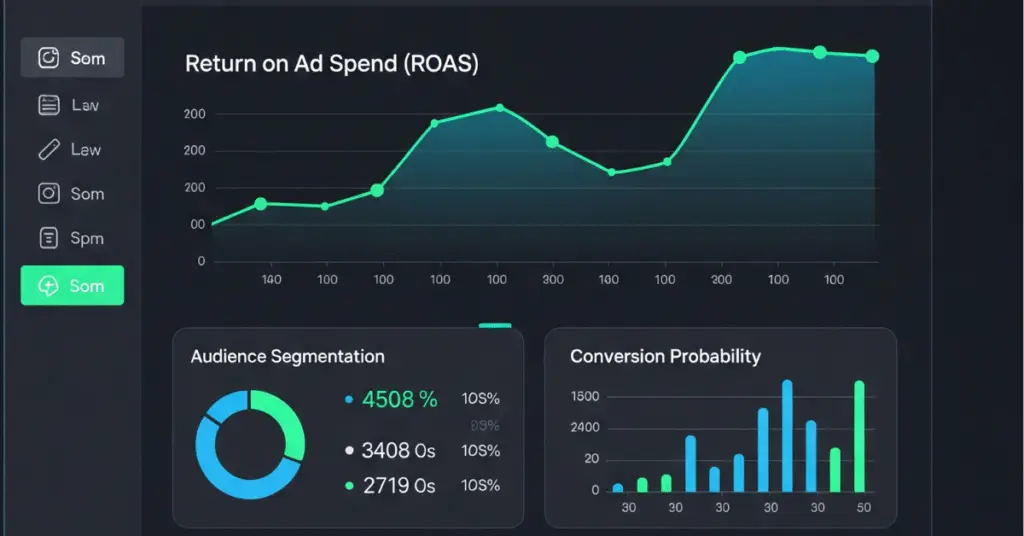
Perhaps the most significant impact of AI-optimized retargeting is on your budget. AI-powered bidding algorithms analyze conversion probability for every single ad impression. This means your budget is automatically allocated toward the users and placements most likely to drive results, drastically improving your Return on Ad Spend (ROAS) by cutting waste.
But this predictive power is only as good as the data it receives, which is why its integration into your core Martech stack is critical.
Integrating AI-optimized Retargeting with Your CDP
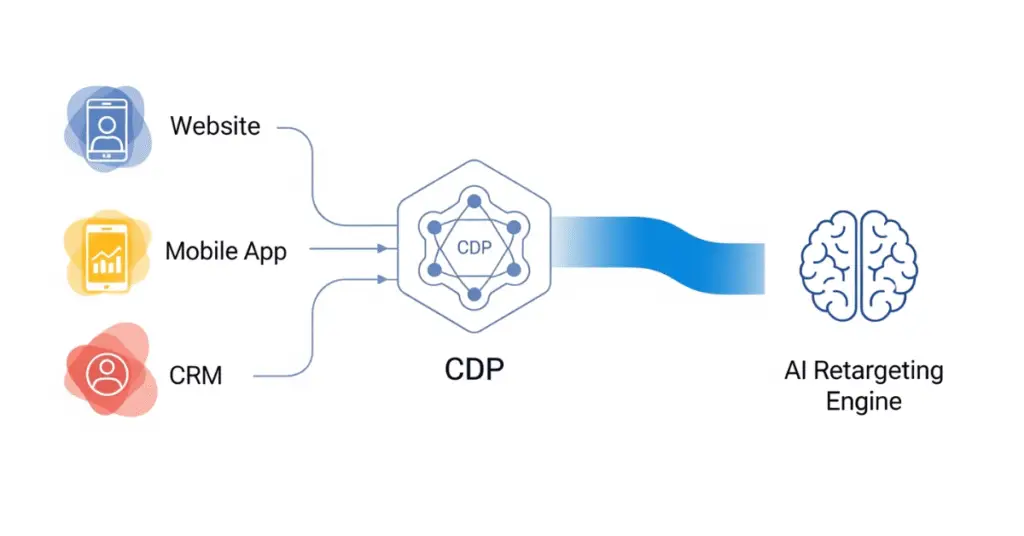
AI-optimized retargeting doesn’t exist in a vacuum. Its true power is unlocked when it’s fed high-quality, unified data from a central source like a Customer Data Platform (CDP).
The Power of First-Party Data: Connecting to a CDP to AI-optimized retargeting allows the AI to leverage rich first-party data—like purchase history, support ticket status, and loyalty program activity—that a simple website pixel cannot see. This creates an incredibly detailed profile for more accurate predictions.
Unifying Customer Signals: A CDP unifies online behavior (website visits) with offline data (in-store purchases or event attendance), feeding the AI a truly holistic customer view. This enables you to retarget a user who saw a product in-store but didn’t buy.
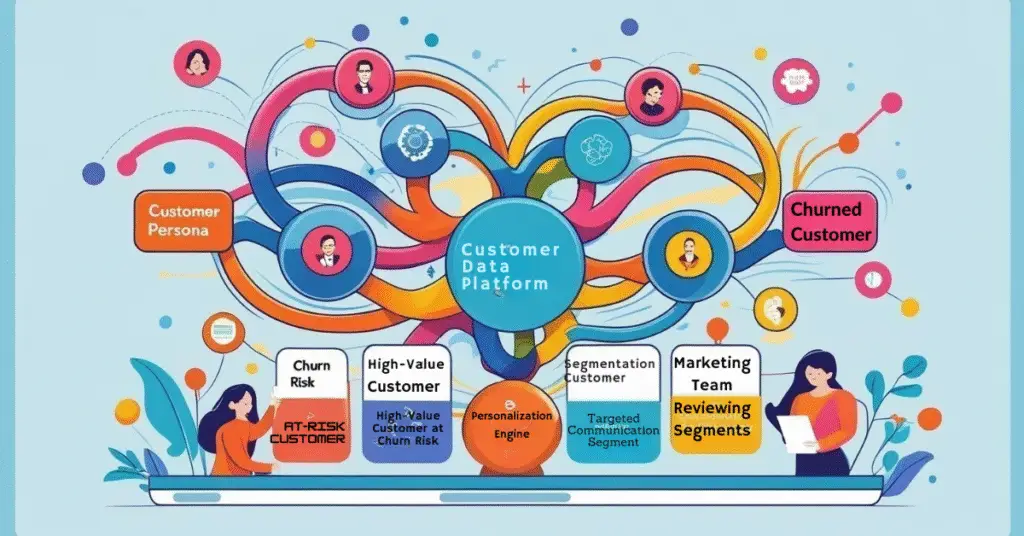
Triggering Intelligent Journeys: With a CDP, you can build granular segments (e.g., “high-value customers at risk of churn”) that automatically trigger a specific, nuanced retargeting journey designed to retain them. This creates a seamless link between your data strategy and advertising execution.
With a foundation of rich, first-party data, you’re also perfectly positioned to tackle the next major industry disruption: the end of the third-party cookie.
AI-optimized Retargeting in a Cookie-less World
The phase-out of third-party cookies is rendering much of traditional retargeting obsolete. AI-powered strategies, especially those built on a CDP, are the solution to this challenge.
Shifting from Identity to Intent: AI helps pivot from relying on individual cookies to interpreting thousands of other signals, including contextual data (the topic of the page a user is on), device type, and on-site engagement patterns to predict intent.
Leveraging Consented, Anonymized Data: In a cookieless world, first-party data is king. AI can use consented, privacy-compliant identifiers like hashed email addresses to effectively reach users across platforms without relying on cookies.
Contextual Intelligence: Instead of following a user with cookies, AI can serve a relevant ad based on the content they are consuming in that exact moment. This makes the ad timely and helpful, not intrusive.
Operating effectively in this new landscape requires not just new technology, but new ways of measuring success.
Beyond ROAS: Measuring the True Lift of Intelligent Retargeting
Marketing leaders are constantly asked to prove their impact. An AI-driven approach provides the tools to demonstrate value far beyond simple Return on Ad Spend (ROAS).
Incremental Lift and Holdout Groups: True AI platforms can run controlled experiments by creating a “holdout group”—a small audience of users who are intentionally not shown ads. By comparing the conversion rates of the targeted group to the holdout group, you can scientifically measure the true “lift” and incremental revenue generated by your campaigns.
AI-Powered Attribution: Machine learning is revolutionizing attribution. It can analyze countless conversion paths to more accurately assign credit across multiple touchpoints, finally proving the value of retargeting efforts that influence a customer early in their journey.
Measuring Impact on Customer Lifetime Value (CLV): The goal isn’t just one more sale. By personalizing offers and messaging, AI-powered retargeting can reactivate dormant customers and increase repeat purchases, measurably improving overall CLV.
Key Considerations for Implementation
Transitioning to an AI-optimized model requires a strategic approach.
Start with High-Quality Data: As emphasized, AI is only as powerful as its data. Ensure your tracking is clean and your CDP is well-maintained.
Set Clear, Measurable Objectives: Define success using the advanced metrics above: aim for a specific incremental lift, a reduction in cost per acquisition (CPA), or an increase in CLV.
Fuel the System with Great Creative: AI handles the mechanical optimization, but human creativity remains essential. Your team’s role shifts from manual tweaking to providing high-quality creative assets for the AI to test and deploy.
Embrace an ‘Always-On’ Optimization Mindset: AI continuously learns and adapts. Marketers must monitor performance holistically to provide strategic direction and interpret the “why” behind the data.
Conclusion: Start Planning the Strategic Leap
The ambition for any marketing team is straightforward: re-engage lost customers and ensure every dollar of ad spend contributes directly to revenue and loyalty. It’s the core objective that drives our daily efforts.
Yet, continuing to rely on outdated, rule-based retargeting actively works against this ambition. It’s a strategy that leaves money on the table, frustrates potential customers with irrelevant ads, and fails to distinguish casual browsers from your most valuable prospects.
This is precisely why a strategic leap to an AI-optimized approach has become a requirement for success in modern digital advertising. By leveraging predictive analytics, CDP integration, and advanced measurement, you can move beyond these limitations. It allows you to finally deliver the kind of personalization at scale that turns potential into profit, ensuring the right message reaches the right user at the perfect time. The question isn’t if AI will transform retargeting, but how quickly you can harness its power to gain a competitive edge. If you’re ready to move from basic rules to intelligent revenue growth, the team at 4thought Marketing can help you build the data foundation and strategic framework for success.
Why a Solid Engagement Model Matters
Picture this: your team is racing toward a critical client go-live, systems humming with activity, stakeholders on standby, but suddenly, a key requirement emerges that no one documented. Deadlines slip. Confidence erodes. The client’s patience wanes. If this scenario feels all too familiar, you’re not alone. Many organizations struggle when project handoffs are messy, communication lapses occur, or “scope creep” runs unchecked.
Enter the Engagement Model; a structured, repeatable roadmap that guides every project from first discussion to post-launch retrospective. When embraced fully, it delivers consistent quality, transparent processes, minimized risks, and—perhaps most importantly—happy clients who know exactly what’s happening and when. In this deep-dive, we’ll explore how to apply the Engagement Model in real life, why it works, and how to make it the beating heart of your project culture.
The “Why” Behind the Model: Purpose & Payoffs
At its core, the Engagement Model standardizes project delivery across your organization. You transform chaotic, one-off efforts into a well-oiled machine by defining clear stages, deliverables, and hand-off points.
Quality delivery: Every stage has built-in checks—so defects are caught early, not after go-live.
Transparency: Stakeholders at all levels see where things stand, minimizing surprises.
Risk mitigation: Formal sign-offs and documented requirements close gaps before they become problems.
Client satisfaction: When clients know exactly what to expect, when, and why, trust soars.
We know this from experience. A new marketing tool was deployed for a global retail client. Because the team followed the Engagement Model’s stage progression and sign-off rigorously, they identified a localization gap before development began, saving weeks of rework and thousands in budget overruns.
Who Should Live by This Model? Defining the Scope
The Engagement Model isn’t a one-size-fits-all checkbox; it’s a collaborative framework that empowers everyone touching a project to move harmoniously. At the heart of this approach are Project Managers—the conductors of our orchestra—who steer scope, schedule, and stakeholder communications. Yet, the rhythm relies equally on Project Leads and Coordinators, whose day-to-day vigilance ensures each deliverable is documented correctly, versions are controlled, and every stage transition is formally acknowledged. Supporting teams—from UX designers and developers to QA analysts and operations specialists—also plug in by aligning their outputs to the model’s templates and SOPs, preventing silos and rework. Finally, Executive Sponsors provide the high-altitude perspective: they monitor project health via regular audits, champion resources when bottlenecks arise, and authorize any necessary deviations from the process. When PMs, leads, teams, and executives embrace their roles, the Engagement Model becomes a living practice rather than a dusty policy.
The Six Stages of Engagement: A Roadmap to Success
Our Engagement Model breaks the project journey into six distinct stages, each with its own goals, artifacts, and sign-off criteria.
Needs Analysis Projects begin with facilitated workshops, interviews, and process mapping sessions that translate high-level goals into detailed requirements. Whether it’s mapping user journeys for a mobile app or charting data-flow diagrams for an integration, this stage zeroes in on the “what” and the “why.” The output—a comprehensive Needs Analysis report—becomes the foundation for all subsequent design and development efforts.
Design With requirements in hand, architects and designers craft the blueprint. Wireframes, technical architecture diagrams, and solution flowcharts clearly show how the system will function. Crucially, at the end of this stage, we gather formal sign-off from both internal technical leads and client stakeholders. That approval locks in the design’s scope and mitigates the risk of late-cycle change requests.
Development Armed with approved designs, development teams begin coding, configuring platforms, and integrating systems. We adopt an iterative cadence, releasing incremental builds for stakeholder demos at predefined intervals. This approach maintains momentum and catches misalignments early, allowing us to course-correct before launch day.
Testing Once the build is feature-complete, dedicated QA and user-acceptance testing teams spring into action. They execute test scripts, log issues in a centralized defect tracker, and validate fixes in structured retest cycles. Only after a formal Testing Sign-Off—documented, dated, and distributed—does the project move into production readiness, safeguarding quality and compliance.
Launch Launch Day is a finely choreographed affair: backups are verified, release notes are published, system health checks are scheduled, and communication blasts go out to all stakeholders. The PM sends a standardized “Launch Complete” email with links to support resources and escalation contacts to both internal and client teams, ensuring everyone knows the system is live and where to turn for help.
Post-Launch Support Even after go-live, our commitment continues. During a predefined hyper-care window, support teams triage any teething issues, track outstanding enhancements, and provide knowledge transfer to client operations staff. Finally, we convene a retrospective workshop to capture lessons learned, celebrate wins, and record actionable improvements for the next project cycle.
Policy in Practice: Rules, Templates & Exception Handling
To keep the Engagement Model from becoming a “nice‐to‐have” appendix, we’ve codified eight mandatory policy tenets.
Every project must proceed through all seven stages unless a formal exception is signed off by the VP of Operations—no cutting corners.
Each stage requires documented requirements and milestone checks before advancing.
Design and Testing stages demand formal sign-offs, and PMs must use company-provided templates, SOPs, and approved tools to maintain consistency.
The model isn’t something you set at kickoff and forget; it must be reviewed with stakeholders at every major checkpoint.
Project plans themselves must mirror the Engagement Model’s sequencing of tasks and timelines.
Any deviations—whether client-driven scope changes or resource constraints—must be documented in writing and approved by the right authority.
Within a few weeks of launch, teams are required to hold a retrospective, evaluating adherence to the model and pinpointing process improvements. Together, these policy rules transform guidelines into guardrails that keep projects on track.
Communication Cadence: Meetings, Deliverables & Emails
Consistent, transparent communication is the lifeblood of the Engagement Model. At each stage, project leaders schedule a series of structured checkpoints—for example, an initial kickoff session to review objectives and clarify roles, a requirements workshop to confirm scope and needs, a design review where technical and user-experience stakeholders endorse the solution, and a pre-launch meeting to validate testing readiness. While informal, on-the-fly discussions are encouraged to resolve urgent issues, every convening must produce concise minutes that are uploaded to a centralized document repository for easy reference.
Deliverables themselves serve as the tangible proof of progress: core artifacts such as the project brief, detailed scope document, design specifications, and test plan are stored in a shared folder hierarchy that mirrors each Engagement Model stage. Every file is maintained under version control—so that edits are tracked, prior drafts remain accessible, and everyone always works from the latest approved copy. This clear structure not only keeps work organized but also creates an audit trail that demonstrates exactly when each milestone was completed.
At the boundary between phases, formal notifications are issued through the team’s chosen collaboration channel—whether that’s a messaging app, group email distribution, or project management feed. Each announcement follows a consistent format (e.g., “[Project X] | Stage Complete: Development Approved”), includes a brief summary of what was delivered, points recipients to the relevant folder or document, and outlines any next steps or review deadlines. These notifications become part of the project record, confirming completion of one stage and empowering the team to move seamlessly into the next.
Roles & Responsibilities: Who Owns What
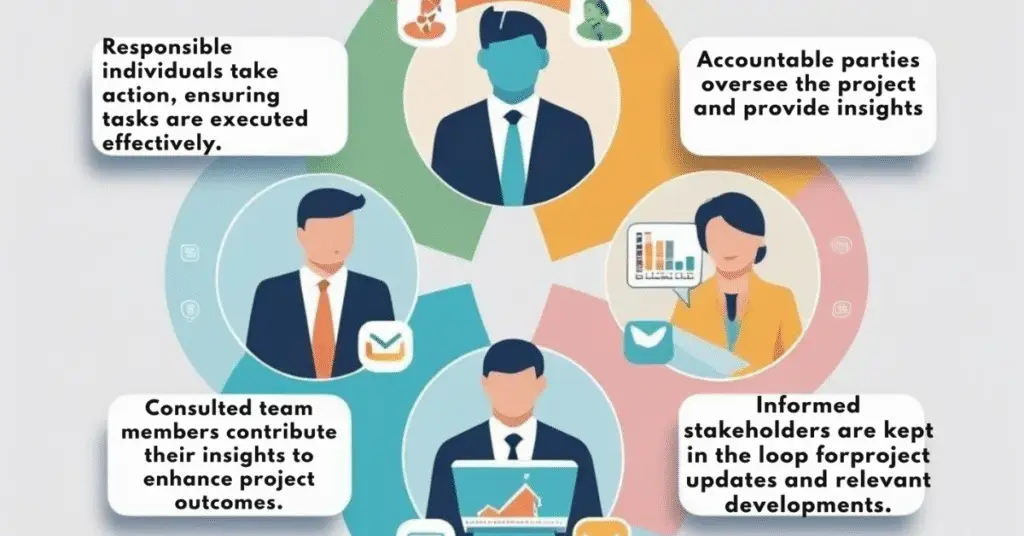
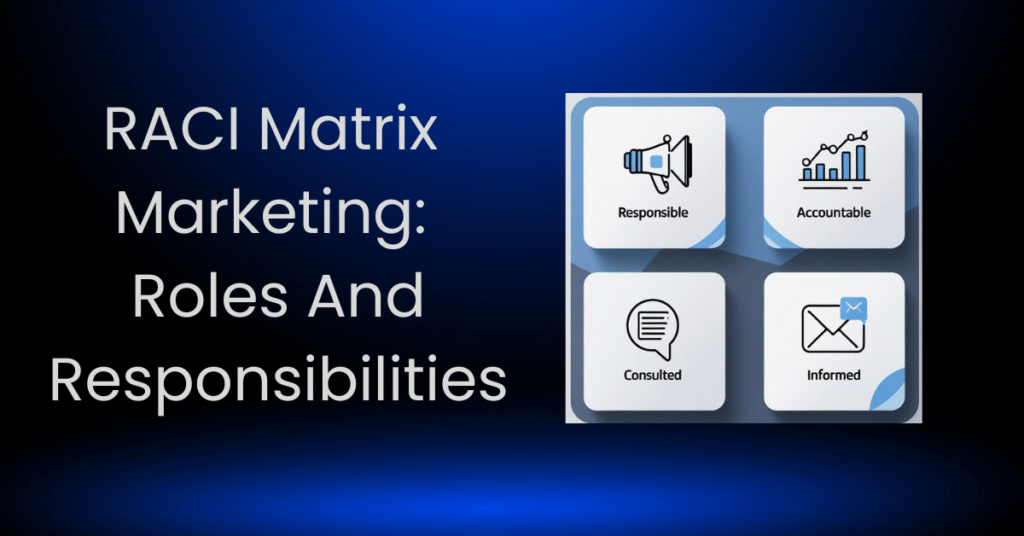
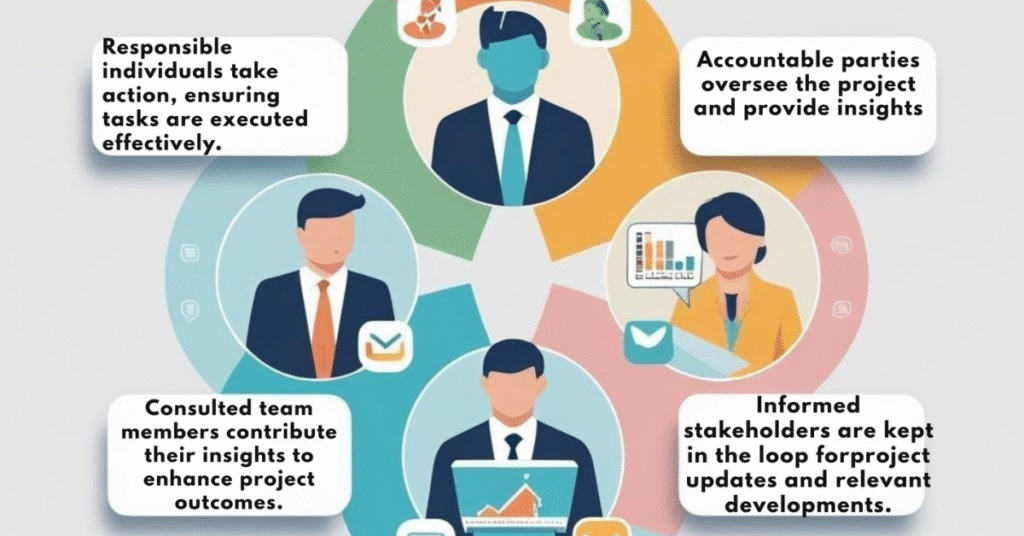
Clear ownership keeps projects moving without hiccups. We apply a streamlined RACI-inspired approach:
Responsible (Doers): These individuals or teams execute the work—drafting designs, writing code, or running tests. Each task should have one or more clear “doers” who coordinate closely to avoid overlap and ensure timely delivery.
Accountable (Approvers): One person holds ultimate accountability for each deliverable. They review and sign off on the work, make final decisions, and bear the risk if outcomes fall short. This single point of approval prevents ambiguity and keeps the project aligned.
Consulted (Advisors): Subject-matter experts, legal or compliance reviewers, and technical architects provide input before key milestones. Their feedback helps catch issues early, ensuring quality and feasibility without blocking progress.
Informed (Observers): Stakeholders who need visibility—such as senior leadership or supporting teams—receive updates on progress and decisions. Keeping them in the loop at the right moments avoids surprises and helps them plan their own activities.
By assigning each task and decision to one Responsible, one Accountable, and the appropriate Consulted and Informed parties, you create a lean, transparent framework that drives accountability and smooth hand-offs throughout every stage.
Governance & Continuous Improvement
To avoid stagnation, the Engagement Model includes built-in governance loops. Conduct audits randomly select active or recently closed projects, reviewing documentation completeness, sign-off records, and adherence to templates. Findings are collated into a concise report and then shared at a timely PM roundtable, where successes are celebrated and gaps are diagnosed. From there, we update our living SOPs and email templates, ensuring that each new project benefits from the lessons of its predecessors. The post-launch retrospective, held within four weeks of go-live, uses a structured template—covering “What Went Well,” “What Could Have Gone Better,” and “Action Items”—to capture insights that directly feed into governance updates and future training sessions. This continuous feedback cycle keeps the Engagement Model agile and effective.
Enabling Success: Training & Resources
Even the toughest framework falls flat if people don’t know how to apply it. That’s why every new project lead completes mandatory Engagement Model training within their first month: a blend of structured walkthroughs of each stage and hands-on practice using our standardized templates and process guides. Throughout the year, we run refresher sessions—especially after any major process updates—to reinforce best practices and introduce new methods. All materials—checklists, diagrams, notification drafts, and FAQs—are housed in a centralized digital toolkit (accessible via our intranet or collaboration platform), complete with automated reminders and sign-off tracking. By investing in onboarding, ongoing education, and easy access to resources, we make it simple for every team member to adopt the model from day one.
Conclusion: Your Next Steps
Ultimately, the Engagement Model is our foundational project engagement framework, turning complexity into consistency. By enforcing rigorous needs analysis in projects and leveraging clear RACI roles in projects, teams align on responsibilities, reduce bottlenecks, and accelerate delivery. A disciplined project communication cadence and well-organized project documentation templates ensure everyone stays informed and audit-ready. Continuous project improvement, fueled by governance loops and retrospectives, transforms each launch into an opportunity to refine workflows. Coupled with robust PM onboarding and training, this comprehensive framework boosts 4TM’s agility and trustworthiness. Clients appreciate transparent updates and predictable milestones, while our teams benefit from structured processes that drive quality and efficiency. This Engagement Model empowers 4Thought Marketing to excel on every engagement.
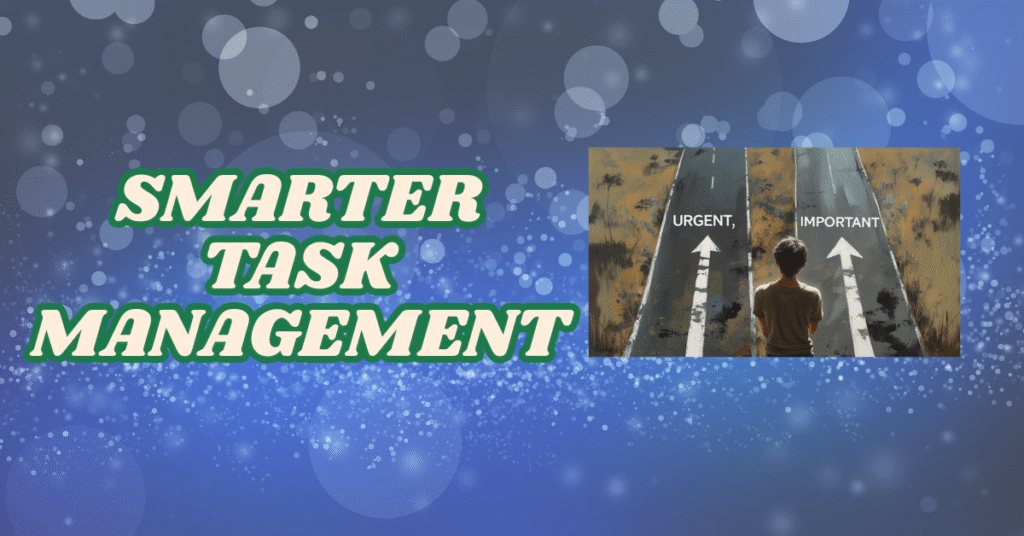
Imagine standing at the airport check-in counter with two bags. One is light but needs to be checked in immediately, while the other holds all your essentials for the trip—but has no deadline. Most people rush to check the one marked urgent, forgetting the importance of what they’ll actually need mid-flight. That, in essence, is the daily struggle of task queue management.
As marketers, project managers, or strategists, our inboxes and to-do lists rarely sit idle. We juggle daily deliverables, strategic planning, client meetings, and surprise fire drills. The challenge isn’t just doing the work—it’s doing the right work at the right time. And often, the real tension lies between what’s due soon and what’s truly important.
This blog will unpack frameworks, real-world strategies, and AI-powered tools to help you balance these forces and build a smarter, more intentional task queue.
The Psychology Behind Task Management
Our brains are wired for short-term wins. Completing quick tasks releases dopamine, giving us a false sense of productivity. That explains why replying to emails or ticking off low-effort items on your list feels good, even if the strategic campaign planning or quarterly performance review remains untouched.
Urgency hijacks our attention—it yells, pings, vibrates. It’s that Slack message blinking, the calendar notification chiming, or the colleague hovering over your desk. Importance, however, is quiet. It requires intentional focus, deeper thinking, and often delayed gratification. Yet it’s this silent, deliberate work that drives long-term growth and innovation.
Take Maya, a digital marketing manager, for example. Her mornings begin with coffee and a quick glance at campaign dashboards. Before she can dive into strategic planning, a whirlwind of Slack messages, feedback requests, and meeting invites derails her. By evening, she realizes her most critical task—creating a strategic roadmap—has been sidelined. Urgency won again. And it usually does unless we step in with structure.
Frameworks That Help
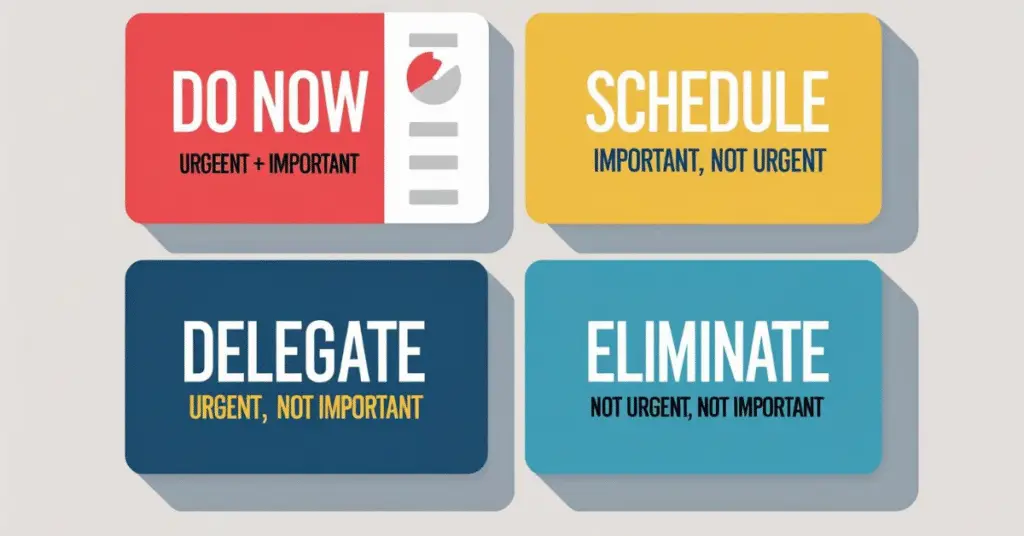
Eisenhower Matrix
Dwight D. Eisenhower once said, “What is important is seldom urgent, and what is urgent is seldom important.” This insight birthed the Eisenhower Matrix—a simple yet powerful way to categorize tasks:
Tasks that are both urgent and important demand immediate attention. Think: resolving a client issue or fixing a broken campaign link. Tasks that are important but not urgent, like strategic planning or developing new skills, should be scheduled deliberately. These are your long-term value builders. Tasks that are urgent but not important (like minor approvals or low-stakes admin work) should be delegated whenever possible. And finally, tasks that are neither urgent nor important often deserve to be dropped altogether.
Imagine having to approve a social post going live in 30 minutes (urgent, but not important for you) versus drafting a strategy document for the next quarter (important, but not urgent). Without a framework like this, our brains default to the former—simply because the clock is ticking.
Time Blocking with Buffer Zones
Time blocking is the art of assigning specific chunks of your calendar to particular tasks. It’s like making appointments with your priorities. But here’s where most people go wrong: they forget to leave room for the unexpected.
A good time-blocking strategy includes buffer zones around meetings, between deep work blocks, and at the start or end of your day. These aren’t empty slots—they’re strategic space. They give you time to breathe, reflect, and absorb the spillover from tasks that ran long.
Think of your day like a well-packed suitcase. If it’s overstuffed, one small addition causes a mess. But if you leave space, you’re always ready to adapt.
The 1-3-5 Rule
This rule encourages you to structure your day around one big task, three medium tasks, and five small ones. It’s a gentle reminder that we aren’t machines—our productivity has limits.
Start your day by identifying the single most important task—your “one thing.” This is your non-negotiable. Then pick three medium-effort tasks that support your progress. Finally, list five quick wins to maintain momentum.
By focusing your energy where it matters most and keeping your list human-sized, you reduce stress and decision fatigue.
Structuring a Smarter Task Queue
An effective task queue isn’t just a list—it’s a system. Instead of letting tasks pile up haphazardly, structure your queue with intention.
Start with tagging. Tools like Notion, Todoist, and Asana allow you to label tasks as #urgent, #important, #low-effort, or #waiting. These tags help you filter and sort based on context and capacity.
Then consider your working environment. Some tasks require full focus and a laptop, while others can be done while commuting or waiting in line. Grouping tasks by context ensures you make the most of your energy and surroundings.
And don’t skip the weekly review. Set aside 30 minutes every Friday to assess what you did, what got missed, and what needs to move up. This ritual helps you realign with your goals and prevents last-minute scrambles.
Josh, a marketing ops lead, swears by this. Every Friday, he reviews his queue, retags tasks, and drags high-impact, low-effort items to the top. It gives him quick wins and keeps the big picture in view.
How AI Can Help Balance Urgency and Importance
AI is no longer a futuristic fantasy—it’s your new productivity partner. With the right tools, it can help you cut through the noise and focus on what truly matters.
Smart Prioritization
AI can analyze due dates, dependencies, and even your work patterns to suggest what should be tackled first. Tools like Motion or Notion AI use natural language processing to understand your task list and reorder it based on actual impact and timing.
Predictive Nudges and Rescheduling
Unlike static to-do lists, AI adapts in real-time. When it sees that your strategic goal has been postponed three times, it doesn’t just sit silently. It nudges you, rebooks your calendar, and makes room for what matters.
Sarah, a content strategist, experienced this with Reclaim.ai. After repeatedly postponing her SEO strategy document, the tool shifted her calendar, blocked focused time, and even deprioritized meetings to give her the space to finally complete it.
Automated Time Blocking
AI assistants can automatically block your calendar based on task urgency, your energy patterns, and meeting load. Clockwise, for example, finds the best slots for deep work and reschedules less urgent tasks to off-peak hours.
Personalized Insights
Over time, AI tools learn how you work. They identify your most productive hours, flag tasks that often get postponed, and suggest when to tackle which type of task.
Need help selecting the right AI stack for your team? We offer consultative support for productivity workflows and digital workstream planning. Just ask.
Pitfalls to Avoid
One of the biggest dangers in task management is the addiction to urgency. When everything feels like a fire drill, there’s no room left for planning or reflection.
Another trap is task hoarding—keeping too many items on your list, many of which will never get done. This creates noise and stress, crowding out what actually matters.
Underestimating how long tasks take is also common. When every day is overbooked, even a small delay can derail the whole plan.
And finally, never reviewing your queue turns it into a graveyard of forgotten goals. A quick weekly check-in can prevent drift and keep your intentions fresh.
Tips for Long-Term Balance
Start every week with a 30-minute planning session. Look at your calendar, assess your top priorities, and schedule time for them first. Use color codes to differentiate types of work—for example, red for urgent, blue for strategic, green for admin.
Always leave at least 20% of your day unscheduled. This margin helps you stay flexible when things change. And defend your focus hours. Treat them like important meetings—because they are.
Managing tasks is like managing your diet. If you only eat what’s fast and convenient, you sacrifice nutrition. Similarly, if you only do what’s urgent, you starve your long-term goals.
Conclusion: Balancing Without Burning Out
In the hustle of modern work, it’s tempting to chase every notification, every deadline, and every seemingly urgent request. It feels productive—but it often leads us away from the work that truly shapes outcomes. Urgency gives us motion; importance gives us meaning.
The real art of productivity lies not in doing more, but in doing what matters—consistently and without distraction. Balancing your task queue is about finding that sweet spot where short-term responsiveness meets long-term vision. It’s where structure meets strategy.
So, take time to pause, prioritize, and plan. Let proven frameworks guide your focus, and let AI lend a hand in doing the heavy lifting behind the scenes. This isn’t about choosing between urgent and important—it’s about designing a workday where both coexist with clarity. If you’re looking to refine your task management approach or integrate AI into your team’s productivity toolkit, we’d be happy to share ideas and consult on strategies that work for your goals.
Between 2020 and 2024, the average rows per query have doubled—marketers are looking at 100% more information for each data point, yet 87% of companies think of data as their most underused asset. Meanwhile, 89% of marketing leaders call personalization essential for future success, with customers willing to spend 38% more with brands that get it right. The disconnect is clear: we’re drowning in data but starving for actionable customer insights.
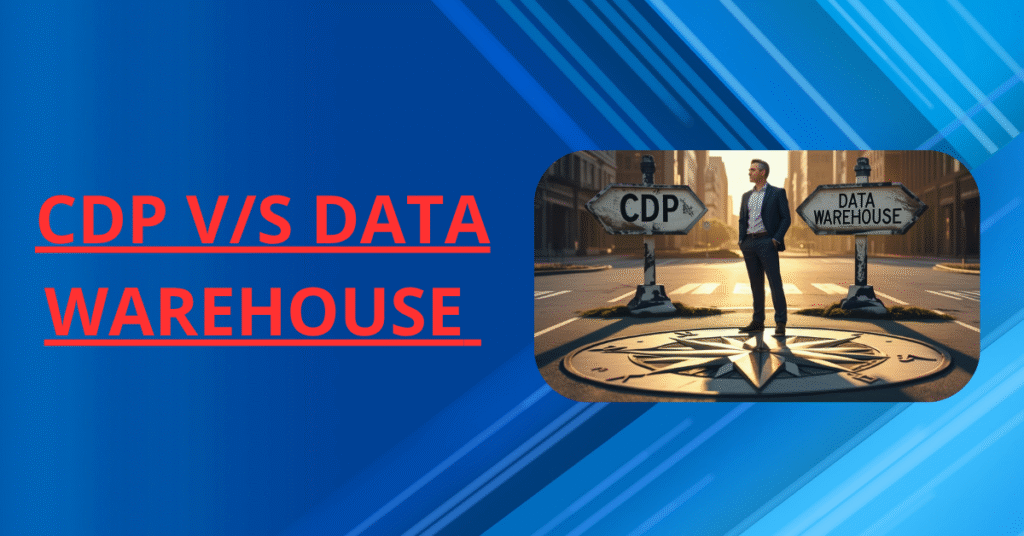
The solution isn’t just collecting more data—it’s choosing the right architecture to turn that data into revenue. Should you invest in a Customer Data Platform (CDP) for real-time personalization, or build a robust data warehouse for comprehensive analytics? For most growing companies, this decision will define their competitive advantage for the next five years.
Understanding the Fundamental Difference
Before diving into the technical details, let’s establish a clear mental model using a relatable analogy.
Imagine your marketing team as a school:
Your data warehouse is like a massive, well-organized library where every department stores all their documents, research, and historical records. It’s comprehensive, searchable, and perfect for deep analysis—but if you need to quickly find which students are in the debate club to send them a meeting reminder, you’re going to be searching through thousands of files.
Your CDP is like a smart student directory app that knows each student’s clubs, contact preferences, and recent activities. When you need to message the debate club about tonight’s meeting, it takes seconds. But if you want to analyze school-wide academic trends over the past decade, you’ll need that library after all.
What Is a Customer Data Platform?
A Customer Data Platform is a software system designed to create unified customer profiles from multiple data sources and activate that data for personalized marketing in real-time.
Core Capabilities
1. Unified Customer Profiles: Creates a single, comprehensive view of each customer by combining data from your website, email, CRM, mobile app, and other touchpoints. When a customer browses your website after clicking an email, the customer data platform connects those interactions to the same person.
2. Real-Time Data Processing: Updates customer profiles instantly as interactions happen. When someone abandons their cart, adds a product to their wish list, or downloads a whitepaper, the customer data platform captures and processes this information within seconds.
3. Identity Resolution: Connects anonymous website visitors to known customers using sophisticated matching algorithms. This means you can personalize experiences even before someone logs in or fills out a form.
4. Audience Segmentation: Creates dynamic, behavior-based segments that update automatically. Your “high-value customers at risk of churn” segment updates in real-time as customer behavior changes.
5. Cross-Channel Activation: Sends the right customer data to email platforms, advertising networks, SMS tools, and website personalization engines simultaneously, ensuring consistent messaging across all channels.
6. No-Code Interface: Allows marketers to create segments, set up automations, and launch campaigns without relying on IT or data engineering teams.
Strengths: When It Shines
✅ Built for marketers: No SQL required for most tasks
✅ Real-time personalization: React to customer behavior instantly
✅ Easy audience activation: Create segments and push to channels in minutes
✅ Reduced IT dependency: Marketing teams can work independently
✅ Compliance ready: Built-in privacy controls and consent management
✅ Quick time-to-value: See results within weeks of implementation
Limitations: Where It Falls Short
❌ Higher per-use cost: Expensive for large customer databases
❌ Limited analytical depth: Not built for complex business intelligence
❌ Vendor dependency: Switching costs can be significant
❌ Feature constraints: Limited to marketing and customer experience use cases
❌ Data duplication: May create another data silo
❌ Customization limits: Less flexible than building your own solution
What Is a Data Warehouse?
It is a central repository that stores structured and semi-structured data from multiple sources, optimized for complex queries and comprehensive business intelligence across your entire organization.
Core Capabilities
1. Massive Scale Storage Handles petabytes of historical data cost-effectively, storing everything from customer interactions and financial transactions to product usage and operational metrics.
2. Complex Analytics Engine Supports sophisticated SQL queries, joins across multiple data sources, and advanced statistical analysis that would be impossible with simpler tools.
3. Cross-Functional Data Hub Serves as the single source of truth for sales performance, marketing attribution, financial reporting, product analytics, and operational dashboards.
4. Advanced Data Governance Provides enterprise-grade security, access controls, data lineage tracking, and audit trails required for compliance and risk management.
5. Custom Data Transformations Allows unlimited flexibility in how data is structured, combined, and calculated to meet specific business requirements.
6. Integration Powerhouse Connects to virtually any data source through APIs, direct database connections, file uploads, and streaming data pipelines.
Strengths: When It Dominates
✅ Ultimate flexibility: Build any analysis or report imaginable
Scenario 1: Real-Time Personalization Is Revenue-Critical
The Challenge: Your e-commerce site needs to show different product recommendations based on a customer’s browsing behavior, purchase history, and email engagement—all updating in real-time as they navigate your site.
Why It Wins: It can instantly recognize returning customers, analyze their behavior patterns, and trigger personalized experiences within seconds. When someone who bought running shoes six months ago visits your site after clicking an email about new athletic wear, it can immediately surface relevant products and trigger personalized messaging.
Business Impact: Companies using real-time personalization see 10-30% increases in conversion rates and significantly higher customer lifetime value.
Scenario 2: Marketing Team Needs Independence
The Challenge: Your marketing team wants to create new audience segments, test different messaging approaches, and launch campaigns quickly without waiting for IT support or data engineering resources.
Why CDP Wins: Modern CDPs provide intuitive, drag-and-drop interfaces that let marketers create complex segments like “customers who spent >$500 in the last 6 months, opened emails in the last 30 days, but haven’t purchased in 60 days.” No SQL required.
Business Impact: Reduces campaign launch time from weeks to hours, enabling more testing and optimization.
Scenario 3: Omnichannel Customer Experience
The Challenge: Ensuring consistent, personalized messaging across email, SMS, push notifications, website, and advertising platforms while respecting customer preferences and privacy settings.
Why CDP Wins: CDPs are built to sync customer data and preferences across all activation channels instantly. When a customer updates their communication preferences or makes a purchase, every channel reflects this change immediately.
Business Impact: Creates seamless customer experiences that build trust and increase engagement rates across all channels.
Scenario 4: Compliance-Heavy Industries
The Challenge: Healthcare, financial services, and retail companies need robust consent management, data privacy controls, and audit trails for customer data usage.
Why CDP Wins: Enterprise CDPs come with built-in privacy controls, consent management systems, and compliance frameworks designed for regulated industries.
Business Impact: Reduces compliance risk while enabling personalized customer experiences.
When to Choose a Data Warehouse: Perfect Use Cases
Scenario 1: Advanced Analytics and Machine Learning
The Challenge: You need to build predictive models for customer lifetime value, create complex attribution models that account for offline and online touchpoints, or analyze product usage patterns to inform development decisions.
Why It Wins: It provides the computational power and flexibility needed for advanced analytics. You can combine customer data with product usage, financial data, and external market information to build sophisticated models.
Business Impact: Enables data-driven decision making across the entire organization, not just marketing.
Scenario 2: Multi-Functional Data Needs
The Challenge: Your sales team needs pipeline analysis, finance needs revenue forecasting, product teams need usage analytics, and marketing needs attribution reporting—all from the same underlying data.
Why It Wins: A properly designed data warehouse serves as the single source of truth for the entire organization. Different teams can build their specific reports and dashboards while ensuring data consistency.
Business Impact: Eliminates data silos and conflicting metrics across departments.
Scenario 3: Cost Optimization at Scale
The Challenge: You’re handling terabytes of customer data, transaction records, and interaction logs. Storage and processing costs are becoming a significant line item.
Why It Wins: Cloud data warehouses like Snowflake, BigQuery, and Redshift offer extremely cost-effective storage for large data volumes, often 10-100x cheaper than CDP per-contact pricing at scale.
Business Impact: Significant cost savings as data volumes grow, with pricing that scales linearly rather than exponentially.
Scenario 4: Strong Technical Team Available
The Challenge: You have dedicated data engineers, analysts who are comfortable with SQL, and the technical infrastructure to support custom data solutions.
Why It Wins: When you have the technical capability, data warehouses offer unlimited flexibility to build exactly what you need without vendor constraints.
Business Impact: Custom solutions that provide competitive advantages and adapt perfectly to your unique business model.
The Emerging Middle Ground: Composable CDP Architecture
The CDP market is experiencing massive consolidation in 2025, with independent CDPs leveraging AI to transform identity resolution, segmentation and orchestration. This has given rise to a hybrid approach called “composable CDP” that combines the best of both worlds.
How Composable CDPs Work
Instead of choosing between a traditional CDP and data warehouse, composable CDPs use your existing warehouse as the foundation and add customer activation capabilities on top.
The Architecture:
Data Warehouse serves as your single source of truth for all customer data
Reverse ETL tools (like Hightouch, Census, or GrowthLoop) act as the activation layer
Marketing platforms receive clean, governed data for personalization and campaigns
Benefits of the Composable Approach
Leverage Existing Investments: If you already have a warehouse, you can add CDP-like capabilities without starting over or duplicating data.
Maintain Data Governance: Customer data stays in your controlled environment with your security and privacy rules, while still enabling marketing activation.
Cost Efficiency: Avoid the high per-contact costs of traditional CDPs while getting similar activation capabilities.
No Vendor Lock-in: You can switch activation tools without losing your data or starting over.
Unlimited Flexibility: Build custom segments and calculations in your warehouse, then push them to marketing tools.
Limitations to Consider
Technical Complexity: Still requires data engineering skills to set up and maintain the integrations.
Latency Trade-offs: Typically, 10-15 minutes for data updates versus seconds with traditional CDPs.
Multiple Vendor Management: You’re coordinating between your warehouse, reverse ETL tool, and marketing platforms.
Implementation Time: Longer setup process compared to plug-and-play CDPs.
The Best-of-Both-Worlds Strategy
Most successful modern companies don’t choose between CDP and data warehouse—they use both strategically in what’s called a “modern data stack” approach.
Phase 1: Foundation (Months 1-6) Build your DW foundation with core customer data sources. Focus on data quality, governance, and basic reporting capabilities.
Phase 2: Activation (Months 7-12) Implement CDP for critical real-time use cases like email marketing, website personalization, and advertising audience creation.
Phase 3: Integration (Months 13-18) Connect your CDP and DW to eliminate data duplication and ensure consistency. Use the warehouse for complex analysis and the CDP for activation.
Phase 4: Optimization (Months 19-24) Advanced use cases like predictive modeling, AI-powered personalization, and cross-functional data applications.
Industry Adoption Patterns & Considerations
Important Context: More than three-fourths (78%) of organizations report centralizing customer data and systems under IT, reducing marketing’s autonomy to strategize and deploy specialized marketing technologies. This trend affects how you should approach your data architecture decision.
Current Market Reality
Despite the strategic importance of customer data platforms, adoption patterns vary significantly across industries, and many organizations are still determining the best approach for their specific needs.
Industry Considerations Based on Use Case Patterns:
E-commerce & Retail: High need for real-time personalization (abandoned cart recovery, product recommendations, dynamic pricing) typically favors CDP capabilities, while complex inventory management and supply chain analytics require warehouse depth.
B2B SaaS: Product analytics, churn prediction, and revenue forecasting benefit from warehouse flexibility, while lead nurturing and customer onboarding sequences may favor CDP activation capabilities.
Financial Services: Regulatory compliance often requires extensive data governance (warehouse strength), but customer experience personalization is becoming critical for competitive differentiation.
Healthcare: Patient experience personalization is emerging as a priority, but HIPAA compliance requirements demand robust data governance and audit capabilities.
Making the Right Choice for Your Organization
Start with Your Business Goals
Revenue Growth Focus: If your primary goal is increasing conversion rates and customer lifetime value through personalization, start with CDP capabilities.
Operational Efficiency Focus: If you need better decision-making across sales, marketing, finance, and operations, prioritize implementation.
Competitive Differentiation Focus: If you’re in a crowded market where customer experience is the key differentiator, consider the hybrid approach.
Assess Your Current Capabilities
Technical Team Assessment:
Do you have data engineers on staff?
Is your marketing team comfortable with SQL?
How quickly do you need to see results?
Data Maturity Evaluation:
How clean and organized is your current customer data?
Do you have established data governance processes?
Are you currently using your data effectively?
Budget and Timeline Reality Check:
What’s your realistic timeline for seeing ROI?
Do you have budget for ongoing technical staff?
How important is vendor independence?
The Decision Matrix
Choose CDP if you answer “yes” to most of these:
Real-time personalization drives significant revenue for your business
Your marketing team needs to move quickly without IT dependencies
You’re in a customer experience-driven industry
Budget allows for higher per-customer costs
You need compliance features built-in
Choose Data Warehouse if you answer “yes” to most of these:
Multiple departments need access to customer and business data
You have strong technical capabilities in-house
Cost efficiency at scale is important
You need advanced analytics and machine learning capabilities
Data governance and security are top priorities
Consider Hybrid Approach if you answer “yes” to most of these:
You need both real-time activation and advanced analytics
You have budget for a phased implementation
Your organization values both marketing agility and data governance
You want to future-proof your data architecture
You have technical resources but also need marketing self-service
Future-Proofing Your Customer Data Strategy
Technology Trends Shaping 2025 and Beyond
AI-Powered Identity Resolution: CDPs are leveraging AI from first principles to transform identity resolution, segmentation and orchestration, making customer identification more accurate across devices and channels.
Privacy-First Architecture: With increasing privacy regulations, both are building privacy-by-design features that make compliance easier while maintaining personalization capabilities.
Real-Time Analytics: The gap is narrowing, with warehouses adding real-time capabilities and CDPs improving their analytical depth.
Composable Data Stacks: The trend toward modular, best-of-breed solutions means you can mix and match components rather than choosing monolithic platforms.
Building for Tomorrow
Start with Clear Requirements: Focus on your current needs while building architecture that can scale and adapt as your business grows.
Invest in Team Capabilities: Technology is only as good as the team using it. Invest in training and hiring to maximize your data investments.
Plan for Integration: Whatever you choose today, ensure it can integrate with other systems as your needs evolve.
Measure and Optimize: Use your data architecture to generate insights about the architecture itself—what’s working, what isn’t, and where to invest next.
Key Takeaways: Your Path Forward
The Strategic Reality
There’s no universal “right” answer to the question. The best choice depends on your specific business goals, technical capabilities, budget constraints, and timeline requirements.
The Decision Simplified
Choose a CDP if: You need immediate marketing activation capabilities, have limited technical resources, and can justify higher per-customer costs for real-time personalization.
Choose a Data Warehouse if: You need comprehensive business intelligence, have strong technical capabilities, want maximum flexibility, and require cost-effective scaling.
Choose Both if: You’re building a mature, scalable customer data strategy that serves multiple business functions while enabling real-time marketing activation.
Choose Composable CDP if: You want data flexibility with CDP-like activation capabilities and have the technical resources to manage a more complex architecture.
Your Next Steps
1. Conduct a Data Audit Assess your current customer data sources, quality, and usage patterns. Understanding what you have is the first step to determining what you need.
2. Define Success Metrics Be specific about what business outcomes you’re trying to achieve. Revenue growth? Operational efficiency? Customer satisfaction? Your goals should drive your technology choices.
3. Evaluate Team Capabilities Honestly assess your technical resources, both current and planned. Your team’s capabilities should match your chosen solution’s requirements.
4. Start Small and Scale Whether you choose any or both, start with one high-impact use case to prove value before expanding.
5. Plan for Integration Design your architecture with future integration in mind. Today’s choice shouldn’t limit tomorrow’s opportunities.
Questions to Guide Your Decision
What customer experience improvements would drive the most revenue for your business?
Do you have the technical resources to implement and maintain a DW?
How quickly do you need to see results from your investment?
What’s your tolerance for vendor dependency versus technical complexity?
How important is cost efficiency as you scale?
Partner with Experts for Your Customer Data Strategy
Choosing between a CDP and data warehouse—or implementing both—is one of the most important technology decisions your marketing organization will make. The right choice can accelerate growth, improve customer experiences, and provide competitive advantages for years to come. The wrong choice can waste budget, slow down your team, and limit your ability to compete effectively.
Ready to make the right choice for your customer data strategy?
Contact 4Thought Marketing today for a personalized consultation. We’ll help you navigate the CDP vs. data warehouse decision with confidence, ensuring your investment drives measurable business results.
Imagine rolling out every campaign with precision—no unexpected delays, no manual firefighting, just consistent, measurable results. That’s the promise of well-crafted marketing automation campaigns. By eliminating repetitive tasks through lead management automation, you free your team to focus on strategic initiatives, foster better alignment between sales and marketing, and ultimately deliver more value to your customers. In this guide, we’ll walk through an end-to-end framework: auditing your current setup, streamlining workflows, integrating data, embedding privacy compliance workflows, and measuring success so your automations keep improving over time with robust data-driven insights.
Why B2B Marketing Operations Matter
Optimizing B2B marketing operations is far more than a technical exercise—it’s the backbone of predictable growth. When your processes run smoothly, campaigns launch on schedule, budgets are allocated efficiently, and teams speak the same data-driven language.
Faster Campaign Cycles: Automating handoffs and approvals through targeted marketing automation campaigns cuts weeks off your timelines. Instead of tracking down busy stakeholders, automated workflows route content, creative assets, and audience segments instantly, so you move from concept to launch in a fraction of the time.
Actionable Data-Driven Insights: With clean, centralized data, you avoid conflicting metrics and “who has the latest spreadsheet” debates. Every stakeholder—from demand gen to the C-suite—refers to the same dashboard, making it easy to spot trends, optimize messaging, and justify budget decisions.
Built-In Privacy Compliance Workflows: As privacy regulations evolve, manual processes struggle to keep up. Embedding consent capture, data retention, and deletion workflows into your campaigns not only reduces risk but also builds trust with prospects who expect transparency and control over their information.
Audit Your Current Operations
Before you can improve, you must understand exactly where inefficiencies and risks lie. A thorough audit combines objective metrics with input from the people who use your systems every day.
map your workflows in detail.
gather quantitative data
qualitative feedback.
review compliance gaps.
Draw out every step—from initial form fill to sales hand-off—identifying which tools and teams touch each task. This visual blueprint uncovers hidden handovers, redundant approvals, and potential single points of failure in your B2B marketing operations. Pull reports from your CRM and marketing platforms to measure cycle times (for example, the average time between form submission and lead assignment in your lead management automation), error rates (such as bounced emails or mis-tagged contacts), and volumes of manual rework (any tasks that require human correction after automation).
Schedule short interviews with campaign managers, digital specialists, and sales reps. Ask them where they experience friction—whether it’s repeatedly correcting data, hunting down assets, or manually exporting reports. Their stories often reveal the most urgent opportunities for automation. Trace how personal data enters your systems, where it’s stored, and whether any hand-off—especially to third-party tools—is fully logged and consented via your privacy compliance workflows. Document any areas where opt-out requests or data deletion still happen offline or via ad hoc emails.
By merging these insights—a clear workflow map, hard numbers, team feedback, and compliance checkpoints—you’ll have a prioritized list of high-impact improvements that set the stage for your first marketing automation campaigns.
Streamline Processes and Implement Automations
With your audit findings in hand, it’s time to transform those gap areas into marketing automation campaigns and lead management automation workflows that save time and reduce errors.
Eliminitating manual hand-offs
Focus on lead scoring and assignment
Create reusable templates and standardized workflows
Review performance metrics
Begin by eliminating manual hand-offs. Replace spreadsheet-based list uploads with dynamic data queries that pull and segment contacts in real time. Instead of emailing approval requests, configure your platform to trigger reminders and automatically advance content once stakeholders sign off. These changes alone can shave hours or even days from your campaign cycle.
Next, focus on lead scoring and assignment. A well-tuned scoring model assigns points based on behaviors like webinar attendance or whitepaper downloads. Once a prospect exceeds your threshold, your marketing automation campaigns can instantly notify sales with all relevant activity history, ensuring rapid follow-up on high-intent leads. This accelerates conversions and enhances credibility—no more cold calls with incomplete context.
For campaign deployment, create reusable templates and standardized workflows. Define rules that insert the right email copy, graphics, and audience segments based on campaign type or region. By centralizing these elements, you avoid inconsistent branding and expert-dependent handoffs. Every email send, ad activation, or nurture stream follows the same validated path.
Finally, institute a test-measure-iterate rhythm. After each campaign launch, review performance metrics—delivery rates, click-throughs, conversion events—and compare them against your baseline. Where automations misfire or data doesn’t sync correctly, adjust your rules and retest. This continuous feedback loop leverages data-driven insights to ensure your marketing automation campaigns become more reliable and effective over time.
Integrate Data Across Your Tech Stack
A fragmented technology stack leads to silos, conflicting metrics, and missed opportunities. True efficiency comes when all your tools speak the same language and share a single source of truth.
Start by documenting every system in use—CRM, email platform, advertising networks, analytics services, webinar tools, and more. For each, note how data currently flows in and out, whether via manual exports, native connectors, or APIs. Then, standardize your data definitions. Agree on uniform field names (e.g., “Lead_Status” rather than “Status” in some tools and “Stage” in others), date formats, and naming conventions for campaigns and assets. When every team works with the same nomenclature, you eliminate confusion and simplify automated reporting.
Next, leverage APIs and middleware. Where native integrations fall short, introduce an integration platform (such as Zapier or Workato) that can orchestrate data transformations and handle volume at scale. These tools let you map fields, schedule syncs, and set error-handling rules so data moves in near real-time without manual intervention. Finally, centralize your data in a master CRM or data warehouse. Feeding all inbound and outbound data into one repository ensures that your dashboards, segment definitions, and reporting pipelines always reflect the latest information.
This unified data layer empowers advanced segmentation—triggering marketing automation campaigns around firmographics, behavior, or engagement signals—all based on up-to-date customer profiles and supported by robust data-driven insights.
Bake Privacy Compliance into Your Workflows
In today’s landscape, embedding privacy compliance workflows into your marketing operations is non-negotiable. Proactively building consent and data-handling rules into your automations not only mitigates risk but also enhances trust with your audience.
Begin by mapping data flows specifically through the lens of personal information. Identify every form, cookie, or third-party integration that touches user data. Then, ensure that each touchpoint captures explicit consent where required, along with clear disclosures on how the data will be used and how long it will be retained.
Automate consent management wherever possible. Your forms should write consent receipts into your CRM or consent management platform, flagging users who opt in or out. Similarly, build automations that respect withdrawal requests—automatically removing unsubscribed contacts from nurture streams and halting ad retargeting campaigns.
Provide easy self-service for data subjects. Automate workflows that validate identity, then export or delete a user’s data on request. Logging each action creates an audit trail that demonstrates compliance in the event of an inquiry. To stay current with evolving rules, schedule quarterly compliance reviews of all integrations, data transfers, and process changes. And for official guidance, consult the GDPR Portal and the California Attorney General’s CCPA page.
How 4Thought Marketing Supports Your Journey
Transforming your B2B marketing operations isn’t a one-off project—it’s an ongoing evolution. That’s where 4Thought Marketing becomes your trusted partner, providing end-to-end support to ensure every stage of your automation journey succeeds:
Strategic Consulting & Roadmapping We begin by aligning your business objectives with a clear automation roadmap. Through stakeholder workshops and technology assessments, we identify quick wins—like improving campaign cycle time—and long-term enhancements in lead management automation.
Seamless Integration Services Siloed systems are a drag on efficiency. Our experts build real-time connections between your CRM (e.g., Salesforce), marketing automation platform (Eloqua or Marketo), ad networks, and analytics stack. This integration ensures your marketing automation campaigns run off unified data and robust data-driven insights.
Custom Automation & App Development Off-the-shelf tools cover many needs, but high-value scenarios often demand bespoke logic. Whether it’s a firmographic-driven lead-scoring algorithm or region-specific privacy compliance workflows, our development team delivers custom apps that slot seamlessly into your ecosystem.
Hands-On Training & Change Management Adoption hinges on people. We deliver tailored training for marketers, operations teams, and sales reps, covering both the “how” and “why” of your new workflows. Through train-the-trainer programs and living playbooks, we ensure your internal champions can extend and refine automations long after our engagement ends.
Ongoing Audits & Continuous Improvement Markets, technologies, and regulations evolve constantly. Every quarter, we perform health-check audits of your automations, integrations, and compliance processes. We surface bottlenecks, identify emerging privacy requirements, and recommend iterative improvements—keeping your campaigns running smoothly and in full regulatory alignment.
Measuring Success and Sustaining Gains
To avoid optimization efforts fizzling out, you need a rigorous measurement framework and a culture of continuous improvement:
Establish Baselines & Define Targets Before your first automation, document current performance on key metrics—campaign cycle time, error/rework rates, lead conversion percentages, and data-quality exceptions. Then set realistic, time-bound improvement targets (e.g., “Reduce campaign cycle time by 40% in six months”).
Build a Centralized Dashboard Aggregate data from your CRM, automation platform, and reporting tools into a single, visually intuitive dashboard. Use automated feeds so your team sees up-to-the-second trends on throughput, engagement, and compliance exceptions, empowering rapid course corrections grounded in data-driven insights.
Run Quarterly Performance Reviews Embed a recurring review cadence with marketing ops, demand gen, sales, and compliance. In each session:
Compare current metrics against baselines and targetsHighlight successes and root-cause any under-performancePrioritize the next set of automations or process tweaks in your lead management automation
Document decisions and lessons learned in your internal playbook so best practices scale with your team.
Encourage a Feedback-Driven Culture Empower frontline users to log issues or improvement ideas directly into your project backlog. Whether it’s a missing data field or an opportunity to A/B test a new nurture stream, these grassroots insights fuel high-impact tweaks.
Adapt as Regulations and Tech Evolve Assign clear ownership for monitoring privacy regulations (GDPR, CCPA, upcoming laws) and platform updates. As new requirements emerge—such as stricter consent rules or updated API versions—rapidly update your workflows and retrain users. This proactive stance prevents compliance drift and ensures your privacy compliance workflows stay future-proof.
By combining clear targets, real-time visibility, structured reviews, and a culture of experimentation, you transform one-off wins into sustained operational excellence. Your marketing automation campaigns will not only launch efficiently today but continue to drive growth and compliance well into tomorrow.
Conclusion
You’ve built robust processes, automated key workflows, and embedded privacy by design—yet many teams find their improvements plateau as regulations shift and new tools emerge. That’s why ongoing partnership is crucial. By combining your in-house expertise in B2B marketing operations with external support, you can keep your marketing automation campaigns at peak performance, avoid common pitfalls, and continue driving measurable business outcomes. Let’s work together to keep your campaigns running smoothly—and your growth trajectory climbing.Tools
B2B marketing operations form the strategic backbone that powers every campaign, from initial lead capture through closed-loop reporting. When teams embrace data-driven decisions, they can eliminate guesswork, optimize resource allocation, and demonstrate clear marketing ROI. By integrating people, processes, and technology under a framework of marketing operations alignment, organizations unlock faster growth and lasting competitive advantage.
Main Functions and Objectives
At its core, marketing operations seeks to create a predictable, measurable path to revenue. Key functions include:
Process Design and Management: Standardized workflows ensure repeatable, efficient campaign launches.
Data and Analytics Oversight: Accurate measurement and reporting turn raw numbers into actionable insights.
Technology Integration: Marketing automation platforms, CRMs, and data tools work in concert to eliminate silos.
Budget Planning and Performance Tracking: Connecting spend to outcomes reveals true ROI.
With privacy regulations tightening, operations also embed compliance and governance at every step—setting up clear data ownership, permission management, and automated cleansing processes.
Core Elements of Effective, Value-Driven Operations
Effective B2B marketing operations revolve around four core areas:
1. Process Design & Management Standardized workflows ensure each campaign launches smoothly and scales predictably. By defining approval gates, deliverable handoffs, and performance reviews, teams remove bottlenecks and focus on high-value activities. This clarity fuels intrinsic motivation marketing—when everyone sees how their work drives revenue, they naturally seek continuous improvement.
2. Analytics Oversight & Data Governance Reliable data sits at the heart of data-driven decisions. Automated cleansing, permission management, and audit trails preserve database health, while real-time dashboards surface trends that inform the next move. Rigorous governance safeguards privacy compliance and builds trust across sales and leadership.
3. Technology Integration Marketing automation platforms, CRMs, and BI tools must speak fluently to one another. Seamless integrations eliminate silos, enabling unified contact profiles and synchronized campaign metrics. When your tech stack works in concert, you can measure marketing ROI accurately and optimize every touchpoint.
4. Budget Planning & Performance Tracking Connecting spend to outcomes is essential for proving value. Campaign budgets should be reviewed alongside pipeline influence, cost per lead, and customer lifetime value. As you align each dollar to a measurable result, stakeholders gain confidence and teams feel empowered by transparent impact reporting.
Demonstrating Value in B2B Marketing Operations
Marketing teams thrive when they can point to tangible wins. Shifting the conversation from “what perks can we earn?” to “how can we drive greater impact?” creates lasting motivation.
Showcase ROI Dashboards: Build executive summaries that tie each campaign to revenue influenced, cost per acquisition, and customer lifetime value. When teams see exactly how a change in creative or channel mix improved numbers, they’re inspired to replicate and refine.
Share Insight “Spotlights”: Weekly email briefs highlighting key trends—like a 25% increase in webinar conversions after targeting a new segment—encourage cross-functional teams to adopt data-driven tactics.
Peer Learning Sessions: Host monthly roundtables where marketers present their most successful campaigns, walk through the data, and discuss lessons learned. This reinforces a culture where insights, not incentives, drive excitement.
Example: After noticing a dip in open rates, one team A/B-tested subject lines tied to customer testimonials. Within two weeks, open rates rose by 18%. By sharing the test results and updated templates across the department, other teams applied the same approach—boosting their averages too.
Leveraging Technology for Insight and Collaboration
Automation and analytics tools become catalysts for intrinsic motivation when they make data accessible and actionable:
Integrated BI Dashboards: Embed visual reports directly in your MAP or CRM. When data lives where teams work daily, response time shortens and collaboration improves.
Real-Time Alerts: Set up notifications for key thresholds—like when a campaign’s conversion rate crosses a target or lead volume exceeds capacity—so teams can react immediately, rather than waiting for end-of-month reports.
Shared Workspaces: Use platforms like Microsoft Teams or Slack channels with connected data widgets so everyone, from creative to demand gen, sees live campaign performance.
Embedding a Value-First Mindset
Define Clear, Outcome-Based Goals. Begin every project by spelling out the business result—whether it’s “increase SQL rate by 15%” or “grow enterprise webinar attendance by 40%.” This focus on impact aligns every task to a measurable objective.
Tie KPIs to Business Drivers. Link scorecards directly to corporate goals, such as pipeline contribution or customer retention. When dashboards spotlight revenue-related metrics, teams naturally prioritize activities that move the needle.
Celebrate Data Wins Publicly. Recognize teams or individuals who turned insight into action—a compelling case study shared at all-hands can be more motivating than any gift card.
Equip Teams with Self-Service Analytics. Empower marketers to explore data, build their own reports, and test hypotheses without relying on IT. The ability to uncover answers independently fuels curiosity and ownership.
How 4Thought Marketing Partners for Success
At 4Thought Marketing, we understand that aligning complex platforms, ensuring compliance, and fostering a culture of data-driven decision-making can feel overwhelming—and teams often find themselves juggling integrations, governance, and reporting without a clear roadmap. Yet, effective B2B marketing operations demand seamless workflows, rigorous data integrity, and shared visibility across every stakeholder. That’s why we combine strategic consulting, hands-on technical integration, and ongoing enablement to transform your operations—and deliver measurable impact.
We start by mapping your current processes and pinpointing gaps in data flow and campaign orchestration, then architect tailored integrations that keep your CRM, MAP, and analytics tools in perfect sync. Alongside, we train your teams on self-service analytics and best practices in governance so insights become everyone’s daily language.
By embedding value at every step—rather than dangling external rewards—B2B marketing operations become a self-sustaining engine for growth, efficiency, and collaborative success. If you’re ready to move beyond fragmented systems and embrace a truly value-focused marketing engine, let’s talk. Reach out today to explore how we can help you turn data into growth—and make every decision count.
June 27, 2025 – Interview with Eloqua Power User Jeff Ellis
Real Talk with a Power User
In this blog post, we will dive into the insights shared during the Interview with Eloqua Power User Jeff Ellis.
Eloqua Office Hours Insights
This month’s Eloqua Office Hours is special. We’re sitting down with Jeff Ellis, a seasoned Eloqua Power User, to discuss what’s working, what’s changing, and what’s next in marketing automation.
You’ll hear firsthand:
How they’re using Eloqua to drive real business outcomes
What they’ve learned about personalization, reporting, and ROI
Where they see the biggest opportunities for marketers today
How AI is (and isn’t) changing the game
This is your chance to learn from someone who’s in the trenches—solving the same challenges you are, and pushing the platform to its full potential.
When executives gather in boardrooms to discuss quarterly performance and strategic direction, the conversation inevitably turns to one critical question: how can we better align our marketing efforts with our corporate goals? The answer increasingly lies in comprehensive marketing ops adoption that transforms isolated marketing activities into a unified engine driving organizational success.
Marketing operations has evolved far beyond campaign management and lead tracking. Today’s marketing ops adoption represents a fundamental shift in how organizations approach revenue generation, customer engagement, and strategic alignment. Yet many companies struggle to move beyond departmental silos and achieve the kind of systematic implementation that truly moves the needle on c-suite goals.
Understanding the Strategic Imperative
The disconnect between marketing activities and corporate objectives often stems from fragmented systems, inconsistent processes, and misaligned metrics. When marketing operations exists in isolation, it becomes a cost center rather than a strategic driver. However, when marketing ops adoption occurs across the entire organization, it creates a multiplier effect that amplifies every business function.
Consider how marketing operations alignment impacts different areas of your business. Sales teams gain access to better qualified leads and more accurate forecasting data. Customer success teams receive detailed behavioral insights that improve retention strategies. Product teams understand market demands more clearly through comprehensive data analysis. Finance gains visibility into marketing ROI and can make more informed budget allocation decisions.
This interconnected approach transforms marketing operations from a tactical function into a strategic enabler of corporate goals. The key lies in creating adoption strategies that extend beyond the marketing department itself.
Building Executive Buy-In for Comprehensive Adoption
Successful marketing ops adoption begins at the top. C-suite executives need to understand how marketing operations alignment directly impacts their most pressing business objectives. This means translating marketing metrics into business language and demonstrating clear connections between operational improvements and financial outcomes. Start by identifying the specific c-suite goals that marketing operations can most directly influence:
Revenue Growth: Show how improved lead scoring, attribution modeling, and customer journey optimization drive measurable revenue increases.
Operational Efficiency: Demonstrate how automated workflows and standardized processes reduce costs across multiple departments.
Data-Driven Decision Making: Highlight how unified reporting and analytics capabilities improve strategic planning at the executive level.
Customer Experience Enhancement: Illustrate how integrated systems create more personalized and effective customer interactions.
The conversation should focus on business outcomes rather than marketing tactics. Executives care about market share growth, customer acquisition costs, lifetime value optimization, and competitive advantage. Frame your marketing ops adoption strategy in these terms to secure the leadership support necessary for organization-wide implementation.
Creating Cross-Functional Adoption Strategies
True marketing ops adoption requires breaking down departmental barriers and creating shared ownership of processes and outcomes. This means developing implementation strategies that acknowledge the unique needs and concerns of different business functions while maintaining overall alignment with corporate goals.
Sales teams, for instance, need to see immediate value in new systems and processes. They require training on how marketing operations improvements will make their jobs easier and more effective. Customer service teams need to understand how marketing data can help them provide better support and identify upsell opportunities. IT departments need clear integration requirements and security protocols.
The most successful adoption strategies create win-win scenarios for every department. When sales sees higher quality leads, when customer success gains predictive insights, and when finance receives clearer ROI reporting, resistance to change diminishes significantly. This requires careful change management and communication that emphasizes benefits specific to each team while reinforcing the larger organizational objectives.
Implementing Systematic Process Changes
Marketing operations alignment succeeds when it becomes embedded in daily workflows rather than existing as an additional layer of complexity. This requires thoughtful process design that integrates seamlessly with existing business operations while gradually introducing more sophisticated capabilities.
Begin with foundational elements that create immediate value across departments:
Unified Data Architecture: Establish single sources of truth for customer information, campaign performance, and sales metrics that all teams can access and trust.
Standardized Reporting Frameworks: Create consistent metrics and KPIs that align with corporate goals and provide transparency across all business functions.
Automated Workflow Integration: Implement processes that reduce manual handoffs and improve coordination between marketing, sales, and customer success teams.
Cross-Functional Communication Protocols: Develop regular touchpoints and feedback mechanisms that ensure ongoing alignment and continuous improvement
These systematic changes require patience and persistence. Organizations often underestimate the time needed for true adoption, but those that commit to comprehensive implementation see compound benefits that accelerate over time.
Measuring Success and Demonstrating Value
Effective marketing ops adoption creates measurable improvements in key business metrics that matter to executive leadership. However, measuring success requires establishing baseline performance levels and creating reporting systems that clearly demonstrate progress toward corporate goals.
The most compelling success metrics connect marketing operations improvements directly to business outcomes. Revenue attribution models show how marketing activities contribute to sales growth. Customer acquisition cost analysis demonstrates operational efficiency gains. Lifetime value calculations reveal the long-term impact of improved customer experiences. Pipeline velocity measurements illustrate how better alignment between marketing and sales accelerates revenue generation.
Regular reporting should tell a story of continuous improvement and strategic value creation. Executive dashboards need to show not just what happened, but why it matters for achieving c-suite goals. This ongoing demonstration of value reinforces the importance of marketing ops adoption and builds support for continued investment and expansion.
Overcoming Common Adoption Challenges
Even well-planned marketing ops adoption initiatives face predictable obstacles. Technology integration issues, resistance to process changes, and competing priorities can derail implementation efforts. Successful organizations anticipate these challenges and develop strategies to address them proactively.
Communication remains the most critical success factor. Teams need to understand not just what is changing, but why these changes matter for their individual success and the organization’s strategic objectives. Training and support must be ongoing rather than one-time events. Leadership must consistently reinforce the importance of marketing operations alignment and celebrate early wins that demonstrate progress toward corporate goals.
Resource allocation also requires careful attention. Marketing ops adoption often requires upfront investments in technology, training, and process development. Organizations must balance these costs against expected returns while maintaining momentum through inevitable implementation challenges.
The Path Forward
Driving marketing ops adoption across your organization represents more than a tactical upgrade to marketing capabilities. It creates a foundation for data-driven decision making, improved customer experiences, and accelerated achievement of corporate goals. The organizations that succeed in this transformation gain significant competitive advantages through better alignment, improved efficiency, and more strategic marketing operations.
The journey requires commitment from leadership, patience with the adoption process, and persistence through implementation challenges. However, the companies that achieve comprehensive marketing operations alignment position themselves for sustained growth and improved performance across all business functions. In today’s competitive environment, this systematic approach to marketing ops adoption has become essential for organizations serious about achieving their most ambitious c-suite goals.
A/B testing measures the impact of two different marketing approaches, such as an email subject line or landing page design, by comparing how each version performs with a segment of your audience. This method gives clear, actionable data that helps teams understand what resonates best with their buyers. In B2B marketing, where every campaign and decision needs to support broader business objectives, A/B testing serves as a direct link between marketing activity and outcomes.
Aligning A/B Testing With Marketing Operations and Corporate Goals
Integrating A/B testing with marketing automation streamlines experimentation. Automation platforms allow organizations to run controlled tests at scale, track sophisticated metrics, and automate follow-up actions based on results. By making adjustments based on test outcomes, marketing operations teams improve efficiency, increase campaign relevance, and support measurable corporate goals such as lead quality and conversion rates.
Why A/B Testing Matters for Marketing Operations
A/B testing stands out as a direct method for enhancing marketing operations and supporting corporate goals. Well-planned experiments allow teams to make changes based on measurable results, rather than assumptions. This systematic approach reduces guesswork, leading to better campaign outcomes and more efficient use of resources.
Driving Efficient Marketing Operations Through Testing
Testing elements like email subject lines, landing page layouts, or call-to-action buttons reveals what resonates with your audience. Improvements that stem from A/B tests can include:
Higher email open and click rates
Increased landing page conversions
Reduced cost per acquisition
Quicker decision-making cycles
As a result, marketing teams focus on tactics that actually move the needle, rather than spreading efforts too thin. This focus helps to streamline processes and eliminates waste which is a necessity for B2B organizations that must prove ROI on every channel.
Aligning A/B Tests to Corporate Goals
A/B testing aligns directly with broader organizational objectives. By connecting test design to specific business outcomes; whether it’s generating more qualified leads, speeding up the sales cycle, or improving engagement, you create a clear path between testing and goal achievement. Tests deliver quantifiable insights that feed into reports for management and key stakeholders.
Adopt testing strategies that map directly to lead generation targets
Monitor test impact on sales-qualified lead progression
Link campaign metrics to revenue results with structured reporting
Effective A/B testing is more than a technical function—it is a way to create a consistent feedback loop, translating small improvements into lasting competitive advantages, and ensuring marketing actions tie directly to corporate success.
Preparing for Your First A/B Test: Key Steps and Strategy
Launching an effective A/B test in your marketing automation platform starts with clear, structured preparation. This stage helps ensure that the results will be meaningful and actionable for your team.
Clarify Your Objectives and Metrics
Begin by defining a specific business goal for your test. For example, you might want to increase email open rates, improve landing page conversions, or generate more qualified leads. Establishing a measurable objective keeps your efforts focused. Decide which metrics will determine success. Common options include:
Email open or click-through rates
Landing page conversion percentage
Cost per lead acquisition
Form submissions
Segment Your Audience
Audience segmentation is essential for meaningful A/B testing. Divide your database so that each test version reaches a statistically valid cross-section of your audience. Consider:
Industry or company size
Buyer persona or job function
Previous engagement with your campaigns
Marketing automation tools like Oracle Eloqua and Adobe Marketo offer built-in segmentation features, while platforms such as 4Thought Marketing provide visual tools for creating and managing these segments without manual effort.
Select Elements to Test
Identify which component you want to compare—test only one major variable at a time. Common candidates include:
Email subject lines or sender names
Call-to-action button colors or wording
Landing page headlines or forms
Document Your Plan
Record your hypothesis, key details about your audience segments, the element being tested, and target metrics. This documentation will help maintain consistency through execution and analysis. Take advantage of planning templates provided by your automation platform, or use consulting services for comprehensive strategy support.
Setting Up Your A/B Test in a Marketing Automation Platform
Once your goals and hypotheses are set, move into building the A/B test inside your marketing automation platform. This step determines how efficiently you execute experiments and measure outcomes across your B2B audience segments.
Choose Your Test Element and Platform
Start by selecting a single element to test. Common examples include email subject lines, sender names, landing page headlines, or CTA buttons. Focus on aspects that have an impact on conversions or engagement. Use your platform’s built-in A/B testing features. Leading systems like Oracle Eloqua, Marketo, and HubSpot provide step-by-step setups specific for B2B workflows, tracking, and reporting needs.
Set Up Audience Segmentation
Segment your audience so both test and control groups accurately represent your target market. For credible results:
Divide your existing campaign list randomly and evenly
Exclude contacts that could skew analysis (e.g., internal addresses or duplicates)
Verify segments do not overlap
Implement the A/B Test Workflow
Create two (or more) versions of the asset you want to test.
Assign version A to one segment and version B to the other.
Schedule and activate the test, ensuring both versions run in parallel for a valid time frame (typically 3–7 days for email).
Use built-in analytics to track opens, clicks, conversions, or whichever metric aligns with your initial goal.
Automated workflows help maintain consistency and make it easier to track outcomes in real time. If you need to manage more advanced routing or reporting, consult with your platform documentation or a B2B consulting team experienced in integration and reporting setup.
Best Practices for B2B Teams
Following each of these steps helps B2B marketing teams gain accurate insights from their A/B tests and supports consistent operational improvement.
Test one variable at a time for clear, actionable results.
Run tests on a statistically meaningful sample size.
Document settings, timing, and campaign goals for reference and repeatability.
Monitor regularly to handle any deliverability or technical issues quickly.
Interpreting Results and Identifying Actionable Insights
After running your A/B test, the next step is to measure performance and translate data into decisions that advance your marketing operations. Proper analysis ensures your team extracts valid conclusions and can make precise adjustments for future campaigns.
Analyze Key Metrics for Each Variant
Start by reviewing the pre-defined success metrics. For example, if you tested two email subject lines, focus on open and click-through rates. For landing pages, examine conversion rates and form interactions. Ensure the results meet statistical significance, meaning there is enough data to trust your findings.
Email Metrics: Open rate, click-through rate, unsubscribe rate
Landing Page Metrics: Conversion rate, form completions, bounce rate
Lead Generation: Number of qualified leads, sales engagement
Compare the performance of each variant side by side. Visual reports or dashboards, often built into marketing automation platforms like Eloqua and Marketo, simplify this process. For more complex segmentation or deep-dive analytics, platforms and expert consultants can assist in structuring reports for actionable outcomes.
Identify Patterns and Determine the “Why”
Look for clear patterns that reveal why one version outperformed the other. Did a specific call-to-action wording increase response? Did a shorter email produce higher engagement? Document any external factors—such as seasonality or send time—that may have influenced the test.
Generate Actionable Insights
Based on your findings, define concrete next steps. Examples include:
Adopt the winning subject line or landing page layout for upcoming campaigns
Refine audience segmentation for more personalized messaging
Test additional elements identified during analysis (e.g., CTA placement)
By continually applying lessons from each test, your team builds a data-driven process where every campaign incrementally supports larger corporate goals. Validated insights reduce wasted effort and ensure your strategy stays responsive to audience behavior.
Common Pitfalls and How to Avoid Them
Even a well-planned A/B test can lose its value if certain mistakes go unchecked. For B2B marketers using marketing automation, being aware of these pitfalls is key to getting reliable results that drive real improvements.
Testing Too Many Variables at Once
Comparing several elements in a single test—such as changing both a subject line and call-to-action—makes it impossible to know what caused a change in performance. Test one variable at a time for clear, actionable insights. This might mean running multiple small tests for different elements, rather than one large test with too many differences.
Inadequate Sample Sizes
Drawing conclusions from a small or unrepresentative sample often leads to misleading results. Make sure each group in your test includes enough contacts to reach statistical significance. Online calculators can help you determine the minimum sample size based on the expected difference in outcomes.
Running Tests for Too Short a Duration
Stopping a test too soon, before most recipients have engaged, results in unreliable data. Allow time for responses to come in—typically at least a few days for emails, or longer for longer buyer cycles. Monitor initial trends, but only take action when data stabilizes.
Ignoring Data Hygiene and Segmentation
Poor-quality data or overlapping audience segments can skew results and hide true performance shifts. Keep your database clean, regularly removing duplicates or inactive contacts. Use precise platform tools for random, non-overlapping segmentation. Services like data management and segmentation solutions help teams set up clean, trustworthy tests in platforms such as Eloqua or Marketo.
Lack of Documentation and Tracking
Failing to record test details, timing, and hypotheses leads to confusion and makes repeatability difficult. Document all setup steps for each test run—this enables better learning and consistent optimization over time. By proactively managing these challenges, B2B marketers maximize the value of A/B testing and build a foundation for ongoing improvement in their marketing operations.
Leveraging Experts for Enhanced Results
After reviewing your test results and establishing next steps, you may encounter resource or expertise gaps that make ongoing improvement difficult. This is where experienced support can have a direct impact. Specialized consulting ensures your A/B testing projects consistently deliver measurable business results and avoid common pitfalls such as poor segmentation, low data quality, or incomplete analysis.
How Experts Accelerate A/B Test Success
External specialists work with B2B teams to create a streamlined, repeatable process for testing and optimization. By handling technical integrations or advanced audience segmentation, they free up internal teams to focus on strategy and execution. Here are a few practical ways expertise leads to enhanced outcomes:
Designing statistically valid experiments and meaningful hypotheses
Integrating automation platforms like Eloqua and Marketo for comprehensive testing setups
Resolving data hygiene issues so segments and reports stay reliable
Managing privacy compliance while collecting and interpreting data
Building automated workflows for test delivery, measurement, and reporting
For many B2B organizations, in-house teams cannot always scale A/B testing or quickly troubleshoot issues around platform integration or campaign reporting. Access to outside expertise eliminates bottlenecks in critical test cycles and ensures experiments align with both technical requirements and company goals.
Working With 4Thought Marketing
4Thought Marketing supports organizations by providing consulting, cloud applications, and data management solutions built around leading marketing automation platforms. Their consultants collaborate on every phase of A/B testing, from goal-setting and strategy development to campaign launch and result interpretation. Features like visual segmentation tools, data cleansing routines, and privacy compliance modules help teams produce accurate outcomes and maintain operational efficiency.
This level of partnership also means companies receive training, workflow audits, and hands-on guidance during complex implementations, reducing the risk of inconsistent results or stalled campaigns. For B2B teams prioritizing ongoing optimization and measurable business growth, external support can pave a faster path to success with marketing automation and A/B testing.
FAQs:
B2B teams often have detailed questions about the practical aspects of running A/B tests in marketing automation. Addressing these common questions can clear up confusion, streamline processes, and help you maximize value from each experiment.
What Is the Ideal Sample Size for Reliable A/B Test Results?
The size of your sample depends on your existing audience and the expected difference between test versions. As a rule, aim for at least a few hundred contacts per group for email campaigns to reach statistical significance. Use online significance calculators to estimate a reliable sample for your situation.
How Long Should I Run an A/B Test?
Run a test until most of your target audience has had a chance to respond, which usually means waiting at least 3–7 days for emails. For longer buying cycles or website-based tests, allow more time to gather enough data. Testing for too short a period can result in misleading outcomes.
What Elements Should I Prioritize When Starting Out?
Focus on high-impact elements first, such as:
Email subject lines
Call-to-action button text or color
Landing page headlines
These often produce measurable changes in engagement or conversion rates and help you refine your strategy efficiently.
Can I Run Multiple A/B Tests at the Same Time?
Yes, but avoid overlapping tests for the same audience or changing multiple variables at once. This keeps results clear and ensures you attribute outcomes to the correct change. Experienced consultants, such as those at 4Thought Marketing, can help you coordinate multiple tests and maintain reliable segmentation across campaigns.
How Do I Know If My Test Results Are Statistically Valid?
Check that your test groups are large enough using a statistical significance calculator. Look for a strong difference between variants—small changes may not be meaningful unless supported by robust data. Consistently use clean data and precise segmentation to ensure trust in your results. To elevate your segmentation, check out 4Segments.
What Happens If Neither Variant Shows a Clear Winner?
If your results are similar, it doesn’t always mean failure. Document the outcome and use it to inform future tests. You might refine your hypothesis or test a new element next time. Over time, each experiment builds your understanding of what your audience responds to best.
Should I Document Every Test? Why?
Yes, document each test’s details, settings, hypothesis, and outcomes. This record-keeping helps your team build a library of learning, avoid repeat mistakes, and apply validated tactics to future campaigns. 4Thought Marketing often recommends and implements customized tracking solutions within Eloqua, Marketo, or similar platforms to streamline this process.
Effective A/B testing in marketing automation requires a structured approach, attention to statistical details, and a willingness to learn from every campaign. Expert partners can simplify setup and reporting, but the strongest results come from consistent application and continuous optimization across your marketing operations.
Ever wonder what truly gets the C-suite executives excited about marketing? It’s not just flashy campaigns; it’s a clear, quantifiable link between marketing efforts and the ultimate business objectives. They want to see how marketing directly impacts the bottom line and propels the company toward its big picture corporate goals. This is precisely where a well-crafted Marketing Ops dashboard becomes indispensable – it’s your marketing team’s secret weapon for demonstrating tangible value.
This isn’t just about reporting; it’s about strategic alignment. A C-suite approved dashboard acts as a nerve center, translating intricate marketing activities into clear, concise, and actionable insights that drive enterprise-wide decisions. It transforms marketing from a cost center into a recognized revenue driver.
Building such a dashboard requires a methodical approach, moving beyond superficial metrics to embed marketing operations directly into the pursuit of corporate objectives. We’ll break down this process into systematic phases, emphasizing how each step directly aids in achieving those overarching goals.
Phase 1:
Strategic Foundation – Understanding “Why” and Aligning with Corporate Vision
Building a C-suite dashboard starts long before you touch any data. This initial phase is about truly understanding the company’s strategic pulse. It’s not a marketing exercise; it’s a fundamental business discussion that ensures your dashboard doesn’t just report numbers, but tells a story of impact.
Immerse Yourself in Corporate Goals:
This begins with direct engagement. Schedule dedicated sessions with the CEO, CFO, and other key executives to gain an unequivocal understanding of the company’s highest-level strategic objectives. Are we aiming for aggressive revenue growth, expanding into new markets, boosting profitability, or perhaps enhancing customer lifetime value? Document these goals with absolute clarity. This crucial first step ensures that every subsequent decision, from selecting KPIs to designing visualizations, is deeply rooted in the company’s overarching mission, immediately positioning marketing as a strategic partner driving core business outcomes.
Translate Corporate Goals into Marketing Objectives and KPIs:
Once those corporate goals are crystal clear, the next critical step is to bridge the gap between high-level business aims and actionable marketing efforts. For every corporate objective, articulate a specific, measurable marketing objective that directly supports it. From these, you’ll derive the specific Key Performance Indicators (KPIs) that will be the cornerstones of your dashboard. For instance, if the company’s goal is to “Increase profitability by 10%,” a marketing objective might be to “Reduce Customer Acquisition Cost (CAC) by 15% without sacrificing lead quality.” Suddenly, “CAC” and “Marketing-Sourced Pipeline Value” become essential KPIs on your dashboard, directly linking marketing’s work to financial health.
Identify the Audience and Their Strategic Questions:
While it’s a C-suite dashboard, it’s crucial to acknowledge that different executives wear different hats and thus have different strategic priorities. A CFO will laser-focus on cost efficiency and ROI, while the CEO might be more concerned with market share and overall growth trajectory. Engage with each key executive to uncover their primary concerns and the questions they want the dashboard to answer at a glance. Tailoring the dashboard to address these specific needs ensures immediate relevance and usability, encouraging adoption and empowering faster, more confident strategic decisions that drive overall business success.
Phase 2:
Data & Technology – Building the Engine for Strategic Insights
With a solid strategic foundation, this phase shifts to the technical backbone of your C-suite dashboard. This is about identifying, integrating, and ensuring the integrity of the data that will power your strategic insights. Without robust and reliable data, even the most beautiful design won’t hold up.
Map Out All Relevant Data Sources:
Begin by conducting a comprehensive audit of all systems where your critical marketing and business data resides. Think broadly: your Customer Relationship Management (CRM) system, Marketing Automation Platform (MAP), web analytics tools, various paid advertising platforms (Google Ads, LinkedIn, Meta), email marketing services, and, crucially, financial systems for revenue and cost data. Identifying all these sources upfront provides a holistic view of performance, preventing blind spots and allowing for comprehensive reporting that showcases marketing’s full impact across the customer journey and its financial implications.
Ensure Data Accuracy, Consistency, and Seamless Integration:
This is perhaps the most critical technical step. Inaccurate or inconsistent data will quickly erode trust. Implement strong data hygiene practices, standardize naming conventions across platforms, and establish clear data entry protocols. Then, invest in a powerful Business Intelligence (BI) platform or a specialized marketing intelligence tool that can connect all these disparate data sources. These tools automate the extraction, transformation, and loading (ETL) process, ensuring your data is refreshed regularly and reliably. When executives trust the numbers, they can make confident, data-backed strategic decisions about resource allocation and market strategy, minimizing risks and accelerating progress toward corporate goals.
Select the Right Dashboarding Tool:
The choice of technology will significantly impact the dashboard’s usability and visual appeal for the C-suite. Options range from comprehensive BI tools like Tableau, Power BI, or Looker Studio, which offer powerful visualization, to specialized marketing intelligence platforms designed for cross-channel reporting. Prioritize tools that offer strong data connectivity, an intuitive interface, and robust security features. A well-chosen, user-friendly, and visually appealing dashboard encourages regular review and engagement from the C-suite, ensuring consistent oversight that allows for timely course correction and strategic adjustments to keep the company on track.
Phase 3:
Design & Presentation – Crafting the Story of Strategic Impact
This is where the raw data truly comes to life, transforming into a compelling, easy-to-understand narrative that resonates with executive decision-makers. It’s all about clarity, conciseness, and delivering immediate, actionable insight.
Lead with the Executive Summary and High-Level Strategic Outcomes:
The C-suite has limited time, so design the dashboard to present the most critical information immediately at the top. This typically includes overall Marketing ROI, the total value of marketing-sourced or influenced pipeline/revenue, and key indicators of overall business health driven by marketing. Think of it like a newspaper headline: immediate impact, followed by the supporting details. This instant strategic overview allows executives to quickly gauge overall performance against corporate financial and growth targets, enabling rapid assessment and identification of critical trends or areas needing immediate attention.
Organize by Strategic Themes or the Customer Journey:
Avoid simply throwing a jumbled collection of charts onto the screen. Instead, structure your dashboard logically around key strategic themes (e.g., Growth, Efficiency, Retention) or the stages of the customer journey (Awareness, Acquisition, Conversion, Retention). This creates a coherent flow, helping the C-suite understand performance across different aspects of the business and how marketing influences each, allowing for targeted resource allocation and operational improvements.
Prioritize Visualizations for Immediate Insight:
Raw tables of numbers aren’t C-suite friendly. Leverage intuitive charts and graphs: use line charts for trends over time, bar charts for comparing different channels or campaigns, and funnel charts to illustrate conversion rates and pinpoint bottlenecks. Gauges or single-number tiles are perfect for displaying current performance against specific targets. Visualizations simplify complex data, allowing for rapid comprehension and pattern recognition, which in turn accelerates decision-making at the executive level, enabling timely interventions and strategic shifts.
Provide Context, Comparisons, and Benchmarks:
Numbers alone mean little. For every KPI, include essential context: show current performance against predefined targets, include historical data (quarter-over-quarter, year-over-year) to illustrate trajectory, and, where applicable, compare your performance to industry benchmarks. Use intuitive color-coding (green for positive, red for underperforming) but ensure accessibility. Contextualized data empowers the C-suite to understand not just what is happening, but why it’s significant, allowing them to assess progress against strategic objectives and make informed decisions on resource allocation.
Phase 4:
Iteration & Adoption – Ensuring Sustained Strategic Value
Building the dashboard is a huge accomplishment, but ensuring it remains a living, trusted strategic asset for the C-suite is the final, ongoing phase. This is where your hard work truly pays off.
Test Thoroughly and Gather Iterative Feedback:
Before a full rollout, conduct pilot tests with a small group of key C-suite members. Observe how they interact with the dashboard, and actively solicit their input. Is anything unclear? Is something missing? This iterative refinement process is crucial for adoption. By involving the C-suite in this phase, you foster a sense of ownership and ensure the dashboard directly addresses their needs, leading to a more relevant and user-friendly tool that supports faster, more confident strategic decision-making.
Provide Training and Onboarding:
While your dashboard should be intuitive, a brief, guided onboarding session can significantly boost adoption. Explain the story behind the numbers, highlight key features, and demonstrate how to interpret the data for strategic insights. Reinforce the direct link between the dashboard’s metrics and overarching corporate goals. Effective training ensures all C-suite members are comfortable and proficient, maximizing the dashboard’s utility as a strategic tool for impacting corporate performance.
Establish a Rhythm for Regular Review and Refinement:
A dashboard is not a static report; it’s a dynamic strategic tool. Set a consistent cadence for reviewing it with the C-suite—perhaps monthly or quarterly, aligning with your strategic planning cycles. Actively solicit feedback on its continued relevance. As corporate goals evolve, so too must the dashboard’s KPIs and visualizations. Ensure automated data refreshes are in place to deliver timely information consistently. This ongoing adaptation ensures marketing operations can dynamically adjust its focus, securing continuous, optimized contribution to the company’s highest-level objectives, year after year.
Summary
Building a Marketing Operations Dashboard that truly earns the C-suite’s trust and becomes an indispensable strategic asset is a journey. It demands a deep understanding of business goals, rigorous data management, thoughtful design, and a commitment to continuous improvement. By meticulously following these phases, your marketing operations team can transition from merely reporting activities to demonstrating profound strategic impact, solidifying its position as a vital driver of corporate success.
Every marketing leader wants to confidently demonstrate ROI, optimize campaigns, and measurably contribute to business growth. This is where data hygiene steps in. We all strive to justify our strategies with clear, impactful results. Yet, many teams struggle with inconsistent performance reports and murky insights. Often, the core issue isn’t a flawed strategy, but the very foundation underpinning our decisions: our data.
It’s the often-overlooked but critical practice that ensures your marketing metrics are not just numbers, but truly reliable metrics. Without a commitment to clean data, efforts to refine your MOPS (Marketing Operations) and align them with overarching corporate goals are built on shifting sand.
Why Data Hygiene is Non-Negotiable for Reliable Metrics
The old adage “garbage in, garbage out” perfectly encapsulates the problem with dirty data. If your CRM or marketing automation platform is riddled with duplicates, outdated contact information, or inconsistent entries, every subsequent analysis will be flawed. Imagine calculating your lead conversion rate when a significant portion of your “new” leads are actually old, unqualified records. Or trying to assess campaign ROI with inflated audience numbers.
Unreliable marketing metrics lead directly to poor decision-making. You might misallocate budget, chase the wrong leads, or misinterpret campaign performance. Internally, a lack of trust in your data erodes credibility with sales teams and leadership, making it harder to secure buy-in for future initiatives. Achieving truly reliable metrics simply isn’t possible without diligent data hygiene.
The Direct Link to Marketing Ops & Corporate Goals
For any MOPS team focused on driving efficiency and impact, clean data is paramount. Robust data hygiene practices enable precise segmentation, personalized communication, accurate lead scoring, and seamless automation of workflows. These are the engines that power effective marketing operations.
Furthermore, aligning marketing operations with overarching corporate goals demands clear, measurable progress. How can you confidently report on your contribution to revenue targets or market share if your foundational data is suspect? Reliable metrics, powered by excellent data hygiene, provide the verifiable proof points needed to demonstrate marketing’s tangible contribution to the bottom line. It allows for accurate forecasting and robust accountability, essential for strategic planning.
Common Challenges
The journey to pristine data isn’t without its hurdles. Common challenges include:
Data Decay: Information ages rapidly; contacts change jobs, companies merge, emails bounce.
Manual Entry Errors: Human mistakes during data input are inevitable.
System Disconnects: Data silos between different marketing, sales, and customer service platforms lead to inconsistencies.
Lack of Standardization: Varied naming conventions or formatting across teams can make data integration a nightmare.
Duplicate Records: Multiple entries for the same individual inflate numbers and confuse engagement tracking.
Pillars of Effective Data Hygiene
Overcoming these challenges requires a systematic approach. Here are key pillars for building a robust data hygiene strategy:
Regular Data Audits & Cleansing: Schedule periodic reviews to identify and remove outdated, duplicate, or incorrect records. This isn’t a one-time task but an ongoing commitment.
Standardization & Governance: Establish clear rules for data entry, formatting, and ownership. Define what constitutes a complete record and ensure consistency across all touchpoints.
Data Enrichment: Proactively fill missing gaps in your records with valuable firmographic, technographic, or demographic data. This transforms basic contact information into actionable insights.
Leveraging Technology & Automation: Utilize your CRM and marketing automation platforms’ built-in features for de-duplication and validation. Explore specialized data quality tools that automate cleaning processes.
Team Training & Cultural Shift: Data hygiene isn’t solely an IT or MOPS responsibility. Foster a culture where every team member understands the importance of clean data and adheres to best practices.
The Strategic Payoff: From Clean Data to Clear Results
The effort invested in data hygiene pays dividends across your entire marketing ecosystem. With clean data, you gain:
Precision Targeting: Achieve highly effective segmentation and personalization.
Accurate Attribution: Confidently identify which marketing efforts truly drive results.
Optimized Campaigns: Make informed, real-time adjustments based on trustworthy performance data.
Confident Reporting: Present clear, defensible ROI and impact to leadership.
Conclusion
Data hygiene isn’t just a technical task; it’s the bedrock for truly effective marketing. Every marketing leader wants to confidently demonstrate ROI and align their efforts with overarching business goals, and when they have reliable metrics, they can make informed decisions that drive growth and secure leadership buy-in. But achieving this is impossible if their underlying data is dirty, inconsistent, or incomplete, leading to wasted resources, inaccurate insights, and missed opportunities. Therefore, investing in robust data hygiene practices is not just about cleaning spreadsheets; it’s about building a foundation for accurate marketing metrics, enabling precise MOPS, and ultimately, ensuring your efforts directly contribute to and achieve your corporate goals.
When marketing operations struggle with unclear accountability and overlapping responsibilities, corporate goals suffer. Projects miss deadlines, budgets stretch thin, and strategic initiatives lose momentum in the chaos of “who’s supposed to do what?” This is where RACI becomes a critical tool for aligning marketing operations with broader business objectives.
The RACI matrix marketing approach eliminates the operational friction that prevents marketing teams from executing on corporate strategy effectively. By creating clear role definitions through a marketing accountability framework, RACI ensures that every marketing initiative directly contributes to organizational success rather than getting lost in internal confusion.
Understanding RACI in Marketing Context
The RACI matrix marketing framework defines four distinct types of responsibility that, when properly assigned, create seamless execution pathways from corporate strategy to tactical implementation.
Responsible individuals execute the work. They’re the hands-on contributors who transform strategic directives into deliverable outcomes. Multiple people can share responsibility, but their coordination must be crystal clear to avoid duplicated efforts that drain resources and delay progress.
Accountable parties own the ultimate outcome. This single point of accountability ensures that corporate initiatives have clear ownership and that someone is personally invested in achieving the business results that matter to leadership. Without this clarity, strategic projects often drift without clear success metrics or timeline adherence.
Consulted stakeholders provide essential input before decisions are made. Their expertise shapes the quality of execution and helps avoid costly mistakes that could derail corporate objectives. However, over-consulting creates bottlenecks that slow strategic implementation.
Informed individuals receive updates on progress and decisions. Strategic communication flows efficiently when everyone knows who needs information versus who needs to provide input, preventing information overload while maintaining organizational alignment.
How RACI Drives Corporate Goal Achievement
The marketing accountability framework directly impacts corporate performance in several ways. First, it eliminates the resource waste that occurs when multiple people work on the same deliverable or when critical tasks fall through accountability gaps. This efficiency improvement allows marketing operations to do more with existing budgets, directly supporting financial objectives.
Second, the RACI framework accelerates decision-making by removing ambiguity about who has authority to move initiatives forward. When corporate priorities shift or market conditions change, marketing operations RACI implementation enables quick pivots because everyone understands their role in implementing new directions.
Third, the marketing accountability framework creates measurable accountability that aligns with corporate performance management. When individuals have clear ownership of outcomes, their performance directly correlates with business results, making it easier to identify and replicate successful approaches while addressing areas that need improvement.
RACI in Strategic Marketing Operations
Consider how the RACI matrix marketing approach transforms common marketing operations scenarios that directly impact corporate goals:
In demand generation campaigns, the Campaign Manager remains responsible for execution while the Marketing Operations Manager stays accountable for results that feed into revenue targets. Sales leadership gets consulted on lead qualification criteria that align with sales targets, while executive leadership stays informed about progress toward pipeline goals. This structure ensures that campaign activities directly support corporate revenue objectives rather than operating in isolation.
When implementing new marketing technology to improve operational efficiency, the Marketing Operations Analyst handles configuration and testing while the Director of Marketing Operations owns the project’s ROI impact. Finance gets consulted on budget implications, and IT provides technical expertise, but clear accountability ensures the implementation delivers promised productivity gains that support broader operational excellence goals.
For lead scoring model updates that improve sales conversion rates, the Marketing Operations Specialist builds and tests while the Marketing Operations Manager owns model accuracy. Sales teams provide consultation on qualification requirements, ensuring the scoring system supports corporate customer acquisition targets rather than generating leads that don’t convert.
Building Strategic RACI Implementation
Successful marketing operations RACI implementation for corporate goal alignment starts with mapping your most business-critical marketing processes. Focus first on activities that directly impact revenue generation, customer acquisition costs, and operational efficiency metrics that leadership tracks closely.
Identify Strategic Processes: Prioritize campaign execution, lead management, marketing technology optimization, and performance reporting that feed into corporate dashboards.
Map Stakeholder Impact: Include not just marketing team members but also sales leadership, finance, and executive stakeholders who need marketing operations to deliver specific business outcomes.
Assign Strategic Accountability: Ensure that accountable parties understand how their outcomes connect to corporate objectives and have the authority to make decisions that support those goals.
Create Communication Flow: Structure consulted and informed roles to support strategic decision-making without creating bureaucratic delays that slow corporate initiative implementation.
Your RACI matrix marketing implementation should reflect the reality that marketing operations serves broader business objectives. When assigning roles, consider how each person’s responsibilities contribute to customer acquisition, revenue growth, operational efficiency, and other key performance indicators that matter to corporate leadership.
Avoiding Implementation Pitfalls
The most common RACI failures in marketing operations stem from treating it as an internal exercise rather than a strategic alignment tool. When the marketing accountability framework assignments don’t connect to corporate objectives, the framework becomes administrative overhead rather than performance improvement.
Multiple accountable parties for the same outcome creates the same confusion the RACI matrix marketing approach was designed to eliminate. Corporate goals require single points of accountability who can be held responsible for specific business results. Similarly, over-consulting slows the rapid execution that competitive markets demand, while under-consulting leads to decisions that don’t align with broader business requirements.
Static marketing operations RACI matrices fail because both corporate priorities and marketing operations evolve. Regular reviews ensure that role assignments continue supporting current business objectives rather than outdated organizational structures.
Measuring RACI Impact on Corporate Performance
The true test of RACI effectiveness lies in improved business outcomes. Track how the marketing accountability framework implementation affects key performance indicators that matter to corporate leadership: faster time-to-market for campaigns, improved marketing qualified lead conversion rates, reduced operational costs, and better cross-functional project completion rates.
When marketing operations run more efficiently through clear role definition, resources get allocated to high-impact activities that drive corporate growth. Decision-making accelerates, allowing marketing to respond quickly to market opportunities and competitive threats. Most importantly, accountability clarity means that marketing operations’ contribution to corporate success becomes measurable and scalable.
The RACI matrix marketing approach transforms marketing operations from an internal support function into a strategic business driver. When every team member understands exactly how their role contributes to corporate objectives, marketing operations becomes a competitive advantage rather than an operational necessity. The marketing accountability framework ensures that organizational clarity supports business performance, making marketing operations an integral part of corporate success rather than just another cost center to manage.
April 8, 2026 | Page 1 of 1 | https://4thoughtmarketing.com/articles/page/13