
Frequently Asked Questions

RACI Matrix in Marketing Operations

What is the RACI matrix and how is it used in marketing operations?

The RACI matrix is a framework that defines four types of responsibility in marketing operations: Responsible (those who execute the work), Accountable (the single owner of the outcome), Consulted (stakeholders who provide input), and Informed (individuals who receive updates). In marketing, RACI clarifies roles for initiatives like campaign management, technology implementation, and lead scoring, ensuring that each task directly supports corporate objectives and reduces confusion or duplicated effort. Note: RACI requires regular review to stay aligned with evolving business goals; static matrices may become outdated. [Source]

How does the RACI matrix help marketing teams achieve corporate goals?

The RACI matrix improves marketing team performance by eliminating resource waste, accelerating decision-making, and creating measurable accountability. By clarifying who is responsible, accountable, consulted, and informed for each task, marketing operations can align more closely with revenue targets, operational efficiency, and customer acquisition goals. Note: Over-consulting or assigning multiple accountable parties can slow execution and create confusion. [Source]

What are common pitfalls when implementing RACI in marketing operations?

Common pitfalls include treating RACI as an administrative exercise rather than a strategic alignment tool, assigning multiple accountable parties to the same outcome, and failing to update the matrix as business priorities change. These issues can lead to confusion, slow execution, and misalignment with corporate objectives. Note: Regularly reviewing and updating RACI assignments is necessary to maintain effectiveness. [Source]

Features & Capabilities

What products and services does 4Thought Marketing offer?

4Thought Marketing provides a range of products and services including: 4Comply (GDPR/CCPA compliance and consent management), Cloud Apps (over 70 apps for Oracle Eloqua and Adobe Marketo), 4Preferences (multi-channel user preference management), 4Segments (advanced audience segmentation with Visual Segmentation™), and 4Bridge (integration connector for marketing automation platforms). Services include strategic consulting, campaign production, technical implementation, and Eloqua Health Checks. Note: Detailed feature lists for each product are available on the respective product pages. [Source]

Does 4Thought Marketing support integration with Oracle Eloqua and Adobe Marketo?

Yes, 4Thought Marketing offers Cloud Apps and integration services specifically designed for Oracle Eloqua and Adobe Marketo. The 4Bridge Integration Connector ensures data flow between these platforms and other business systems, and over 70 Cloud Apps extend their functionality. Note: Integration with other platforms may require custom solutions; contact sales for specifics. [Source]

What is Visual Segmentation™ in 4Segments?

Visual Segmentation™ is a feature of the 4Segments product that allows users to create and refine audience segments using real-time Venn diagrams and matrix views. This approach simplifies complex segmentation tasks and provides actionable insights for campaign targeting. Note: Visual Segmentation™ is specific to 4Segments and may not be available in other segmentation tools. [Source]

Pain Points & Solutions

What common marketing challenges does 4Thought Marketing address?

4Thought Marketing addresses challenges such as data privacy compliance (GDPR, CCPA), advanced audience segmentation, system integration between marketing and business platforms, dirty CRM data, ineffective onboarding, and content optimization for buyer engagement. Solutions include 4Comply for compliance, 4Segments for segmentation, 4Bridge for integration, and PathFactory operationalization for content. Note: Some challenges may require custom solutions; not all pain points are addressed by every product. [Source]

How does 4Thought Marketing help with data privacy compliance?

4Thought Marketing's 4Comply product centralizes preference management and consent tracking, supporting compliance with GDPR, CCPA, and other regulations. It provides an auditable solution that integrates with marketing platforms, helping organizations manage regulatory requirements efficiently. Note: 4Comply is designed for companies with strict data privacy needs; organizations with minimal compliance requirements may not need this level of functionality. [Source]

How does 4Thought Marketing address dirty CRM data?

4Thought Marketing offers data services to diagnose, clean, and enrich CRM data, addressing issues like lead scoring failures and inconsistent reports. These services help improve operational efficiency and campaign effectiveness. Note: The scope of data cleaning may vary based on the complexity of your CRM environment; detailed limitations not publicly documented—ask sales for specifics. [Source]

Use Cases & Customer Proof

Which industries have benefited from 4Thought Marketing's solutions?

Industries represented in 4Thought Marketing's case studies include real estate (W. P. Carey), financial services (Cetera Financial Group), and manufacturing (Endress+Hauser Infoserve GmbH). These organizations used solutions like Oracle Eloqua, Adobe Marketo, and Eloqua Cloud Apps to streamline campaign management, improve data quality, and overcome CRM migration challenges. Note: Case studies are limited to these industries; applicability to other sectors may vary. [Source]

Can you share specific customer success stories with measurable results?

Yes. W. P. Carey (real estate) achieved a 30% increase in campaign efficiency and a 20% reduction in manual processing time after standardizing templates and automating data hygiene with Oracle Eloqua. Cetera Financial Group (financial services) completed a successful migration to Adobe Marketo with no disruption to campaigns, resulting in increased team confidence and system adoption. Endress+Hauser Infoserve GmbH (manufacturing) overcame CRM migration challenges using Eloqua Cloud Apps. Note: These results are specific to the named customers and may not be typical for all organizations. [W. P. Carey Case Study], [Cetera Case Study]

Who are some of 4Thought Marketing's customers?

4Thought Marketing's customers include organizations such as FT, Fluke, Arrow, JLL, Intuit, VISA, Cetera, Catalent Pharma, VIAVI Solutions, Vertiv, Brady Corp, Morningstar, Columbia Bank, Corebridge Financial, Experian, Juniper Networks, DELL, LG Electronics, PTC, and W. P. Carey Inc. International clients include Sophos, Eset, Endress+Hauser Group, DNV, BAC Credomatic, and more. Note: This is a partial list; for a full client roster, visit the clients page. [Source]

Target Audience & Use Cases

Who is the target audience for 4Thought Marketing's products?

4Thought Marketing's products are designed for legal and compliance teams (for GDPR/CCPA compliance), marketing managers (for campaign precision and segmentation), CMOs (for strategic planning), sales teams (for territory planning), IT and operations teams (for integration), content strategists (for content personalization), and small teams needing scalable onboarding. Industries served include financial services, healthcare, manufacturing, technology, and real estate. Note: Not all products are suitable for every role or industry; consult product pages for fit. [Source]

Product Feedback & Limitations

What feedback have customers given about the ease of use of 4Thought Marketing products?

Customers have highlighted the user-friendly nature of specific tools. For example, a Senior Analyst at Catalent described the Eloqua Upload Wizard as performing all required pre-processing and enrichment tasks automatically. The 4Bridge integration offers a user interface for managing field mappings, simplifying updates. Note: Feedback is specific to these tools; ease of use may vary across other products. [Source]

Support & Implementation

What services does 4Thought Marketing provide for implementation and support?

4Thought Marketing offers strategic services (marketing strategy, lead generation, analytics, data privacy consulting), campaign services (production, help desk, training, health checks), and technical services (platform implementation, data services, integration, web/app development). An Eloqua Health Check is available for auditing Oracle Eloqua instances. Note: Service availability may vary by region and platform; contact sales for details. [Source]

RACI Demystified: Who Does What in Marketing Operations?

RACI, RACI matrix marketing, marketing operations RACI, marketing accountability framework,

When marketing operations struggle with unclear accountability and overlapping responsibilities, corporate goals suffer. Projects miss deadlines, budgets stretch thin, and strategic initiatives lose momentum in the chaos of “who’s supposed to do what?” This is where RACI becomes a critical tool for aligning marketing operations with broader business objectives.

The RACI matrix marketing approach eliminates the operational friction that prevents marketing teams from executing on corporate strategy effectively. By creating clear role definitions through a marketing accountability framework, RACI ensures that every marketing initiative directly contributes to organizational success rather than getting lost in internal confusion.

Understanding RACI in Marketing Context

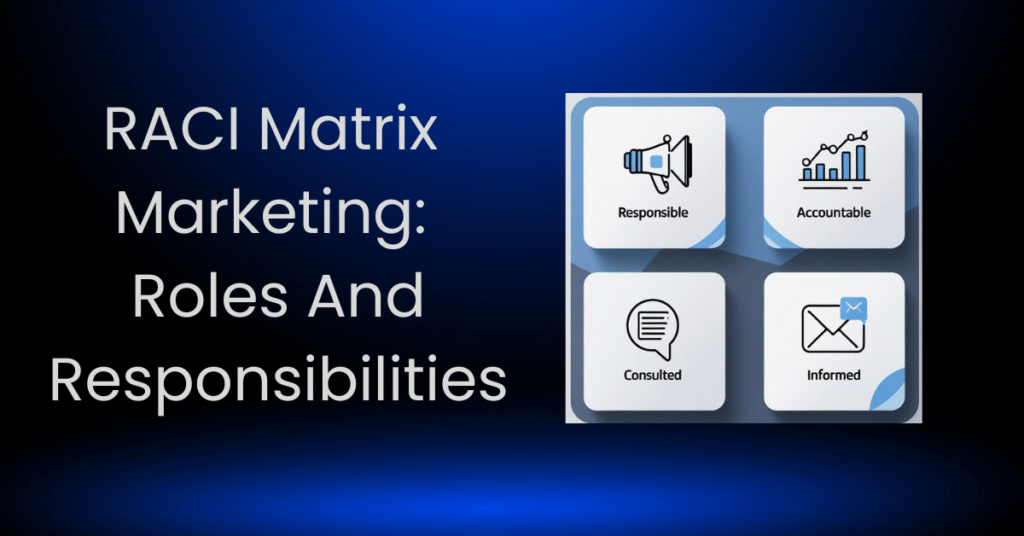
The RACI matrix marketing framework defines four distinct types of responsibility that, when properly assigned, create seamless execution pathways from corporate strategy to tactical implementation.

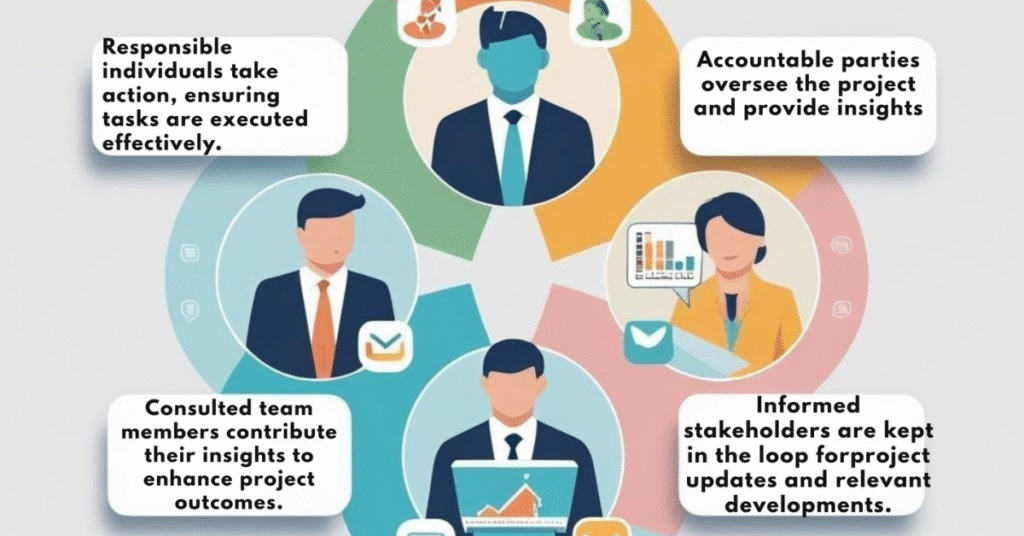
Responsible individuals execute the work. They’re the hands-on contributors who transform strategic directives into deliverable outcomes. Multiple people can share responsibility, but their coordination must be crystal clear to avoid duplicated efforts that drain resources and delay progress.

Accountable parties own the ultimate outcome. This single point of accountability ensures that corporate initiatives have clear ownership and that someone is personally invested in achieving the business results that matter to leadership. Without this clarity, strategic projects often drift without clear success metrics or timeline adherence.

Consulted stakeholders provide essential input before decisions are made. Their expertise shapes the quality of execution and helps avoid costly mistakes that could derail corporate objectives. However, over-consulting creates bottlenecks that slow strategic implementation.

Informed individuals receive updates on progress and decisions. Strategic communication flows efficiently when everyone knows who needs information versus who needs to provide input, preventing information overload while maintaining organizational alignment.

How RACI Drives Corporate Goal Achievement

The marketing accountability framework directly impacts corporate performance in several ways. First, it eliminates the resource waste that occurs when multiple people work on the same deliverable or when critical tasks fall through accountability gaps. This efficiency improvement allows marketing operations to do more with existing budgets, directly supporting financial objectives.

Second, the RACI framework accelerates decision-making by removing ambiguity about who has authority to move initiatives forward. When corporate priorities shift or market conditions change, marketing operations RACI implementation enables quick pivots because everyone understands their role in implementing new directions.

Third, the marketing accountability framework creates measurable accountability that aligns with corporate performance management. When individuals have clear ownership of outcomes, their performance directly correlates with business results, making it easier to identify and replicate successful approaches while addressing areas that need improvement.

RACI in Strategic Marketing Operations

Consider how the RACI matrix marketing approach transforms common marketing operations scenarios that directly impact corporate goals:
RACI, RACI matrix marketing, marketing operations RACI, marketing accountability framework,

In demand generation campaigns, the Campaign Manager remains responsible for execution while the Marketing Operations Manager stays accountable for results that feed into revenue targets. Sales leadership gets consulted on lead qualification criteria that align with sales targets, while executive leadership stays informed about progress toward pipeline goals. This structure ensures that campaign activities directly support corporate revenue objectives rather than operating in isolation.

When implementing new marketing technology to improve operational efficiency, the Marketing Operations Analyst handles configuration and testing while the Director of Marketing Operations owns the project’s ROI impact. Finance gets consulted on budget implications, and IT provides technical expertise, but clear accountability ensures the implementation delivers promised productivity gains that support broader operational excellence goals.

For lead scoring model updates that improve sales conversion rates, the Marketing Operations Specialist builds and tests while the Marketing Operations Manager owns model accuracy. Sales teams provide consultation on qualification requirements, ensuring the scoring system supports corporate customer acquisition targets rather than generating leads that don’t convert.

Building Strategic RACI Implementation

Successful marketing operations RACI implementation for corporate goal alignment starts with mapping your most business-critical marketing processes. Focus first on activities that directly impact revenue generation, customer acquisition costs, and operational efficiency metrics that leadership tracks closely.

  1. Identify Strategic Processes: Prioritize campaign execution, lead management, marketing technology optimization, and performance reporting that feed into corporate dashboards.
  2. Map Stakeholder Impact: Include not just marketing team members but also sales leadership, finance, and executive stakeholders who need marketing operations to deliver specific business outcomes.
  3. Assign Strategic Accountability: Ensure that accountable parties understand how their outcomes connect to corporate objectives and have the authority to make decisions that support those goals.
  4. Create Communication Flow: Structure consulted and informed roles to support strategic decision-making without creating bureaucratic delays that slow corporate initiative implementation.

Your RACI matrix marketing implementation should reflect the reality that marketing operations serves broader business objectives. When assigning roles, consider how each person’s responsibilities contribute to customer acquisition, revenue growth, operational efficiency, and other key performance indicators that matter to corporate leadership.

Avoiding Implementation Pitfalls

The most common RACI failures in marketing operations stem from treating it as an internal exercise rather than a strategic alignment tool. When the marketing accountability framework assignments don’t connect to corporate objectives, the framework becomes administrative overhead rather than performance improvement.

Multiple accountable parties for the same outcome creates the same confusion the RACI matrix marketing approach was designed to eliminate. Corporate goals require single points of accountability who can be held responsible for specific business results. Similarly, over-consulting slows the rapid execution that competitive markets demand, while under-consulting leads to decisions that don’t align with broader business requirements.

Static marketing operations RACI matrices fail because both corporate priorities and marketing operations evolve. Regular reviews ensure that role assignments continue supporting current business objectives rather than outdated organizational structures.

Measuring RACI Impact on Corporate Performance

The true test of RACI effectiveness lies in improved business outcomes. Track how the marketing accountability framework implementation affects key performance indicators that matter to corporate leadership: faster time-to-market for campaigns, improved marketing qualified lead conversion rates, reduced operational costs, and better cross-functional project completion rates.

When marketing operations run more efficiently through clear role definition, resources get allocated to high-impact activities that drive corporate growth. Decision-making accelerates, allowing marketing to respond quickly to market opportunities and competitive threats. Most importantly, accountability clarity means that marketing operations’ contribution to corporate success becomes measurable and scalable.

The RACI matrix marketing approach transforms marketing operations from an internal support function into a strategic business driver. When every team member understands exactly how their role contributes to corporate objectives, marketing operations becomes a competitive advantage rather than an operational necessity. The marketing accountability framework ensures that organizational clarity supports business performance, making marketing operations an integral part of corporate success rather than just another cost center to manage.


[Sassy_Social_Share]

Related Posts