Email marketing has always been part science, part art—and now, artificial intelligence is becoming the most intriguing collaborator in this creative process. Subject lines, those critical seven to nine words determining whether a message gets noticed or lost in the digital shuffle, are undergoing a quiet revolution. AI isn’t here to replace human creativity but to amplify it in ways we’re just beginning to understand.
The Promise of AI-Generated Subject Lines
Imagine having a marketing assistant who can instantaneously analyze thousands of customer interactions, predict engagement patterns, and craft subject lines with surgical precision. That’s the emerging reality of AI-powered email marketing. Consider how a clothing retailer might use AI to transform a generic “Winter Sale” into a personalized “Your Perfect Cozy Layer Awaits, [Name]”—a message that feels less like marketing and more like a thoughtful recommendation. It’s not about replacing human insight but augmenting it with unprecedented precision.
Potential Limitations & Risks
Yet, like any powerful technology, AI-generated subject lines come with nuanced challenges. The risk isn’t just technical—it’s emotional and strategic. An algorithm might technically optimize a subject line but miss the subtle brand voice or cultural context that makes communication resonate.
The effectiveness of AI-powered subject lines hinges on a delicate balance between data sources and ethical considerations. Training exclusively on a company’s first-party data can be limiting, potentially creating an echo chamber that fails to capture broader communication trends. Yet, leveraging more expansive datasets introduces complex privacy and contextual relevance challenges.
The most successful marketing teams will view data not as a static resource but as a dynamic ecosystem. The goal isn’t accumulating the most information but cultivating meaningful insights—balancing technological capability with genuine human understanding.
Best Practices for Implementation
Successful AI integration is less about technology and more about collaboration. Think of AI as a sophisticated brainstorming partner—generating ideas and providing insights but never making final decisions. The most effective approaches involve:
Continuously training both the AI system and marketing team
Future Outlook
The future of marketing technology isn’t about complete automation but intelligent augmentation. We’re moving toward AI systems that understand context, emotion, and individual customer journeys with remarkable depth. The most successful marketing teams will be those who view AI as a powerful tool for human creativity, not a replacement for it.
Final Thoughts
AI-enhanced subject lines represent more than a technological upgrade—they’re an evolving conversation between data, creativity, and human connection. Success will be measured not by algorithmic precision but by our ability to use these tools to create more meaningful, personalized communication.
AI in marketing is no longer a futuristic concept; it’s a powerful tool actively transforming how we connect with audiences through AI in marketing. In fact, a significant 64% of marketers report that content generated with AI in marketing performs as well as or even better than traditional methods. This increasing success of AI in marketing is fueled by its ability to boost efficiency, scale content creation, and reduce costs using AI in marketing strategies.
Generative AI has taken the world by storm. Each new development brings new possibilities so rapidly that reporting on them as they occur is a full-time job. Every industry wants to know what AI can do and how they can best incorporate it into their offerings. And in the marketing world, those questions are especially interesting.
Artificial intelligence has the potential to change our marketing approach fundamentally. While many of these changes appear promising, it also creates new challenges. The question is no longer if you should incorporate generative AI. Rather, it’s how your company can best use AI in marketing now and following future developments. Let’s explore how you can effectively integrate AI in marketing to elevate your strategies and achieve more impactful results.
Utilizing AI in marketing for idea generation can spark creativity and innovation within teams. Furthermore, AI in marketing can help optimize email campaigns, ensuring higher engagement rates.
Idea Generation & Brainstorming
By leveraging AI in marketing analytics, brands can tailor their messages to suit specific customer segments more effectively. AI in marketing ensures that your strategies are data-driven, giving you a competitive edge. AI in marketing helps personalize customer experiences, increasing engagement and loyalty.
For marketers, AI in marketing can be a powerful tool for idea generation. An AI can help your marketing team brainstorm content topics, assemble outlines, or even edit the tone of an article you give it. The AI can’t (and shouldn’t) write for you. However, it can give you valuable suggestions to improve the material you’ve already written using AI in marketing tools. Incorporating AI in marketing can also help analyze customer behavior at scale, leading to better product recommendations.
AI in marketing can facilitate real-time engagement, ensuring your brand stays connected with customers. An AI can also perform data analysis to help with future marketing efforts. For instance, having an AI look over your most recent email marketing campaign might highlight suggestions for getting more clicks. This lets your marketing team explore options to test and refine upcoming campaigns accordingly.
A human might not notice this pattern immediately, but an AI can quickly review the data and identify trends. An AI marketing tool can also sift through past company data, competitor campaigns, and even industry trends to see what’s worked in the past and what might work in the future. This proactive approach helps your marketing team move beyond relevance into pioneering.
Market Segmentation & Social Listening
One of AI’s most valuable contributions to marketing is its ability to analyze social media data at an unprecedented scale. An AI can examine your company’s social media posts and interactions to identify critical patterns. Automating routine tasks with AI in marketing allows your team to focus on more strategic initiatives.
Much like the email marketing example, this kind of data analysis tells your team what works and for what customer segments. This kind of segmentation doesn’t have to stop with social media, either. Emails, text messages, and other marketing communications could benefit from a quick AI analysis to determine what’s working. AI in marketing is a powerful ally in data analysis, transforming raw data into actionable insights.
Personalization & Engagement
AI in marketing can significantly increase efficiency, allowing for faster decision-making and campaign adjustments. By using AI in marketing, brands can quickly adapt to market trends and consumer preferences. AI in marketing provides insights that can lead to more effective campaign strategies. AI in marketing can enhance predictive analytics, enabling businesses to forecast customer behavior accurately. Customer interests shift—and so will their purchases from you. If you can’t keep up with what they want using AI in marketing, they might lose interest and look elsewhere.
Incorporating AI in marketing allows for the creation of customer profiles that improve targeting efforts. AI in marketing helps uncover insights that drive better product development and service offerings. Moreover, AI in marketing can streamline processes, making it easier for teams to focus on high-value activities. Understanding AI in marketing is crucial for any business looking to thrive in the digital age. Marketers must remain cautious while adopting AI in marketing, ensuring ethical practices are followed.
Finally, AI can also facilitate real-time engagement with customers through chatbots. An AI-powered chat function on your website can provide instant customer support and address FAQs. Make sure that these AI-powered tools hand the conversation over to a human representative if more complex or sensitive matters arise.
Overestimating AI in marketing can lead to unrealistic expectations and potential setbacks. Balancing the use of AI in marketing with human creativity is essential for successful outcomes. Proper supervision of AI in marketing tools is vital to ensure they meet evolving business needs.
Busywork
Some AI systems can even use a computer the way a human would to handle manual tasks. One example is Claude, a group of LLMs that is currently learning how to perform simple computer commands. The developers provide an example: telling Claude to fill out a form online using data stored on the user’s computer. Claude would interpret these instructions as individual steps. It checks the indicated file containing the data, moves the mouse to click on a web browser, opens the required webpage, and fills in the form using the provided data. As of November 2024, Claude cannot reliably complete tasks like this. However, the developers are working on solutions to make it possible.
AI Data Analysis: A Huge Time Saver
Marketing involves collecting, sorting, and using a lot of data, especially when leveraging AI in marketing. What exactly this data is used for varies. However, one thing holds true: raw data is not particularly useful. The collected data must be examined, refined, interpreted, and connected to other information to boost your marketing efforts.
Recent AI developments show promise in making this data more accessible, especially for those less experienced with complex analytics software. In fact, a significant 79% of marketers identify increased efficiency as a top benefit of adopting AI, highlighting its power to rapidly process and analyze marketing data.
What Can AI-Driven Data Analysis Do?
An AI can read a detailed spreadsheet of data in seconds. The tool can then assist with several key marketing functions that offer particular value. First, an AI can perform a rapid quality check on your data and confirm if it’s accurate and usable. An AI can also highlight any potential errors or instances of anomalous or “dirty data” to remove and suggest improvements for future data collection.
Second, AI-assisted data analysis allows for detailed predictive analytics to be developed much faster than before, and compare the results with industry benchmarks. This allows your team to more accurately guess which direction the market may be going and what consumers will want in the near future. This leads to better decision-making that’s far more likely to capture and retain customer interest. It also saves precious time, allowing your team to be among the first to identify and capitalize on an upcoming trend.
Third, AI-driven customer data analysis allows for increased personalization. An AI tool can make connections or inferences from data points that a human might miss. It can also consider every minute piece of information, even things that might not seem immediately helpful. The result? Your marketing team can explore and construct more detailed customer profiles and create content that speaks directly to a customer’s pain points.
Finally, AI can simply uncover new insights from collected data that aren’t readily apparent, even things some expert data analysis might overlook. If you understand what the data contains but aren’t sure how to narrow it down to what you want, an AI can be an excellent tool.
Remember: while AI-driven data analysis offers valuable help to marketers who aren’t experts, the results still require human review and validation. AI still makes plenty of mistakes. Your data analytics expert can help locate and fix errors in the AI’s results.
AI in Marketing: What Not to Do
While AI offers significant advantages, its adoption isn’t without hurdles. A recent survey highlights that marketers face several barriers, with data privacy concerns being the most prominent at 40.44%. Additionally, lack of technical expertise (37.98%) and the cost of implementation (33.17%) are significant challenges that companies must address when considering integrating AI into their marketing strategies.
Overestimating What AI Can Do
While AI is powerful, it’s neither a magic bullet nor a replacement for human insight and creativity. AI excels at analyzing vast amounts of data, identifying patterns, and making predictions. However, it cannot process nuance the way people can. It also can’t create something entirely original.
Perhaps most importantly, AI can and will make mistakes. Even the most sophisticated models still produce inaccurate or misleading information. The internet has collectively begun referring to these responses as “hallucinations”. People who assumed tools like ChatGPT knew what they were talking about have been proven wrong in hilarious fashion many times by now.
What to Do Instead: Use AI to supplement your marketing efforts, not replace them. Combine AI’s data-driven insights with your team’s creativity and intuition to craft campaigns that resonate with your audience. For instance, your AI tools can identify which content performs best at different stages of the customer journey. However, human employees are better at crafting a compelling narrative that engages and converts. Your AI’s insights can guide your actions, but cannot and should not perform them all for you. Additionally, remember to double-check anything your AI produces. The last thing you want is a glaring error in your output.
Jumping on the AI Bandwagon Without a Plan
AI may be the hottest new thing, but if your company rushes to implement your own AI approach without a concrete plan, you’ll likely struggle. AI needs to align with your overall marketing strategy—and you need to know how it aligns. Without a plan, you can end up wasting resources, creating inconsistent messaging, and creating marketing campaigns with abysmal conversion rates.
What to Do Instead: Clearly define your marketing goals and determine how AI can help achieve them. Are you trying to increase engagement, boost conversions, or improve customer retention? Once you have a clear objective, identify the specific AI tools and techniques that can support your goals. In other words, fit AI into the marketing strategy that you know works, rather than rebuilding your entire strategy just to include AI.
Ignoring Data Quality & Quantity
AI thrives on data—that’s no surprise by now. But it can’t work with just any data. Poor-quality or irrelevant data can lead to inaccurate insights and misguided marketing strategies. You also need to consider where your data is coming from. Is it your own? If it originates from outside your company, are you even allowed to use it?
What to Do Instead: Invest time in collecting, cleaning, and organizing your data before feeding it into your AI tools. Ensure your data is relevant, up-to-date, and representative of your target audience. This means removing duplicate entries, correcting inaccuracies, and filling in missing information. You also need to be absolutely sure that any data you don’t create yourself comes from willing sources.
Getting Way Too Personal
Personalization is one of AI’s most celebrated capabilities, but there’s a fine line between providing personalized experiences and coming off as intrusive. It’s tempting to give AI every bit of data you can. But as experts have pointed out, AI lacks the emotional intelligence of a human, so it doesn’t know when it’s being insensitive or invasive.
What to Do Instead: Use personalization thoughtfully and avoid being overly familiar with your audience. Aim to add value by providing relevant content, offers, or recommendations rather than trying to showcase how much you know about your customers. For example, instead of using hyper-specific details like mentioning a customer’s recent purchase in an email subject line, focus on recommending products or content based on their broader preferences.
Above all, do not give your AI marketing tools confidential or sensitive data. Not only is this a serious violation of privacy principles, but it will only harm your reputation in the public eye. Collect and use only the data you’re legally permitted to have.
Making Customer Interactions Robotic
AI-powered chatbots and automated responses can handle many customer inquiries, but relying solely on AI for customer interactions can backfire. AI tools don’t always understand what a customer is asking for. Other times, when dealing with complex or sensitive issues, an AI’s lack of emotion can lead to upsetting responses. It’s no secret that when many customers call a helpline or use an online chatbot, many try to get the robot to send them to a human representative as fast as possible.
What to Do Instead: Implement a hybrid approach that combines AI with human support. Use AI to handle routine inquiries, tasks, or FAQs. Meanwhile, your actual employees should handle more complex or sensitive issues. This improves efficiency and ensures that customers feel valued and understood.
If your system defaults to an AI at the beginning of a conversation, state that upfront. Also, make it easy to get to a human representative. Your customers shouldn’t have to navigate a complex menu to talk to a real person.
Not Supervising Your AI
AI needs near-constant supervision and performance review. Algorithms can save your team a lot of work—but your company’s needs will change. Your customers’ preferences will change. And if you don’t ensure that your algorithms change with them, you’ll continue to churn out campaigns that fail to deliver the desired results.
What to Do Instead: Regularly review your AI-driven campaigns and strategies to identify areas for improvement. Use metrics such as engagement rates, conversion rates, and customer feedback to gauge performance. AI learns over time, so the more you monitor and refine it, the more effective it becomes.
In the age of data breaches and privacy scandals, ethical considerations are more important than ever. Too many marketers make the mistake of using AI to collect and analyze data without fully considering the ethical implications, which can lead to a loss of trust and damage to your brand’s reputation.
This invasive type of data collection is painfully obvious in cases like that of Eli Stein. He and his wife discovered they were expecting a child, but chose to hold back on making the announcement online. That didn’t stop a presumably AI-powered algorithm from flooding his social media feeds with ads for new baby supplies. And personal life events aren’t the only thing to consider. AI is trained on human-created data—and unfortunately, that data can reflect biases that the AI then perpetuates.
What to Do Instead: Be transparent about how you’re using AI and data. Ensure you have the proper consent from your customers before collecting their information, and respect their privacy by using data responsibly. Additionally, be aware of potential biases in your AI algorithms and take steps to address them to avoid perpetuating stereotypes or excluding certain groups from your marketing efforts.
Assuming AI is Good to Go Right Away
Many marketers expect immediate results once they implement AI solutions. It’s hard to blame them—AI’s capabilities are praised to high heaven. The reality is that AI requires time to learn and adapt, and it often takes weeks or even months to see significant improvements in performance.
What to Do Instead: Set realistic expectations and timelines for your AI projects. Understand that AI is a long-term investment, and be prepared to invest the necessary time and resources to see tangible results. Start with small pilot projects, gather insights, and gradually scale your AI initiatives as you gain confidence in their effectiveness.
What Comes Next?
Achieving greater marketing success and efficiency is a key goal for any marketer. The potential of AI to help scale content, reduce costs, and improve performance is undeniable. However, the path to successful AI adoption isn’t always straightforward. Concerns around data privacy, the need for technical expertise, and implementation costs can feel like significant hurdles.
Ultimately, realizing success with AI means confidently integrating it to streamline your marketing efforts and achieve a more significant impact. By understanding the insights shared here, and with the right guidance from partners like 4Thought Marketing, you can navigate these challenges and unlock AI’s power to drive your marketing forward.
Don’t let the next AI development catch you by surprise! Get a head start on using AI in marketing with expert help from our team.
AI is one of the most rapidly evolving segments of technology worldwide. As more companies adopt it in some form, its influence only grows. Of course, this raises the question of what AI means for the future of marketing.
This series of articles looks at several tangible ways AI can improve your marketing approach. Today, we’ll examine the potential role of AI in data analysis and marketing automation.
AI in marketing is a hot topic. But underneath all the hype lies the all-important question: what, specifically, can AI in marketing do? How can your team use it in day-to-day work?
Let’s explore a few clever ways to use AI in marketing and turn this buzzword into action.
Beyond simple data analysis, an AI can also help with actual content creation. An AI can help your marketing team brainstorm content topics, assemble outlines, or even edit the tone of an article you give it. The AI can’t (and shouldn’t) write for you. However, it can give you valuable suggestions to improve the material you’ve already written.
An AI marketing tool can also sift through past company data, competitor campaigns, and even industry trends to see what’s worked in the past and what might work in the future. This proactive approach helps your marketing team move beyond relevance into pioneering.
Market Segmentation & Social Listening
One of AI’s most valuable contributions to marketing is its ability to analyze social media data at an unprecedented scale. An AI can examine your company’s social media posts and interactions to precisely identify critical patterns.
Much like the email marketing example, this kind of data analysis tells your team what works and for what customer segments. This kind of segmentation doesn’t have to stop with social media, either. Emails, text messages, and other marketing communications could benefit from a quick AI analysis to determine what’s working.
Personalization & Engagement
Customer interests shift—and so will their purchases from you. If you can’t keep up with what they want, they might lose interest and look elsewhere.
Finally, AI can also facilitate real-time engagement with customers through chatbots. An AI-powered chat function on your website can provide instant customer support and address FAQs. Make sure that these AI-powered tools hand the conversation over to a human representative if more complex or sensitive matters arise.
Embracing AI for a Competitive Edge
As AI becomes more entrenched in marketing circles, those who leverage its capabilities will gain a competitive edge. However, the key to success lies in using AI to complement, rather than replace, human creativity. By applying AI in ideation, market segmentation, and personalization, marketers can enhance their campaigns, deliver more targeted and engaging content, and ultimately drive better results.
AI is one of the most rapidly evolving segments of technology worldwide. As more companies adopt it in some form, its influence only continues to grow. Of course, this raises the question of what AI means for the future of marketing.
This series of articles looks at several tangible ways AI can improve your marketing approach. Today, we’ll examine the potential role of AI in data analysis and marketing automation.
Marketing involves collecting, sorting, and using a lot of data. What exactly this data is used for varies. However, one thing holds true: raw data is not particularly useful. The collected data must be examined, refined, interpreted, and connected to other information to boost your marketing efforts. And what happens if your company’s data analytics expert is unavailable, or worse, you don’t have one?
Recent developments show promise in using AI to help your marketing team make the data more usable. This is especially true for those with a firm grasp of marketing analytics fundamentals but less than ideal experience using complex data analytics software.
What Can AI-Driven Data Analysis Do?
An AI can read a detailed spreadsheet of data in seconds. The tool can then assist with several key marketing functions that offer particular value.
First, an AI can perform a rapid quality check on your data and confirm if it’s accurate and usable. An AI can also highlight any potential errors or instances of anomalous or “dirty data” to remove and suggest improvements for future data collection.
Second, AI-assisted data analysis allows for detailed predictive analytics to be developed much faster than before, and compare the results with industry benchmarks. This allows your team to more accurately guess which direction the market may be going and what consumers will want in the near future. This leads to better decision-making that’s far more likely to capture and retain customer interest. It also saves precious time, allowing your team to be among the first to identify and capitalize on an upcoming trend.
Third, AI-driven customer data analysis allows for increased personalization. An AI tool can make connections or inferences from data points that a human might miss. It can also consider every minute piece of information, even things that might not seem immediately helpful. The result? Your marketing team can explore and construct more detailed customer profiles and create content that speaks directly to a customer’s pain points.
Finally, AI can simply uncover new insights from collected data that aren’t readily apparent, even things some expert data analysis might overlook. If you understand what the data contains but aren’t sure how to narrow it down to what you want, an AI can be an excellent tool.
Remember: while AI-driven data analysis offers valuable help to marketers who aren’t experts, the results still require human review and validation. AI still makes plenty of mistakes. Your data analytics expert can help locate and fix errors in the AI’s results.
Should You Consider AI Data Analysis?
If your business handles significant amounts of data, your team can benefit from using AI to do the busy work. Not only does this free up time, it also allows for more personalized marketing efforts and even unearthing new insights that a human might have overlooked. And AI isn’t going anywhere. Now is an excellent time to look into AI data analysis for your marketing team.
Artificial intelligence has left an undeniable impact on the marketing landscape today. From personalized campaigns to predictive analytics, AI influences our approach to almost every aspect of online marketing.
However, just like any other tool, AI used incorrectly does more harm than good. Are you making any of these AI marketing mistakes?
1. Overestimating What AI Can Do
While AI is powerful, it’s neither a magic bullet nor a replacement for human insight and creativity. AI excels at analyzing vast amounts of data, identifying patterns, and making predictions. However, it cannot process nuance the way people can. It also can’t create something entirely original.
Perhaps most importantly, AI can and will make mistakes. Even the most sophisticated models still produce inaccurate or misleading information. The internet has collectively begun referring to these responses as “hallucinations”. People who assumed tools like ChatGPT knew what they were talking about have been proven wrong in hilarious fashion many times by now.
What to Do Instead: Use AI to supplement your marketing efforts, not replace them. Combine AI’s data-driven insights with your team’s creativity and intuition to craft campaigns that resonate with your audience. For instance, your AI tools can identify which content performs best at different stages of the customer journey. However, human employees are better at crafting a compelling narrative that engages and converts. Your AI’s insights can guide your actions, but cannot and should not perform them all for you.
Additionally, remember to double-check anything your AI produces. The last thing you want is a glaring error in your output.
2. Jumping on the AI Bandwagon Without a Plan
AI may be the hottest new thing, but if your company rushes to implement your own AI approach without a concrete plan, you’ll likely struggle. AI needs to align with your overall marketing strategy—and you need to know how it aligns. Without a plan, you can end up wasting resources, creating inconsistent messaging, and creating marketing campaigns with abysmal conversion rates.
What to Do Instead: Clearly define your marketing goals and determine how AI can help achieve them. Are you trying to increase engagement, boost conversions, or improve customer retention? Once you have a clear objective, identify the specific AI tools and techniques that can support your goals. In other words, fit AI into the marketing strategy that you know works, rather than rebuilding your entire strategy just to include AI.
3. Ignoring Data Quality & Quantity
AI thrives on data—that’s no surprise by now. But it can’t work with just any data. Poor-quality or irrelevant data can lead to inaccurate insights and misguided marketing strategies. You also need to consider where your data is coming from. Is it your own? If it originates from outside your company, are you even allowed to use it?
What to Do Instead: Invest time in collecting, cleaning, and organizing your data before feeding it into your AI tools. Ensure your data is relevant, up-to-date, and representative of your target audience. This means removing duplicate entries, correcting inaccuracies, and filling in missing information. You also need to be absolutely sure that any data you don’t create yourself comes from willing sources.
4. Getting Way Too Personal
Personalization is one of AI’s most celebrated capabilities, but there’s a fine line between providing personalized experiences and coming off as intrusive. It’s tempting to give AI every bit of data you can. But as experts have pointed out, AI lacks the emotional intelligence of a human, so it doesn’t know when it’s being insensitive or invasive.
What to Do Instead: Use personalization thoughtfully and avoid being overly familiar with your audience. Aim to add value by providing relevant content, offers, or recommendations rather than trying to showcase how much you know about your customers. For example, instead of using hyper-specific details like mentioning a customer’s recent purchase in an email subject line, focus on recommending products or content based on their broader preferences.
Above all, do not give your AI marketing tools confidential or sensitive data. Not only is this a serious violation of privacy principles, but it will only harm your reputation in the public eye. Collect and use only the data you’re legally permitted to have.
5. Making Customer Interactions Robotic
AI-powered chatbots and automated responses can handle many customer inquiries, but relying solely on AI for customer interactions can backfire. AI tools don’t always understand what a customer is asking for. Other times, when dealing with complex or sensitive issues, an AI’s lack of emotion can lead to upsetting responses. It’s no secret that when many customers call a helpline or use an online chatbot, many try to get the robot to send them to a human representative as fast as possible.
What to Do Instead: Implement a hybrid approach that combines AI with human support. Use AI to handle routine inquiries, tasks, or FAQs. Meanwhile, your actual employees should handle more complex or sensitive issues. This improves efficiency and ensures that customers feel valued and understood.
If your system defaults to an AI at the beginning of a conversation, state that upfront. Also, make it easy to get to a human representative. Your customers shouldn’t have to navigate a complex menu to talk to a real person.
6. Not Supervising Your AI
AI needs near-constant supervision and performance review. Algorithms can save your team a lot of work—but your company’s needs will change. Your customers’ preferences will change. And if you don’t ensure that your algorithms change with them, you’ll continue to churn out campaigns that fail to deliver the desired results.
What to Do Instead: Regularly review your AI-driven campaigns and strategies to identify areas for improvement. Use metrics such as engagement rates, conversion rates, and customer feedback to gauge performance. AI learns over time, so the more you monitor and refine it, the more effective it becomes.
In the age of data breaches and privacy scandals, ethical considerations are more important than ever. Too many marketers make the mistake of using AI to collect and analyze data without fully considering the ethical implications, which can lead to a loss of trust and damage to your brand’s reputation.
This invasive type of data collection is painfully obvious in cases like that of Eli Stein. He and his wife discovered they were expecting a child, but chose to hold back on making the announcement online. That didn’t stop a presumably AI-powered algorithm from flooding his social media feeds with ads for new baby supplies. And personal life events aren’t the only thing to consider. AI is trained on human-created data—and unfortunately, that data can reflect biases that the AI then perpetuates.
What to Do Instead: Be transparent about how you’re using AI and data. Ensure you have the proper consent from your customers before collecting their information, and respect their privacy by using data responsibly. Additionally, be aware of potential biases in your AI algorithms and take steps to address them to avoid perpetuating stereotypes or excluding certain groups from your marketing efforts.
8. Assuming AI is Good to Go Right Away
Many marketers expect immediate results once they implement AI solutions. It’s hard to blame them—AI’s capabilities are praised to high heaven. The reality is that AI requires time to learn and adapt, and it often takes weeks or even months to see significant improvements in performance.
What to Do Instead: Set realistic expectations and timelines for your AI projects. Understand that AI is a long-term investment, and be prepared to invest the necessary time and resources to see tangible results. Start with small pilot projects, gather insights, and gradually scale your AI initiatives as you gain confidence in their effectiveness.
Using AI Wisely in Marketing
AI is a tool that can enhance your marketing efforts when used correctly. It is not a one-size-fits-all solution. It is also no substitute for human intervention. But neither is it inherently a net negative. Using AI with human creativity and insight can help you create marketing strategies that produce worthwhile returns.
AI has firmly cemented itself into the marketing world. Everyone knows about it, and most people are excited to use it. But this raises a question: what exactly can AI do? And more importantly, what’s the best way to use it in your particular company?
To answer these questions, we reached out to several marketing leaders to learn how they’re harnessing the power of AI. Here are a few of our favorite suggestions, offering a glimpse into how AI can drive success across various strategies and industries.
We value experimenting and testing with AI to make the best data-driven decisions possible. One specific way is by testing emerging technologies with some of our SEO processes to spur innovation and provide our clients with a competitive advantage. We believe that AI should assist our human-centered work and not completely replace efforts.
One way we use artificial intelligence to promote our products better and enhance the customer experience is through faster and more efficient keyword research. AI helps us analyze vast amounts of data to identify popular and trending keywords, allowing us to make informed decisions about the content we create. This approach boosts our search rankings and ensures we are providing valuable and timely information to our audience. The result is a more effective content strategy that drives organic traffic and enhances the overall customer experience.
One specific way we are leveraging AI to promote our products and services and enhance the customer experience is by automating communication with our candidates when they are on assignment. We use AI to send timely updates and notifications to keep them informed throughout their placement.
Additionally, AI helps us ensure we follow up with both candidates and clients by sending automatic reminders to our team. Customizing messages to our customers is crucial, and AI has significantly reduced the time it takes to personalize these communications, allowing us to maintain high levels of engagement and satisfaction.
One specific way I’ve leveraged AI to enhance conversion optimization and A/B testing is through predictive analytics. By using AI to analyze customer behavior patterns on my customers’ e-commerce sites, we can predict which elements—like product placements, calls-to-action, or content formats—are most likely to drive conversions. For example, on one client’s site, we implemented AI-driven heatmaps to understand where users were clicking and where they were dropping off.
This insight allowed us to redesign the layout, placing high-converting elements in the most engaging spots. We then A/B tested these changes, and the results were impressive: a 25% increase in conversion rates within a month. This approach isn’t just about leveraging data; it’s about making informed, strategic decisions that directly impact the bottom line. AI gives us the tools to anticipate customer needs and tailor their journey, making their experience seamless and significantly boosting conversions.
One specific way I’m leveraging AI to enhance customer experience is through chatbots. We built a custom chatbot for a client in the e-commerce space. It wasn’t just for answering basic questions—it used AI to personalize product recommendations based on browsing history and past purchases. This resulted in a 15% boost in average order value and happier customers who felt like they were getting relevant suggestions, not generic pitches.
The key is using AI to enhance, not replace, human interaction. It frees your team to handle complex inquiries while the chatbot tackles FAQs and provides 24/7 support. So, if you’re looking for an AI tool that can truly impact your marketing, consider chatbots for personalized experiences and happy customers!
We are increasingly using AI in our marketing workflows. Our most successful approach is based on social listening: We leverage the KWatch.io platform to monitor social media and automatically apply advanced sentiment analysis (based on generative AI) to the social media posts and comments on Reddit, Twitter/X, LinkedIn, etc. This allows us to receive real-time alerts when potential customers mention our brand, our competitors, or any interesting topic related to our business.
I’ve successfully implemented Predictive Customer Service to enhance our customer interactions. By analyzing historical data, we anticipate customer needs and proactively address their concerns before they arise. This approach not only improves customer satisfaction but also significantly reduces response times.
For instance, we developed models that predict when customers are likely to need support, allowing our team to reach out with solutions before an issue escalates. This innovation has transformed our customer-experience strategy, ensuring that we stay one step ahead. Through this method, we have seen a marked increase in customer loyalty and retention, proving that understanding data can lead to meaningful, lasting relationships with our clients.
One specific way we leverage AI to promote our products and enhance customer experience is through our custom GPT, “Before You Write.” This AI tool conducts preliminary research by identifying potential customer questions, reviewing top-ranking sites, and assembling a comprehensive outline. Integrating “Before You Write” into our workflow has significantly improved the efficiency and consistency of our campaigns.
The single most effective use we’ve found for AI in our marketing department is automating our PPC ads. With the right prompts, we’re able to quickly and efficiently adapt to changing pricing and performance data, helping us to get more bang for our buck in this area.
It will be through personalized content recommendations. AI-driven algorithms can analyze customer behavior and preferences to suggest products or services that match their interests. This not only makes marketing more relevant but also improves the overall user experience. For example, AI tools can track browsing patterns and past purchases to deliver tailored email campaigns or on-site recommendations. This kind of personalization helps in engaging customers more effectively and boosting conversion rates by presenting them with exactly what they’re looking for, right when they need it.
We aren’t using AI to write our content, but AI is fantastic for identifying gaps between our own content and what our competitors are doing to outrank us within Google search. We are also using AI to put together more complete content outlines for blog posts, providing a more complete picture of what we’re trying to cover on any given page. That only increases and enhances our site’s overall authority and expertise in the eyes of the search engines, which helps us expand our organic footprint and further promote our products to prospective customers.
I’m using AI to help me streamline my writing process. There are some great generative AI tools out there that can suggest some pretty interesting alternatives to your content, your writing structure, and more. I know people have been skeptical about the use of AI for content writing, but if you (the writer) know what you’re talking about, you can actually use AI to give you insights.
The expectations for content writers are pretty high in terms of delivery of content, and AI is certainly helping with that. While there are times when using AI can actually slow you down (because it simply doesn’t give you what you’re looking for), it’s mostly a great tool to assist you.
We’ve integrated AI into our content-creation process to analyze engagement metrics and handle proofreading and grammar checks. This approach ensures our articles are well-optimized and mistake-free, allowing us to focus on content that resonates with our audience. As a result, we save time and improve the quality of our content.
If you aren’t sure where to start with AI or how far to take it in your marketing strategy, don’t worry—you’re not alone. Get in touch with our marketing team today to take full advantage of this revolutionary tool.
Artificial intelligence has found its way into almost every industry now. Its impact cannot be overstated, and its popularity continues to grow. And for the marketing automation industry in particular, AI is poised to play an increasingly transformative role.
As marketing experts take more advantage of artificial intelligence, we may see significant shifts in areas such as:
Hyper-personalization: AI can enable marketers to create highly personalized experiences at scale. AI can deliver tailored content, product recommendations, and communication timing by analyzing a wider range of customer data in detail, resulting in deeper customer engagement and improved conversion rates.
Predictive analytics: As AI-powered predictive analytics become more sophisticated, marketers can more effectively anticipate customer behavior and preferences, enabling them to address needs and concerns proactively. Predictive models can also help identify high-value leads and the best times to engage with them, improving lead nurturing and conversion rates.
Direct customer communication: chatbots with AI integration will answer customer queries and engage in meaningful conversations, troubleshoot issues, and facilitate transactions. This level of automation will improve customer support, reduce response times, and enhance the overall customer experience.
Marketing attribution: AI-driven attribution models may offer more accurate insights into the customer journey. Marketers can better understand the impact of each touchpoint on conversions, enabling data-driven decision-making and more efficient allocation of marketing budgets.
Augmented decision-making: AI will not replace human creativity, but will encourage it by providing data-driven recommendations and insights that lead to more effective strategies and campaigns.
But even as AI becomes more and more prominent in the marketing world, it can never fully replace humans. Surveys have provided valuable insights into customers’ thoughts on AI, most notably:
57% of consumers overall prefer their first contact with a company to be by phone rather than via chat.
How to Approach AI in Marketing Automation
The future of AI in marketing automation appears poised to revolutionize customer engagement, campaign optimization, and data-driven decision-making. As AI technologies continue to evolve, businesses that embrace these innovations could gain a competitive edge in delivering personalized and seamless customer experiences.
It’s important to ensure that AI applications align with both business goals and customers’ expectations in an increasingly data-sensitive world. But don’t worry: we can help with both! Contact our team today and start taking advantage of all that AI has to offer your marketing strategy.
As consumers become increasingly aware of their data privacy rights and the options available to them, businesses need to adjust accordingly. Personalized marketing materials still work wonders, but how can your company collect enough data for personalization without violating privacy laws? What’s the balance between respecting user privacy and effectively using data?
The Evolution of Preference Management
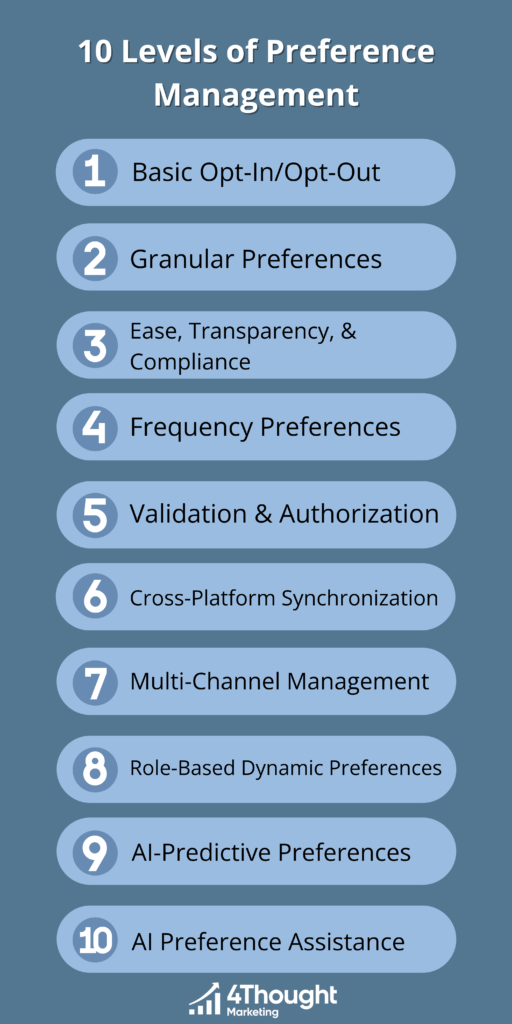
In short, the answer lies in a practice called preference management. This allows customers to control exactly what data they provide to your company and how they allow your company to use the collected data. There are multiple ways to approach this. Today, we’ll be looking at ten levels of preference management, each building on the previous one.
Level 1: Basic Opt-In/Opt-Out
At the most fundamental level, preference management begins with the ability for customers to opt in or opt out of communications. While this may seem elementary, providing a balanced choice like this goes a long way. A well-designed preference center not only offers an opt-out option but also encourages customers to opt back in by explaining exactly how and when their data will be used. This keeps contacts informed and ensures they feel in control of their choices.
Level 2: Granular Preferences
Granular preferences allow customers who have opted in to specify the types of communications they wish to receive. This can be segmented by product lines, content types, business units, or any number of other relevant categories. This choice assures customers that the communications they’ll receive will be both relevant and not overwhelming.
Level 3: Ease, Transparency, & Compliance
This level of preference management has three distinct levels of its own.
First, ease of use. Preference centers should be intuitive and straightforward. Too many options will overwhelm users and make them more likely to opt out of everything. Keep your dashboards scannable and simple.
Second, transparency. Being honest about your data collection and usage is crucial at this stage. Don’t ask for more data than you need. Explain how and when you’ll use the data you ask for, and stick to it. Make your privacy policy easily available for customers to review.
Third, legalcompliance. It’s essential to prove that you’re honoring your customers’ requests. A customer’s preference submission is already connected to their email address. To be truly compliant, you must gather additional identifying data such as date, time, and form location, that show when and how the request was made. Returning only the most recent opt in or out state, if it’s a checked or unchecked box, is insufficient evidence if your compliance is ever challenged. You must provide a history of changes.
Level 4: Frequency Preferences
Some visitors who ask to unsubscribe might not want to completely stop communications—they may just want a break. Providing an ability to control how often they receive things -frequency preferences, makes this easy for both them and you.
Depending on your company’s exact marketing approach, frequency preference management can take different forms, such as:
You may give visitors the option to pause all communications for a period.
Alternatively, you may want to give them to control, for each preference they opt into a frequency option. For example they may want to get newsletters only quarterly, but product support information immediately.
Finally, you may want to consider “fatigue analysis”, which slows down communications to customers who aren’t actively engaging with your messages anymore. Communications will pick back up when their participation does. This keeps messaging frequency at the customers’ comfort level without costing you a contact.
Level 5: Validation & Authorization
This level is fairly straightforward: making sure the customer is who they say they are. This can be accomplished with something as simple as an identity verification email. This adds an extra layer of security to the preference management process, ensuring that no one else can sign up a customer for unwanted communications or change their set preferences.
Level 6: Cross-Platform Synchronization
In large organizations, recorded customer preferences may be scattered across various systems and departments. This obviously makes managing these preferences harder for internal marketing and privacy professionals that must deal with making multiple systems legally compliant. It also makes submitting those preferences in the first place harder, as customers have to navigate multiple menus and webpages. Consolidating them into a single, unified view through cross-platform synchronization makes things far easier for the customer and for you. Some jurisdictions even legally mandate this.
Level 7: Multi-Channel Management
Email marketing may be the most lucrative form of online advertising, but it’s far from the only one. SMS, push notifications, and other communication channels are still effective ways to reach your audience. And different demographics will prefer different channels. For example, one age group may prefer SMS messages over email, while another group wants email communication and nothing else. This is another layer of choice that your preference center needs to offer.
Level 8: Role-Based Dynamic Preferences
Prospects, customers, and company partners will have different areas of focus when it comes to receiving communication from you. Offering a universal preference center can make those areas of focus harder to track. Consider creating one preference center for prospects, one for current customers, one for company partners, and others as required so you can offer each group a relevant set of choices. (You’ll also need to remember the validation step of level 5 as you do this.) This makes things easier for the users and, by extension, increases their engagement.
Level 9: AI-Predictive Preferences
This level uses artificial intelligence to predict and then pre-set customer preference settings based on historical data, behavior, and other inputs. Many companies do this with an algorithm today, but enabling an AI to set these is typically far more capable when preferences are many and complex.
While AI-predictive preferences should not replace customer-set preferences, they can provide a valuable starting point, especially for new customers or prospects.
Level 10: AI Preference Assistance
The most advanced level of consent management involves AI-powered systems that interact directly with customers to understand their preferences. Imagine typing into a preference page:
“Every two months, send me an update with hyperlinks for all content on everything happening regarding home appliances from this company only. However, I’d like product announcements to be sent to me immediately.”
“I’ve turned on the three preferences below that pertain to home appliances with a frequency of every two months, and also the preferences for product announcements to come as soon as available.”
These systems look and behave like your typical chatbot, except they are intentionally focused and pre-prompted to understand all the content a company creates and the concept of preferences. This futuristic approach can simplify the preference management process, making it more even intuitive and user-friendly.
Implementing Effective Preference Management
While understanding these levels is crucial, implementing them effectively requires strategic planning and execution. As you begin:
Assess your current state: Identify which level your organization currently operates at. Are you still at basic opt-in/opt-out, or have you moved towards AI-predictive preferences?
Prioritize ease and transparency: Regardless of the level, ensure your preference center is easy to navigate and transparent about what each option means. Use clear language and, where possible, visual aids.
Take advantage of technology: Use technology to automate and streamline preference management. This includes using AI for predictive preferences and cross-platform synchronization to consolidate data from different systems.
Focus on compliance: Stay up-to-date with legal requirements and ensure your preference management practices comply with relevant laws. This not only protects your organization from legal risks but also builds trust with your customers.
Customize and personalize: Tailor your preference management to different user groups. Use role-based dynamic preferences to provide relevant options to prospects, customers, and partners.
Stay flexible and adaptive: As new technologies and customer expectations evolve, be prepared to adapt your preference management strategies. Regularly review and update your practices to stay ahead of the curve.
Conclusion
Effective preference management is a dynamic and evolving process that requires a thoughtful approach and the right blend of technology and strategy. By understanding the different levels of preference management and implementing best practices, marketers can offer personalized experiences while maintaining compliance and building customer trust. The journey from basic opt-in/opt-out to AI-driven preference assistance is not just a technological upgrade. Rather, it is a strategic evolution that can significantly enhance customer engagement and satisfaction.
AI has certainly made its mark. Many companies jumped on board early, eager to take advantage of AI-powered tools’ extra capabilities. Marketers, in particular, were intrigued by this shiny new toy. And with good reason—AI-powered marketing efforts offer increased efficiency, help eliminate busywork, and can improve customer relations.
But this shiny new toy comes with inherent risks still being uncovered. Companies that choose to take advantage of AI need to understand the impact it can truly have, both now and as the technology continues to evolve. One excellent way to start is an AI audit.
What are AI Audits?
An AI audit assesses how AI is used in your organization and the impact it has. The audit also ensures that your AI tools comply with ethical standards and legal requirements for privacy, security, and transparency.
This audit also covers every area where your company uses AI. This goes beyond your website chatbot. AI may be more visible now, but marketers have been using it in some fashion in marketing automation for years. No matter how insignificant, every AI tool needs to be a part of this audit.
Why AI Audits Matter
An AI audit gives you a clear picture of who uses AI in your company, how they use it, and how often. It also helps identify potential problems. AI audits specifically look for:
Not only will an AI audit will help you catch problems early on, but it will also demonstrate your company’s commitment to ethics and transparency.
Best Practices for Effective AI Audits
AI audits function much like any other type of audit in your company. As you prepare, keep these best practices in mind:
Define clear objectives: Before starting an AI audit, define what you aim to achieve. Whether it’s compliance verification, performance assessment, or risk identification, clear objectives will guide the audit process and ensure it focuses on your concerns.
Involve cross-functional teams: AI audits should involve collaboration between various departments, including IT, legal, compliance, and marketing.
Use standardized tools and frameworks: Tools such as AI impact assessments and algorithmic audits can provide a structured approach and make things simpler.
Conduct continuous audits: AI systems evolve, and so should the auditing processes. Regular audits allow for continuous oversight and the ability to address new challenges as they arise.
Focus on transparency and documentation: Maintaining transparency through comprehensive documentation of AI systems and audit processes is vital. This transparency not only supports regulatory compliance but also builds trust with consumers.
Engage external experts: Sometimes, the complexity of AI systems can benefit from external expertise. Third-party auditors with specialized knowledge in AI can provide an unbiased view and help uncover issues that internal teams might overlook.
AI Audits in Your Company
At the end of the day, AI is simply another tool at marketers’ disposal. This new tool has to follow the same rules and adhere to the same standards as any other system. By prioritizing AI audits, you demonstrate your commitment to keeping marketing ethical and legally compliant even as technology evolves.
How else can you incorporate AI into your marketing strategies? Do your existing AI systems need a checkup? Contact our team today to discuss all your marketing needs.
The introduction of low-code platforms turned marketing automation from complex coding into a simple, visual interface. More recently, artificial intelligence has been making a no less significant impact. Both completely changed how people thought of marketing and made certain aspects of the job simpler.
But as both technologies work in tandem, shifts in the marketing landscape could occur faster than ever. What can your company expect? Here’s what eight marketing automation specialists think.
Whether you see it as good or bad depends on which team you’re on, but AI in digital marketing automation has caused a shift for paid media managers, especially in paid search where creativity is less impactful than in more visual experiences.
Google’s (and Microsoft’s) shifts to more black-box automation and AI-driven bidding have tied the hands of paid media managers. What used to take a lot of time, consideration, and data analysis, not only isn’t as advantageous as it once was, but it isn’t even as possible.
For that reason, we’ve shifted management tactics and have embraced the big company march toward AI. At PPC Assist, we’ve launched a low-cost, on-demand management service that embraces the AI-driven, conversion-based bidding strategies promoted by Big Tech. This allows small businesses to run campaigns more efficiently, putting a much higher percentage of their budget toward actual advertising. Of course, when they want to make changes, we’re there when they need us.
This movement away from granular optimizations by paid media managers toward AI-based conversions is only going to continue in the future. Targeting options will continue to be removed and simplified in favor of AI, and sooner or later the market will have to adjust and accept it
One specific negative impact that low-code and AI have had on marketing automation is the potential for over-automation. While these technologies have made it easier to automate tasks, they’ve also led to a surge in impersonal, generic communications. Customers are increasingly receiving messages that feel robotic and lack a personal touch, which can harm the customer experience and brand perception.
Moving forward, there’s a risk that this trend could intensify. As more companies adopt low-code and AI solutions, the volume of automated communications could increase, further diluting the personal connection between brands and their customers. It’s crucial for businesses to strike a balance between efficiency and personalization, to ensure that their communications resonate with their audience and build meaningful relationships.
One issue I’ve observed with AI’s role in marketing is the flood of content it produces, which tends to be quite similar and not always of high quality. This can make it challenging for truly unique and insightful content to grab the spotlight.
Fortunately, search engines like Google have become quite adept at recognizing and rewarding original content. They’re equipped with sophisticated methods to identify and promote content that genuinely offers something new and valuable. So, looking ahead, there’s a real opportunity for creators who prioritize uniqueness and quality in their content to stand out and succeed.
4. Low-Code Democratizes Marketing for Small Businesses
In my over 25 years of experience in marketing, particularly at FireRock Marketing, I’ve seen the transformative impact of low-code platforms and AI on marketing automation. One significant impact is the democratization of technology, allowing smaller businesses with limited technical resources to implement sophisticated marketing automation systems. This has opened up new avenues for these businesses to compete with larger enterprises by enabling them to craft personalized customer experiences and automate repetitive tasks, which has led to increased efficiency and scalability.
A concrete example of this is a small retail client we partnered with. By leveraging a low-code platform, we were able to quickly deploy a customized marketing automation solution that integrated seamlessly with their existing systems. This solution automated the client’s email marketing campaigns, using AI to segment customers and personalize content based on their behavior and preferences. The result was a 40% increase in email engagement rates and a 22% rise in conversion rates within the first six months of implementation.
Looking forward, the continuous advancements in AI will push the boundaries of what marketing automation can achieve, particularly in predictive analytics and customer journey mapping. We’re likely to see systems that can not only analyze and react to customer behavior in real-time but also anticipate future actions and adapt strategies autonomously. This will enable businesses to stay several steps ahead in their marketing efforts, ensuring they remain relevant and responsive in a rapidly changing landscape. The key for businesses will be to stay informed and leverage these technologies to enhance their marketing strategies, keeping the focus on creating exceptional customer experiences.
In my journey from IT enthusiast to a leader in the startup ecosystem, I’ve witnessed the significant impact low-code and AI have made on marketing automation. A particularly compelling instance was during my time at PacketBase, where we used low-code platforms to quickly develop and deploy marketing automation tools without the need for extensive programming knowledge. This agility allowed us to iterate our marketing strategies rapidly, leveraging AI to refine and personalize communication at an unprecedented scale. We were able to triple our lead generation within a quarter, all thanks to the precision and efficiency these technologies brought into our marketing operations.
AI, in particular, has transformed the way we approach data analysis and customer engagement. For instance, by using AI-driven insights, we were able to predict customer behaviors and preferences, tailoring our marketing efforts to meet their specific needs. This not only improved our engagement rates but also significantly enhanced customer satisfaction and loyalty. The use of AI in analyzing marketing performance data helped us identify patterns and trends we would have otherwise missed, enabling us to make data-driven decisions quickly and accurately.
Looking to the future, I believe the role of low-code and AI in marketing automation will only expand, offering even more sophisticated capabilities for predictive analysis and customer journey optimization. These technologies will enable businesses to not only respond to current market trends and customer behavior but also anticipate future changes, staying ahead of the curve in a competitive landscape. The key will be to leverage these tools in creating more meaningful and personalized customer experiences, which will be paramount in achieving long-term success in any venture.
The occasional error in the information offered by AI algorithms is one disadvantage I’ve come across. Even with their enhanced capabilities, there have been times when the insights or recommendations produced by AI haven’t properly matched the state of the industry or customer behavior. As a result, certain poor decisions were made, and the effectiveness of several efforts slightly declined.
Going forward, I think it’s very important that marketers continue to make use of these tools, but they also need to continue exercising human oversight and a critical eye to ensure the data and insights produced are accurate and pertinent. Optimizing low-code and AI’s benefits for marketing automation while reducing risks will depend on striking the correct balance between automation and human judgment.
As an entrepreneur with over a decade of experience in the technology business, notably in software development and AI, I’ve seen firsthand the impact of low-code and AI on marketing automation. One specific positive impact is the democratization of automation technologies via low-code platforms, which allows marketers with limited coding skills to construct sophisticated automated workflows. This has enabled firms to streamline their marketing processes, enhance productivity, and improve results without relying heavily on technical skills.
However, one possible disadvantage of this development is the risk of oversaturation and decreasing distinction in the marketing automation field. With the rise of low-code solutions and AI-powered marketing tools, it’s conceivable that some firms may favor quantity over quality, resulting in generic, cookie-cutter ads that don’t connect with their target audience.
Looking ahead, the incorporation of AI into marketing automation is set to dramatically transform the sector. AI-powered algorithms can use massive volumes of data to tailor marketing campaigns, predict customer behavior, and optimize campaign performance in real-time. This will allow organizations to deliver hyper-targeted and highly relevant content to their target audience, resulting in increased engagement, conversion rates, and, ultimately, higher ROI.
In my experience, the integration of low-code and AI into marketing automation has brought about a significant transformation. It has democratized automation capabilities, allowing marketers like me, with limited technical skills, to create and execute advanced automated campaigns more seamlessly.
This accessibility has greatly enhanced the efficiency and scalability of our marketing operations, enabling our team to optimize resource allocation effectively. Looking ahead, I anticipate that the ongoing advancements in low-code platforms and AI technologies will further revolutionize marketing automation. This progress will empower us to develop even more personalized and targeted campaigns on a larger scale.
However, I also recognize that along with these advancements come challenges, such as the need to address data privacy concerns and establish robust governance frameworks to ensure ethical AI usage in marketing practices.
Whether your organization needs help implementing a new low-code platform, integrating with an AI tool, or both, we’ve got the skills to get you on track. Contact us today to get started.
The ideal sales experience is an in-person interaction between the vendor and prospective customer. And if you can create a similar experience online, you should see improved results over static copy on your website. But it’s not possible for every customer to visit you in person. This is why websites increasingly leverage chatbots to simulate in-person conversation to increase engagement.
The 4Thought Marketing team has helped multiple companies improve their marketing strategies and technology. Recently, we were able to do something particularly interesting with a client: getting the most value out of their AI-chat tool, Drift.
When a user visits a website with Drift active, a pop-up on the bottom right corner of the screen invites them to chat. Drift then uses this chat to collect data through the chat like a standard form submission. Drift also captures other critical information such as activity data and customer interests.
Marketo Drift Integration
Our client had already been using Marketo as their primary marketing automation platform, and used Drift for capturing general customer data. We helped them leverage the two programs working together. Our team provided the necessary help to integrate Drift and Marketo to make users’ website experiences as smooth and pleasant as possible.
This is where Drift truly shines. First, Marketo kicks off a specialized nurture campaign for the user.
Next, when the client clicks on the email and goes to a personalized landing page, Drift leverages its screen takeover, guiding the user to schedule a meeting right away.
Because Drift and Marketo are integrated, scheduling a meeting requires fewer steps, and is as simple as selecting a date and time from a provided list. This is all designed to fast-track the sales process and make scheduling a sales meeting as easy as possible for the potential client.
The results are undeniable. Customers clearly appreciate the smoothness of the entire process. Since implementing the Drift screen takeover and nurture email campaigns, our client has enjoyed a significantly higher conversion rate and increased revenue.
Leveraging AI Chatbots for Improved Marketing
The potential for AI in marketing is hard to overstate. If you’re interested in upgrading your existing marketing automation setup with an AI chatbot like Drift, get in touch with us today. We’ll help you make the customer experience all the more streamlined and straightforward.
If you’ve worked in marketing for any period of time, then you know how much your team relies on data. Webpage visits, email clicks, customer purchases, event registrations, marketing consent or lack thereof—there’s no end to the information you have to sort through. And you have to make it all say something. How should your strategy change depending on all this data?
This is where data analysis comes in. Raw information on its own isn’t super helpful. You have to understand what the data means and how to read it. But what if you’re not a data analysis expert? Fortunately, a tool released in 2023 offers an efficient, user-friendly way to approach this task. This tool, of course, is the ChatGPT data analysis system.
Why Choose the ChatGPT Data Analysis Tool?
The ChatGPT data analysis tool offers several major benefits to anyone who needs a quick bit of basic data help, most notably:
Accessibility for all skill levels: Whether you’re a novice who has never analyzed data before or an experienced data analyst looking for a quick solution, the tool offers a straightforward and intuitive interface.
No coding required: You don’t need to write complex scripts or commands to analyze your data. Instead, you can interact with the tool using natural language queries, making it accessible to a broader audience regardless of their coding experience.
Time-efficient: Time is often a critical factor when working with marketing data. ChatGPT’s Data Analysis tool allows you to perform data analysis tasks quickly and efficiently. You can get insights from your data without the need for extensive setup or learning curves.
Interpretation assistance: Analyzing data is not just about running calculations—it’s about understanding the results and drawing meaningful conclusions. ChatGPT’s tool not only helps you crunch the numbers but also provides basic explanations and interpretations, making it easier to grasp the significance of your findings.
How to Use the ChatGPT Data Analysis Tool
Using ChatGPT’s Data Analysis tool is a straightforward process.
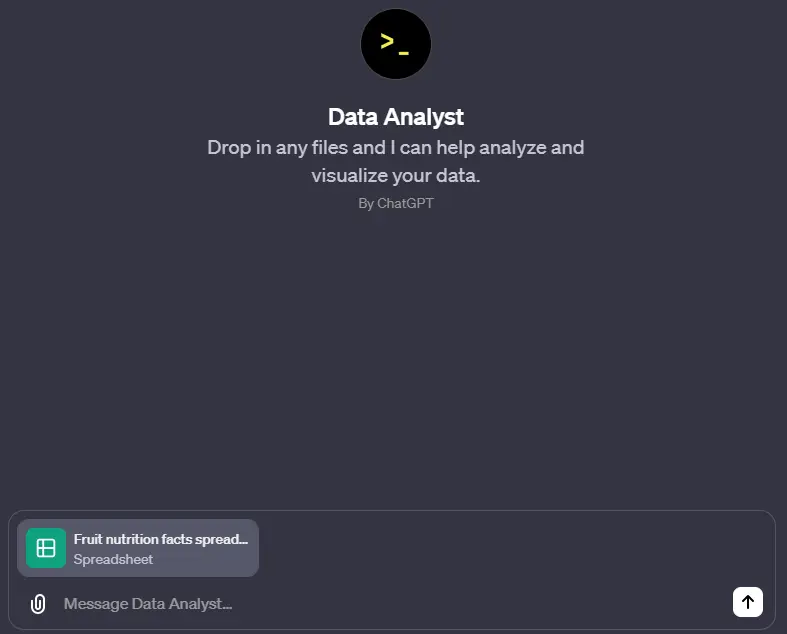
To begin, you can access ChatGPT’s Data Analysis tool through a web browser or an integrated platform that offers the tool. Make sure you have a dataset ready for analysis in a compatible format (e.g., CSV, Excel). Once you’re in the tool, you’ll find an option to upload your dataset. Click the paperclip icon and choose the file you want to upload, or drag and drop the file directly into the chatbox. (Remember that the maximum file size you can upload to any ChatGPT tool is 512 MB.)
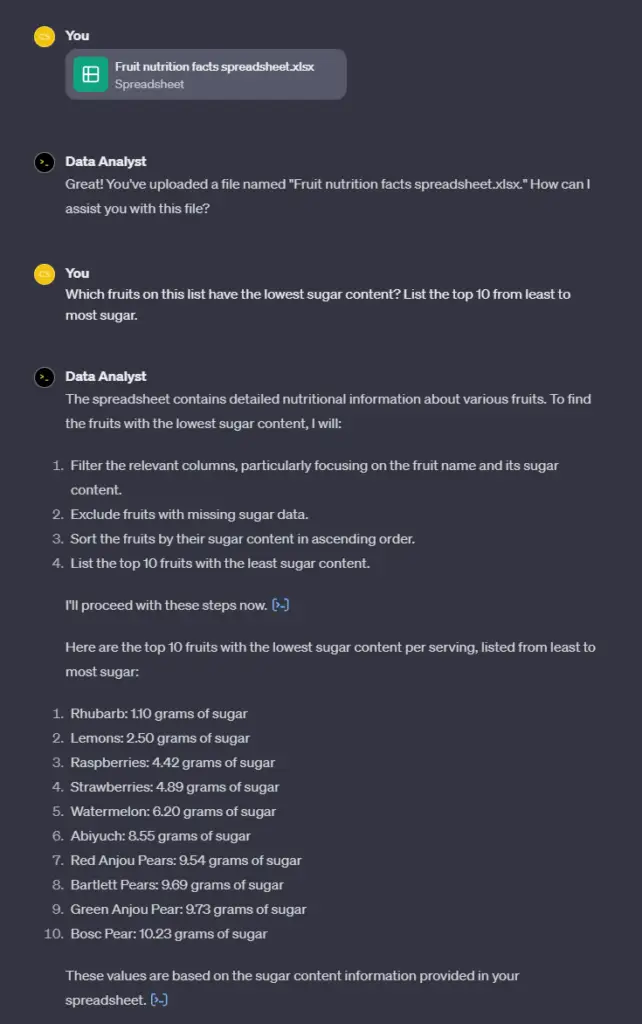
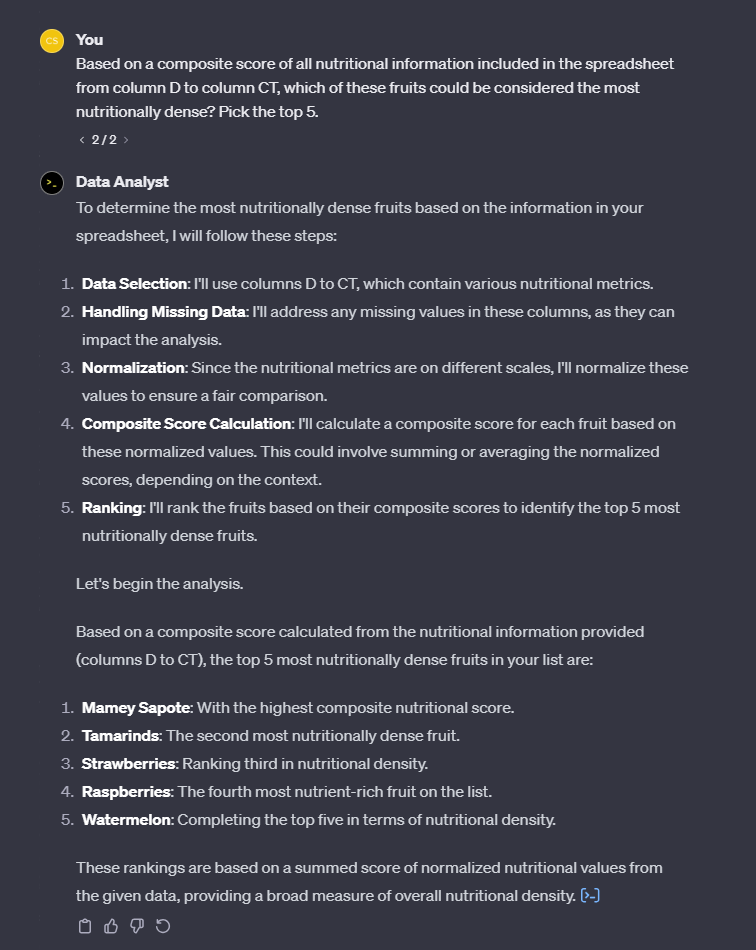
Here’s where the magic happens. You can start by asking the tool questions about your data. For example, you can inquire about the average, median, or sum of a particular column, or you can request a breakdown of your data by specific categories.
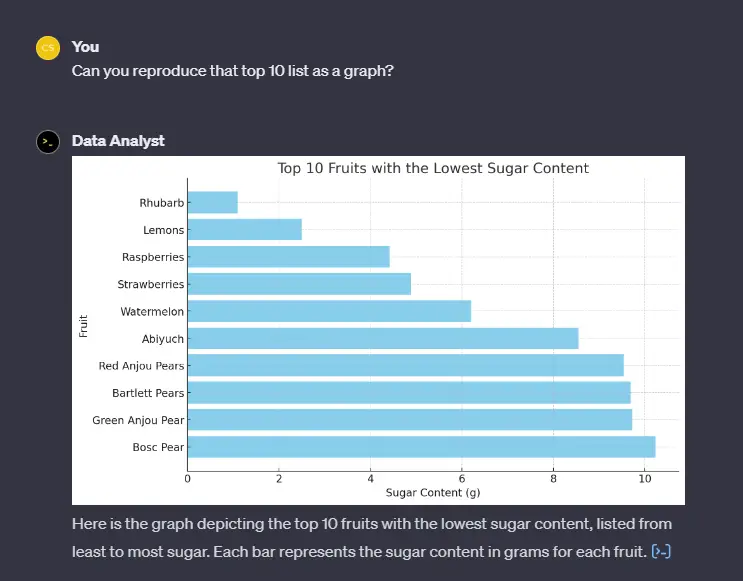
After posing your questions, ChatGPT’s Data Analysis tool will process the data and provide you with relevant insights. You can explore charts, graphs, and explanations to better understand your data.
Don’t hesitate to refine your questions and explore different aspects of your dataset. The tool is designed to be interactive, allowing you to iteratively analyze and refine your findings.
Once you’re satisfied with your analysis, you can export the results or share them with colleagues or stakeholders. This makes collaboration and decision-making more accessible.
Conclusion
The ChatGPT Data Analysis tool offers a straightforward approach to basic data analysis, making it accessible to individuals and professionals across various domains. With its intuitive interface, no coding requirement, time efficiency, and interpretation assistance, the tool empowers users to gain insights from their data without the steep learning curve associated with traditional data analysis tools.
Embrace the power of data analysis without the intimidation factor, and let this tool guide you in making informed decisions based on your data-driven discoveries.