Alt text has long been associated with accessibility — a behind-the-scenes feature that ensures users relying on screen readers can understand the content of images. While that remains a critical function, its role is expanding in increasingly relevant ways to marketers. Today’s email clients, including Apple Mail and Gmail, use more advanced methods to display message previews. These systems often draw not only from subject lines, preview text, and image metadata. In this environment, well-written descriptions don’t just support accessibility — they contribute to how an email is summarized, interpreted, and prioritized in the inbox.
Beyond Compliance: Why Alt Text Quality Matters
Despite its growing importance, alternative text is often overlooked or inconsistently applied. It’s not uncommon to see placeholders like “image1.jpg” or vague descriptors such as “photo” or “graphic.” While these may satisfy technical requirements, they do little to enhance the user experience or support your messaging.
Common challenges include:
Missing or empty attributes, resulting in poor screen reader experiences and vague previews.
Generic or overly broad language, which provides no meaningful context.
Manual inconsistencies can reduce content quality and introduce errors across campaigns.
As inbox environments evolve, these shortcomings become more noticeable and impactful. Descriptions are increasingly part of the first impression your email makes. It can differ between a reader opening your email or scrolling past it.
A More Strategic Approach
When treated as part of a broader content strategy, alternative text can reinforce brand voice, support clarity, and contribute to stronger engagement. Clear, specific descriptions make your message more inclusive and help ensure that it’s understood and presented accurately, even when images are not displayed.
Effective alt text:
It enhances the experience for users with visual impairments or those using privacy tools that block images.
Supports better inbox previews, especially in platforms that generate summaries dynamically.
Reduces confusion and improves overall clarity across email campaigns.
Demonstrates attention to detail and reinforces brand professionalism.
Improves email deliverability and prevents your email from landing in the spam folder.
This is particularly valuable in high-volume or high-visibility campaigns, where consistency and quality are critical.
Moving Forward
To address these challenges, incorporating AI into your content development and quality assurance processes can significantly improve the quality of your alt text and reduce errors. AI can check image descriptions and suggest improvements. This helps improve the quality of alt text and reduces the risk of errors, making it easier to meet accessibility standards.
An AI-powered solution works by analyzing template documents or completed HTML, generating a list of recommendations based on the context and intent of the image. Features like:
Automated heat maps that highlight weak or missing alt text,
Can include a glossary for a more detailed explanation of recommendations for new users,
Best-practice templates for common marketing use cases and
…make it easier to maintain quality across campaigns while saving time and reducing risk.
The ability to standardize and optimize alt text at scale — without sacrificing clarity or nuance — represents a practical and modern approach to marketing operations. It ensures that each image reinforces the message rather than becoming a missed opportunity or a source of confusion.
Get started with AI Tools for Image Alternative Text
You can use almost any AI tool to check the quality of your alt text. To help you get started, we recommend using a good prompt (which we’ll provide at the end of this article), or you may use the 4TM Alternate Text Checker Custom GPT developed by 4Thought Marketing. This Custom GPT is designed to check if content templates include high-quality alt text and can be used on HTML code.
Moving Forward
Alternative text may not be the centerpiece of an email campaign, but their impact is meaningful. They improve accessibility, enhance user experience, and increasingly contribute to how content is perceived in the inbox. They also have the potential to improve email deliverability. Marketers who give this element the same strategic attention as other content elements and adopt modern, AI-powered tools to support that process will be better positioned to meet evolving standards, reach broader audiences, and present their messages more effectively across every device and inbox.
Alt Text Checker Prompt
You are an accessibility and SEO expert specializing in HTML content. Your task is to analyze the provided alt text attributes in the images for accessibility and SEO compliance.
Follow these best practices:
1. Choose alt text language as per the content language used in a document, PDF, or the HTML content language
2. Descriptive Language & Context Relevance: Use concise, accurate language that clearly describes the image’s content and purpose, including any links present.
Standards & Compliance:Ensure alt text adheres to ADA compliance and WCAG 2.0 guidelines.
3. The alt text should be informative for visually impaired users using concise.
4. With Apple Intelligence introducing AI Summaries and Gmail’s Automatic Extraction, your alt text prompt should be adjusted to: Optimize for machine readability (AI Summaries & SEO)
5. Ensure clarity in all-image emails
6. Enhance AI-generated preview text accuracy
7. Character Count Limit: Keep alt text within 90 characters.
8. Decorative Images: If an image is decorative, confirm the alt attribute is either empty or managed appropriately.
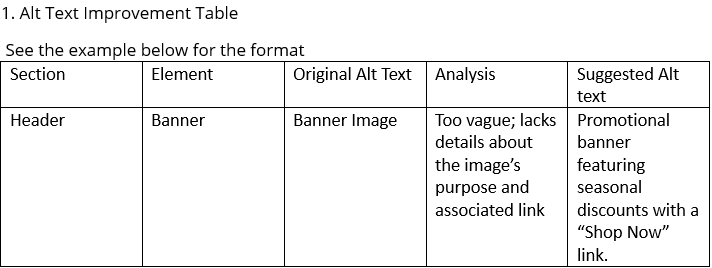
9. Output Requirements:Alt Text Improvement Table, Heatmap Table.
a) For Alt Text Improvement Table:
Columns: Section/Element, Original Alt Text, Analysis, Suggested Alt Text
Provide an analysis of the current alt text along with a suggested improvement.
b) For Heatmap Table:
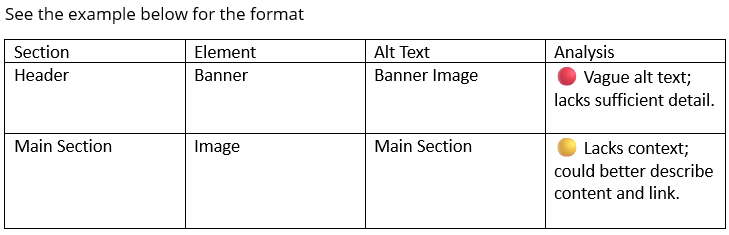
Columns: Section/Element, Alt Text, Analysis
Use heatmap indicators (🟢, 🟡, 🔴) with a short explanation.
Glossary: Include definitions and examples for terms used in the analysis.
Note: For decorative images, an empty alt attribute is recommended.
2. Heatmap Table in a formatted way as alt text improvement
Glossary:
1. Alt Text: Text alternative for images to convey content for users who can’t see them. Example: "Promotional banner featuring seasonal discounts with a 'Shop Now' link."
2. Banner Image: A prominent image used on webpages (often at the top) that typically includes key messaging or links.
3. ADA Compliance: Adhering to the Americans with Disabilities Act guidelines to ensure digital content is accessible to all users, including those with disabilities.
4. WCAG 2.0: Web Content Accessibility Guidelines version 2.0; a set of recommendations for making web content accessible.
5. Descriptive Language: Use of detailed, specific language to clearly describe an image’s content. Example: "Welcome banner displaying company mission with a link to the About page."
6. Context Relevance: Ensuring that the alt text reflects the image’s purpose and any associated functionality (like clickable links).
7. Decorative Image: An image used solely for visual enhancement with no essential informational value; such images should have an empty alt attribute to avoid distraction.
Hey marketers! Ever feel like your Marketo database is more of a tangled web than a well-oiled machine? You’re not alone. We’ve all been there. A messy database can seriously drain your marketing budget and leave you scratching your head wondering why your ROI isn’t where it should be. At 4thought marketing, we know how crucial a clean database is for data-driven success. So, let’s dive into some practical steps to whip your Marketo data into shape, starting with a comprehensive Marketo database audit.
The Marketo Database Audit
Think of this as your database’s annual health check – your Marketo database audit. We’re going to get down to the nitty-gritty and see what’s really going on.
Workspace and Partition Deep Dive
Ever find yourself wondering why your data feels scattered and disorganized? The culprit might just be your workspace and partition setup within Marketo. To tackle this, as part of your Marketo database audit, we strongly advise documenting how your workspaces, person partitions, and business units align. Misaligned partitions can quickly turn into a recipe for confusion and data nightmares, leading to headaches for your entire team. Ultimately, the goal is straightforward: ensure everyone clearly understands data ownership and access rights. Simple, right?
Smart List Sleuthing
Think of your system smart lists as your database’s health monitor, providing a crucial snapshot of its overall condition during your Marketo database audit. To keep things running smoothly, you should actively track several key metrics.
Empty Critical Fields: Are you missing essential demographic data during your Marketo database audit? If so, it’s time to fill those gaps.
Invalid Email Addresses: Identify and eliminate invalid email addresses, like those ending in “@example.com,” to ensure your communications reach real people. Aim to keep this number below 1% of your total database, a key metric in your Marketo database audit.
Lead Performance: Regularly monitor lead performance to understand your database’s growth trends, an important stage in a Marketo database audit.
Inactive Leads: Keep a close eye on inactive leads as well, as they may be prime candidates for reactivation campaigns. Pay special attention to leads that have been inactive for 30, 60, or 90 days, as a part of a thorough Marketo database audit.
API Calls: Stay vigilant about API calls to detect any unauthorized integrations that might be compromising your data’s integrity, an important security measure when performing a Marketo database audit. API call activity should be minimal unless your team is conducting intentional integrations.
Ongoing Routine After Marketo Database Audit
The Marketo database audit provides a starting point, but database cleanliness demands continuous attention. This isn’t a one-time fix; it’s an ongoing process. A healthy database hinges on consistent monitoring of specific metrics, ensuring that the data fueling your marketing efforts remains accurate and relevant. Aim for an active lead percentage exceeding 70%; this indicates a vibrant and engaged audience. If you notice it dipping below that necessitates immediate reactivation efforts, such as targeted email campaigns or personalized content, to re-engage those leads and bring them back into the fold.
Invalid emails should remain under 1%, a testament to the quality of your data acquisition and hygiene practices. Prompt removal of any faulty records, like those with typos or outdated domains, is crucial to maintain deliverability and prevent wasted resources. API calls, the connections between your database and other systems, should be infrequent, except during active integration work. Unexplained API activity could signal unauthorized access or integration errors; any unexpected activity warrants a thorough investigation to safeguard your data and maintain system integrity.
This vigilant approach ensures your database remains a reliable and powerful asset for your marketing initiatives.
Why Does This Matter?
A meticulously maintained database, resulting from a successful Marketo database audit, translates directly into tangible benefits for your marketing efforts. Imagine a scenario where every marketing dollar is spent effectively, reaching genuine prospects. This is precisely what a clean database delivers:
Enhanced ROI: Eliminating bad data means no more wasted budgets on irrelevant or non-existent contacts. Every communication, every campaign, hits its mark, maximizing your return on investment.
Precision Targeting: With accurate and up-to-date data, you can craft highly targeted campaigns, ensuring your message resonates with the right people at the right time. This level of precision leads to higher engagement and conversion rates.
Reliable Insights: Clean data provides a clear and accurate picture of your marketing performance. You can confidently analyze campaign results, track key metrics, and make informed decisions based on reliable data. This accurate reporting empowers you to refine your strategies and optimize your marketing efforts for continuous improvement.
Value of a Consistent Marketo Database Audit
In conclusion, regular Marketo database audits and consistent monitoring of key metrics within Marketo are vital for maintaining a healthy marketing database. Focusing on smart lists, workspaces, and data hygiene can maximize ROI and drive effective marketing campaigns.
The 4thought Takeaway
Don’t let a messy database hold you back. Regularly conducting a Marketo database audit and implementing good data hygiene practices can turn your Marketo database into a powerful asset. Got questions? Need help cleaning up your Marketo data or conducting a Marketo database audit? We’re here to help! Reach out to the 4thought marketing team, and let’s get your database working.
Imagine your enterprise software but intuitive and user-friendly. That’s the goal with Oracle Redwood. It’s not just a visual update; it’s a fundamental shift in how we interact with Oracle’s cloud applications. It is their next-gen design system, built on simplicity and personalization. The goal is to make accessing insights faster and easier, bringing a consumer-grade experience to business.
Why Oracle Redwood Matters: A Leap Forward in UX
Oracle Redwood is more than just a new interface. It’s a strategic investment in user productivity and satisfaction. Imagine a world where complex enterprise applications are as intuitive and engaging as your favorite consumer apps. That’s the promise of Redwood.
A large logistics company, struggling with onboarding new dispatchers, found their existing Oracle system overwhelming. The multitude of screens and complex navigation led to lengthy training periods and frequent errors. After implementing Redwood, the streamlined interface and intelligent search drastically reduced onboarding time and improved accuracy. This is not an outlier. This is the power of Redwood.
Key Benefits of Oracle Redwood:
Enhanced Productivity: Redwood’s clean, minimalist design reduces cognitive overload, enabling users to focus on what matters most. Streamlined workflows and intelligent search capabilities accelerate task completion.
Improved User Adoption: A user-friendly interface translates to faster onboarding and reduced training costs. Redwood’s intuitive design minimizes the learning curve, empowering users to leverage the full potential of Oracle applications.
Data-Driven Insights: Redwood’s advanced data visualization tools transform raw data into actionable insights. Users can quickly identify trends, patterns, and anomalies, leading to better decision-making.
Personalized Experience: Redwood’s machine learning capabilities provide personalized recommendations for tasks and workflows, reducing the time it takes for users to find the information they need. Machine learning algorithms personalize the user experience, adapting to individual preferences and workflows. This tailored approach enhances user engagement and satisfaction.
Future-Proofing Your Business: Staying ahead of the curve is crucial in today’s dynamic business environment. Redwood represents the future of Oracle UX, ensuring your organization remains competitive and adaptable.
Accessibility: Oracle has put a large focus on making the software more accessible to all users. This helps companies comply with regulations, and also helps increase the amount of talent that can effectively use the software.
Oracle Redwood: ROI & Strategy
For business leaders, the transition to Redwood isn’t just about aesthetics; it’s about strategic advantage and measurable ROI.
Oracle Redwood delivers tangible ROI for business leaders. Streamlined workflows and an intuitive UI drive increased employee efficiency, reducing operational overhead. Robust data visualization and machine learning insights empower data-driven decision-making, leading to improved business outcomes. Furthermore, the modern, user-centric interface enhances employee satisfaction and retention. By adopting Oracle Redwood, organizations gain a competitive advantage through access to cutting-edge technology, attracting top talent and positioning themselves for sustained growth.
Latest Updates and Rollout Information
Redwood is now the default UI in Oracle Eloqua, although users can easily switch back to the previous version.
Oracle is continuously enhancing Redwood by actively reviewing suggestions and implementing feedback from the community. The more we use Redwood and familiarize ourselves with it, the better prepared all users will be for the transition.
Driving Productivity and Growth with Oracle Redwood
Failure to adopt Oracle Redwood can lead to significant consequences for organizations. Inaction translates to decreased productivity as outdated interfaces create frustration and inefficiency, directly impacting the bottom line. Legacy systems also drive-up training costs, requiring extensive resources compared to Redwood’s intuitive design. Furthermore, a poor user experience reduces user satisfaction, negatively affecting employee morale and customer loyalty. In today’s competitive landscape, organizations that neglect user-centric design risk falling behind, as competitors prioritize intuitive solutions. Finally, delaying the upgrade to Oracle Redwood creates technical debt, making the eventual transition more complex and costly.
For Eloqua users, the Oracle Redwood UI represents a significant leap forward in user experience. While the transition might initially present a learning curve, the benefits are substantial. The streamlined, intuitive design simplifies complex tasks, allowing marketers to focus on strategy rather than wrestling with navigation. This improved efficiency is crucial as marketing demands become increasingly complex. By embracing Redwood, Eloqua users are proactively addressing the challenge of staying agile and competitive. Delays in adopting the new UI could lead to missed opportunities and increased technical debt in the long run. Ultimately, the transition to Redwood empowers Eloqua users with a modern, user-centric platform that enhances productivity and paves the way for future marketing success.
4Thought Marketing: Your Partner in Redwood Transition
Improving productivity within Oracle Eloqua is everyone’s goal, and the new Redwood UI is part of that vision. But you may be struggling to make the jump because it takes time learn new interfaces, time you prefer devoting to building and launching campaigns. If you’re keen to make the switch, and maximize your productivity, the experts at 4Thought Marketing are here to help. Contact us if you want to learn more.
Marketing operations teams frequently struggle with the same challenge—MOPS documentation that is woefully out of date. It’s never intentional. The typical MOPS professional recognizes the value of good documentation. But amid platform updates, shifting priorities, and daily fire drills, updating process docs inevitably slides down the priority list.
The cost can be substantial. When documentation is neglected, teams face significant downstream effects: lengthy onboarding periods for new employees, knowledge gaps after team transitions, repeated errors from following outdated processes, and wasted time troubleshooting issues that proper documentation would have prevented.
Why MOPS Documentation Falls Apart
MOPS documentation typically starts to crumble when teams rush to meet deadlines. Someone quickly changes a workflow, promising to “document it later.” Later never comes. New team members arrive, inheriting processes they don’t fully understand. They make educated guesses about how things work. Before long, carefully designed systems bear little resemblance to what’s written down in the documentation.
The most common documentation failure occurs when institutional knowledge remains locked with specific team members rather than being captured in accessible resources. When these team members depart, they take critical operational knowledge with them, leaving gaps that can take months to fill, highlighting the importance of proper documentation.
Weaving MOPS Documentation into Workday
Documentation maintenance isn’t a separate project—it needs to be part of the fabric of daily work. Successful teams implement the principle that MOPS documentation updates should happen alongside process changes, not after them. Every time someone modifies a process; they immediately update the corresponding document. This approach dramatically reduces documentation debt over time.
Another effective strategy involves assigning “ownership” to the people closest to each process. For example, the marketing automation specialist owns the documents for nurture campaigns, and the analytics guru maintains reporting documentation. When these documentation is recognized as a part of someone’s job responsibilities, documentation quality improves drastically.
Technology as a Documentation Ally
The right tools make a world of difference for managing your documents. Teams that move from static documents to collaborative platforms often see dramatic improvements. Wiki-style systems where MOPS documentation lives alongside MOPS processes can transform maintenance practices. When the documentation displays its last review date prominently, it becomes apparent when information needs refreshing.
Screen recording tools have proven to be another game-changer for many organizations. Teams that supplement written documentation with process recordings create resources that new team members can follow visually, reducing misinterpretation and improving adoption.
Creating a Culture Where Documentation Matters
Organizations that excel at MOPS documentation maintenance often foster a culture where it’s visibly valued. This might include public recognition for thorough documentation efforts or sharing stories about when good marketing operations documentation prevented problems. These practices send a powerful message about organizational priorities.
Some teams have found success with friendly competition around documentation quality. Though light-hearted, such approaches can effectively elevate documentation processes from afterthought to priority.
Keeping it Fresh Without Drowning in Reviews
No team has time to constantly review all MOPS documentation. A more practical approach leverages trigger events—when upgrading systems, teams review all the change touches. When a team member transitions, they review that person’s process areas. When something breaks, they update the documentation as they fix it.
Another practical approach ties MOPS documentation reviews to quarterly planning cycles. By selecting a limited number of critical process areas each quarter for deep documentation reviews, teams can ensure everything necessary gets refreshed annually without overwhelming resources.
Learning From Users
The most valuable feedback comes from the people who use the MOPS documentation. Simple feedback mechanisms at the end of documents can reveal which ones need work. Dedicated communication channels where team members can quickly flag issues or outdated information help capture improvement opportunities before they cause problems in your MOPS documentation.
Starting Small for Lasting Change
The most successful MOPS documentation initiatives start small. Begin by documenting critical processes that would cause the most significant problems if they broke. Focus on making those documents excellent, then expand from there.
Remember, good MOPS documentation doesn’t mean perfect documentation. It means documentation that helps teams work more effectively today. By making documentation part of the everyday workflow rather than a separate project, marketing operations teams build knowledge bases that evolve naturally with their operations—saving time, reducing errors, and making everyone’s workday more productive.
The Path Forward with MOPS Documentation
Imagine your marketing operations team with MOPS documentation that is so current and accessible that new hires become productive in days instead of weeks. Picture campaigns launching without last-minute scrambles because processes are documented. Envision a world where platform updates don’t cause panic because your documentation evolves alongside your technology. This is what success looks like—and 4ThoughtMarketing can help you achieve it. Our team brings marketing automation expertise and best practices to implement sustainable documentation systems tailored to your specific environment. Whether you need a complete MOPS documentation overhaul or targeted improvements to critical areas, we provide guidance, templates, and implementation support to transform how your team maintains its operational knowledge base.
Did you know that almost 70% of people decide whether to open an email based on the subject line and preview text? That’s an important space you need to use wisely. A key tip for mastering it is to include whitespace, a line break after the preview text. In this article, we’ll explain white space and show you how to effectively use it to enhance your preview text.
What is Whitespace? & Why it Matters (Even in the Preview)
Whitespace, also known as negative space, refers to the empty areas surrounding text and images. It’s not just about blank space; it’s about creating balance and visual breathing room. In email marketing, this principle applies to both the design of the email body and, crucially, the preview text. Let’s understand why whitespace is crucial, especially in the context of email marketing:
Improved Readability: Makes your email easier to digest, especially on mobile with short attention spans.
Enhanced Focus: Directs the reader’s eye to your key message or call to action, increasing click-through rates.
Creates a Sense of Sophistication: Elevates your brand perception, making your emails feel more premium and less like spam.
Sets the Tone: Establishes a visual hierarchy and guides the reader through your email content.
What happens if you don’t use whitespace?
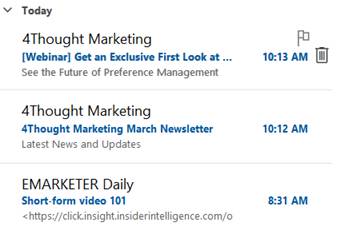
In the example below, the first two items display only the subject line and preview text. However, in the third example, HTML from the message body bleeds into the preview, making it less valuable.
Implementing Preview Text Whitespace: A Best Practice Guide
So, how do we create whitespace in the preview text? The answer lies in using special characters that render as blank spaces in most email clients. Here’s how:
The Zero-Width Space (ZWSP): This invisible character, represented by ​ or u200B in HTML, is the star of our show. It takes up no visible space but can be used to pad the preview text.
The Non-Breaking Space (NBSP), represented by in HTML, prevents line breaks and can also be used to create small, consistent gaps.
The good folks at Litmus have a more complete overview in their article.
Implement the Hack in Oracle Eloqua
The hack can be utilized in Oracle Eloqua through dynamic content with ZWSP and NBSP, making implementation very easy.
Create your Dynamic Content
Create a new dynamic content component and paste in the following HTML :
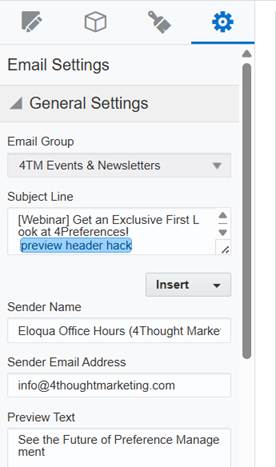
Insert the Preview Hack at the end of your subject line:
Preview Text Hack in Marketo
Marketo, a robust marketing automation platform, offers several ways to control the preview text of your emails. Marketo’s Velocity scripting language allows for dynamic content. You can create a Velocity script token to populate the preview text. This is more advanced but offers greater flexibility for personalized preview text.
Edit the HTML in the Rich Text Token and enter the hack code:
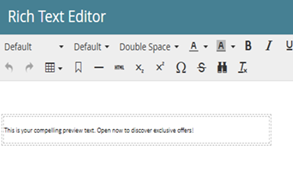
<p><br /> ‌ ‌ ‌ ‌ ‌ ‌ ‌ ‌ ‌ ‌ ‌ ‌ ‌ ‌ ‌</p> <p> ‌ ‌ ‌ ‌ ‌ ‌ ‌ ‌ ‌ ‌ ‌ ‌ ‌ ‌ ‌ ‌ ‌ ‌ ‌ ‌ ‌ ‌ ‌ ‌ ‌ ‌ ‌ ‌ ‌ ‌ ‌ ‌ ‌ ‌ ‌ ‌ ‌ ‌ ‌ ‌ ‌ ‌ ‌ ‌ ‌ ‌ ‌ ‌ ‌ ‌ ‌ ‌ ‌ ‌ ‌ ‌ ‌ ‌ ‌ ‌<br /> ‌ ‌ ‌ ‌ ‌ ‌ ‌ ‌ ‌ ‌ ‌ ‌ ‌ ‌ ‌ ‌ ‌ ‌ ‌ ‌ ‌ ‌ ‌ ‌ ‌ ‌ ‌ ‌ ‌ ‌ ‌ ‌ ‌ ‌ ‌ ‌ ‌ ‌ ‌ ‌ ‌ ‌ ‌ ‌ ‌ ‌ ‌ ‌ ‌ ‌ ‌ ‌ ‌ ‌ ‌ ‌ ‌ ‌ ‌ ‌ ‌ ‌ ‌ ‌ ‌ ‌ ‌ ‌ ‌ ‌ ‌ ‌ ‌ ‌ ‌</p> <p><span style="font-family: 'Calibri Light',sans-serif;">This is your compelling preview text. Open now to discover exclusive offers!</span></p>
Your Rich Text Editor looks like this.
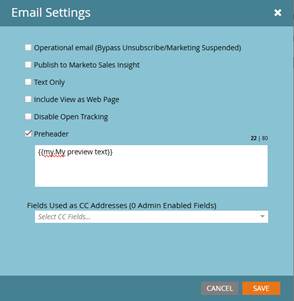
Change your Email Settings and set the preheader as:
Your Preview Text is all set.
Considerations:
Talking about optimizing email preview text, It’s more than just writing a catchy sentence. A key element is whitespace, and its strategic use can significantly impact open rates. Now, it’s crucial to remember that email clients render content differently. So, we need to test across major platforms—Gmail, Outlook, Apple Mail—to ensure consistency. Also, keep in mind the differences between the mobile and desktop experiences. Character limits and preview text truncation vary, so we need to optimize for both. Don’t just add whitespace arbitrarily. Use it to highlight key offers, create a sense of urgency, or guide the reader’s eye. Think of it as visual pacing. And, of course, the best way to determine what works is through A/B testing. Experiment with different whitespace variations and analyze the results. It’s about leveraging data to refine our approach and maximize engagement.
Beyond the Hack: Elevating Your Preview Text Strategy
While this whitespace hack is a valuable tool, remember that the content of your preview text is still essential. Effective utilization of email preview text necessitates strategic enhancement of the subject line by providing supplementary context or generating curiosity.
For instance, a subject line announcing “New Arrivals” can be enhanced by preview text that details the discovery of recent styles and exclusive promotions. Furthermore, offering subscribers a preliminary glimpse of the email’s content is crucial. This may involve highlighting specific discounts or products within a sale announcement, or teasing key insights from a shared blog post.
Clear directives are essential; subscribers should be explicitly guided toward desired actions through the employment of action-oriented language, such as “Shop Now,” “Learn More,” or “Register Today.” Personalization, facilitated by dynamic content, significantly improves engagement, with even simple first name inclusions demonstrably increasing open rates. Finally, the creation of urgency within the preview text, utilizing phrases such as “Limited Time Offer” or “Don’t Miss Out,” serves to stimulate immediate action from recipients.
The Cost of Neglecting Whitespace
Failing to utilize whitespace effectively in your preview text can have several detrimental effects. A cluttered, dense preview can overwhelm recipients, leading to immediate deletion. It can also project an unprofessional image, damaging your brand’s credibility. Furthermore, a lack of clear visual cues can obscure your key message, resulting in missed opportunities for engagement and conversions.
Conclusion: Unlock Your Email Potential
Mastering the nuances of email marketing, such as the strategic use of preview text whitespace, can significantly impact the success of your campaign. By combining a well-crafted preview text with strategic whitespace, you can create a more engaging and visually appealing email. Optimizing Preview Text Whitespace is a key part of email marketing best practices, and at 4thought Marketing, we understand the intricacies of effective email marketing. We’re dedicated to helping businesses like yours implement best practices and achieve exceptional results. Whether you need assistance with strategy development, campaign execution, or performance optimization, we’re here to help. Ready to take your email marketing to the next level? Contact 4thought Marketing today to discover how we can help you enhance your prospects and drive meaningful results.
Marketing operations teams face real challenges when working across multiple regions. As the operational backbone of marketing organizations, these teams need to balance standardized processes with regional flexibility while maintaining the technology that powers marketing activities. To successfully implement a Marketing Operations Framework, teams that align on strategy, goals, objectives, and methods achieve better results. This article explores building a practical operational framework that helps global marketing operations deliver consistent, measurable results.
What’s a Practical Marketing Operations Framework
A practical framework for marketing operations defines how your team gets things done—through people, processes, technology, governance, and measurement. For global marketing operations teams, this clarity drives consistency and focus across:
Standardized Processes: Ensuring everyone follows the same campaign processes.
Centralized Technology Management: Managing marketing technology across regions effectively.
Efficient Data Flow: Streamlining data flow between systems and teams.
Consistent Measurement: Measuring success uniformly across the board.
Optimized Resource Allocation: Allocating resources and talent for maximum impact.
When marketing operations align across regions, teams spend less time fixing problems and more time driving meaningful results.
Key Elements for Success
An Executive Sponsor Who Can Remove Roadblocks
A visible and supportive executive sponsor is crucial for the success of your framework. They should:
Understand the Big Picture: Grasp strategic marketing goals and operational realities.
See the Impact of Decisions: Recognize how technology and process choices affect marketing outcomes.
Resolve Conflicts: Break down barriers and unblock roadblocks.
Support Critical Investments: Back essential investments in infrastructure and process optimization.
Clear Rules for Technology and Strategic Vendor Use
A well-defined framework clarifies:
Centralized Platform Management: Marketing platforms that are centrally managed and those that are managed regionally.
Regional Customization: How regional teams can customize within those platforms.
New Technology Evaluation: The process for evaluating and integrating new technologies.
Data Connectivity: How data connections between systems are maintained.
Global Security and Compliance: Enforcing security and compliance standards globally.
A Unified Approach to Campaigns
Shared processes for planning, executing, and measuring campaigns streamline regional operations. A unified approach should outline:
Standardized Request Processes: How campaign requests are submitted and processed.
Consistent Asset Management: Shared practices for managing marketing assets.
Efficient Scheduling: Clear protocols for scheduling and dependency management.
Continuous Improvement: Post-campaign analysis and improvement steps.
Smart Data Management
Data drives marketing decisions. Your operational framework should include:
Centralized Data Management: Managing customer data across platforms.
Standardized Metrics: Consistent data collection and performance metrics.
Data Quality Assurance: Ensuring data quality across all systems.
Controlled Data Access: Defining access levels for analytics.
Regional Privacy Compliance: Enforcing privacy compliance by region.
Realistic Resource Planning
A strong framework helps marketing operations teams manage resource constraints and competing priorities by:
Accurate Capacity Planning: Conducting honest assessments of team capacity.
Clear Prioritization: Defining clear criteria for prioritizing tasks.
Facilitated Resource Sharing: Enabling resource sharing across regions.
Skill Development: Investing in training and knowledge sharing.
Overcoming Common Roadblocks
Legacy Systems: Address legacy systems by mapping your technology landscape, identifying critical integration points, and creating a phased improvement plan.
Regional Inconsistencies: Align regional teams by documenting key processes, identifying best practices, and standardizing processes with built-in flexibility.
Uneven Skill Distribution: Address skill gaps by defining core skills, implementing training programs, and fostering peer-to-peer learning.
Global vs. Regional Priorities: Balance global and regional priorities by establishing transparent conflict resolution processes, defining service-level expectations, and facilitating regular alignment meetings.
A Practical Roadmap to Success
Aligning global marketing operations is an ongoing journey. Start with these steps:
Assess your current state: Map technologies, processes, skills, and decision-making structures.
Identify pain points: Gather feedback from operations teams and marketers.
Visualize the future state: Define how technology, campaign execution, and data flow should ideally function.
Plan the transition: Sequence changes to minimize disruption.
Establish decision-making forums: Set regular meetings for alignment and problem-solving.
Track progress: Use dashboards to monitor performance and highlight issues.
Commit to continuous improvement: Schedule reviews to assess progress and adjust as needed.
Striking the Right Balance
A strong operational framework recognizes when to standardize and when to allow regional flexibility:
Aligning global marketing operations streamlines processes, empowers teams, optimizes technology investments, and provides better support for marketers worldwide.
4Thought Marketing can help you achieve this alignment. Our team of experts can assist you with marketing operations, technology integration, and campaign execution. By partnering with us, you can focus on strategic priorities while we streamline your operations, enhance efficiency, and deliver measurable results that drive marketing success. Ready to take the next step? Contact us today to discuss your needs and learn how we can help you build a robust marketing operations framework.
What can the marketing industry expect next year?
When we submitted this question to various thought leaders, we received an overwhelming response—enough to make this one of our favorites. Everyone’s contributions provide valuable insight into what’s to come in 2025. Let’s take a look at what marketing challenges are on the horizon.
At DeBella DeBall Designs, we’re looking ahead to 2025 with both excitement and strategic caution. Here’s what’s keeping me up at night – and why it should matter to you too.
The rising cost of quality content creation is becoming a significant hurdle. With AI-generated content flooding feeds, standing out requires increasingly sophisticated, human-crafted storytelling. We’re seeing this firsthand with our coaching clients – they’re having to invest more in authentic, deep-dive content that genuinely resonates. Those beautiful deep purple carousel posts don’t just happen by themselves anymore!
But here’s the opportunity: brands that master the balance between efficiency and authenticity will win big. We’re already helping our clients build content ecosystems where one premium piece can be thoughtfully adapted across platforms, maintaining quality while managing costs.
The real challenge? It’s not just about creating content – it’s about creating content that converts in an increasingly skeptical market. The brands that will thrive are those brave enough to show their real work, share genuine client transformations, and build true community engagement beyond surface-level metrics.
Mark my words: 2025 will separate the authentic storytellers from the noise makers.
Authenticity has always been important in content marketing, and it will become even more critical with so much generic and robotic content being generated with ChatGPT, etc. Consumers are becoming increasingly discerning, and they can quickly identify content that feels forced or inauthentic. Who would have thought that the killer application would be authentic interactions, not Artificial Intelligence? While your competition generates robotic messages that sound generic, you can stand out and break through the sea of sameness with personalized, thoughtful communication serving their specific needs. So don’t get distracted by dreading the latest shiny AI object; to win in the future, authenticity is what people remember. Building connections and relationships with your audience and showing your humanity is more important than ever!
We’re more time-starved than ever. Attention spans keep shrinking as Internet time accelerates with all the new technologies. The world is becoming more visual when it comes to consuming content which has made visual-driven platforms like YouTube/Instagram/TikTok gain popularity in selling. With the rise of a generation that would much rather watch/look at something vs sit/read, there is going to be a growing trend of more visual content, including pictures/videos (long and short form)/memes/diagrams /infographics. As more people shifted online during the pandemic, live streams will be increasingly used to host public events/meetings on platforms like Twitch.
Probably one of the most significant challenges for marketers in 2025, I think, is dealing with the ethical challenges associated with increasing AI adoption in campaigns. AI has great potential for personalization and efficiency, but it also poses issues of privacy and transparency. For instance, AI-based consumer behavior insights can generate extremely precise campaigns, but you can easily hit a plateau where users perceive their data as being misused in ways they did not consent to. For me, the most important thing for marketers is to be transparent with consumers about the way that data is collected and used so that consumers don’t feel victimized. This balance will require intelligent plans and transparent messaging to bolster a brand’s authenticity.
In 2025, SEO will present exciting challenges and opportunities as technology and user behavior continue to evolve. User experience will remain a key focus, with Google prioritizing speed, mobile-friendliness, and visual stability. My goal will be to ensure my clients’ websites are fast, mobile-optimized, and easy to navigate, offering a seamless experience that drives higher rankings and conversions.
AI-driven algorithms are reshaping how search engines rank content. In 2025, it won’t be enough to write great content; it must be structured to align with AI’s understanding of user intent. Focusing on clarity, relevance, and smart keyword usage will be crucial for businesses to stay competitive in 2025.
With the rise of zero-click searches, voice searches, and rich snippets, I’ll fine-tune content to capture visibility in these high-traffic spots without requiring a click. Structured data, conversational keywords, and image optimization will be key strategies.
As emerging trends like augmented reality and AI-driven personalization take off, I’m preparing to leverage these innovations to keep clients ahead of the curve. By staying agile, embracing new technologies, and delivering high-quality, user-focused content, we’ll drive organic traffic’s competitive edge in 2025.
Marketing leaders already expect a surge in the use of AI for everything from creating assets to planning and strategy. They are experimenting with it and responding to questions from other leaders in their business. It’s even affecting some 2025 budgets.
But the AI backlash is just around the corner. By the second half of 2025, many will begin seeing that AI excels at being “good enough.” That’s it. The output looks fine at first because it’s better than what people expect. However, it falls short when it comes to a strong brand voice, barrier-breaking creativity, deep customer insights, and other aspects of what allows a brand to differentiate itself.
When those shortcomings become more apparent, “good enough” won’t actually seem good enough at all. AI-generated marketing assets and strategies will seem too homogenous. Because of that, the pendulum will swing the other way for leading brands. Many will back away from AI in order to separate from the pack. AI usage will eventually settle somewhere in the middle, but it will take a few of these swings, along with advances in AI models, before it becomes a part of the standard marketing toolkit.
I’m pretty sure the global economy is likely to remain volatile, influenced by factors like inflation and geopolitical tensions. This unpredictability can lead to tighter budgets and reduced consumer spending. Marketers will need to emphasize value in their messaging and promotions to attract cost-conscious consumers. For instance, brands may focus on highlighting the long-term benefits of their products rather than just immediate savings.
AI will be at the forefront of marketing strategies. By 2025, AI tools will enable hyper-personalization, allowing businesses to tailor content and customer experiences with remarkable precision. However, marketers must balance this automation with the need for genuine human connection. These days chatbots can handle customer inquiries efficiently, so brands should ensure that human representatives are available for more complex issues.
At the same time, consumers will expect seamless interactions across all channels-whether online or offline. An omnichannel approach will be essential, requiring brands to deliver consistent messaging and personalized experiences across platforms like social media, websites, and physical stores. Companies that invest in customer journey mapping and experience management tools will likely see enhanced satisfaction and loyalty.
As competition for digital ad space intensifies, costs are expected to rise significantly. This trend could push marketers to explore alternative strategies such as organic content marketing or partnerships with micro-influencers, who often yield higher engagement rates compared to larger influencers.
As we look toward 2025, one of the primary challenges marketing professionals will face is navigating the increasing importance of data privacy regulations. With frameworks like GDPR and CCPA evolving, and new regional regulations anticipated, marketers will need to strike a delicate balance between personalization and compliance. This means investing in privacy-first technologies and adapting strategies to use first-party data effectively. Additionally, the deprecation of third-party cookies will force a shift toward contextual advertising and stronger reliance on direct customer relationships through email marketing, loyalty programs, and community-building efforts.
Another key development will be the proliferation of AI-powered marketing tools. While these technologies promise enhanced efficiency and deeper customer insights, their rapid adoption presents a learning curve. Professionals will need to upskill to leverage AI effectively while ensuring transparency and ethical use of such tools. Beyond AI, immersive experiences powered by AR/VR are set to become integral to customer engagement strategies, presenting both opportunities for innovation and challenges in execution. Adapting to these changes will require agility, a strong focus on customer-centricity, and continuous investment in cutting-edge technologies.
The potential breakup of Google is a hot topic, and for good reason. It could significantly reshape the digital marketing landscape as we know it. If Google’s various businesses are forced to operate independently, marketers will need to adapt to a whole new set of challenges and opportunities.
Imagine a world where search, advertising, and analytics are no longer seamlessly integrated. We might see increased costs, more complex campaign management, and a greater need for cross-platform expertise. On the flip side, this fragmentation could also foster innovation and competition, leading to new tools and strategies that benefit marketers. In this evolving landscape, agility and adaptability will be key. Marketers who can quickly adjust to the changing dynamics, embrace new technologies, and diversify their strategies will be best positioned to thrive in a post-Google breakup world. It’s a challenge, no doubt, but also an exciting opportunity to redefine the future of digital marketing.
Looking ahead to 2025, I think one of the biggest challenges for marketers will be keeping up with how fast everything’s changing. Technology like AI and automation is growing like crazy, which is exciting, but if we’re not careful, it can make marketing feel cold and disconnected. Finding that sweet spot between using tech to work smarter and still creating personal, human connections will be key.
Another big thing is standing out in the flood of content out there. Everyone is posting, sharing, and creating, so it’s going to take some real focus on storytelling, targeting the right audience, and creating experiences people actually remember.
And let’s not forget sustainability and social responsibility. Consumers aren’t just buying products anymore – they’re looking for brands that align with their values. If marketers can’t show they’re authentic and transparent, they’ll lose trust. It’s not just about selling; it’s about connecting on a deeper level.
As we approach 2025, we anticipate two major developments shaping the marketing landscape: the growing influence of AI-driven tools and the increasing importance of authentic content. AI tools will enhance targeting precision and predictive analytics, enabling more efficient campaign planning.
However, the challenge will lie in integrating these tools without losing the human touch that makes content resonate.
We also foresee a shift towards decentralised platforms and community-driven marketing. Platforms like Discord or Web3-based social networks are becoming spaces where brands can build direct relationships with audiences.
The challenge will be adapting strategies to these emerging ecosystems while maintaining relevance on established platforms like Instagram and TikTok.
In 2025, there are two challenges I expect marketers will face. First, the rapid rise of AI and automation will mean that we need to apply these tools to improve the customer experience without abandoning the human touch. It will be crucial to strike a balance between effectiveness and personal connection as more and more processes become automated.
Secondly, privacy is still going to be a major issue. In an era of increasing regulation and increasing expectations regarding data security, marketers will need to prioritize transparency and establish trust by demonstrating how they safeguard user data. Anyone who isn’t ready to implement data privacy best practices is going to struggle.
Looking toward 2025, marketing professionals will face the challenge of increasing demand for personalized content, driven by advances in AI and data analytics. Consumers expect more tailored experiences, requiring strategic use of data for hyper-personalized interactions. Balancing personalization with ethical data usage will be crucial as privacy regulations evolve.
Video content’s role in consumer engagement will grow, with platforms like YouTube thriving. A strategy leveraging both short and long-form video will be essential for capturing attention and enhancing brand loyalty.
As e-commerce rises, we must adapt to new consumer behaviors, optimizing online shopping with integrated marketing channels. Effective omnichannel approaches that blend online and offline experiences will be key to maintaining a competitive edge.
We are focusing on the impact AI will have in the marketing space. With AI it has a strong ability to generate content for us, but we are finding that the accuracy of the information is not ideal yet and it is lacking the human touch. We have found some AI that is useful in our day to day operations and it has saved our team time and money but we are still focused on how it will affect our business in the future. It’s like testing the water before you dive in. We like the human nature of writing blogs and content but AI is catching up for sure. Google has also updated its core and we are finding that some older AI is now putting website rankings lower. So we all have to be careful with how we use AI because our customers are in the balance here. I’d say tread lightly.
B2B marketers must include AI search in their SEO planning because potential buyers use AI tools like ChatGPT and Gemini to find solutions, vendors, and service providers.
At the very least, ask an AI tool what they know about your brand to ensure it’s accurate. Ideally, it’ll pick up on your desired messaging, but since AI pulls from so many sources, it may include negative aspects about your brand that are old, false, or misleading.
One of the most profound impacts I believe will accelerate in 2025 is how AI will change digital “marketing”. Let’s start with SEO. When a user performs a search, they are looking for an answer to their question, not a list of links. Traditional SEO will fade and value proposition focused on-page content will prevail. Search will return answers not resources and the more authentic, value focused a brand is the more they will be part of the answer to the user’s question.
The challenges and developments we will continue to see in 2025 are if and how to incorporate AI tools into marketing processes. Questions that are inevitably being raised such as is it ethical to use AI generated content without disclosing it? With the rate of speed that this technology is moving, many businesses should be exploring its value and how it could benefit them – from saving time and money to optimizing their marketing processes. Those companies who fail to experiment with AI will be at risk of being left behind.
Effectively using AI to secure leads. I feel that so many marketers have poorly incorporated AI into their marketing campaigns (particularly in content creation), which might backfire in 2025. AI is good, don’t get me wrong- it creates a whole lot of opportunities for content creation. However, it is not perfect and when poorly used in an era where customers require personalized messaging, it might negatively impact markets’ leads.
In 2025, one of the most significant challenges marketing professionals will face is navigating the evolving landscape of consumer privacy and data regulation. It is inevitable that as third-party cookies phase out, marketers will need to shift towards first-party data collection strategies. This transition requires not only technological adaptation but also a strong focus on transparency and ethical practices to build and maintain consumer trust. Ensuring compliance with stricter privacy regulations will be crucial, as will finding innovative ways to deliver personalized experiences without infringing on user privacy. This balancing act will demand strategic thinking and a commitment to ethical marketing practices, making it a central focus for the industry.
In 2025, I expect the biggest challenge to be keeping up with rapidly evolving technology and the increased demand for personalization. With AI and automation continuing to grow, marketers will need to find ways to use data effectively without overwhelming their audience. For example, crafting personalized experiences that feel authentic rather than intrusive will be key. Another challenge will be maintaining trust, as privacy concerns around data collection and usage will only intensify. I believe the focus will be on striking the right balance between personalization and respect for user privacy.
As the Marketing Manager at Stallion Express, I look forward to big problems and chances in 2025. As privacy laws worldwide get stricter, finding a balance between personalized marketing and following the rules will be significant. Now that third-party cookies are being phased out, we must rely more on first-party data and new AI-powered tools to learn more about our audience.
Another problem is that Gen Z is becoming a larger group of buyers. Because they want brands to be real and have a reason, marketers need to rethink their messages and focus on real, value-driven content.
From what I’ve seen in SEO and SEM, tactics will change as voice search and AI-enhanced search algorithms become more important. For example, our rankings have increased by 15% since we started optimizing for conversational searches. To do well in a modern world that is changing quickly, you must stay flexible and welcome these changes.
One of the biggest challenges facing marketing professionals in 2025 is the effective integration of AI into their content, SEO, and branding strategies. While AI tools can enhance efficiency and deliver valuable insights, the challenge lies in using them without losing the authenticity and creativity that define strong branding. Marketers must also adapt to shifting SEO landscapes, where search engines increasingly reward high-quality, AI-informed but human-driven content. Success in 2025 will require balancing innovation with strategy, ensuring AI complements-not replaces-the emotional resonance and storytelling that connect with audiences.
All marketers seem to have caught up to each other recently, so those who wish to stand out must differentiate themselves by exploring advanced, harder-to-implement strategies like server-side tagging and adopting more robust analytical approaches, such as marketing mix modeling, to move beyond buzzwords and deliver measurable results. Additionally, rising wages and the shortage of quality marketing talent in the local job market will drive companies and agencies to adopt AI solutions to streamline operations. They will also increasingly look to international talent pools, seeking professionals who can be client-facing while fluently communicating in the company’s local language. This combination of innovation and global reach will be key to staying competitive in a challenging market landscape.
The marketing landscape in 2025 will test even the most seasoned professionals as they continue to move through a rapidly evolving digital ecosystem. The rising demand for personalized and authentic experiences, fueled by advancements in AI and data analytics, presents both an opportunity and a challenge lots of industries will have: how to balance customer privacy with hyper-targeted strategies. Additionally, marketers must adapt to consumer expectations around sustainability and inclusivity, ensuring their campaigns speak authentically. Marketing has always needed to be authentic, but now more so than before, in a growth influence from social media content creators, it needs to be even more so. To succeed, marketers in 2025 must embrace agility, deepen their understanding of emerging technologies, and foster cross-disciplinary collaboration to stay ahead. Without this understanding, marketing dollars will be wasted and ROI will be dismal.
Email marketing has always been part science, part art—and now, artificial intelligence is becoming the most intriguing collaborator in this creative process. Subject lines, those critical seven to nine words determining whether a message gets noticed or lost in the digital shuffle, are undergoing a quiet revolution. AI isn’t here to replace human creativity but to amplify it in ways we’re just beginning to understand.
The Promise of AI-Generated Subject Lines
Imagine having a marketing assistant who can instantaneously analyze thousands of customer interactions, predict engagement patterns, and craft subject lines with surgical precision. That’s the emerging reality of AI-powered email marketing. Consider how a clothing retailer might use AI to transform a generic “Winter Sale” into a personalized “Your Perfect Cozy Layer Awaits, [Name]”—a message that feels less like marketing and more like a thoughtful recommendation. It’s not about replacing human insight but augmenting it with unprecedented precision.
Potential Limitations & Risks
Yet, like any powerful technology, AI-generated subject lines come with nuanced challenges. The risk isn’t just technical—it’s emotional and strategic. An algorithm might technically optimize a subject line but miss the subtle brand voice or cultural context that makes communication resonate.
The effectiveness of AI-powered subject lines hinges on a delicate balance between data sources and ethical considerations. Training exclusively on a company’s first-party data can be limiting, potentially creating an echo chamber that fails to capture broader communication trends. Yet, leveraging more expansive datasets introduces complex privacy and contextual relevance challenges.
The most successful marketing teams will view data not as a static resource but as a dynamic ecosystem. The goal isn’t accumulating the most information but cultivating meaningful insights—balancing technological capability with genuine human understanding.
Best Practices for Implementation
Successful AI integration is less about technology and more about collaboration. Think of AI as a sophisticated brainstorming partner—generating ideas and providing insights but never making final decisions. The most effective approaches involve:
Continuously training both the AI system and marketing team
Future Outlook
The future of marketing technology isn’t about complete automation but intelligent augmentation. We’re moving toward AI systems that understand context, emotion, and individual customer journeys with remarkable depth. The most successful marketing teams will be those who view AI as a powerful tool for human creativity, not a replacement for it.
Final Thoughts
AI-enhanced subject lines represent more than a technological upgrade—they’re an evolving conversation between data, creativity, and human connection. Success will be measured not by algorithmic precision but by our ability to use these tools to create more meaningful, personalized communication.
AI in marketing is no longer a futuristic concept; it’s a powerful tool actively transforming how we connect with audiences through AI in marketing. In fact, a significant 64% of marketers report that content generated with AI in marketing performs as well as or even better than traditional methods. This increasing success of AI in marketing is fueled by its ability to boost efficiency, scale content creation, and reduce costs using AI in marketing strategies.
Generative AI has taken the world by storm. Each new development brings new possibilities so rapidly that reporting on them as they occur is a full-time job. Every industry wants to know what AI can do and how they can best incorporate it into their offerings. And in the marketing world, those questions are especially interesting.
Artificial intelligence has the potential to change our marketing approach fundamentally. While many of these changes appear promising, it also creates new challenges. The question is no longer if you should incorporate generative AI. Rather, it’s how your company can best use AI in marketing now and following future developments. Let’s explore how you can effectively integrate AI in marketing to elevate your strategies and achieve more impactful results.
Utilizing AI in marketing for idea generation can spark creativity and innovation within teams. Furthermore, AI in marketing can help optimize email campaigns, ensuring higher engagement rates.
Idea Generation & Brainstorming
By leveraging AI in marketing analytics, brands can tailor their messages to suit specific customer segments more effectively. AI in marketing ensures that your strategies are data-driven, giving you a competitive edge. AI in marketing helps personalize customer experiences, increasing engagement and loyalty.
For marketers, AI in marketing can be a powerful tool for idea generation. An AI can help your marketing team brainstorm content topics, assemble outlines, or even edit the tone of an article you give it. The AI can’t (and shouldn’t) write for you. However, it can give you valuable suggestions to improve the material you’ve already written using AI in marketing tools. Incorporating AI in marketing can also help analyze customer behavior at scale, leading to better product recommendations.
AI in marketing can facilitate real-time engagement, ensuring your brand stays connected with customers. An AI can also perform data analysis to help with future marketing efforts. For instance, having an AI look over your most recent email marketing campaign might highlight suggestions for getting more clicks. This lets your marketing team explore options to test and refine upcoming campaigns accordingly.
A human might not notice this pattern immediately, but an AI can quickly review the data and identify trends. An AI marketing tool can also sift through past company data, competitor campaigns, and even industry trends to see what’s worked in the past and what might work in the future. This proactive approach helps your marketing team move beyond relevance into pioneering.
Market Segmentation & Social Listening
One of AI’s most valuable contributions to marketing is its ability to analyze social media data at an unprecedented scale. An AI can examine your company’s social media posts and interactions to identify critical patterns. Automating routine tasks with AI in marketing allows your team to focus on more strategic initiatives.
Much like the email marketing example, this kind of data analysis tells your team what works and for what customer segments. This kind of segmentation doesn’t have to stop with social media, either. Emails, text messages, and other marketing communications could benefit from a quick AI analysis to determine what’s working. AI in marketing is a powerful ally in data analysis, transforming raw data into actionable insights.
Personalization & Engagement
AI in marketing can significantly increase efficiency, allowing for faster decision-making and campaign adjustments. By using AI in marketing, brands can quickly adapt to market trends and consumer preferences. AI in marketing provides insights that can lead to more effective campaign strategies. AI in marketing can enhance predictive analytics, enabling businesses to forecast customer behavior accurately. Customer interests shift—and so will their purchases from you. If you can’t keep up with what they want using AI in marketing, they might lose interest and look elsewhere.
Incorporating AI in marketing allows for the creation of customer profiles that improve targeting efforts. AI in marketing helps uncover insights that drive better product development and service offerings. Moreover, AI in marketing can streamline processes, making it easier for teams to focus on high-value activities. Understanding AI in marketing is crucial for any business looking to thrive in the digital age. Marketers must remain cautious while adopting AI in marketing, ensuring ethical practices are followed.
Finally, AI can also facilitate real-time engagement with customers through chatbots. An AI-powered chat function on your website can provide instant customer support and address FAQs. Make sure that these AI-powered tools hand the conversation over to a human representative if more complex or sensitive matters arise.
Overestimating AI in marketing can lead to unrealistic expectations and potential setbacks. Balancing the use of AI in marketing with human creativity is essential for successful outcomes. Proper supervision of AI in marketing tools is vital to ensure they meet evolving business needs.
Busywork
Some AI systems can even use a computer the way a human would to handle manual tasks. One example is Claude, a group of LLMs that is currently learning how to perform simple computer commands. The developers provide an example: telling Claude to fill out a form online using data stored on the user’s computer. Claude would interpret these instructions as individual steps. It checks the indicated file containing the data, moves the mouse to click on a web browser, opens the required webpage, and fills in the form using the provided data. As of November 2024, Claude cannot reliably complete tasks like this. However, the developers are working on solutions to make it possible.
AI Data Analysis: A Huge Time Saver
Marketing involves collecting, sorting, and using a lot of data, especially when leveraging AI in marketing. What exactly this data is used for varies. However, one thing holds true: raw data is not particularly useful. The collected data must be examined, refined, interpreted, and connected to other information to boost your marketing efforts.
Recent AI developments show promise in making this data more accessible, especially for those less experienced with complex analytics software. In fact, a significant 79% of marketers identify increased efficiency as a top benefit of adopting AI, highlighting its power to rapidly process and analyze marketing data.
What Can AI-Driven Data Analysis Do?
An AI can read a detailed spreadsheet of data in seconds. The tool can then assist with several key marketing functions that offer particular value. First, an AI can perform a rapid quality check on your data and confirm if it’s accurate and usable. An AI can also highlight any potential errors or instances of anomalous or “dirty data” to remove and suggest improvements for future data collection.
Second, AI-assisted data analysis allows for detailed predictive analytics to be developed much faster than before, and compare the results with industry benchmarks. This allows your team to more accurately guess which direction the market may be going and what consumers will want in the near future. This leads to better decision-making that’s far more likely to capture and retain customer interest. It also saves precious time, allowing your team to be among the first to identify and capitalize on an upcoming trend.
Third, AI-driven customer data analysis allows for increased personalization. An AI tool can make connections or inferences from data points that a human might miss. It can also consider every minute piece of information, even things that might not seem immediately helpful. The result? Your marketing team can explore and construct more detailed customer profiles and create content that speaks directly to a customer’s pain points.
Finally, AI can simply uncover new insights from collected data that aren’t readily apparent, even things some expert data analysis might overlook. If you understand what the data contains but aren’t sure how to narrow it down to what you want, an AI can be an excellent tool.
Remember: while AI-driven data analysis offers valuable help to marketers who aren’t experts, the results still require human review and validation. AI still makes plenty of mistakes. Your data analytics expert can help locate and fix errors in the AI’s results.
AI in Marketing: What Not to Do
While AI offers significant advantages, its adoption isn’t without hurdles. A recent survey highlights that marketers face several barriers, with data privacy concerns being the most prominent at 40.44%. Additionally, lack of technical expertise (37.98%) and the cost of implementation (33.17%) are significant challenges that companies must address when considering integrating AI into their marketing strategies.
Overestimating What AI Can Do
While AI is powerful, it’s neither a magic bullet nor a replacement for human insight and creativity. AI excels at analyzing vast amounts of data, identifying patterns, and making predictions. However, it cannot process nuance the way people can. It also can’t create something entirely original.
Perhaps most importantly, AI can and will make mistakes. Even the most sophisticated models still produce inaccurate or misleading information. The internet has collectively begun referring to these responses as “hallucinations”. People who assumed tools like ChatGPT knew what they were talking about have been proven wrong in hilarious fashion many times by now.
What to Do Instead: Use AI to supplement your marketing efforts, not replace them. Combine AI’s data-driven insights with your team’s creativity and intuition to craft campaigns that resonate with your audience. For instance, your AI tools can identify which content performs best at different stages of the customer journey. However, human employees are better at crafting a compelling narrative that engages and converts. Your AI’s insights can guide your actions, but cannot and should not perform them all for you. Additionally, remember to double-check anything your AI produces. The last thing you want is a glaring error in your output.
Jumping on the AI Bandwagon Without a Plan
AI may be the hottest new thing, but if your company rushes to implement your own AI approach without a concrete plan, you’ll likely struggle. AI needs to align with your overall marketing strategy—and you need to know how it aligns. Without a plan, you can end up wasting resources, creating inconsistent messaging, and creating marketing campaigns with abysmal conversion rates.
What to Do Instead: Clearly define your marketing goals and determine how AI can help achieve them. Are you trying to increase engagement, boost conversions, or improve customer retention? Once you have a clear objective, identify the specific AI tools and techniques that can support your goals. In other words, fit AI into the marketing strategy that you know works, rather than rebuilding your entire strategy just to include AI.
Ignoring Data Quality & Quantity
AI thrives on data—that’s no surprise by now. But it can’t work with just any data. Poor-quality or irrelevant data can lead to inaccurate insights and misguided marketing strategies. You also need to consider where your data is coming from. Is it your own? If it originates from outside your company, are you even allowed to use it?
What to Do Instead: Invest time in collecting, cleaning, and organizing your data before feeding it into your AI tools. Ensure your data is relevant, up-to-date, and representative of your target audience. This means removing duplicate entries, correcting inaccuracies, and filling in missing information. You also need to be absolutely sure that any data you don’t create yourself comes from willing sources.
Getting Way Too Personal
Personalization is one of AI’s most celebrated capabilities, but there’s a fine line between providing personalized experiences and coming off as intrusive. It’s tempting to give AI every bit of data you can. But as experts have pointed out, AI lacks the emotional intelligence of a human, so it doesn’t know when it’s being insensitive or invasive.
What to Do Instead: Use personalization thoughtfully and avoid being overly familiar with your audience. Aim to add value by providing relevant content, offers, or recommendations rather than trying to showcase how much you know about your customers. For example, instead of using hyper-specific details like mentioning a customer’s recent purchase in an email subject line, focus on recommending products or content based on their broader preferences.
Above all, do not give your AI marketing tools confidential or sensitive data. Not only is this a serious violation of privacy principles, but it will only harm your reputation in the public eye. Collect and use only the data you’re legally permitted to have.
Making Customer Interactions Robotic
AI-powered chatbots and automated responses can handle many customer inquiries, but relying solely on AI for customer interactions can backfire. AI tools don’t always understand what a customer is asking for. Other times, when dealing with complex or sensitive issues, an AI’s lack of emotion can lead to upsetting responses. It’s no secret that when many customers call a helpline or use an online chatbot, many try to get the robot to send them to a human representative as fast as possible.
What to Do Instead: Implement a hybrid approach that combines AI with human support. Use AI to handle routine inquiries, tasks, or FAQs. Meanwhile, your actual employees should handle more complex or sensitive issues. This improves efficiency and ensures that customers feel valued and understood.
If your system defaults to an AI at the beginning of a conversation, state that upfront. Also, make it easy to get to a human representative. Your customers shouldn’t have to navigate a complex menu to talk to a real person.
Not Supervising Your AI
AI needs near-constant supervision and performance review. Algorithms can save your team a lot of work—but your company’s needs will change. Your customers’ preferences will change. And if you don’t ensure that your algorithms change with them, you’ll continue to churn out campaigns that fail to deliver the desired results.
What to Do Instead: Regularly review your AI-driven campaigns and strategies to identify areas for improvement. Use metrics such as engagement rates, conversion rates, and customer feedback to gauge performance. AI learns over time, so the more you monitor and refine it, the more effective it becomes.
In the age of data breaches and privacy scandals, ethical considerations are more important than ever. Too many marketers make the mistake of using AI to collect and analyze data without fully considering the ethical implications, which can lead to a loss of trust and damage to your brand’s reputation.
This invasive type of data collection is painfully obvious in cases like that of Eli Stein. He and his wife discovered they were expecting a child, but chose to hold back on making the announcement online. That didn’t stop a presumably AI-powered algorithm from flooding his social media feeds with ads for new baby supplies. And personal life events aren’t the only thing to consider. AI is trained on human-created data—and unfortunately, that data can reflect biases that the AI then perpetuates.
What to Do Instead: Be transparent about how you’re using AI and data. Ensure you have the proper consent from your customers before collecting their information, and respect their privacy by using data responsibly. Additionally, be aware of potential biases in your AI algorithms and take steps to address them to avoid perpetuating stereotypes or excluding certain groups from your marketing efforts.
Assuming AI is Good to Go Right Away
Many marketers expect immediate results once they implement AI solutions. It’s hard to blame them—AI’s capabilities are praised to high heaven. The reality is that AI requires time to learn and adapt, and it often takes weeks or even months to see significant improvements in performance.
What to Do Instead: Set realistic expectations and timelines for your AI projects. Understand that AI is a long-term investment, and be prepared to invest the necessary time and resources to see tangible results. Start with small pilot projects, gather insights, and gradually scale your AI initiatives as you gain confidence in their effectiveness.
What Comes Next?
Achieving greater marketing success and efficiency is a key goal for any marketer. The potential of AI to help scale content, reduce costs, and improve performance is undeniable. However, the path to successful AI adoption isn’t always straightforward. Concerns around data privacy, the need for technical expertise, and implementation costs can feel like significant hurdles.
Ultimately, realizing success with AI means confidently integrating it to streamline your marketing efforts and achieve a more significant impact. By understanding the insights shared here, and with the right guidance from partners like 4Thought Marketing, you can navigate these challenges and unlock AI’s power to drive your marketing forward.
Don’t let the next AI development catch you by surprise! Get a head start on using AI in marketing with expert help from our team.
AI is one of the most rapidly evolving segments of technology worldwide. As more companies adopt it in some form, its influence only grows. Of course, this raises the question of what AI means for the future of marketing.
This series of articles looks at several tangible ways AI can improve your marketing approach. Today, we’ll examine the potential role of AI in data analysis and marketing automation.
AI in marketing is a hot topic. But underneath all the hype lies the all-important question: what, specifically, can AI in marketing do? How can your team use it in day-to-day work?
Let’s explore a few clever ways to use AI in marketing and turn this buzzword into action.
Beyond simple data analysis, an AI can also help with actual content creation. An AI can help your marketing team brainstorm content topics, assemble outlines, or even edit the tone of an article you give it. The AI can’t (and shouldn’t) write for you. However, it can give you valuable suggestions to improve the material you’ve already written.
An AI marketing tool can also sift through past company data, competitor campaigns, and even industry trends to see what’s worked in the past and what might work in the future. This proactive approach helps your marketing team move beyond relevance into pioneering.
Market Segmentation & Social Listening
One of AI’s most valuable contributions to marketing is its ability to analyze social media data at an unprecedented scale. An AI can examine your company’s social media posts and interactions to precisely identify critical patterns.
Much like the email marketing example, this kind of data analysis tells your team what works and for what customer segments. This kind of segmentation doesn’t have to stop with social media, either. Emails, text messages, and other marketing communications could benefit from a quick AI analysis to determine what’s working.
Personalization & Engagement
Customer interests shift—and so will their purchases from you. If you can’t keep up with what they want, they might lose interest and look elsewhere.
Finally, AI can also facilitate real-time engagement with customers through chatbots. An AI-powered chat function on your website can provide instant customer support and address FAQs. Make sure that these AI-powered tools hand the conversation over to a human representative if more complex or sensitive matters arise.
Embracing AI for a Competitive Edge
As AI becomes more entrenched in marketing circles, those who leverage its capabilities will gain a competitive edge. However, the key to success lies in using AI to complement, rather than replace, human creativity. By applying AI in ideation, market segmentation, and personalization, marketers can enhance their campaigns, deliver more targeted and engaging content, and ultimately drive better results.
AI is one of the most rapidly evolving segments of technology worldwide. As more companies adopt it in some form, its influence only continues to grow. Of course, this raises the question of what AI means for the future of marketing.
This series of articles looks at several tangible ways AI can improve your marketing approach. Today, we’ll examine the potential role of AI in data analysis and marketing automation.
Marketing involves collecting, sorting, and using a lot of data. What exactly this data is used for varies. However, one thing holds true: raw data is not particularly useful. The collected data must be examined, refined, interpreted, and connected to other information to boost your marketing efforts. And what happens if your company’s data analytics expert is unavailable, or worse, you don’t have one?
Recent developments show promise in using AI to help your marketing team make the data more usable. This is especially true for those with a firm grasp of marketing analytics fundamentals but less than ideal experience using complex data analytics software.
What Can AI-Driven Data Analysis Do?
An AI can read a detailed spreadsheet of data in seconds. The tool can then assist with several key marketing functions that offer particular value.
First, an AI can perform a rapid quality check on your data and confirm if it’s accurate and usable. An AI can also highlight any potential errors or instances of anomalous or “dirty data” to remove and suggest improvements for future data collection.
Second, AI-assisted data analysis allows for detailed predictive analytics to be developed much faster than before, and compare the results with industry benchmarks. This allows your team to more accurately guess which direction the market may be going and what consumers will want in the near future. This leads to better decision-making that’s far more likely to capture and retain customer interest. It also saves precious time, allowing your team to be among the first to identify and capitalize on an upcoming trend.
Third, AI-driven customer data analysis allows for increased personalization. An AI tool can make connections or inferences from data points that a human might miss. It can also consider every minute piece of information, even things that might not seem immediately helpful. The result? Your marketing team can explore and construct more detailed customer profiles and create content that speaks directly to a customer’s pain points.
Finally, AI can simply uncover new insights from collected data that aren’t readily apparent, even things some expert data analysis might overlook. If you understand what the data contains but aren’t sure how to narrow it down to what you want, an AI can be an excellent tool.
Remember: while AI-driven data analysis offers valuable help to marketers who aren’t experts, the results still require human review and validation. AI still makes plenty of mistakes. Your data analytics expert can help locate and fix errors in the AI’s results.
Should You Consider AI Data Analysis?
If your business handles significant amounts of data, your team can benefit from using AI to do the busy work. Not only does this free up time, it also allows for more personalized marketing efforts and even unearthing new insights that a human might have overlooked. And AI isn’t going anywhere. Now is an excellent time to look into AI data analysis for your marketing team.
Marketing quality assurance checks involve more than making sure your marketing emails look good. QA is an essential step in maintaining brand integrity and improving the user experience. Marketers cannot afford to cut corners in quality assurance.
But one thing that’s easy to forget is that QA doesn’t start when the email is finished. Effective quality assurance begins along with the campaign design itself to catch any errors before they can cause trouble. From template reviews to link-checking and more, every step of the process requires a level of QA. Watch as Dharam Singh explains why these checks matter and how to take your QA to the next level in your future campaigns.
Ready to elevate your marketing efforts? With our dedicated quality testing, we’ll help ensure every detail aligns with your brand’s standards. Discover the impact of precision and let’s make your next campaign shine.
March 12, 2026 | Page 1 of 1 | https://4thoughtmarketing.com/marketing/page/5/