common sales and marketing alignment mistakes

Sales and marketing need to work together—but common sales and marketing alignment mistakes get in the way. Below are six pitfalls you can spot fast and practical fixes you can apply this quarter. Sales and marketing alignment is the operating system for growth: shared definitions (ICP, MQL/SQL/SAL), a simple service-level agreement (SLA), and unified KPIs so leads move quickly from interest to opportunity to revenue. When teams prevent common sales and marketing alignment mistakes, handoffs get faster, win rates rise, and pipeline becomes more predictable.

1) The Marketing Expertise Trap

You are a marketing professional, dedicated to the art and science of marketing. A copy of Claude Hopkins’ Scientific Advertising sits in a prominent place on your office bookshelf. You use Eloqua and other sophisticated marketing automation tools. You’ve run events with hundreds or thousands of attendees. You’ve delivered hundreds of drip and nurture campaigns while earning multiple certifications. You’re proud of your accomplishments, and rightly so. But don’t fall into the expertise trap.

When you meet with your sales reps, you’re probably out of your domain. Your marketing expertise can come across as “educating” sales—dazzling them with automation and MQL volume—rather than aligning to their daily reality. Unless you speak in terms that show you understand how sales works, you risk sounding out of touch.

Fix — Speak sales’ language and priorities
Adopt the vocabulary sales uses: pipeline creation, SQL acceptance rate, meetings set, win rate, and time-to-close. Bring 1–2 quick stories that link your programs to those outcomes (e.g., “webinar X drove 12 new opportunities and reduced time-to-first-meeting by 3 days”). Save marketing jargon for internal sessions.

2) Fighting Over KPIs: Marketing vs. Sales Qualified Leads

Historically, sales and marketing argue over KPIs. Marketing points to MQLs generated last month; the VP of Sales counters that referral leads close faster. Meanwhile, growth goals suffer while both teams defend their dashboards.

Sales leaders watch talk time, activity metrics (calls, meetings), and interactions that move deals forward. Page views and time on site may feel distant from that reality. And the tech stack fuels confusion—when exactly does a prospect become a lead ready for sales?

Marketing may call a lead “sales-ready” after three activities (download, email open, social interaction). Sales pushes back, noting that many of those contacts aren’t BANT-qualified.

Fix — Share one journey-wide scorecard
Agree on a lean set of shared KPIs: MQL quality, SQL acceptance rate, opportunity creation, pipeline value, win rate, and sales cycle time. Use closed-loop reporting so sales can reference the content that influenced opportunities (e.g., “this case study was cited in 28% of won deals”). This reframes the discussion away from volume toward business outcomes—reducing common sales and marketing alignment mistakes tied to KPI silos.

3) No Clear Lead Definition

Marketers equate traffic, event attendance, and asset downloads with “leads.” Sales lives in a world of quota and accelerators. If you host a great webinar and many attend, are they all “leads”? From a marketing perspective, yes. From sales, not necessarily. If sales feels swamped by low-quality names, they’ll naturally cherry-pick—and real opportunities may be left on the table.

Fix — Define MQL/SAL/SQL + set an SLA
Create clear lifecycle definitions together and automate the handoff in Eloqua and your CRM:

  • SQL: sales-validated need and timing (BANT/MEDDIC elements present).
    Add a simple 24-hour follow-up SLA for accepted MQLs. If a contact doesn’t meet the threshold, nurture until they do. This single page of definitions and response times eliminates one of the common sales and marketing alignment mistakes that causes the most friction.
  • MQL: fits ICP + meets a behavioral score threshold (e.g., webinar attended + high-intent page views).
  • SAL (Sales Accepted Lead): SDR/AE validates fit and basic need.

4) Not Seeking Feedback from Sales

At the start of the fiscal year, everyone’s aligned: win key accounts, build the brand, grow share. A few months later, each team pursues its own plan. Resentment builds quietly; suspicions emerge about who’s “missing the number.” Left alone, that resentment erodes performance.

Fix — Install a monthly feedback loop
Don’t wait until quarter-end. Book a 45-minute monthly sync with sales leaders and SDRs. Bring a tight agenda:

  • Top customer questions and objections this month
  • Which assets helped advance deals (and which didn’t)
  • Content gaps to fill quickly (one-pager, case snippet, objection-handling email)
  • Patterns from lost deals worth addressing in nurture
    Report back the following month on what changed. This habit prevents alignment drift—another of the common sales and marketing alignment mistakes.

5) Sales and Marketing Technology Frustrates Cooperation

Marketing owns CRM, Eloqua, and the database. Sales relies on Salesforce and tools like Yesware, Outreach, or Salesloft for prospecting. If platforms don’t talk, insights die in silos. Even basics like email deliverability learnings don’t transfer—so both teams repeat avoidable mistakes (hello, Gmail Promotions tab).

Fix — Integrate and surface context where sales works
Map fields and events from Eloqua into CRM so reps see score, last marketing touch, and high-intent behaviors next to the contact. Share deliverability insights both ways (subject lines, send times, domain health). Stand up shared dashboards (MQL→SQL flow, SLA compliance, pipeline created) to replace anecdote with data and reduce tech-driven common sales and marketing alignment mistakes.

6) Sales and Marketing Incentives Are Not Aligned

It’s tempting to pay both teams only on revenue. Or to comp Marketing on MQL volume alone. Both approaches can backfire—blurring accountability or encouraging low-quality volume.

Fix — Use a balanced Marketing scorecard
Blend revenue influence with quality and velocity metrics: demo requests, SQL acceptance rate, influenced pipeline/ARR, and content utilization. Keep revenue as a shared north star, not the only lever for Marketing compensation. This directs effort toward the behaviors that actually help sales win.

Conclusion: Take Ownership of the Alignment Problem

Since Marketing owns the top of the funnel, it’s on you to set the system: shared definitions, a simple SLA, one scorecard, and a monthly feedback loop. Do that consistently and the common sales and marketing alignment mistakes that slow pipeline will disappear—replaced by faster handoffs, higher win rates, and fewer “who dropped the ball?” conversations.

  • Start with formal alignment techniques such as ironing out complimentary goals and streamlining sales and marketing software.
  • Connect with your sales team frequently. Find out how they win and lose and work together on solutions.

By proactively engaging sales, you will realize two benefits. First, you will avoid complaints about the marketing department appearing out of touch with customer relations. Second, you will be better informed to adjust your marketing tactics and methods to suit the needs of sales.

If your sales and marketing teams are struggling to work together, then we invite you to contact us. Let us share our experience working with many sales and marketing teams to work better together and improve sales and marketing outcomes.

baseline privacy program, data privacy program, data privacy compliance, privacy impact assessment,

Establishing a data baseline privacy program is crucial, but there’s no need to feel overwhelmed by the challenges it may present. If you start with realistic expectations, you can establish a framework for success.

Building your data privacy program is more of a marathon than a sprint. Instead of aiming for perfection right from the start, focus on setting up a solid foundation that meets the current legal requirements. This approach helps you avoid immediate penalties while giving you time to learn and improve. Once you’ve covered the basics, you can start fine-tuning your program, expanding your efforts, and training employees as needed. Continuous improvement is key, so as privacy laws evolve, your program can grow and adapt to meet new standards.

The Journey to Data Privacy Compliance

Data privacy and compliance demand a lot of time, money, and manpower. This makes aiming to get each component of a program perfect a non-viable task. Instead, businesses trying to prioritize privacy should focus on simply establishing a baseline privacy program—making sure they’re in compliance, but not worrying about the details just yet. This gives the organization time to learn what works. More importantly, it brings the business into legal compliance to avoid immediate penalties.

Once these minimum standards are in place, it’s time to fine-tune and scale up as necessary. For example, a long-term privacy plan requires extensive training for your employees. But not all of them need this training right away. Those who don’t directly work with data can wait a little longer while the critical employees get the training they need. Whatever your approach, continuous improvement is vital.

Steps to Create a Baseline Privacy Program

Baseline privacy standards will look different from company to company, but the steps required to create these standards are fairly universal. Let’s take a quick look at what the process includes.

Evaluate In-House Capabilities

What can your in-house team do for your privacy program? You may need to set up an internal team and a leader to spearhead the program. Carefully evaluate your required technical, budgetary, legal, and operational investments to determine what might need to be outsourced.

Conduct a Privacy Impact Assessment

Privacy impact assessments will identify every potential point of contact with customer data. Any policy or procedure that deals with collecting, storing, processing, distributing, or deleting customer information needs to be examined so you can address any problems immediately.

Conduct Risk Assessments

Identify and assess risks from a variety of perspectives via various data privacy assessments. For example, an assessment of the geographies of customers and operations will help determine which privacy regulations need to be adhered to. A risk assessment will also help classify risks from high threat levels to the lowest, so your newly formed privacy team knows what to prioritize.

Regulation Planning

Conducting business in multiple regions means having to comply with multiple data privacy regulations. Once these regulations have been identified, start looking at them with a unified lens, finding commonalities, and singling out the most stringent aspects.

In practice, this might mean comparing the GDPR and CCPA and noting that both emphasize data minimization. Adopting the most stringent aspects of data minimization rules from each law can mean that your program meets the compliance requirements for both while saving time and resources.

Documentation

Document every single step. It will demonstrate compliance during audits and identify any gaps and areas that require improvement.

Ask for Help

Establishing baseline privacy standards is an ongoing process that needs to be given the space to grow into a full-fledged, sustainable data privacy and compliance program. Engage with your legal team when required and ask for technical assistance from experts to ensure your new privacy program is starting on the right foot.

Our signature solution, 4Comply, can help you go beyond the minimum by making adding or updating privacy laws easy while maximizing your marketing potential. Contact us today to get started.


email contact list, email marketing, purchased email list, grow email database, email list growth, GDPR compliance, Eloqua email marketing, Marketo email marketing

A thriving email contact list is the foundation of effective campaigns, and when your data is accurate and complete, it fuels lead generation, engagement, and higher conversions. Every marketer dreams of steady email list growth and a responsive audience that reads and acts on messages.

Yet, when that growth slows, the temptation to buy from list vendors grows stronger, promising instant access to new contacts. A purchased email list may seem like the fastest route to grow your email database, but it comes with hidden risks that can damage your reputation, deliverability, and compliance.
Building your own list through ethical, opt-in strategies is the only approach that safeguards trust, keeps you aligned with regulations, and sets you up for long-term marketing success.

Email Contact List Compliance and Privacy Laws

Email lists can be purchased or rented from third-party vendors. Some may even claim to sell “opt-in” lists—meaning the contacts agreed to receive emails from a specific source at some point. The catch? They never agreed to receive emails from you. This creates serious GDPR compliance issues and can violate privacy laws and email marketing regulations.

By incorporating zero-party data collection into your outreach strategy, you not only protect customer privacy but also build ethical, transparent relationships. Every contact in your database has actively chosen to connect with you, ensuring your outreach remains compliant.

Platforms like Eloqua email marketing offer robust compliance features to support consent-based campaigns, but these work best when your list is permission-based from the start.

Improving Email Deliverability With an Organic Email Contact List

A purchased email list is often riddled with outdated or invalid addresses, leading to high bounce rates that hurt your email deliverability.

Instead, collect addresses via opt-in methods like post-purchase surveys, newsletter sign-ups, or dedicated landing pages. These contacts are more likely to engage with your content, improving your sender reputation and ensuring your messages actually reach inboxes.

For example, Marketo email marketing users can leverage advanced segmentation to boost deliverability rates—provided the database is clean and organically grown.

Avoiding the Spam Folder Through Clean Email Contact Lists

Using purchased addresses can trigger spam traps, sending your campaigns straight to the spam folder. Spam folder prevention is becoming more challenging as providers like Google and Yahoo tighten email sender regulations—requiring spam complaint rates below 0.1%. With an owned list, you can run targeted re-engagement campaigns, reminding inactive subscribers of the value you deliver. This keeps your audience active and your spam rates low.

Keeping Your ESP Happy With High-Quality Contact Lists

Email service providers (ESPs) expect high-quality lists. Poorly sourced lists can harm deliverability for all customers sharing the same IP. That’s why most ESPs prohibit the use of purchased lists.

By maintaining a clean, permission-based database, you safeguard your relationship with your ESP and ensure reliable campaign performance.

Focusing on Quality Over Quantity in Email Marketing

A smaller but high-quality list often outperforms a massive database filled with unqualified or disengaged contacts. Purchased addresses may not reflect your target audience, leading to poor email engagement and wasted effort.

Subscribers who opt in are genuinely interested in your brand and more likely to provide valuable zero-party data you can use for personalization. This means better segmentation, more relevant messaging, and higher conversion rates—without the risk and unpredictability of purchased lists.

Conclusion

An organic email contact list gives you accuracy, relevance, and the trust of an audience that has chosen to hear from you. That means better email engagement, stronger email deliverability, and compliance with privacy laws like GDPR.
Buying contacts might seem like a shortcut, but it undermines these benefits, leaving you with high bounce rates, spam complaints, and wasted resources.
When you invest in building your list ethically, you protect your sender reputation, get better results from platforms like Eloqua email marketing and Marketo email marketing, and create lasting connections that turn subscribers into loyal customers. Contact Us


Eloqua migration checklist, Eloqua migration best practices, migrate to Eloqua, Eloqua implementation, Eloqua data migration steps, Eloqua integration services

Migrating to a platform can transform your marketing automation from “good enough” to a true growth engine. But without the right process, the transition can become a costly, time-consuming headache, resulting in lost data, broken campaigns, and frustrated teams. This marketing automation migration checklist walks you through a proven 10-step process we’ve used to help marketing teams switch platforms with zero downtime and full data integrity.

Whether moving from Eloqua, HubSpot, Marketo, Pardot, or another platform, success comes down to following a clear, structured plan that protects your data and keeps your marketing running smoothly. Follow these steps, and you’ll be ready to launch your new platform quickly, confidently, and without the costly missteps.

Migration Checklist: 10 Steps to Avoid Costly Mistakes

Platform migration involves transferring all your information from one platform to another. However, platform migration requires more attention and care than a simple file transfer between systems. Aside from data security, you must carefully choose what to migrate first and double-check that the new system is compatible with your usual marketing procedures—feeling a little lost? To simplify the process, this migration checklist will help you stay on track from start to finish.

1. Look at the Big Picture Before Your Migration

Start by developing a plan for the whole process. Make a list of every data component to migrate and set a deadline for each one. Even seemingly insignificant pieces of data need to move. More importantly, every piece of data needs attention to ensure it’s transferred correctly. This is the foundation of any platform migration checklist.

2. Plan and Prioritize Your Data Migration Steps

During the migration process, there will be many moving parts to track and deadlines to meet. Following a prioritized migration checklist ensures you know exactly what data needs to move first and what can wait until later. Handling the essentials first gives you more time to transfer the rest.

3. Manage, Clean, and Back Up Data Before Migration

An effective migration checklist always includes a thorough data audit. Dirty data like hard bounce backs will only add more time to the migration process and take up valuable space in the new platform. Remove all unusable entries, verify consent information, and create a backup before moving anything. If something goes wrong, you’ll be glad you did.

4. Align Naming Conventions for Compatibility

As you prepare for migration, ensure the target platform supports your existing naming conventions. Standardize and, if needed, shorten values to fit your new platform’s capabilities. This step should be clearly outlined in your migration checklist to avoid rework.

5. Activity Data to Migrate and Archive

Not all activity data is worth migrating. Your migration checklist should help you decide which records are critical to keep and which can be archived. For example, ten-year-old engagement logs may not be relevant unless tied to legal or compliance matters.

Need Expert Help With Your Migration?
Our certified specialists can review your data, clean your lists, and design a migration plan that saves weeks of work.
Book Your Free Migration Audit →

6. Test Data Functionality After Migration

After transferring your data, use your migration checklist to verify every key process—lead management, segmentation rules, reporting, and automation triggers—before going live.

7. Test Third-Party Integrations

If you rely on third-party integrations, test them early. Your migration checklist should include running dummy data through these apps to check compatibility and ensure nothing breaks when you switch systems.

8. Set Up Redirects to Preserve Landing Page Performance

Migration affects your customers too. As you transfer to a new platform, you’ll need to make sure your customers can still access your website from links they may have already saved. Draw up a list of affected landing pages for your technical team to focus on. Following the migration process, your customers can be redirected to your new web pages instead of facing a 404-error message.

9. Train Your Team for a Smooth Implementation

This one is straightforward—bring your marketing team up to speed. Provide training sessions or materials they can review and make sure they can find answers to their questions. 

10. Follow Up and Monitor Platform Performance

Your migration process may be finished, but you still have some work to do. Migration to a new system may change certain values including domain names and IP Addresses that can affect deliverability. Be certain to follow best practices for new system start-ups.

Conclusion

Marketing automation platform migration doesn’t happen often. With any luck, your new platform will last you for many years. But when migration is necessary, poor planning will cost you time and money that you can’t afford. Stick to reliable tools and best practices for migration and use our 10-step process to minimize the risk of errors.

Need help migrating from your old marketing automation platform? We can help! Don’t risk lost leads or broken campaigns. Book your free migration audit today and see how we can move you faster, safer, and smarter. Contact us today.


global consent orchestration, cross-border privacy management, global resource consent, Eloqua consent management, Marketo consent management

Privacy compliance is no longer a looming obligation; it is a global operational challenge. With more than 140 countries and over 20 U.S. states actively enforcing data protection laws, organizations today face increasing pressure to align with diverse and complex regulatory requirements.

What’s needed is not just compliance, but global consent orchestration. Consent orchestration is a strategic approach to managing user permissions across channels, regions, and regulations for companies operating in multiple jurisdictions. This means going beyond local solutions and building a framework that respects consent at every interaction point.

Yet many teams continue to manage consent through disconnected systems. Data is collected through multiple channels without a cohesive structure for global consent documentation or governance. This fragmented process creates inconsistencies and limits a company’s ability to scale trust and operate with agility in a privacy-first world.

Global consent orchestration is the solution, integrating consent capture into business-critical touchpoints and ensuring that compliance logic adapts dynamically to each user’s regional context. This is where 4Comply plays a vital role. Built to assist organizations in maintaining consistent, cross-border privacy practices, 4Comply enables centralized consent orchestration.

The Case for Global Consent Orchestration

Collecting consent is no longer enough. With new laws emerging across countries and U.S. states, businesses must manage how consent is captured, what is collected and stored, and applied across regions and systems.

This shift demands a smarter approach: global consent orchestration that supports consistent policies, adapts to jurisdictional requirements, and ensures consent is valid across systems. From contact form submissions to event registrations and beyond.

By moving toward cross-border privacy management, companies reduce complexity, improve data accuracy, and position themselves for scalable, regulation-ready growth.

Introducing 4Comply as the Consent Orchestration Engine

4Comply is purpose-built for organizations managing consent at scale. It goes beyond surface-level tools by capturing consent directly at the data entry points, whether through contact forms, event signups, contact list uploads, or data integrations.

Using location-aware logic, 4Comply applies the correct regional compliance standards, allows collecting policy context, and stores a full audit trail; automatically. It ensures that consent is both compliant and actionable from the moment it’s collected. By centralizing how consent is captured and applied, 4Comply supports true global resource consent and simplifies cross-border privacy management; all from a single, scalable platform.

Real-World Use Case: Capturing Consent in Motion

Consider a company expanding its digital footprint across North America, Europe, and Southeast Asia. Its marketing strategy includes gated content downloads, webinar registrations, demo requests, and newsletter subscriptions. Each of these interactions requires capturing and documenting consent—differently, depending on where the user is based.

When a prospect in California requests a product demo, 4Comply ensures CPRA requirements are applied. A user in Germany signing up for a webinar is processed under GDPR rules. In Singapore, PDPA governs how a newsletter signup is handled.

4Comply applies the correct regional compliance framework, and logs consent along with key metadata such as timestamp, purpose, and legal basis. This consent record is instantly synced with platforms like Eloqua, Marketo, etc. ensuring campaigns respect the permissions granted by their consent activity without any manual handoffs.

By handling consent data at the point of entry, 4Comply eliminates fragmented workflows and replaces them with a unified model for global consent orchestration; one that supports both agility and accountability across markets.

Conclusion: Turning Compliance into Confidence

Privacy expectations are only growing, both from regulators and from the individuals whose data you collect. Earning and maintaining trust now depends not only on meeting legal obligations, but on demonstrating that consent is captured, understood, and honored in every region where you operate.

Yet managing consent across jurisdictions, platforms, and business units remains a major operational challenge. Manual workarounds, siloed tools, and regulation-specific workflows may keep you compliant today, but they don’t scale. What organizations need is a smarter foundation: a way to embed privacy governance into the core of their data operations.

That’s the purpose behind 4Comply. Developed by the team at 4Thought Marketing, it offers a scalable model for global consent orchestration to simplify cross-border privacy management, ensure audit readiness, and align with the marketing systems already in place.

Whether you’re managing Eloqua consent management, Marketo consent management, or broader data compliance strategies, 4Comply helps you replace uncertainty with clarity and transforms compliance from a bottleneck into a business advantage. If your organization is ready to take a more strategic approach to consent, 4Thought Marketing can help you put the right framework in place with 4Comply at the center of it.


campaign velocity, campaign execution, marketing operations, speed up campaign execution

Campaigns don’t fail because marketers lack ideas. They fail because ideas get stuck. May be in approvals, in disconnected tools, or may be in endless revisions. Campaign velocity isn’t just about moving fast; it’s about building a culture that prioritizes execution, alignment, and adaptability. In a world where timing often beats perfection, the teams that win are the ones that launch smarter, not later.

Campaign velocity is no longer a nice-to-have metric. It’s a decisive mindset that separates growth-focused teams from the ones that are forever stuck in planning mode. At 4Thought Marketing, we see it every day: when execution gets faster, creativity doesn’t suffer, it thrives. Because speed, when paired with structure, doesn’t just get things done. It gets it moving.

The Landscape of Lag

Every marketer knows the rush of a great campaign idea and the agony of watching it collect dust in a backlog. The terrain between concept and launch is littered with hidden traps that slow even the most capable teams. We call this terrain The Landscape of Lag.

You’ve likely encountered a few of these along the way: The Bottleneck Bog, Approval Mountain, Integration Icefields, The Launch Cliff…

In this environment, momentum dies quietly. Not because of failure, but from friction. And when teams start to normalize delays, the real cost isn’t just speed, its creativity, morale, and marketing’s strategic value.

The Velocity Scorecard

Measure What’s Slowing You Down? What Could Be Lifting You Up?

Most marketing teams don’t set out to move slowly. But somewhere between campaign brief and launch, velocity starts leaking out. Not because people aren’t working hard but because the system they’re working within isn’t designed to support speed. If you don’t measure that drag, you’ll never know what it’s costing you.

That’s why smart marketing leaders are beginning to track campaign velocity not as a productivity stat, but as a health check for their operating rhythm.

Ask yourself these five high-impact questions:

  • Are campaigns piling up in the “almost done” stage?
  • What’s your average time from brief to launch?
  • How many people need to say “yes” before something goes live?
  • Where do campaigns typically get stuck — and who feels it first?
  • Can your current team scale up campaign output by 2x without burning out?

If the answer is no, you don’t have a velocity problem. You have a capacity design problem. That’s the difference between teams that ship more and teams that stall when demand rises.

The takeaway? Campaign velocity is a system-wide reflection of how your marketing engine performs under real-world conditions. It’s not about running faster. It’s about removing the weight that’s slowing you down and designing operations that support agility without sacrifice.

This is where 4Thought Marketing thrives. We partner with teams not just to launch more, but to launch smarter, cleaner, and faster with confidence. Because velocity, done right, isn’t chaos. It’s momentum by design.

Acceleration Tactics: Trail-Tested by 4Thought

Speed doesn’t come from just working harder. It comes from working smarter within a system designed for motion. Here are the core tactics that fast-moving marketing teams deploy and how 4Thought helps make them real:

  • Modular Campaign Templates – Launch faster with 80% of the work already done. We help you build reusable frameworks tailored to your needs.
  • Pre-Scoped Execution Pods – Skip the hiring cycle. Our ready-to-go teams plug into your workflow and deliver with precision.
  • Connected Martech Stack – No more tool friction. We integrate your platforms so data flows and triggers fire without delay.
  • Automated Workflows – Eliminate repeat blockers like approvals and routing with smart automation built around your real-world process.
  • Pre-Built Campaign Assets – From forms to landing pages, we supply ready-made components so your team focuses on strategy & not assembly.

These aren’t shortcuts. They’re velocity enablers that are designed to give your team the space and systems to move with confidence.

The Expert Guide Advantage

You don’t climb a mountain without a guide who’s seen the terrain before. And you don’t reclaim your campaign velocity by just working harder. You do it by working with someone who’s done it hundreds of times. At 4Thought Marketing, we don’t just “support” campaigns. We embed velocity into your process. Whether you’re launching five emails a week or managing global rollouts, our model is built for momentum:

  • Dedicated campaign units who know your systems and brand.
  • On-demand bandwidth that flexes with your marketing calendar.
  • Built-in compliance and QA, so campaigns don’t just go fast, they go right.
  • Strategic insight to improve every launch cycle, not just deliverables.

And because we operate behind the scenes, your team gets the credit. While we keep things moving like clockwork. This is our edge. Not just faster execution. But a trusted rhythm. A repeatable system. A mindset of velocity, baked into your marketing operations.

Reaching Base Camp: The Velocity Payoff

When campaign velocity becomes a mindset & not just a metric, everything changes. Ideas stop aging out before they launch. Teams feel energized, not overloaded. Marketing earns its seat at the strategy table because it delivers, again and again. And most importantly, the gap between what could be done and what gets done finally starts to close. Velocity doesn’t just improve throughput. It improves clarity, confidence, and trust across teams, stakeholders, and customers.

We’ve seen what happens when teams get their rhythm back:

  1. Campaigns launch on time.
  2. Teams feel supported.
  3. Results compound faster.
  4. Growth Accelerates.

Let’s Build Your Velocity Together

If this vision feels familiar, if you’ve got the ideas, the team, and the intent but still find campaigns stuck in the queue; then maybe what’s missing isn’t effort. It’s alignment. It’s systems. It’s velocity, by design. At 4Thought Marketing, we don’t just support marketing execution. We co-engineer it for speed, structure, and scale. Whether you need on-demand bandwidth, better campaign templates, or a fresh look at your workflows, we’ll help you clear the path. Let’s explore what campaign velocity could look like for your team and how to make it your competitive edge. Call Us. We Answer.


automation vs autonomy, marketing operations, AI in marketing strategy, Eloqua, Marketo
Automation vs Autonomy. What’s the Future?

For years, marketing operations have chased the promise of automation: faster workflows, fewer errors, and repeatable processes. Automated email triggers, CRM updates, and scheduled reports have been the backbone of modern marketing teams. Yet, as markets evolve at breakneck speed, a new reality is clear: automation alone isn’t enough.

While automation executes rules, it can’t think. It doesn’t adapt to sudden compliance changes, shifting buyer behavior, or market disruptions without manual intervention. To stay competitive in a world where data changes by the hour, marketing operations must evolve beyond rule-based efficiency into autonomy, where systems learn, adapt, and self-optimize with minimal human oversight.

This is the shift from automation vs autonomy, and it will define the next era of marketing performance.

Automation vs Autonomy: What’s the Difference?

Automation is rule-based. It follows predefined instructions: send an email when a lead fills out a form, trigger a nurture sequence, update a record. This approach is efficient but static, and it often collapses under market complexity.

Autonomy, by contrast, is adaptive and self-learning. Leveraging AI in marketing strategy, autonomous systems can:

  • Analyze performance and adjust campaigns without manual rewrites
  • Refine audience segments as behavior changes in real time
  • Recommend next-best actions—or even execute them—without waiting for team intervention

For example, platforms like Oracle Eloqua or Adobe Marketo Engage can move beyond traditional rule-based triggers by integrating with AI layers that monitor performance patterns and initiate automated adjustments.

In short, automation repeats, autonomy evolves. In an era where B2B buying cycles are long, privacy rules are tight, and channels change rapidly, the ability to adapt instantly is the new competitive edge.

Why Rigid Automation Is Holding Teams Back

Most marketing teams have reached automation saturation. Adding more workflows or triggers brings only marginal gains. Common pain points include:

  • Slow responses to market shifts – A new regional privacy law or platform update often requires manual workflow reconfiguration.
  • Siloed data and disconnected tools – Automation can’t orchestrate across fragmented Martech stacks, leaving insights untapped.
  • Lost creative bandwidth – Teams spend hours maintaining automations instead of driving strategy or innovation.

Gartner reports that marketers use only 33% of their martech stack’s functionality—a staggering underutilization that drags on strategic agility and underscores the limitations of traditional automation.

This is especially true in legacy deployments of tools like Eloqua and Marketo, where over-reliance on rigid workflows has made agility difficult. Without augmentation through AI and real-time data integration, these platforms struggle to deliver timely, context-aware experiences.

How AI Is Powering Autonomous Marketing Operations

The rise of AI in marketing strategy is the catalyst behind true autonomy in marketing operations. Today’s advanced platforms like Salesforce, Adobe, and GPT-powered systems don’t just automate tasks; they interpret data, learn from outcomes, and adjust strategy on the fly.

Rather than relying on static workflows, autonomous systems reshape operations through continuous feedback loops and real-time optimization. Here’s how:

  • Real-Time Segmentation – Machine learning models automatically refine audience segments as behavior shifts, ensuring targeting stays accurate without constant manual intervention.
  • Dynamic Journey Mapping – AI adapts each customer’s journey in real time, adjusting touchpoints, messaging, and timing based on engagement signals and intent—no need for pre-scripted flows.
  • Self-Optimizing Campaigns – Content, channels, and delivery timing evolve automatically based on performance data, allowing campaigns to improve continuously without human input.

This shift unlocks decision agility; the ability to respond to new data immediately, not after weeks of analysis or manual reconfiguration. Marketing teams move from firefighting workflows to strategizing for growth, with AI acting as a real-time optimization engine.

Shifting from Automation to Autonomy: Where to Start

Transitioning to autonomous marketing operations isn’t about replacing your team with AI. It’s about freeing them from repetitive oversight so they can focus on high-value strategy.

Here’s how to start:

  • Audit Your Current Workflows – Identify where rules-based automation creates bottlenecks or requires constant human intervention.
  • Invest in Adaptive AI Tools – Choose platforms that learn and self-optimize—from segmentation to campaign timing.
  • Unify Data Across Your Martech Stack – Connected data fuels autonomous decisions. Break silos between CRM, email, and analytics platforms.
  • Redefine Team Roles – Shift talent from “workflow maintenance” to insight analysis and creative innovation.
  • Foster a Learning Culture – Encourage experimentation and trust in AI-driven insights to build confidence in autonomy.

When implemented correctly, existing automation platforms like Marketo or Eloqua can serve as strong foundations; especially when paired with AI engines that enable dynamic content assembly, real-time prioritization, and predictive orchestration.

The Future: Decision Agility as a Competitive Advantage

Markets are accelerating, privacy laws are tightening, and customer expectations are rising. Incremental automation will no longer differentiate marketing teams.

The organizations that win will:

  • Embrace decision agility through autonomous systems
  • Operate on real-time learning and self-optimization
  • Free their teams to focus on creative strategy, not workflow firefighting

Autonomy doesn’t replace human marketers; it elevates them. By letting machines handle adaptation, your marketing ops can finally think forward instead of chasing fixes. The next evolution of marketing operations isn’t just about doing things faster; it’s about doing the right things, automatically.


scalable campaign velocity, marketing operations efficiency, campaign execution, Eloqua campaign execution, Marketo campaign velocity,

Backlogs are the silent killer of marketing momentum.

Campaigns often wait in line. Not because the ideas are weak, but because Marketing Operations can’t keep up with the Marketing team’s demand. This is where scalable campaign velocity becomes the ultimate advantage.

It’s the ability to launch campaigns at the speed of market demand, even when your internal team is stretched thin. True agility isn’t about working longer hours, it’s about marketing operations efficiency and operational flexibility, powered by processes and on-demand resources that flex when priorities shift or new opportunities appear.

Consider this:

In B2B SaaS, campaigns that launch 30 days sooner can double their pipeline impact by reaching prospects before competitors do.

When unplanned campaigns hit your calendar, you have two choices: delay or scale instantly. Teams that adopt this flexible approach can respond immediately, achieving speed-to-market without burning out the core team.

How to Scale Campaign Velocity, and Why It Matters

Scalability in campaign velocity means launching quickly and reliably, even during spikes in demand or when unplanned requests arrive. Unlike general speed discussions, the focus here is on how MOPS teams expand capacity without sacrificing quality.

In the MOPS world, the clock starts when creative assets, copy, and design are complete. From here, the team:

  • Builds emails, landing pages, nurtures, and campaign orchestration
  • Connects forms, automations, and reporting dashboards
  • Ensures compliance and data alignment

But velocity often stalls here. Approvals pile up, and new campaigns compete with the existing schedule. For teams limited to current headcount, this means late launches or extended hours.

Dynamic scaling solves this. By tapping on-demand MOPS support, marketing teams can handle surges without losing momentum. These teams could be your specialists trained in Eloqua campaign execution or a team to enhance the Marketo campaign velocity. The result is a smooth campaign execution that drives revenue impact without adding stress.

The Competitive Advantage No One Talks About

Marketing teams compete on creativity and asset creation, but the hidden advantage is the ability to move fast when the market shifts. Scaling velocity ensures your ideas become live campaigns while competitors are still in approvals.

Imagine a SaaS company facing a sudden market opportunity after a competitor exits a region. Multiple campaigns, offers, landing pages, and social pushes had to go live in days. The team executed flawlessly without overloading internal staff by leveraging on-demand MOPS support. Within three weeks, they saw a 35% increase in new opportunities after launching before the market cooled.

This agility isn’t luck, it’s preparation. Teams that can scale their campaign velocity dynamically can respond to market signals instantly. Internal staff focuses on managing the backlog, while on-demand partners handle priority campaigns, therefore, turning timing into measurable revenue.

The 5 Key Drivers of Scalable Campaign Velocity

  • Streamlined Approvals – Modular designs and pre-approved templates reduce bottlenecks, allowing campaigns to move without endless sign-offs.
  • Centralized Data & Automation – Integrated stacks—Eloqua, Marketo, Pardot—combined with CRM integration reduce errors and improve campaign execution efficiency.
  • Pre-Built Assets & Modular Content – Ready-to-use emails, landing pages, and forms enable last-minute changes without complete rebuilds.
  • Aligned Teams & SLAs – Clear handoff timelines between ops, creative, and demand gen teams keep campaigns in sync with the demand generation strategy.
  • On-Demand Marketing Ops Support – Surge capacity ensures operational agility during spikes, maintaining execution speed without adding permanent headcount.

Building a Culture of Velocity

Tools can create speed, but culture sustains it. Leaders who value agility over perfection empower MOPS teams to execute quickly without fear of red tape.

A velocity-driven culture:

  • Rewards campaigns that meet market timing over endless revisions
  • Gives teams confidence to execute, knowing quality standards are baked in
  • Treats surge capacity as a proactive advantage, not a last-minute rescue

When scaling velocity becomes part of the mindset, every opportunity feels actionable, and backlog stops controlling your marketing pace.

Conclusion

In modern marketing, the fastest team often wins. Scalable velocity multiplies the value of your existing ideas, driving earlier revenue and a real speed-to-market advantage. If your campaigns feel stuck in traffic, it’s time to rethink how you scale. 4Thought Marketing can help you unlock scalable campaign velocity—so no opportunity slips through the cracks.


In our last article, we spoke about having too many marketing automation tools.  In today’s post, we’re going to talk about our last common mistake in this series: Relying Exclusively on Internal Marketing Automation Expertise.

The Silent Business Killer

Once you become comfortable with marketing technology, you run the risk of becoming too comfortable. According to some experts, complacency is the silent business killer.  Ask yourself: are you running the same types of campaigns, and rely on the same performance metrics?  Running your systems the same way year after year may mask a growing threat: that you’re falling behind. How? You are failing to explore all of the capabilities available to you – and you are not limited to the ideas your own marketing team brings to bear.

Offering professional development opportunities to your marketers is one approach. For instance, this might include attending marketing technology conferences. Another is establishing a mentoring program between your senior and new marketing staff. However, if you have a smaller company, launching an internal training program just for marketers may not be an option. That’s a good time to look for external consulting assistance.

Also, what if your marketing technology platform’s built-in capabilities impose limits on your creativity.  You might consider using Oracle Eloqua add-ons that build on and extend your existing platform, solutions that create new opportunities to drive growth.

In Conclusion

Marketing automation systems and tools are powerful technologies that can help drive desired outcomes.  However, don’t get distracted by shiny new tools or grow hesitant from past mistakes.  First, start with good segmentation and segmentation strategy.  Take time to examine your data and avoid personalization mistakes.  Confirm your inbound marketing strategy, make certain you know your entry points and confirm leads are flowing.  Don’t ignore compliance, failure to do so can lead to serious financial penalties.  Ensure the size and scale of your technology stack match your available resources.  And finally, don’t grow complacent or stop improving yourself and your marketing systems.

If your marketing campaigns keep producing disappointing results no matter what you try, then we invite you to contact us to discuss ways to improve your marketing outcomes.

Download this entire eBook “How to Avoid Common Marketing Automation Mistakes” today.


Compliance Is Opportunity for Marketers in 2020

In the past few years, we’ve seen a seismic shift in how consumers feel about their personal information. They’ve seen their information exploited for financial and political gain.  Tech companies increasingly innovate new ways to gather information. And with the lack of oversight, devise ingenious if perhaps diabolical methods to track, collect, and leverage as much information as is possible. All to monetize or manipulate consumers to achieve their objectives.

And then, in 2018, the GDPR became law in Europe. Governments around the world have followed suit ever since, and new privacy laws are passed every year.

Regulators have the power to impose financial penalties on companies that fail to meet new privacy compliance regulations. But more importantly, due to media coverage about privacy and data breaches, consumers are much savvier. They know they hold the upper hand and can end their relationship with companies by never offering consent, or uttering one word: unsubscribe. If customers now have control, how do you adapt your approach and seize the opportunity?

Building Trust Through Compliance

Most marketing organizations today invest substantially to improve the customer experience, increase personalization, and execute cross-channel orchestration. Each requires data to work correctly. In the face of new compliance regulations, the common perception is that less information gathering might occur. But for customers who DO give you information, it will be more precise, especially if you choose the correct time and place to request consent and data.

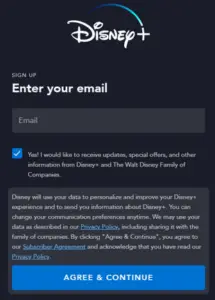
Example Form from Disney Plus

The best email campaigns are about timing, delivering the right message at the right time. It’s the same for compliance. The best time is when the customer is engaging with your brand.

One good example is Disney+ and its subscription streaming service. If you sign up for a free trial, they collect just enough information to get your trial subscription started, ask for permission to contact you about other marketing activities, and disclose the purpose of data collection. There are also prominent links to their privacy policy and subscriber agreement.

Even if the user chooses not to opt in, they may do so in the future. And nothing is preventing Disney from including the same offer again in the future.Because they are leading with privacy compliance in mind, the customer is more likely to trust them and, as a result, provide more data and potentially opt in more often if they have a genuine interest in their products or services.

Building a Foundation for Trust

It does not require a significant investment to improve the customer experience by asking for permission at the appropriate time. But you need a flexible framework that ensures you collect the correct information based on location, prompts for the right information and records how they gave consent. And don’t forget that each jurisdiction has dramatically different rules and processes, so your privacy compliance framework must be sufficiently flexible to accommodate those details. With a bit more up-front planning, you can lower the total cost of ownership. This planning will help prepare for future changes as well.

Of course, you could make some ad hoc changes to your existing systems, patch them up, and push them out there. And this may be your current, budget-friendly plan. The problem with this approach is that it’s a time bomb. At the very least, the cost of ownership of your marketing automation solutions will grow and grow as each new slice of legislation requires more and more detailed changes. But more importantly, you could lose a massive opportunity to create deeper trust with your customers.

Privacy Compliance Solutions for Oracle Eloqua

For Oracle Marketing Cloud (Eloqua) professionals, there’s a simple answer. 4Thought Marketing offers 4Comply and Eloqua Cloud Apps that takes the hard work out of building this capability from scratch. Our compliance apps cover the full privacy compliance lifecycle from data upload, form compliance (for landing pages), customer rights management (including the right to access, update and porting data, as well as the right to be forgotten), and compliance reporting. The whole process is made more manageable through our set-up wizard. So, in the future, you can accommodate critical changes to legislation through simple administration and not expensive coding. Additionally, our privacy compliance experts are on hand to ensure a smooth transition and answer your marketer’s questions.

To find out more about how you can turn data privacy compliance into enduring customer trust and loyalty, contact our team today.


Upload Wizard Cloud App, Lead Engine, Oracle Eloqua integration, Salesforce CRM integration

4Thought Marketing recently improved its Upload Wizard Cloud App to meet the unique requirements of a long-time customer, a global distributor. As part of their Marketing Technology Stack, they use Oracle Eloqua as its marketing automation platform and Salesforce for customer relationship management (CRM). The enhanced Upload Wizard Cloud App serves as the foundation for their comprehensive lead management strategy.

Business Challenge

Every day, the distributor processes orders from around the world. These leads need to quickly and accurately enter their systems and get assigned to the correct sales team. When they receive orders for new accounts, their first step is to connect with them and determine how to best work together. It’s the first step towards their objective to drive more business through optimized lead processing workflows.

The distributor initially contacted 4Thought Marketing when they needed to optimize their business processes and enable growth. 4Thought Marketing helped connect their CRM and Oracle Eloqua systems through seamless Oracle Eloqua integration. But their requirements could not be met using the out-of-the-box Salesforce integration. After careful review with the distributor, they purchased the Cloud App. They now affectionately refer to the Cloud App as the Lead Engine, and it’s central to keeping the entire sales operation running smoothly with efficient CRM integration.

Solution

The Upload Wizard Cloud App helps Eloqua marketers improve data quality by eliminating bad data at the source. It automatically identifies low-quality data through advanced filtering mechanisms. Another benefit is that non-Eloqua users can easily import data without risking the overall data quality. The Upload Wizard allows more people or processes to perform Eloqua uploads, without compromising data quality standards across the Eloqua integration platform.

The distributor receives leads from marketing efforts, from suppliers, and from the manufacturers whose products they sell. However, the primary lead source is from online orders. They feed the leads into the Engine, where they are then enriched and scored through sophisticated algorithms. When leads score high enough and become a marketing-qualified lead (MQL), they flow into Salesforce through seamless Salesforce integration. From there, teams in North America, Europe, and China contact the accounts using standardized processes.

The 4Thought Marketing App also helps organizations improve data quality and enrich data beyond basic lead capture. As data flows into the Engine, it normalizes the data, compares data against other tables to enhance the details, or adds data used in other systems. The Lead Engine helps the distributor execute a five-contact approach by setting up tasks in Salesforce and kicking off follow-up by sales automatically through integrated Salesforce CRM workflows.

The Engine also enhances demand generation activities through intelligent campaign management. When campaigns run, the Engine flags products related to active campaigns as a high priority. Any orders that include a high priority product are “fast-tracked,” sending it immediately into Eloqua and Salesforce through streamlined integration processes.

Results

The Lead Engine powered by the 4Thought Upload Wizard is an integral part of the sales process at the global distributor. It helps the sales team efficiently process the considerable volume of data entering their systems each day through robust lead management capabilities. The Lead Engine checks the data quality, and enriches leads with the latest product information ingested daily through continuous Oracle Eloqua integration. Leads are scored and routed for further qualification using advanced automation features. Select leads are sent immediately to sales if it contains products that are part of a campaign or promotion, leveraging the power of integrated Salesforce CRM integration.

Future

Since deployed five years ago, 4Thought Marketing has implemented dozens of improvements to the Upload Wizard Cloud App to meet their customer’s unique requirements. The global distributor continues to innovate using the Lead Engine, pushing more and more data into the system through enhanced processing capabilities. A project is currently underway to help provide better reporting and accountability for leads generated by their suppliers by pushing them through the Lead Engine with improved Oracle Eloqua integration features.

When complete, they can automatically identify and report on lead record quality and help them generate better leads for the distributor to close for their suppliers through advanced Salesforce CRM integration analytics. And the Lead Engine, powered by the Eloqua Upload Wizard Cloud App from 4Thought Marketing, is at the heart of the system driving continued business growth.


email marketing, nurture foundation,

At the heart of successful email marketing lies a powerful yet often overlooked principle: a strong Nurture Foundation. It’s not just about sending messages—it’s about building meaningful, timed, and trust-driven conversations that turn cold contacts into loyal advocates.

Pop Quiz: Sales rejected over 90% of Marketing’s Leads this quarter, what do you do?

We see this a lot.  Typically, the definition of a Lead is someone with a heartbeat.  Meaning that a visitor only did one thing – like downloaded an asset.  Do you personally want to be called by a Sales rep for downloading one document off a website?  We’re pretty sure the answer is no.

Conversion, warming up Leads, Making MQLs, whatever you call it, is what every Marketing department focuses on.

The answer to a high lead rejection problem is a Nurture Foundation.

Our definition of a Nurture Foundation is not a series of email marketing campaigns that you press the ‘send’ button on to a segmented audience.  Not even close.  If you’re continuously hitting the ‘send’ button, you’re missing a key benefit of Eloqua – automation.

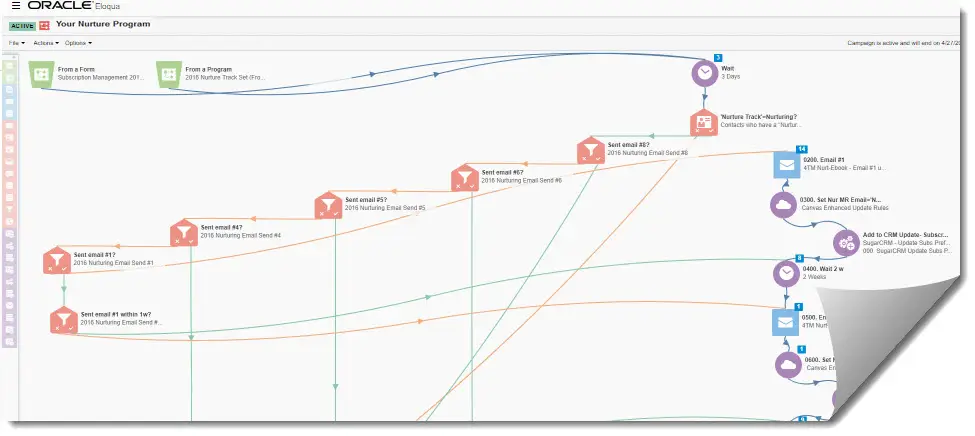
The word “Foundation” in an email marketing Nurture Foundation is included because you architect an infrastructure of automated pathways (the foundation) that Customers can go in and out of on their journey with you.

Oracle Email Nurture Campaign, email marketing, nurture foundation,

Emails that require manually pressing the send button should be reserved for the date driven Events and Product Announcements; communication that are complementary to foundational pathways.

Get started on your Nurture Foundation

Characteristics of a Nurture Foundation

  1. Addresses the Customer Journey – all stages of the Customer Journey are covered, from the Awareness stage all the way through to the Advocacy stage.

    How to make the most of it: Beyond the classic Awareness, Education, Evaluation stages, don’t forget about New Customer Onboarding with some TLC, and only cross-sell after the TLC.

  2. Relies on Content (Content is King!) – and should be appropriately aligned to all stages of the Customer Journey.

    How to make the most of it: At every stage the customer is asking something different.  Your content should address those questions AND be in a stage appropriate format.  Don’t dump 5 page case studies on them when they’re only ready for a 1 minute video.

  3. Takes Time – since Nurture means to care for and encourage the growth of a customer’s interest in us and our solutions over time, take that time. Tell them Why, How, and What, in that order.  And wait to know they’ve heard it.

    How to make the most of it: Depending on your Sales Cycle, have a few emails at every stage starting with Thought Leadership and really setting up the Problem you can solve, before you talk product features.

  4. Tracks the Content Consumed – since customers go on this Journey at their own pace, track their digital behavior to know where in their journey they are, and fast track them if they consume the right content.

    How to make the most of it: Track which content they consume and the recency of that consumption from one piece to another.  Include ALL the places they can consume it from (tracked links).

  5. Listens for Interest – automatically move them from one solution pathway to another. Listening for THEIR interest takes precedence over what YOU think they should be interested in.

    How to make the most of it: Start by assuming interest based on like Profiles, but use their engagement (or lack thereof) to tell you their true interest.  Carefully design the right balance of pathway movement to avoid jumping from one topic to another.

  6. Uses Automated Pathways – we said it already and we’ll say it again. Long-living, architecturally sound, automated pathways.

    How to make the most of it: Lead sources, segments, feeders, page tag groups, wait steps, decision rules – they’re all needed in this architecture.

As Modern Marketers, we strive to marry traditional marketing strategy like — content is king — with modern technology, knowing where a customer is in their journey, and inferring which products/solutions they are interested in, using digital behavior.

Go Slow to Go Fast
Getting your nurtures right takes time!  It’s not easy to build all of the pathways, with all of the right content – with all the right motivational messaging – for every solution –and for every stage of the journey.  We know; we’ve been helping our customers do this for years.  The trick is to take a phased approach to get there.

Good email marketing nurtures are critical for ongoing success and make it possible for Marketers to:

  1. Rest easier at night knowing all their contacts are getting the Right Message at the Right Time. (Imagine being able to say that with confidence!)
  2. Focus on Event, New Product Announcement and other Channel marketing
  3. Fine-tune and optimize their nurture pathways over time by reviewing the KPI’s that Matter that will tell you what’s working and what to improve.

You’re closer than you think

It’s not about coming up with the next flashy, amazingly worded, award-winning campaign this month or this week.  It’s about designing a customer journey with aligned content — you can reutilize existing content — and then beautifully architecting these different pathways.

Don’t let your Sales team say Marketing Leads suck.  Don’t let them think they should cherry pick and throw the rest away.  Take the time to Nurture your leads, warm them up, and shorten the sales cycle.

This is the essence of Modern Marketing.  This is a Nurture Foundation.

What does your Nurture Foundation look like?  Do you have to come up with a topic you think a specific segment might want to know about on a weekly or monthly basis?  How often do you hit the send button?  If you’re not thrilled with your answers, it’s time for a change – and we’re here to help!

email marketing, nurture foundation,

4Thought Marketing Logo   April 8, 2026 | Page 1 of 1 | https://4thoughtmarketing.com/articles/page/11