ip warming, email deliverability, sender reputation, cold email, DNS Update, Outlook email authentication

Modern email service providers recognize and filter out spam messages. Emails from unfamiliar IP addresses, especially many at once, send up red flags that trigger the filter. Unfortunately, an overzealous filter might wrongly flag your legitimate marketing emails. How can you ensure your messages reach the intended recipient?

For new systems, IP warming is one of the most critical steps in ensuring your emails land in inboxes—not spam folders. This strategic process gradually builds the credibility of your IP address, paving the way for successful email delivery. Here’s everything you need to know about IP warming and how to execute it effectively.

Action Required: Prepare for Outlook’s New Rules

Big news for email senders! Outlook is dropping stricter authentication rules (SPF, DKIM, DMARC) after May 5th, 2025, especially for high-volume senders. No authentication = straight to junk! This makes warming up your IP and building trust absolutely ESSENTIAL right now. Don’t get left behind!

What Is IP Warming?

IP warming is the gradual process of increasing the volume of emails sent from a new or dormant IP address. The goal is to establish a positive sender reputation with internet service providers like Gmail, Yahoo, and Hotmail. Without proper warming, ISPs may flag your emails as spam due to an unproven reputation.

Why is this so crucial? ISPs and email filters rely on sender behavior and engagement metrics to determine email deliverability. A sudden surge in email volume from an unfamiliar IP address could trigger alarms, leading to deliverability issues. Proper IP warming prevents this by demonstrating consistent, high-quality sending behavior over time.

Major email providers like Outlook are increasingly getting strict about email authentication. Starting May 2025, high-volume senders must have SPF, DKIM, and DMARC properly configured to avoid the junk folder. Considering that a significant portion of cold email senders neglect these crucial steps, the importance of building a positive sender reputation through IP warming becomes even clearer for new IP addresses.

How to Warm Up Your IP Address

Start Slow

Begin with small, controlled batches of emails sent to your most engaged recipients. Focus on new subscribers and those who have opened or clicked on one of your marketing emails within the last six months. Avoid sending to older or less active addresses, as these are more likely to trigger spam complaints or hit spam traps.

Are you wondering which subscribers to target first? Your best bet is recent purchasers, frequent website visitors, and those who’ve explicitly opted in within the last 30 days. These folks are practically waiting to hear from you!

Focus on High-Quality Content

In this early stage, the more engaging content you share, the higher your chances of getting clickthrough. Use campaigns designed to increase recipient interest, such as:

  • Welcome emails for new subscribers.
  • Awareness campaigns promoting your new sender identity (e.g., encouraging recipients to add your email to their address books).
  • Proven content that has performed well in past campaigns.

Follow a Gradual Volume Increase

Use a phased approach to increase daily email volumes across your subscriber base. As your reputation improves, you can expand your reach to re-engage older contacts. For example:

  • On day one, send 200 emails to Gmail and 500 to smaller ISPs.
  • By day seven, gradually ramp up to 7,000 emails to Gmail and 14,000 emails overall.
  • The key is maintaining steady volumes for a few days at each stage before scaling up further.

IP Warming Calendar Template

You may follow the below given IP warming calendar template for your IP warming strategy. Based on list size of your subscribers & clients the numbers can be varied proportionally.

Day Gmail Recipients Yahoo/Outlook Recipients Other ISPs Total Daily Volume
1-2 200 200 500 900
3-4 500 500 1,000 2,000
5-7 1,000 1,000 2,000 4,000
8-10 2,500 2,500 4,000 9,000
11-14 5,000 5,000 7,000 17,000
15-21 7,500 7,500 10,000 25,000
22-30 10,000+ 10,000+ 15,000+ 35,000+

Monitor and Adjust

Track metrics such as bounce rates, open rates, and spam complaints regularly. If performance declines, slow down the warming process or refine your recipient list to exclude problematic addresses. Seeing those bounce rates creep up? That might be a sign to slow down your volume increases. Remember, it’s better to take an extra week warming up than to rush and damage your sender’s reputation.

Advanced Ramp-Up Strategies

After successfully completing the warming phase, you can move into the ramp-up phase to reach your full sending capacity. This phase involves incremental increases in volume over several weeks. Depending on your level of aggressiveness, volume can be increased by 25% to 50% every 2-3 days. However, proceed with caution—poor-quality data or overly aggressive ramp-ups can harm your IP reputation.

Common IP Warming Pitfalls to Avoid

  • Going Too Fast

The most common mistake we see is rushing the process. Even if your marketing calendar is packed, stick to the plan. Those emails won’t help if they never reach the inbox.

  • Ignoring Warning Signs

If you notice a sudden drop in open rates or increase in spam complaints, don’t push forward. Take a step back, analyze what’s happening, and adjust your approach.

  • Sending to Cold Subscribers

That list of 50,000 subscribers who haven’t engaged in 18 months? Save them for later—much later—in your warming process, if at all.

  • Using Low-Quality Content

Your very best content should go out during warming. This isn’t the time to test that experimental campaign you’ve been unsure about.

Do not let your email turn into spam. Help your email marketing with IP warming

Industry-Specific Warming Tips

  • B2B marketers often require longer warming periods due to reduced engagement rates. Consider implementing a 6–8 week plan instead of a 4-week one.
  • E-commerce – Focus initial sends on recent purchasers and cart abandoners—they have the highest engagement potential.
  • Financial Services – Be extra cautious with volume increases, as many financial domains have stricter spam filtering policies.

Troubleshooting Guide:

What to Do If…

  • Your Bounce Rate Exceeds 5%

Immediately halt volume increases and review your most recent subscriber additions. You must also check for sending domain issues and consider temporarily decreasing the volume.

  • Your Emails Are Being Bulked (Sent to Spam)

Focus exclusively on your highest-engagement segments. Simplify email design and reduce the image count. Check your authentication records (SPF, DKIM, DMARC) and review your content for spam trigger words.

  • Engagement Suddenly Drops

Verify your sending domain isn’t on any blacklists. Then check for recent content for any potential rendering issues across devices. You may try to reduce your sending volume temporarily while you fix the issues before resuming your IP warming. Switching to your highest performing email template may also aid in overcoming the issues.

Key Takeaways for Successful IP Warming

  • Engagement is king: Target only highly engaged recipients to maximize positive feedback and minimize complaints.
  • Slow and steady wins the race: Abrupt increases in volume are a surefire way to raise red flags with ISPs.
  • Stay vigilant: Monitor your performance metrics and adjust your approach as needed.
  • By following these best practices, you’ll establish a strong sender reputation and set your email marketing campaigns up for long-term success.

Final Words

Successfully reaching your audience’s inbox is crucial for any new marketing push or when transitioning to a new IP. However, without careful preparation, deliverability can be a significant hurdle. Taking the time to properly warm up your IP is therefore a vital investment. This foundational step ensures your emails are welcomed, ultimately leading to stronger engagement and the success of your email campaigns.


Consent Management Platform, CMP, Data Privacy, User Consent, Privacy Compliance, GDPR, CCPA, Data Protection, Cookie Consent, Tracking Consent, Ethical Marketing, Transparency User Trust, Data Quality, Personalized Marketing, Marketing Technology Stack, Privacy-First Marketing, Consent Management, Digital Marketing Privacy,

The marketing playbook has undergone a fundamental shift. No longer can data be collected and utilized without explicit consideration for individual privacy. Consumers are more informed and protective of their digital footprint, and regulations worldwide are tightening the reins on data handling. This evolving environment, marked by the increasing awareness of data privacy and the rise of global regulations like GDPR, CCPA, and the e-Privacy Directive, makes building trust and ensuring transparency paramount for effective marketing. Enter the Consent Management Platform, not just as a tool for compliance, but as a crucial ally guiding marketers through the complexities of privacy and paving the way for ethical and sustainable engagement.

For any modern marketing strategy, understanding the pivotal role of a Consent Management Platform is now essential to meet evolving user expectations. A well-implemented Consent Management Platform can significantly enhance user trust and engagement.

What is CMP?

A Consent Management Platform serves as the central nervous system for managing user consent across all digital interactions. It empowers businesses to obtain, meticulously record, and honor user preferences regarding data collection and processing. However, the value of a CMP extends beyond mere adherence to legal frameworks. It’s a catalyst for enhanced user experiences, stronger brand relationships built on trust, and, ultimately, more meaningful marketing outcomes.

A Consent Management Platform integrates seamlessly with existing marketing technology stacks, acting as a trusted record of consent and bridging the gap between anonymous and known user interactions. Implementing a robust CMP is a significant step towards building a privacy-first marketing approach and realizing a strong return on investment.

The Crucial Roles of a Consent Management Platform in Modern Marketing

Fortifying Legal Compliance and Avoiding Pitfalls

At its core, a Consent Management Platform acts as a shield against legal vulnerabilities. It provides the necessary infrastructure to obtain verifiable consent for the use of cookies, tracking technologies, and various data processing activities, ensuring adherence to regulations such as GDPR, CCPA/CPRA, and other regional mandates like the LGPD. This proactive approach significantly minimizes the risk of substantial fines and reputational damage associated with non-compliance, making a CMP an indispensable tool.

Moreover, leveraging a Consent Management Platform enables businesses to adapt to changing regulations and consumer expectations, ensuring that their marketing strategies remain effective and compliant.

Cultivating Trust Through Transparency with Your Consent Management Platform

By integrating a robust Consent Management Platform, companies can also provide users with transparency on how their data is used, ultimately enhancing user trust and satisfaction.

In an era where data breaches and privacy violations erode consumer confidence, a Consent Management Platform fosters transparency. By providing users with clear, accessible information and granular control over their data, businesses demonstrate a commitment to respecting individual privacy rights. This builds invaluable trust, strengthening brand loyalty and fostering long-term customer relationships, all facilitated by an effective CMP. A user-centric approach to consent, facilitated by a CMP, is crucial here.

Elevating User Experience with Seamless Integration

A well-implemented Consent Management Platform prioritizes user convenience. It offers intuitive interfaces, clear and concise language, and easily manageable consent preferences. By empowering users with control over their data in a seamless manner, businesses enhance the overall user experience, leading to more positive interactions with their websites and applications. The user-centric design of a good CMP is key to this, ensuring consent is freely given, specific, informed, and unambiguous, avoiding intrusive or misleading requests.

Enhancing Data Quality for Precision Marketing with a CMP

When users willingly provide their consent through a Consent Management Platform for specific data processing purposes, the resulting data is inherently more valuable. This opt-in data reflects genuine interest and intent, leading to improved data accuracy and reliability. Marketers can then leverage this higher-quality data for more effective audience segmentation and targeted campaigns. By integrating with Customer Data Platforms (CDPs), a CMP ensures that all data used in marketing is backed by explicit consent, making it both usable and compliant, ultimately improving conversion rates.

Enabling Ethical Personalization Through Your Consent Management Platform

Personalization remains a powerful marketing tool, and a CMP facilitates its ethical application. By respecting user consent preferences, marketers can still deliver relevant and engaging content tailored to individual needs and interests. This consent-driven personalization fosters stronger connections without compromising privacy. CMPs enhance Marketing Automation Platforms (MAPs) by enabling the creation of email segments based on consent, ensuring campaigns are both targeted and compliant. This aligns with the future of consent management, allowing for AI-driven personalization within privacy boundaries.

Establishing Robust Audit Trails for Accountability with a CMP

A well-structured Consent Management Platform not only streamlines compliance but also empowers users, making them feel more in control of their personal data.

Consent Management Platforms maintain comprehensive records of user consent, including timestamps and specific consent details. This detailed audit trail serves as crucial documentation for demonstrating compliance to regulatory bodies and effectively addressing any potential privacy inquiries or concerns. The audit capabilities of a CMP are vital for accountability and long-term cost savings by avoiding non-compliance penalties.

Centralizing Consent Control Across Channels with a Unified CMP

A Consent Management Platform provides a unified platform for managing consent across various digital touchpoints, including websites, mobile apps, and other online channels. This centralized approach ensures consistency in data privacy practices and simplifies consent management for both users and marketing teams. This also complements Customer Identity and Access Management (CIAM) systems by managing the consent layer and ensuring data collection aligns with user preferences, all orchestrated by the CMP. Key features to look for in a CMP include customizable banners, granular options, automatic blocking, easy withdrawal, integration capabilities, multi-language support, and robust reporting.

Conclusion

Marketers aim to forge genuine connections with their audience, and a Consent Management Platform offers the pathway to achieve this ethically and with impact. Navigating the intricacies of data privacy can seem daunting, but a well-implemented CMP not only addresses these complexities therefore it unlocks a significant opportunity: building enduring trust and superior user experiences, which are essential for sustained marketing success in today’s privacy-aware environment.

To effectively address your privacy concerns and build these stronger customer relationships, explore how 4Comply, a 4Thought Marketing’s CMP platform, can guide you. With the right Consent Management Platform, businesses can build stronger customer relationships and unlock the full potential of their marketing strategies.


data enrichment, marketing automation data, customer data enrichment, lead enrichment, data quality marketing,

Your marketing automation platform can be a sophisticated engine, capable of orchestrating complex campaigns and delivering personalized experiences with impressive efficiency. But like any high-performance machine, its true potential hinges on the quality of its fuel: quality and complete data.

It’s the strategic process of taking the foundational information you possess about your audience and layering it with rich, contextual insights. This transformation goes far beyond simply amassing more data; cultivating smarter data that empowers your automation to understand, connect with, and ultimately convert your audience on a deep human level.

Data enrichment bridges the gaps and adds essential dimensions to your existing information managed by Adobe Marketo, Oracle Eloqua, or other marketing automation systems. They capture engagement patterns on your website, the specific content they’ve downloaded, and their purchase history. Imagine knowing their industry and even the technologies their company utilizes.

While you may already possess some of this data, enrichment takes it a step further by expanding your data points. This deeper understanding enables better segmentation and allows you to transcend generic outreach, ultimately leading to interactions that are genuinely relevant and impactful.

Unpacking the Layers: What Exactly Does Data Enrichment Entail?

Data enrichment isn’t a one-dimensional process. It involves several key layers that work together to create a comprehensive and actionable view of your audience:

Filling in the Blanks

Often, initial data capture leaves crucial fields empty. Enrichment processes automatically append this missing information, whether it’s a phone number, a job title, the size of their organization, or their geographic location. Completing these profiles ensures you have the necessary details for effective communication and segmentation.

Ensuring Accuracy and Freshness

Data is dynamic. People change jobs, companies evolve, and contact information becomes outdated. Data enrichment includes ongoing verification and updating processes to cleanse your database, correcting inaccuracies and ensuring you’re reaching the right individuals with current information. This prevents wasted efforts and maintains the integrity of your data.

Adding Contextual Depth

This is where the real magic happens. Enrichment appends entirely new categories of data that provide invaluable context about your audience:

  • Behavioral Insights: Tracking website visits, content consumption, email engagement, and past purchase history reveals a prospect’s interests and intent, allowing for highly targeted follow-ups.
  • Firmographic Details (for B2B): Information like industry, annual revenue, employee count, and company growth trajectory enables precise targeting of ideal customer profiles.
  • Technographic Data: Understanding the software and hardware a company uses can be crucial for offering relevant solutions and tailoring your messaging.
  • Demographic Information (for B2C): Details such as age, gender, location, income level, and lifestyle preferences allow for nuanced personalization of consumer-focused campaigns.
  • Social Signals: While requiring careful consideration of privacy, understanding a prospect’s social media activity can offer additional insights into their interests and engagement patterns.

Standardizing for Seamless Integration

Inconsistent data formats across various sources can create headaches for analysis and automation. Enrichment processes standardize this information, ensuring your marketing automation platform can seamlessly utilize data from all touchpoints.

Data Enrichment Elevates Your Marketing Automation

Investing in data enrichment isn’t just about having “nicer” data; it translates directly into tangible benefits that significantly impact your marketing effectiveness and drive business growth:

data enrichment, marketing automation data, customer data enrichment, lead enrichment, data quality marketing,

Hyper-Personalization That Resonates

Gone are the days of generic email blasts. With enriched data, you can segment your audience with incredible granularity and craft highly personalized messages, content recommendations, and offers that speak directly to individual needs, challenges, and aspirations. This level of personalization builds stronger connections and significantly boosts engagement.

Smarter Lead Scoring and Sales Alignment

Imagine being able to identify your hottest leads with greater precision. Enriched data provides a holistic view of a lead’s profile and behavior, enabling more sophisticated and accurate lead scoring models. This ensures your sales team prioritizes the most promising prospects, leading to higher conversion rates and a more efficient sales process.

Precision Targeting Across Channels

Whether you’re running targeted email campaigns, social media advertising, or account-based marketing initiatives, enriched data empowers you to reach the right audiences with the right message at the right time and on the right platform. This minimizes wasted ad spend and maximizes the impact of your marketing efforts.

Nurturing Leads with Context and Care

Generic nurturing sequences often feel impersonal and ineffective. With enriched data, you can tailor your nurturing content to address specific pain points, interests, and where a lead is in their buyer’s journey. This builds trust, educates prospects effectively, and guides them naturally towards conversion.

Crafting Exceptional Customer Experiences

Understanding your customers deeply through enriched data allows you to provide more valuable and relevant interactions at every touchpoint. From personalized support to proactive recommendations, you can create a seamless and positive customer experience that fosters loyalty, advocacy, and repeat business.

Boosting Data Quality and Trustworthiness

The very process of data enrichment often involves data cleansing, deduplication, and validation, resulting in a more accurate and reliable database. This reduces errors, improves the accuracy of your reporting, and ensures your marketing decisions are based on sound information.

Unlocking Deeper Insights and Strategic Advantages

 With richer and more complete data, your marketing automation platform can generate more insightful reports and analytics. This allows you to gain a deeper understanding of campaign performance, identify emerging trends, and make data-driven decisions to continuously optimize your marketing strategies.

Orchestrating Seamless Omnichannel Experiences

Enriched data provides a unified view of each customer across all the ways they interact with your brand. This enables you to deliver consistent and relevant messaging regardless of the channel, creating a cohesive and impactful omnichannel experience that strengthens brand engagement.

Navigating the Data Enrichment Landscape: Tools and Best Practices

Implementing data enrichment effectively requires the right tools and a thoughtful strategy:

  • Selecting Right Tools: A wide array of data enrichment tools exists, from specialized platforms to integrated features within CRM and marketing automation systems. Carefully consider your specific requirements, budget, and the types of data you need to enrich when making your selection.
  • Define Enrichment Objectives: What specific data points will have the biggest impact on your marketing and sales goals? Having clear objectives will ensure your enrichment efforts are focused and measurable.
  • Uphold Data Privacy and Compliance: Always prioritize data privacy regulations (like GDPR and CCPA) throughout your data enrichment processes. Ensure you have the necessary consent and maintain transparency with your audience regarding data collection and usage.
  • Establish a Continuous Enrichment Cycle: Data isn’t static. Implement a regular process for data enrichment to ensure your information remains accurate, up-to-date, and valuable over time.
  • Leverage Your Internal Data First: Don’t underestimate the value of the data you already possess. Analyze your CRM, website analytics, and past campaign performance to identify opportunities for internal data enrichment before seeking external sources.

The Future of Marketing is Data-Driven and Human-Connected

In conclusion, data enrichment is not just a technical add-on for marketing automation; it’s the very foundation upon which truly effective and human-centric marketing is built. By investing in enriching your understanding of your audience, you unlock the full potential of your automation platform, enabling personalized interactions, smarter targeting, and ultimately, stronger customer relationships and sustainable business growth. In an increasingly noisy digital world, enriched data allows you to cut through the clutter, connect with your audience on a meaningful level, and transform your marketing automation from a mere tool into a powerful engine for engagement and conversion. Embrace the power of enriched data, and watch your marketing efforts flourish.


email QA testing, QA testing, QA testing email campaign tools, email campaign quality assurance template, email testing best practices, marketing automation QA, email rendering issues, A/B test emails, email performance testing,

Your email campaign is polished and ready to go. The copy is on point, and the design is engaging. However, before you hit ‘send,’ there’s one critical step that can make or break your success: Email QA testing.

QA testing in email marketing is not just a technical formality. It serves as your last defense against issues like broken links, clunky formatting, and embarrassing errors that may harm your brand or reduce conversions. In today’s competitive inbox environment, even minor mistakes can significantly impact engagement and ROI.

In this article, we’ll walk through the core stages of the email QA testing—from planning and checklist creation to execution and post-launch monitoring—and explore how modern tools, including AI-powered solutions, can elevate your testing process to new heights.

Planning Your Email QA Testing Strategy

Before diving into execution, a well-defined plan is your North Star for a successful QA testing journey. This initial stage involves meticulously aligning the scope and objectives of your QA testing with the overarching goals of your marketing campaign. Consider the scale and complexity of your outreach – a personalized email to a select group will naturally require fewer approval layers than a mass communication to millions. Asking crucial questions like the number of testing rounds needed, the levels of approval required, and whether cross-platform rendering checks are necessary sets the stage for thorough scrutiny. This foundational planning ensures that your QA efforts are targeted and effective from the outset, and importantly, are checked against the initial design documents.

Creating an Effective Email QA Testing Checklist

Think of your QA checklist as the detailed blueprint for your campaign’s success. This robust document encompasses a wide spectrum of elements, meticulously covering design, content, functionality, and user experience. Each item on this list is carefully crafted to leave no stone unturned, guaranteeing a comprehensive evaluation of every facet of your campaign. From verifying compelling visuals to scrutinizing persuasive copy and ensuring seamless functionality, a well-constructed checklist acts as your guiding compass throughout the QA testing.

Execution: QA Testing Plan In Action

Your QA experts will now transition to the execution phase, where precision is crucial.

This phase demands a meticulous examination of each checklist item, ensuring that no detail is overlooked. Every aspect of the campaign is rigorously evaluated, from the copy’s nuances to the design’s aesthetic appeal and the functionality’s flawless operation. Any discrepancies identified at this stage are thoroughly documented, setting the stage for required corrections.

Documentation: Building a Knowledge Repository

Documenting the QA testing is more than just record-keeping; it helps build a valuable repository of insights for future campaigns.

Keeping detailed records throughout the QA testing journey, including any identified issues, their causes (whether design flaws or development hiccups), and resolutions, serves as invaluable learning tools. This comprehensive archive allows marketers to improve continuously, ensuring that future campaigns benefit from past experiences.

Iterative Refinement Through QA Testing Feedback

QA testing is not a standalone activity; it thrives on a dynamic feedback loop that encourages collaboration and iterative refinement.

Constructive feedback based on QA findings is quickly shared with the campaign team, enabling swift implementation of necessary changes. This open communication ensures issues are addressed efficiently and enhances the campaign’s overall effectiveness.

Last Checkpoint: The QA Testing Final Review

Before going live, a final, comprehensive review acts as your last line of defense.

This vital checkpoint verifies that every campaign component meets established quality standards. It provides a final opportunity to resolve any lingering issues or discrepancies, effectively protecting against potential pitfalls that could affect success post-launch.

Post-Launch Monitoring: Nurturing Ongoing Success

The campaign’s journey doesn’t end when it goes live. Post-launch monitoring is essential for maintaining the ongoing performance of your marketing efforts.

By diligently tracking key metrics and promptly addressing any issues that arise in the live environment, marketers can ensure the campaign’s sustained success and optimal performance in the ever-changing digital landscape.

Elevating Campaign Effectiveness Through QA Excellence

In conclusion, QA testing is not just a step in the marketing campaign process; it is a fundamental principle of precision and excellence.

By formalizing QA testing, marketers create an environment of trust and efficiency, both internally and externally. The reduction of errors directly correlates to an increase in ROI and revenue potential, highlighting QA’s crucial role in achieving tangible marketing success.

By effectively communicating the intricacies of QA testing within your organization, you empower your teams to understand the meticulous steps involved in crafting a seamless campaign, fostering a culture of vigilance and attention to detail that elevates the recognition of QA testing in marketing automation.


: Company Matching, Oracle Eloqua, B2B Marketing Operations, Contact to Account Matching, Account-Based Marketing (ABM)

You’re in B2B Marketing Operations, and you know that connecting your contacts to the right companies is fundamental. It’s the bedrock for effective segmentation and targeted marketing. Get it wrong, and your sales and marketing efforts can suffer. That’s why mastering contact-to-account matching, or Company Matching as it’s often called, within a platform like Oracle Eloqua isn’t just a nice-to-have – it’s essential for building better relationships and achieving the results you’re aiming for.

What is Company Matching?

At its core, Company Matching is the process of accurately linking individual contact records in your marketing automation and CRM systems to their respective company or account records. Think of it as building the organizational chart for your leads. Whether these contacts enter your Oracle Eloqua database through online forms, sales interactions, or imported lists, it aims to establish a clear relationship between the person and the business they represent.

One of the most common and straightforward methods involves using the contact’s email domain. For instance, if a new contact signs up with an email address ending in @example-inc.com, the system can look for an existing company record with the same domain, example-inc.com, and associate the contact accordingly.

Company Matching can be approached in two primary ways:

  • Manual Company Matching: This involves manually searching for the correct company record and updating the necessary field to link the contact. While offering greater control, this method is often time-consuming and less scalable, especially with a growing database.
  • Automatic Company Matching: This leverages the capabilities within your marketing automation platform, such as Oracle Eloqua, to automatically identify and link contacts to companies based on predefined rules and data points. This significantly improves efficiency and accuracy at scale.

By establishing a solid foundation, B2B marketers can unlock a wealth of opportunities to engage more effectively with their target audience.

Why Accurate Company Matching Matters

Enhanced Segmentation and Personalization

Accurate company matching in Oracle Eloqua is the key to moving beyond basic segmentation. By correctly linking contacts to their companies, you unlock the ability to segment based on crucial firmographic data like industry and size, enabling highly targeted campaigns. This company-level understanding also fuels impactful personalization, allowing you to tailor your messaging with company-specific details, ultimately increasing engagement and strengthening relationships with potential customers.

Improved Lead Scoring and Prioritization

Instead of solely evaluating individual contact behavior, you can attribute engagement and activities to the entire company. This provides a more holistic view of an account’s interest level, allowing you to prioritize outreach to companies showing strong collective engagement. By understanding which organizations are actively interacting with your marketing content, your sales team can focus their efforts on the most promising accounts, leading to more efficient resource allocation and higher conversion rates.

Streamlined Reporting and Analytics

Instead of sifting through individual contact data, you can analyze marketing performance at the account level. This provides a clearer picture of which companies are engaging with your campaigns, the effectiveness of your ABM strategies, and the overall ROI of your marketing efforts in relation to specific organizations. This company-centric view enables more informed decision-making and a better understanding of your impact on key accounts.

Effective Account-Based Marketing (ABM) Enablement

Robust company matching is the foundational pillar for successful Account-Based Marketing (ABM) within Oracle Eloqua. By accurately identifying and grouping contacts within target accounts, you can orchestrate highly personalized and coordinated campaigns directed at multiple organizational stakeholders. This ensures that your messaging resonates with the entire account’s specific needs and pain points, fostering stronger relationships and increasing your chances of winning high-value deals. Without accurate company matching, executing effective ABM strategies becomes significantly more challenging.

Enhanced Data Quality and Governance

Implementing a strong company matching process in Oracle Eloqua directly contributes to improved data quality and governance. By accurately linking contacts to their respective companies, you reduce the occurrence of orphaned contact records and create a more unified and reliable database. This enhanced data integrity ensures that your segmentation, personalization, lead scoring, and reporting are based on precise information, minimizing errors and maximizing the effectiveness of your marketing operations. Ultimately, cleaner company data leads to more trustworthy insights and better decision-making across your marketing and sales teams.

Demystifying Company Matching in Oracle Eloqua: How It Works

: Company Matching, Oracle Eloqua, B2B Marketing Operations, Contact to Account Matching, Account-Based Marketing (ABM)

Data Points Leveraged for Matching

Oracle Eloqua employs various data points to accurately link contacts to companies, with the email domain being a primary identifier. It can also leverage domain lookup services to enrich data based on the email domain. Information captured in form data, such as company name and website, also plays a crucial role. Additionally, IP address mapping can provide clues about a contact’s organization, and integrations with third-party data providers can further enhance the matching accuracy by bringing in more comprehensive company information.

Matching Rules and Configuration

The power of company matching in Oracle Eloqua lies in its flexible matching rules. Marketers can configure these rules based on the data points mentioned above, prioritizing certain fields and defining the matching logic (e.g., exact match, fuzzy match). Setting up effective deduplication rules at the company level is also critical to maintain data integrity. By carefully configuring these rules, you can tailor Eloqua’s matching engine to align with your specific data landscape and accuracy requirements.

Manual vs. Automated Matching Processes

While manual company matching involves individual searching and linking of contacts to accounts, offering direct control, Oracle Eloqua excels in automated company matching. This automated approach uses the configured rules to efficiently and scalable link records as they enter the system, significantly saving time and reducing errors. While manual review might still be necessary in some complex cases, automation is the key to effectively managing company matching at scale within Eloqua.

Eloqua’s Company Matching Features and Functionality

Oracle Eloqua provides specific features and functionalities to facilitate company matching. The company object serves as the central record for company information. Eloqua’s matching engine, configurable through the platform’s settings, automates the linking process based on defined rules. Furthermore, integrations with Data as a Service (DaaS) offerings and apps from the Eloqua App Cloud can enhance data quality and matching accuracy by providing access to external company data and specialized matching algorithms.

Conclusion

The goal is clear: B2B marketing excellence and strong revenue growth come from engaging the right accounts with personalized approaches. Company matching in Oracle Eloqua is key to making this happen through better segmentation and ABM. However, many struggle with messy data, making it hard to see the full picture of their prospects. This leads to wasted effort and missed chances. Focusing on mastering company matching in Oracle Eloqua is essential. By understanding accounts and using Eloqua’s features well, you can gain a clear view of your market and boost revenue. Want to improve your Oracle Eloqua results? A strong company matching strategy is the answer, and we can help.


Alt text, Email marketing, Accessibility, Inbox previews, AI alt text, Email deliverability, WCAG compliance, ADA compliance

Alt text has long been associated with accessibility — a behind-the-scenes feature that ensures users relying on screen readers can understand the content of images. While that remains a critical function, its role is expanding in increasingly relevant ways to marketers. Today’s email clients, including Apple Mail and Gmail, use more advanced methods to display message previews. These systems often draw not only from subject lines, preview text, and image metadata. In this environment, well-written descriptions don’t just support accessibility — they contribute to how an email is summarized, interpreted, and prioritized in the inbox.

Beyond Compliance: Why Alt Text Quality Matters

Despite its growing importance, alternative text is often overlooked or inconsistently applied. It’s not uncommon to see placeholders like “image1.jpg” or vague descriptors such as “photo” or “graphic.” While these may satisfy technical requirements, they do little to enhance the user experience or support your messaging.

Common challenges include:

  • Missing or empty attributes, resulting in poor screen reader experiences and vague previews.
  • Generic or overly broad language, which provides no meaningful context.
  • Manual inconsistencies can reduce content quality and introduce errors across campaigns.

As inbox environments evolve, these shortcomings become more noticeable and impactful. Descriptions are increasingly part of the first impression your email makes. It can differ between a reader opening your email or scrolling past it.

A More Strategic Approach

When treated as part of a broader content strategy, alternative text can reinforce brand voice, support clarity, and contribute to stronger engagement. Clear, specific descriptions make your message more inclusive and help ensure that it’s understood and presented accurately, even when images are not displayed.

Effective alt text:

  • It enhances the experience for users with visual impairments or those using privacy tools that block images.
  • Supports better inbox previews, especially in platforms that generate summaries dynamically.
  • Reduces confusion and improves overall clarity across email campaigns.
  • Demonstrates attention to detail and reinforces brand professionalism.
  • Improves email deliverability and prevents your email from landing in the spam folder.

This is particularly valuable in high-volume or high-visibility campaigns, where consistency and quality are critical.

Moving Forward

To address these challenges, incorporating AI into your content development and quality assurance processes can significantly improve the quality of your alt text and reduce errors. AI can check image descriptions and suggest improvements. This helps improve the quality of alt text and reduces the risk of errors, making it easier to meet accessibility standards.

An AI-powered solution works by analyzing template documents or completed HTML, generating a list of recommendations based on the context and intent of the image. Features like:

  • Automated heat maps that highlight weak or missing alt text,
  • Can include a glossary for a more detailed explanation of recommendations for new users,
  • Best-practice templates for common marketing use cases and
  • Built-in checks for ADA and WCAG compliance

…make it easier to maintain quality across campaigns while saving time and reducing risk.

The ability to standardize and optimize alt text at scale — without sacrificing clarity or nuance — represents a practical and modern approach to marketing operations. It ensures that each image reinforces the message rather than becoming a missed opportunity or a source of confusion.

Get started with AI Tools for Image Alternative Text

You can use almost any AI tool to check the quality of your alt text. To help you get started, we recommend using a good prompt (which we’ll provide at the end of this article), or you may use the 4TM Alternate Text Checker Custom GPT developed by 4Thought Marketing. This Custom GPT is designed to check if content templates include high-quality alt text and can be used on HTML code.

Moving Forward

Alternative text may not be the centerpiece of an email campaign, but their impact is meaningful. They improve accessibility, enhance user experience, and increasingly contribute to how content is perceived in the inbox. They also have the potential to improve email deliverability. Marketers who give this element the same strategic attention as other content elements and adopt modern, AI-powered tools to support that process will be better positioned to meet evolving standards, reach broader audiences, and present their messages more effectively across every device and inbox.


Alt Text Checker Prompt

You are an accessibility and SEO expert specializing in HTML content. Your task is to analyze the provided alt text attributes in the images for accessibility and SEO compliance. 
Follow these best practices:
1. Choose alt text language as per the content language used in a document, PDF, or the HTML content language
2. Descriptive Language & Context Relevance: Use concise, accurate language that clearly describes the image’s content and purpose, including any links present.
Standards & Compliance:Ensure alt text adheres to ADA compliance and WCAG 2.0 guidelines.
3. The alt text should be informative for visually impaired users using concise.
4. With Apple Intelligence introducing AI Summaries and Gmail’s Automatic Extraction, your alt text prompt should be adjusted to: Optimize for machine readability (AI Summaries & SEO)
5. Ensure clarity in all-image emails
6. Enhance AI-generated preview text accuracy
7. Character Count Limit: Keep alt text within 90 characters.
8. Decorative Images: If an image is decorative, confirm the alt attribute is either empty or managed appropriately.
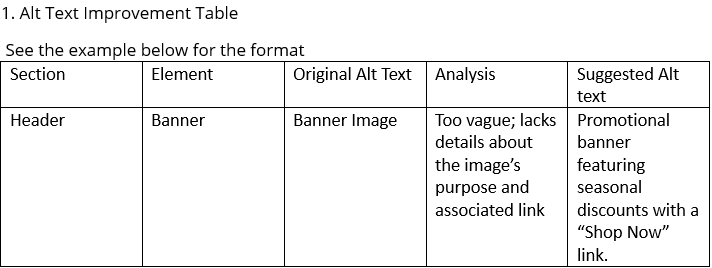
9. Output Requirements:Alt Text Improvement Table, Heatmap Table.
a) For Alt Text Improvement Table:
Columns: Section/Element, Original Alt Text, Analysis, Suggested Alt Text
Provide an analysis of the current alt text along with a suggested improvement.
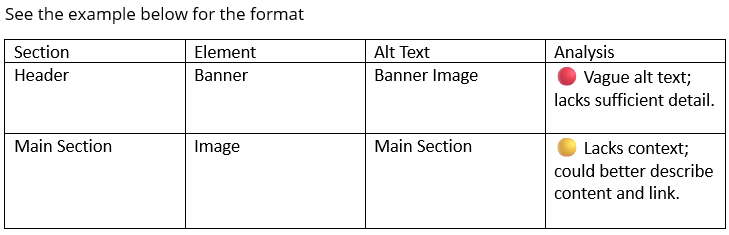
b) For Heatmap Table:
Columns: Section/Element, Alt Text, Analysis
Use heatmap indicators (🟢, 🟡, 🔴) with a short explanation.

Glossary:
Include definitions and examples for terms used in the analysis.

Note: For decorative images, an empty alt attribute is recommended.

2. Heatmap Table in a formatted way as alt text improvement

Glossary: 
1. Alt Text: Text alternative for images to convey content for users who can’t see them. Example: "Promotional banner featuring seasonal discounts with a 'Shop Now' link."
2. Banner Image: A prominent image used on webpages (often at the top) that typically includes key messaging or links.
3. ADA Compliance: Adhering to the Americans with Disabilities Act guidelines to ensure digital content is accessible to all users, including those with disabilities.
4. WCAG 2.0: Web Content Accessibility Guidelines version 2.0; a set of recommendations for making web content accessible.
5. Descriptive Language: Use of detailed, specific language to clearly describe an image’s content. Example: "Welcome banner displaying company mission with a link to the About page."
6. Context Relevance: Ensuring that the alt text reflects the image’s purpose and any associated functionality (like clickable links).
7. Decorative Image: An image used solely for visual enhancement with no essential informational value; such images should have an empty alt attribute to avoid distraction.

Eloqua Campaign Responses, Campaign Response Rules, CRM Integration, Marketing Automation, Lead Tracking, Customer Engagement, CRM Member Status, Eloqua Bulk API

Imagine having a direct line of sight into your customer’s journey, knowing which actions trigger their interest and drive them closer to a purchase. That’s the power of Eloqua campaign responses rules. It’s not just about tracking clicks and opens; it’s about building a narrative of engagement that translates customer interactions into actionable CRM data. Think of it as turning the scattered puzzle pieces of campaign activity into a clear, compelling picture of your customer’s intent, empowering your sales and marketing teams to connect on a deeper, more effective level.

Understanding Campaign Response Fundamentals

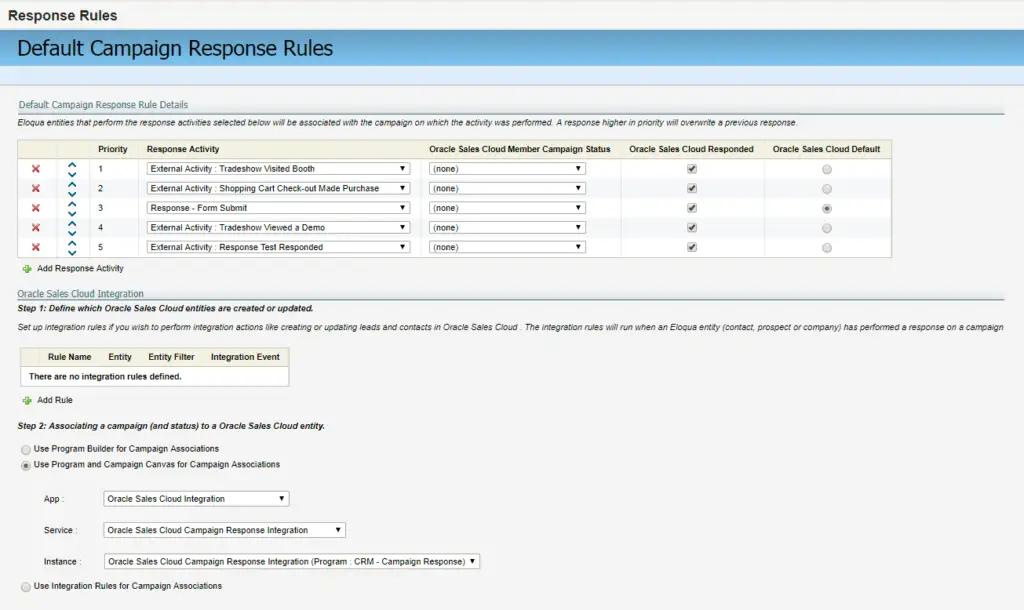
Before diving into the mechanics, it’s crucial to grasp the fundamental building blocks of Eloqua Campaign Responses. These components are designed to work harmoniously, creating a continuous flow of information that connects your marketing efforts directly to your CRM. First, we have Campaign Activities, also known as Response Activities. These are the specific actions your contacts take when interacting with your campaigns.

Think of them as the footprints they leave behind. These activities fall into two main categories: Internal Activities, which are actions that occur directly within Eloqua, such as opening emails, clicking links, or submitting forms; and External Activities, which are actions taken outside of Eloqua, like registering for or attending a webinar, but can still be tracked and integrated into your campaign data.

These activities are the raw data that Eloqua transforms into actionable insights.

Campaign Response Rules

These are the defined parameters that dictate which activities are considered significant responses. They are prioritized to ensure that the most relevant interaction is recorded.

This prioritization is very important because if a customer attends a webinar and clicks an email, depending on your prioritization, the webinar attendance could be designated as more important to record than the email click.

Eloqua Campaign Responses, Campaign Response Rules, CRM Integration, Marketing Automation, Lead Tracking, Customer Engagement, CRM Member Status, Eloqua Bulk API

Campaign Responses (Campaign Member Status)

This represents the final, highest-priority activity transmitted to the CRM, providing a concise overview of the contact’s engagement. Examples of campaign responses are “registered,” “attended,” and “responded.”

The Mechanics of Campaign Responses in Eloqua

The Eloqua email campaign serves as the cornerstone of this process. The CRM campaign ID acts as a linkage point, ensuring accurate tracking and recording of campaign activity within the CRM system.

  • Campaign Setup: When setting up a campaign within Eloqua, it’s crucial to include all relevant assets, such as email assets and associated forms, on the campaign canvas. Linking the Eloqua campaign to the corresponding CRM campaign ID ensures data integrity.
  • Activity Tracking: Once the campaign is activated, Eloqua diligently tracks response activities, including email clicks and form submissions. Furthermore, external activities, such as webinar registration and attendance, can be incorporated as campaign responses, providing a holistic view of customer engagement.
  • Response Rule Configuration: Response rules are pivotal in defining what constitutes a campaign response. This involves setting parameters for activities like email sends, clicks, and form submissions, and mapping these activities to CRM member statuses. For instance, activities can be designated as ‘Attended’, ‘Registered’, or ‘Responded’, depending on the specific action taken by the contact.

  • Prioritization: Prioritizing these response rules is equally vital. When multiple response activities occur, Eloqua sends the highest priority activity to the CRM. This ensures that the most significant interaction is accurately recorded, providing valuable insights for sales and marketing teams.

Processing and Delivering Campaign Responses

The process of converting campaign activities into campaign responses occurs in the background of Eloqua. Every five minutes, Eloqua processes these activities and updates the campaign response table. Understanding this timing is crucial for troubleshooting issues related to delayed CRM updates.

Eloqua offers multiple methods for transmitting campaign responses to a CRM system, each with its own advantages:

  • Program Builder: This method is recommended for non-Salesforce CRM systems, such as Microsoft Dynamics. It allows for more customized workflows, ensuring accurate reflection of campaign responses in the CRM.
  • Program or Campaign Canvas: This method is particularly effective for Salesforce and Oracle Sales Cloud. It utilizes listener steps to automatically trigger CRM updates once campaign responses are generated.

  • Integration Rules: This method offers another avenue for transferring campaign response data, providing flexibility for specific integration requirements.

It’s important to note that only one of these methods can be selected at a time, so careful consideration should be given to choosing the most appropriate approach for your organization’s needs.

Practical Application and Best Practices

To ensure a seamless flow of campaign responses from Eloqua to your CRM, consider the following best practices:

Accurate Campaign Setup

Ensure that your campaign is set up with the correct CRM campaign ID to maintain data integrity.

Precise Response Rule Definition

Define and prioritize response rules accurately to capture the most relevant customer interactions.

Appropriate Integration Method Selection

Utilize the most suitable method (Program Builder, Program Canvas, or Integration Rules) to send responses to your CRM.

Understanding the Eloqua Bulk API

For those needing to pull or manipulate the data, understanding the Eloqua Bulk API is important. This allows for better automation of reports, and data manipulation.

By adhering to these best practices, you can ensure that all relevant interactions are captured and reflected in your CRM, providing valuable insights for your sales and marketing teams.

Conclusion:

Wouldn’t it be incredible to really see how your customers move through your campaigns, to know exactly which actions nudge them closer to a sale? That’s the promise of Eloqua’s campaign responses, turning every click and interaction into a story you can use. You’ve got the tool, and the potential is huge, but let’s be honest, getting all the pieces to fit—the strategic setup, the backend stuff, and making it play nice with your CRM—it can feel like a mountain to climb.

To truly get the most out of Eloqua, to make those smarter decisions and see those marketing wins, having someone who’s been there, done that, makes all the difference. Eloqua, in the right hands, can seriously boost your engagement and conversions. So, instead of letting the technical bits hold you back, why not have a chat? Let’s see how we can make Eloqua work its magic for you.


Effective lead nurturing is a critical component of successful B2B marketing strategies. Distributing content without a targeted framework often leads to inefficient resource allocation and suboptimal lead conversion. This article will delve into the powerful integration of Marketo Nurture Stream Programs and Lead Scoring, demonstrating how these steps can be leveraged to establish meaningful relationships with leads and drive measurable revenue growth. We will examine the mechanics of these tools and illustrate their capacity to automate converting potential clients into valuable, sales-ready prospects.

The Magic of Marketo Nurture Streams:

Marketo Nurture Stream Programs facilitate a refined, gradual engagement approach akin to the meticulous preparation of a custom blend. Rather than employing indiscriminate email campaigns, these programs deliver highly personalized content tailored to each lead’s specific stage within the buyer’s journey. This strategy prioritizes relationship cultivation over unsolicited mass communication. The operational framework of these programs can be summarized as follows:

  • Strategic Stream Segmentation: Marketo Nurture Streams are structured into distinct pathways, such as ‘Top of Funnel,’ ‘Middle of Funnel,’ and ‘Bottom of Funnel,’ to accommodate varied lead progression.
  • Dynamic Content Delivery: Each stream is configured with a unique cadence, targeted content, and transition rules, ensuring timely and relevant communication.
  • Scalable Personalization: Leveraging tokens, snippets, and intelligent segmentation, Marketo enables the efficient deployment of personalized marketing initiatives, achieving a high degree of individualization at scale.

Through these steps, marketers can effectively guide leads through the sales pipeline, enhancing engagement and fostering a more productive sales environment.

Marketo Nurture & Lead Scoring: Your Intent Decoder

A key aspect of successful lead management is recognizing when a lead moves from the nurturing phase to being sales-ready. Without a robust scoring mechanism, marketers operate without precise indicators of buyer intent, resulting in inefficient resource allocation. Lead scoring provides a quantitative methodology to assess and prioritize leads based on predefined criteria, facilitating a more targeted sales engagement strategy. The key elements of this scoring process are outlined below:

Demographic Qualification

This assesses the alignment of a lead with the ideal customer profile, considering factors such as job title, company size, and geographical location. This ensures that sales efforts are focused on prospects that match strategic business objectives.

Behavioral Engagement Analysis

This measures the level of interaction a lead has with marketing assets, including website visits, form submissions, and email engagement. This provides insights into the lead’s active interest and readiness to engage further.

Threshold-Driven Sales Enablement

Upon reaching a predefined scoring threshold, automated alerts are triggered to notify the sales team, and leads are seamlessly transitioned through the nurture streams. This facilitates a streamlined handoff process, ensuring timely and effective sales engagement.

By implementing a structured lead scoring framework, organizations can optimize their sales pipeline, enhancing the efficiency of their sales teams and maximizing conversion rates.

The Power Couple: Marketo Nurture + Lead Scoring

The true efficacy of Marketo‘s capabilities is realized through the integrated application of Marketo nurture programs and lead scoring. This synergy creates a robust revenue generation system, optimizing the lead-to-customer conversion process. By systematically nurturing leads and accurately identifying sales-ready prospects, organizations can prioritize quality interactions over mere volume, significantly enhancing the efficiency of their sales pipeline.

Strategic Implementation Recommendation

  • Rigorous A/B Testing: Conduct comprehensive A/B testing to determine optimal content and messaging strategies, ensuring data-driven decision-making.”
  • Periodic Scoring Model Refinement: “Implement quarterly reviews of the lead scoring model to adapt to evolving buyer behaviors and market dynamics, maintaining relevance and accuracy.
  • Cross-Functional Alignment: Foster seamless alignment between sales and marketing teams, establishing shared objectives and metrics to ensure cohesive lead management and revenue generation efforts.
  • Automated Lifecycle Management: Utilize intelligent transition rules to automate lead progression through the lifecycle, optimizing resource allocation and enhancing operational efficiency.

By adhering to these strategic recommendations, organizations can maximize the return on their marketing automation investments and achieve sustainable revenue growth.

Conclusion:

Achieving meaningful growth starts with connecting your marketing efforts to real buyer intent. Marketo Nurture Stream Programs and Lead Scoring offer a powerful framework to identify, prioritize, and engage the right leads at the right time. When used effectively, these tools move your strategy beyond guesswork and vanity metrics, enabling consistent, relevant communication that builds trust and accelerates pipeline. This article explores how to shift from reactive marketing to a data-driven approach that drives measurable impact and long-term success.

Contact us…


Your company has chosen a specialized application that does not offer built-in integration with your marketing automation platform.  So, what are your options?  You could use an integration platform with connectors for your business software and marketing automation system.  However, these solutions can be costly and require expertise to install and configure.  Another option that might be ideal for your situation is a custom API integration.  It’s not just about connecting systems; it’s about crafting a seamless experience and a streamlined workflow for your team.

Understanding the Digital Bridge: APIs and Custom API Integration

When we talk about APIs, we talk about the language that allows different software systems to communicate. In a custom API integration, we’re creating a tailored dialogue, a specific set of instructions that enable your systems to exchange data and functionality in a way that perfectly suits your needs. This is more than just connecting; this is orchestration. Think of it this way: to achieve a robust custom API integration, you are building a dedicated data highway optimized for your specific traffic. Here are some technical aspects of custom API integration that you should know:

  • RESTful APIs and JSON data formats are commonly used in custom API integration for flexibility and efficiency.
  • Security is paramount in custom API integration
  • Effective integration demands precise data mapping to prevent errors.

The Strategic Advantage:

For marketers, custom API integration is not a luxury; it’s a necessity. It’s about more than just syncing data; it’s about creating an intelligent, responsive marketing ecosystem. Without robust integrations, your marketing efforts are disjointed and ineffective, like a symphony without a conductor. Consider these benefits:

  • Achieve unparalleled data accuracy, ensuring every customer interaction is informed by reliable information.
  • Automate complex workflows, allowing your team to focus on strategic initiatives.
  • Deliver personalized customer experiences, leading to increased engagement and conversions.
  • Scale your marketing efforts, adapting to the evolving needs of your business.
  • Maximize your ROI, optimizing every marketing campaign for peak performance.

Real-World Applications

While out-of-the-box solutions are our starting point, we excel in crafting bespoke integrations when necessary. Our approach begins with a thorough exploration of existing integration possibilities. We prioritize leveraging native integrations or simple workarounds to minimize complexity and time investment. However, when custom solutions are imperative, our expertise shines.

We recently developed a tailored Eloqua cloud app for a financial services client, bridging the gap with their customer data platform. This integration enabled seamless segmentation data transfer, creating dynamic objects within Eloqua and significantly enhancing their targeted marketing efforts. Similarly, for a media and communications company, we created an app to streamline contact marketability checks, ensuring compliance and optimizing outreach.

Our most extensive project involved a bi-directional integration for a large enterprise client, linking Eloqua with their CRM system during a platform migration. This complex undertaking, requiring custom APIs and an Identity Server, facilitated real-time data exchange, effectively replicating a native integration. This project presented unique challenges, demanding meticulous development and testing to ensure seamless operation.

These projects exemplify our commitment to delivering precise, effective custom API integrations. Whether it’s a cloud app or a comprehensive server-based solution, our process ensures a seamless, tailored experience, driving efficiency and ROI for our clients. We understand that custom API integration is not just about connecting systems; it’s about optimizing them for peak performance.

Eloqua’s and Marketo’s Custom API Integration

Eloqua and Marketo are powerful platforms with robust APIs. A well-designed custom API integration allows your business-critical software to communicate with these platforms. When you are considering integration, think of it as optimizing the performance of already powerful platforms.

Partnering for Success: 4thought Marketing’s Custom API Integration Expertise

At 4thought Marketing, we specialize in crafting bespoke custom API integration solutions. We understand the nuances of API development and the complexities of integrating diverse systems. Our team works closely with you to design and implement custom API integration strategies that drive tangible results. We are experts in custom API integration. Ready to transform your marketing ecosystem with custom API integration? Contact us for a consultation today. Let’s explore how we can help you unlock the full potential of your marketing efforts.


Privacy laws continue to evolve rapidly, with consumer expectations reaching new heights, making data privacy marketing a vital focus for businesses moving forward. As marketers navigate this shifting landscape, balancing personalization with compliance has become even more critical for maintaining brand integrity. Privacy isn’t just a consideration—it’s a cornerstone of successful marketing. Marketing privacy efforts play a significant role in building and retaining customer trust, ensuring that marketing strategies align with consumer expectations. Here’s a look at the latest challenges and actionable solutions to help marketers stay ahead.

Privacy as a Competitive Edge in Data Privacy Marketing

The misconception that privacy regulations stifle creativity persists, but forward-thinking marketers know better. Privacy is a competitive edge that can set your brand apart, especially when it comes to data privacy marketing approaches that foster strong customer relationships. With regulations like the Digital Markets Act (DMA) in the EU and expanded provisions under CCPA 2.0, transparency and robust data protection are more crucial than ever. Start by embedding privacy into your strategy from the get-go. Use it as a marketing differentiator—highlight your brand’s commitment to protecting customer data in your messaging to build trust and loyalty. By positioning marketing privacy compliance at the heart of your efforts, you can showcase your dedication to ethical data practices while still innovating.

Addressing Resistance to Privacy Innovation and Data Privacy Regulations

Resistance to privacy-driven changes remains a hurdle, especially as newer regulations like India’s DPDP Act and stricter enforcement of global data privacy regulations come into play. To overcome this, focus on fostering a mindset shift that emphasizes marketing privacy initiatives as a catalyst for growth. Organize hands-on workshops that demonstrate how privacy tools and practices can streamline workflows rather than disrupt them. Share updated case studies, like Meta’s multimillion-dollar penalties in 2024, to illustrate the financial and reputational consequences of non-compliance. Emphasizing the benefits of data privacy marketing can help teams see privacy as a way to add value for customers and drive loyalty.

Navigating Expanding Global Data Privacy Regulations

The privacy landscape includes more stringent global laws, including updates to GDPR and new regional frameworks in Asia and South America. For marketers handling multi-jurisdictional campaigns, staying compliant is becoming increasingly complex. Use AI-powered compliance platforms to monitor data privacy regulations across borders in real-time, a strategy that aligns well with progressive marketing privacy objectives. Regularly collaborate with legal and privacy teams to ensure your campaigns are built with a global perspective, avoiding costly mistakes. By proactively integrating data privacy marketing tactics, you can address each market’s unique requirements while building a consistent, trustworthy brand image.

Strengthening Cross-Departmental Privacy Collaboration

Marketing teams rely heavily on data from IT, analytics, and external vendors. Ensuring privacy compliance across these touchpoints is non-negotiable, which underscores the importance of data privacy marketing at every level. Build a culture of accountability by establishing privacy champions in every department. Update your workflows to include regular cross-departmental check-ins and shared dashboards for tracking compliance metrics. Simplify processes like DSARs and vendor assessments by leveraging collaborative tools that integrate privacy management across departments. By championing marketing privacy goals internally, each team can align on the importance of safeguarding customer information and maintaining consistent data practices. Understanding the impact of data privacy in marketing is crucial for this collaboration.

Overcoming Limited Resources Amid Growing Expectations

Privacy teams still face resource challenges, but the demand for comprehensive privacy measures has never been higher. Marketers can make a stronger case for increased investment by quantifying the ROI of privacy initiatives, positioning this as part of a broader data privacy marketing strategy. Highlight how improved customer trust leads to higher retention rates and how risk mitigation saves on potential legal costs. Look into blockchain-based tools for enhanced transparency and automation, which can stretch limited resources further. Incorporating marketing privacy solutions into budget proposals can also help leadership understand the long-term financial and reputational benefits. Recognizing the impact of data privacy in marketing helps to quantify this ROI.

Scaling Privacy Programs for Future Growth and Data Privacy Regulations

As businesses expand, their data ecosystems grow more complex. Scalability is a top priority for privacy programs, especially when factoring in global data privacy regulations and multi-platform campaigns. Marketers should partner with privacy experts to adopt modular tools that can grow alongside organizational needs and support marketing privacy frameworks. Focus on building flexible processes that allow for quick adaptation to new regulations or business models. For instance, consider using decentralized data storage solutions that align with stricter privacy laws while supporting scalability. By planning for future growth, your data privacy marketing initiatives remain resilient and ready to adapt.

Simplifying Privacy Technology for Effective Data Privacy

The privacy tech landscape is evolving rapidly, with smarter and more intuitive tools emerging. Marketers must prioritize solutions that integrate seamlessly into existing workflows without sacrificing functionality, aligning with data privacy marketing goals. Opt for platforms that use machine learning to automate consent tracking, data audits, and compliance checks. By simplifying these processes, your team can focus on crafting impactful campaigns while maintaining regulatory compliance. Embracing marketing privacy solutions that are easy to integrate can ultimately enhance efficiency and reduce the risk of privacy missteps.

Understanding the Impact of Data Privacy in Marketing

Privacy isn’t just a regulatory necessity—it’s a chance to strengthen your brand and build deeper connections with your audience. Success lies in embracing privacy as a core element of your marketing strategy, leveraging data privacy marketing insights to drive brand differentiation. And you don’t have to navigate this alone. Our team of privacy experts is here to help you implement the latest solutions and tools, tailored to your unique needs. Let’s turn privacy challenges into opportunities for growth. Contact us today to get started, and discover how marketing privacy innovations can position your brand for long-term success.


Oracle Guided Campaigns, Eloqua Add-ons

Modern marketing thrives on personalization. Yet crafting email campaigns that resonate with individual prospects while maintaining brand consistency can feel overwhelming. You might have strong ideas for positioning your brand, but aligning teams, creating approved materials, and delivering a seamless email experience can be challenging. This is where Oracle’s solution comes in, helping you streamline every stage of your campaign while preserving a high level of quality in all communications.

Oracle Guided Campaigns offer a structured approach that relieves the burden of crafting brand-approved emails on tight deadlines or with limited resources. If you work in B2B marketing or technology, you’ve probably seen how quickly campaigns can grow complex—especially when you need to target multiple accounts with highly personalized messaging. These guided campaigns, powered by Oracle Eloqua, simplify that workflow and ensure you can quickly launch messages that stay on brand. Whether you’re dealing with dozens or thousands of contacts, the platform’s step-by-step process cuts down manual labor, enforces your branding guidelines, and keeps your outreach relevant.

What is Oracle Guided Campaigns?

Oracle Guided Campaigns are a structured framework that walks you through the process of designing and executing effective email outreach. They’re built to serve fast-paced marketing environments by laying out step-by-step instructions for tailoring messages. The goal is to help you easily create campaigns that are both brand-approved and highly specific to each segment of your audience.

By guiding you through each stage, these campaigns simplify how you blend personalization with consistent branding. Instead of starting every email from scratch, you can adopt ready-made templates that protect your brand voice. This approach also ensures you keep customers engaged with relevant content and meet your organizational standards for quality, style, and message consistency.

A key piece of Oracle Guided Campaigns relies on Oracle Eloqua. Eloqua provides the rules, segmentation tools, and integrations needed to manage data flows and personalize emails at scale. You can seamlessly pull in critical information like purchase history or previous interactions, thanks to Oracle’s ecosystem of advanced features. The result is a ready-to-launch email stream that captures attention and drives conversions across multiple accounts.

We’ll now take a closer look at the key benefits that make Oracle Guided Campaigns a powerful choice for your marketing efforts.

Key Benefits of Oracle Guided Campaigns

Oracle Guided Campaigns do more than just provide a convenient template for your outreach. They significantly reduce the manual tasks that often bog down campaign creation. Rather than building complex workflows from the ground up, you can rely on automation to schedule sends, track responses, and pull in customer details—letting you focus on strategy and creativity instead of repetitive processes.

When it comes to ensuring brand consistency, these guided campaigns excel by offering pre-approved templates and messaging. You’re free to personalize content while still following design and language standards, so your emails reflect the same professional image every time. This consistency fosters stronger brand loyalty, boosts trust, and makes it easier for potential clients to recognize your company in their inbox.

Personalization takes another leap forward with Oracle’s AI-driven audience targeting and account-based scoring capabilities. By layering audience intelligence features such as Oracle Unity, you can identify which prospects are most likely to engage with particular messages. This type of precision has already helped companies in technology markets deliver highly relevant emails at exactly the right time, while Eloqua marketers have cut through the clutter in crowded inboxes with content shaped by real data and insights.

Features That Make Oracle Guided Campaigns Stand Out

One of the biggest strengths of Oracle Guided Campaigns lies in its prebuilt workflows and audience targeting tools. Marketers can select from a variety of templates, such as basic single-email messages or more complex, multi-step nurture layouts. These workflows help you map out timing, frequency, and content flow with minimal guesswork. By combining them with Oracle Eloqua’s data segmentation and automation, you can unify your outreach strategy in one convenient interface.

Long-term engagement is made possible through the multi-step nurture feature. Instead of sending a single touchpoint and hoping for results, you can build a structured series of messages that respond to how leads interact with your emails. Technology companies often leverage multi-step campaigns to onboard prospects or upsell existing customers on related services. Each piece of content gets delivered exactly when it’s most likely to resonate.

Actionable analytics are another area where these guided campaigns shine. Real-time reporting lets you see how each email is performing, giving you clear indicators of whether your audience targeting and content strategy are hitting the mark. Detailed dashboards highlight open rates, click-throughs, and conversions across target accounts. If a particular message isn’t gaining traction, you can adjust on the fly, ensuring your communications stay agile and finely tuned to audience needs.

Next, we’ll discuss the best ways to implement these powerful campaigns so you can get the most value from each feature.

How to Implement Oracle Guided Campaigns for Maximum Impact

Oracle Guided Campaigns, Eloqua Add-ons

One of the first steps is to connect Oracle Guided Campaigns with Oracle Eloqua and any other tools you rely on. Whether you’re running CRM integrations or leveraging AI-driven insights, a seamless connection means data flows smoothly and personalization happens in real time. This can make a major difference in industries where high-value leads require multiple touches, or in technology sectors, where you might have large product catalogs and complex buyer journeys.

When setting up new campaigns, take time to define your audience segments clearly. Identify which attributes—such as industry, purchasing intent, or past engagement—will guide how you tailor content. Planning your content upfront also saves time, as Oracle’s templated system makes it easy to reuse artwork, copy blocks, or personalized tokens across different segments. By keeping this process organized, you can stay focused on fine-tuning the messaging rather than piecing everything together at the last minute.

Training is another key factor. Even though Oracle Guided Campaigns streamline many tasks, your team still needs to feel confident in using them. Workshops or hands-on sessions can help them quickly master the platform’s interface, from configuring multi-step nurtures to adjusting brand-approved templates. You’ll find that even a small investment in ongoing education leads to higher-quality campaigns that go out the door faster.

We’ve covered the nuts and bolts of standing up Oracle Guided Campaigns. Next, let’s recap the transformative value they bring and show you how you can take action to elevate your marketing approach.

Unlock the Potential of Oracle Guided Campaigns Today

Oracle Guided Campaigns can fundamentally change how your organization approaches email outreach. By bringing together personalization, brand consistency, and time-saving automation, you’ll be able to create communications that truly resonate with each person on your list. B2B marketing agencies have seen success generating targeted leads ready for deeper engagement, while technology companies often leverage the system for onboarding, upselling, and maintaining continuous conversations with key accounts. With more control and insight, your marketing efforts become not just more efficient, but more impactful. If you’re ready to see tangible results, now’s the time to act. We encourage you to explore Oracle Guided Campaigns by visiting the official website or scheduling a demo. You’ll see firsthand how you can streamline your marketing ecosystem and deliver meaningful interactions that keep your brand top of mind.


Data is a critical asset for marketing professionals in today’s marketing environment. The imperative lies in effectively utilizing personal information for targeted campaigns while adhering to stringent privacy regulations. This necessity extends beyond legal compliance; it encompasses cultivating trust and respect with clients. Establishing a robust privacy first marketing approach is essential for fostering enduring client relationships and maintaining brand integrity in an increasingly data-conscious market.

GDPR, CCPA, and Beyond in Privacy First Marketing

Imagine you’re navigating a whitewater rafting course. That’s what dealing with regulations like GDPR and CCPA feels like. One wrong move, and you’re capsized.

  • GDPR (General Data Protection Regulation): This European titan demands explicit consent, data minimization, and the “right to be forgotten.” For instance, a UK-based e-commerce site must now ensure that customers can easily access, modify, or delete their personal data. Failure to comply can result in fines exceeding 4% of annual global turnover.
  • CCPA (California Consumer Privacy Act): Across the pond, the CCPA grants California residents the right to know what data is collected, to opt out of sales, and to request deletion. A marketing agency running targeted ads in California must be transparent about its data collection practices and provide clear opt-out options.

The real struggle is juggling these diverse regulations while maintaining a seamless customer experience. As governments worldwide grapple with ethical data use, we should expect more stringent regulations regarding AI-driven marketing, further emphasizing the need for privacy first marketing.

The Value Exchange in Privacy First Marketing

Think of data as a gift, not a commodity. Users give it willingly when they see the value. To illustrate, consider how Netflix suggests shows based on your viewing history; that’s a value exchange where they use your data to enhance your entertainment experience. Similarly, a fitness app offering premium workout routines in exchange for tracking your activity benefits both parties. Loyalty programs, too, offering personalized discounts based on purchase history, build customer loyalty. The key to successful value exchange? Transparency is paramount. Clearly communicate what data you collect and how it’s used, a core principle of privacy first marketing.

Building Brand Loyalty through Privacy First Marketing

Imagine a customer who receives a personalized email, not because their data was scraped from some shady source, but because they opted in. They feel valued, respected. That’s the power of privacy first marketing. A recent study by Pew Research Center found that 81% of Americans say they are concerned about the data collected by companies. A small business, initially struggling with customer trust, implemented a transparent data policy and saw a 30% increase in customer retention within six months. When brands respect user privacy, they build lasting relationships.

Technology and Privacy: A Dynamic Duo in Privacy First Marketing

Privacy-Enhancing Technologies (PETs), such as differential privacy, minimize the risk of re-identification while still allowing for data analysis. Robust encryption and access controls are essential to protect sensitive data from breaches. The era of third-party cookies is fading. First-party data, collected with user consent, is the new gold. Brands must focus on building direct relationships with their customers, a key element of privacy first marketing.

Privacy Compliance Checklist:

  • Obtain explicit consent for data collection.
  • Clearly communicate data usage and storage practices.
  • Implement data minimization: collect only necessary data.
  • Provide easy opt-out options.
  • Ensure secure data storage and transmission.
  • Regularly update privacy policies to reflect regulatory changes.
  • Train marketing personnel on privacy best practices.
  • Audit marketing activities for compliance.
  • Utilize privacy enhancing technologies.
  • Prioritize first party data collection.

4thought Marketing: Your Privacy Compass in Privacy First Marketing

Marketers are constantly challenged by the increasing complexity of privacy regulations and the growing demand for personalized experiences. Because consumers are more aware of their data rights and increasingly choose brands that prioritize privacy. 4thought Marketing provides expert guidance and support to help businesses build privacy first marketing strategies that foster trust and drive sustainable growth. Our services are designed to navigate this complex landscape. With 4Comply, we can integrate privacy compliance into your marketing workflows, ensuring privacy is built into every process step. Finally, we conduct thorough audits of your current marketing practices to identify potential risks and ensure compliance.

Conclusion

By embracing a privacy first marketing mindset, you’re not just complying with regulations; you’re building a brand that customers trust and respect. Contact 4thought Marketing to learn how we can help you navigate the privacy landscape and build a sustainable, ethical marketing strategy.


4Thought Marketing Logo   April 8, 2026 | Page 1 of 1 | https://4thoughtmarketing.com/articles/page/16