Marketing is a critical part of any company’s operations—but customers today are increasingly receiving too much. Marketing emails lose effectiveness when a customer regards them as merely spam. The last thing any marketer wants is for their messages to be ignored or, worse, blocked. How can we, as marketers, retain our audience’s interest without overdoing it?
Part of the answer lies in giving customers control over what they receive and when. And for Eloqua users, one straightforward way to do both is the snooze program that pauses Eloqua campaigns. Watch as Queena Quý discusses this function and how to implement it here.
Anyone who has used Marketo or Salesforce knows that, like peanut butter and jelly, they work best together. That’s why you’ll want to pursue one critical plan: integration.
Marketo & Salesforce: The Basics
Marketo and Salesforce are both powerful platforms that offer significant value to marketers. But they do play slightly different roles. To briefly summarize each:
Marketo: As a robust marketing automation platform, Marketo empowers businesses to engage prospects and customers across their journey. With tools spanning lead generation, nurturing, and comprehensive analytics, Marketo facilitates targeted email campaigns and meaningful interactions.
Salesforce: Renowned as a premier CRM solution, Salesforce offers a comprehensive suite tailored to manage customer relationships holistically. From sales to service and marketing, Salesforce is a central hub for nurturing leads into loyal advocates.
Together, Marketo and Salesforce give your marketing strategy a significant boost.
What Can You Expect Following Integration?
Once your Marketo-Salesforce integration is complete, you can expect to see an improvement in:
Unified customer insights: Integration eliminates data silos, providing a unified view of customer data. This cohesion enables precise segmentation and personalized engagement strategies.
Streamlined lead management: Seamless syncing of leads between Marketo and Salesforce accelerates the lead-to-opportunity process, empowering sales teams with timely access to qualified leads.
Holistic reporting: Integration facilitates closed-loop reporting, enabling marketers to track campaign performance through to revenue generation. This insight-driven approach optimizes marketing strategies for tangible returns.
Personalized engagement: By leveraging comprehensive customer data from both platforms, marketers can craft hyper-targeted campaigns, driving higher engagement and conversion rates.
What Data is Synchronized Between Marketo and Salesforce?
Following an integration, Marketo and Salesforce synchronize virtually every piece of data, most notably:
It’s also important to remember that edits to leads, contacts, or Salesforce campaigns in either platform appear in both systems following an integration. However, all other synchronizations occur solely from Salesforce to Marketo.
Key Integration Features
A Marketo-Salesforce integration offers a suite of features designed to foster collaboration and efficiency:
Automated lead syncing: Bidirectional syncing ensures real-time updates between Marketo and Salesforce, maintaining data integrity across platforms.
Attribution models: Sophisticated attribution models track campaign effectiveness, providing invaluable insights into the impact of marketing efforts on revenue.
Scoring and routing: Lead scoring models developed in Marketo inform lead prioritization and automated routing in Salesforce, optimizing sales efficiency.
Data enrichment: Integration allows for enriching lead profiles with additional data from both platforms, enhancing targeting precision and personalization.
Best Practices for Implementation
Successful integration hinges on meticulous planning and execution. Here’s how to ensure a seamless implementation:
Hide fields: Be sure to hide all fields you do not need in Marketo from the sync user before clicking Sync Fields. This duplicates all the visible fields permanently—you cannot delete mistakes later.
Sandbox sync: Check Sandbox if you are syncing a Marketo Sandbox to a Salesforce Sandbox.
Start sync: If you want to look over the mappings and customize them, this is your only chance to do so! Once you click Start Salesforce sync, it’s done. Remember also that your first sync can take hours or days as Marketo copies the entire database. Later syncs will go much faster as they only update altered data.
Clear objectives: Define integration objectives and KPIs upfront to align efforts and measure success effectively.
Data hygiene: Prioritize data cleanliness and consistency across platforms to mitigate issues during integration.
Stakeholder engagement: Involve stakeholders from marketing and sales teams to gather requirements and foster collaboration.
Comprehensive training: Provide thorough training to users on integrated features to drive adoption and maximize utilization.
Continuous optimization: Regularly monitor and optimize the integration based on feedback and evolving business needs to sustain long-term value.
Successful Marketo-Salesforce Integration
Your first Marketo-Salesforce integration will take some time and effort. But once you get past the initial hurdle, future syncs and updates will go much faster. Better yet, you’ll enjoy the benefits of both platforms working together. Your marketing strategy will get a very helpful boost.
The introduction of low-code platforms turned marketing automation from complex coding into a simple, visual interface. More recently, artificial intelligence has been making a no less significant impact. Both completely changed how people thought of marketing and made certain aspects of the job simpler.
But as both technologies work in tandem, shifts in the marketing landscape could occur faster than ever. What can your company expect? Here’s what eight marketing automation specialists think.
Whether you see it as good or bad depends on which team you’re on, but AI in digital marketing automation has caused a shift for paid media managers, especially in paid search where creativity is less impactful than in more visual experiences.
Google’s (and Microsoft’s) shifts to more black-box automation and AI-driven bidding have tied the hands of paid media managers. What used to take a lot of time, consideration, and data analysis, not only isn’t as advantageous as it once was, but it isn’t even as possible.
For that reason, we’ve shifted management tactics and have embraced the big company march toward AI. At PPC Assist, we’ve launched a low-cost, on-demand management service that embraces the AI-driven, conversion-based bidding strategies promoted by Big Tech. This allows small businesses to run campaigns more efficiently, putting a much higher percentage of their budget toward actual advertising. Of course, when they want to make changes, we’re there when they need us.
This movement away from granular optimizations by paid media managers toward AI-based conversions is only going to continue in the future. Targeting options will continue to be removed and simplified in favor of AI, and sooner or later the market will have to adjust and accept it
One specific negative impact that low-code and AI have had on marketing automation is the potential for over-automation. While these technologies have made it easier to automate tasks, they’ve also led to a surge in impersonal, generic communications. Customers are increasingly receiving messages that feel robotic and lack a personal touch, which can harm the customer experience and brand perception.
Moving forward, there’s a risk that this trend could intensify. As more companies adopt low-code and AI solutions, the volume of automated communications could increase, further diluting the personal connection between brands and their customers. It’s crucial for businesses to strike a balance between efficiency and personalization, to ensure that their communications resonate with their audience and build meaningful relationships.
One issue I’ve observed with AI’s role in marketing is the flood of content it produces, which tends to be quite similar and not always of high quality. This can make it challenging for truly unique and insightful content to grab the spotlight.
Fortunately, search engines like Google have become quite adept at recognizing and rewarding original content. They’re equipped with sophisticated methods to identify and promote content that genuinely offers something new and valuable. So, looking ahead, there’s a real opportunity for creators who prioritize uniqueness and quality in their content to stand out and succeed.
4. Low-Code Democratizes Marketing for Small Businesses
In my over 25 years of experience in marketing, particularly at FireRock Marketing, I’ve seen the transformative impact of low-code platforms and AI on marketing automation. One significant impact is the democratization of technology, allowing smaller businesses with limited technical resources to implement sophisticated marketing automation systems. This has opened up new avenues for these businesses to compete with larger enterprises by enabling them to craft personalized customer experiences and automate repetitive tasks, which has led to increased efficiency and scalability.
A concrete example of this is a small retail client we partnered with. By leveraging a low-code platform, we were able to quickly deploy a customized marketing automation solution that integrated seamlessly with their existing systems. This solution automated the client’s email marketing campaigns, using AI to segment customers and personalize content based on their behavior and preferences. The result was a 40% increase in email engagement rates and a 22% rise in conversion rates within the first six months of implementation.
Looking forward, the continuous advancements in AI will push the boundaries of what marketing automation can achieve, particularly in predictive analytics and customer journey mapping. We’re likely to see systems that can not only analyze and react to customer behavior in real-time but also anticipate future actions and adapt strategies autonomously. This will enable businesses to stay several steps ahead in their marketing efforts, ensuring they remain relevant and responsive in a rapidly changing landscape. The key for businesses will be to stay informed and leverage these technologies to enhance their marketing strategies, keeping the focus on creating exceptional customer experiences.
In my journey from IT enthusiast to a leader in the startup ecosystem, I’ve witnessed the significant impact low-code and AI have made on marketing automation. A particularly compelling instance was during my time at PacketBase, where we used low-code platforms to quickly develop and deploy marketing automation tools without the need for extensive programming knowledge. This agility allowed us to iterate our marketing strategies rapidly, leveraging AI to refine and personalize communication at an unprecedented scale. We were able to triple our lead generation within a quarter, all thanks to the precision and efficiency these technologies brought into our marketing operations.
AI, in particular, has transformed the way we approach data analysis and customer engagement. For instance, by using AI-driven insights, we were able to predict customer behaviors and preferences, tailoring our marketing efforts to meet their specific needs. This not only improved our engagement rates but also significantly enhanced customer satisfaction and loyalty. The use of AI in analyzing marketing performance data helped us identify patterns and trends we would have otherwise missed, enabling us to make data-driven decisions quickly and accurately.
Looking to the future, I believe the role of low-code and AI in marketing automation will only expand, offering even more sophisticated capabilities for predictive analysis and customer journey optimization. These technologies will enable businesses to not only respond to current market trends and customer behavior but also anticipate future changes, staying ahead of the curve in a competitive landscape. The key will be to leverage these tools in creating more meaningful and personalized customer experiences, which will be paramount in achieving long-term success in any venture.
The occasional error in the information offered by AI algorithms is one disadvantage I’ve come across. Even with their enhanced capabilities, there have been times when the insights or recommendations produced by AI haven’t properly matched the state of the industry or customer behavior. As a result, certain poor decisions were made, and the effectiveness of several efforts slightly declined.
Going forward, I think it’s very important that marketers continue to make use of these tools, but they also need to continue exercising human oversight and a critical eye to ensure the data and insights produced are accurate and pertinent. Optimizing low-code and AI’s benefits for marketing automation while reducing risks will depend on striking the correct balance between automation and human judgment.
As an entrepreneur with over a decade of experience in the technology business, notably in software development and AI, I’ve seen firsthand the impact of low-code and AI on marketing automation. One specific positive impact is the democratization of automation technologies via low-code platforms, which allows marketers with limited coding skills to construct sophisticated automated workflows. This has enabled firms to streamline their marketing processes, enhance productivity, and improve results without relying heavily on technical skills.
However, one possible disadvantage of this development is the risk of oversaturation and decreasing distinction in the marketing automation field. With the rise of low-code solutions and AI-powered marketing tools, it’s conceivable that some firms may favor quantity over quality, resulting in generic, cookie-cutter ads that don’t connect with their target audience.
Looking ahead, the incorporation of AI into marketing automation is set to dramatically transform the sector. AI-powered algorithms can use massive volumes of data to tailor marketing campaigns, predict customer behavior, and optimize campaign performance in real-time. This will allow organizations to deliver hyper-targeted and highly relevant content to their target audience, resulting in increased engagement, conversion rates, and, ultimately, higher ROI.
In my experience, the integration of low-code and AI into marketing automation has brought about a significant transformation. It has democratized automation capabilities, allowing marketers like me, with limited technical skills, to create and execute advanced automated campaigns more seamlessly.
This accessibility has greatly enhanced the efficiency and scalability of our marketing operations, enabling our team to optimize resource allocation effectively. Looking ahead, I anticipate that the ongoing advancements in low-code platforms and AI technologies will further revolutionize marketing automation. This progress will empower us to develop even more personalized and targeted campaigns on a larger scale.
However, I also recognize that along with these advancements come challenges, such as the need to address data privacy concerns and establish robust governance frameworks to ensure ethical AI usage in marketing practices.
Whether your organization needs help implementing a new low-code platform, integrating with an AI tool, or both, we’ve got the skills to get you on track. Contact us today to get started.
The ideal sales experience is an in-person interaction between the vendor and prospective customer. And if you can create a similar experience online, you should see improved results over static copy on your website. But it’s not possible for every customer to visit you in person. This is why websites increasingly leverage chatbots to simulate in-person conversation to increase engagement.
The 4Thought Marketing team has helped multiple companies improve their marketing strategies and technology. Recently, we were able to do something particularly interesting with a client: getting the most value out of their AI-chat tool, Drift.
When a user visits a website with Drift active, a pop-up on the bottom right corner of the screen invites them to chat. Drift then uses this chat to collect data through the chat like a standard form submission. Drift also captures other critical information such as activity data and customer interests.
Marketo Drift Integration
Our client had already been using Marketo as their primary marketing automation platform, and used Drift for capturing general customer data. We helped them leverage the two programs working together. Our team provided the necessary help to integrate Drift and Marketo to make users’ website experiences as smooth and pleasant as possible.
This is where Drift truly shines. First, Marketo kicks off a specialized nurture campaign for the user.
Next, when the client clicks on the email and goes to a personalized landing page, Drift leverages its screen takeover, guiding the user to schedule a meeting right away.
Because Drift and Marketo are integrated, scheduling a meeting requires fewer steps, and is as simple as selecting a date and time from a provided list. This is all designed to fast-track the sales process and make scheduling a sales meeting as easy as possible for the potential client.
The results are undeniable. Customers clearly appreciate the smoothness of the entire process. Since implementing the Drift screen takeover and nurture email campaigns, our client has enjoyed a significantly higher conversion rate and increased revenue.
Leveraging AI Chatbots for Improved Marketing
The potential for AI in marketing is hard to overstate. If you’re interested in upgrading your existing marketing automation setup with an AI chatbot like Drift, get in touch with us today. We’ll help you make the customer experience all the more streamlined and straightforward.
The digital marketing landscape changes constantly, and marketing automation is at the forefront. Excelling in marketing automation is not just about understanding how to use sophisticated tools or execute campaigns. It’s about creating seamless, personalized experiences that resonate with audiences across various channels. This evolving domain requires a harmonious blend of technical skills, strategic insight, and the agility to adapt to new technologies.
Building a Strong Foundation
A successful marketing automation career lies in recognizing its complexity. It intertwines customer psychology, data analytics, and an in-depth comprehension of digital platforms to deliver impactful marketing messages. Essential facets of this foundation include:
Market dynamics: Acknowledge the significant demand for marketing automation expertise, driven by its crucial role in streamlining marketing strategies and enhancing customer engagement. This demand signals a plethora of opportunities for career growth and specialization.
Comprehensive skill set: Mastering marketing automation demands more than just operational knowledge of tools like Eloqua, HubSpot, or Marketo. It also requires:
Technical proficiency: A solid command over automation platforms, CRM systems, and an understanding of programming languages for custom solutions.
Analytical acumen: The ability to dissect and leverage data to optimize campaign strategies and measure their effectiveness.
Creative ingenuity: Creativity in content, campaign strategy, and execution to stand out in the digital noise.
Strategic outlook: A vision to align marketing automation efforts with overarching business objectives, ensuring that every automated interaction adds value to the customer journey.
Strategies for Marketing Automation Career Advancement
Progressing in the marketing automation career requires a proactive approach to career development. This strategy may include, but is not limited to:
Committing to continuous learning: Focus on improving your skills through certifications, webinars, and live events. This keeps your skills up-to-date and demonstrates your commitment to staying current with industry trends.
Demonstrating leadership in projects: Seek leadership roles in projects or initiatives within your organization. Leading a project highlights your ability to manage complex tasks and underscores your strategic thinking and problem-solving capabilities.
Cultivating a robust network: Engage with the marketing community through social media, professional groups, and industry events. Networking provides insights into emerging trends, opens doors to mentorship opportunities, and can pave the way for future career moves.
Specialize or diversify: Consider specializing in a niche area of marketing automation that fascinates you or diversifying your skill set to include adjacent fields such as SEO, content marketing, or data analytics. This can make you more versatile and valuable in the job market.
Looking Ahead: Future-Proofing Your Marketing Automation Career
The essence of thriving in a marketing automation career lies in anticipating the future of digital marketing. This means:
Embracing innovation: Stay informed about new technologies and tools to enhance marketing efficiency and effectiveness. Be open to experimenting with emerging platforms and strategies.
Adapting to change: Stay flexible! Marketing evolves rapidly, and staying on top of things is critical.
Focusing on customer experience: As technology evolves, so do customer expectations. Always prioritize creating engaging, personalized experiences that meet or exceed customer needs.
How 4Thought Marketing Can Help
Navigating a marketing automation career requires more than just technical expertise. It demands a continuous pursuit of knowledge, strategic thinking, and a proactive approach to professional development. By honing your skills, embracing ongoing learning, and staying flexible in the face of change, you can advance in your career and drive meaningful impact in the ever-evolving digital marketing landscape.
Of course, improving your knowledge of marketing automation software is an essential step in your career development. If you’re ready to take this next step, give us a call. Our Eloqua training professionals can put you on the path to learning.
Boost your Eloqua skills through real-world examples. This month, we’re exploring how to add a snooze option to pause campaigns, and enhancing data quality.
We will discuss:
Adding a snooze option to pause campaigns
Enhancing data quality in Eloqua with real-time validation
Should your marketing team continue nurturing while your sales team works on opportunities? Listen as 4Thought Marketing CEO Mark LeVell discusses the pros, cons, and options that empower sales to influence marketing nurture behavior.
If you’d like expert help with both nurturing and selling, get in touch with us today and take your marketing game to the next level.
In marketing automation, Oracle Eloqua is a leader for marketers aiming to streamline their workflows and elevate efficiency. Among its suite of tools, two features stand out for automating marketing tasks: Program Builder and Program Canvas. Both are designed to automate workflows and eliminate repetitive manual tasks, yet they cater to different needs and offer unique advantages.
Understanding Program Builder
Program Builder is a legacy automated workflow module crucial in managing and optimizing various marketing tasks. Whether for lead scoring, nurturing, data modification, or other marketing functions, Program Builder has been the go-to for marketers. It operates based on a set run mode that adjusts its processing capacity according to the size of your database. For instance:
For a small database size (classified as <50K contacts):
Priority mode: 25/cycle, 300/hr
Standard mode: 2500/cycle, 10,000/hr
Bulk mode: 10,000/cycle, 5000/hr
For a medium database size (classified as >50K and <1M contacts):
Priority mode: 100/cycle, 1200/hr
Standard mode: 12,500/cycle, 50,000/hr
Bulk mode: 50,000/cycle, 25,000/hr
For a large database size (classified as >1M contacts):
Priority mode: 250/cycle, 3,000/hr
Standard mode: 25,000/cycle, 100,000/hr
Bulk mode: 100,000/cycle, 50,000/hr
The Evolution to Program Canvas
While Program Builder has served many well, the advent of Program Canvas marks a significant leap forward in marketing automation within Oracle Eloqua. Program Canvas offers a modern, easy-to-use, drag-and-drop interface that transforms data in real-time, enhancing CRM integration, data cleansing, and security label management, among other functions. Its ability to integrate apps from the Oracle Marketing App Cloud further extends its capabilities, making it a powerful tool for automating complex marketing workflows.
Transitioning to Efficiency: Program Canvas vs. Program Builder
The transition from Program Builder to Program Canvas is not just a change of tools—it’s a strategic upgrade. For instance, a lead data standardization process that might take hours in Program Builder can be accomplished in minutes with Program Canvas, thanks to its rapid execution and the unique “Listener” step. This step continuously monitors database records based on specific criteria and updates them in real-time, a useful feature for tracking and updating lead scores instantly. Program Canvas also introduces advanced capabilities not available in Program Builder, such as using cloud apps and an advanced drag-and-drop UI.
The key differences between Program Canvas and Program Builder are:
Program Canvas
Program Builder
Processes records very fast
Standard mode: 15 minutes to process records between steps Priority mode: 5 minutes to process records
Uses a listener for field tracking; monitors database records based on specific criteria and updates them in real time; makes lead scoring very fast
Uses feeders from external programs or campaigns
Can’t use deduplication or match rules
Can use deduplication or match rule
Cannot send emails
Can send emails from each program step
Cannot create a program for companies
Can create a program for your company’s record type
Advanced but easy-to-use drag-and-drop UI
Uses the old UI from E9 to add steps and design rule
Can add a lead scoring model as a listener and update the score
Not available
Can create a contact security label program
Not available
Why Make the Switch?
The distinction between Program Canvas and Program Builder lies in their efficiency and capability to handle complex tasks swiftly. Program Canvas’s advanced UI, real-time data processing, and integration with cloud apps make it the superior choice for marketers looking to optimize their Eloqua automation processes.
However, transitioning to a new tool can be daunting, which is where we come in. Our expertise in leveraging Program Canvas to its fullest potential can help you seamlessly transition, ensuring your marketing automation system is maintained and significantly improved. From setting up sophisticated lead scoring models to automating CRM integration and beyond, our services are designed to help you unlock the full potential of Program Canvas.
We’ve also developed additional tools for Program Canvas to expand its functionality further. With default settings, Eloqua’s feeder options make it tricky to set up precise filtering criteria for particular records or last-minute edits. To fill these gaps, we created the Contact Cloud Feeder and CO Cloud Feeder cloud apps. Both apps can be configured to run every few minutes instead of only once daily. They also offer increased flexibility and more options for your filters, building upon Eloqua’s default options. With our cloud apps in your toolbox, Program Canvas will open to you even more.
Embracing the Future of Marketing Automation
The shift from Program Builder to Program Canvas is more than an upgrade; it’s a strategic move towards more efficient and effective marketing automation. With Program Canvas, marketers are equipped with a tool that speeds up processes and opens up new possibilities for data management and marketing strategies.
If you want to elevate your marketing automation and harness the full power of Oracle Eloqua, consider migrating to Program Canvas. Our team is here to assist you through every transition step, ensuring your marketing efforts are automated and optimized for the best possible outcomes. Embrace the future of marketing automation today with Program Canvas.
Any marketer knows that personalizing emails goes a long way toward conversion. Customers appreciate content tailored to their needs and interests. And for Eloqua users, there’s a straightforward way to approach email personalization: dynamic content. See what exactly dynamic content is and what it can do in this excerpt from our March 2024 Eloqua Office Hours session.
Email marketing is a cornerstone of effective communication strategies for businesses worldwide. Not only does it enable your team to reach out to potential and existing customers directly, but it also drives engagement and conversions.However, the effectiveness of any email marketing campaign hinges on its ability to deliver messages that are both accessible and engaging across a myriad of devices and email clients. This is where email preview testing shines. Getting a snapshot of how emails will appear within the customer’s email client ensures marketers can refine their messages to perfection before hitting send.Today, we’ll look a little closer at what email preview testing is, why it’s essential, and the best ways to do it.
What is Email Preview Testing?
Email preview testing is a process that allows marketers to preview how their email campaigns will look across different email clients and devices. This is crucial because each email client and device can display the same email in varied ways, potentially affecting layout, design, and overall readability. The aim is to identify and rectify any issues hindering the recipient’s engagement with the email.
Why is Email Preview Testing Important?
Every email marketing campaign must include a preview testing stage because:
It ensures compatibility and consistency: ensuring your email appears as intended across different email providers and devices is daunting. Email preview testing mitigates this by highlighting discrepancies across platforms, allowing for adjustments that ensure a consistent and professional appearance.
It enhances user experience: A well-designed email that looks great across all platforms significantly improves the user experience. This elevates the brand’s perception and makes it more likely that the recipient will click through to your website.
It boosts email engagement rates: Emails optimized for readability and engagement are more likely to be opened, read, and acted upon. Preview testing allows marketers to make informed decisions on layout, design, and content, making the final campaign more effective.
It reduces the risk of spam filtering: Emails with broken layouts or unoptimized images can trigger spam filters. Marketers can reduce this risk by conducting thorough preview tests and ensuring their emails reach their intended audience.
Overview of Effective Email Preview Testing
A comprehensive email preview testing strategy should include several key components to ensure that every aspect of the email is optimized for success. These components include:
Testing across multiple email clients and devices: See how your email renders on the most popular email clients and a range of devices. This ensures your message is effectively conveyed regardless of how or where it is viewed.
Checking load times: Heavy emails with large images or complex HTML can take longer to load, especially on mobile devices with slower internet connections. Preview testing should include checking email load times to ensure they open quickly, reducing the chance of recipient frustration and email abandonment.
Verifying links and call-to-action (CTA) buttons: All links and CTA buttons in the email should be tested to ensure they direct to the correct pages and are easily clickable across all devices. This is critical for driving conversions and engagement from your email campaigns.
Assessing subject lines and preview header texts: Your subject line and preview text can make or break an email campaign. Experimenting with different variations (often called A/B testing) can provide insights into what resonates best with your audience.
Analyzing spam score: Emails that are likely to be marked as spam will never reach their audience. Using tools to analyze the spam score of your email can help identify elements that need to be modified to avoid spam filters.
Don’t Skip the Preview Stage
Email preview testing is a non-negotiable aspect of modern email marketing strategies. Investing time and resources into comprehensive preview testing can set the stage for successful email marketing campaigns that resonate with audiences and achieve desired objectives.But sometimes, you need an outside perspective. Or maybe your emails pass preview tests but still aren’t getting the desired results. That’s where we come in. Contact our team today to schedule an email efficacy evaluation and get expert help optimizing your campaigns.
Oracle Eloqua is a potent marketing automation tool. By adopting a few simple strategies, you can streamline its use, making campaign and program building and future troubleshooting much easier. This ensures you fully leverage Eloqua’s capabilities while keeping your Eloqua campaigns straightforward and manageable.
Here are a few changes to make to simplify your future Eloqua campaigns and programs:
Number Every Step in the Flow
When you have a logical process that needs to follow steps 1 through N, why not make it so that anyone who will access the asset can easily follow the path? By numbering each step, you can directly specify a specific step when showing the campaign or program to someone else. Alternatively, you can check which was the exit step of a specific record you’re trying to troubleshoot. We recommend adding a number in an increment of tens or hundreds, so that the first step is either 10 or 100, and keep going from it to 20 or 200. That way, if you ever need to add a new step to the flow, you have room to add it and not break the numeration/sequence: you can add step 15 between 10 and 20 without it feeling out of place.
Include an Error Step
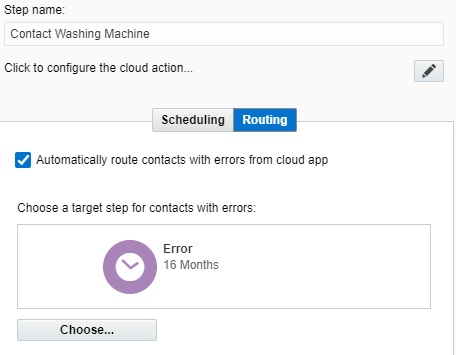
If you use apps in your Eloqua campaigns or programs, it’s a great idea to add, and route contacts to, an error step. Most Eloqua apps can be configured to do exactly that, as in this example:
This will help you a lot when troubleshooting potential issues in your process. Better yet, this allows you to process failed records differently or keep them in the flow for a manual check.
Keep Your Formatting & Labeling Consistent
Something as simple as routing all “no” decisions to the left will help you make your flow easier to follow. As part of this, adding a meaningful name to the step (along with its numeric value as explained in point 1) will make the flow feel more natural. Some steps (like wait steps) might seem self-explanatory already, but they may be serving a different purpose. For instance, wait steps can be used as placeholders while you wait for a field to be populated, or can even be used as an error step (as in point 2). Adding the intended purpose to each step’s name prevents you from forgetting why you inserted a wait step at a particular spot.
We all want to tap into Oracle Eloqua’s full potential, because it can greatly improve your marketing campaigns and bring in more leads. But it’s easy to get tangled in its complexity. If you are not certain how to get the most out of Oracle Eloqua, that’s where 4Thought Marketing can help. Get in touch with our team of marketing automation experts today to learn how to make Eloqua work for you.
Respecting user privacy is paramount in marketing automation. And for companies that want to give user privacy the attention it deserves, there’s arguably no better strategy than privacy by design. Developed by the former Privacy Commissioner of Ontario, this approach advocates for integrating data privacy principles into your marketing strategies from the outset.
But if your marketing automation framework is already up and running, you need a way to implement these privacy measures without starting over. We asked six marketing experts for their thoughts on practical ways to incorporate privacy by design into existing marketing automation plans. Here’s what they told us.
In order to ensure privacy by design is built into your marketing automation plan, it is essential to minimize data collection upfront and only gather the essential information needed to meet your goals. For example, only ask for key details like an email address and interests through opt-in forms and analytics, rather than full contact details. Allow users to access or delete their data upon request and build these capabilities directly into your marketing automation platform.
Additionally, you must design your workflows and segments with privacy at the forefront of your mind and remove any unnecessary data points that are not critical. For example, avoid overly broad segmentation that could lead to the improper use of personal data and implement granular segmentation based only on relevant behaviors. You must also put security controls in place, such as encryption and access restrictions, to protect contact data within your marketing automation system.
When collecting data, take a “less is more” approach, and only gather the minimum information required for specific marketing activities. You should only use data for the stated purposes and have stricter default settings. For example, default to opt-outs rather than opt-ins for data sharing. It is a good idea to anonymize or pseudonymize contact details where possible. An automation template for enabling auto-deletion of data after periods of inactivity is a great practice. You should focus on providing clear consent, access, and deletion rights to give users more control over their information. Embedding these privacy-focused practices at every stage of your marketing automation workflows is essential.
Overall, minimizing data collection, securing data properly, anonymizing where possible, and providing transparency and control to users are practical ways to build privacy and data protection into your marketing automation strategy from the start. This ensures you have robust governance over contact data and can build trust and compliance into your marketing programs.
A practical way to incorporate privacy by design into a marketing automation plan is to implement explicit opt-in mechanisms for all data collection and communication processes. This means ensuring that customers are fully informed about what data is being collected, how it will be used, and giving them clear, straightforward options to consent or opt out.
By integrating these opt-in features directly into your automation tools, you not only comply with privacy regulations like the GDPR, but you also build trust with your audience by respecting their privacy preferences from the outset. This approach demonstrates a commitment to ethical data practices, enhancing brand reputation and customer relationships.
To embed privacy by design in a marketing automation plan, implement granular consent mechanisms. Instead of a one-size-fits-all approach, offer users clear choices regarding data usage. Allow them to customize their privacy preferences, specifying the types of communication they’re comfortable with. This ensures transparency and empowers users to control their data.
By integrating these privacy choices seamlessly into your automation workflows, you not only comply with regulations but also build trust with your audience. It’s a practical way to demonstrate a commitment to privacy while maintaining a personalized and effective marketing strategy.
Privacy by design means ensuring your business methods and technology align with your aims and goals, and having them independently verified for added trust. All details about how you handle personal data, your policies, and processes should be open to the people involved.
The technical aspects and procedures should be clear and open to both the users and those providing the service. There’s a significant focus on Fair Information Practices, which include being responsible, transparent, clear, and compliant with regulations. In this context, responsibility is paramount. This means when you collect personal data, you must also ensure its security. Everything you do related to privacy policies and procedures should be documented and recorded.
Embedding privacy by design principles in a marketing automation strategy involves prioritizing transparency and user control. A practical step is to integrate preference centers into the automation platform. This empowers customers to dictate their data usage preferences, including opting in or out of certain marketing communications.
Implementing granular consent mechanisms ensures compliance with privacy regulations while fostering trust with the audience. Furthermore, adopting a privacy-first mindset across all touchpoints, from data collection to campaign execution, reinforces the brand’s commitment to respecting user privacy.
At Love Advice, integrating privacy by design starts with anonymizing user data in our marketing automation tools. By doing so, we can still personalize and target our content effectively without compromising individual privacy.
This approach ensures that personal information is protected, fostering a secure environment for our subscribers. It’s not just about adhering to regulations; it’s about valuing our readers’ trust and privacy, which, in turn, strengthens our relationship with them.
Implementing privacy by design in your existing marketing strategy will help your business in the long run. You’ll earn customer trust and decrease your risk of privacy violations and penalties. But what’s the best place to start? Don’t worry—we can help. Contact our team of privacy experts today to kick off your privacy-first marketing rework.
April 8, 2026 | Page 1 of 1 | https://4thoughtmarketing.com/articles/page/22