The marketing funnel was built to infer buyer intent, not to map behavior precisely.
Funnel breakdowns came from human cognitive limits, not from flaws in the model.
Two-dimensional segmentation reduced relevance as buyer signals grew more complex.
AI enables multidimensional intent inference at a resolution humans cannot manage.
Marketing funnel evolution depends on signal precision, not content volume.
The funnel has survived every major shift in marketing for a reason. Not because it perfectly represents how buyers behave, but because it helps organizations decide how to respond when buyer behavior is uncertain. The real problem was never the funnel itself. It was the narrow way we learned to think about it.
The idea behind the marketing funnel evolution was always sound. It was designed as a practical mental model, a way to simplify complexity so teams could make decisions at scale. It helped marketing and sales infer intent, estimate readiness, and determine what to communicate next. The funnel was never intended to be a literal representation of human decision-making. It was an abstraction built to enable action.
Where progress stalled was not in the concept itself, but in its resolution. For decades, marketing automation operated within a two-dimensional constraint. We reduced buyers to a market segment and a funnel stage because that was all humans could reasonably manage. The marketing funnel evolution did not stop evolving because it was complete. It stopped because our cognitive capacity forced it to.
Funnels were built for inference, not precision
At its core, the marketing funnel evolution exists to answer a single question. Given what we know about this buyer right now, what is the most relevant next message.
That is an inference problem. Funnels were designed to work statistically across populations, not deterministically at the individual level. Friction emerged when teams began treating stages as fixed process steps rather than probabilistic indicators.
Buyers did not become unpredictable. They were always complex. The failure came from applying a simplified model uniformly to individuals without accounting for context, intent, or nuance.
The true limitation was dimensional compression
Traditional marketing automation relied on two dominant dimensions: market segment and funnel stage. Five segments multiplied by five stages created a manageable framework. Within that boundary, the marketing funnel evolution functioned adequately.
Reality, however, was never that simple.
Two buyers could occupy the same segment and stage while having fundamentally different needs. Product ownership, competitive exposure, geography, engagement behavior, and maturity all influence intent. Most of these signals were flattened or ignored to preserve manageability.
That compression reduced relevance. Messaging became generalized. Performance declined. Not because the funnel failed, but because its resolution was frozen at a level humans could manually sustain.
Complexity without a model does not improve outcomes
As markets matured, many organizations responded by embracing complexity. More journeys. More touchpoints. More orchestration. Yet complexity alone does not improve decision-making.
Describing a complex environment does not help teams decide what matters most in the moment. The strength of the marketing funnel evolution was never completeness. It was focus. Removing that focus without replacing it with a higher resolution model only increases noise.
Marketing did not need fewer abstractions. It needed better ones.
How AI changes what marketing can handle
Marketing automation intelligence fundamentally changes the economics of buyer modeling. AI does not make buyers more complex. It makes complexity usable.
AI systems process far more dimensions than humans can manage. They continuously reassess signals and adjust assumptions in real time. Within the marketing funnel evolution, this enables segmentation to become adaptive rather than static. Funnel position becomes inferred rather than assigned.
Buyer intent modeling shifts from periodic evaluation to continuous interpretation. AI-driven personalization emerges not from producing more content, but from weighting signals correctly.
From static stages to multidimensional inference
In an AI-enabled environment, the marketing funnel evolution does not disappear. It evolves.
Buyers may exist in different inferred states simultaneously depending on context. An account may signal readiness for one product while remaining exploratory for another. Intent is interpreted dynamically rather than forced into predefined paths.
Customer segmentation strategy becomes fluid. Segments form based on multidimensional similarity rather than static attributes. Signal-based marketing replaces campaign assumptions with real-time interpretation driven by buyer intent signals.
The funnel retains its purpose while operating at a resolution no human team could maintain manually.
Precision matters more than volume
AI lowers the cost of content creation, but relevance does not scale automatically. Without discipline, organizations risk flooding channels with personalized noise that dilutes attention.
The most effective use of marketing automation intelligence is not speaking louder. It is listening more precisely. Signal quality matters more than message quantity. Precision compounds over time. Volume does not.
The marketing funnel evolution succeeds when AI is used to improve inference rather than accelerate output indiscriminately.
What this means for marketing and sales leadership
This evolution requires a mindset shift. Funnels do not need to be defended or discarded. They need to be refined.
Teams must move from static segmentation to adaptive interpretation. From campaign planning to intent-led decisioning. From assumed readiness to continuously inferred readiness.
When marketing and sales align around shared inference models, conversations become more relevant and handoffs more effective. The funnel becomes what it was always meant to be. A guide for understanding buyer intent and determining what matters most right now.
The funnel was never the enemy
Buyers were always complex. Funnels were never meant to capture that complexity perfectly. They were designed to make action possible in its presence.
The future of the marketing funnel evolution is expansion, not abandonment. AI removes the cognitive limits that once constrained marketing to two dimensions. What emerges is a higher resolution model that respects buyer reality while preserving clarity and focus.
The funnel was never the problem. Our two-dimensional thinking was.
Final Words
The marketing funnel did not lose relevance. It lost resolution. Buyers were always complex, but two-dimensional thinking limited how well intent could be understood and acted on. AI now makes higher precision possible by allowing signals, context, and behavior to be interpreted together rather than flattened into stages. Organizations that treat this shift as an intent modeling challenge, not a content production race, will align marketing and sales more effectively and compete on relevance rather than volume. At 4Thought Marketing, we work with teams navigating this exact transition, helping them rethink funnels, data, and automation through a precision first lens that turns buyer signals into meaningful action.
Frequently Asked Questions (FAQs)
1. What does marketing funnel evolution really mean today?
Marketing funnel evolution refers to shifting from static, stage-based models toward dynamic intent inference, where buyer signals, context, and behavior are continuously interpreted to guide more relevant decisions.
2. Is the marketing funnel still relevant in modern marketing automation?
Yes. The funnel remains relevant as an inference framework, not as a rigid process. Its value lies in helping teams understand probable buyer intent and decide what action makes sense next.
3. How does AI improve buyer intent modeling in the funnel?
AI improves buyer intent modeling by analyzing multiple signals simultaneously, adjusting assumptions in real time, and supporting more precise interpretations of readiness across different contexts.
4. What is the difference between traditional segmentation and multidimensional segmentation?
Traditional segmentation relies on a limited set of attributes such as segment and stage, while multidimensional segmentation incorporates behavior, product context, geography, and engagement patterns to improve relevance.
5. Why does signal-based marketing matter more than content volume?
Signal-based marketing prioritizes understanding intent over producing more content. As attention becomes scarcer, relevance driven by accurate signal interpretation delivers stronger outcomes than volume alone.
Key Takeaways
Template libraries decay without systematic governance frameworks
Fourteen warning signs reveal operational bottlenecks and efficiency losses
Template standardization balances creative flexibility with brand consistency marketing
Four-phase methodology addresses technical and organizational challenges
Measurable outcomes validate framework effectiveness across platforms
Marketing teams invest in template libraries expecting accelerated production and brand consistency. Yet selecting the correct one or proposing a new design is the biggest challenge, timelines extend rather than compress, and brand inconsistencies multiply. This deterioration happens gradually and silently. Without realizing it, organizations accumulate template debt that erodes velocity, fragments brand execution, and slows production. As detailed in our marketing automation audit guide, template standardization intersects with workflow architecture and data governance—two critical health factors that determine system scalability.
What Template Inventory Red Flags Indicate Library Deterioration?
1. Your Template Library Contains More Variations Than Campaigns Launched Last Quarter
This pattern indicates template proliferation without governance—organizations create variations continuously while never retiring obsolete assets.
2. Production Teams Spend 20+ Minutes Searching for “The Approved Version”
When locating the correct starting point requires navigating multiple folders, comparing versions, and consulting colleagues, the library has become an obstacle rather than accelerator.
3. Templates Reference Outdated Branding, Products, or Legal Language
Templates containing outdated branding, discontinued products, or superseded legal language indicate governance failure—each organizational change should trigger systematic updates across the library.
4. Teams Bypass the Template Library and Build Emails from Scratch
Template bypassing often reflects absent stakeholder accountability rather than template quality issues. Without executive enforcement—such as CMOs declaring approved template versions mandatory—individual managers will request custom designs regardless of standardization investments.
What Governance Gaps Create Template Management Failures?
5. No Approval Process Exists Before Templates Enter Production Use
Approval workflows ensure templates meet brand, legal, and technical standards before production use. Without gates, libraries accumulate non-compliant assets.
6. Template Ownership Is Unclear When Updates Are Needed
Ambiguous ownership stalls template evolution. When brand guidelines change, privacy policies update, or technical issues surface, organizations need clear accountability for implementing corrections.
7. Version Control Doesn’t Exist—Teams Modify Templates in Place
Editing production templates directly rather than maintaining version history eliminates change reversibility, prevents conflict resolution when multiple editors work simultaneously, and makes troubleshooting nearly impossible.
8. Brand Consistency Guidelines Exist but Templates Don’t Enforce Them
Brand guidelines specify color palettes, typography, spacing, and imagery usage—but if templates don’t encode these rules automatically, enforcement depends entirely on individual compliance.
9. Template Documentation Is Missing, Outdated, or Stored Separately
Templates without accompanying usage guidelines, customization boundaries, and technical specifications create adoption barriers preventing effective use and consistent application.
What Efficiency Bottleneck Symptoms Reveal Operational Impact?
10. Campaign Production Timelines Haven’t Improved Despite Template Investments
Stagnant or declining campaign build times indicate templates add process overhead without delivering promised acceleration.
11. Different Business Units Maintain Separate Template Libraries
While business units may require specialized content, foundational elements like headers, footers, legal disclaimers, and structural components should centralize. Separate libraries multiply maintenance effort, prevent cross-team reuse, and complicate governance.
12. New Team Members Require 3+ Weeks Before They Can Use Templates Independently
If new campaign managers need extensive training before confidently using templates, the library structure, naming taxonomy, or documentation needs simplification.
13. Landing Page Templates Don’t Match Email Templates Stylistically
Visual inconsistency between email and landing page templates fragments customer experience. Prospects clicking email CTAs should arrive at landing pages with consistent design language, creating seamless journeys.
14. Template Requests Create Bottlenecks with Design or Operations Teams
When campaign managers must request new templates from centralized teams, and those requests accumulate into multi-week backlogs, template library management has created dependency rather than enabling autonomy.
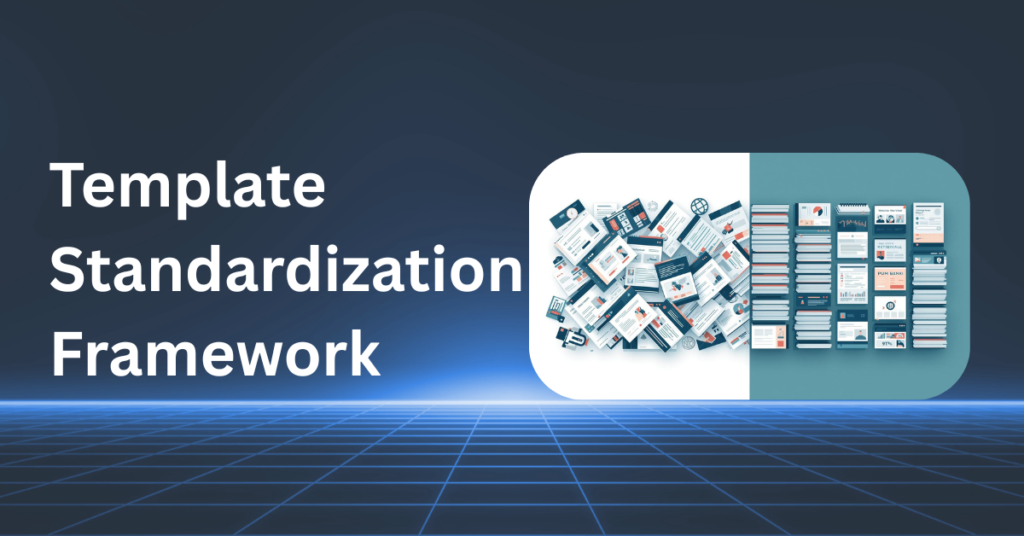
The 4TM Template Standardization Framework
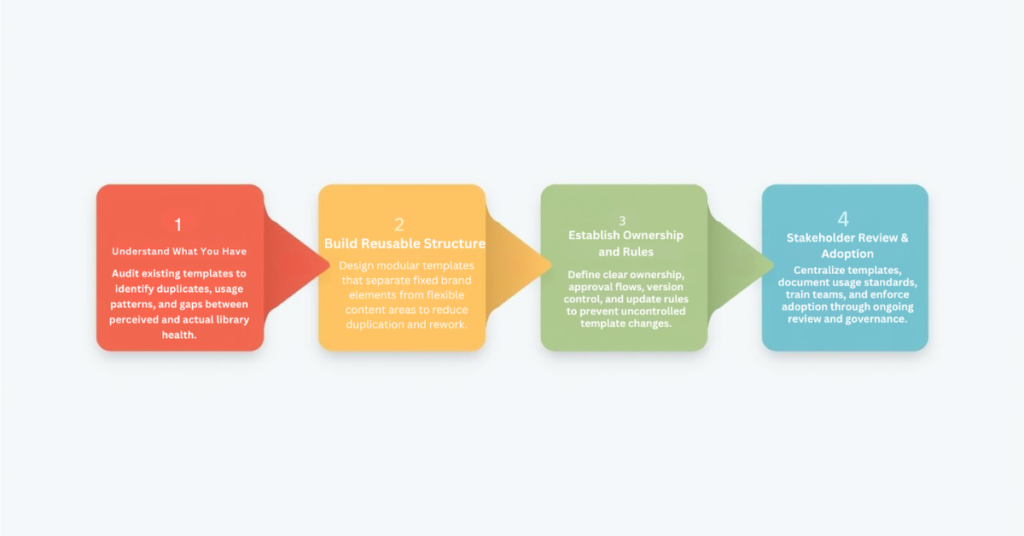
Organizations move from template chaos to operational efficiency through four structured phases addressing what exists, how it should work, who maintains it, and how teams adopt it.
Phase 1: Understand What You Have
Audit existing templates to identify volume, usage patterns, duplicates, and governance gaps. This reveals the gap between what organizations think they have and actual library health.
Phase 2: Build Reusable Structure
Create modular templates separating fixed brand elements from flexible content zones. Establish clear taxonomy (email types, landing page purposes, form functions) and version control preventing modification chaos.
Phase 3: Establish Ownership & Rules
Define who approves templates, who maintains them, and how updates happen. Assign clear ownership for template requests, brand evolution, training, and systematic retirement of outdated assets.
Phase 4: Stakeholder Review
Implement centralized library with documentation, secure stakeholder review and approval of standardized templates, communicate mandatory usage expectations, train teams on proper usage, and conduct quarterly audits. Capture feedback loops showing what works and what needs evolution
Measuring Success
Organizations track three outcome categories:
Efficiency: Campaign production time (30-40% reduction target), template search time (under 3 minutes), new team member ramp time (under 1 week).
Quality: Brand compliance score (95%+ target), template utilization rate (80%+ adoption), library health ratio (60%+ active templates).
Operations: Template request backlog (under 10 days), cross-team reuse patterns, documentation completeness (100% for production templates).
Conclusion
Template standardization represents the intersection of workflow architecture, data governance, and operational efficiency. Organizations recognizing these fourteen warning signs early implement systematic frameworks preventing template libraries from becoming operational liabilities.
4Thought Marketing’s Campaign Services team has implemented this methodology across platforms, industries, and organizational scales. Whether your diagnostic revealed early warnings or critical red flags, remediation begins with comprehensive assessment and continues through sustainable governance frameworks.
Frequently Asked Questions (FAQs)
What causes template libraries to deteriorate over time?
Template decay results from absent governance allowing uncontrolled creation and quality drift, poor documentation making templates difficult to use, and organizational changes not systematically reflected in updates.
How long does template standardization typically take to implement?
Comprehensive standardization requires 3-5 months: discovery and assessment (2-4 weeks), architecture and design standards (4-6 weeks), governance implementation (3-4 weeks), and adoption with training (4-8 weeks), varying by inventory size and organizational complexity.
Can organizations standardize templates without limiting creative flexibility?
Yes—modular architecture separates required brand elements from flexible content zones, establishes clear customization boundaries, and provides sufficient variety addressing legitimate campaign diversity without unnecessary proliferation.
What’s the difference between template governance and template control?
Governance establishes frameworks ensuring quality and consistency while enabling appropriate flexibility, whereas control restricts usage through centralized bottlenecks that create dependency.
Should different business units maintain separate template libraries?
Business units should share foundational templates (headers, footers, legal components) while potentially maintaining specialized templates for unique needs—complete separation prevents efficiency gains and complicates brand consistency.
How do organizations prevent template libraries from becoming chaotic again after standardization?
Sustainable standardization requires quarterly audits removing unused templates, systematic update processes when requirements change, usage analytics identifying adoption patterns, continuous training for new members, and designated ownership maintaining library health.
Key Takeaways
Capacity varies by subscription tier and vendor
Field patterns indicate consolidation or expansion timing
API monitoring shows if allocations match operational needs
Asset standards prevent inefficiency as systems scale
Marketing automation platforms include capacity allocations—such as field limits, API quotas, and storage boundaries—matched to subscription tiers. Teams initially operate well within these parameters, building campaigns and workflows without concern. Growth changes the equation. Campaign sophistication increases, data requirements expand, and integration complexity grows until utilization approaches limits.
Organizations then face strategic decisions: consolidating existing resources, upgrading subscription tiers, or redesigning the architecture. As explored in our marketing automation audit guide, understanding these constraints enables informed planning rather than reactive adjustments. The following scenarios illustrate how teams evaluate capacity patterns and inform platform scalability decisions.
How Should Organizations Evaluate Field Capacity When Approaching Platform Allocation?
Marketing automation platforms allocate contact fields based on subscription tier. For example, Eloqua offers 250 contact fields, while Marketo’s limits vary by package, and HubSpot’s allocations differ across its tiers. Organizations approaching these limits face three strategic options.
An assessment performed for a mid-market B2B technology company illustrates what can happen after a period of rapid growth:
235 active contact fields (of 250 available)
15 new business requirements identified
40 fields created for one-time campaigns but never deactivated
12 fields storing duplicate information with naming variations
8 fields mapping to deprecated CRM attributes
Field consolidation resulted in 35 fields of increased capacity without requiring any subscription changes. The decision framework considers:
Current utilization against allocation
Projected quarterly growth rate
Consolidation potential through field audit
Subscription upgrade costs
Organizational tolerance for architectural complexity
Prevention: Quarterly field audits, which examine creation dates, utilization frequency, and business justification, maintain visibility before immediate action becomes necessary.
What Role Does API Consumption Monitoring Play in Platform Capacity Management?
Platforms enforce API rate limits to maintain stability and ensure equitable resource allocation. These limits specify the number of calls allowed within defined periods—per day, hour, or minute.
Platform API Allocation Examples
Platform
Standard Daily Limit
Expansion Options
Eloqua
2,000 calls/day
Purchase additional capacity
Marketo
50,000 calls/day
Included in most packages
HubSpot
40,000-500,000 calls/day
Varies by subscription tier
Monitoring Framework
An enterprise financial services firm discovered consumption issues during assessment. Their architecture included:
Schedule adjustment: Batch operations moved to low-activity periods (35% reduction)
Process consolidation: Eliminated redundant data pulls across integrations
Frequency optimization: Reduced polling intervals to match business requirements
Organizations projecting growth beyond projected limits should evaluate whether purchasing additional API capacity or upgrading tiers provides better value. The framework examines:
Current consumption baseline
Growth trajectory projections
Optimization potential
Incremental capacity costs
Additional features in higher tiers
Monitoring cadence: Real-time dashboards with automated alerts when usage approaches thresholds, weekly pattern reviews, and monthly trend analysis.
Why Does Asset Organization Become Critical as Platform Usage Scales?
Poor asset organization creates operational friction that compounds as libraries grow. While not a hard limit like field capacity or API rate limits, disorganized systems significantly impact team productivity.
Impact Assessment
A global enterprise technology company’s Marketo instance illustrated this pattern:
Asset Type
Volume
Issue
Email templates
800+
Inconsistent naming conventions
Programs
1,200+
Various structural approaches
Segments
400+
Unclear purposes
Landing pages/forms
Numerous
Scattered across folders
Operational cost: Marketing operations spent time weekly searching for assets, determining template usage, and identifying whether segments existed or needed to be recreated.
Root Cause
Implementation lacked enforced standards:
Individual team members followed personal preferences
Business units structured programs differently
No centralized template library existed
Asset descriptions remained empty
Governance Framework
Establishing standards required:
Naming conventions: Consistent format across all asset types
Folder structure: Production, test, and archived materials are separated
While asset organization differs from technical platform constraints, it has a critical impact on system capacity planning. As teams scale, efficiency depends on quickly locating and reusing assets rather than recreating them.
Implementation timeline: Organizations that defer standards until libraries become unwieldy face significantly higher remediation efforts than those implementing governance from the outset.
Conclusion
Platform capacity management represents strategic planning rather than crisis response. Understanding that systems include capacity parameters by design—such as field allocations, API rate limits, and storage boundaries—enables teams to monitor utilization, anticipate when current allocations may no longer accommodate their needs, and evaluate options proactively. As detailed in our marketing automation audit guide, architectural constraints represent one of the five critical health factors that determine system scalability. Organizations conducting systematic assessments identify utilization patterns when multiple options remain available. 4Thought Marketing’s methodology helps teams establish monitoring frameworks, conduct utilization analysis, and develop marketing automation capacity planning strategies that support growth while optimizing platform investments.
Frequently Asked Questions (FAQs)
How do organizations know when they’re approaching platform capacity limits?
Establish quarterly monitoring for contact field utilization, API consumption patterns, data storage usage, and asset library growth rates to identify trends 6-12 months before limits require evaluation.
What factors should organizations consider when deciding between consolidation and subscription upgrades?
Evaluate consolidation potential, effort required, subscription upgrade costs, additional features in higher tiers, and projected growth trajectory to determine which option provides better long-term value.
Can field consolidation be performed without losing historical data?
Yes, systematic migration preserves data by mapping deprecated fields to standardized replacements, executing transfer workflows, and validating results before deactivating original fields.
How often should marketing operations teams monitor API consumption?
Implement real-time monitoring with automated alerts at threshold percentages, conduct weekly pattern reviews, and perform monthly trend analysis to project future allocation needs.
What’s the difference between proactive capacity planning and reactive adjustments?
Proactive planning establishes monitoring before constraints impact operations and evaluates options with sufficient analysis time, while reactive adjustments occur after capacity already limits operations.
Does poor asset organization actually impact marketing automation platform performance?
Asset organization primarily affects operational efficiency rather than technical performance, but measurably impacts team productivity through time spent searching, recreating assets, and managing duplicates.
Get More Value from Eloqua with Cloud Apps
At our December 2025 Eloqua Office Hours, we explored popular Eloqua cloud apps, including Many-to-One and Cloud Feeders, to maximize Eloqua value and streamline workflows. We also demonstrated sending internal notification emails using Webhooks and n8n.
Campaign cloning compounds technical debt over time
Lead scoring disconnects prevent intelligent routing
Missing error handling hides nurture program failures
Organizations lack documentation for complex branching logic
Early detection prevents expensive infrastructure rebuilds
Marketing teams invest significant resources building nurture programs that guide prospects through sophisticated buyer journeys. These automated campaigns promise efficiency through personalized, behavior-driven communication adapting to engagement patterns. Success depends on intelligent nurture campaign architecture routing contacts based on scoring signals, persona attributes, and interaction history.
System health checks consistently reveal struggles with nurture program design that appears functional but deteriorates due to accumulated technical debt, data integration gaps, and a lack of error visibility. Programs launch successfully and emails send on schedule, yet beneath this surface lies architecture that cannot scale, logic teams fear modifying, and failures occurring invisibly.
As detailed in our marketing automation audit guide, workflow architecture represents one of five critical health factors determining whether systems support growth. Nurture campaigns—the most complex workflows organizations build—expose architectural vulnerabilities hidden in simpler executions. The following scenarios demonstrate common failures that comprehensive evaluations uncover.
Scenario 1: How Does Campaign Cloning Create Unmaintainable Technical Debt?
What the Audit Revealed
When evaluators examined a mid-market B2B software company’s nurture infrastructure, they discovered severe technical debt from campaign cloning practices. These failures in the cloning practices are quite common and many B2B companies often face similar consequences, such as:
Marketing operations cloned existing nurture programs to launch new campaigns quickly
Cloned campaigns retained test branches, deprecated decision logic, and obsolete content references
Inherited complexity accumulated with each successive clone creating architectural chaos
No team member understood complete logic inherited from original source campaigns
Modifications triggered unexpected failures in seemingly unrelated campaign sections
Root Cause Analysis
Technical debt accumulated through shortcuts during high-velocity launches. Marketing operations faced aggressive deadlines without time for proper architecture planning. Cloning existing campaigns seemed efficient—the structure worked, requiring only content updates. However, teams never removed test branches from original development, deprecated steps remained active but hidden, and special case handling persisted across clones.
Each generation inherited full complexity plus new modifications. Over three years, a five-step nurture evolved into 40+ steps with branching logic no single person comprehended. Documentation never updated, and original builders left taking institutional knowledge with them.
Business Impact
Campaign cloning technical debt created operational paralysis and business risk:
Marketing operations spent 60% of time troubleshooting nurture failures instead of building new capabilities
New product launches delayed significantly because nurture infrastructure couldn’t accommodate requirements
Contacts received incorrect content when hidden logic branches triggered unexpectedly
Campaign scalability stalled as complexity made launching new nurtures prohibitively risky
Team turnover eliminated the few individuals who partially understood inherited logic patterns
Revenue impact from nurture conversion rates declining as campaign reliability deteriorated
Remediation Approach
The organization required a systematic redesign of its nurture program, combining technical cleanup with sustainable governance. This comprehensive approach—guided by 4Thought Marketing’s expertise in nurture campaign architecture—began with the complete documentation of existing campaign logic, identifying which steps served active business requirements versus those that addressed inherited technical debt. The analysis uncovered campaign steps that provided no current business value.
The solution established a template-based nurture architecture with standardized components reusable across programs. Marketing operations built clean nurture frameworks without legacy complexity, then migrated active contacts from bloated legacy campaigns to streamlined replacements. The new architecture separated content from logic, enabling template reuse while maintaining program-specific personalization. Governance standards prevented future cloning by requiring teams to build from approved templates rather than duplicating production campaigns.
Prevention Framework
Prevent campaign cloning technical debt through:
Establish template-based architecture prohibiting production campaign cloning
Require documentation updates before any campaign modification approval
Conduct quarterly nurture audits, identifying unnecessary complexity for removal
Implement version control tracking, why specific logic exists, and which business requirement it serves
Build clean foundation campaigns from templates rather than duplicating existing programs
Enforce mandatory code review process before launching new nurture programs
Scenario 2: Why Does Lead Scoring Disconnection Break Intelligent Nurture Routing?
What the Audit Revealed
A global enterprise technology firm’s nurture evaluation exposed critical data integration failures:
Nurture program design assumed access to real-time behavioral lead scoring for branching decisions
Lead scoring calculations stored in automation platforms never synchronized to CRM
Nurture campaigns couldn’t access scoring data needed to route contacts intelligently
All prospects flowed through generic nurture tracks regardless of engagement level
High-value engaged prospects received same cadence as cold unresponsive contacts
Root Cause Analysis
The disconnect emerged from siloed teams during implementation. Marketing designed sophisticated lead nurturing strategy with branching logic routing engaged prospects to sales-ready tracks while low-engagement contacts received extended education. Strategy depended on behavioral scores calculated from content downloads, email engagement, and web activity in custom objects.
Data architecture never established integration making scores accessible within campaign logic. As detailed in our analysis of Eloqua-Salesforce integration issues, custom object sync failures commonly trap intelligence where downstream systems cannot access it. Scoring data existed but remained isolated from automated nurture campaigns requiring it.
Business Impact
Lead scoring disconnection eliminated the intelligence nurture program design intended to provide:
Nurture conversion rates remained flat despite sophisticated scoring model investment
Sales teams received prospects at wrong lifecycle stages because routing logic defaulted to time-based progression
Revenue opportunity cost from inability to accelerate high-intent prospects through appropriate nurture tracks
Remediation Approach
The firm needed integrated data architecture making behavioral signals accessible within nurture campaign logic in real-time. This solution—implemented through 4Thought Marketing’s data integration methodology—established custom object field mappings exposing scoring values as standard contact attributes that marketing automation workflows could evaluate. The architecture enabled real-time score updates triggering immediate nurture track changes when engagement thresholds crossed.
Intelligent routing logic replaced time-based progression with behavior-driven branching. High-engagement prospects automatically transitioned to sales-ready nurtures when scores exceeded thresholds, while low-engagement contacts received additional education content. The integration maintained scoring calculation in custom objects for reportability while synchronizing decision-relevant values to fields accessible within campaign logic.
Prevention Framework
Prevent lead scoring integration failures through:
Design data architecture and nurture logic simultaneously ensuring required signals are accessible
Map custom object scoring fields to contact attributes available within campaign branching logic
Test data availability before building nurture programs depending on behavioral intelligence
Establish real-time integration updating scores immediately when engagement thresholds cross
Document which data sources feed nurture decisions and verify integration health regularly
Build monitoring dashboards tracking scoring data synchronization reliability
Scenario 3: How Do Missing Error Handlers Hide Nurture Program Failures?
What the Audit Revealed
When auditors examined a financial services organization’s nurture infrastructure, they discovered contacts disappearing from programs without visibility. This is another very common issue that we often discover:
Contacts entering nurtures with incomplete data failed lookup operations and exited programs invisibly
No logging captured when contacts disappeared from active nurture tracks
No automated alerts notified marketing operations when failure volumes exceeded normal thresholds
Manual spreadsheet tracking attempted to identify contacts requiring re-injection into the correct nurture stages
Root Cause Analysis
The gap resulted from focusing exclusively on happy-path design without planning for failures. Marketing operations, built programs assuming data would always be complete, lookups would succeed, and validation would pass. When reality contradicted these assumptions—contacts entered with missing fields, API calls failed intermittently, or data type mismatches prevented processing—campaigns had no defined exception behavior.
Platforms defaulted to silently removing failed contacts rather than alerting to problems that occurred. Teams remained unaware until sales complained or manual audits revealed discrepancies. The workflow complexity described in our marketing automation audit guide compounds when campaigns lack systematic error visibility and recovery mechanisms.
Business Impact
Missing error handling created revenue loss and operational chaos:
15-20% of contacts entering nurture programs failed silently before completing the first nurture stage
Revenue opportunities disappeared when high-value prospects exited nurtures due to unhandled validation errors
Marketing operations discovered failures only through manual audits performed quarterly
Sales teams encountered prospects who never received promised nurture content despite enrollment
Customer experience suffered when contacts reported requesting information that never arrived
The organization required a comprehensive error handling architecture with failure logging, automated alerting, and recovery workflows. This systematic solution—implemented using 4Thought Marketing’s campaign reliability framework—established error capture at every potential failure point, including data validation, lookup operations, and external API calls.
Error logging recorded the complete context when failures occurred, including contact identifier, failure type, timestamp, and campaign step location. Automated monitoring tracked error volumes and triggered alerts when failure rates exceeded established baselines. Recovery workflows automatically retried transient failures while routing persistent problems to manual review queues with sufficient context for diagnosis. Operations dashboards provided real-time visibility into nurture program health, showing success rates, failure volumes by type, and contacts awaiting manual intervention.
Prevention Framework
Prevent silent nurture failures through:
Build error handling into every campaign step that validates data or performs lookups
Implement comprehensive logging, capturing failure context for diagnosis and recovery
Establish automated monitoring alerting when error volumes exceed normal thresholds
Create recovery workflows automatically retrying transient failures and routing persistent issues for review
Build operations dashboards providing real-time visibility into campaign health metrics
Test failure scenarios explicitly during campaign development rather than only validating happy paths
Conclusion
System evaluations consistently reveal struggles with nurture campaign architecture, including technical debt from cloning, data integration gaps that prevent intelligent routing, and missing error handling that hides failures. These vulnerabilities develop gradually through shortcuts during high-velocity launches, siloed planning, and happy-path focus without failure scenarios.
As explored in our marketing automation audit guide, workflow architecture represents a critical health factor where problems compound until blocking scalability. Organizations conducting systematic assessments identify architectural vulnerabilities when remediation remains straightforward and inexpensive. Waiting until conversion rates decline or sales escalations force visibility transforms preventable issues into expensive infrastructure rebuilds disrupting active campaigns. 4Thought Marketing’s methodology helps organizations design template-based frameworks, integrate behavioral intelligence, and implement error handling enabling reliable scaling.
Frequently Asked Questions (FAQs)
What makes nurture campaign architecture different from simpler marketing automation workflows?
Nurtures combine long execution timelines, complex branching logic, behavioral data dependencies, and multi-touch sequences creating more failure points than batch campaigns.
How does campaign cloning create technical debt in nurture programs?
Cloning copies everything including test branches, deprecated logic, and special-case handling. Each generation inherits full complexity plus new modifications, compounding until no one understands complete logic.
Why can’t nurture campaigns access lead scoring data in many organizations?
Scoring often calculates in custom objects or external systems not integrated with campaign logic. Data exists but remains inaccessible if architecture doesn’t expose scores as evaluable fields.
What happens when nurture programs lack error handling?
Contacts silently exit when validation fails or data issues prevent processing. Operations remain unaware until manual audits or sales complaints reveal missing leads.
How often should organizations audit nurture campaign architecture?
Comprehensive assessments should occur annually examining technical debt, data integration, and error handling. Quarterly performance reviews provide ongoing monitoring.
Can nurture architecture problems be fixed without rebuilding all campaigns?
Many issues remediate through templates, data integration, and added error handling. However, severely bloated programs often require rebuilding because modification risk exceeds rebuild cost.
Key Takeaways
One to one marketing strategy now demands compliance-first frameworks
Global privacy laws redefine data collection and usage practices
Consent-based workflows protect brands while preserving trust
Transparency and accountability separate market leaders from laggards
A one to one marketing strategy has always promised remarkable results: perfectly timed messages that respond to browsing behavior, purchase history, and what customers might want next. Marketing teams have built sophisticated tools to deliver the right message to the right person at the right time. Yet many now face a growing challenge. Campaigns get paused because consent is unclear. Legal teams raise red flags about how customer data is collected and stored. Customers ask uncomfortable questions about who has access to their information and why. The creative vision remains strong, but proving that every email, every offer, and every interaction follows the law becomes nearly impossible.
This is where modern one to one marketing strategy transforms the landscape. By integrating privacy compliance directly into the creation and management of campaigns, organizations can deliver personalized experiences that customers trust while meeting the stringent requirements of regulations such as GDPR and CCPA. The way forward combines precision with responsibility, transforming legal obligations into a foundation for stronger and more transparent customer relationships.
One to One Marketing Now Requires a Compliance Framework
What does privacy-first personalization actually mean?
Privacy-first personalization means that every marketing decision—from how you segment your audience to what message you send—must be traceable back to a legal reason for using that customer’s data. Think of it as having receipts for everything. When someone signs up for your newsletter, you record what they agreed to receive. If they only wanted product updates but not promotional offers, your system must respect that choice automatically. This approach also means collecting only the information you genuinely need. If you don’t need a customer’s birthday to deliver value, don’t ask for it. And when someone asks you to delete their data, you must be able to find and remove it from every system you use.
This framework does not limit creativity. It provides clear boundaries that protect both your customers and your organization. Leading brands now map exactly where customer data flows—from the moment someone fills out a form to how that information gets used in email campaigns, website personalization, and analytics tools. They identify risky activities and build automatic controls. For example, if someone withdraws consent, the system immediately stops using their data in active campaigns.
Key compliance pillars for personalization:
Explicit consent capture at every touchpoint where personal data is collected.
Real-time preference synchronization across platforms
Automated suppression when consent is withdrawn
Audit logs documenting consent activity
How do global privacy regulations reshape marketing workflows?
Privacy laws, such as GDPR in Europe and CCPA in California, have changed the rules for how businesses handle customer information. GDPR requires companies to demonstrate that they are following the rules, not just claim to be doing so. Before launching a campaign, marketers should be prepared to provide evidence of their legal right to contact those customers.
Under CCPA, customers can ask what information you have about them, how you use it, and demand that you stop selling it to others. Global privacy regulations in marketing mean you cannot assume someone wants to hear from you simply because they made a purchase once. You cannot hide unsubscribe buttons in tiny footer text. You cannot ignore customer requests to access or delete their data simply because responding takes time and effort.
Marketing teams must now maintain detailed records of who has consented to what, manage contracts with every vendor that handles customer data, and ensure those vendors also comply with privacy rules. This complexity necessitates new processes, technologies, and accountability measures. Organizations that treat privacy as only an IT department problem will struggle. Those that weave privacy into their marketing strategy will build lasting customer trust and transparency.
Regulatory impacts on daily workflows:
Consent must be freely given, specific, informed, and unambiguous
Pre-checked boxes and inactivity-based consent are prohibited
Data subject rights honored within statutory deadlines
Cross-border transfers require adequacy decisions or contractual clauses
Building Permission-Aware Campaigns
What is permission, and how does it apply to email campaigns?
Permission is the result of reviewing all relevant consent activity and calculating a simple ‘Yes’ or ‘No’ that your marketing automation system uses to either send or suppress an email to a specific contact in the campaign workflow. It’s a final checkpoint before an email is sent to the contact. Think of it as a license verification—your marketing automation platform must confirm that a contact granted consent for this type of communication before the message can be sent. This system operates automatically in real-time, querying the current permission from your privacy compliance system. If someone has withdrawn consent for promotional emails but still wants transactional updates, it enforces what is allowed to be sent without manual intervention.
This mechanism transforms compliance from a manual audit exercise into an automated safeguard embedded directly within your marketing automation infrastructure. It prevents non-compliant sends before they happen, protecting both your brand reputation and customer trust. Leading organizations synchronize their preference centers with campaign execution platforms in real time, ensuring that every consent change—whether it happens on a website, through an email preference update, or via customer service—is reflected instantly across all touchpoints where personal data is collected.
Pre-send validation checklist:
Real-time consent status queries before every campaign send
Automated suppression when consent is withdrawn or expired
Audit logs documenting every permission check and send decision
How does compliance affect segmentation?
Compliance fundamentally reshapes how segmentation rules are built and executed. When someone withdraws consent for behavioral tracking, your system must immediately stop using their browsing data, purchase patterns, or predictive scores in active segmentation logic. This is not a batch process that runs overnight—it must happen in real time. If a customer opts out of promotional communications at 2 PM, any campaign scheduled to send at 3 PM must automatically exclude that contact. Consent-aware segmentation means every audience filter, every dynamic content rule, and every personalization trigger must query current permission status as part of its execution logic.
This operational discipline protects your brand by ensuring no message reaches someone who has clearly declined to receive it. It also future-proofs your marketing operations as regulations tighten and enforcement actions increase. Building compliance into segmentation means connecting preference data directly to your audience-building tools, implementing automated suppression workflows that activate within seconds of consent changes, and maintaining detailed audit trails that document how segmentation decisions respect customer choices.
Compliance-driven segmentation best practices:
Segmentation queries check consent status in real time, not from cached data
Behavioral data fields become unavailable when tracking consent is withdrawn
Automated workflows pause contacts who revoke permissions mid-journey
Regular compliance audits identify segments that may violate consent boundaries
Transforming Privacy Compliance into Customer Trust
Why is transparency the new currency in customer relationships?
Customers want to understand how their data gets used. Vague privacy policies and hidden tracking damage trust. Privacy compliant personalization requires clear communication at every stage of the customer journey personalization process. When someone visits your website, your consent banner should explain in plain language what information you collect, why you need it, and who else might see it. When a subscriber changes their preferences, your confirmation message should acknowledge the update and explain what will change. Transparency builds trust, and trust drives long-term engagement and loyalty.
Organizations that embrace transparency stand out in crowded markets. They publish clear privacy disclosures written for real people, not lawyers. They offer easy-to-use tools that let customers control their own data. They proactively communicate when data practices change. This approach aligns with the principle of customer trust and transparency, turning a legal requirement into a brand strength. A data-driven customer experience built on transparency is not just compliant; it performs better, because customers willingly share information when they understand and trust how it will be used.
Transparency in action:
Plain-language privacy policies with real examples of data use
Proactive notifications when data practices change
Self-service tools letting customers view, update, or delete their data
Regular privacy updates in newsletters and customer communications
Conclusion
The transformation of one to one marketing strategy reflects how organizations now balance personalization with accountability. Marketing teams once struggled with campaigns halted by compliance gaps, legal scrutiny over data practices, and customer skepticism about transparency. Today, the solution lies in embedding privacy into the foundation of every workflow; from consent capture to segmentation to campaign execution. This approach does not diminish personalization. It strengthens it by building customer relationships on respect, clarity, and trust.
Organizations that master this balance deliver the data-driven customer experience modern consumers expect while meeting regulatory requirements that protect both parties. The result is marketing that performs better because it operates with integrity and earns customer confidence through every interaction.
For marketing leaders ready to transform these challenges into strategic advantages, partnering with experts who understand both the creative and compliance dimensions of modern personalization becomes essential. 4Thought Marketing has established itself in privacy-first marketing strategy, guiding organizations through the complexities of global regulations while preserving the power of personalized engagement.
Their purpose-built solution, 4Comply, provides the infrastructure and expertise needed to make consent management, DSAR workflows, and audit-ready documentation seamless and scalable. When you bring your privacy and personalization challenges to 4Thought Marketing, you gain more than technology—you gain a strategic partner committed to helping you build marketing operations that customers trust and regulators respect.
Frequently Asked Questions (FAQs)
What is a one to one marketing strategy in the context of privacy laws?
A one to one marketing strategy now means creating personalized customer experiences using data collected legally, with clear consent, and with processes that can prove compliance with regulations like GDPR and CCPA.
How does GDPR affect personalized marketing campaigns?
GDPR requires marketers to document legal justifications for using customer data, honor customer rights to access or delete their information within strict deadlines, and maintain audit trails proving compliance.
What are the risks of ignoring customer data privacy in marketing?
Ignoring privacy can result in substantial fines from regulators, legal action from customers, damage to your brand reputation, and loss of customer trust that undermines long-term business performance.
How can marketing teams prepare for data subject access requests?
Teams should map where customer data exists across all systems, use consistent customer identifiers that link records together, and build automated workflows that can retrieve and export complete information within regulatory deadlines.
Why is consent-based marketing important for brand reputation?
Consent-based marketing shows customers you respect their choices, builds trust in your brand, and protects you from compliance violations that can trigger public criticism and financial penalties.
What role does transparency play in customer journey personalization?
Transparency helps customers understand how you use their data, which increases their willingness to share information and strengthens their engagement and loyalty to your brand over time.
What You’ll Learn
Systems fail gradually through governance gaps, not catastrophic crashes
Marketing automation audit reveals five factors distinguishing healthy systems from deteriorating ones
Architectural limits become obstacles when discovered reactively versus managed proactively
Integration failures cause leads to vanish, creating sales friction and revenue loss
Early pattern recognition prevents expensive remediation and maintains growth velocity
How healthy is your marketing automation system? Most marketing leaders struggle to answer that question with confidence. The system technically works; campaigns launch, emails send, leads flow into CRM platforms, but without a marketing automation audit, hidden deterioration goes undetected. Everything appears functional on the surface. Yet beneath that surface, small problems accumulate. Data sync errors happen with increasing frequency. Manual interventions become routine rather than exceptional. Without a marketing automation audit, these issues remain invisible. The sales team grows frustrated about leads arriving late or landing in the wrong territory. Marketing operations feels less like strategic execution and more like daily firefighting.
This is the paradox of system health in marketing automation. Systems rarely fail catastrophically. Instead, they deteriorate gradually through the accumulation of small decisions, governance gaps, and architectural constraints that leaders don’t recognize until they become operational crises. The system works, but barely. Teams manage constant triage rather than driving strategy. This pattern intensifies during growth phases. As organizations scale, platforms become increasingly complex. Most leaders don’t recognize the degradation until it causes visible friction with sales, limits marketing agility, or forces expensive workarounds. By then, what could have been preventive maintenance becomes crisis remediation.
A comprehensive marketing automation audit examines five critical health factors that determine whether your system can support growth or whether it’s silently deteriorating. These factors apply universally across Eloqua, Marketo, HubSpot, CRM platforms Marketing Cloud, and other enterprise platforms. Understanding them transforms reactive problem-solving into proactive system optimization, helping organizations maintain marketing automation platform performance as they scale.
Why Do Marketing Automation Systems Need Regular Health Assessments?
A marketing automation audit reveals how platforms degrade silently through operational friction that compounds over time, not through catastrophic failures that demand immediate attention.
Unlike software that crashes or servers that go offline, marketing automation degradation manifests as subtle operational friction. These problems compound gradually until they create visible crises. Consider what happens in a typical mid-market B2B organization two to five years into their marketing automation journey. The initial implementation launched successfully. Campaigns executed as planned. Lead routing worked. Integration with CRM platforms functioned reliably. The system delivered exactly what the business needed.
Then growth happened. Marketing teams expanded. Campaign sophistication increased. New business units launched. Additional product lines required segmentation. Sales territories became more complex. Each change introduced new requirements that the system needed to accommodate.
The Pattern of System Health Decline
Here’s where system health begins its quiet decline. Teams solve immediate problems without considering long-term implications:
A new campaign needs a data field, so someone creates one without checking if similar fields already exist
An integration error occurs, but the team manually fixes affected records rather than addressing the root cause.
A program grows complex with special cases and exceptions, but refactoring feels risky when campaigns are actively running
Asset naming follows individual preferences because enforcing standards seems like bureaucracy
These individual decisions seem reasonable in isolation. Each solves a real business problem. None appears problematic on its own. But collectively, they create technical debt that accumulates until the system strains under its own complexity.
Prevention Versus Remediation
Marketing automation best practices emphasize prevention over remediation. Regular health assessments identify degradation patterns early, when intervention is straightforward and inexpensive. Waiting until problems become crises transforms what could be routine optimization into expensive re-architecture projects that disrupt operations and delay strategic initiatives.
Organizations that conduct systematic marketing automation audit maintain visibility into system health. They recognize warning signs before they escalate. They intervene early, prevent costly rework, and maintain the marketing velocity their growth demands. These proactive marketing automation audit differ significantly from reactive troubleshooting—they examine the entire platform systematically rather than addressing isolated incidents. The difference between reactive troubleshooting and proactive marketing automation audit is the difference between crisis management and strategic optimization.
Key Benefits of Regular Assessments
Early detection prevents expensive crisis remediation
Visibility into trends enables proactive intervention
What Are the Five Critical Factors That Determine Marketing Automation System Health?
Platform health depends on five interconnected factors that either maintain operational excellence or gradually deteriorate.
Each factor represents a dimension where systems succeed or fail. Understanding these factors helps leaders diagnose current state, prioritize interventions, and establish ongoing governance. A thorough assessment examines all five factors to provide a complete picture of platform health and scalability potential.
Factor 1: How Do Architectural Constraints Impact Your System’s Scalability?
Every marketing automation platform has feature limits that become obstacles when discovered reactively rather than managed proactively. Field capacity constraints. Data storage boundaries. API rate limits. CRM limitations. Organizational constraints. A marketing automation audit identifies which constraints pose the greatest risk. These constraints aren’t defects—they’re design decisions based on expected use cases and customer profiles. A healthy system has visibility into these limits, plans for them proactively, and establishes governance preventing integration errors. An unhealthy system discovers constraints only when they become obstacles to business goals.
Understanding Constraint Accumulation
Architectural constraints don’t appear suddenly. They accumulate through a predictable pattern that unfolds across growth phases.
Initial Phase:
System feels unlimited with apparent infinite capacity
Teams build freely and explore capabilities
Governance seems unnecessary
Field creation is unrestricted
Asset naming follows individual preferences
Growth Phase:
Capacity issues appear in isolated areas
Teams work around constraints rather than addressing them systematically
Adding another field seems simpler than refactoring the data model
Performance degradation gets attributed to asset volume
Workflow execution & build out times increase progressively
Organization Chaos:
Finding and organizing assets becomes difficult due to naming inconsistency
Teams spend significant time searching for templates, segments, or data fields
Duplicate assets proliferate because discovery is harder than recreation
Assets build over time, lack of naming convention, makes it hard to troubleshoot later.
Capacity Pressure:
Teams debate field and attribute usage because capacity forces prioritization
Every new requirement trigger discussion about what existing functionality might be eliminated
Data gets stored in unconventional places or external systems rather than using native structures
Workaround Complexity:
Increasingly elaborate processes accomplish what should be straightforward functionality
Workarounds require documentation, training, and ongoing maintenance
Special case handling becomes the norm rather than the exception
Strategic Response to Architectural Constraints
Addressing architectural constraints requires both immediate action and long-term governance. The priority framework helps determine urgency. When conducting a marketing automation audit, architectural constraints often emerge as the most visible capacity issue requiring immediate attention.
Priority Level
Characteristics
Immediate Actions
Red Flag
Hit or nearly hit hard limits; new capabilities declined; naming inconsistent
Conduct comprehensive audit; document inactive assets; establish emergency health checks; missed leads;(loss of opportunity)
Yellow Flag
Approaching constraints; performance degradation common; some naming conventions exist
Establish documented standards; implement governance processes; plan cleanup
Green Flag
Headroom against limits; documented constraints; clear standards followed
Factor 2: Why Is Integration Integrity the Foundation of System Reliability?
Marketing automation must synchronize reliably with CRM platforms, ERP systems, and analytics platforms—failures cause leads to disappear and create direct revenue impact.This is why integration integrity is a core component of every marketing automation audit. Integration integrity assessment is a foundational element of every marketing automation audit because failures directly impact revenue.
Marketing automation exists to orchestrate outbound action and gather inbound intelligence. This constant two-way data flow is the operational backbone of marketing and sales alignment. A healthy system has visible error tracking, automated recovery processes, and defined escalation paths. An unhealthy system loses data silently and discovers problems only through customer or sales team complaints.
How Integration Health Deteriorates
Integration problems emerge through a characteristic pattern:
Configuration Gaps:
Initial implementations built for pilot volumes
Don’t anticipate current data velocity or update frequency
API configurations tuned for testing scenarios
Never recalibrated for production scale
Error Handling Failures:
Special cases and exceptions accumulate without systematic handling
Operations that were originally one-off scenarios now happen regularly
Weren’t architected to handle merge operations, data corrections, or bulk updates gracefully
Test configurations or test data persist in production environments
They don’t account for data changing over time.
Monitoring Blind Spots:
Error logs exist but aren’t reviewed systematically
Integration continues functioning for most records (import and export discontinues)
Failures remain invisible until they cause downstream impact
Eloqua-Salesforce integration represents the most common enterprise marketing technology connection where these failures manifest consistently. Discover what auditors find when evaluating Eloqua-Salesforce integration health, including custom object sync failures that trap lead intelligence, contact field architecture chaos approaching platform limits, and silent error patterns causing lead routing failures.
Recognizing Integration Deterioration
During a marketing automation audit, these patterns indicate declining integration health:
Sales Team Friction:
Regular reports of missing leads, delayed assignments, or sales assignments
Records in CRM platforms don’t match what marketing automation shows
Discover discrepancies only through complaints
Manual intervention in the data
System Discrepancies:
Growing gaps between record counts in marketing automation and CRM platforms
Comparing totals reveals numbers that don’t align
Investigation reveals records that failed to sync or synced incorrectly
Manual Intervention Escalation:
Team members develop routines for finding records that disappeared between systems
Manual interventions transform from emergency response to scheduled tasks
“We’ll fix that manually” becomes standard operating procedure
Performance Degradation:
Sync operations visibly take longer to complete
What once synchronized in real-time now experiences noticeable delays
Batches that completed in minutes now take hours
Unmonitored Errors:
Error logs exist but aren’t systematically reviewed
Someone finally examines them and discovers hundreds or thousands of failures
Accumulated over weeks or months without visibility
Building Integration Resilience
Addressing integration integrity requires different responses based on severity. This aspect of marketing automation platform performance directly impacts revenue operations and should be prioritized in any comprehensive system assessment.
Priority Level
Error Volume
Manual Fixes
Recovery Automation
Red Flag
High volume, regular
Multiple times daily
None exists
Yellow Flag
Moderate frequency
Occasional
Incomplete
Green Flag
Low error rate
Rare
Comprehensive
Factor 3: What Role Does Data Architecture Play in Marketing Automation Performance?
Clear rules about how data gets structured, organized, maintained, and archived prevent the chaos that makes segmentation unreliable and reporting untrustworthy. Data governance evaluation forms a critical pillar of any comprehensive marketing automation audit. Data governance assessment forms a critical pillar of any marketing automation audit. An optimal system has documented standards that teams follow consistently. An unhealthy system evolves organically with each team solving problems independently, resulting in data silos, redundancy, contamination, and unreliable segmentation.
Understanding Data Governance Frameworks
Data architecture encompasses several interconnected dimensions:
Structural Elements:
How data is organized through standard fields, custom fields, custom objects, and external systems
Naming conventions and asset organization standards that make information discoverable
Data quality standards and validation rules that ensure accuracy
Operational Elements:
Separation of test data from production data to maintain reporting reliability
Data retention and lifecycle management policies
Segmentation and list architecture
Preference management and exclusion logic
When data governance is weak, downstream operations become unreliable. Segmentation becomes guesswork. Campaign targeting misses the mark. Reporting can’t be trusted. Compliance risks emerge. Preference management represents one of the most critical data governance challenges that audits consistently expose. Organizations struggle to centralize customer communication preferences across business units, maintain systematic opt-out tracking, and synchronize preferences across multiple communication channels. Discover how marketing automation audits expose preference management failures including fragmented multi-brand systems, missing opt-out audit trails, and channel synchronization gaps.
The Governance Deterioration Pattern
Governance follows a characteristic decline across predictable phases:
Early Phase:
Clear standards exist and are followed
Asset organization is logical
Data models are well-defined
System feels clean and organized
Growth Phase:
New team members and requirements create variance from standards
Conventions exist but aren’t always followed
Redundancy begins appearing but remains manageable
Documentation falls behind reality
Scale Phase:
Multiple teams operate independently, creating their own approaches
System grows large enough that inconsistencies hide easily and accumulate without visibility
Identifying Governance Problems
Warning signs of governance breakdown include:
Organizational Chaos:
Difficulty finding and organizing assets because naming is inconsistent
Duplicate fields or attributes performing similar functions
Large numbers of inactive segments or workflows cluttering the system
Data Quality Issues:
Missing values in critical fields
Inconsistent formatting across similar data
Invalid data in standard fields
No validation at point of entry
Test Contamination:
Test data mixed with production data
Reports include test records
Difficulty distinguishing test from production
Inconsistent Standards:
Multiple teams storing similar data in different ways
Preference management handled inconsistently
Exclusion logic not applied consistently across campaigns
Restoring Data Governance
Response to governance issues depends on severity. Platforms built on weak data governance become increasingly unreliable as organizations scale, making this a critical component of any comprehensive system assessment.
Priority Level
Standards
Asset Clutter
Data Quality
Test Separation
Red Flag
None documented
Large volume
Significant issues
Doesn’t exist
Yellow Flag
Some, inconsistent
Moderate
Some issues
Imperfect
Green Flag
Clear, followed
Clean, organized
Strong
Clear separation
Factor 4: How Does Workflow Architecture Affect Marketing Operations Efficiency?
Workflows are the operational engine where strategy becomes execution—they must be clear, appropriately scoped, error-handled, and documented. Workflow complexity assessment is essential in every marketing automation audit to identify hidden technical debt.
Marketing automation workflows orchestrate how contacts flow through your system and what actions trigger at each step. These automated sequences—whether called programs, smart campaigns, campaigns, journeys, or workflows depending on your platform—execute your marketing strategy. A healthy system has workflows that are clear and well-documented. An unhealthy system has workflows that grew organically and have become difficult to understand, maintain, or modify safely. Workflow complexity assessment is essential in a comprehensive marketing automation audit.
Nurture campaigns represent the most complex workflow architecture challenge organizations face. These long-running, multi-touch programs combine behavioral triggers, scoring logic, and branching decisions that expose architectural vulnerabilities hidden in simpler campaigns. Discover how marketing automation audits expose nurture campaign architecture problems including cloning technical debt, data integration gaps, and missing error handling that causes contacts to disappear silently.
The Workflow Complexity Trap
Workflow reliability degrades through a characteristic pattern:
Early Phase:
Simple, purpose-built workflows
Single responsibilities
Easy to understand
Well-documented
Straightforward to troubleshoot
Growth Phase:
Business requirements accumulate
Workflows add features
Complexity increases
Documentation falls behind
Still functional with effort to understand
Scale Phase:
Workflows have many steps and decision branches
Multiple business functions combine in single sequences
Workarounds and special cases built in
Test logic remains because removal feels risky
Modification becomes risky due to unclear impact
Crisis Phase:
Problems in workflows provide no visibility into failures
Leads fail silently
Manual interventions become routine
Modifying workflows is high-risk
Complete behavior is unclear
Why Workflow Architecture Deteriorates
Workflow problems accumulate for several reasons:
No systematic refactoring or cleanup occurs
Teams iteratively add features without redesigning
Test logic or temporary elements remain in production
Documentation doesn’t update as workflows evolve
No standardized error handling approach exists
No monitoring tracks workflow performance or failures
Recognizing Workflow Problems
Several indicators suggest workflow architecture is deteriorating:
Structural Issues:
Workflows contain many steps performing multiple distinct business functions
Error handling implemented in some workflows but not others
Test code or test logic remains in production workflows
Multiple similar workflows across brands or teams suggest duplication
Operational Problems:
Records disappear from workflows without logging or notification
Workflows trigger in parallel or overlap, causing conflicts
Workflow execution times increase over time
Documentation Gaps:
Documentation missing or significantly outdated
New team members struggle to understand workflow logic
Modification requires extensive investigation
No clear ownership of specific workflows
Rebuilding Workflow Reliability
Workflow issues require responses matching severity. Complex workflow architecture significantly impacts operational scalability, making workflow assessment a cornerstone of effective system audits.
Priority Level
Structure
Error Handling
Test Logic
Manual Fixes
Red Flag
Complex, unclear
Little or none
In production
Regular
Yellow Flag
Some complex
Partial
Some present
Occasional
Green Flag
Well-structured
Comprehensive
None present
Rare
Factor 5: Why is having good measurement habits important to prevent system problems?
Visibility into system performance through tracked metrics, regular reviews, and improvement decisions prevents silent problem accumulation that becomes visible crises. A thorough marketing automation audit evaluates whether measurement infrastructure exists. A healthy system has key metrics that are tracked and reviewed regularly. An unhealthy system accumulates problems silently because no one is systematically watching for degradation. Problems are discovered only when they become visible crises.
What Marketing Operations Scalability Requires
Measurement discipline encompasses several dimensions:
System Health Metrics:
Integration error rates
Workflow failure rates
Data quality measurements
Operational Metrics:
Lead velocity
Time to assignment
Workflow execution time
Data Metrics:
Field utilization rates
Data completeness percentages
Data validation pass rates
Governance Compliance Metrics:
Naming standard adherence
Documentation freshness
Process compliance rates
Performance Metrics:
Sync duration
Report generation time
API response times
Trend Analysis:
Performance improving, stable, or degrading over time
Comparison against established baselines
Predictive indicators of future problems
Why Measurement Gets Deprioritized
Measurement discipline breaks down through a predictable pattern:
Early Phase:
New systems work well
Measurement feels unnecessary
Focus is on capability and adoption, not diagnostics
Growth Phase:
Teams focused on execution
Measurement gets deprioritized
“We’ll review that next quarter” becomes default response
Scale Phase:
No systematic monitoring happens
Problems accumulate invisible to leadership
Eventually something breaks visibly or sales complains loudly
Crisis Phase:
Measurement becomes urgent but reactive
Diagnosing problems after they’ve caused damage
No prevention, only response
Measurement breakdowns happen because:
No ownership assigned for system health monitoring
Problems in one area don’t cascade into visibility until they affect customers
Monitoring tools and dashboards weren’t prioritized during implementation
Recognizing Measurement Gaps
Warning signs of missing measurement discipline:
Monitoring Gaps:
No regular review of error or failure logs
No baseline established for key operational metrics
No tracking of trends over time
Reactive Discovery:
Problem discovery through complaints rather than monitoring
No regular health check meetings or reviews
Leadership surprised by system problems when surfaced
Visibility Problems:
No shared dashboards showing system health
Metrics scattered across different systems rather than unified
Teams can’t answer “how is the system performing?” with data
Building Measurement Systems
Response to measurement gaps varies by severity. Measurement discipline enables operational scalability by providing the visibility needed to prevent problems before they escalate. Every comprehensive assessment should evaluate whether adequate measurement infrastructure exists.
Priority Level
Infrastructure
Monitoring
Review Cadence
Baselines
Red Flag
None exists
Reactive only
None scheduled
Not established
Yellow Flag
Exists, inconsistent
Some metrics only
Occasional
Partial
Green Flag
Comprehensive
Automated alerts
Regular schedule
Documented
Conclusion
System health deteriorates through predictable patterns that are remarkably consistent across organizations and platforms. Understanding where your system falls within these patterns is the first step toward changing course. A proactive assessment reveals these patterns before they become operational crises.
The progression from healthy to crisis follows a recognizable trajectory—early flexibility without governance, growth-phase workarounds that become structural debt, scale-phase constraints that limit capability, and crisis-phase remediation that disrupts operations. Addressing constraint issues, integration failures, data governance gaps, workflow complexity, and measurement blind spots early costs far less than rearchitecting after reaching breaking points. A proactive marketing automation audit makes these issues visible before they escalate.
Organizations with healthy systems don’t rely on one-time audits. They build continuous monitoring, regular review cycles, and governance discipline into normal operations. This becomes part of how teams work, not a special initiative. Marketing automation best practices emphasize ongoing assessment rather than periodic crisis response. While specific platform implementations differ across Eloqua, Marketo, HubSpot, CRM platforms Marketing Cloud, and other enterprise platforms, the underlying factors that drive system health apply universally. The patterns we’ve examined transcend individual platform features.
Your path forward starts with assessing where you are across the five factors, prioritizing based on what’s causing the most operational friction, building the governance and measurement discipline to prevent recurrence, and integrating health monitoring into your regular operational rhythm. Regular system assessments ensure operational scalability keeps pace with business growth. 4Thought Marketing’s marketing automation audit methodology examines the marketing automation platform performance diagnostics and platform optimization strategy that help organizations recognize degradation patterns early and intervene before they become crises. Our comprehensive methodology examines all five critical health factors to provide actionable insights that drive measurable improvements in system reliability and operational efficiency.
Frequently Asked Questions (FAQs)
How often should we conduct a marketing automation audit?
Organizations should perform comprehensive marketing automation audits annually and lighter health checks quarterly. More frequent monitoring becomes necessary during high-growth phases or after major system changes like platform upgrades or large-scale integrations. Regular evaluations prevent small issues from becoming expensive remediation projects.
What’s the difference between a marketing automation audit and routine monitoring?
A marketing automation audit provides comprehensive evaluation examines all five health factors with deep investigation into root causes and architectural decisions. Routine monitoring tracks specific metrics continuously to identify emerging problems before they require full audits.
Can we perform a marketing automation audit internally or do we need external consultants?
Internal teams can conduct effective marketing automation audits if they have platform expertise, time for thorough investigation, and objectivity about past decisions. External consultants bring fresh perspective, specialized diagnostic tools, and experience recognizing patterns across multiple organizations. Many organizations benefit from combining internal knowledge with external expertise.
Which health factor should we prioritize first in our marketing automation audit?
Every marketing automation audit should assess integration integrity first because failures directly impact revenue operations and sales relationships. However, your specific situation might warrant different prioritization based on where the most operational friction exists. A comprehensive assessment identifies which factors need immediate attention versus long-term planning.
What are the warning signs that our system needs a marketing automation audit immediately?
The timeline depends upon results of your marketing automation audit. Red flags include sales teams regularly reporting missing or incorrectly assigned leads, marketing operations spending more time on manual fixes than strategic work, inability to implement new capabilities due to system constraints, and leadership discovering problems through escalations rather than monitoring. These symptoms indicate your platform needs immediate assessment.
Key Takeaways
Custom object sync failures trap lead intelligence in Eloqua
Field bloat creates mapping chaos approaching capacity limits
Silent errors cause lead routing failures and revenue loss
Most organizations lack integration health monitoring infrastructure
Early detection prevents expensive emergency remediation efforts
Eloqua Salesforce integration represents the most critical connection in enterprise marketing technology stacks, yet system assessments consistently expose severe data integrity failures. Auditors discover custom objects that never sync to Salesforce, contact field architectures approaching platform limits, and silent errors causing leads to disappear between systems. These failures manifest as sales teams missing critical lead intelligence, marketing operations performing daily manual interventions, and revenue opportunities lost because prospect data never reaches CRM. As detailed in our marketing automation audit guide, integration integrity represents a foundational health factor where failures create direct revenue impact. The following scenarios demonstrate the most common Eloqua Salesforce integration failures that comprehensive evaluations uncover and why organizations need proactive monitoring rather than reactive problem-solving.
Scenario 1: Custom Object Sync Gap Reduces Lead Intelligence
What the Audit Revealed
When evaluators examined a mid-market B2B software company’s Eloqua Salesforce integration, they discovered critical synchronization failures:
Custom objects storing lead intelligence are not synchronized to CRM
Event registration data, product interest signals, and behavioral scores existed only in Eloqua
Three years of webinar attendance and content downloads invisible to sales teams
Product demo requests existed only in Eloqua, while sales worked from incomplete Salesforce data
Root Cause Analysis
The custom object architecture was designed to address Eloqua reporting requirements without considering the implications for Eloqua Salesforce integration. Marketing operations designed custom objects for campaign tracking and lead scoring calculations, assuming this data would be accessible when needed. However, the team never mapped these custom objects to corresponding Salesforce objects because the initial integration configuration only covered standard contact and account fields. As campaign sophistication increased and more behavioral data flowed into custom objects, the gap between Eloqua’s more complete view and Salesforce’s limited visibility widened significantly.
Business Impact
The sync failure created measurable revenue and operational consequences:
Sales teams consistently undervalued high-engagement prospects, missing behavioral intelligence
Territory managers prioritized cold prospects over warm leads with engagement history
Leads with custom object scores above 75 converted at 3x higher rates but sales couldn’t access scores
Marketing-sales alignment deteriorated as each team blamed the other for poor lead quality
Revenue impact from missed opportunities and inefficient resource allocation across territories
Remediation Approach
The organization required a custom object architecture redesign, ensuring Salesforce compatibility from the initial design. This strategic approach—implemented through 4Thought Marketing’s Eloqua Salesforce integration expertise—involved mapping Eloqua custom objects to Salesforce custom objects with proper parent-child relationships, establishing bidirectional sync for behavioral data, and implementing real-time updates rather than batch processing. The solution included external activity tracking for engagement signals and custom object field mapping that preserved data integrity across systems. Integration monitoring provided visibility into sync job success rates and automated alerting when failures occurred.
Prevention Framework
Custom object architecture must consider CRM integration requirements during initial design rather than as afterthought. Teams should map data flow from Eloqua custom objects through to Salesforce before building campaign infrastructure that depends on this data. Regular integration health checks verify that custom object data synchronizes correctly and completely. Documentation should specify which custom objects sync to Salesforce, mapping relationships, and business justification for any data remaining Eloqua-only.
Scenario 2: Contact Field Architecture Approaching Capacity Limits
What the Audit Revealed
A global enterprise technology firm’s system evaluation exposed severe contact field management issues:
Active contact fields in Eloqua approaching the 250-field capacity limit
Duplicate fields storing identical information with naming variations
Dozens of fields created for one-time campaigns still actively syncing to Salesforce
Fields with mappings pointing to incorrect or deprecated CRM fields
Excessive contact fields in Salesforce creating confusion about authoritative data sources
Root Cause Analysis
Field proliferation occurred due to a lack of governance and the loss of institutional knowledge during team transitions. Marketing operations professionals created new fields without verifying whether similar fields already existed, as there was no centralized documentation cataloging the existing architecture. The “Company_Name” versus “CompanyName” versus “Account_Name” pattern repeated across multiple data categories. Teams working on urgent campaign launches prioritized speed over architecture review, creating temporary fields that became permanent fixtures. When Eloqua administrators changed roles, their undocumented field decisions became organizational mysteries that subsequent team members worked around rather than rationalized.
Business Impact
Field architecture chaos created operational and strategic consequences:
Data quality deteriorated as teams couldn’t determine which fields contained accurate information
Segmentation became unreliable with multiple fields storing job titles showing different values
Performance degradation from hundreds of unnecessary fields synchronizing on every integration run
Approaching a system field capacity limit blocked new business requirements until consolidation occurred
Marketing operations spent 15 hours weekly reconciling data across duplicate fields
Sales confidence in data accuracy eroded due to inconsistent contact information across systems
Remediation Approach
The firm needed a comprehensive field architecture rationalization combining audit, consolidation, and ongoing governance. This systematic approach—guided by 4Thought Marketing’s consultants—began with a thorough field inventory that documented purpose, usage frequency, Salesforce mapping, and the business owner. The analysis identified consolidation opportunities where multiple fields could merge into a single authoritative source. Migration workflows transferred data from deprecated fields to standardized replacements before deactivating obsolete fields. New governance established naming conventions, required architectural review before field creation, and maintained living documentation of field purposes and mappings. The cleanup reduced the number of active fields by 38%, thereby improving data quality and integration reliability.
Prevention Framework
Field governance prevents architecture decay through documented standards and mandatory review processes. Organizations should maintain field inventories that catalog the purpose, mapping, usage, and ownership of every contact field. Creating new fields requires checking existing architecture first and obtaining approval from data governance authority. Quarterly field audits identify candidates for deprecation or consolidation. Integration mapping documentation prevents fields from pointing to incorrect Salesforce destinations. Field capacity monitoring provides early warning before approaching platform limits.
Scenario 3: Silent Integration Errors Causing Lead Routing Failures
What the Audit Revealed
During infrastructure assessment of a financial services organization’s Eloqua Salesforce connection, evaluators discovered silent integration failures:
Integration errors occurred daily but remained invisible to marketing operations
Error logs showed thousands of failed sync attempts over 90 days
Leads stuck in Eloqua awaiting CRM sync that would never complete
Opt-out requests not propagating to Salesforce allowing unwanted communications
Salesforce updates failing to return to Eloqua causing duplicate records and data conflicts
Root Cause Analysis
The Eloqua Salesforce integration was configured during initial Eloqua implementation but monitoring and testing process was never established. Marketing operations assumed that Eloqua Salesforce integration either worked completely or failed catastrophically with obvious symptoms. The team didn’t realize that partial failures—individual records failing while bulk sync completed—occurred silently without alerting anyone. API rate limits occasionally triggered when campaign volumes spiked, causing batch operations to fail mid-process. Error logs existed in both Eloqua and Salesforce but no one reviewed them systematically. When sales complained about missing leads, marketing operations investigated individual cases reactively rather than identifying systemic patterns.
Business Impact
Silent integration failures created direct revenue and compliance consequences:
Revenue opportunities disappeared when high-value leads never routed to sales territories
Territory managers received incomplete lead assignment due to sync failures
Customer experience suffered when opt-out requests didn’t sync causing continued communications
Compliance risk emerged from inability to demonstrate preference changes honored across systems
Sales credibility with marketing eroded as “where’s my lead” escalations became routine
Marketing operations transformed from strategic function into daily firefighting and manual interventions
Remediation Approach
The organization required comprehensive Eloqua Salesforce integration monitoring combining automated health checks, error alerting, and recovery workflows. This proactive methodology—implemented using 4Thought Marketing’s integration monitoring frameworks—included scheduled validation comparing Eloqua and Salesforce record counts to identify sync gaps, automated alerts when error rates exceeded thresholds, dashboard visibility into integration health metrics, and documented escalation procedures when failures occurred.
The solution established error recovery workflows that automatically retried failed syncs and flagged records requiring manual intervention. API rate limit monitoring prevented threshold breaches by scheduling intensive operations during low-activity periods. The monitoring process transformed Eloqua Salesforce integration management from reactive troubleshooting to proactive optimization.
Prevention Framework
Integration health monitoring must be implemented as core infrastructure component rather than optional enhancement. Organizations should establish automated validation comparing source and destination systems to detect sync gaps. Error log review should occur on scheduled basis rather than waiting for user complaints. Eloqua Salesforec integration dashboards provide real-time visibility into sync job success rates, API consumption, and failure patterns. Automated alerting notifies responsible teams immediately when error thresholds are breached. Recovery workflows should handle transient failures automatically while escalating persistent issues requiring investigation.
Conclusion
System evaluations consistently reveal that Eloqua Salesforce integration, despite being the most common enterprise marketing technology connection, suffers from custom object sync failures, contact field architecture chaos, and silent error patterns that cause significant revenue impact. These failures develop gradually through governance gaps and insufficient monitoring rather than catastrophic technical breakdowns. As detailed in our marketing automation audit guide, integration integrity represents one of five critical health factors determining whether marketing automation systems can scale reliably.
Organizations conducting systematic integration assessments identify these vulnerabilities when remediation remains straightforward and inexpensive. Waiting until sales escalations force emergency response transforms preventable issues into crisis remediation requiring significant resources. 4Thought Marketing’s Eloqua integration expertise helps organizations design custom object architecture for Salesforce compatibility, rationalize contact field infrastructure, and implement monitoring frameworks that prevent silent failures before they impact revenue operations.
Frequently Asked Questions (FAQs)
What causes Eloqua custom objects to fail syncing with Salesforce?
Custom object sync failures typically result from architecture designed without Eloqua Salesforce integration planning, missing object mapping between systems, incorrect parent-child relationship configuration, or field data type mismatches. Organizations often build custom objects for Eloqua reporting purposes without establishing corresponding Salesforce objects and mapping relationships. API limitations and insufficient error monitoring compound these architectural issues.
How many contact fields can Eloqua support before hitting capacity limits?
Eloqua supports 250 total contact fields combining standard system fields and custom fields that organizations create. This hard limit includes both active fields and those marked inactive but not deleted. Organizations approaching this threshold cannot create new fields until existing fields are permanently removed, making field governance critical for maintaining platform scalability and flexibility.
Why do Eloqua Salesforce integration errors go undetected for extended periods?
Integration errors remain invisible because partial failures affect individual records while bulk operations complete successfully, creating perception that integration functions properly. Error logs exist but require manual review that many organizations never implement. Teams assume catastrophic failures would be obvious when reality shows gradual degradation through accumulating individual record failures that only become apparent through user complaints.
What is the difference between Eloqua custom objects and Salesforce custom objects?
Eloqua custom objects store related data sets like event registrations or product interests with parent-child relationships to contacts, primarily for segmentation and reporting. Salesforce custom objects extend CRM data model for business-specific requirements. While conceptually similar, they require explicit mapping and integration configuration to synchronize. Architectural differences mean custom objects built for Eloqua functionality may not map cleanly to Salesforce without redesign.
How often should organizations audit Eloqua-Salesforce integration health?
Comprehensive integration audits examining custom object sync, field mapping, and error patterns should occur annually as part of broader system health assessments. Monthly reviews of integration error logs and sync job success rates provide ongoing monitoring. Weekly validation of critical integration points—lead routing, opt-out synchronization, and high-priority data fields—ensures business-critical functions remain operational.
Can contact field consolidation be performed without data loss?
Yes, through systematic migration workflows that transfer data from deprecated fields to standardized replacements before deactivation. The process requires careful planning including data mapping, identifying authoritative sources when multiple fields contain conflicting information, testing consolidation logic before production deployment, and maintaining backup data. Organizations should document which fields consolidated into which replacements for audit trail purposes and future reference.
Key Takeaways
Centralized preference systems prevent multi-brand fragmentation
Channel synchronization ensures preferences apply across all touchpoints
Most organizations lack systematic preference change documentation
Early detection prevents customer frustration and brand damage
Organizations strive to respect customer communication preferences through centralized systems that honor choices across all brands, channels, and touchpoints. Marketing teams want customers to control what they receive, when they receive it, and through which channels—creating positive experiences that build trust and engagement. The ideal state empowers customers with granular preference options to oversome preference management failures while providing marketing operations with clean data and efficient management.
However, system health checks often expose significant gaps between this vision and reality. Auditors discover fragmented preference centers across business units, inconsistent opt-out processing, and channel preferences that don’t synchronize. These vulnerabilities manifest quietly—no system crashes or obvious errors announce the problem. Instead, issues accumulate silently until customer complaints escalate, the brand’s reputation suffers, or sales teams discover that prospects are frustrated by unwanted communications. As detailed in our marketing automation audit guide, data governance represents a foundational health factor determining whether systems can scale reliably. The following scenarios illustrate common preference management failures that system assessments reveal, and why early detection prevents costly remediation.
Scenario 1: Fragmented Multi-Brand Preference Systems
What the Audit Revealed
A mid-market B2B technology company’s system assessment exposed three completely separate preference centers operating independently across product brands:
Customers using multiple products received conflicting communications across brands
No unified interface existed for customers to manage preferences in one location
Duplicate opt-out records appeared across systems with inconsistent enforcement
Zero central visibility into customer communication preferences organization-wide
Root Cause Analysis
The fragmentation developed through rapid organic growth without governance oversight. Each product brand launched its own system to meet immediate marketing needs. Teams created isolated email lists, built brand-specific preference pages, and stored data in separate databases. No enterprise architecture existed to consolidate these systems. Marketing operations lacked a mandate and resources to enforce centralized management as new brands were launched.
Business Impact
The fragmented approach created measurable operational and customer experience consequences:
40% increase in customer service inquiries about unwanted communications
Wasted resources managing three duplicate preference systems manually
Compliance exposure from inability to produce unified preference documentation
Pipeline damage as prospects developed a negative brand perception
Sales friction from communication frustration affecting conversion rates
Marketing teams spent excessive time reconciling conflicting preference data manually across systems. Customer service was unable to explain why someone who had unsubscribed from one brand still received emails from another. Sales teams encountered prospects who expressed frustration about communication overload, directly impacting pipeline quality and conversion rates.
Remediation Approach
The organization needed centralized preference infrastructure with business unit architecture that provided brand autonomy while maintaining unified customer records. This approach—enabled by implementing unified preference management failures proof systems with organizational separation capabilities—allowed each product line to maintain distinct preference options while customers accessed everything through a single interface. The solution established single-source-of-truth for all communication preferences with real-time synchronization across marketing automation platforms and CRM systems. Comprehensive migration consolidated historical preference data from legacy systems into the new architecture.
Prevention Framework
Prevent multi-brand fragmentation through:
Design a preference architecture with enterprise-wide consolidation from the start
Mandate that new business units integrate into existing preference infrastructure
Establish naming conventions and data standards across all brands
Conduct regular assessments verifying preference data remains consolidated
Ensure customer experience stays consistent across all organizational touchpoints
Scenario 2: Missing Audit Trails for Opt-Out Tracking
What the Audit Revealed
When evaluators examined a global financial services firm’s preference management systems, they discovered critical opt-out tracking preference management failures:
No systematic audit trail existed for customer unsubscribe requests
Opt-out processing relied on manual spreadsheet tracking and email forwards
Individual platform updates occurred with no centralized logging
Documentation requests revealed incomplete records spanning multiple disconnected systems
Historical preference changes had no timestamps or change attribution
Root Cause Analysis
The gap resulted from implementing marketing automation without considering the need for preference change history. Initial system design focused on campaign execution rather than tracking infrastructure. As the organization scaled, no one established automated logging for preference modifications. Manual processes initially seemed adequate, but they couldn’t scale with a growing customer base and increasing communication complexity. The marketing operations team assumed the platform automatically tracked preference changes, while IT believed marketing maintained proper documentation manually.
Business Impact
Missing opt-out audit trails created operational chaos and customer trust issues:
Customer trust eroded as individuals continued receiving communications after unsubscribing
Manual opt-out processing averaged three days from request to enforcement across all channels
Brand reputation suffered when prospects received unwanted marketing despite explicit opt-out requests
Customer service spent hours investigating “why am I still getting emails” complaints
Marketing operations performed daily manual audits, trying to identify processing preference management failures
No ability to demonstrate systematic respect for customer preference changes over time
Remediation Approach
The firm needed integrated systems combining customer-facing preference controls with comprehensive change tracking. This strategic approach—implemented using centralized preference management process with automated audit capabilities—captured every preference modification with automatic logging, including timestamps, IP addresses, user actions, and specific selections. The preference change history function maintained complete records accessible for internal audits and customer inquiries. Integration workflows enforced preference updates immediately across all marketing systems, eliminating manual processing delays. Operations dashboards provided real-time visibility into opt-out request volumes and processing times.
Prevention Framework
Establish robust opt-out tracking through:
Implement automated audit trails capturing every preference change with sufficient detail
Log complete modification history, not just current preference state
Enforce preference changes immediately across all channels through integration architecture
Establish monitoring dashboards showing opt-out processing times and volumes
Create escalation procedures when processing exceeds acceptable timeframes
An enterprise SaaS company’s infrastructure review exposed severe channel preference synchronization issues:
Opt-out preferences didn’t synchronize to SMS or phone communication systems
Customers who unsubscribed from email continued receiving text messages and calls
Channel preferences managed in complete silos by different marketing teams
No unified view showing which customers opted out of which channels
Preference changes in one channel never propagate to other channels automatically
Root Cause Analysis
The company’s preference architecture wasn’t designed for multi-channel coordination when initially implemented for email-only marketing. As SMS and phone programs launched, each channel team built separate preference management failures without integration planning. Email marketing used one platform, SMS used another vendor, and outbound calling used a third system. No architectural plan existed for synchronizing preferences across channels. Teams assumed that customers who opted out of email also didn’t want to receive any other channels, creating unwanted outreach on channels to which customers had never requested.
Business Impact
Channel synchronization failures created severe customer experience problems:
Customer complaints about unwanted communications increased 67% after SMS program launch
Customers opted out multiple times through different channels, trying to stop communications
Brand perception declined significantly as prospects felt the company ignored their preferences
Marketing operations spent 20 hours weekly manually updating preferences across systems
Customer service escalations about “why are you still contacting me” became routine
Sales relationships damaged when prospects expressed frustration about communication harassment
Remediation Approach
The organization required unified preference architecture synchronizing choices across all communication channels automatically. This comprehensive solution—implemented through centralized preference infrastructure with cross-channel enforcement—maintained preference state for email, SMS, phone, direct mail, and push notifications in a single system. When customers opted out of any channel, the preference immediately applied across the unified architecture. The system provided customers with granular control, allowing opt-out of specific channels while remaining opted-in for others if desired. Real-time synchronization eliminated the delays that caused customers to receive communications on channels they’d already opted out of.
Prevention Framework
Prevent channel synchronization failures through:
Design preference architecture supporting all current and planned communication channels
Enforce channel preferences immediately across all systems through centralized infrastructure
Provide customers with granular channel control in unified preference center
Test cross-channel synchronization regularly verifying opt-outs apply universally
Monitor for customers opting out multiple times as signal of synchronization failure
Conclusion
System health evaluations consistently expose how organizations struggle with customer communication preference management across fragmented multi-brand architectures, missing opt-out audit trails, and channel synchronization gaps. These patterns develop gradually through governance gaps rather than sudden system breakdowns. As detailed in our marketing automation audit guide, data governance represents one of five critical health factors determining system scalability. Organizations that conduct systematic preference management failures assessments identify these vulnerabilities early when remediation is straightforward and inexpensive.
Waiting until customer complaints escalate or brand reputation suffers transforms preventable issues into expensive crisis remediation requiring emergency system overhauls. 4Thought Marketing’s methodology examines preference management method as part of comprehensive system health evaluations, helping organizations recognize failure patterns before they damage customer relationships.
Frequently Asked Questions (FAQs)
What preference management failures do marketing automation audits typically discover?
Audits most frequently expose fragmented preference systems across business units, missing audit trails for opt-out requests, channel preferences not synchronized across communication systems, inconsistent preference enforcement between brands, and inability to provide customers unified preference control. These preference management failures develop gradually through governance gaps rather than technical problems.
How do fragmented preference systems create customer experience problems?
When different departments maintain separate preference centers, customers must manage preferences in multiple locations and still receive unwanted communications because systems don’t share preference data. Customers who opt out through one brand continue receiving emails from other brands, creating frustration and damaging brand perception across the entire organization.
Why are opt-out audit trails critical for preference management?
Without automated audit trails capturing timestamps and user actions, organizations cannot demonstrate that they systematically honor customer unsubscribe requests. When customers complain about continued communications after opting out, teams have no documentation showing when the request was received, how it was processed, or whether enforcement occurred across all channels.
What makes multi-channel preference synchronization so challenging?
Different communication channels often use separate platforms managed by different teams. Email marketing uses one system, SMS uses another vendor, and outbound calling uses third-party platforms. Without unified preference architecture, opt-out requests processed in one channel never propagate to other channels, causing customers to receive unwanted communications on channels they thought they’d unsubscribed from.
How often should organizations audit preference management failures in the systems?
Comprehensive preference management assessment should occur annually as part of broader marketing automation system audits. Quarterly health checks should verify opt-out processing functionality and cross-channel synchronization. More frequent monitoring becomes necessary when launching new communication channels, after platform changes, or when customer complaint volumes increase.
Can preference management failures be fixed without complete system replacement?
Most preference management failures can be remediated through implementing centralized preference infrastructure, establishing automated audit trails, and integrating cross-channel synchronization capabilities. Complete platform replacement is rarely necessary. However, remediation complexity and cost increase significantly when issues aren’t addressed until they become customer experience crises or brand reputation emergencies.
No one noticed exactly when it slipped in.
Perhaps it arrived between a rushed campaign launch and someone whispering that the CRM was “acting strange again.” Or maybe it wandered in when the content team was arguing about subject lines. However it happened, one day a curious creature appeared in your marketing department — quiet, watchful, undeniably clever.
Its name, of course, is AI.
It didn’t knock. It didn’t wait. It simply arrived, settling itself among your dashboards as if it had always belonged there. And now the team must decide what to make of this visitor — whether it becomes a trusted companion or a misunderstood mystery.
This manifesto is a guide for every team learning to live, work, and grow alongside this new creature.
Begin by Observing the Creature — It Reveals More Than You Expect
Like any newcomer, AI behaves strangely until understood, especially when teams are still exploring how AI fits into their marketing rhythm. The first instinct may be to assign it tasks immediately: “Write this.” “Score that.” “Fix my workflow, dear creature.”
But the creature responds best when people pause and watch how it thinks. You’ll see it spark when given clarity. You’ll see it stumble when fed vague direction. You’ll see it offer brilliance without ego, and errors without shame. Understanding comes before training — and once your team sees its true nature, alignment begins almost effortlessly.
And when the fear softens, curiosity takes its place.
Let the Creature Wander Through Real Work — That’s Where It Learns Your Rhythm
AI doesn’t align with theoretical strategies; AI learns best from the real, everyday work your team navigates. It aligns with your day-to-day reality.
Invite it to the corners of work where repetition has dulled creativity: the endless A/B tests, the segmentation housekeeping, the “quick copy tweak” that was never quick. Let the creature sit beside the writer shaping 20 variants. Let it hover near the analyst wrestling with data chaos. Let it peek over the shoulder of the automation specialist navigating rules older than the office furniture.
When AI sees the real problems, it offers real relief.
And when the team sees the relief, trust takes root — gently, naturally.
Notice Who Connects With the Creature First — They Hold the Early Clues
In every team, someone speaks the creature’s language instinctively, often sensing how AI responds before anyone else does.
Maybe it’s the content writer who enjoys experimenting with prompts in secret. Maybe it’s the operations manager who treats workflows like puzzles. Maybe it’s the analyst who treats data like poetry.
These early connectors are not “champions” because of a title. They are champions because the creature chooses them first.
Give them room to explore. Let them share the little wins that make the creature feel less foreign to everyone else.
Their stories carry far more influence than any formal training plan.
Introduce the Creature Gradually — Too Much Noise Makes It Hide
Overloading AI with tasks is like surrounding a shy animal with loud voices, and AI retreats when overwhelmed. It gets confused. Your team gets frustrated. Everyone retreats.
Instead, begin with a few intentional responsibilities — ones that are meaningful but safe.
Let the creature automate a small part of the nurture program. Let it suggest optimizations for an upcoming campaign. Let it flag anomalies in your data before anyone else notices.
And momentum makes the creature braver — and more helpful.
Listen Closely to Its Signals — They’re Softer Than You Expect
The creature doesn’t speak in words. It speaks in behaviors, the quiet cues AI offers when it needs clarity or direction.
When adoption is going well, the creature becomes attentive and precise. When alignment slips, it grows repetitive or oddly literal — its version of a sigh.
Build rituals where your team can reflect:
“What felt easier this week?”
“What surprised us?”
“What confused the creature?”
“What did the creature help us see?”
These conversations become the invisible threads that tie your team together.
And the creature thrives when it feels the team thinking collectively.
Let Leadership Approach the Creature First — Their Courage Shapes the Culture
Every creature watches the leader before anyone else, including AI, which adapts quickly when leadership models curiosity. If leaders pet it — metaphorically — others follow.
When leadership uses AI dashboards in meetings, or asks the creature for input before making a decision, it sends a quiet message:
“It’s safe to try.”
This permission, subtle yet powerful, unlocks alignment faster than any mandate.
When curiosity becomes cultural, not personal, the creature settles into its new home.
Treat the Creature as a Companion — Not a Replacement, Not a Threat
is a creature of cooperation. It carries no ambition. It seeks no promotions. It has no desire to replace the people who feed it context and clarity.
thrives when the team sees it as a partner: one that lifts the burdens of repetition, one that sharpens insights, one that multiplies the impact of human imagination.
The creature cannot do your job. It can only help you do it better.
And once the team accepts this truth, alignment is no longer a goal — it becomes the natural way of working.
A Final Whisper
The arrival of AI is not a disruption. It is an invitation.
An invitation to work smarter. To collaborate more freely. To free humans from the mundane so creativity can breathe again. To build marketing automation that feels less mechanical and more intuitive.
If your team welcomes the creature with patience, curiosity, and shared ownership, it will return the favor with insight, efficiency, and unexpected moments of brilliance. The creature is already here — bright-eyed, alert, ready.
The real question is: Are you ready to walk alongside it?Chat with us.
Key Takeaways
Custom objects support flexible data models for complex marketing operations.
Native features now allow cleaner governance and more efficient management.
Advanced data manipulation requires thoughtful structure and automation.
Program Canvas and the REST API expand transformation capabilities.
A scalable custom object architecture strengthens long-term data quality.
Oracle Eloqua custom objects offer a flexible data layer that enables marketers to store structured information that does not fit within standard contact fields. They support detailed behavioral history, recurring events, and multistep journeys that require reliable tracking. As more campaigns rely on personalization, these structures become essential to Eloqua data management and long-term program accuracy.
As the number of custom objects grows, their behavior, automation paths, and update rules require thoughtful planning to ensure stability. Without a clear strategy, teams’ risk inaccurate segments, broken journeys, and inconsistent records. This blog explains how to utilize modern Eloqua custom objects best practices to manage data at scale, approaches advanced custom objects data manipulation, and outlines the design of an Eloqua data architecture that supports both daily operations and future growth.
What is Custom Objects and Why Do They Matter?
Oracle Eloqua custom objects are multi-record tables linked to a contact or account, used when a single person or company can have many related interactions. They matter because most marketing data changes frequently and needs historical tracking that standard contact fields cannot support.
These structures enable teams to manage renewals, subscriptions, transactions, and product usage within a single relational layer. When used thoughtfully, custom objects enhance segmentation accuracy, support personalized journeys, and provide Program Canvas automation with a deeper foundation to work with. For example, a subscription-based business may track every renewal date inside a custom object rather than storing only the most recent version. This supports more accurate reminders, personalized upsell workflows, and long-term customer lifecycle automation.
Custom objects become even more valuable when organizations manage multiple product lines or maintain ongoing customer interactions. Each row tells a story about a behavior, purchase, or action, which helps marketers understand trends that individual fields cannot capture. This is why strong custom object governance in Eloqua is crucial for both operational reliability and strategic decision-making.
What Can Eloqua do with Custom Objects and Where Are the Limits?
Standard Eloqua features include storing records, updating fields, routing data through Program Canvas, and triggering Eloqua marketing automation workflows. These functions support most basic use cases but fall short when teams require multirow calculations or conditional transformations.
Native features cannot compare multiple records, calculate new values, or perform structured Eloqua CO transformation across large datasets. If a renewal date needs to be advanced, if multiple usage rows must be aggregated, or if conditional logic depends on historical interactions, standard tools cannot execute these steps alone. As a result, advanced operations rely on a combination of Program Canvas automation and Eloqua REST API updates to fill these gaps.
A related limitation appears when cleaning Eloqua custom object data. Basic updates can correct small inconsistencies, but they do not support the systematic cleanup that high volume environments require. Data imported from multiple systems may contain inconsistent formats, spacing errors, or missing link fields. These issues can block segmentation or cause workflows to misroute contacts. For these reasons, advanced manipulation becomes a structured practice rather than an occasional task.
What Data Manipulation Needs Do Marketing Teams Commonly Encounter?
Most manipulation needs come from recurring business processes that depend on accurate, timely custom object data. As personalization increases, Eloqua custom objects data manipulation becomes central to keeping campaigns consistent and meaningful.
Many organizations track ongoing events such as renewals, product usage milestones, support interactions, or purchase cycles. Each of these events becomes a row within the custom object. When rules change or lifecycle programs expand, hundreds or thousands of rows may need recalculations. Program Canvas can detect new activity but cannot fully execute transformations, which is where external logic becomes necessary.
Another common scenario involves synchronizing multiple objects. A contact may have usage data in one object and entitlement data in another. If one changes, the other must remain aligned to prevent errors during segmentation. Integrations also introduce challenges. When two systems send data into Eloqua, formatting inconsistencies appear. Cleaning Eloqua CO data becomes essential before the information can enter active campaigns.
These patterns highlight the practical need for advanced manipulation techniques and a predictable data management process inside Eloqua.
How Can Advanced Custom Object Manipulation Be Achieved Effectively?
Advanced manipulation is best supported by combining Program Canvas automation with REST API powered logic. Program Canvas manages routing, identifies new activity, and triggers specific processes. The Eloqua REST API updates record in batches, performs calculations, and supports deeper transformations that Program Canvas cannot execute alone.
In practice, Program Canvas identifies new rows in a custom object, checks relevant conditions, and routes them into the appropriate Eloqua marketing automation workflows. The API then performs tasks such as multirow comparisons, recalculations, synchronized updates, or large-scale cleanup. This approach divides responsibilities clearly. Program Canvas handles orchestration, while the API performs heavy lifting.
Some teams opt to utilize cloud apps to streamline these operations. Cloud apps can streamline conditional logic, validate incoming data, or automate structured updates. They eliminate the burden of manual scripting and make processes easier to maintain. This combination of tools creates a reliable environment where Oracle Eloqua custom objects remain accurate even as campaigns evolve.
What Are the Best Practices for Building a Scalable Custom Object Architecture?
A scalable custom object architecture ensures long-term performance, predictable automation, and consistent data quality. The first best practice is to define a clear purpose for each custom object. When multiple unrelated concepts are stored in the same table, workflows become harder to maintain. A single-purpose structure minimizes complexity.
Naming conventions strengthen readability and simplify troubleshooting. When multiple system owners work in Eloqua, clear naming makes relationships obvious and reduces onboarding time for new team members. Link fields should be validated regularly. Without a reliable link between a custom object and its contact or account, programs cannot function correctly.
Performance must also be considered. Large updates should be executed through Eloqua REST API updates and broken into batches to avoid failures. Regular cleanup prevents bloated datasets that slow performance. Teams should avoid creating unnecessary objects and instead align new data with the existing architecture. Each object added introduces new relationships, and without a plan, the environment becomes difficult to manage.
Finally, teams should define which tasks belong to Program Canvas automation, which belong to API based transformation, and which belong to upstream systems. This separation creates cleaner workflows and a more predictable Eloqua data architecture overall.
Conclusion
Advanced data management using Oracle Eloqua custom objects helps marketing teams build stronger, more reliable customer experiences. As organizations scale, better structure, cleaner automation patterns, and consistent transformation practices become essential. When data stays accurate and workflows remain stable, campaigns perform more effectively and personalization becomes easier. If your team wants to strengthen its custom object architecture, improve transformation processes, or build more scalable workflows, 4Thought Marketing can help you create a structure that remains strong as your programs grow.
Frequently Asked Questions (FAQs)
1. What are the common limitations of custom objects?
Native features cannot perform multirow calculations or deep conditional logic without using the REST API or cloud apps.
2. Can custom objects be updated automatically?
Yes. Program Canvas automation and the REST API can work together to trigger updates and transformation workflows.
3. How do custom objects link to contacts?
They use a link field that stores the contact’s unique identifier, which must remain accurate for segmentation and automation.
4. Are there limits to how many records can be updated at once?
Yes. Bulk updates require batching through the REST API to ensure stable performance.
5. When should a custom object be used instead of a contact field?
When one contact requires multiple related records, or when data needs to be tracked historically.
6. What types of tasks require advanced manipulation?
Calculations, synchronization tasks, cleanup activities, and multi-row comparisons typically require API support or cloud applications.
Key Takeaways
Basic prompts produce plans lacking context and structure.
Strategic AI for marketing planning requires iterative questioning.
Meta-prompting helps AI understand constraints before generating outputs.
Template-driven approaches dramatically improve relevance and alignment.
Interactive editing enables targeted refinement without document disruption.
Transform your marketing automation planning process by partnering with AI for marketing planning to surface hidden dependencies, test resource scenarios before committing budgets, and structure discovery questions that reveal gaps traditional methods miss. Strategic AI engagement delivers plans grounded in operational reality rather than aspirational thinking. Yet most marketing leaders face a different challenge every marketing automation planning cycle: transforming vague goals and scattered insights into cohesive strategies while teams approach AI with high expectations, typing quick prompts and hoping for roadmaps aligned with organizational realities.
Generic recommendations disconnected from actual capacity, technology constraints, or strategic priorities emerge instead. The problem is not the AI itself but the inputs it receives. Without context, constraints, and iterative refinement, even advanced tools produce hallucinated plans that sound impressive but offer little practical value. The solution lies in treating AI for marketing planning for automation as a strategic partner through structured prompting, recursive questioning, and template-driven refinement rather than expecting magic answers.
Why Do Marketing Teams Struggle with the Annual Planning Process?
Most AI for marketing planning for automation efforts fail before AI even comes into play. Teams rely on incomplete inputs, outdated assumptions, and expect AI to intuitively understand organizational dependencies, technology limitations, and team capacity.
Common Planning Failures:
Problem Area
Impact on Planning
Vague or missing objectives
AI generates generic, unfocused recommendations
Undocumented workflows
Critical bottlenecks and constraints go unaddressed
Reusing outdated templates
Plans ignore current performance gaps
No capacity assessment
Overly ambitious initiatives that cannot be executed
Missing stakeholder input
Plans fail to account for cross-functional dependencies
Without documenting current workflows, bottlenecks, and performance gaps, teams skip the critical step of identifying what is not working and where operational constraints exist. The result is a cycle of wasted effort where plans cannot be executed and goals remain disconnected from capacity.
How Can AI Support a Better, More Strategic Planning Process?
When used correctly, AI for strategic marketing planning becomes a discovery mechanism rather than a final answer generator.
How AI Enhances Planning:
Surfaces hidden gaps: AI-assisted planning frameworks excel at uncovering dependencies teams did not realize existed.
Structures discovery: Prompting AI to ask clarifying questions forces articulation of unstated assumptions.
Tests scenarios: Recursive questioning helps refine objectives and prioritize initiatives based on sequencing logic.
Categorizes initiatives: Planning with AI tools helps structure prioritization by grouping efforts into strategic, operational, and foundational buckets.
This classification prevents teams from overloading plans with aspirational projects that lack the infrastructure to succeed. Human judgment remains essential. AI can structure thinking, but final decisions must account for political realities, risk tolerance, and cultural readiness.
How Do You Build Prompts That Help AI Ask You the Right Questions?
The quality of AI for marketing planning for automation depends entirely on prompt architecture. Basic prompts produce basic results. Structured prompts that include role definitions, task parameters, constraints, and required clarifications produce actionable insights.
Essential Prompt Components:
Role definition: Specify what perspective AI should adopt (strategic consultant, process analyst, planning facilitator)
Task parameters: Define what the AI must accomplish and in what format
Business context: Establish system limitations, workflows, and known problems
Constraint boundaries: Clarify team capacity, budget limits, and technology restrictions
Required questions: Instruct AI to request clarifications before generating recommendations
Output format: Specify structure, length, and level of detail expected
A structured prompt would instruct AI to act as a strategic planning consultant, gather information about current performance gaps, technology stack limitations, team capacity, and budget constraints, then propose a phased roadmap with dependencies clearly mapped.
Iterative Refinement:
Prompts should specify that AI must ask questions one by one, allowing each answer to inform subsequent questions. This sequential approach enables deeper discovery. Marketing automation decision frameworks improve when AI is prompted to challenge assumptions, identify overlooked dependencies, and test whether proposed initiatives align with stated constraints.
What Frameworks and Templates Should Be Used to Guide AI During Planning?
AI-driven scenario modeling and planning improve dramatically when grounded in proven frameworks. Context-gathering templates help teams document current state realities before engaging AI for marketing planning.
Framework Categories:
Framework Type
Purpose
Key Questions Addressed
Context-gathering templates
Document current state
What’s not working? Why did initiatives underperform? Where are bottlenecks?
Dependency mapping frameworks
Sequence initiatives logically
What must happen first? What blocks progress? What requires external approval?
Capacity discovery templates
Assess resource availability
How many hours available? What skills exist? What gaps need filling?
Initiative grouping frameworks
Categorize by type
Which are strategic vs. operational vs. foundational?
Scenario modeling templates
Test resource allocation
What if budget decreases 20%? What if headcount stays flat?
Cross-functional alignment
Map stakeholder dependencies
Who must approve? What IT resources needed? When do other teams need deliverables?
Dependency mapping prevents AI planning templates from suggesting advanced personalization before verifying that data hygiene and segmentation foundations are in place. Strategic versus operational versus foundational initiative grouping provides clarity on what must happen first. Foundational work (cleaning data, documenting workflows, aligning on definitions) often gets deprioritized in favor of visible campaigns. Scenario modeling templates allow teams to test different resource allocation approaches. By feeding AI alternative capacity assumptions, leaders can evaluate tradeoffs between aggressive growth targets and conservative execution plans.
Conclusion
The difference between generic AI outputs and actionable plans lies in how strategically you engage the technology. AI for marketing planning is not a shortcut but a multiplier of thoughtful preparation. When teams invest time in meta-prompting, recursive questioning, and template-driven refinement, they transform AI from a content generator into a strategic structuring tool. Better prompts lead to better discovery questions. These surface the constraints and dependencies that truly shape feasible plans.
The organizations that excel at AI for marketing planning are those that recognize the technology’s role: organizing thinking, revealing blind spots, and accelerating iteration. Your 2026 strategy will only be as strong as the context you provide and the rigor you apply in refining outputs. To see these principles in action and gain deeper implementation guidance on the six-level framework for AI for marketing planning, contact 4Thought Marketing. Watch the full webinar replay below.
Frequently Asked Questions for using AI for Planning?
What is the biggest mistake teams make when using AI for marketing planning?
Asking AI to generate a plan without providing organizational context, constraints, or current performance data, this results in generic recommendations disconnected from reality that cannot account for team capacity, technology limitations, or operational dependencies.
How much context does AI need before it can provide useful recommendations?
AI for marketing planning requires enough information to understand constraints, dependencies, and current performance baselines. Vague inputs produce vague outputs. Detailed context that includes documented workflows, stakeholder requirements, and historical performance data enables nuanced recommendations.
How does meta-prompting improve planning outcomes?
Meta-prompting uses AI to design better prompts by clarifying objectives, specifying output formats, and defining required context. This approach leads to more relevant and structured planning outputs because the AI understands exactly what information it needs before generating recommendations.
Why is recursive questioning more effective than single-prompt planning?
Recursive questioning allows AI to build on previous answers, uncovering dependencies and constraints iteratively rather than making assumptions based on incomplete information. Each question informs the next, creating a discovery process that surfaces gaps teams would otherwise overlook.
Can AI evaluate whether my existing workflows are efficient?
Yes, but only if you provide detailed process documentation, performance metrics, and known bottlenecks. AI for marketing planning cannot assess workflows it cannot see. Teams must document current state operations before AI can identify inefficiencies or recommend improvements.
Does AI adapt to custom technology stacks?
Generic references to platforms are insufficient. AI needs platform names, integration points, data flow diagrams, and known limitations to provide relevant guidance that aligns with your existing infrastructure. The more specific your technology documentation, the better AI can recommend initiatives that work within your constraints.
Should I trust AI recommendations without validation?
No. AI reasons based on provided inputs but cannot verify factual accuracy or account for unspoken organizational dynamics. Always validate outputs against institutional knowledge and practical feasibility. Cross-check recommendations with stakeholders who understand political realities, budget constraints, and cultural readiness.
How do I prevent AI from hallucinating details in my plan?
Explicitly instruct AI to request clarifications before generating recommendations. Validate all outputs against actual performance data. Treat AI for marketing planning as a structured thinking partner rather than a final authority. Iterative review and cross-checking against documented processes are essential safeguards.
April 1, 2026 | Page 1 of 1 | https://4thoughtmarketing.com/articles/page/4