email marketing, nurture foundation,

At the heart of successful email marketing lies a powerful yet often overlooked principle: a strong Nurture Foundation. It’s not just about sending messages—it’s about building meaningful, timed, and trust-driven conversations that turn cold contacts into loyal advocates.

Pop Quiz: Sales rejected over 90% of Marketing’s Leads this quarter, what do you do?

We see this a lot.  Typically, the definition of a Lead is someone with a heartbeat.  Meaning that a visitor only did one thing – like downloaded an asset.  Do you personally want to be called by a Sales rep for downloading one document off a website?  We’re pretty sure the answer is no.

Conversion, warming up Leads, Making MQLs, whatever you call it, is what every Marketing department focuses on.

The answer to a high lead rejection problem is a Nurture Foundation.

Our definition of a Nurture Foundation is not a series of email marketing campaigns that you press the ‘send’ button on to a segmented audience.  Not even close.  If you’re continuously hitting the ‘send’ button, you’re missing a key benefit of Eloqua – automation.

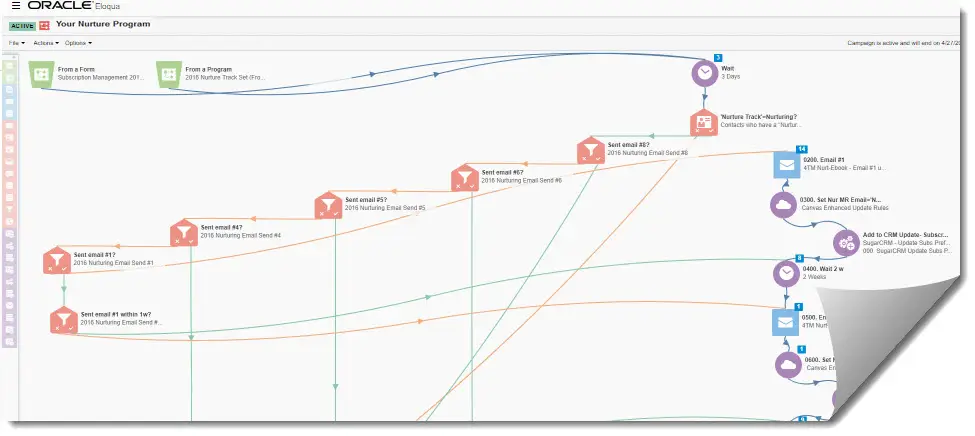
The word “Foundation” in an email marketing Nurture Foundation is included because you architect an infrastructure of automated pathways (the foundation) that Customers can go in and out of on their journey with you.
Oracle Email Nurture Campaign, email marketing, nurture foundation,

Emails that require manually pressing the send button should be reserved for the date driven Events and Product Announcements; communication that are complementary to foundational pathways.

Get started on your Nurture Foundation

Characteristics of a Nurture Foundation

  1. Addresses the Customer Journey – all stages of the Customer Journey are covered, from the Awareness stage all the way through to the Advocacy stage.

    How to make the most of it: Beyond the classic Awareness, Education, Evaluation stages, don’t forget about New Customer Onboarding with some TLC, and only cross-sell after the TLC.

  2. Relies on Content (Content is King!) – and should be appropriately aligned to all stages of the Customer Journey.

    How to make the most of it: At every stage the customer is asking something different.  Your content should address those questions AND be in a stage appropriate format.  Don’t dump 5 page case studies on them when they’re only ready for a 1 minute video.

  3. Takes Time – since Nurture means to care for and encourage the growth of a customer’s interest in us and our solutions over time, take that time. Tell them Why, How, and What, in that order.  And wait to know they’ve heard it.

    How to make the most of it: Depending on your Sales Cycle, have a few emails at every stage starting with Thought Leadership and really setting up the Problem you can solve, before you talk product features.

  4. Tracks the Content Consumed – since customers go on this Journey at their own pace, track their digital behavior to know where in their journey they are, and fast track them if they consume the right content.

    How to make the most of it: Track which content they consume and the recency of that consumption from one piece to another.  Include ALL the places they can consume it from (tracked links).

  5. Listens for Interest – automatically move them from one solution pathway to another. Listening for THEIR interest takes precedence over what YOU think they should be interested in.

    How to make the most of it: Start by assuming interest based on like Profiles, but use their engagement (or lack thereof) to tell you their true interest.  Carefully design the right balance of pathway movement to avoid jumping from one topic to another.

  6. Uses Automated Pathways – we said it already and we’ll say it again. Long-living, architecturally sound, automated pathways.

    How to make the most of it: Lead sources, segments, feeders, page tag groups, wait steps, decision rules – they’re all needed in this architecture.

As Modern Marketers, we strive to marry traditional marketing strategy like — content is king — with modern technology, knowing where a customer is in their journey, and inferring which products/solutions they are interested in, using digital behavior.

Go Slow to Go Fast
Getting your nurtures right takes time!  It’s not easy to build all of the pathways, with all of the right content – with all the right motivational messaging – for every solution –and for every stage of the journey.  We know; we’ve been helping our customers do this for years.  The trick is to take a phased approach to get there.

Good email marketing nurtures are critical for ongoing success and make it possible for Marketers to:

  1. Rest easier at night knowing all their contacts are getting the Right Message at the Right Time. (Imagine being able to say that with confidence!)
  2. Focus on Event, New Product Announcement and other Channel marketing
  3. Fine-tune and optimize their nurture pathways over time by reviewing the KPI’s that Matter that will tell you what’s working and what to improve.

You’re closer than you think

It’s not about coming up with the next flashy, amazingly worded, award-winning campaign this month or this week.  It’s about designing a customer journey with aligned content — you can reutilize existing content — and then beautifully architecting these different pathways.

Don’t let your Sales team say Marketing Leads suck.  Don’t let them think they should cherry pick and throw the rest away.  Take the time to Nurture your leads, warm them up, and shorten the sales cycle.

This is the essence of Modern Marketing.  This is a Nurture Foundation.

What does your Nurture Foundation look like?  Do you have to come up with a topic you think a specific segment might want to know about on a weekly or monthly basis?  How often do you hit the send button?  If you’re not thrilled with your answers, it’s time for a change – and we’re here to help!

email marketing, nurture foundation,

Sales and marketing play different roles in the customer journey. But they truly shine when both can work together. To do this, many companies implement a “nurturing while selling” strategy, which allows sales reps to manage some marketing campaigns while working on opportunities. But how might this work in your organization? Let’s explore nurturing while selling further.

Nurturing While Selling: The Basics

To understand nurturing while selling, you must first grasp the concept of the customer journey: the process of a customer moving from initial interest to eventual purchase. While most companies focus on marketing at the beginning and sales at the end, the middle portion often remains neglected. This is where nurturing while selling comes into play.

Nurturing while selling involves supporting your sales reps with marketing automation and other tools while they engage in the selling process. This approach can include sending targeted emails and offering resources to help your sales reps close deals.

The Role of Marketing Automation in Nurturing While Selling

One of the most common challenges in sales is keeping leads warm. Fortunately, marketing automation provides a much-needed solution. Sales reps can take advantage of automated marketing communications to stay in touch with potential customers and gently nudge them toward a purchase. Your team will be able to automate targeted email campaigns, provide tailored communications, track customer interactions, and provide valuable insights into consumer behavior. Best of all, this automated approach to nurturing while selling allows sales reps to focus on their core tasks without worrying about accidentally ghosting leads.

Navigating the Sales Process

In the early stages of sales, qualification is crucial. Sales reps rely on customer needs and behavior data to narrow down a potential client base for their products or services. Marketing automation can help here too. Page tagging can track customer behavior and provide insights into product interest. Meanwhile, automated email campaigns keep customers engaged with relevant information and promotions.

As leads enter the evaluation stage of the customer journey, opportunity management becomes the focus. At this stage, customers compare products and services and decide what to purchase. Providing content that helps customers make informed choices without overwhelming them with broad, early-stage content is essential. Social proof and testimonials are particularly effective here.

nurture while selling

Implementing Control for Sales Reps

Sales reps who typically handle larger, more complex deals might object to marketing’s involvement in their sales process. You can mitigate this problem by giving your sales reps control over when and how marketing automation comes into the picture. Not only does this provide them with valuable tools, but it also ensures they feel empowered in their role.

You may choose to give control to your sales reps through:

  • On/off control: This basic option allows sales reps to stop or start nurturing campaigns.
  • Pause capability: This option adds a pause function to the on/off control, allowing reps to pause nurturing when actively engaging with leads and resume it when needed.
  • Campaign selection: This allows sales reps to choose from a list of nurturing campaigns based on their needs. This approach is powerful but requires more involvement and expertise from the reps.

You may also want to consider automatic nurturing. This campaign kicks in if a set period of time passes with no sales activity, ensuring leads don’t go cold from lack of communication. Whatever your final choice, the key is to give your sales reps control over the process without overwhelming them with options.

Nurturing While Selling: Final Thoughts

Nurturing while selling can be a game-changer for organizations looking to improve their sales and marketing alignment. Keeping everyone on the same page ensures a smooth customer journey and potentially higher conversion rates. But taking the first step can be tricky. Changes can feel overwhelming when your sales and marketing teams have their preferred systems and approaches established. That’s where we can help. Contact to help your sales and marketing teams work together and focus on nurturing while selling.


leverage customers

Companies that put all their money into advertising and sales may be missing a potentially valuable source of revenue. You have an additional option to maintain customer connections and increase sales: leveraging your relationship with existing customers.  Even the strictest privacy laws allow you to contact leads who have demonstrated a strong interest in what you have to offer. And the longer you can keep a conversation going, the more likely you are to be rewarded with a purchase—or even a long-term loyal client that will spread the word about your company!

Leverage Customer Relationships

Happy customers are far more likely to leave a good review, recommend you to a friend, or help you out in some other way! But don’t forget that preexisting customers are likely to buy from you again if they like what you have to offer. Even if you don’t get a new client out of the deal, retaining a particularly profitable one can be just as good.

A few ways to leverage customers include:

  • Keep existing clients engaged. For example, a customer is more likely to click on an email sidebar for a product they’ve shown interest in.
  • Offer rewards for referrals. Anyone who refers a new client to your company might get a gift card, a discount on future products or services, or some other reward. (Some companies may also offer incentives for positive reviews.)
  • Write a success story with them. Invite the client to talk about how your product or service improved their own business. A professional success story lends significant credibility to your brand.
  • Continue nurturing your customers. Stay within reason—obviously, no customer wants to receive sales calls or emails every day. But a customer that has already purchased from your brand is a potential repeat customer. Upsell related products or services they’ll appreciate.

Leveraging customer feedback is a relatively untapped source of potential promotions. Don’t ignore it!

An Additional Source of Revenue

Existing customers who appreciate your products or services will spend more money with you. Especially appreciative customers will happily encourage a friend to check you out or share their success story with you for promotional purposes. And in an increasingly competitive world, every potential avenue for marketing should be explored. How are you leveraging your customers?

Finally, remember it’s not just products or services that make customers happy with you. Professional communication that plays to their interests goes a long way. If you’re struggling to determine who needs communication and when, based both on local privacy laws and the customer’s own interest, we can help! Our privacy compliance software, 4Comply, will keep your customer communication plan profitable and legally viable. Get in touch today to learn more and get on the path to higher profits.

leverage customers

4Thought Marketing Logo   March 20, 2026 | Page 1 of 1 | https://4thoughtmarketing.com/articles/tag/nurture/