As the holiday season kicks off in full force, marketers have a unique opportunity. Obviously everyone wants to meet their end-of-year goals. But beyond that, holiday marketing offers your team a chance to establish customer relationships that will last long after the new year.
Let’s look at a few crucial steps toward holiday marketing success.
1. Start Early with a Clear Plan
Successful holiday campaigns are made long in advance. Planning early ensures you can develop a consistent theme across all touchpoints, from social media to email. Most importantly, the earlier you get started, the more time you have to test and adjust before the holiday rush begins.
Consumers are deal-driven during the holidays, actively seeking discounts. Match their sense of urgency with flash sales or week-long discounts. Online-only discount codes or similar offers also help to drive online sales. Not only will these promotions appeal to your current customers, but they can also attract plenty of new ones.
3. Make Gift-Giving Easy with Bundles & Guides
Holiday shoppers are often overwhelmed with choices. Providing curated gift guides or wish lists—whether in email campaigns or as a feature on your website—can ease decision fatigue. These guides should feature popular products segmented by recipient type or interest, making them shoppable with clear CTAs like “Shop Now.” Discounting these gift bundles will also streamline the experience and encourage future purchases.
4. Tap into Nostalgia
The holidays bring a desire for warmth and familiarity. Incorporating nostalgic elements—like vintage design, traditional holiday music, and classic imagery—allows your customers to associate those positive elements with your brand. Try using specific content like sepia-toned photos and traditional holiday elements in your marketing.
5. Build Customer Loyalty Through Personalization
While the holiday season is a great time to attract new customers, loyal ones are often the highest spenders. Personalized holiday emails for loyal customers can strengthen loyalty and encourage repeat purchases. Offer your top customers exclusive previews, special discounts, or even handwritten thank-you notes. These gestures demonstrate appreciation, helping keep your brand top-of-mind as they shop for gifts.
6. Engage on Mobile & Social Channels
With more shoppers shopping on mobile devices and browsing on social media, optimizing both channels is essential. Focus on mobile-friendly shopping experiences with easy navigation and fast checkout processes. Social media, particularly Instagram, Pinterest, and TikTok, offers high engagement potential. Use these platforms to showcase visually appealing content, video product demos, and shareable holiday-themed posts that encourage interaction and sharing.
7. Offer Convenience & Value with Each Purchase
Today’s shoppers are not only looking for deals—they also value convenience. Offering features like free shipping, gift-wrapping, or seamless return policies can set your brand apart. Consider including perks like early access to holiday sales or fast, reliable shipping, as these are especially attractive during a busy season and can reduce the likelihood of cart abandonment.
8. Keep a Close Eye on Metrics
Finally, closely track the performance of your campaigns. Identify and analyze KPIs such as engagement rates, conversion rates, and ROI for specific promotions. Monitoring these metrics allows you to make data-informed adjustments, refine your campaign approach, and maximize your impact in real time.
The Challenge of Holiday Marketing
With a combination of early planning, customer-centric tactics, and thoughtful, authentic engagement, marketers can position their brands for holiday success. Embracing nostalgia, delivering convenience, and investing in loyalty-building strategies will not only drive revenue but also strengthen customer relationships, ensuring that the holiday season is both profitable and meaningful.
Don’t let the holiday season get away from you! Contact us today to get a head start.
Your email marketing campaign is only as good as your database of email addresses. Despite claims to the contrary, high-quality email lists with an engaged, interested audience cannot be purchased. Building an email list is not a one-off task, either. It is in constant flux as defunct email addresses are removed, people unsubscribe, new email addresses are added, and the list grows.
There are many strategies that marketers can employ to achieve a growing list of quality subscribers.
Shifting from Outbound Marketing to Inbound
People are inundated with email blasts. Often, the first reaction is to hit the delete button. In fact, 45% of spam receivers hit delete while a further 27% report unsolicited emails as spam.
Shifting strategies from outbound to inbound marketing allows you to actively engage the right audience as you build brand awareness and build genuine relationships with potential customers. Social media, SEO, and content creation are all inbound marketing strategies (demand generation strategies) which are further aided by lead generation.
Lead Generation Strategies
Lead generation is the part of the marketing funnel that helps capture customer data, including their email addresses. This allows marketers to create highly personalized campaigns to further engage an already interested audience.
Using demand and lead generation strategies allows marketers to collect valuable zero-party data i.e., information offered by the customers themselves. Using zero-party data and being transparent about its use builds trust with customers. It also helps marketers remain compliant with various data privacy laws around the world.
Give Customers a Reason to Share Their Email Addresses
Gated content offerings are a popular way to collect email addresses and segment your audience by interests. According to Semrush, 17% of marketers and business owners claim that gated content is their top performing type of content.
Gated content needs to be carefully curated, high-value content that your target audience is looking for. Gated content typically comes in the form of whitepapers, original research publications, webinars, and online courses. Tools like calculators, presentation templates, workbooks, or free trials for programs are other forms of gated content to consider.
Make Sharing Easy
Make your emails easy to share by including a share button where clicking it takes reader straight to a compose email window to share it with friends and colleagues. An opt in button in the same email allows these friends and colleagues to subscribe to your emails with a single click and promotes organic growth. Social sharing buttons are also a great way to reach new subscribers. The more unique and interesting your content, the more shares you are likely to see.
Keep Forms Short
A long, complicated contact form is the quickest way to deter a prospective lead. Keep your forms short and use your nurture journey to gather more information as you go along.
Re-Engage Stale Contacts
If you have an old list of email addresses that you suspect are mostly stale leads, consider sending them an option to opt in for emails again. Alternatively, use a fresh approach and give them the opportunity to snooze emails for a while. This will allow you to re-engage old clients as well as scrub your list of disinterested parties and improve email deliverability as well.
Place CTAs Strategically
CTAs on your business’s home page, contact page, and even about page can encourage potential clients to sign up for your newsletter or a gated resource. Promote your gated content or offers on your marketing channels to drive viewership and engagement.
Craft your CTA text to show customers the value and benefits of signing up with you. Get creative and add a CTA to your employees’ email signatures to take people to an opt in landing page for a newsletter. Always A/B test copy and emails to see what works best.
Need help improving your email database? Get in touch with our marketing experts for more strategies on how you can build your email list with privacy compliant, zero-party data.
A long list of engaged, interested leads makes any marketer happy. After all, the more people interested in a company’s products or services, the better the bottom line. However, a broad and diverse pool of clientele can lead to an unexpected problem: the conventional marketing funnel doesn’t always apply.
This is the situation Cetera, a leading wealth management services provider, found itself in.
The Challenge: A Diverse & Rapidly Expanding Customer Base
Following rapid growth and multiple company acquisitions, Cetera wanted a way to connect to prospects with varying needs and preferences in a more bespoke way to better classify and route leads. Cetera’s existing methods relied on qualifying leads as part of the initial CSR engagement process, which wasn’t as efficient.
“Our team was spending more time on the phone classifying leads than we wanted,” explained Merrill Varghese, Senior VP of Corporate Marketing. “We needed a better approach that allowed us to get right to a needs-focused conversation in that first call, so it could be more about how we could support the prospect’s needs.” Fortunately, the team didn’t have to wait long. What started as a project building an internal tool for mapping interest to available services became the spark for a client-facing, scalable, and self-selected approach.
The Solution: Implementing a Dynamic Customer Engagement Tool
Cetera knew what they needed. However, building and implementing the solution would take time—time the team couldn’t afford. To address this challenge, Cetera turned to the 4Thought Marketing team.
The 4Thought team used Cetera’s existing tech stack, including Adobe Marketo, to construct a tool to streamline the routing process. The “Find Your Fit” tool guided prospects through a series of questions, allowing them to identify their own needs and self-match with the most relevant offerings from Cetera.
The solution leveraged advanced algorithms and data-driven insights to categorize prospects based on their responses. This ensured that each prospect received a personalized recommendation, directing them to the top three programs that were the best match for their interests and needs. This approach enhanced the customer experience and streamlined Cetera’s internal processes.
How It Worked: A Personalized Journey for Every Customer
The system was a dynamic “choose your own adventure” experience. Prospects were prompted to answer questions upon visiting Cetera’s platform. Depending on their answers, the tool used predefined algorithms to categorize them into distinct customer segments.
For instance, if a prospect indicated an interest in tax and accounting services, the tool would direct them to content and service options specifically designed for tax professionals and accountants, ensuring they found exactly what they needed without unnecessary searching. This improved user satisfaction and increased the likelihood of conversion, as clients were more likely to engage with content directly relevant to their needs.
The Results: Enhanced Engagement & Higher Conversion Rates
It didn’t take long for Cetera to see an improvement. “The ‘Find Your Fit’ system made it easy for prospects to find exactly what they were looking for and understand how we could support their specific needs, and gave our sales team an immediate advantage. It was a game-changer for us and the prospect experience we were trying to create,” Merrill Varghese explains.
The implementation of the self-categorization tool yielded impressive results for Cetera:
Improved customer engagement: The tool significantly increased customer engagement and satisfaction by providing a more personalized experience.
Higher conversion rates: The tailored approach led to higher conversion rates, as prospects were directed to the most relevant services and support personnel from the start. This reduced the time and effort required for decision-making.
Operational efficiency: The tool allowed Cetera to manage a diverse customer base more efficiently. By automating the initial sorting and categorization of prospects, the tool reduced the workload on sales and marketing teams, allowing them to focus on more strategic tasks.
Data-driven insights: This approach also provided Cetera with valuable customer preferences and behavior data. This data was instrumental in refining marketing strategies and ensuring that each advisor segment received the most relevant content and offers.
Key Takeaways for Marketers
Cetera’s experience highlights several important lessons for marketers facing similar challenges:
Adaptability is crucial: As businesses grow and evolve, so too must their marketing strategies. A flexible approach that can accommodate diverse customer needs is essential for success in a dynamic market.
Personalization drives engagement: Tools that enable customers to self-identify their needs can significantly enhance the customer experience and improve engagement and conversion rates.
Leverage technology for efficiency: Automating the segmentation process improves accuracy and allows marketing teams to focus on strategy rather than administrative tasks.
Continuous learning and improvement: Using data to understand customer behavior is key to refining marketing strategies and ensuring long-term success.
If your company has the same challenge as Cetera, the answer might already be in your existing tech stack. We can help you find it and put it into practice. Get in touch with our team today to learn more and take the first step toward a long-term solution.
October 31, 2024
Driving Growth Through Collaboration – Eloqua Office Hours Replay
When Morningstar sought to kickstart a new lifecycle marketing strategy, they organized a two-day hackathon to spark innovative ideas and increase collaboration across teams. Mindy Chase from Morningstar and Colleen Lenahan of 4Thought Marketing will share how they planned and executed the event and the impressive results they’ve achieved so far.
You will learn about
The genesis for this event
Why they chose a hackathon format
How it was conducted
How the products of the hackathon are being used to shape strategy
Artificial intelligence has left an undeniable impact on the marketing landscape today. From personalized campaigns to predictive analytics, AI influences our approach to almost every aspect of online marketing.
However, just like any other tool, AI used incorrectly does more harm than good. Are you making any of these AI marketing mistakes?
1. Overestimating What AI Can Do
While AI is powerful, it’s neither a magic bullet nor a replacement for human insight and creativity. AI excels at analyzing vast amounts of data, identifying patterns, and making predictions. However, it cannot process nuance the way people can. It also can’t create something entirely original.
Perhaps most importantly, AI can and will make mistakes. Even the most sophisticated models still produce inaccurate or misleading information. The internet has collectively begun referring to these responses as “hallucinations”. People who assumed tools like ChatGPT knew what they were talking about have been proven wrong in hilarious fashion many times by now.
What to Do Instead: Use AI to supplement your marketing efforts, not replace them. Combine AI’s data-driven insights with your team’s creativity and intuition to craft campaigns that resonate with your audience. For instance, your AI tools can identify which content performs best at different stages of the customer journey. However, human employees are better at crafting a compelling narrative that engages and converts. Your AI’s insights can guide your actions, but cannot and should not perform them all for you.
Additionally, remember to double-check anything your AI produces. The last thing you want is a glaring error in your output.
2. Jumping on the AI Bandwagon Without a Plan
AI may be the hottest new thing, but if your company rushes to implement your own AI approach without a concrete plan, you’ll likely struggle. AI needs to align with your overall marketing strategy—and you need to know how it aligns. Without a plan, you can end up wasting resources, creating inconsistent messaging, and creating marketing campaigns with abysmal conversion rates.
What to Do Instead: Clearly define your marketing goals and determine how AI can help achieve them. Are you trying to increase engagement, boost conversions, or improve customer retention? Once you have a clear objective, identify the specific AI tools and techniques that can support your goals. In other words, fit AI into the marketing strategy that you know works, rather than rebuilding your entire strategy just to include AI.
3. Ignoring Data Quality & Quantity
AI thrives on data—that’s no surprise by now. But it can’t work with just any data. Poor-quality or irrelevant data can lead to inaccurate insights and misguided marketing strategies. You also need to consider where your data is coming from. Is it your own? If it originates from outside your company, are you even allowed to use it?
What to Do Instead: Invest time in collecting, cleaning, and organizing your data before feeding it into your AI tools. Ensure your data is relevant, up-to-date, and representative of your target audience. This means removing duplicate entries, correcting inaccuracies, and filling in missing information. You also need to be absolutely sure that any data you don’t create yourself comes from willing sources.
4. Getting Way Too Personal
Personalization is one of AI’s most celebrated capabilities, but there’s a fine line between providing personalized experiences and coming off as intrusive. It’s tempting to give AI every bit of data you can. But as experts have pointed out, AI lacks the emotional intelligence of a human, so it doesn’t know when it’s being insensitive or invasive.
What to Do Instead: Use personalization thoughtfully and avoid being overly familiar with your audience. Aim to add value by providing relevant content, offers, or recommendations rather than trying to showcase how much you know about your customers. For example, instead of using hyper-specific details like mentioning a customer’s recent purchase in an email subject line, focus on recommending products or content based on their broader preferences.
Above all, do not give your AI marketing tools confidential or sensitive data. Not only is this a serious violation of privacy principles, but it will only harm your reputation in the public eye. Collect and use only the data you’re legally permitted to have.
5. Making Customer Interactions Robotic
AI-powered chatbots and automated responses can handle many customer inquiries, but relying solely on AI for customer interactions can backfire. AI tools don’t always understand what a customer is asking for. Other times, when dealing with complex or sensitive issues, an AI’s lack of emotion can lead to upsetting responses. It’s no secret that when many customers call a helpline or use an online chatbot, many try to get the robot to send them to a human representative as fast as possible.
What to Do Instead: Implement a hybrid approach that combines AI with human support. Use AI to handle routine inquiries, tasks, or FAQs. Meanwhile, your actual employees should handle more complex or sensitive issues. This improves efficiency and ensures that customers feel valued and understood.
If your system defaults to an AI at the beginning of a conversation, state that upfront. Also, make it easy to get to a human representative. Your customers shouldn’t have to navigate a complex menu to talk to a real person.
6. Not Supervising Your AI
AI needs near-constant supervision and performance review. Algorithms can save your team a lot of work—but your company’s needs will change. Your customers’ preferences will change. And if you don’t ensure that your algorithms change with them, you’ll continue to churn out campaigns that fail to deliver the desired results.
What to Do Instead: Regularly review your AI-driven campaigns and strategies to identify areas for improvement. Use metrics such as engagement rates, conversion rates, and customer feedback to gauge performance. AI learns over time, so the more you monitor and refine it, the more effective it becomes.
In the age of data breaches and privacy scandals, ethical considerations are more important than ever. Too many marketers make the mistake of using AI to collect and analyze data without fully considering the ethical implications, which can lead to a loss of trust and damage to your brand’s reputation.
This invasive type of data collection is painfully obvious in cases like that of Eli Stein. He and his wife discovered they were expecting a child, but chose to hold back on making the announcement online. That didn’t stop a presumably AI-powered algorithm from flooding his social media feeds with ads for new baby supplies. And personal life events aren’t the only thing to consider. AI is trained on human-created data—and unfortunately, that data can reflect biases that the AI then perpetuates.
What to Do Instead: Be transparent about how you’re using AI and data. Ensure you have the proper consent from your customers before collecting their information, and respect their privacy by using data responsibly. Additionally, be aware of potential biases in your AI algorithms and take steps to address them to avoid perpetuating stereotypes or excluding certain groups from your marketing efforts.
8. Assuming AI is Good to Go Right Away
Many marketers expect immediate results once they implement AI solutions. It’s hard to blame them—AI’s capabilities are praised to high heaven. The reality is that AI requires time to learn and adapt, and it often takes weeks or even months to see significant improvements in performance.
What to Do Instead: Set realistic expectations and timelines for your AI projects. Understand that AI is a long-term investment, and be prepared to invest the necessary time and resources to see tangible results. Start with small pilot projects, gather insights, and gradually scale your AI initiatives as you gain confidence in their effectiveness.
Using AI Wisely in Marketing
AI is a tool that can enhance your marketing efforts when used correctly. It is not a one-size-fits-all solution. It is also no substitute for human intervention. But neither is it inherently a net negative. Using AI with human creativity and insight can help you create marketing strategies that produce worthwhile returns.
With an average ROI of $36 for every dollar spent, email marketing remains one of the most lucrative campaign strategies. It’s every marketer’s dream to maintain an impressive ROI. But what happens when your existing strategies are falling short? In that case, it’s time to consider how to optimize email campaigns for your audience.
Are Optimized Email Campaigns Really That Important?
Simply defined, an optimized email marketing strategy empowers your team to create high-quality campaigns that not only land in recipients’ inboxes but also drive engagement and align with your business objectives. A poorly optimized email strategy hurts your campaigns. Customers won’t be as engaged, and your ROI will plummet.
Your email campaign may need a rework if you’re experiencing:
Elevated levels of customer complaints or spam reports
Drops in click-through rates or opens with no clear reason
Increased bounce or unsubscribe rates
Characteristics of an Optimized Email Campaign
On the other hand, an optimized email campaign includes the following characteristics:
Effective list building: A healthy email program starts with your subscriber list and great segmentation. Everyone in your campaign should be genuinely interested in your offerings and ready to engage with your emails.
Regular list maintenance: Inactive or invalid email addresses result in failed deliveries. Review your email database regularly and get rid of the unusable contact info.
High deliverability: Your emails should reliably reach recipients’ inboxes rather than getting lost in spam folders.
Smooth workflow: From ideation to design, production, and testing, the email creation process should flow seamlessly to minimize disruptions.
Engaging campaigns: Whether it’s making a purchase or signing up for an event, your emails should drive recipients to a desired action. Keep your messages compelling, straightforward, and intriguing.
Always improving: Experiment, learn, and refine your strategies accordingly. Keeping up with technological changes and customer preferences ensures you don’t get left behind.
Watching for red flags: Keep an eye on your email metrics: click-throughs, bounces, spam reports, unsubscribes, etc. Addressing the problems quickly will help prevent them from snowballing.
Giving Your Email Marketing Strategy a Checkup
If you’re not sure how optimized your existing email marketing strategy is, it’s time for an audit. Use this checklist to determine what needs to change:
Consistent engagement and deliverability: Are your emails being opened and clicked on? Are they reaching inboxes at all?
Sender reputation score: Do email providers trust your company enough to display your messages?
Authentication records: Are your SPF, DKIM, and DMARC records correctly configured?
Integration and automation: Are your automated processes in the background running smoothly?
Content functionality: Does your email properly load? Are the copy, images, and links all readily visible? Do the links lead to the right pages?
Cross-client compatibility: Your contacts will use a variety of different email clients. Do your messages render correctly for each of them?
Re-engagement effectiveness: Do your re-engagement campaigns get results?
Regular audits will help you identify areas that need improvement. More importantly, these audits will allow you and your team to proactively address any problems in their early stages.
Optimize Email Campaigns & Improve Your ROI
Maintaining a healthy email marketing program is crucial for maximizing the impact and ROI of your email marketing efforts. Regularly assessing key metrics, addressing issues promptly, and adopting best practices all go a long way toward keeping your email marketing strategy in the best shape possible.
Ensuring that new users are well-trained is crucial for fully utilizing any platform, such as Oracle Eloqua. New users require a strong foundational understanding of the tool and specialized training tailored to the company’s standards and processes. When personalized, on-demand training is made accessible, companies can rapidly onboard users. A global technology company found this out when their team couldn’t keep up with training demands.
The Challenge: Generic Training Materials
Like many large organizations, our client leverages Eloqua to the fullest with highly optimized processes and procedures. Their marketing teams use Oracle Eloqua to manage customer communications, automate campaigns, and analyze performance. Every Eloqua user, newcomer, or long-time employee can access training materials when needed.
However, these training materials didn’t always provide the instruction users required. A collection of documents stored in a SharePoint folder covered the basics but contained limited information about Eloqua’s advanced features or company-specific use cases. Most of the team was granted self-service access to Eloqua, but mistakes were easy to make without proper training. This led to confusion among the team members and disruption across multiple campaigns.
The company faced a pressing question: How could they ensure that new Eloqua users received the necessary training without distracting seasoned users from their own tasks?
The Solution: A Custom-Built, On-Demand Training Program
Recognizing the need, the client collaborated with a specialized team from 4Thought Marketing to develop a training program tailored to their needs. The goal was to provide users with a basic understanding of Eloqua and create a comprehensive, step-by-step program to ensure users were fully prepared before gaining access to the production environment.
Script Development & Customization
The development process began with creating detailed scripts for training videos. These scripts were not just reiterations of Eloqua’s existing training materials but were heavily customized to reflect the client’s specific use cases, making the training more immediately practical for users.
The customization process was highly collaborative. The 4Thought team worked closely with the client and key stakeholders to refine the scripts. In real-time sessions, they discussed what should be included and omitted, ensuring that every part of the training was necessary and valuable. This approach made the training more effective and helped engage users by showing them exactly what they needed to know.
A Structured, Automated Training Path
Once the scripts were finalized, the team moved on to the production phase. They created a series of pre-recorded video modules, each focusing on a different aspect of Eloqua. Users had to pass a quiz at the end of each module to unlock the next one. This not only ensured that they retained the information they had learned, but it also prevented anyone from skipping ahead. This method assured the client that users were acquiring the necessary skills as they progressed through the training.
Additionally, the training program was built using their Eloqua instance. When they completed a module, users automatically received an email with a link to the next module. This seamless integration meant the training program required minimal manual intervention, allowing the team to focus on other critical tasks.
The Sandbox Environment: Safe Practice, Real Results
An integral part of the training program was the client’s use of a sandbox environment, which mirrored their Eloqua instance but completely isolated from their live customer data. Users had access to this sandbox from the beginning of training. Here, they could apply what they had learned, experiment, and make mistakes without the risk of affecting actual campaigns. Only after they completed the entire training program and demonstrated their proficiency through the final quiz did they receive access to the production environment.
The Outcome: A Stronger, More Capable Team
The training program’s results were impressive. Since its implementation, many users have successfully completed the training, demonstrating a marked improvement in their Eloqua skills. The program’s structured approach ensured that users only gained access to the live environment once they were truly ready, reducing the risk of errors that had previously caused disruptions.
While it’s difficult to quantify the exact impact on the client’s operations, the improvement in user competence is clear. The training program empowered users to work more effectively and protected the integrity of their marketing efforts. By preventing untrained users from accessing critical systems, the company minimized the risk of costly mistakes and ensured that their campaigns ran smoothly.
Building Your Own Customized Eloqua Training Course
For marketers working with complex tools like Oracle Eloqua, this story highlights the importance of investing in a structured training program that goes beyond the basics. Our client expanded their team’s knowledge, trained a larger team to use the system, and improved performance through a customized training course focused on the client’s standards and processes.
If you’re ready to set your team on the path to success with an Eloqua training course built specifically for you, contact 4Thought Marketing today.
AI has firmly cemented itself into the marketing world. Everyone knows about it, and most people are excited to use it. But this raises a question: what exactly can AI do? And more importantly, what’s the best way to use it in your particular company?
To answer these questions, we reached out to several marketing leaders to learn how they’re harnessing the power of AI. Here are a few of our favorite suggestions, offering a glimpse into how AI can drive success across various strategies and industries.
We value experimenting and testing with AI to make the best data-driven decisions possible. One specific way is by testing emerging technologies with some of our SEO processes to spur innovation and provide our clients with a competitive advantage. We believe that AI should assist our human-centered work and not completely replace efforts.
One way we use artificial intelligence to promote our products better and enhance the customer experience is through faster and more efficient keyword research. AI helps us analyze vast amounts of data to identify popular and trending keywords, allowing us to make informed decisions about the content we create. This approach boosts our search rankings and ensures we are providing valuable and timely information to our audience. The result is a more effective content strategy that drives organic traffic and enhances the overall customer experience.
One specific way we are leveraging AI to promote our products and services and enhance the customer experience is by automating communication with our candidates when they are on assignment. We use AI to send timely updates and notifications to keep them informed throughout their placement.
Additionally, AI helps us ensure we follow up with both candidates and clients by sending automatic reminders to our team. Customizing messages to our customers is crucial, and AI has significantly reduced the time it takes to personalize these communications, allowing us to maintain high levels of engagement and satisfaction.
One specific way I’ve leveraged AI to enhance conversion optimization and A/B testing is through predictive analytics. By using AI to analyze customer behavior patterns on my customers’ e-commerce sites, we can predict which elements—like product placements, calls-to-action, or content formats—are most likely to drive conversions. For example, on one client’s site, we implemented AI-driven heatmaps to understand where users were clicking and where they were dropping off.
This insight allowed us to redesign the layout, placing high-converting elements in the most engaging spots. We then A/B tested these changes, and the results were impressive: a 25% increase in conversion rates within a month. This approach isn’t just about leveraging data; it’s about making informed, strategic decisions that directly impact the bottom line. AI gives us the tools to anticipate customer needs and tailor their journey, making their experience seamless and significantly boosting conversions.
One specific way I’m leveraging AI to enhance customer experience is through chatbots. We built a custom chatbot for a client in the e-commerce space. It wasn’t just for answering basic questions—it used AI to personalize product recommendations based on browsing history and past purchases. This resulted in a 15% boost in average order value and happier customers who felt like they were getting relevant suggestions, not generic pitches.
The key is using AI to enhance, not replace, human interaction. It frees your team to handle complex inquiries while the chatbot tackles FAQs and provides 24/7 support. So, if you’re looking for an AI tool that can truly impact your marketing, consider chatbots for personalized experiences and happy customers!
We are increasingly using AI in our marketing workflows. Our most successful approach is based on social listening: We leverage the KWatch.io platform to monitor social media and automatically apply advanced sentiment analysis (based on generative AI) to the social media posts and comments on Reddit, Twitter/X, LinkedIn, etc. This allows us to receive real-time alerts when potential customers mention our brand, our competitors, or any interesting topic related to our business.
I’ve successfully implemented Predictive Customer Service to enhance our customer interactions. By analyzing historical data, we anticipate customer needs and proactively address their concerns before they arise. This approach not only improves customer satisfaction but also significantly reduces response times.
For instance, we developed models that predict when customers are likely to need support, allowing our team to reach out with solutions before an issue escalates. This innovation has transformed our customer-experience strategy, ensuring that we stay one step ahead. Through this method, we have seen a marked increase in customer loyalty and retention, proving that understanding data can lead to meaningful, lasting relationships with our clients.
One specific way we leverage AI to promote our products and enhance customer experience is through our custom GPT, “Before You Write.” This AI tool conducts preliminary research by identifying potential customer questions, reviewing top-ranking sites, and assembling a comprehensive outline. Integrating “Before You Write” into our workflow has significantly improved the efficiency and consistency of our campaigns.
The single most effective use we’ve found for AI in our marketing department is automating our PPC ads. With the right prompts, we’re able to quickly and efficiently adapt to changing pricing and performance data, helping us to get more bang for our buck in this area.
It will be through personalized content recommendations. AI-driven algorithms can analyze customer behavior and preferences to suggest products or services that match their interests. This not only makes marketing more relevant but also improves the overall user experience. For example, AI tools can track browsing patterns and past purchases to deliver tailored email campaigns or on-site recommendations. This kind of personalization helps in engaging customers more effectively and boosting conversion rates by presenting them with exactly what they’re looking for, right when they need it.
We aren’t using AI to write our content, but AI is fantastic for identifying gaps between our own content and what our competitors are doing to outrank us within Google search. We are also using AI to put together more complete content outlines for blog posts, providing a more complete picture of what we’re trying to cover on any given page. That only increases and enhances our site’s overall authority and expertise in the eyes of the search engines, which helps us expand our organic footprint and further promote our products to prospective customers.
I’m using AI to help me streamline my writing process. There are some great generative AI tools out there that can suggest some pretty interesting alternatives to your content, your writing structure, and more. I know people have been skeptical about the use of AI for content writing, but if you (the writer) know what you’re talking about, you can actually use AI to give you insights.
The expectations for content writers are pretty high in terms of delivery of content, and AI is certainly helping with that. While there are times when using AI can actually slow you down (because it simply doesn’t give you what you’re looking for), it’s mostly a great tool to assist you.
We’ve integrated AI into our content-creation process to analyze engagement metrics and handle proofreading and grammar checks. This approach ensures our articles are well-optimized and mistake-free, allowing us to focus on content that resonates with our audience. As a result, we save time and improve the quality of our content.
If you aren’t sure where to start with AI or how far to take it in your marketing strategy, don’t worry—you’re not alone. Get in touch with our marketing team today to take full advantage of this revolutionary tool.
Did Someone Say Oracle Eloqua Merge Contacts?
No, your eyes are not deceiving you. Up until this very moment, you probably only imagined, wished, even begged for an easy way to merge Eloqua contact records and preserve activity history. Since 2015, over 4,300 Eloqua users upvoted this idea on TopLiners.
Let that sink in: Merge Contacts, and Preserve Activity History*. Bada Bing, Bada Boom.
Introducing the Eloqua Merge Contacts Cloud App
You might at first wonder how that could happen – well, here’s one example how: The first time they filled out a form, they gave their name as [email protected]. Then, a couple of weeks, or months later, they come back as [email protected]. All of their contact data is the same – but now you have two email addresses for the same person.
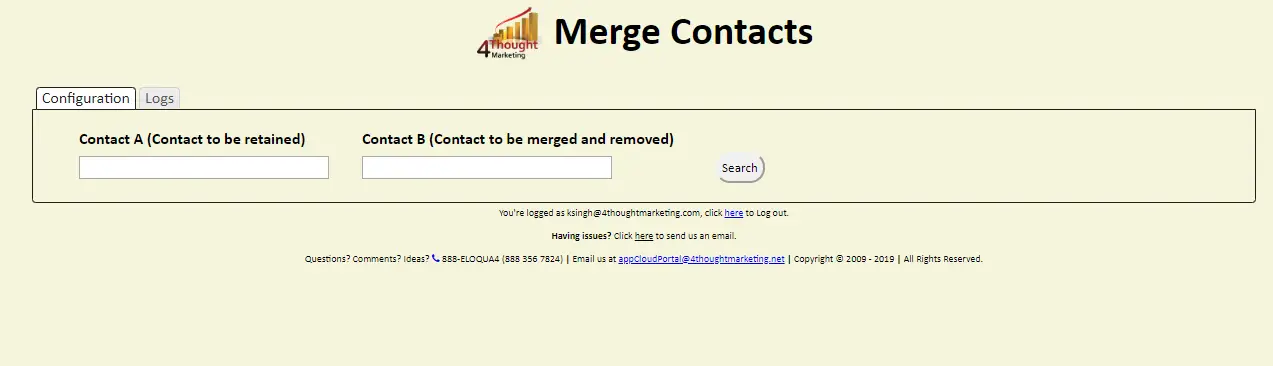
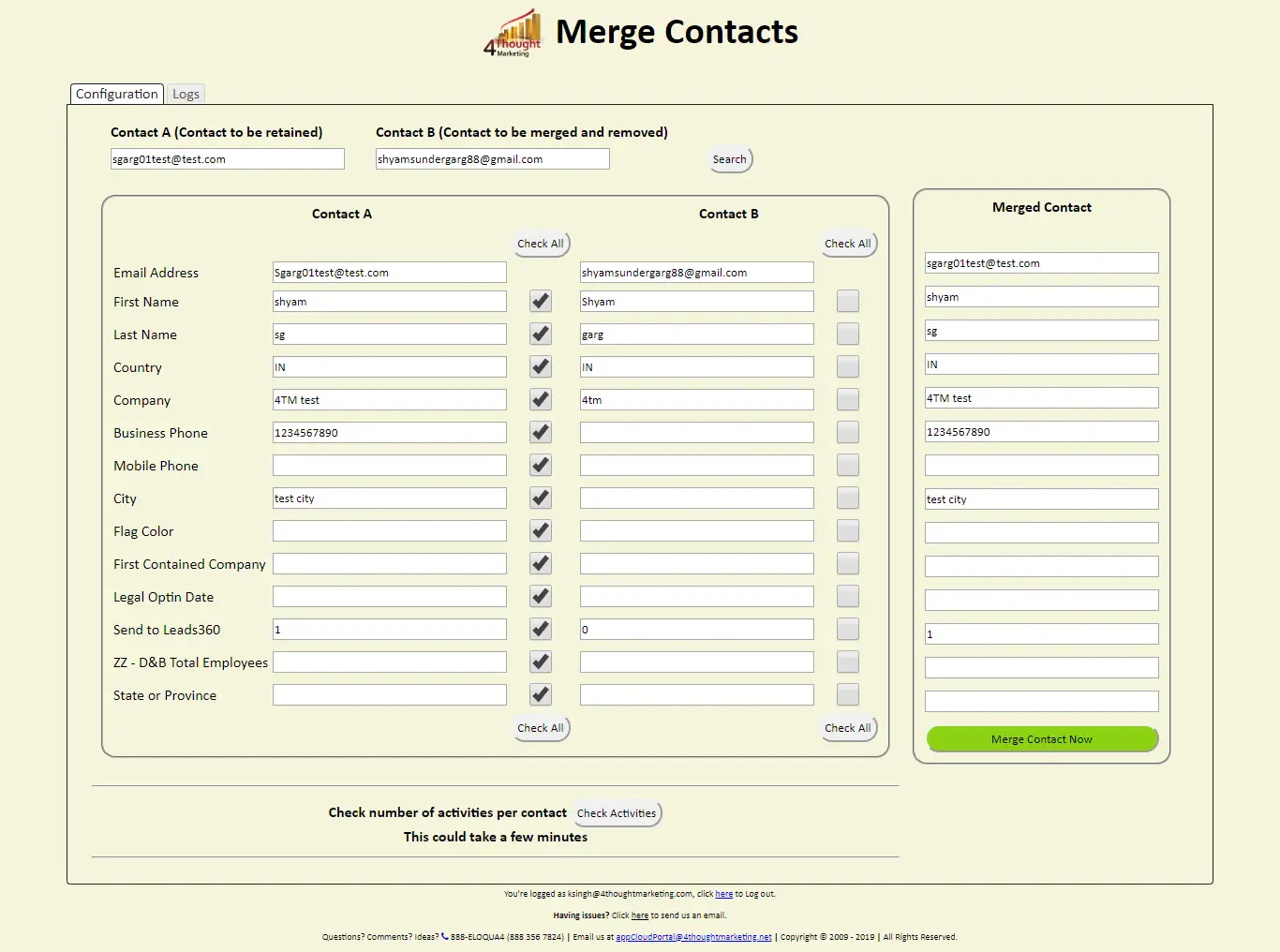
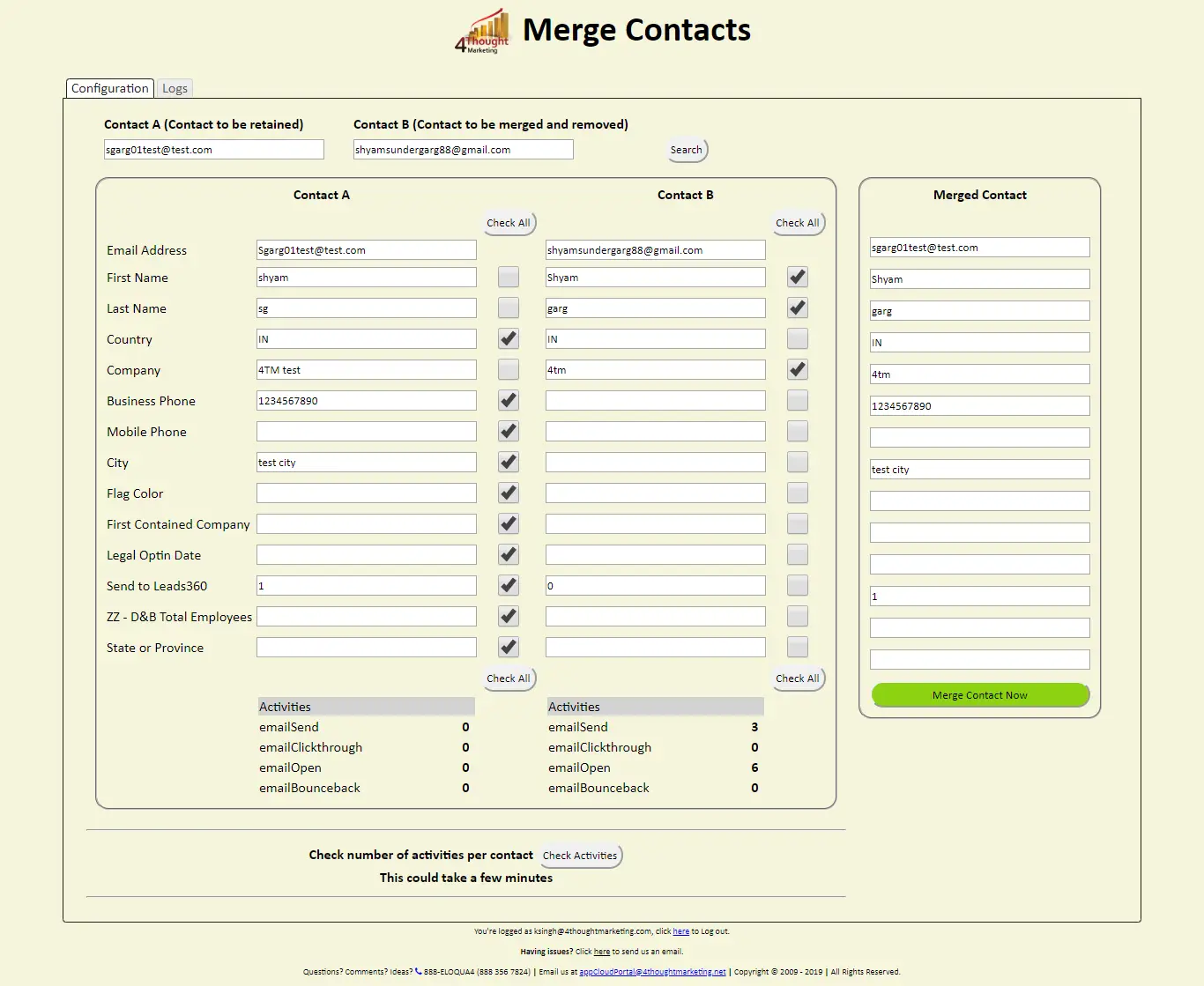
Merging contacts is easy using the Eloqua Merge Contacts Cloud App from 4Thought Marketing.
1. Select the records to merge
2. Select the fields to preserve from the original or the duplicate contact record
3. Retrieve existing records for each contact, choose which fields will be preserved
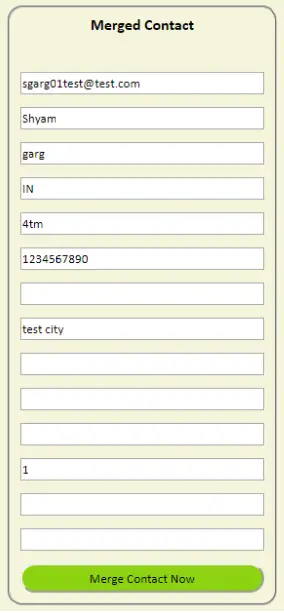
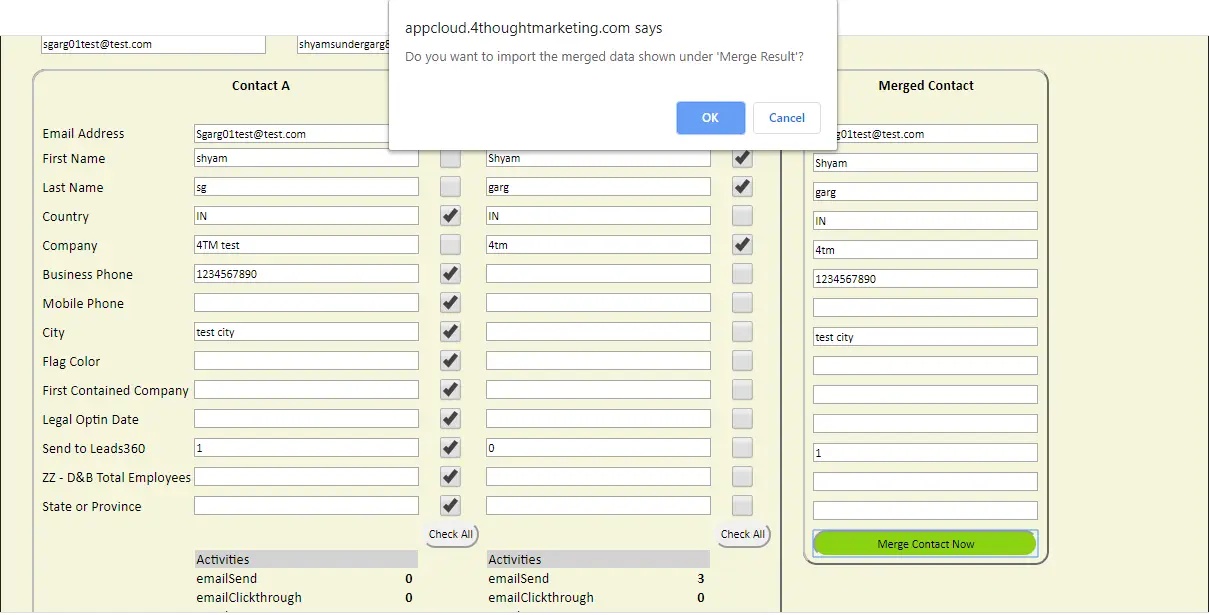
4. Preview how the merged contact record will appear, and make any necessary adjustments.
5. When ready, select Merge, and the processing will begin.
Processing takes from 2-3 minutes, but can also take longer depending on the number of activities. Activities from the merged contact will be re-created as new external activities in Eloqua.
Please Contact us if you are interested in our Merge Contact Cloud App, or any of our other products and services.
August 29, 2024
Addressing Unanswered Questions and Open Q&A – Office Hours
This month we answered some questions not previously answered on topics ranging from attribution to streamlining repetitive processes, unusual open rates due to spam and link checkers, and data privacy.
Disasters come in all shapes and sizes. Some originate at the heart of a company, while others affect a part of the world’s population at large. How a company handles a crisis can make a world of difference. However, not all circumstances can be mitigated by using lighthearted humor, as KFC did in 2018. Sometimes, pausing a marketing campaign is the most appropriate response. Today, we’re looking at a few examples of these circumstances.
Natural Disasters and Health Crises
Natural disasters like floods, wildfires, hurricanes, and earthquakes are all too common. Although natural disasters are typically localized events, many still receive extensive media coverage around the world. Particularly devastating storms or disasters can dominate headlines for weeks. Pausing a campaign during such times is common practice.
Civil Unrest, War, & Terrorist Attacks
Marketers need a large amount of optimism. However, uncertain times often mean taking a hard look at your campaigns and evaluating how they can affect your brand’s image. A little bit of homework may reveal that you need to hit pause. Pepsi discovered this the hard way in 2017, when the company released an ad that many viewers felt trivialized the ongoing Black Lives Matter protests.
Death of A Prominent Personality
The death of a leader can deeply affect the public. Pausing marketing campaigns to the affected community displays respect and empathy.
One excellent example comes from Planters. In early 2020, the company planned to “kill off” its mascot, Mr. Peanut. But when news broke of Kobe Bryant’s death, Planters immediately stopped sharing the ad in paid social media posts, saying they wanted to respect “those impacted by this tragedy”. (The planned TV spot still aired once during the Super Bowl.)
Business Scandals & Brand Crises
When bad press surrounds your business, all marketing needs to stop immediately until the issue has been addressed. And for a recent example of bad press, look no further than Kellogg’s, whose CEO suggested in early 2024 that low-income families could handle rising food costs by just buying more cereal. Unsurprisingly, the backlash was sharp and immediate.
A 2019 study by Crisp Thinking found that 53% of customers expected businesses to respond to a crisis within an hour and 59% stated that they wanted the response to come from the CEO. Following a corporate misstep, hitting the pause button on your marketing campaigns can give you some breathing space to fix your mistake. Additionally, it can reduce opportunities for customers to spread negativity via social media and unsubscribe from your mailing list.
The Decision-Making Process: To Pause Completely or Change Your Tone
The scenarios described above certainly warrant a pause to your planned marketing campaigns. However, they may not necessarily mean stopping all communication with your clientele either. These few questions can help you decide which path to choose:
Do you need to send update messages? For example, are there changes to your operational hours or delivery times because of the crisis?
Can you build brand awareness while helping your customers? Although regular marketing campaigns may be paused, you can still communicate with your customers by letting them know you’re here to help. For example, if your brand is actively involved with relief efforts in the area, you can direct customers to resources where they can get help or encourage them to donate to the efforts.
Does your copy resonate? The last thing you want is for your brand to come across as insensitive or tone-deaf. Any messaging during a crisis needs to be thoughtful and sensitive. (Quite a few companies learned this the hard way during the infamous era of COVID-themed commercials.)
Is it easier to let your customers choose to take a break? Consider giving your customers the power to hit the snooze button on your marketing campaigns. This allows you to give them a highly personalized experience without your customers unsubscribing due to frustration.
Batch and blast email campaigns certainly require far less time to put together than more personalized messages. But as most marketing experts understand, the tradeoff isn’t worth it. Batch and blast messages are known to produce significantly less revenue than personalized emails sent to interested contacts.
However, simply knowing that personalized messages perform better is just the first step. The real challenge comes when making the transition from the low-performing but easy batch and blast strategy to more demanding personalized campaigns. Here’s what eleven industry experts have to say.
From my experience, one of the main hurdles with transitioning to personalized email marketing, as opposed to the more generic batch-and-blast campaigns, is that it requires considerably more time and effort. This is especially challenging for small businesses that often struggle with limited time and resources to maintain consistency in their marketing efforts. Thankfully, there are now tools available to help streamline this process.
For instance, we use automated campaign tools and platforms like Townsquare Interactive’s business management platform, which allows us to handle our email marketing efforts from top-of-funnel to bottom. This platform integrates an inbox, calendar features, customer relationship management tools, and automated email and SMS messaging, providing everything necessary to grow our subscriber base effectively.
Additionally, we focus on prioritizing high-impact activities. We concentrate on email marketing strategies that align closely with our business goals and offer the most significant return on investment. We ensure that every email includes strong calls to action, tied to conversion activities like booking a demo or purchasing a product or service. This has helped us make the most of our efforts in email marketing by directly influencing our business outcomes.
A significant challenge in personalized email marketing is navigating the increased privacy concerns and ensuring compliance with regulations such as GDPR. Customers are more sensitive about how their data is being used, and rightly so. To tackle this, we have made transparency a core part of our email strategies, ensuring that our communications clearly state how we use data and providing customers with easy options to control their privacy preferences. This helps build trust and ensures that we comply with legal standards, thereby protecting our business and our customers’ rights.
If you want to get more from your email marketing, personalization is the name of the game. But it’s not without its challenges. One of the biggest hurdles is ensuring your data is clean, uniform, and reliable. The amount of personalization you implement depends on how many data points you have for your contacts.
Your audience data properties need to be consistently formatted and correctly inputted. Behavioral segmentation must be spot-on; targeting folks based on actions like adding to a shopping cart or clicking on a product requires precise and accurate segment creation.
Keeping your data updated is crucial. Customer behaviors and preferences evolve, and your segmentation must dynamically reflect these changes. Implementing real-time data-tracking and updating systems can help maintain the relevance and accuracy of your personalized campaigns.
In short, transitioning to personalized email campaigns means paying close attention to data integrity and segmentation accuracy. Nail these aspects, and you’ll unlock the true power of personalization, driving better engagement and results from your email marketing efforts.
That would be managing the increased complexity in data and segmentation. Personalized campaigns require more detailed customer data and sophisticated segmentation strategies to ensure that each email is relevant to the individual recipient.
For instance, you’ll need to invest in tools and processes for gathering and analyzing customer data to create tailored content. This might mean integrating CRM systems, enhancing your email marketing platform’s capabilities, and developing more granular customer profiles. Initially, it can be a bit overwhelming, but the payoff is worth it: personalized campaigns tend to see higher engagement and conversion rates than generic batch-and-blast emails. Investing in the right technology and processes will help you effectively manage this complexity and deliver more impactful, personalized content.
One challenge marketers might face is the need for creative and compelling content that resonates with diverse audiences. Unlike batch-and-blast campaigns, which rely on a one-size-fits-all message, personalized campaigns require tailored content that aligns with individual customer interests and stages in the buyer’s journey. This necessitates a deeper understanding of customer personas and their motivations, which can be resource-intensive. Marketers may struggle to consistently produce high-quality, relevant content for every segment, making it crucial to establish a strong content strategy that emphasizes creativity and adaptability.
One significant challenge when shifting from batch-and-blast to personalized email campaigns is effectively segmenting your audience and creating relevant content for each segment. Start small, measure results, and continuously refine your approach based on performance data. The transition requires a deep understanding of your customer base, often involving collecting and analyzing vast amounts of data. This can be overwhelming, especially for smaller teams or those with limited data analytics capabilities.
Creating multiple versions of content tailored to different segments is time-consuming and resource-intensive. It requires a delicate balance between personalization and scalability to ensure the effort remains manageable and cost-effective. We tackled this by starting with broad segmentation based on user behavior and gradually refining our approach. We developed content blocks that could be mixed and matched for different segments, which helped streamline the process.
When shifting from batch-and-blast to personalized email campaigns, one significant challenge marketers can expect is managing and integrating the vast amounts of data required to create truly personalized experiences. Personalization demands a deep understanding of individual customer preferences, behaviors, and interactions, which involves collecting, analyzing, and acting on data from various sources.
We faced this challenge head-on when we moved from generic email campaigns to more personalized approaches. Here’s how we addressed and overcame this challenge:
Firstly, we recognized the need for a robust data management system. Our existing infrastructure was not equipped to handle the detailed segmentation and dynamic content needs of personalized campaigns. We invested in a comprehensive CRM system integrated with our email marketing platform. This allowed us to centralize customer data, track interactions, and segment our audience based on specific criteria such as past behaviors, interests, and demographic information.
The next step involved ensuring data accuracy and completeness. Inaccurate or incomplete data can lead to ineffective personalization and even damage customer trust. We undertook a thorough data-cleaning process, removing duplicates, filling in missing information, and regularly updating our database to ensure it reflected the most current and relevant customer details. Creating personalized content at scale was another significant challenge. Unlike batch-and-blast campaigns, which rely on a single message sent to everyone, personalized campaigns require multiple versions of emails tailored to different segments.
To manage this, we developed a content strategy that included dynamic content blocks within our emails. These blocks automatically adapted based on the recipient’s profile and behavior, allowing us to deliver relevant messages without manually creating countless variations. Another crucial aspect was ensuring seamless integration across all touchpoints.
Personalization is not limited to email but extends to all customer interactions, including website visits, social media engagements, and customer service interactions. We used marketing automation tools to track these interactions and trigger personalized emails based on real-time behaviors, such as abandoned carts or recent purchases.
A challenge is ensuring that the personalized content is not only relevant but also timely. The effectiveness of a personalized email campaign can diminish if the content reaches the recipient at the wrong time. To address this, we utilize predictive analytics to understand optimal timing for engagement based on past interactions. This data-driven approach ensures that our emails are not only relevant but also timely, increasing the likelihood of engagement and conversion.
The biggest challenge of switching to personalized email marketing is the initial costs. Batch-and-blast campaigns have a lower initial cost. This may make you doubt switching to personalized campaigns.
However, it is important to remember that email marketing will cost you less in the long run. Sending out mass emails is not as effective as a customized approach. Though your upfront costs will be lower, you will not convert as many customers.
Personalized email marketing has a higher initial cost because it requires specialized software. Your audience will engage more with your campaign, and you will save money. Customers will also have a more positive view of your brand when they do not see you as spam.
Batch-and-blast email has had its time… but today’s consumer opens up their email desktop every morning, and “delete, delete, delete.” If we have time, we also “unsubscribe.” The only effective marketing delivers the right message to the right people at the right time…when they’re already thinking of you. But there are more ways to do this than just PPC. Successful marketers will take the time to find and develop this kind of promotion because it just works better. These include: social media marketing, affiliate marketing, video marketing, referral marketing, and messages on hold.
In my experience, one of the toughest parts of prioritizing personalization over traditional batch-and-blast email campaigns is creating a single customer view. When you try to find common threads across different channels, the goal is to form a clearer image of who your customers truly are by integrating their data into one unified customer profile. However, research indicates that marketers often struggle to link data effectively to individual customer profiles. This challenge stems largely from the diverse data sources and types that need to be consolidated.
For example, a customer’s interaction on social media, their purchase history, and email engagement metrics must all be synchronized without discrepancies. Often, the technology or the systems in place aren’t fully equipped to handle this level of integration seamlessly. Moreover, ensuring data accuracy and consistency across channels can be a daunting task, as errors in data can lead to misguided personalization efforts that, rather than delight, might alienate customers.