eloqua custom objects

Eloqua custom objects (abbreviated as CO) provide a simple and flexible way to store additional data, such as purchase history or areas of interest, for segmentation and personalization. To maximize how the data can be used, Eloqua users may want to copy or move data between a contact or account record and a linked CO record, or between CO records. That’s where 4Thought Marketing Cloud Apps come into play. We’ve built a variety of apps that expand Eloqua’s functionality and give your team tools to enhance your data manipulation options, streamline integration, and supercharge your marketing campaigns. Let’s look at a couple of examples of how our apps can help. 

Storing Current Status in an Eloqua Custom Object

Often an outside system, like a purchasing or CRM system, sends transactional data to Eloqua—for instance, a record of a product renewal transaction. Eloqua will store this information for future use in nurturing, segmentation, or reporting campaigns. However, you might also like to see and filter on the most recent status of a product renewal. In this case, transactional data will be difficult to use, since there will be multiple transactions for the same product—and you only need the most recent status.

In this case, you might want to build two CO tables, one for the ongoing transactions and one for the current status. Incoming data would feed the transaction table. But how do you populate the current status table?

4Thought Marketing has built an app for that purpose—the CO-to-CO Updater. In this example, you would be able to take data from the transaction record and populate data in the second CO table to record only the current status. If you use COs frequently, the CO-to-CO Updater app has a long list of potential uses.

Handling Multiple Products of Interest

In a related process, let’s say that you have an integration process that feeds your contact record with current product interest. This particular contact has shown interest in several of your different product lines. Since your integration is feeding your Eloqua Contact record, how would you create a series of CO records that show the breadth of interest from this individual?

The 4Thought Marketing cloud app Contact to CO Updater is just the solution to this problem. By using this app, you would be able to create CO records linked to the contacts, one for each product of interest. In this way, you can segment this contact based on multiple product interests or lack thereof. For example, you could build an upsell campaign for everyone showing interest in Product X, but not in Product Z. Or you could build a campaign for everyone showing interest in both Product A and Product B. The applications are endless.

eloqua custom objects

Sending Recent Products of Interest to your CRM

Finally, let’s say that you have an integration that feeds your CRM system from Eloqua with the most recent product interest. You also have a custom object that stores multiple product interests accumulated over time. If you want to send the most recent data, you would either need to build a new integration for the most recent CO record, or you could just move the data from the CO record into the contact record, and continue with your integration. This can easily be accomplished with our CO to Contact Updater app.

Expanding Eloqua’s Capabilities with Cloud Apps

We have run across dozens of real business use cases that require data manipulation that is not easily accomplished with Eloqua’s out-of-the-box functionality. But we believe in getting the most value out of Eloqua. Our cloud apps are designed to build on Eloqua’s existing capabilities to make your job easier and more streamlined than ever.

Our clients have used Eloqua Cloud Apps and custom objects to demonstrably improve their revenue and customer engagement. For instance:

In addition to the cloud apps discussed above, 4Thought Marketing offers apps like the CO Form Submitter, the CO Deleter, and more to take your custom object development to a new level. And if our existing suite of apps doesn’t quite meet your needs, don’t worry—we can build a custom cloud app for your Eloqua instance.

Contact us for more information and a price list of all our apps.

customer segmentation keep it simple

Identical mass marketing emails simply don’t work anymore. Customers want materials that are relevant to them and their interests. Your marketing automation system depends on a robust segmentation strategy to do its best work.

Let’s consider a very basic segmentation: customer vs. prospect. Obviously, there is a critical difference between a person who has purchased from your company and an interested window shopper. This is a very important but easy first segment to add to your system.

Unfortunately, this is where you might start overthinking it.

The Problem

It’s easy to take customer vs. prospect segments and immediately jump to harder tasks. Why not store everything a customer has purchased so you can further segment by product? Maybe a renewal date for a subscription service they’ve purchased? And obviously you want feedback, so why not segment further to send detailed follow-ups or surveys? This thought process can quickly turn the simple act of customer vs. prospect segmentation into something intimidating.

The good news is, you don’t have to get that detailed quite yet. Start with a simple goal and save the additional capabilities for a future project.

Customer Segmentation Can Be Simple

Are you having difficulty getting a list of all your customers into Eloqua? You might have conflated your project scope too quickly.

It’s easy to think that customer segmentation in Eloqua typically involves a long, detailed process:

  • Having meetings to define what a customer is:

    • What if they are really small customers?
    • What if they haven’t been active for several years?
    • What if they are only a service/support customer?

  • Asking sales reps to go through and flag all their customers or which contacts at an account should be considered customers
  • Scrubbing the list of accounts/contacts
  • Creating a complex ERP integration

All of these are good ideas, of course. But you don’t need to worry about them immediately. Spread your more detailed segmentation plans over several incremental updates to avoid overwhelming your team. You can still get excellent value from your simpler segmentation strategy in the meantime.

customer segmentation

A Simpler Approach

Consider taking the simpler approach. Every quarter, ask the accounting department for a list of customer companies. Even if the list is incomplete, you can still easily upload the list to Eloqua and flag the companies as contacts, then set the contacts as customers. And there you have it! You’ve segmented by customer, and all it took was a few hours of work that you’ll repeat every quarter.

As you eventually work your way to a more detailed strategy, consider using the following distinctions for segments:

  • Industry: You can use standard definitions of industries, like the North American Industry Classification System, or create your own categories (e.g., venture-backed enterprise software startup companies founded in the last 24 months).
  • Geography: This might include country, state/province, city, and postal code.
  • Job Level: Different job levels (manager, VP, etc.) will have different interests for you to market to.
  • Job Role: Consider the department your prospects work in (sales, marketing, etc.)
  • Activity: Choose segments based on their engagement with your marketing (e.g., prospects who have attended a webinar).

As you master this basic strategy, you can begin implementing updates over time. Don’t rush—give your team the time they need to adjust to each change.

This article is an excerpt from our ebook, “7 Common Marketing Automation Mistakes & How to Avoid Them”. Download the full ebook for free here.


marketing and privacy

Marketing and privacy are functionally two sides of the same coin. Chief Marketing Officers (CMOs) are responsible for gathering, analyzing, and tracking consumer data to perform their roles effectively. Meanwhile, Data Protection Officers (DPOs) are tasked with safely managing data collection and processing in accordance to the appropriate laws and privacy policies.

Unfortunately, these complementary roles can feel like they’re in conflict. Marketing wants to use collected data to its fullest potential for as long as possible. Legal leans towards playing it safe and strictly interpreting data privacy laws in their policies, restricting how much data can be collected, how it can be used, and how long it can be retained. Is it possible for these two departments to work together?

Thankfully, yes! CMOs and DPOs can work collaboratively to achieve their objectives while safeguarding the organization and respecting consumers’ data privacy rights. Today, we’ll explore a few ways CMOs and DPOs can improve their working relationship.

1. Prioritize Education & Communication Between Departments

Firstly, DPOs should prioritize education and communication. While their primary responsibilities may involve conducting audits or reviewing contracts, keeping their colleagues in marketing informed has a positive spillover effect on their other duties. When marketers understand the importance of data privacy, they become more cautious about their vendor choices, know where consumer data lives and how it flows within the organization.

Additionally, CMOs need to learn how their work relates to privacy risks. Many marketers are surprised to discover the degree of overlap between their roles and data privacy. Modern data privacy regulations focus on protecting consumers’ rights over their data, and marketers handle the most consumer data in a typical organization. As a result, learning how to respect consumer data privacy rights is part of the modern digital marketer’s job. To help bridge this knowledge gap, marketing professionals can explore educational resources that focus on privacy-first marketing and common compliance strategies.

2. Participate in Data Mapping Together

Marketing professionals handle the most consumer data out of anyone in any company. Accordingly, CMOs must be active participants in their organization’s data inventory, also known as data mapping. A robust data inventory requires the involvement of multiple stakeholders within the organization, and keeping it up-to-date is an ongoing exercise. However, it is the key to effective compliance down the line, allowing privacy professionals to work more efficiently and reducing disruptions to marketing professionals’ core tasks.

marketing and privacy

3. Develop Privacy Compliance Solutions Together

Privacy strategies developed in a vacuum are not ideal for long-term success. DPOs should include marketers when evaluating compliance solutions that manage consumer data, such as consent management, website experience, customer relationship management (CRMs), email tools, and other potential sources of information. Because marketing professionals handle the most consumer data in most organizations, they need to have a seat at the table when it comes to evaluating compliance solutions.

4. Remember the Impact of Compliance Strategies on Marketing

Finally, DPOs need to be sensitive to the impact that compliance solutions have on marketing. Implementing compliance solutions can result in significant changes for the marketing department. For example, consent management platforms may require a company to collect less web data, which marketers use to perform their jobs. By proactively communicating and educating their peers and by consulting with marketing before selecting a compliance solution, privacy professionals can prevent disruptions to marketing operations.

Conclusion

In conclusion, marketing and privacy are more intertwined than one might think. When marketing and privacy operate separately, it can lead to negative outcomes. Without collaboration, marketing does not follow through on the privacy team’s recommendations, the privacy team does not see the results they hoped for, and the organization ultimately finds itself at greater risk. CMOs and DPOs need to be in regular communication with one another, learn about each other’s roles and responsibilities, and work in tandem to safeguard the organization and respect consumers’ data privacy rights.

Contact us today to give your marketing and legal departments a head start in learning how to work together.


eloqua training

Is your marketing team eager to onboard self-service Eloqua users? Great news! Onboarding a new Eloqua user is a valuable investment that pays off by empowering your team. You can efficiently and effectively bring each new team member up to speed with excellent training options, even in a fast-paced environment. Streamline your process without sacrificing quality with these top-notch Oracle Eloqua training options.

Solution 1: Oracle University—Virtual or In-Person Live Training

Oracle itself provides extensive training options through its Oracle University program. Oracle University offers in-person and virtual private events, creating a safe and collaborative environment for your team to learn, question, and explore.

Better yet, when you contact Oracle to schedule a training event for your team, you get to help develop the lesson plan. Your private event will focus on your organization’s specific pain points and practices. This also helps provide your team with a sense of familiarity and alignment, ensuring that everyone is on the same page.

Customized training offered by Oracle University provides a targeted and efficient approach to address your organization’s particular needs and information gaps. By participating in private events, your team can learn, question, and explore in a safe and collaborative environment.

Solution 2: Oracle University—Free & Paid Options

For professionals looking for a ready-made training program, Oracle University provides additional options for Eloqua training, including:

  • The Learning Explorer Program: This free Oracle Eloqua training system offers entry-level online courses.
  • Oracle Cloud Learning Subscriptions: Eloqua’s cloud is always updating and changing. These paid courses allow your team to keep up with every update and fill in information gaps.
  • Oracle Training & Certification: These specialized courses focus on specific job roles or Eloqua functions, giving your team members the chance to develop their particular skills and earn certifications. This option also offers the chance to speak with Oracle product experts for valuable insights and interactive learning.
eloqua training

Solution 3: Developing Your Own Eloqua Training Program

If you have access to a learning management system that aligns with your business requirements, you can also consider designing your own Eloqua training program. This may be a good option for a large company with the time and resources to devote to a fully customized, in-house training system.

If you’re interested in implementing this kind of training program or seeking assistance from an agency, here are some tips to guide you through the process:

  • Determine access levels: Clearly define the level of access you want to grant to self-serve users and identify the specific assets they should be able to interact with. Decide where to draw the line between user control and restricted areas.
  • Develop training content: Creating the training materials, especially the videos, will require a significant investment of resources. However, by dedicating time to develop comprehensive training videos tailored to your company’s specific needs, you can save valuable hours in the long run.
  • Build quizzes: While making training materials available is important, incorporating quizzes adds an extra layer of assurance that trainees are comprehending the content. Quizzes encourage active learning and help ensure trainees are not simply going through the motions. They provide a structured learning experience, reinforcing knowledge from previous videos and validating the trainee’s understanding.
  • Tailor the training sequence: Based on the areas of Eloqua you want users to learn, determine the number and sequence of training materials. Start with basic concepts and gradually progress to more complex topics.
  • Provide incentives to finish training: Restricting access to the Eloqua system until the training program is completed serves as motivation for trainees to engage with the materials. It reinforces the importance of training and ensures that individuals who gain access to the powerful system are equipped to use it effectively.
  • Build campaign materials: Set up the campaign materials within Eloqua, including emails, landing pages, and quizzes. Custom JavaScript coding is often required for landing page validation and form data collection.
  • Consider incorporating existing training materials: Regarding the use of existing Eloqua training videos, it is certainly an option worth considering. If you lack the time or resources to create custom videos, incorporating the general Eloqua training videos can supplement your training course. However, custom videos offer the advantage of covering client-specific information, such as naming conventions and folder structures, that may not be addressed in the general training videos.
  • Thorough testing: Prioritize extensive testing of the training program with both experienced individuals who understand the desired flow and newcomers who provide fresh perspectives. Gather feedback to identify any areas that require improvement or clarification.
  • Continuous improvement: Once the training program is live and users start utilizing it, gather feedback from trainees to enhance the training further. Identify weak points and refine the program based on user input, aiming to make it as useful as possible for self-serve users.

Remember that these tips can be tailored to your organization’s specific requirements and preferences. The key is to ensure that your self-serve users receive effective training to empower them without causing any additional issues.

eloqua training

Solution 4: Customized Eloqua Training with 4Thought Marketing

At 4Thought Marketing, we have created custom training solutions for many clients that focus on emphasizing the client’s particular branding and pain points. Our approach involves implementing a self-paced and structured training format that ensures users actively engage with the training materials. We take the time to help trainees retain what they’ve learned, rather than simply rushing through a set of tests to get Eloqua access before they’re ready.

Here are the key components of our custom-built training program:

  • Emails: Similar to a customer communication campaign in Eloqua, the program utilizes a series of triggered emails based on specific criteria. These emails guide users through a sequence of training materials, structured in a logical order that facilitates building upon previous modules.
  • Custom training videos: To effectively convey concepts, we develop tailored training videos specifically designed for each client. These videos cover both the general usage of Eloqua and client-specific standards and practices, including naming conventions and asset utilization within Eloqua.
  • Quizzes: To ensure effective learning and knowledge retention, the training program includes quizzes. These quizzes serve as checkpoints to confirm that participants have absorbed and understood the training content before progressing to the next stage of the program.

At 4Thought Marketing, we believe that getting the most value out of your Oracle Eloqua instance is a critical step to long-term business success. We’d love to help you get started training your team to use this software better than ever. Contact us today to plan your training event.


cookieless world of marketing

Third-party cookies have been a staple in the digital marketing industry for quite some time. These small text files are placed on a user’s computer by a website other than the one they are currently visiting and are used to track users’ browsing habits and behavior, which is then used to serve personalized ads and marketing content. However, amid growing concern for online privacy, many companies and browsers, including Google Chrome, have decided to eliminate third-party cookies. This upcoming cookieless world will have a significant impact on the digital marketing industry, and it’s important for marketers to understand the implications of this decision and prepare for it.

The Impact of a Cookieless World on Marketers and Advertisers

For marketers, the elimination of third-party cookies poses a significant challenge. Without a significantly diminished ability to track individual users’ browsing behavior across multiple website, they will lose valuable data and tracking capabilities. This makes it more difficult for them to target specific audiences and will lead to an increased reliance on first-party data. Additionally, the elimination of third-party cookies may result in the rise of alternative tracking methods, which may not be as effective or reliable. This loss of data and tracking capabilities will affect the ability of marketers to create targeted and personalized advertising campaigns that target specific individuals, which could have a negative impact on their ROI.

cookieless world of marketing

The Impact of a Cookieless World on Consumers

From a consumer perspective, the elimination of third-party cookies is generally seen a positive development. It means increased privacy and security for users. They will no longer have to worry about their browsing behavior being tracked by unknown third-party websites. Additionally, targeted advertising will be reduced, which may lead to a less intrusive ad experience. However, this change may also lead to a decline in free content, as online publishers may struggle to monetize their content without the use of third-party cookies.

Alternatives to Third-Party Cookies for Marketing and Advertising

Marketers will have to find alternative ways to track users’ browsing behavior. Google’s Privacy Sandbox is one such method that shows promise. The main objective of the Privacy Sandbox technology is to facilitate online advertising without third-party cookies. To do this, Google is collaborating with the ad industry to transition to new private ad technologies and deprecating support for third-party cookies in Chrome. Over the past several months, Google has already released trial versions of several new Privacy Sandbox APIs in Chrome for developers to test. These include privacy-preserving solutions such as first-party cookies, browser fingerprinting, server-side tracking and identity resolution, and contextual advertising. Marketers will need to explore and test these alternatives to determine their effectiveness and how they can integrate them into their advertising strategy.

Preparing for a Cookieless World

The elimination of third-party cookies in Chrome is a significant change for the digital marketing industry. A cookieless world will absolutely affect the ability of marketers to create targeted and personalized advertising campaigns and impact the ROI. However, this change also brings about an opportunity for marketers to explore new and innovative ways of tracking users’ browsing behavior without compromising privacy. As the industry continues to evolve, it will be important for marketers to stay informed and adapt to the new era of online advertising. Marketers should start preparing for this change now and explore alternative solutions that will enable them to continue reaching their target audience and drive conversions.

If you want to learn more about how this change will affect you and what you can do about it, please don’t hesitate to contact us. We’ll be happy to help you navigate the new era of online advertising in a cookieless world.


data subject access requests

With each new privacy law that emerges, the rights of consumers to assert control over their personal data become more formidable, and the significance of data subject access requests (DSARs) gains greater prominence. As a marketer, are you positioned not just to comply but to take the lead in revolutionizing these interactions? It’s not just about adhering to the legal mandates—it’s an exciting opportunity to elevate the overall customer experience by seamlessly incorporating DSARs!

Empowering Consumer Rights

The foundation of this movement lies in these key consumer rights:

  • Right to access: It’s empowering for individuals to have the ability to peer into the data that a company holds about them. This transparency builds trust and fosters a sense of control.
  • Right to update: People change, and so does their data. This right acknowledges the dynamic nature of personal information and allows individuals to correct inaccuracies, leading to more accurate insights and communications.
  • Right to portability: This right introduces the element of choice, enabling consumers to request their data or transfer it to another organization. This portability is a testament to a customer-centric approach, where the confines of a single platform no longer bind individuals.
  • Right to be forgotten: The power to request the erasure of personal data signifies a fresh start, a clean slate. It’s a recognition that individuals should be free to disconnect.

These rights empower customers to file DSARs. Although no single law outlines an exact process for fulfilling DSARs, several well-established best practices shine a light on the path forward. Let’s explore the exciting ways marketers can connect with customers using DSARs!

Do’s for Elevating Customer Experience through DSARs

Plan Your Approach

DSARs are not just a checkbox on the compliance list—they’re an opportunity to show your customers that you care. View this process as a journey, not just a destination. Consider automating some more repetitive tasks, so your team can focus on the human touch, providing a personalized response that leaves a lasting positive impression.

Create a Request Intake Workflow

Consider DSARs as a bridge between your brand and your customers, which should be as accessible and welcoming as possible. Let’s look at the California Privacy Rights Act (CPRA) as an example. The CPRA emphasizes providing multiple channels for customers to submit DSARs, but allows companies to choose their preferred methods.

Why not make your DSAR intake methods as accessible and user-friendly as possible—like a simple online form? The ease and efficiency of this approach lend themselves well to DSAR automation while also creating a memorable, positive experience for your customers.

Incorporate Consumer Validation

Validation is not just about confirming the requester’s identity—it’s about creating a secure and reassuring environment for your customers. After all, user trust is paramount. Taking the time to verify a user’s identity shows your customers that you take the utmost care to protect their data from unauthorized access.

For basic data requests, simple authentication data like sending a link to an email address, asking for account numbers or addresses might suffice. However, for more sensitive data, consider offering additional layers of validation, such as security questions or document uploads. This extra effort not only ensures compliance but also demonstrates your commitment to protecting your customers’ interests.

Invest in Training

data subject access requests

Your staff members are ambassadors for your brand. And the better trained and equipped they are to handle incoming DSARs, the better it will reflect on your company as a whole.

Providing comprehensive training to all staff members involved in handling DSARs is essential. It’s not just about understanding the legal requirements—it’s about internalizing the importance of these interactions in fostering customer trust. When your entire team is aligned with the same goal of providing exceptional customer experiences, you create a truly effective privacy strategy.

Don’ts for Elevating Customer Experience through DSARs

Don’t Force Account Creation

Remember, customer convenience is king! Laws like the CPRA prohibit account creation for DSARs, but legal requirements aside, creating a smooth experience shows respect for your customers. It demonstrates that you won’t put unreasonable barriers between them and their rights. This demonstrates your commitment to a customer-first approach.

Don’t Let Requests Slip Through the Cracks

Promptness is a virtue when it comes to responding to DSARs. Although the exact timeframes vary between different privacy laws, striving for the shortest possible response time should be a shared goal. When customers receive prompt responses, it shows that you respect their time and helps to build continued trust in your brand.

Don’t Request Unnecessary Personal Information

Transparency and data minimization go hand in hand. When designing your intake process, ensure that you collect only the essential information needed for request verification. Show your customers that you won’t ask them to hand over everything to you. Remember, when it comes to data collection, less is more!

The Case for DSAR Automation

Automation isn’t as complicated as it sounds. Embracing DSAR automation allows you to turn a typical rights request into an exciting customer engagement tool. Automating steps such as data intake and verification is a game changer—they streamline the entire DSAR journey, both for you and your customers. And the more efficient and simpler the process is, the more satisfied your customers will be.

Conclusion

DSAR fulfillment is a chance to showcase your brand’s commitment to customer satisfaction. And luckily, it’s not difficult for marketers like you to navigate DSARs to enrich customer experiences. Be proactive and transparent, and prioritize privacy to forge unbreakable bonds with your customers.

Ready to transform your DSAR fulfillment strategy into a customer experience triumph? Connect with our privacy experts today!


marketing automation mistakes

Marketing automation is a must in the modern world. A robust automation system gives you the capability to capture new contacts, nurture current ones, manage data handling, and much more. It’s no wonder that newer professionals see marketing automation as an essential tool with limitless possibilities.

But establishing a good marketing automation strategy still requires a lot of work. After all, your system needs guidance from you to function. Failing to provide effective guidance can lead to unfortunate consequences, from annoyed customers to lost revenue.

Today, we’ll be looking at several of the most common mistakes we’ve observed in marketing automation and how you can avoid wasting your time on them.

marketing automation mistakes

  1. Failing to segment: Having a segmentation strategy has always been a marketing basic. Long before Eloqua, or even the internet, identifying your top audiences has been essential to marketing. Many companies now take it even further with buyer personas and additional levels of segmentation. But now that marketing is primarily driven by and dependent on technology, it’s easy to forget to actually invest time in identifying segments yourself.
  2. Making segmentation too complicated: Identical mass marketing emails simply don’t work anymore. Customers want materials that are relevant to them and their interests. Your marketing automation system depends on a robust segmentation strategy to do its best work. Unfortunately, it’s far too easy to overthink things and make your strategy unmanageably complex.
  3. Weak quality and personalization testing: Amazingly, basic personalization mistakes still happen. And the more custom fields you use in a pre-generated email, the higher the chance of these mistakes occurring. A glaring error like this obviously makes it difficult to make a good impression on a prospect, which in turn makes the entire rest of your carefully crafted email less effective.
  4. No inbound marketing strategy: Simply put, inbound marketing can be defined as the creation of content and incentives that reach your prospects by addressing their specific pain points and generating requests for more information. Whatever form your inbound marketing strategy takes, don’t ignore it. You need those leads!
  5. Missing or incomplete compliance monitoring: With new privacy laws passing every year, and customers increasingly requesting more control over their own data, you’ve got your work cut out for you. It might seem like too much hassle. But legal compliance isn’t something you can just ignore. Marketing automation programs and processes that don’t account for legal requirements will suffer in the long run.
  6. Too many marketing automation tools: Using too many tools can only slow you down if you lack the manpower or expertise to get the most value from them. You’ll spend money on tools you never use or only use rarely. You might see your website performance suffer as your tools consume bandwidth.
  7. Relying exclusively on internal marketing automation expertise: Your campaigns might be going steady, but are they bringing in new leads and increasing revenue? Are you still relying on the same performance metrics you always have? In a rapidly evolving world, running your systems the same way year after year can make you fall behind. The reason is simple: you aren’t exploring every capability your systems and your marketing team have to offer. You’re passing up easy opportunities for growth.

Any one of these mistakes could significantly set back your marketing automation strategy. But fortunately, with a little time invested, all these problems can be addressed.

This article is an excerpt from our ebook, “7 Common Marketing Automation Mistakes & How to Avoid Them”. Download the full ebook for free here.


august 2023 eloqua office hours replay

Listen to Laura Mullen, Senior Marketing Technologist from First Tech Federal Credit Union, and Sam Caram, Senior Marketing Operations Consultant at 4Thought Marketing, as they discuss optimizing Eloqua data imports, prioritization, and personalization.

You’ll learn how First Tech Federal:

  • Reduced dependency on contact fields for personalization
  • Migrated from contact to custom object imports
  • Solved list upload data priority issues
  • Improved contact data flow into campaigns

eloqua training

Onboarding a new Eloqua user requires sufficient time from an ever-increasing workload. Additionally, when staff turnover occurs, the process must be repeated, training new users as quickly and effectively as possible.

To address this issue, the team at 4Thought Marketing has helped many companies leverage the automation capabilities of Eloqua itself to create an on-demand training program. Our approach involves implementing a self-paced and structured training format that prepares new users before granting access to Eloqua and ensures they actively engage with the training materials, including video content. It is designed to be self-paced, allowing trainees to revisit the content whenever necessary. We aim to ensure that users complete the training assignments and comprehend and retain the knowledge conveyed.

How Automated Eloqua Training Works

So, what exactly can you as an administrator expect during the process? The flow of our automated training program is as follows:

  1. Initial enrollment: When someone expresses interest in learning Eloqua, they reach out to the designated individual responsible for managing Eloqua access within their organization.
  2. Sandbox user instance: In our program, the trainee is added to the training program in the production environment and provided with a sandbox user account. This allows them to practice and experiment with Eloqua without the risk of affecting live campaigns or accidentally contacting actual clients.
  3. Welcome email and training video: Once added to the campaign canvas, the trainee receives a welcome email containing a link to the first training video.
  4. Video quizzes: Each training video comes with a quiz that the trainee must complete successfully before progressing to the next step.
  5. Progression through emails: Each time a trainee passes a quiz, they move forward on the campaign canvas and receive the next email in the series. This enables them to continue their learning journey in a structured and progressive manner.
  6. Final quiz and completion: As soon as the trainee successfully passes the final quiz, a notification email is sent to the Eloqua admin. This notification signifies the trainee’s readiness to transition to the production version of Eloqua.
  7. User creation in production: The Eloqua Admin can then create a user account for the trainee in the production version of Eloqua. This step allows the trainee to begin utilizing the system confidently and effectively.

This process ensures a structured learning experience for new Eloqua users that prepares them to work within company guidelines and according to established standards.

eloqua training

How Training Looks to the Trainee

The trainee’s journey begins with an introduction email that serves as a guide to the program, explaining the sequential nature of the training. It also includes a link to the first video. Upon clicking the video link, trainees are directed to an Eloqua landing page specifically designed for the training program, where they can watch the video. (Transcripts in other languages, or fully translated videos, are available upon company request.)

After finishing the video, trainees have the chance to take the first quiz right away by clicking another link. Each quiz consists of a maximum of 10 questions and is custom-coded to validate trainees’ responses. If the trainee gets an answer wrong, an error message appears, giving them a chance to review their response. A score of 100% is required to pass the quiz. Once the trainee successfully passes the quiz, they are added to the pass list, which enables them to proceed further along the training path.

Incentivizing trainees to complete the training is crucial. Restricting access to the Eloqua system until the training program is completed serves as motivation for trainees to really engage with the materials. It reinforces the importance of training and ensures that individuals who gain access to the powerful system are equipped to use it effectively.

This is an excerpt from our eBook, “Building Customized Training for New Eloqua Users”. Download and read the full eBook for free here.


marketing team development

Marketing success hinges on two critical factors: your customers and your team. Unfortunately, many marketers tend to prioritize the former while neglecting the latter.

Your marketing team is your most valuable asset, and investing in their development is critical to achieving better performance and results. In this blog post, we will explore a few simple, low-cost strategies to empower your team to excel through marketing team development.

Encourage Training

Provide your marketing team with access to a comprehensive library of training materials. Free or low-cost platforms such as LinkedIn Learning are a good place to start. While these platforms may lack in-depth content, they serve as an excellent introduction to continuous skill development. Empowering your team with self-paced learning opportunities enables them to expand their knowledge base and stay updated with the latest marketing trends.

Of course, the best or most in-depth training is rarely free. Consider offering a training stipend to your marketing team members or offering to cover the cost of approved self-development courses, books, events, or workshops. This allows employees to personalize their learning experiences while staying within budget.

Quarterly Workshops for Marketing Team Development

Your company likely has its own unique procedures or strategies that a generalized training program won’t cover. That’s where company-run workshops come into play. These events can be tailored to specific topics or tactics that require in-depth training, as well as provide collaborative and interactive learning experiences for targeted groups within your team. By investing in focused training, you equip your marketing team with the skills and knowledge necessary to excel in critical areas.

Individual Training

Recognize the key players in your marketing team who contribute significantly to your organization’s success. Consider offering them additional personalized training to further enhance their skills and unlock their full potential. This can not only improve individual performance, but also boost employee engagement and retention. When team members feel valued and supported, they are motivated to perform at their best and contribute to the team’s success.

marketing team development

Employee Socialization

Encourage your marketing team to have lunch together regularly. This simple act provides an opportunity for team members to connect, socialize, and foster stronger relationships. Additionally, hosting periodic lunch-and-learn sessions, where team members discuss their experiences or teach relevant topics, promotes sharing of skills and encourages a culture of continuous learning.

Companies with remote employees can accomplish this through virtual meetups. Whether it’s a Zoom call “lunch break” or an informal online chat about new ideas, a virtual marketing team meetup can be just as helpful as an in-person one.

Explore Hypothetical Scenarios

This is a fun and creative way to challenge your marketing team’s problem-solving abilities. By creating hypothetical scenarios and asking the team to strategize and react accordingly, you stimulate innovative thinking and explore alternative approaches. These exercises prepare your team to tackle unexpected situations and find effective solutions, ensuring their readiness in the face of real-world challenges.

Investing in Marketing Team Development

Elevating your marketing capabilities begins with investing in marketing team development. With these strategies, you can empower your marketing team to reach new heights of performance, collaboration, and morale. Start with one approach that aligns with your team’s needs and resources, and gradually explore the others. Remember, improving your marketing team doesn’t have to be complex or expensive – it simply requires a commitment to their growth and a willingness to foster a culture of continuous learning and innovation.

Interested in developing new training programs or strategies for your marketing team? We can help! Get in touch with our team today to schedule a call.


segmentation for marketing

Marketing campaigns are most effective when they deliver the right message to the right people at the right time.  Hitting this target is key to success for marketers. This is where segmentation for marketing comes into play. You can tailor your communications to their unique needs and preferences by dividing your audience into specific groups.

That’s all good, but what does this look like in practice? Let’s look at an example.

Real-World Use Case for Segmentation

Sarah is the manager of an event marketing agency with 100-plus clients. She and her team have a wealth of data on their clients and want to use this data to promote an upcoming concert.

Sarah’s team leverages segmentation tools to analyze customer information and segment prospects based on relevant factors. In the case of this particular concert, the factors include:

  • Geographic location: customers who live within a certain distance from the concert location. Not every customer is willing to travel very far for a concert.
  • Engagement: customers who consistently open emails promoting similar events or events hosted by the same artist.
  • Purchase history: customers who have previously bought tickets for the same artist’s concert or events like it.

These segments help Sarah identify the most promising potential ticket buyers for the upcoming concert. Armed with this knowledge, Sarah and her team can then turn the raw data into tangible actions. The team sends promotional emails only to the most relevant audience, making it far more likely that the recipients will be interested. This results in higher open and click-through rates and increased revenue from ticket purchases.

segmentation for marketing

Marketing Automation & Segmentation Working Together

Another powerful tool in Sarah’s arsenal is marketing automation. This allows emails to be sent automatically based on user activity, changes in data, or other factors resulting in highly relevant and timely communications without requiring the marketing team to assemble anything hurriedly.

When Jack subscribes to emails from Sarah’s event agency, she’s already set up an automated system to walk him through the next few steps. Jack receives a personalized welcome email immediately after subscribing. Not only does this welcome Jack to the mailing list and show him what to expect, but it also provides him with an easy path for future purchases. It also lets him receive promotional emails for other upcoming events he may be interested in (again, based on segmentation data).

Automated emails can also leverage segmentation data for ongoing customer nurture emails. Let’s continue our example. Jack receives an email promoting a concert that he’s interested in, and he ends up purchasing a ticket. Months later, the same artist is performing again. Because the system knows Jack previously bought a ticket to see this artist, not only does he receive another promotional email, but he also gets a special deal: for instance, a “buy one ticket, get the second half off” discount code. This creates a sense of exclusivity and encourages Jack to take advantage of the deal, keeping him as a recurring customer. It also makes it more likely for Jack to stay subscribed—he doesn’t want to miss another exclusive discount code!

The Important Role of Segmentation for Marketing

Truly effective email campaigns rely both on segmentation and automation. As the first step, segmentation for marketing lets you narrow down your audience and tailor your marketing materials specifically for them. Next, automation ensures that timely and relevant emails are sent to the right individuals based on their interactions and behaviors. By employing these strategies, marketers can achieve higher engagement, stronger conversion rates, and ultimately, greater success in their email marketing endeavors.

Ready to improve your segmentation strategy? Get in touch with our team today.


marketing backfires

In the world of advertising and marketing, you create campaigns to produce positive outcomes. Unfortunately, this isn’t always how things work out. The severity of these backfires can range from minor to major and can significantly impact the perception of a brand or message.

To avoid these pitfalls, marketers need to really get to know their target audience and design campaigns that resonate with them. In this article, we’ll look at the factors contributing to marketing backfires and strategies to avoid them.

Understanding Backfires

A marketing backfire occurs when a campaign fails to reach its intended audience effectively or generates unintended consequences. It can happen when the marketing team works with inaccurate data or misjudges what their target audience would appreciate.

Let’s look at a real-world example of this. In 2012, Illumination Entertainment released The Lorax, an animated film based on the Dr. Suess story of the same name. The story famously depicts the negative impact of its antagonists’ business ventures vs the protagonist’s priorities. That’s why many people were unpleasantly surprised when Illumination loaned the movie’s branding to a newly aired commercial for the Mazda CX-5, a car not known for being environmentally friendly. The backlash forced Mazda to cut the campaign short.

In this case, Illumination’s marketing team missed the mark in two significant ways. First, they didn’t consider that the target audience of a movie like The Lorax probably wouldn’t be thrilled about a car with less-than-stellar environmental impact ratings. Second, the choice to partner with Mazda signals that Illumination either didn’t know about the car’s environmental impact or didn’t care—neither of which is a good look.

So what’s the secret to avoiding marketing backfires like this one? A holistic approach, collecting accurate data, understanding your target audience, and considering potential risks can make your campaigns more effective (and more positively received).

A Holistic Approach to Marketing Campaigns

marketing backfires

Balancing Data and Creativity

Marketing teams should find effective ways to balance their creativity with the data they’ve collected on their target audience. Data and creativity are not mutually exclusive. Instead, they are two essential components of successful marketing campaigns. Data provides valuable insights into target parameters, while creative thinking fills the gaps and stimulates interest. By leveraging data alongside imaginative strategies, marketers can effectively tailor their messages and minimize the risk of backfires.

The Role of Office Culture

Your marketing team should also be free to learn from their own mistakes. In environments where mistakes are stigmatized or concealed, valuable lessons never see the light of day. Conversely, fostering an office culture that encourages open communication enables your marketing team to identify marketing backfires and develop strategies to avoid them in future efforts. Diversity within teams, both in terms of perspectives and predispositions, further enhances the ability to identify potential pitfalls.

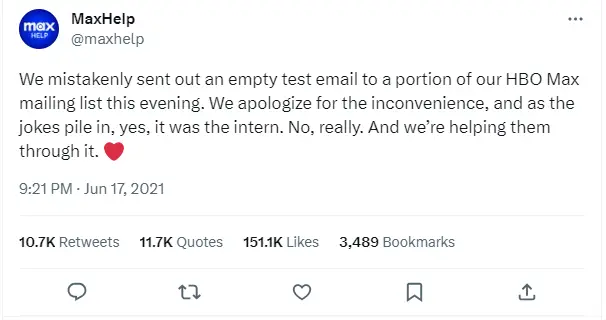
For a fantastic example of positive culture, look no further than HBO’s 2021 incident. In June of that year, a large portion of HBO’s streaming subscribers received an empty email with the subject line “Integration Test Email #1”. This obviously caused a lot of confusion and made users wonder if the email was a phishing scam using HBO’s branding. The answer came in the form of a tweet from HBO shortly after the email was discovered:

marketing backfires

The “blame the intern” joke quickly turned into a trend under the hashtag #DearIntern, as people around the internet chimed in to tell the intern in question that it was okay, everyone makes mistakes. Many users also shared their own slip-ups. The result was a flood of heartwarming and hilarious social media posts that both eased the pressure on HBO and provided everyone involved with a good laugh. This whole scenario demonstrates how important a positive response and determination to learn from your mistakes can be.

Keeping Marketing Backfires to a Minimum

While completely eliminating backfires may not be possible, marketers can take proactive measures to minimize their occurrence. These measures may include:

  • Encouraging a culture of communication within the team, enabling individuals to voice concerns and provide feedback without fear of repercussions.

  • Conducting after-the-fact campaign analyses to identify improvement areas and openly discuss backfires. This allows teams to refine their approach and build upon successes.

  • Developing hypotheses and testing them with data. This approach fosters a data-driven decision-making process.

  • Being willing to pivot when necessary. If an approach is not yielding the desired results, adapt and explore alternative strategies without stigmatization.

    Don’t Let Marketing Backfires Hold You Back

    Marketing backfires can have far-reaching consequences for brands and campaigns. Understanding the target audience, interpreting messages correctly, and fostering a supportive office culture are all crucial in mitigating the risks associated with backfires. Ultimately, the path to successful marketing lies in embracing a data-driven and creative approach and a willingness to adapt in the face of unexpected outcomes. Contact us today for more information on running successful marketing campaigns.


4Thought Marketing Logo   April 9, 2026 | Page 1 of 1 | https://4thoughtmarketing.com/articles/page/26