cetera find your fit

A long list of engaged, interested leads makes any marketer happy. After all, the more people interested in a company’s products or services, the better the bottom line. However, a broad and diverse pool of clientele can lead to an unexpected problem: the conventional marketing funnel doesn’t always apply.

This is the situation Cetera, a leading wealth management services provider, found itself in.

The Challenge: A Diverse & Rapidly Expanding Customer Base

Following rapid growth and multiple company acquisitions, Cetera wanted a way to connect to prospects with varying needs and preferences in a more bespoke way to better classify and route leads. Cetera’s existing methods relied on qualifying leads as part of the initial CSR engagement process, which wasn’t as efficient.  

“Our team was spending more time on the phone classifying leads than we wanted,” explained Merrill Varghese, Senior VP of Corporate Marketing. “We needed a better approach that allowed us to get right to a needs-focused conversation in that first call, so it could be more about how we could support the prospect’s needs.” Fortunately, the team didn’t have to wait long. What started as a project building an internal tool for mapping interest to available services became the spark for a client-facing, scalable, and self-selected approach.

The Solution: Implementing a Dynamic Customer Engagement Tool

Cetera knew what they needed. However, building and implementing the solution would take time—time the team couldn’t afford. To address this challenge, Cetera turned to the 4Thought Marketing team.

The 4Thought team used Cetera’s existing tech stack, including Adobe Marketo, to construct a tool to streamline the routing process. The “Find Your Fit” tool guided prospects through a series of questions, allowing them to identify their own needs and self-match with the most relevant offerings from Cetera.

The solution leveraged advanced algorithms and data-driven insights to categorize prospects based on their responses. This ensured that each prospect received a personalized recommendation, directing them to the top three programs that were the best match for their interests and needs. This approach enhanced the customer experience and streamlined Cetera’s internal processes.

How It Worked: A Personalized Journey for Every Customer

The system was a dynamic “choose your own adventure” experience. Prospects were prompted to answer questions upon visiting Cetera’s platform. Depending on their answers, the tool used predefined algorithms to categorize them into distinct customer segments.

For instance, if a prospect indicated an interest in tax and accounting services, the tool would direct them to content and service options specifically designed for tax professionals and accountants, ensuring they found exactly what they needed without unnecessary searching. This improved user satisfaction and increased the likelihood of conversion, as clients were more likely to engage with content directly relevant to their needs.

cetera find your fit

The Results: Enhanced Engagement & Higher Conversion Rates

It didn’t take long for Cetera to see an improvement. “The ‘Find Your Fit’ system made it easy for prospects to find exactly what they were looking for and understand how we could support their specific needs, and gave our sales team an immediate advantage. It was a game-changer for us and the prospect experience we were trying to create,” Merrill Varghese explains.

The implementation of the self-categorization tool yielded impressive results for Cetera:

  • Improved customer engagement: The tool significantly increased customer engagement and satisfaction by providing a more personalized experience.
  • Higher conversion rates: The tailored approach led to higher conversion rates, as prospects were directed to the most relevant services and support personnel from the start. This reduced the time and effort required for decision-making.
  • Operational efficiency: The tool allowed Cetera to manage a diverse customer base more efficiently. By automating the initial sorting and categorization of prospects, the tool reduced the workload on sales and marketing teams, allowing them to focus on more strategic tasks.
  • Data-driven insights: This approach also provided Cetera with valuable customer preferences and behavior data. This data was instrumental in refining marketing strategies and ensuring that each advisor segment received the most relevant content and offers.

Key Takeaways for Marketers

Cetera’s experience highlights several important lessons for marketers facing similar challenges:

  • Adaptability is crucial: As businesses grow and evolve, so too must their marketing strategies. A flexible approach that can accommodate diverse customer needs is essential for success in a dynamic market.
  • Personalization drives engagement: Tools that enable customers to self-identify their needs can significantly enhance the customer experience and improve engagement and conversion rates.
  • Leverage technology for efficiency: Automating the segmentation process improves accuracy and allows marketing teams to focus on strategy rather than administrative tasks.
  • Continuous learning and improvement: Using data to understand customer behavior is key to refining marketing strategies and ensuring long-term success.

If your company has the same challenge as Cetera, the answer might already be in your existing tech stack. We can help you find it and put it into practice. Get in touch with our team today to learn more and take the first step toward a long-term solution.


August 29, 2024

Addressing Unanswered Questions and Open Q&A – Office Hours

This month we answered some questions not previously answered on topics ranging from attribution to streamlining repetitive processes, unusual open rates due to spam and link checkers, and data privacy.


batch and blast

Batch and blast email campaigns certainly require far less time to put together than more personalized messages. But as most marketing experts understand, the tradeoff isn’t worth it. Batch and blast messages are known to produce significantly less revenue than personalized emails sent to interested contacts.

However, simply knowing that personalized messages perform better is just the first step. The real challenge comes when making the transition from the low-performing but easy batch and blast strategy to more demanding personalized campaigns. Here’s what eleven industry experts have to say.

Allocate More Time & Resources

Patrick Beltran,
Marketing Director, Ardoz Digital

From my experience, one of the main hurdles with transitioning to personalized email marketing, as opposed to the more generic batch-and-blast campaigns, is that it requires considerably more time and effort. This is especially challenging for small businesses that often struggle with limited time and resources to maintain consistency in their marketing efforts. Thankfully, there are now tools available to help streamline this process.

For instance, we use automated campaign tools and platforms like Townsquare Interactive’s business management platform, which allows us to handle our email marketing efforts from top-of-funnel to bottom. This platform integrates an inbox, calendar features, customer relationship management tools, and automated email and SMS messaging, providing everything necessary to grow our subscriber base effectively.

Additionally, we focus on prioritizing high-impact activities. We concentrate on email marketing strategies that align closely with our business goals and offer the most significant return on investment. We ensure that every email includes strong calls to action, tied to conversion activities like booking a demo or purchasing a product or service. This has helped us make the most of our efforts in email marketing by directly influencing our business outcomes.

Navigate Privacy & Compliance Issues

Marc Bishop, Director, Wytlabs

A significant challenge in personalized email marketing is navigating the increased privacy concerns and ensuring compliance with regulations such as GDPR. Customers are more sensitive about how their data is being used, and rightly so. To tackle this, we have made transparency a core part of our email strategies, ensuring that our communications clearly state how we use data and providing customers with easy options to control their privacy preferences. This helps build trust and ensures that we comply with legal standards, thereby protecting our business and our customers’ rights.

Ensure Data Cleanliness & Reliability

Jonathan Buffard,
Digital Marketing Director, Bottom Line Marketing Agency

If you want to get more from your email marketing, personalization is the name of the game. But it’s not without its challenges. One of the biggest hurdles is ensuring your data is clean, uniform, and reliable. The amount of personalization you implement depends on how many data points you have for your contacts.

Your audience data properties need to be consistently formatted and correctly inputted. Behavioral segmentation must be spot-on; targeting folks based on actions like adding to a shopping cart or clicking on a product requires precise and accurate segment creation.

Keeping your data updated is crucial. Customer behaviors and preferences evolve, and your segmentation must dynamically reflect these changes. Implementing real-time data-tracking and updating systems can help maintain the relevance and accuracy of your personalized campaigns.

In short, transitioning to personalized email campaigns means paying close attention to data integrity and segmentation accuracy. Nail these aspects, and you’ll unlock the true power of personalization, driving better engagement and results from your email marketing efforts.

Manage Increased Data Complexity

Josh Bluman, Co-Founder, Hoppy Copy

That would be managing the increased complexity in data and segmentation. Personalized campaigns require more detailed customer data and sophisticated segmentation strategies to ensure that each email is relevant to the individual recipient.

For instance, you’ll need to invest in tools and processes for gathering and analyzing customer data to create tailored content. This might mean integrating CRM systems, enhancing your email marketing platform’s capabilities, and developing more granular customer profiles. Initially, it can be a bit overwhelming, but the payoff is worth it: personalized campaigns tend to see higher engagement and conversion rates than generic batch-and-blast emails. Investing in the right technology and processes will help you effectively manage this complexity and deliver more impactful, personalized content.

Produce Creative & Relevant Content

One challenge marketers might face is the need for creative and compelling content that resonates with diverse audiences. Unlike batch-and-blast campaigns, which rely on a one-size-fits-all message, personalized campaigns require tailored content that aligns with individual customer interests and stages in the buyer’s journey. This necessitates a deeper understanding of customer personas and their motivations, which can be resource-intensive. Marketers may struggle to consistently produce high-quality, relevant content for every segment, making it crucial to establish a strong content strategy that emphasizes creativity and adaptability.

Balance Personalization & Scalability

One significant challenge when shifting from batch-and-blast to personalized email campaigns is effectively segmenting your audience and creating relevant content for each segment. Start small, measure results, and continuously refine your approach based on performance data. The transition requires a deep understanding of your customer base, often involving collecting and analyzing vast amounts of data. This can be overwhelming, especially for smaller teams or those with limited data analytics capabilities.

Creating multiple versions of content tailored to different segments is time-consuming and resource-intensive. It requires a delicate balance between personalization and scalability to ensure the effort remains manageable and cost-effective. We tackled this by starting with broad segmentation based on user behavior and gradually refining our approach. We developed content blocks that could be mixed and matched for different segments, which helped streamline the process.

Integrate & Manage Vast Data

When shifting from batch-and-blast to personalized email campaigns, one significant challenge marketers can expect is managing and integrating the vast amounts of data required to create truly personalized experiences. Personalization demands a deep understanding of individual customer preferences, behaviors, and interactions, which involves collecting, analyzing, and acting on data from various sources.

We faced this challenge head-on when we moved from generic email campaigns to more personalized approaches. Here’s how we addressed and overcame this challenge:

Firstly, we recognized the need for a robust data management system. Our existing infrastructure was not equipped to handle the detailed segmentation and dynamic content needs of personalized campaigns. We invested in a comprehensive CRM system integrated with our email marketing platform. This allowed us to centralize customer data, track interactions, and segment our audience based on specific criteria such as past behaviors, interests, and demographic information.

The next step involved ensuring data accuracy and completeness. Inaccurate or incomplete data can lead to ineffective personalization and even damage customer trust. We undertook a thorough data-cleaning process, removing duplicates, filling in missing information, and regularly updating our database to ensure it reflected the most current and relevant customer details. Creating personalized content at scale was another significant challenge. Unlike batch-and-blast campaigns, which rely on a single message sent to everyone, personalized campaigns require multiple versions of emails tailored to different segments.

To manage this, we developed a content strategy that included dynamic content blocks within our emails. These blocks automatically adapted based on the recipient’s profile and behavior, allowing us to deliver relevant messages without manually creating countless variations. Another crucial aspect was ensuring seamless integration across all touchpoints.

Personalization is not limited to email but extends to all customer interactions, including website visits, social media engagements, and customer service interactions. We used marketing automation tools to track these interactions and trigger personalized emails based on real-time behaviors, such as abandoned carts or recent purchases.

Ensure Content Relevance & Timing

A challenge is ensuring that the personalized content is not only relevant but also timely. The effectiveness of a personalized email campaign can diminish if the content reaches the recipient at the wrong time. To address this, we utilize predictive analytics to understand optimal timing for engagement based on past interactions. This data-driven approach ensures that our emails are not only relevant but also timely, increasing the likelihood of engagement and conversion.

Address High Initial Costs

James Owen, Co-Founder
& Director, Click Intelligence

The biggest challenge of switching to personalized email marketing is the initial costs. Batch-and-blast campaigns have a lower initial cost. This may make you doubt switching to personalized campaigns.

However, it is important to remember that email marketing will cost you less in the long run. Sending out mass emails is not as effective as a customized approach. Though your upfront costs will be lower, you will not convert as many customers.

Personalized email marketing has a higher initial cost because it requires specialized software. Your audience will engage more with your campaign, and you will save money. Customers will also have a more positive view of your brand when they do not see you as spam.

Deliver the Right Message

Batch-and-blast email has had its time… but today’s consumer opens up their email desktop every morning, and “delete, delete, delete.” If we have time, we also “unsubscribe.” The only effective marketing delivers the right message to the right people at the right time…when they’re already thinking of you. But there are more ways to do this than just PPC. Successful marketers will take the time to find and develop this kind of promotion because it just works better. These include: social media marketing, affiliate marketing, video marketing, referral marketing, and messages on hold.

Create a Single Customer View

Amir Elaguizy, CEO and Co-Founder, Cratejoy, Inc

In my experience, one of the toughest parts of prioritizing personalization over traditional batch-and-blast email campaigns is creating a single customer view. When you try to find common threads across different channels, the goal is to form a clearer image of who your customers truly are by integrating their data into one unified customer profile. However, research indicates that marketers often struggle to link data effectively to individual customer profiles. This challenge stems largely from the diverse data sources and types that need to be consolidated.

For example, a customer’s interaction on social media, their purchase history, and email engagement metrics must all be synchronized without discrepancies. Often, the technology or the systems in place aren’t fully equipped to handle this level of integration seamlessly. Moreover, ensuring data accuracy and consistency across channels can be a daunting task, as errors in data can lead to misguided personalization efforts that, rather than delight, might alienate customers.

If you’re still relying on batch and blast messages, it’s time to make the switch. Get in touch with our marketing experts today to develop a game plan.


As consumers become increasingly aware of their data privacy rights and the options available to them, businesses need to adjust accordingly. Personalized marketing materials still work wonders, but how can your company collect enough data for personalization without violating privacy laws? What’s the balance between respecting user privacy and effectively using data?

The Evolution of Preference Management

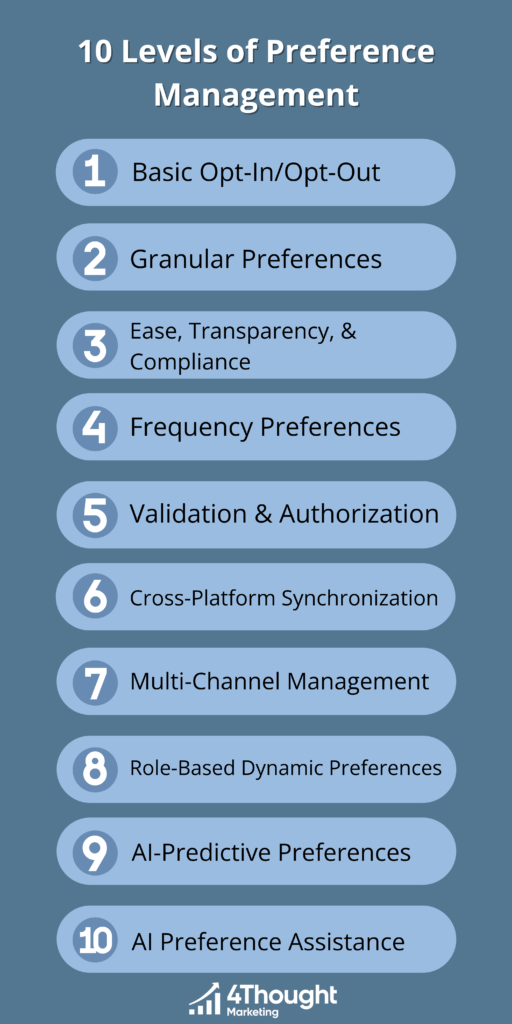
In short, the answer lies in a practice called preference management. This allows customers to control exactly what data they provide to your company and how they allow your company to use the collected data. There are multiple ways to approach this. Today, we’ll be looking at ten levels of preference management, each building on the previous one.

Level 1: Basic Opt-In/Opt-Out

At the most fundamental level, preference management begins with the ability for customers to opt in or opt out of communications. While this may seem elementary, providing a balanced choice like this goes a long way. A well-designed preference center not only offers an opt-out option but also encourages customers to opt back in by explaining exactly how and when their data will be used. This keeps contacts informed and ensures they feel in control of their choices.

Level 2: Granular Preferences

Granular preferences allow customers who have opted in to specify the types of communications they wish to receive. This can be segmented by product lines, content types, business units, or any number of other relevant categories. This choice assures customers that the communications they’ll receive will be both relevant and not overwhelming.

Level 3: Ease, Transparency, & Compliance

This level of preference management has three distinct levels of its own.

First, ease of use. Preference centers should be intuitive and straightforward. Too many options will overwhelm users and make them more likely to opt out of everything. Keep your dashboards scannable and simple.

Second, transparency. Being honest about your data collection and usage is crucial at this stage. Don’t ask for more data than you need. Explain how and when you’ll use the data you ask for, and stick to it. Make your privacy policy easily available for customers to review.

Third, legal compliance. It’s essential to prove that you’re honoring your customers’ requests. A customer’s preference submission is already connected to their email address. To be truly compliant, you must gather additional identifying data such as date, time, and form location, that show when and how the request was made. Returning only the most recent opt in or out state, if it’s a checked or unchecked box, is insufficient evidence if your compliance is ever challenged. You must provide a history of changes.

preference management

Level 4: Frequency Preferences

Some visitors who ask to unsubscribe might not want to completely stop communications—they may just want a break. Providing an ability to control how often they receive things -frequency preferences, makes this easy for both them and you.

Depending on your company’s exact marketing approach, frequency preference management can take different forms, such as:

  • You may give visitors the option to pause all communications for a period.
  • Alternatively, you may want to give them to control, for each preference they opt into a frequency option. For example they may want to get newsletters only quarterly, but product support information immediately.
  • Finally, you may want to consider “fatigue analysis”, which slows down communications to customers who aren’t actively engaging with your messages anymore. Communications will pick back up when their participation does. This keeps messaging frequency at the customers’ comfort level without costing you a contact.

Level 5: Validation & Authorization

This level is fairly straightforward: making sure the customer is who they say they are. This can be accomplished with something as simple as an identity verification email. This adds an extra layer of security to the preference management process, ensuring that no one else can sign up a customer for unwanted communications or change their set preferences.

Level 6: Cross-Platform Synchronization

In large organizations, recorded customer preferences may be scattered across various systems and departments. This obviously makes managing these preferences harder for internal marketing and privacy professionals that must deal with making multiple systems legally compliant. It also makes submitting those preferences in the first place harder, as customers have to navigate multiple menus and webpages. Consolidating them into a single, unified view through cross-platform synchronization makes things far easier for the customer and for you. Some jurisdictions even legally mandate this.

Level 7: Multi-Channel Management

Email marketing may be the most lucrative form of online advertising, but it’s far from the only one. SMS, push notifications, and other communication channels are still effective ways to reach your audience. And different demographics will prefer different channels. For example, one age group may prefer SMS messages over email, while another group wants email communication and nothing else. This is another layer of choice that your preference center needs to offer.

preference management

Level 8: Role-Based Dynamic Preferences

Prospects, customers, and company partners will have different areas of focus when it comes to receiving communication from you. Offering a universal preference center can make those areas of focus harder to track. Consider creating one preference center for prospects, one for current customers, one for company partners, and others as required so you can offer each group a relevant set of choices. (You’ll also need to remember the validation step of level 5 as you do this.) This makes things easier for the users and, by extension, increases their engagement.

Level 9: AI-Predictive Preferences

This level uses artificial intelligence to predict and then pre-set customer preference settings based on historical data, behavior, and other inputs. Many companies do this with an algorithm today, but enabling an AI to set these is typically far more capable when preferences are many and complex.

While AI-predictive preferences should not replace customer-set preferences, they can provide a valuable starting point, especially for new customers or prospects.

Level 10: AI Preference Assistance

The most advanced level of consent management involves AI-powered systems that interact directly with customers to understand their preferences. Imagine typing into a preference page:

“Every two months, send me an update with hyperlinks for all content on everything happening regarding home appliances from this company only. However, I’d like product announcements to be sent to me immediately.”

“I’ve turned on the three preferences below that pertain to home appliances with a frequency of every two months, and also the preferences for product announcements to come as soon as available.”

These systems look and behave like your typical chatbot, except they are intentionally focused and pre-prompted to understand all the content a company creates and the concept of preferences.  This futuristic approach can simplify the preference management process, making it more even intuitive and user-friendly.

Implementing Effective Preference Management

While understanding these levels is crucial, implementing them effectively requires strategic planning and execution. As you begin:

  • Assess your current state: Identify which level your organization currently operates at. Are you still at basic opt-in/opt-out, or have you moved towards AI-predictive preferences?
  • Prioritize ease and transparency: Regardless of the level, ensure your preference center is easy to navigate and transparent about what each option means. Use clear language and, where possible, visual aids.
  • Take advantage of technology: Use technology to automate and streamline preference management. This includes using AI for predictive preferences and cross-platform synchronization to consolidate data from different systems.
  • Focus on compliance: Stay up-to-date with legal requirements and ensure your preference management practices comply with relevant laws. This not only protects your organization from legal risks but also builds trust with your customers.
  • Customize and personalize: Tailor your preference management to different user groups. Use role-based dynamic preferences to provide relevant options to prospects, customers, and partners.
  • Stay flexible and adaptive: As new technologies and customer expectations evolve, be prepared to adapt your preference management strategies. Regularly review and update your practices to stay ahead of the curve.

Conclusion

Effective preference management is a dynamic and evolving process that requires a thoughtful approach and the right blend of technology and strategy. By understanding the different levels of preference management and implementing best practices, marketers can offer personalized experiences while maintaining compliance and building customer trust. The journey from basic opt-in/opt-out to AI-driven preference assistance is not just a technological upgrade. Rather, it is a strategic evolution that can significantly enhance customer engagement and satisfaction.

To take the next step in customer preference management and data privacy, contact 4Thought Marketing today.

preference management

dynamic content

Email marketing still ranks among the most effective forms of marketing. With a remarkable ROI of $36 for every $1 spent, it has more than proven its worth. But part of that success comes from a specific aspect of email marketing: personalization.

Emails structured around a customer’s specific interests boast a significantly improved open rate and ROI compared to generic emails. And for marketers to take full advantage of this, they can turn to dynamic content.

What is Dynamic Content?

Dynamic content refers to digital content that changes and adapts based on various factors, such as user behavior, preferences, and real-time interactions. Unlike static content, which remains the same for all users, dynamic content provides a tailored experience for each individual. This goes hand-in-hand with segmentation. A few common examples include:

  • Content based on preferences: Personalizing emails with content relevant to a contact’s preferences avoids clutter and irrelevant information, providing a better user experience. For instance, an email can have different sections dynamically inserted based on the recipient’s indicated interests, such as different images or text tailored to their preferences.
  • Geographic relevance: Companies operating in multiple regions can use dynamic content to connect customers with local representatives. This is also a good way to promote live events near the recipient.
  • Industry-specific engagement: Emails can be tailored with images and content relevant to the recipient’s industry. For example, a furniture resale company might use dynamic images linked to specific types of furniture that interest the recipient, making the communication more relevant and avoiding unnecessary information.

Outcomes of Using Dynamic Content

Marketers who take advantage of dynamic content and personalization can see improvement very quickly. A few of the most prominent changes could include:

  • Enhanced user experience: Tailoring interactions to individual preferences and behaviors makes communications feel personal and directly relevant.
  • Increased engagement: Personalized content is more engaging, leading to higher interaction rates.
  • Higher conversion rates: Relevant information and tailored calls-to-action make it easier for recipients to connect with resources and make decisions.
  • Customer retention and loyalty: Personalized campaigns foster deeper connections with recipients, encouraging repeat business.
  • Data-driven decision making: Dynamic content provides real-time feedback and analytics, helping marketers make strategic decisions and align strategies with audience preferences.
  • Optimized marketing efforts: Continuous improvement through data-driven insights ensures that each campaign is more targeted and effective, maximizing marketing ROI.

Implementing Dynamic Content: A Checklist

To successfully implement dynamic content, consider the following checklist:

  • Default criteria rule: Ensure there is a generic default version of the email for recipients who do not meet any specific criteria.
  • Content style and fonts: Consistent styling and fonts are crucial to avoid rendering issues.
  • Data accuracy: Keep dynamic content updated and relevant to customer needs.
  • Live testing: Test dynamic content live to ensure all criteria are functioning correctly and to mitigate any issues before launching campaigns.

Dynamic Content: A Game-Changer

Dynamic content transforms a generic email into a highly personalized message that the recipient will appreciate. In turn, this improves user experience, boosts engagement, and ultimately achieves higher conversion rates. The near-instantaneous feedback from contacts also tells you what to change in future campaigns. For any marketer taking advantage of email marketing, dynamic content is a must.

To learn more about implementing dynamic content in your campaigns, or to get some expert help, contact the 4Thought Marketing team today.

dynamic content

customer segmentation keep it simple

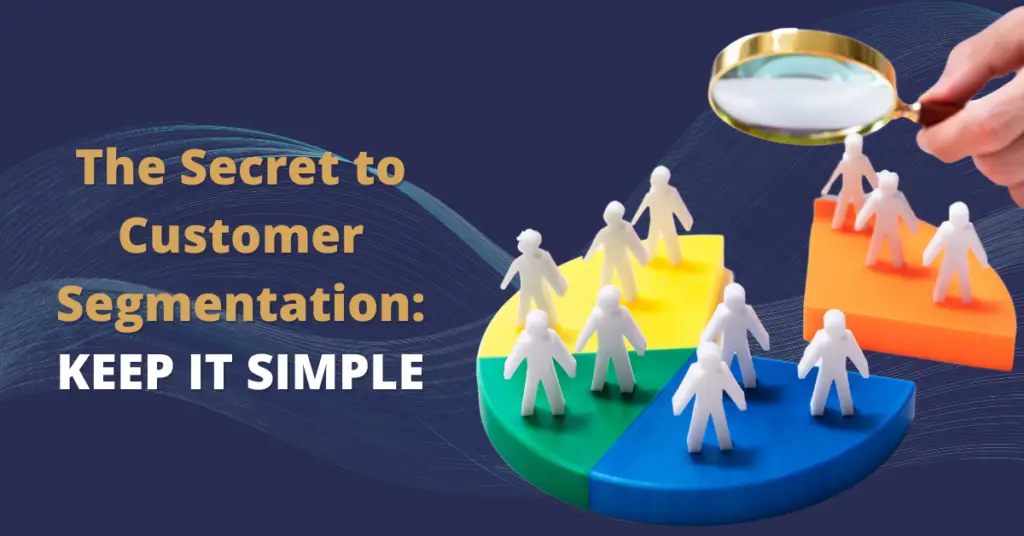
Identical mass marketing emails simply don’t work anymore. Customers want materials that are relevant to them and their interests. Your marketing automation system depends on a robust segmentation strategy to do its best work.

Let’s consider a very basic segmentation: customer vs. prospect. Obviously, there is a critical difference between a person who has purchased from your company and an interested window shopper. This is a very important but easy first segment to add to your system.

Unfortunately, this is where you might start overthinking it.

The Problem

It’s easy to take customer vs. prospect segments and immediately jump to harder tasks. Why not store everything a customer has purchased so you can further segment by product? Maybe a renewal date for a subscription service they’ve purchased? And obviously you want feedback, so why not segment further to send detailed follow-ups or surveys? This thought process can quickly turn the simple act of customer vs. prospect segmentation into something intimidating.

The good news is, you don’t have to get that detailed quite yet. Start with a simple goal and save the additional capabilities for a future project.

Customer Segmentation Can Be Simple

Are you having difficulty getting a list of all your customers into Eloqua? You might have conflated your project scope too quickly.

It’s easy to think that customer segmentation in Eloqua typically involves a long, detailed process:

  • Having meetings to define what a customer is:

    • What if they are really small customers?
    • What if they haven’t been active for several years?
    • What if they are only a service/support customer?

  • Asking sales reps to go through and flag all their customers or which contacts at an account should be considered customers
  • Scrubbing the list of accounts/contacts
  • Creating a complex ERP integration

All of these are good ideas, of course. But you don’t need to worry about them immediately. Spread your more detailed segmentation plans over several incremental updates to avoid overwhelming your team. You can still get excellent value from your simpler segmentation strategy in the meantime.

customer segmentation

A Simpler Approach

Consider taking the simpler approach. Every quarter, ask the accounting department for a list of customer companies. Even if the list is incomplete, you can still easily upload the list to Eloqua and flag the companies as contacts, then set the contacts as customers. And there you have it! You’ve segmented by customer, and all it took was a few hours of work that you’ll repeat every quarter.

As you eventually work your way to a more detailed strategy, consider using the following distinctions for segments:

  • Industry: You can use standard definitions of industries, like the North American Industry Classification System, or create your own categories (e.g., venture-backed enterprise software startup companies founded in the last 24 months).
  • Geography: This might include country, state/province, city, and postal code.
  • Job Level: Different job levels (manager, VP, etc.) will have different interests for you to market to.
  • Job Role: Consider the department your prospects work in (sales, marketing, etc.)
  • Activity: Choose segments based on their engagement with your marketing (e.g., prospects who have attended a webinar).

As you master this basic strategy, you can begin implementing updates over time. Don’t rush—give your team the time they need to adjust to each change.

This article is an excerpt from our ebook, “7 Common Marketing Automation Mistakes & How to Avoid Them”. Download the full ebook for free here.


segmentation for marketing

Marketing campaigns are most effective when they deliver the right message to the right people at the right time.  Hitting this target is key to success for marketers. This is where segmentation for marketing comes into play. You can tailor your communications to their unique needs and preferences by dividing your audience into specific groups.

That’s all good, but what does this look like in practice? Let’s look at an example.

Real-World Use Case for Segmentation

Sarah is the manager of an event marketing agency with 100-plus clients. She and her team have a wealth of data on their clients and want to use this data to promote an upcoming concert.

Sarah’s team leverages segmentation tools to analyze customer information and segment prospects based on relevant factors. In the case of this particular concert, the factors include:

  • Geographic location: customers who live within a certain distance from the concert location. Not every customer is willing to travel very far for a concert.
  • Engagement: customers who consistently open emails promoting similar events or events hosted by the same artist.
  • Purchase history: customers who have previously bought tickets for the same artist’s concert or events like it.

These segments help Sarah identify the most promising potential ticket buyers for the upcoming concert. Armed with this knowledge, Sarah and her team can then turn the raw data into tangible actions. The team sends promotional emails only to the most relevant audience, making it far more likely that the recipients will be interested. This results in higher open and click-through rates and increased revenue from ticket purchases.

segmentation for marketing

Marketing Automation & Segmentation Working Together

Another powerful tool in Sarah’s arsenal is marketing automation. This allows emails to be sent automatically based on user activity, changes in data, or other factors resulting in highly relevant and timely communications without requiring the marketing team to assemble anything hurriedly.

When Jack subscribes to emails from Sarah’s event agency, she’s already set up an automated system to walk him through the next few steps. Jack receives a personalized welcome email immediately after subscribing. Not only does this welcome Jack to the mailing list and show him what to expect, but it also provides him with an easy path for future purchases. It also lets him receive promotional emails for other upcoming events he may be interested in (again, based on segmentation data).

Automated emails can also leverage segmentation data for ongoing customer nurture emails. Let’s continue our example. Jack receives an email promoting a concert that he’s interested in, and he ends up purchasing a ticket. Months later, the same artist is performing again. Because the system knows Jack previously bought a ticket to see this artist, not only does he receive another promotional email, but he also gets a special deal: for instance, a “buy one ticket, get the second half off” discount code. This creates a sense of exclusivity and encourages Jack to take advantage of the deal, keeping him as a recurring customer. It also makes it more likely for Jack to stay subscribed—he doesn’t want to miss another exclusive discount code!

The Important Role of Segmentation for Marketing

Truly effective email campaigns rely both on segmentation and automation. As the first step, segmentation for marketing lets you narrow down your audience and tailor your marketing materials specifically for them. Next, automation ensures that timely and relevant emails are sent to the right individuals based on their interactions and behaviors. By employing these strategies, marketers can achieve higher engagement, stronger conversion rates, and ultimately, greater success in their email marketing endeavors.

Ready to improve your segmentation strategy? Get in touch with our team today.


It’s not uncommon for routine data cleaning to remove contacts from your Eloqua database, breaking the mapping to custom objects (CO). But don’t worry, if they come back through purchases or form submissions, you can use the Unlinked CO Mapper Cloud App to restore all of that valuable segmentation and personalization data you might have lost. With this tool, you can easily re-map those unlinked custom object records and get your data back on track.

Click here to learn more about the Unlinked CO Mapper Cloud App and request a free trial.


4Thought Marketing Logo   March 24, 2026 | Page 1 of 1 | https://4thoughtmarketing.com/articles/tag/segmentation/