Oracle Eloqua users should be quite familiar with the wide variety of built-in functions this marketing software offers. But it’s possible to expand both the value and functionality of Eloqua to improve your marketing strategy even further. What’s the best way to do this? For many Eloqua users, the answer is to use specialized Eloqua Add-Ons called Cloud Apps.
Here at 4Thought Marketing, we have several favorite Eloqua apps that we use, including several we made ourselves. Let’s take a look at what they are and how they make our workday easier.
Motiva AI
Artificial intelligence and machine learning now play an increasingly significant role in marketing optimization. The Motiva AI app uses the same AI that Google uses for paid searches to improve your email engagement and analyzes customer data for future campaign improvements.
What It Does: Motiva uses real-time data from your Eloqua instance to automatically optimize your campaigns and increase engagement.
Key Benefits:
Increased engagement through hyperspeed content testing, per-contact send-time optimization, and subject line advice
Monitors contact data quality to help you clean out unreachable contacts, find bots, fix deliverability issues, and lower your licensing costs
Automated segment discovery and rich reporting
Frequency management and touchpoint optimization
5-minute integration, GDPR/CCPA and HIPAA compliant
Vidyard
CTAs are an invaluable part of your marketing strategy, and can be used everywhere from emails to blogs and even videos! The Vidyard app allows you to generate leads from within your video content.
What It Does: This app allows you to embed CTAs and data collection forms before, after, or even during a video.
Key Benefits:
Choose the perfect time to add CTAs in the video’s runtime
Create gated video content to gather data at the beginning of the process
End videos with a CTA to encourage customers to continue
Gather and follow up on leads faster
Track watch time and determine quality of leads based on their apparent interest
Campaign Contact Remover
If you have more than a hundred contacts in Eloqua, the Campaign Contact Remover app can make your average workday much easier.
What It Does: This app does the heavy lifting of ensuring your marketing contacts receive the correct campaigns.
Key Benefits:
Set campaign filters once so you never lose track of what you are working on
Avoid sending the same offer to contacts multiple times
What to Remember: This isn’t the only cloud app developed by 4Thought Marketing. Browse a complete list here.
Contact Washing Machine
Once dirty data gets into your contact record, it’s hard to get rid of. Manual review certainly isn’t an option for the vast majority of businesses. That’s where the Contact Washing Machine comes in.
What It Does: This app reviews your collected contact data to remove dirty data quickly and efficiently.
Key Benefits:
Trim left and trim right to clean data, similar to the trim function in Microsoft Excel
Improved automation: use regular expressions to change data in a contact
Facebook Lead Ads
It’s possible to generate a lead from Facebook without the user ever leaving the Facebook site. But how do you move those leads from Facebook into your system? One reliable method is using the Facebook Lead Ads app.
What It Does: This app automatically transfers leads from Facebook to Oracle Eloqua.
Key Benefits:
Increased productivity for businesses that already rely on Facebook Lead Ads
Improved lead quality resulting from current information shared with Facebook, leading to higher customer response
LinkedIn Campaign Manager
Connecting to leads is a critical step in the sales process. With the LinkedIn Campaign Manager app, you can now engage more directly with your contacts on LinkedIn and even follow their profile to tailor promotions to their latest preferences.
What It Does: This app integrates Eloqua with LinkedIn for a more meaningful customer connection and lead follow-up.
Key Benefits:
Capture and nurture leads from LinkedIn
Target individual LinkedIn users with specialized ads
SMS Gateway
In a study of more than 1,000 campaigns, Cellit found that SMS has 8 times the response rate of email. The SMS Gateway app allows you to take advantage of the very lucrative potential of text message-based campaigns.
What It Does: This app optimizes your SMS campaigns for better delivery and increased customer response.
Key Benefits:
Two-way support: no more “do not reply” email addresses necessary
SMS-Friendly Copy: counts characters in your message to ensure optimal delivery
International support: generate numbers unique to each country you contact
What to Remember: Without consent, your SMS campaigns could be labeled as spam by the FTC. Don’t get in your own way!
“There’s an Eloqua App for That”
When used correctly, Eloqua apps can provide a much-needed boost to both your workday productivity and your profits. But it’s important to remember not to get so focused on finding the next great app that you lose sight of your competitors stealing your customers right from under your nose—or of privacy laws challenging your practices and putting you at risk of fines for noncompliance.
Once you have your favorite Eloqua apps all in a row, what’s next for your marketing strategy? Focus on issues with potentially long-lasting consequences, such as your compliance (or lack thereof) with relevant privacy laws. Talk to us about achieving GDPR compliance without endangering your newly revamped marketing strategy—or the profits it’s bringing in.
Oracle Eloqua Insight, powered by Oracle Business Intelligence Enterprise Edition (Oracle BI EE), is a powerful tool to analyze your data across Eloqua. It contains several out-of-the-box reports which cover different facets of campaigns, contacts, emails, forms, and landing pages. I learned my way through Insight through exploring these reports.
My analyst journey grew from standard reports, to editing these reports to make my own, and ultimately to creating my own reports and formulas from scratch. It was not a smooth journey. To (hopefully) make your journey easier than mine, I’d like to share several important lessons I learned the hard way about Eloqua Insight.
1. Report & Agent CANNOT Share the Same Name
I personally prefer to give related files the same name so that I can cross-reference between files if needed. On my hard drive, my Excel document can have the same name as my PowerPoint and Word documents in the same project, and there is no issue. In Eloqua, my campaign can share the same name as its email, form and landing page, and there is no issue. This is not the case with Eloqua Insight.
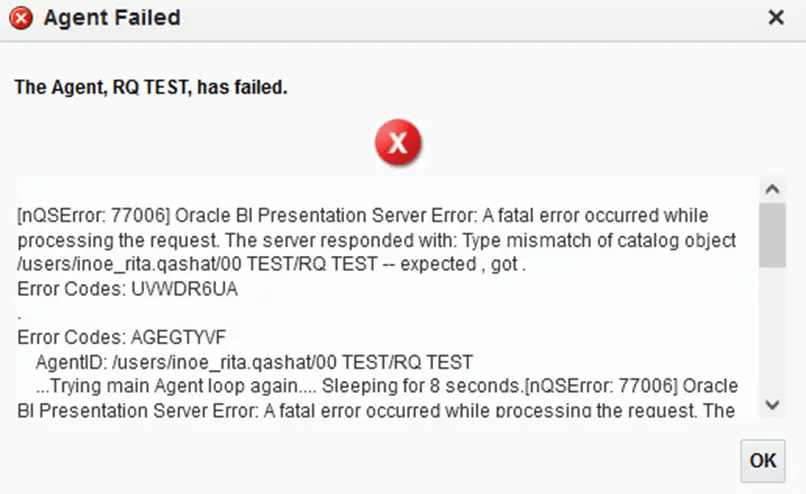
I had hoped to keep a similar organization style in Insight to make it easier to search and lookup reports and their scheduling agent. Accordingly, I attempted to assign the same file name to my report and its scheduling agent. When I went to run the agent, I received this error message:
Yes, Eloqua did give me a warning message before saving the agent, but I wrongfully assumed I was safe. Besides receiving this error message, my custom analysis report was gone since the agent overwrote it.
To recap: Whatever you do, do not give your report and agent the same name in Eloqua Insight. You will have to start all over with your analysis!
2. Reports Cannot Be Moved After They Have Been Scheduled
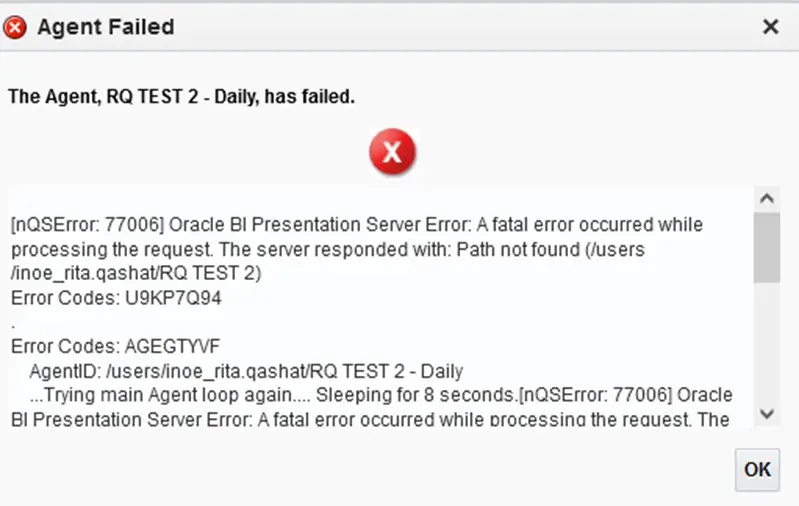
My Insight library was a mess with no rhyme or reason. I attempted to tidy things up by creating folders sorting by time and product. The good news is that my shared library was beginning to look in order. However, the next day I started to receive notices that stakeholders were not receiving their scheduled reports. When I went to check the agent, I received this error message:
I was able to modify the agent via the Condition tab to the updated location of the file, but it was a lot of work. This headache could have been avoided had I just followed the correct folder structure from the start.
To avoid making the same mistake I did, I recommend creating folders in Insight following naming conventions and rulesets similar to the ones you use in Eloqua. This makes it much, much easier to find the reports you need. I also keep a running tally of the reports I create in a spreadsheet including the following columns: date, cadence, report name, agent name, distribution list, subject line, and email. There have been many times I have been asked, for one reason or another, to remove a certain person from receiving scheduled reports. I can easily look up their email in my spreadsheet, locate the agents they are part of, and remove their email address.
3. Avoid Scheduling Multiple Reports at the Same Time
You can technically do this, and Eloqua will display all the reports as delivered. But as I discovered, when several reports are scheduled at the same time, not all of the reports reach the distribution lists even if they’re marked as delivered. When I began to set the report at random times throughout the hour instead, the queries of people looking for their reports dropped significantly. I began following this rule religiously with my scheduled agents after finding this out. A few extra minutes of work on my end saved me and my contacts a lot more time later on.
The Potential of Eloqua Insight
As you explore, build, and analyze Eloqua Insight, you will find just how powerful this tool can be. Want to see what it can do for your company? Our team of Eloqua experts can get you on the right track. Get in touch with us today to get started.
We take it for granted that a phone screen, tablet screen, computer monitor, or laptop will show us crystal-clear graphics. Blurry images tend to be blamed on malfunctions or just low-quality files. But the introduction of retina displays created another potential issue: an otherwise high-quality image displayed on a screen it wasn’t designed for.
What are Retina Displays?
Apple introduced Retina displays in 2010. Retina displays use twice as many pixels as standard displays, a design intended to make graphics even crisper. But increasing the screen’s pixel count doesn’t increase the pixel count of any images that the screen may be displaying. In other words, an image that looks fine on a standard screen might look blurry or even pixelated on a retina display.
The problem here is obvious. Not only are blurry images hard to look at (especially if they contain text), but they can also make your marketing materials look low-effort and unprofessional.
How Many People Use Retina Displays?
As of 2021, more than 113 million Americans (or 47% of all smartphone users in America) owned an iPhone. Meanwhile, in 2017, Apple estimated that there were about 100 million active Macintosh users, compared to Microsoft’s 400 million Windows 10 users. There’s also a 40% chance that these currently active users either bought their device recently or upgraded to the newest model when they could. All of these newer devices would have a retina display.
Let’s do a little math here. Between iPhone and Macintosh users, at least 213 million Americans regularly use Apple products as a primary or secondary device. 40% of them have recently upgraded to a new device. That’s 85.2 million Americans alone that regularly view websites and emails on a retina display!
Marketers focused on ROI tend to cater to the majority. If a few users don’t have the right technology or behavior to warrant nurturing, they may be brushed aside in favor of more profitable contacts. It may sound like retina display users can be safely ignored—they aren’t necessarily the majority, especially when the solution is so simple. But 85.2 million people is far too many to simply overlook.
Optimizing Images for Retina Displays
Since a retina display has twice as many pixels as standard displays, marketers should focus on doubling the number of pixels in their promotional images. Let’s look at email design for an example. Standard email width is 600 pixels, which will look blurry on a retina display. An email banner 1200 pixels wide will render much better.
To produce a retina display-friendly graphic, create the image with the doubled number of pixels. In the case of an email banner, that would be 1200 pixels by 400 pixels as opposed to 600 by 200. Save the completed image file. In your Eloqua email template, set the width and height in your <img> tag to 600 and 200 pixels respectively, then insert your high-pixel image. This allows you to retain the higher quality without disrupting your email formatting.
Of course, increasing pixel count usually means increasing the file size of the image. Since larger files take longer to load, only increasing pixel count doesn’t necessarily fix the problem. Use a file compression tool (like this one recommended by Hubspot, or this one from Website Planet) to decrease the file size while retaining as much image quality as possible. This way, you can keep the best of both worlds: high-quality, crisp images with a quick loading time.
Finally: consider which images in your email need the retina display treatment. The most noticeable differences in resolution show up in images with high-contrast elements, text, or geometric shapes. Many photos don’t have any of the above. While creating higher-quality versions of nonessential images certainly can’t hurt your campaigns, the extra time required to create them may not be worth it. To get the best retina display results quickly, stick to optimizing unique elements such as your logo, any icons in the email, and your branded font.
Keep Up with New Marketing Technology
Effective marketing teams know to keep up with customer behavior and developing trends. But your team should also keep track of new marketing technology, especially anything that impacts email as much as retina displays can. See how you can use these new developments to your advantage and improve your engagement rates.
Want some expert help bringing your marketing strategy up to speed with evolving trends? Contact 4Thought Marketing today for more information.
In 2021, Apple deployed its latest privacy feature: Mail Privacy Protection (hereafter MPP), allowing Apple users to hide their IP address and other information when opening emails. For email marketers, MPP presents an interesting challenge. How much of an impact will privacy measures like MPP have on your email metrics?
To answer this question, we need to take a closer look at what MPP is and what exactly it does.
What is Apple Mail Privacy Protection/MPP?
MPP is an option on Apple devices that users can toggle on or off depending on their preferences. When toggled on, MPP blocks certain private information from being shared with email senders.
Email messages you receive may include remote content that allows a sender to collect information when you view a message, such as when and how many times you view it, whether you forward it, your IP address, and other data. Mail Privacy Protection prevents senders from learning your information.
Apple Support
To summarize, MPP privatizes the following information:
The recipient’s IP address
Whether they opened the email at all
The time they opened the email
How many times they viewed the email
Whether they forwarded the email to anyone else
Email marketers will recognize the problem immediately. Without this information, how can you analyze your email performance?
Other Measures to Focus On
Fortunately, the introduction of MPP does not spell the end of your email campaigns. It simply means that it’s time to focus on metrics that drive revenue, such as clicks and conversions, instead of just email opens.
As an example, let’s look at an imaginary contact named Mike. Mike is an Apple user who has activated MPP on his phone, so you can’t see which of your emails he’s opened nor how many times. But if Mike is interested in one of your products and clicks through an email to visit your website, your marketing tools can keep track of his visit and what he looked at while he was there. You can track any purchases he makes, allowing you to draw a picture of Mike’s interests based on his activity outside of email. With this in hand, you can send Mike emails tailored to his preferences and hopefully encourage him to be a repeat customer.
To summarize, instead of looking at email opens to calculate ROI, watch these metrics instead:
Clickthroughs
Website activity
Products viewed on your website
Products purchased (or potentially added to wishlists)
Segmenting Your Contacts Ahead of Time
As Apple users choose to activate MPP, you might notice a sudden drop in your email open rates and panic. Don’t worry—thousands of people are not just randomly dropping off the face of the earth. Chances are, they’re still engaging with your emails even if you can’t see them.
To keep MPP from skewing your email engagement rates and confusing you, consider creating a unique segment for Apple users in your contact list. You can then segment further based on who seems to have MPP activated and who doesn’t.
Keep Your Email Game Going
You should already be tracking website engagement. But even if you are, connecting that information to emails can be tricky—especially when MPP is involved. Let us help! Contact 4Thought Marketing today for help maintaining your email ROI regardless of data blocking measures.
Modern marketers go beyond the click-through and open rates. Although good to track, they just scratch the surface of how you are performing. When asked the question “how did that campaign do?” what do you measure in order to answer? For a marketing manager, it’s critical to present meaningful data and make sure the team’s Key Performance Indicators (KPIs) are focused on what is impactful to success. It’s also important to understand the implications of those KPIs – for better or worse – in order to use the data to make actionable decisions.
Take your rejected MQL (marketing-qualified lead) rate, for example: if 85% of your MQLs are being returned to marketing, do you know what’s wrong? What kind of content needs to be improved? When you focus on the KPIs that really matter, they can tell you about how your marketing campaigns are performing –and point to what to consider.
6 KPIs That Matter
MQL Conversion Rate
The MQL conversion rate indicates the overall quality of leads being handed off to sales. If the conversion rate is low, it indicates that leads are of poor quality or sales, potentially, is not responding to the leads quickly enough – when they are “hot”.
Why This is Important This is an important metric because the MQL stage is where marketing hands off a lead to sales. This KPI provides the first glimpse into marketing’s ability to generate those sales leads and how well marketing and sales are working together. The measurement itself is a great way to encourage movement through the pipeline.
Rejected leads are not only the important learning metric here; tracking them also creates another way to bridge that divide between marketing and sales. If the rate of rejected leads is high, marketing should look for trends and then meet with sales to discuss why. Solving the ‘why’ is not something that your teams are going to get on the first try. It’s important to keep communication open between the marketing and sales teams to ensure that these sorts of weak points in the overall process continue to improve over time. If marketing and sales are effectively communicating this conversion rate should increase over time.
SAL to SQL Conversion Rate
This KPI measures the next critical point in the pipeline. Sales has created an opportunity and this lead is starting to show some real promise. These leads have become the cream of the crop, and what happens to these is what Marketing should really be learning from.
Why This is Important The SAL conversion rate is where you can begin to really analyze attribution and find out which campaigns and trends are creating quality leads and which ones are not. Not only does this give insight into which messaging is resonating most with high value leads, your analysis at this stage becomes a tool for correcting course and moving budget to where it will have the biggest impact. Be prepared to dive in to details, such as these examples:
Did any of these leads attend this year’s costly event?
What is the least productive lead source? How much did you spend with that content syndication vendor?
Funnel Velocity
This is a great KPI to get a picture of how quickly leads are moving from one stage to the next. There are many insights to gain depending on how you look at the velocity.
Why This is Important
Tying velocity to campaigns can help determine which campaigns are converting leads the quickest and are the most likely to contribute to a steady revenue stream. Measuring velocity makes it easier to draw conclusions when that velocity is tied to a lead stage, such as how quickly MQLs are being accepted or rejected. This can be very telling when trying to measure lead quality.
Being able to demonstrate how quickly a lead moves from SAL to SQL can also help convince sales of the value of marketing’s efforts in keeping that lead in evaluation stage nurturing (a typical debate that marketing loses, particularly without funnel velocity proof).
Journey Nurture Progression
Nurture campaigns are set up to move leads through the buyer journey, so it’s nice to see how leads are progressing through them. Since nurtures are highly content and message driven, and also focused on the stages of the buyer journey, it’s important to make sure that the content you deliver resonates with those stages, or that the message focuses on the right audience.
Why This is Important The Journey Nurture Progression is a great metric for gauging the overall quality of content, messaging and also how well you’ve segmented your database. If you find a stage in your nurture where leads are not moving from one stage into the next, it might be a good indication that it is either the wrong time to put that particular message in front of prospects, or maybe it is just the right message – but going to the wrong audience. Use this metric as a great way to learn and proactively course correct.
Campaign Attribution
First touch? Last touch? Multi-touch? There is no wrong model. Whichever one you use, you’ll want to track campaign association to learn which campaigns get the most touches, which ones fall flat, and which ones turn into leads and opportunities.
Why This is Important Tracking campaign attribution is not only useful on its own, it is a crucial building block for other KPIs. In fact, you won’t be able to derive any of the other recommended KPIs without it.
Campaign Attribution helps you identify trends in the content being consumed in addition to quantifying how many touches it takes for a lead to become and opportunity – or better yet, a closed-won opportunity. Eloqua users can even track campaign engagement from unknown web visitors when they use the 4Thought Marketing Anonymous Campaign Attribution App. This app provides visibility into what visitors are interested in and then associates those anonymous visits with the right named lead once that visitor supplies identifying information.
Closed-Won Opportunity Attribution
This KPI is the mother of them all. Closed-won opportunity attribution ties a specific lead source (channel) or campaign to a closed-won opportunity. This is where real revenue is attributed back to marketing. Measure this and you have what you need to prove Marketing’s value to the business.
Why This is Important Closed-won attribution takes campaign attribution and attaches it to an opportunity.
If a marketing team can track closed-won opportunities to associated touch points, it will be easier to identify which campaigns are the most effective, and which ones need improvement.
Equally important, marketing can quantify what percent of the total opportunity dollar amount closed and won was influenced by marketing and what percent came from marketing-generated leads. This is what puts a real value on marketing’s contribution to revenue and provides management and the C-suite the visibility into how big a piece of the pie marketing contributed to revenue. This is the KPI that justifies budgets and earns organizational respect. This KPI is CMO gold.
Key Takeaway
Getting the benefit of what KPIs can tell you comes down to collecting the right data, applying logic to that data, and then putting it into an easily digestible format. Visit our KPIs page for more information on how 4Thought Marketing helps marketing teams build out their KPI and reporting strategy, or reach out to our team for expert help.
How to Survive and Thrive in the New Economy
by Mark LeVell, CEO of 4Thought Marketing
As a digital marketing professional and an Oracle Eloqua advocate for many years, I’m always looking for indicators of where global markets are heading. And between COVID and significant economic fluctuations, there’s lots to consider.
VUCA and Abraham Maslow
When the Cold War ended in the 1980s, the world entered a new era of re-alignment. In military circles, this is known as VUCA: Volatility, Uncertainty, Complexity, and Ambiguity. This perfectly describes the period that we’re in right now.
Our customers’ needs are changing. Getting the latest products at the best prices, collecting loyalty points, and socializing are giving way to safety and security as the guiding principles for many. We’ve slipped down Abraham Maslow’s Hierarchy of Needs faster than a kid on a scooter.
And all this has massive implications for Customer Experience professionals and, specifically, marketing leaders.
Five Lessons from History
Whenever I feel like I’m experiencing VUCA, the first thing I tend to do is retreat into history to see what lessons we can learn from those who have gone before us. I came up with five specific lessons that all marketers should consider carefully.
1. Re-Segment & Re-Target
In a down economy, there are always some sectors that continue to spend. Some of these sectors are obvious (Biotech and Healthcare are obvious choices during Covid-19). As a marketing professional, you should target them immediately to gain some early wins.
However, many sustaining or growing sectors are not obvious, and identifying these micro-sectors in a sea of data is critical. Dig into your Eloqua and CRM data. Look carefully at who is buying, and to catch these micro-segments even earlier at who is responding.
Then, invest your time and energy into figuring out why these segments are doing well. For many, once you see who is responding, WHY they are doing well and responding becomes obvious… and this leads directly to the all-important messaging.
For others, you may have to dig deeper. I’ll assume you know the apparent marketing tactics, including using our visual segmentation solution 4Segments.
Another easy and effective approach is to talk to your customers. It’s easy to do, but I’ve always found marketers hesitant to pick up the phone and call their customers. Why? I think at some subconscious level they feel it’s sales’ job.
Ultimately, it’s marketing’s job to figure out messaging. To do this, and you need to know what your customers are thinking. Pick up that phone!
2. Focus on Customers
Now is the time that you should focus on your existing customer base. It costs roughly five times more to sell to new customers versus your current customers. And the last thing you want right now is extra-hungry, aggressive competitors stealing away your customers. To continue growing in a down economy, focus on your precious customer base.
3. Innovation Supported by Integration is Your Greatest Weapon.
When stress levels are high, creativity suffers. I’ve discovered this both personally and professionally across my career. Yet innovation can be a crucial customer attraction engine in the age of VUCA. Marketers are famous for innovation and creativity, so is the problem solved? It’s a bit more complicated than that.
Start with innovation. Identify gaps in your processes, data, or systems. Next, identify the business value you could achieve by finding a solution. Then quantify the benefit and prioritize your list.
Next, explore how to integrate your solution. You may want to focus first on existing capabilities. If you cannot achieve the desired results for your highest priority issues, look to new integrations and custom solutions to help achieve your goals.
Therefore, the second lesson is to choose your marketing automation apps carefully and select strategic partners who can handle any integration or functional extensions you may need.
4. Be a Challenger
Challengers are the people who deliver valuable insight to their customers, look at their customers’ problems through a different lens (re-framing), tailor their messaging to match, address their needs and take control of the sales cycle. For marketers, this has significant implications. Re-examine your content strategy and ensure it delivers real, unique insight at a deeper personalization level. This should be easily customizable for your sales teams.
In the last economic downturn following the global financial crisis of 2008, some salespeople (in the complex enterprise B2B area) continued to be highly successful.
One small research company – CEB (now part of Gartner) – set out to find why. What was it about this cohort of sales professionals that made them succeed where many others – even in the same company – failed abysmally?
In their book, The Challenger Sales, they detailed the most successful salespeople’s behaviors. They named the most successful persona “The Challenger.” No longer were the relationship builders, the problem solvers, the hard workers, and the ubiquitous mavericks the best sellers – the challengers stood head and shoulders above all others.
5. Frugal Innovation Rules
Most organizations use around 20% of the horsepower of their existing systems. In my experience, the same is valid for marketing automation solutions. By unlocking more functionality from your current apps, you can leverage frugal innovation to stay one step ahead of your competitors, even with slashed marketing budgets.
By conducting system audits (from those who deeply understand these apps) and implementing effectiveness studies, you can quickly understand your existing solutions’ full, untapped capabilities. It might be as simple as investing in more training for your current staff or asking your Martech partners to create a simple add-on to unlock this latent value.
Insulating Your Organization
As a digital marketing professional, how should you insulate yourself from an economic downturn? Here are three things you should do immediately:
Invest in world-class CX. Make sure you maximize the value of your existing customer base. Start with a ‘frugal innovation’ strategy and then see where your gaps in capability are. With Oracle CX Marketing / Eloqua, you’re already in good shape. You can extract even more value by partnering smartly with an organization to ensure you get the maximum value from your investment. Focus on both innovation and integration.
Build elasticity into your marketing model. To ride the waves of an undulating economic outlook, ensure you can both expand and contract your business to smooth out the waves. We’re now living in the age of “everything as a service.” Choose the right strategic partners and solution providers. Build a tight organizational core and an agile operating strategy that can elegantly expand and contract to enable you to surf the VACU we’re all living through successfully.
Invest in your people. Ensure the key staff in your operational ‘core’ have the right skills and competencies to excel in the age of VUCA. Develop hard skills to unlock your technology’s value, plus the softer skills of psychological resilience and ability to support their fellow workmates through the tough times. To deliver a great customer experience, you first need to nail the employee experience.
Conclusion
To survive and thrive in the new economy, you need to make some fast decisions and adopt a different marketing-department posture.
Adopt a survive and thrive mindset so that you’re continually learning from your successes and your failures. Don’t descend into a blaming culture. You will succeed or fail as a team.
Transform your business into being agile by design, applying it to your people, processes, and technology. Each has a part to play in delivering an excellent customer experience
Build a scalable operating model to ride the economic uncertainty waves, including both upward and downward scalability.
Assemble an ecosystem of strategic partners who can share the workload. Focus on your organization’s core value, the things your customers care about. Consider outsourcing the rest!
In good times even mediocre organizations can perform well and make money. When a downturn hits, you find out which ones have a robust and sustainable operating model. Or, in the words of the investment guru, Warren Buffett, “Only when the tide goes out, do you discover who’s been swimming naked.”
About Mark LeVell
Mark LeVell has over 25 years of experience in Silicon Valley, including the founding of three start-ups, along with other marketing and sales executive positions at a variety of software companies. He has been at the forefront of both the CRM and Marketing Automation revolutions, starting with building one of the first sales automation software companies, TeLeVell Inc, over 20 years ago. More recently, he was Vice President at Market2Lead and Director of the Market First Group at CDC Software. Mark has helped hundreds of companies find and implement solutions to their marketing and sales needs.
It’s not uncommon for routine data cleaning to remove contacts from your Eloqua database, breaking the mapping to custom objects (CO). But don’t worry, if they come back through purchases or form submissions, you can use the Unlinked CO Mapper Cloud App to restore all of that valuable segmentation and personalization data you might have lost. With this tool, you can easily re-map those unlinked custom object records and get your data back on track.
Click here to learn more about the Unlinked CO Mapper Cloud App and request a free trial.
Marketing and advertising can take advantage of countless media in the modern world. And with consumers using technology for almost everything, there’s never been a better time to provide them with customized marketing materials designed to cater to their interests. While there are several ways to do this, one popular choice for most companies is to send an email.
But any marketer knows that there’s more involved than just typing a couple of lines of text and clicking send. Effective marketing emails need engaging content, eye-catching colors, an aesthetically pleasing design, and more to bring in business. And don’t forget about customizing the email’s content to match the customer’s interests! Marketing automation tools can help you create successful emails, but they won’t do all the work for you.
Your End Goal: Generating Conversions
As you begin designing and writing your campaign emails, keep your end goal in mind: generating conversions. This goal should influence each step of the process. What is your email offering the customer? Does it meet their needs? Will they be satisfied with the offer? Your customers’ thought process should be at the forefront of your campaign plans.
With this goal in mind, let’s take a look at how to design emails for effective marketing.
The 6 Types of Marketing Emails
Businesses focused on e-commerce should focus on six key types of marketing emails to retain or boost customer engagement. These emails include:
Welcome emails shortly after subscription
Promotional or announcement emails about a new product or upcoming event
Receipt emails sent to confirm an order
Re-engagement emails to revive interest in inactive customers
Newsletter emails to keep customers engaged and updated
Cart abandonment emails to remind customers about an unfinished online transaction
Each email demands its own layout and design. Since the type of email determines the design you’ll be creating, knowing what type of email you’re creating is a critical first step.
How to Design Emails: Aesthetics
There are a few key elements to keep in mind as you design your email layout. First of all, consider how this email is likely to be viewed. Do your customers tend to open emails on their phones or laptops? Your final design should be mobile-friendly and still look good on a larger screen.
Second, branding. Is your logo and/or company name prominently displayed? Can the customer tell at a glance which company is contacting them?
Third, colors. Too many colors can create an email so bright it’s painful to look at, and may even slow loading time. Overly busy patterns can cause similar problems. On the other hand, not enough colors can make your email look stale and boring. Find a balance of colors that will catch the eye without overwhelming your reader. And most importantly, keep your colors consistent with your brand! Using hot pink in an email when your logo is dark blue isn’t a great idea.
Finally, consider white space. It shouldn’t take up your entire email. Instead, use white space strategically to distinguish between different sections of your message. This will help the email flow. You can also use white space to highlight important sections, such as your CTA button.
Making a Great First Impression
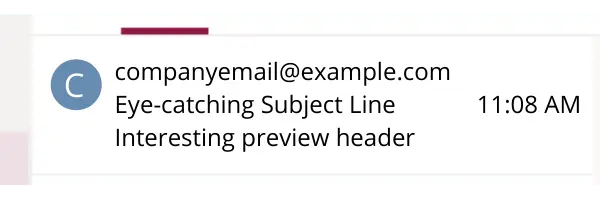
Before a customer clicks your email, two all-important lines of text appear in their inbox: the subject line and the preview header. Both play an important role in customer engagement.
The subject line is the first part of an email the recipient will see. It has to be intriguing! A subject line that’s too long will make a customer lose interest and, worse yet, may even be cut off since most email inboxes restrict subject lines to 60 characters. Some mobile devices even cap the limit at 30 characters! Keep it short and sweet without sacrificing the all-important intrigue.
Next is the preview header. This is a line or two of text below the subject line that adds a bit more detail about the email’s contents. This should be close to your subject line length, with a standard upper limit of 40-50characters. Put the most important ideas first, just in case your preview header is cut off. But don’t give it all away here! Make the customer interested enough to click the email rather than get all the info they need from the preview.
Additionally, make sure to add something for the preview header, even if it’s short. If you leave the space blank, your client’s inbox will display the first line or two of your email body instead. It’s far better (and cleaner-looking) to add a short, snappy preview header.
Personalizing the Message
Timely, relevant, and personalized emails can significantly increase the likelihood that a customer will respond. Addressing the recipient by name is already a great start, but don’t stop there. Further data segmentation enables you to create emails designed to make customers happy and more likely to buy. To use an example, segmentation should prevent you from sending an email promoting a new brand of cat food to someone who owns a dog and has no use for cat food.
Eloqua users will be happy to know that Eloqua’s custom objects system allows you to segment and personalize emails like a pro! Learn more about how to use custom objects in email design here.
What to Write?
It’s finally time to draft your email. But what does it take to create the perfect email copy?
There are a few principles to keep in mind as you write your email body. First and foremost, keep it simple. Invite your readers to click on landing page links for more details instead of trying to fit all those details into your email. Short, to-the-point email copy will leave a much bigger impression on your readers than trying to write an entire essay.
Second, remember to humanize your content. This goes beyond personalization measures like inserting the reader’s first name. If your email sounds like a robot wrote it, people will get bored and click off. Make the email feel like it was written specifically for them.
Third, consider whether your email works better as active or passive content. (A quick refresher: active content invites the reader to do something, such as make a purchase or register for an event. Passive content, such as a white paper or infographic, simply presents information without asking the user for action in return.) The vast majority of marketing emails should consist of active content.
Technical Considerations
Now that you have your email drafted, it’s time to start designing. But there’s more to keep in mind at this stage than just graphic design principles. A well-designed email that doesn’t function correctly is a failed email. As you design your message, prioritize these technical considerations:
Links: Double and triple check that each link works and sends you to the correct webpage or asset
Fallback fonts: Sometimes your branded font may not load properly in a client’s inbox. When this happens, the inbox will load your email in a default font instead. Choosing a fallback font lets you control how the default font looks without compromising your email design.
Email dimensions: It’s generally advised to stick to 600 px for desktop emails and 320 px for mobile. Remember to check your final email in both desktop and mobile inboxes to ensure the design changes to fit your screen.
File size: There’s no ideal file size for your finished email or its assets. However, remember that the bigger your email is, the longer it will take to load, especially on mobile. Experiment to find a good balance between eye-catching visuals and shorter loading times.
On rare occasions, an image in your email may fail to load properly. The recipient will see a blank white space when this happens. However, if you add alt text to your image, this white space will display the alt text if the image fails to load. Adding alt text that flows well with the rest of your message and describes the missing image makes the email feel more complete even if something goes wrong.
The All-Important CTA Button
Your email might have multiple CTA links, but only one should take the spotlight and be the primary focus of your email. This one links to the action you really want to encourage: making a purchase, downloading a document, registering for an event, etc. Your primary CTA should be separate from the rest of the message, ideally in a colorful button surrounded by white space to make it stand out. Keep the copy short and sweet—“Shop now” will work far better than “Browse these amazing deals and more in our online store”.
Overall, your CTA button should clearly explain what you want the customer to do, stand out in your email, and be compelling enough to motivate the customer to click.
Don’t Forget the Footer
Once the rest of your email is done, start thinking about the potentially most boring part that few customers pay attention to in the footer. Don’t overlook this even if you suspect your customers will. Not only can you use the footer to build additional connections, but it can also play a key role in your legal compliance.
A well-crafted email footer should contain several things:
Reinforcement of your branding to make it absolutely clear who sent the email
Contact and/or subscription information required by law (for instance, the address or contact info of your company, preference management options, and possibly terms and conditions)
Additional links (for example, links to contact your company or visit your social media pages)
Privacy policy or a link to view it to show your commitment to privacy compliance
The email footer is your last chance to include vital content. Make sure to take full advantage of this.
Taking the Email for a Test Drive
Now it’s time to test the email!
There are three major things you should test for at this stage. First, see if everything loads correctly. When you open the email in your own inbox, are all the images showing up? Is the text formatting still good? Do all the links still work?
Second, perform a quick spam test. Sometimes you can accidentally trigger someone’s spam filter, get routed to their junk folder, and pass under their radar completely. See if your own inbox flags your email as spam. There are plenty of free and commercial spam checkers available online. Make any changes you need to pass the test.
Finally, it’s time to send the email out. This is where the third, more long-term focused testing stage comes in: A/B testing. You might have multiple subject lines or email layouts for a particular campaign and aren’t sure which one is the better choice. Send out both! Monitor your results to see which option performs better, and use this information when designing future campaigns.
Email Campaigns Take Time
When it comes to marketing email campaigns, quantity no longer determines the winner. In fact, sending out emails en masse can get you flagged as spam by some inboxes. Quality rules now. A professional marketing email designed to provide the customer with exactly what they want will be far more successful than past mass email campaigns.
Ready to start designing better marketing emails? Get in touch with us today to learn more about how we can help.
During times of economic downturn, inflation, and recession, businesses of varying sizes often face challenging decisions. Sometimes this can include budget cuts and unfortunately, the marketing budget is often one of the first to take a hit. But this is a mistake. It is important to understand that, during these times more than ever, efficient digital marketing can be a business’s best tool.
Marketing automation is a great place to start. It’s a tool that can help to boost sales, grow the existing customer base and cut costs. Let’s take a look at this tool in more detail and how you can get started with using it.
What is Marketing Automation & Why is It Important?
In simple terms, marketing automation is the process whereby marketing activities are automated using software. It can be a game-changer for businesses as it makes it easier and faster to reach customers with personalized messages.
In addition, marketing automation handles some of the routine and labor-intensive marketing tasks without the need for human action. By automating email marketing, data entry, social media management and other repetitive tasks, businesses can save time and money. In addition to reducing labor, it can help existing sales and marketing teams work more closely together by automating tasks such as lead assignment, follow-up, and nurturing.
Automation can also be a useful tool to help track customer interactions, behaviors, and preferences. This information can be used to adjust marketing strategies to meet customer needs. This allows businesses to remain agile, which is particularly important in a tough economic climate.
In a recession, marketing automation can be a powerful tool to help businesses maintain and even grow their customer base. By automating marketing tasks, businesses can free up time and resources to focus on surviving the downturn.
Getting Started with Marketing Automation
There are several effective strategies for leveraging marketing automation. Some of the most popular include:
Automate email marketing: automated emails are a cost-effective way to keep in touch with your customers and continue promoting your products or services.
Social media: pre-scheduling and automating social media posts allow you to continue connecting with your customers and promoting content.
Targeted content & offers: If you’ve already segmented your customers based on activity and interests, use your collected data to deliver the right message at the right time. This is great for adding effective and ongoing customer touchpoints.
Conclusion
In conclusion, marketing automation can help businesses to be more efficient, which is particularly important during times of economic uncertainty and recession. It is a tool which can be easily implemented which can help to reduce operating costs and free up employees to focus on other areas.
2021 was the year the world worked remotely. What started as a temporary measure during the pandemic has largely become something likely to remain with us semi-permanently. As revealed by Owl Labs’ ���State of Remote Work 2021” report, as many as 70% of the US workforce have worked remotely, with most still doing so.
Not only does this suggest a shift in the way workplaces must let employees get their work done, but it also means that Eloqua tactics and B2B marketing for remote workers must evolve too. In this article, we’ll break down the steps that marketers should consider to adjust to the new work-at-home paradigm.
Shift to a Casual Tone
For many, the new norm is having kids and pets occasionally on-screen, showing up in T-shirts even for external meetings, and otherwise approaching business from a much more casual perspective. This shift has expanded across most aspects of business, including communication styles. Your content will now resonate better if it echoes the new normal. For example:
Attire: Stock photos of people in suits and conference rooms may show you are disconnected from the current state. Even if this doesn’t happen consciously, it may not resonate well. Offices are so two years ago!
Cats in emails: Except for Petco, pets were unacceptable in 2019. But maybe they can be worked in, in 2022 and beyond.
Less formal grammar and tone: Consider how your support/salespeople and your customers are going to interact. Are they going to meet in T-shirts in Zoom rooms with funky backdrops? If so, an overly formal marketing tone may feel “separate” and “different” from the new way the corporation works. An updated content tone should stay consistent with the rest of the business and workforce.
Re-Evaluate Location Calculations
Legacy code/flows in your MA system may use IP addresses to fill in city, state, etc. Usually, this system works under the assumption that the IP address is associated with the company headquarters. However, in 2022, it’s more likely that the address is connected to someone’s home. You’ll need to keep this in mind and change your marketing automation setup as necessary to accommodate it.
Re-Evaluate Send Times
Many workers now juggle kids and work simultaneously. When scheduling emails, you should consider the times that kids may be impacting opens. Previous send-times such as 3:00 pm that might have been considered “open and at the desk” now may have different results.
Set Aside Technologies that Associate Team Members with Companies by IP Address
Many MA and Leadgen systems feature the ability to identify a user’s employer company by looking at their IP address. However, for remote workers, this now reports incorrectly. You should consider updating your MA algorithms and deprecate any systems whose core functionality is based on this.
Reconsider Territory Mappings
A lot of companies use contact locations to determine which rep to assign. With more than 20% of people moving during the pandemic, and most of them having moved away from their company headquarters this is an important consideration. Company headquarters should supersede contact location and how international headquarters vs. local-country headquarters should impact.
Why This Matters: Remote Work is Here to Stay
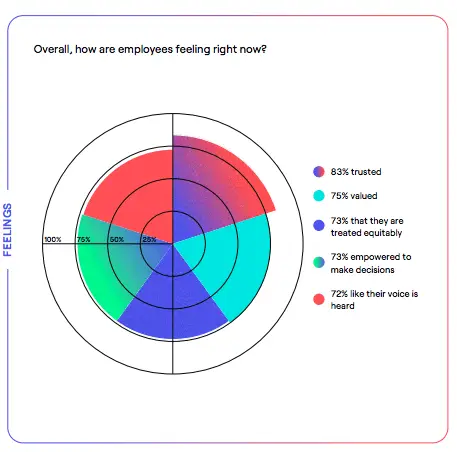
Employees feel differently working from home. Owl Labs’ research supports this notion (refer to the chart below), with key stats such as 73% of participants “feeling empowered to make decisions”. This can have many benefits to businesses and provide fantastic opportunities for both employees and organizations through increased creativity, productivity, and staff retention. Updating your B2B marketing for remote workers not only allows you to keep up with new challenges, but also demonstrates to your client base that you’re willing to meet them where they are.
As marketers, it is important to leverage every opportunity to increase lead flow and stay ahead of the competition. There isn’t a LOT needed to adjust to the new work-from-home environment, but there are definitely things to consider and change! And of course, if you need help, 4Thought Marketing specializes in keeping your marketing for remote workers current, personalized, and relevant. Get in touch with us today to learn more.
Eloqua’s often-overlooked page tagging feature is a powerful tool you should definitely be using. But why is this feature so important? Besides obvious benefits like webpage categorization, well-done page tagging can improve the sales process, from customer segmentation to lead scoring. Let’s take a closer look at several top benefits of page tagging.
1. More Accurate Lead Scoring
Page tagging allows you to categorize each webpage based on its place and value in the sales process. For example, you can observe when customers move from lower-value to higher-value pages and thus progress a prospect through the sales funnel. These patterns will help you plan the ideal customer journey and revise your website as needed to make it happen.
2. Easier Categorization
Along with information such as the funnel stage, consider adding general categories to each web page’s tags. Category tags might include:
Case studies
eBooks
Nurture
Upsell
This tells you at a glance what categories on your website get the most attention, and which play the more important roles in the customer journey.
Finally, with product/solution tags, you can easily identify cross-selling opportunities and build your segmentation strategy around them. For example, a customer buying a new phone might want a case, screen protector, or other accessories. A well-constructed page tagging system will show you what products they might be interested in for your segmentation strategy.
Get Started Creating Page Tags
Eloqua’s page tagging capabilities can significantly contribute to your marketing and sales efforts. With their potential to increase the quality of your lead scoring, website design, and future marketing strategies, they are well worth your time.
Ready to start adding page tags to your website, but not quite sure where to begin? Get in touch with us for professional help.
Among its many features, Eloqua offers one function that often goes overlooked: page tagging. In a previous article, we explored how page tagging can enhance customer segmentation and contribute to more effective marketing campaigns. Today, we’ll delve deeper into various practical methods for creating page tags in Eloqua and how they can significantly impact your marketing strategy.
Eloqua provides four distinct methods to create and manage page tags, each designed to cater to different needs and scenarios:
Manual
File upload
Auto-tagging
Meta-tagging
Additionally, before starting any page tagging, remember to track your web pages in Eloqua. Untracked pages will not appear as tag options, and for this to work, every page on your site needs at least one tag.
Understanding the strengths and weaknesses of each method will help you choose the best approach for your specific situation.
Manual Page Tags
For users just starting with page tagging, the manual method is a straightforward option. Within Eloqua, you can create a tag and assign it to individual pages or entire folders with only a few clicks. After saving your work, you’re all set! Though manual tagging is user-friendly, it can be a time-consuming task, especially for larger websites with many pages. It’s important to weigh the benefits of control and specificity against the time investment required. Consider how often you’ll need to update tags and if this method will scale with your needs.
Anyone new to page tagging will likely start with the manual method. Within Eloqua, you can create a tag and assign it to individual pages or to whole folders of web pages with just a few clicks. Save your work, and you’re done! While manual tagging is the easiest solution, it is the most tedious and may not be your best option.
File Upload for Page Tags
The file upload method necessitates some preparation. To begin, create a spreadsheet featuring two columns: one for the page URLs you wish to tag and another for the corresponding tags. You can apply multiple tags by separating them with commas. Once your spreadsheet is ready, upload it to Eloqua using the Upload Wizard. During this process, you’ll determine how you want the new tags to interact with any existing tags—whether to replace them or append them. After uploading, Eloqua will automatically assign your new tags, and you’ll receive a confirmation email once the process is complete. This method is particularly beneficial for users managing numerous pages at once, as it saves substantial time compared to manual tagging.
The file upload method requires some preparation ahead of time. Create a spreadsheet with two columns: one for each page URL you want to tag, and one for the tags you wish to apply. You can apply multiple tags using this method by separating them with commas. Next, upload your spreadsheet to Eloqua using the Upload Wizard, and determine how you want these new tags handled (for instance, whether they should replace any existing tags or simply be added). Eloqua will then assign your new tags, and you’ll receive a confirmation email.
Auto Page Tags
For dynamic websites that frequently add or remove URLs, relying on manual tagging or file uploads can be impractical. This is where Eloqua’s automated system shines.
To maximize the effectiveness of this approach, ensure that your spreadsheet is meticulously organized. Inaccuracies or inconsistencies can lead to failed uploads or misassigned tags, so double-check your entries before proceeding.
The auto-tagging method allows you to assign a set of tags to a specific URL, which can then be applied to any related URLs added subsequently. For instance, if a group of tags is assigned to example.com/products/toys, those tags will automatically apply to example.com/products/toys/board-games and example.com/products/toys/rc-vehicles. This method streamlines tag management as your website evolves, making it easier to maintain accurate tracking without constant manual updates.
Setting up auto-tagging rules requires careful planning. Be sure to consider the hierarchy of your URLs and their structure, as this will affect how broadly tags are applied. Additionally, it’s wise to regularly review the effectiveness of your auto-tagging rules to ensure they continue to meet your marketing goals.
To set this up, create an auto-tagging rule within Eloqua and double-check the generated preview for any issues. You can also manually create exclusions at this stage if needed. From there, save your work. Eloqua will automatically run the rule and tag new pages every time your sitemap updates.
Using Meta Tags
After creating your meta-tagging rule within Eloqua, configure the system’s crawling preferences. This will dictate how often Eloqua scans your website to generate new tags. Regular updates can ensure that your tagging remains reflective of your current content and marketing strategies, helping maintain effective customer segmentation.
Lastly, almost every website includes meta tags that enhance SEO and search visibility. These tags can also be utilized to generate and assign page tags. This approach is particularly useful for tagging pages that may not fit neatly into a parent-child structure, which can be a limitation of the default auto-tagging system. If your website has a well-defined taxonomy, meta-tagging may be the most effective method for creating Eloqua page tags.
Finally, virtually every website includes meta tags to help improve SEO and search results. These tags can also be used to generate and assign page tags. This method works best when you want to automatically tag pages that don’t necessarily follow a parent-child structure and thus don’t fall under the default auto-tagging system. If you have a well-constructed taxonomy for your website, this may be the best solution to create Eloqua page tags.
Within Eloqua, you can create a meta-tagging rule and configure the system to crawl your website as you wish. Double-check the generated preview and save your work. From there, your job is done. Eloqua will crawl your website once a day (or as often as you specify) and generate new page tags according to your specifications.
Conclusion
With Eloqua’s user-friendly interface and extensive capabilities, mastering page tagging is not only straightforward but can also yield remarkable results for your marketing efforts. Allocate time to explore everything Eloqua has to offer, as you may be pleasantly surprised by the positive impact on your campaigns!
If you’re ready to implement page tags but feel uncertain about the initial steps, don’t hesitate to email us for prompt, expert assistance. Our team is here to help you make the most of Eloqua’s powerful features, ensuring you achieve your marketing objectives effectively.
Ready to assign page tags, but not quite sure how to get started? Email us for quick, expert help.
April 8, 2026 | Page 1 of 1 | https://4thoughtmarketing.com/marketing-automation/page/14/




 Why This is Important