page tag

We frequently work with customers to improve their marketing strategy and online presence. A significant part of this involves guiding marketers to explore Eloqua’s “hidden” features that they may not be leveraged to their full capabilities, or might not even be aware of.

You likely have a customer segmentation system based on past purchases or provided information, but what if you could start even earlier, or continue observing their journey? What if you could see which pages each customer viewed and where they are in the sales funnel? With Eloqua, you can do both of these and more with an often-overlooked function: creating page tags.

Today, we’ll look a little closer at why page tagging with Eloqua is so important and how it can drive engagement and conversions.

Utilizing page tags effectively can greatly enhance your understanding of customer behavior and improve your marketing efforts.

How Webpage Tagging Beats the Competition

In a nutshell: page tagging provides valuable information for customer segmentation based on website activity. You may already have customer information, but page tagging provides a more up-to-date picture of customer interests. This leads to better segmentation, more accurate targeting, more effective nurturing, and a higher chance of generating a lead or conversion.

Getting Started with Page Tags

Page tags let you see where visitors frequent your website, creating a profile you can use to send them relevant, targeted offers. For tags to work, every page on your website—even blog posts!—needs tags.

Let’s explore tags in terms of a physical store. A customer who spends 30 minutes in your store might spend 20 minutes browsing auto parts, and 10 minutes in the grocery department. To get them to shop with you a second time, you can offer them coupons based on their past browsing activity: for instance, a discount code for auto services or a buy-one-get-one grocery offer. Both are relevant, but neither is so specific that your customer feels spied on.

With a few variations between industries and business size, tag categories might include:

  • Target audience
  • Products
  • Services
  • Industry/vertical
  • Problem/solution
  • Marketing funnel stage

As you create page tags, try to use easy-to-understand naming conventions. The goal of page tagging is to make segmentation easier. Self-explanatory tags such as “department=automotive” or “stage=conversion” will work far better than cryptic tags such as “stage=3” or “audience=25”, for example.

Once you know which categories are relevant to your business, it’s time to start page tagging.

Level 1 Page Tags

This is the most basic page tagging, dependent only on a few categories. You’ve analyzed your website and identified the categories that apply to your business. You determine which individual pages fall into each category and tag them accordingly. All your products, regardless of price or popularity, receive the “product” webpage tag. All your services receive the “service” webpage tag and related tags.

Now, this does allow you to collect some information on visitors to your site. But stopping here means you’ll miss out on so much more potential that comes from more in-depth page tagging. Let’s move on to Level 2.

Level 2 Page Tags

In this stage, you’ll add additional category tags to your pages to narrow things down a little further. Instead of giving a product page only the “product” webpage tag and calling it a day, you’ll consider what other categories may be applicable. Your end goal should be to assign every webpage at least 2 tags, using a combination of your chosen categories, and to give each page a clear purpose (i.e., to track interest in a product or convey pricing).

You likely will have to rewrite some of your web pages at this stage. That’s alright—just keep the new content consistent with the tags.

Level 3 Page Tags

As we saw in Level 2, different web pages can and will have different purposes. What might not immediately be obvious is that they can also have different audiences. When focusing on webpage tagging, keep both the page’s purpose and its audience in mind. This will tell you what tags you need.

For example, your analysis of webpage purposes and audiences might look something like this:

Page Audience Page Purpose Eloqua Webpage Tags (Vertical, Product, Funnel Stage)
Financial Services Convey Financial Service Expertise Vertical=Finserv
Late-Stage prospects & Customers Describe ProdX Warranty Product=ProdX Stage=Conversion if not customer.  Stage=Service if customer.
Prospects Compare ProdY to Competition Product=ProdY Stage=Conversion
Fin Serve Prospects Compare ProdX to competitors Product=ProdX Stage=Conversion, Vertical=FInserv
All Prospects/Customers Pricing Stage=Conversion

After the Page Tagging is Done

Microsoft Teams

Page tagging is just the first step. Now that you have your data collection system in place, it’s time to turn the tags into data fields in Eloqua that your team can use for segmentation as well as triggering nurtures, newsletters, and other key components of marketing.

Data fields like “Funnel Stage”, “Vertical”, “Product_of_Interest”, etc., can be directly populated from your webpage tags. This makes it easy to sort new contacts as you track the pages they visit. From there, you can automatically include them in targeted nurture campaigns, knowing that they’re likely to be quite interested.

Conclusion

Creating webpage tags is easily accomplished with proper planning. A particularly expansive website might take weeks to properly tag. But it’s absolutely worth your time. Improving your segmentation improves your marketing efforts, which ultimately can improve your profit margin. Interested in page tagging with Eloqua but not sure where to start? Contact us for more


lead generation vs. demand generation

Lead generation and demand generation may sound like the same thing. In practice, they can be similar. However, the differences are critical for any marketer to understand. Let’s compare lead generation vs. demand generation and see how they differ, and what that looks like practically.

What is Demand Generation?

lead generation vs. demand generation

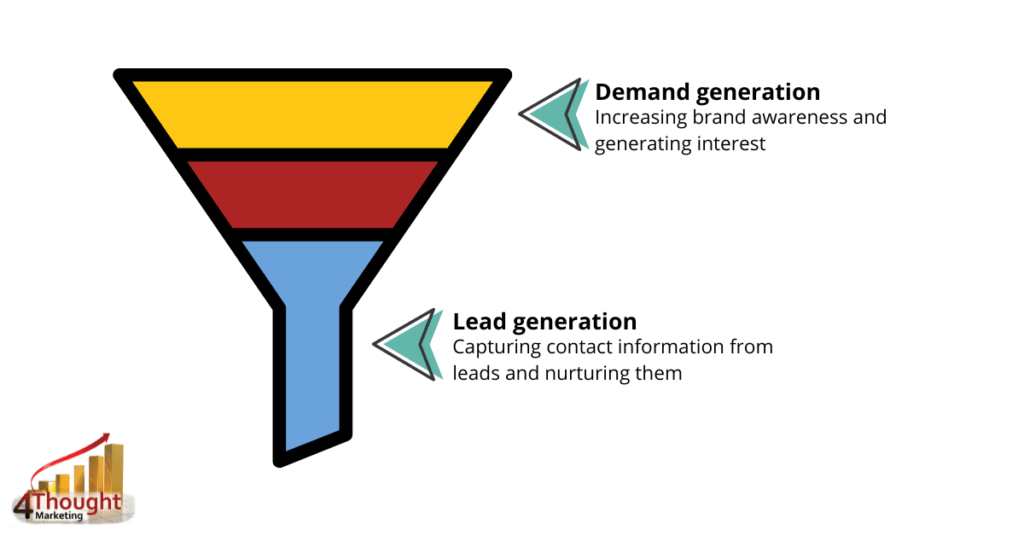
Marketers must view demand generation as the bigger picture and lead generation as one element of the wider demand generation function.

Demand generation is the process of increasing awareness and demand for your company’s service or product. The focus here is getting your brand name out there and drumming up interest in what your brand has to offer.

In other words, demand generation is bringing new visitors to your business or website. The goal is to establish your target audience, get them thinking or talking about you, and build trust with them through thoroughly planned content and interactions.

One common method of demand generation is creating ungated content, meaning customers don’t have to commit to anything to access the content. Examples of this can include:

  • Blog posts
  • Case studies
  • Interviews
  • Infographics
  • Press releases
  • Social media posts
  • Resource pages
  • Videos

This content aims to increase the brand’s or company’s profile and attract attention to it. You can build trust and connect with your target audience through engaging content. That will encourage them to come to you.

What is Lead Generation?

lead generation vs. demand generation

Lead generation requires a specific skill set, as it is about conveying interest to leads and guiding them through the funnel. It could be described as a way to funnel through eventual buyers of your service or product. Its purpose is to capture personal data.

Remember that lead generation strategies are used to obtain names, email addresses, and phone numbers, with the hope that some of these people will convert into qualified leads. Hence, gated content is the main priority here, meaning people must sign up and share their contact information to download or receive the content.

The most typical types of lead generation content include:

  • Email subscriptions
  • Ebooks
  • Research papers
  • Online courses
  • Product demos and free trials
  • PDF guides
  • Cheat sheets or checklists
  • Whitepapers
  • Viral contests

Where Do Lead Generation & Demand Generation Fit into the Sales Process?

lead generation vs. demand generation

Comparing lead generation vs. demand generation efforts is essential to tracking the impact of your B2B sales process. These strategies involve applying research, building credibility, and addressing consumer challenges through your content. Well-produced demand-generation content offers solutions and helps connect your target audience, resulting in more leads.

Demand generation marketing techniques let you reach a big audience with impactful messaging in different ways. The goal is to raise visibility for your digital presence, solidify your position as a thought leader, and keep your business at the forefront of your mind. Demand generation thus fits well into the research and prospecting part of the sales process.

Meanwhile, lead generation strategies enable better access to set up a first sales consultation or product demo for interested parties. It also keeps the sales pipeline filled with qualified leads you can move throughout the sales process. Identify where those leads are in the sales funnel and personalize the approach according to their interest level. That will help you close more deals and establish better long-term client relationships.

Running Both Strategies Together

lead generation vs. demand generation

What you need to bear in mind about lead generation and demand generation is that they are both essential to your B2B marketing strategy. They are made to work well together, along with lead generation, to support the work completed by demand generation.

Other organizations may focus on lead generation to acquire contacts and email addresses to hit sales targets. However, the ideal approach is to deploy both lead and demand generation simultaneously. This is because you cannot produce leads to your fullest potential or sustainably if there is no demand in the first place. People must know who you are and the products or services you provide.

Similarly, demand generation requires the further push of lead generation. Otherwise, all the hard work to get people interested in your brand could go to waste if you cannot convert them into leads.

Lead Generation and Demand Generation: Better Together

So, should you pursue lead generation or demand generation?

Realistically, you should pursue both. Without demand gen, you will have trouble getting leads into your funnel to convert a significant number into customers. On the other hand, you may end up attracting poor-fit customers who won’t help you grow your brand and business without quality lead-gen strategies.

With strong inbound and organic marketing processes to raise awareness of your site and excellent lead-generation practices to identify best-fit customers, you will be well on your way to huge growth.

How 4Thought Marketing Can Help

Determining what your prospects want and what they need to conquer their challenges will help your sales efforts. Deliver information that supports your solutions and demonstrates their effectiveness. Those ongoing lead and demand generation efforts drive high-quality engagements with qualified leads and continuously connect with new prospects. 

At 4Thought Marketing, we are well-versed in B2B sales and can guide you on the tools, strategies, and techniques essential to flourish in your B2B sales process. Get in touch with us today to get your marketing strategy on the path to success.


account based marketing

When most people think of marketing, what they’re really thinking of is conventional marketing: an approach that begins by generating as much attention as possible and narrowing down to potential leads based on that. This approach is the most common today. And it certainly works to a degree. But in more recent years, a different strategy has begun to make itself known: account-based marketing (ABM). Let’s look a little closer at both.

account based marketing

Conventional Marketing Funnel

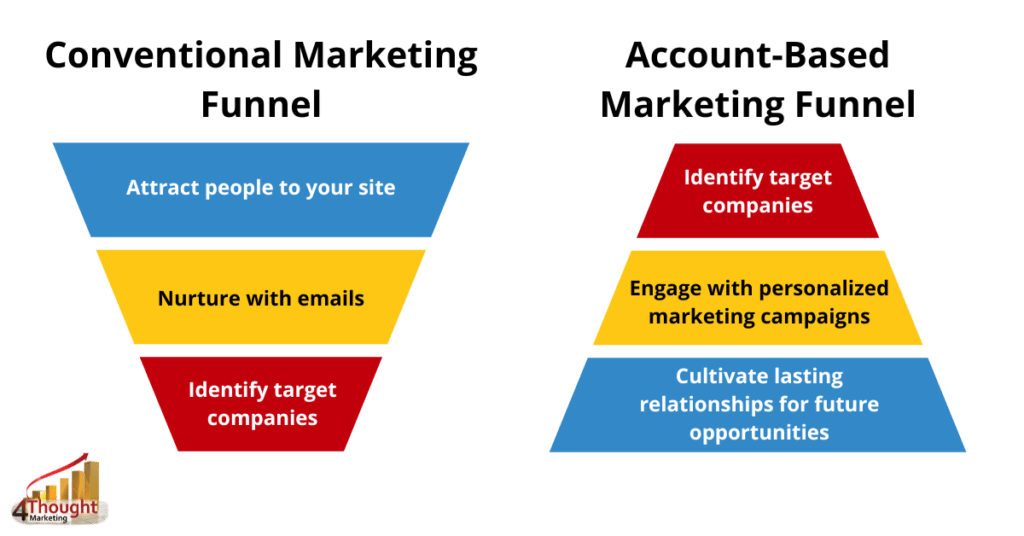
Conventional marketing starts by casting a wide net and trying to get your products and services in front of as many people as possible. From there, marketers narrow the audience down to potentially interested people. Nurturing begins through automated emails, personalized offers, and similar methods. Finally, sales joins the process downstream to turn these interested targets into conversions. Sales then reports back to marketing on which leads were good and which didn’t work out, and marketing can alter their future plans accordingly.

In practice, conventional marketing means spending a lot of time mass-producing content and showing it to everybody without knowing for sure if they’ll be interested. Sales isn’t involved until the nurture stage or later. And of course, because you’re starting with such a huge group of only potentially interested people, not every lead will be a success.

Account-Based Marketing Funnel

Account-based marketing takes the conventional marketing funnel and flips it on its head. Marketing and sales have a partnership from the beginning in ABM as both work together to identify and focus on their target audience. They grow the list of potential clients through careful research. Once they have a completed list, the nurturing and personalized marketing campaigns begin. Any leads that don’t work out are crossed off the list. Meanwhile, every target that responds with interest or converts remains a future opportunity.

In practice, account-based marketing involves sales from the very beginning so nurture begins early. This also allows marketing to produce targeted materials for a specific audience rather than generic advertisements. The process also produces far fewer leads to track and nurture. Since both sales and marketing can focus on a small group rather than trying to please a massive audience, they are more likely to win over leads and build long-term customer relationships.

ABM’s Advantages Over Conventional Marketing Methods

So why can ABM lead to more successful campaigns than conventional marketing? There are several key reasons. First: as stated above, both sales and marketing can target key accounts through ABM, resulting in more personalized (and thus more effective) marketing. Second: sales is involved from the very beginning, not just marketing, so everyone’s in the loop from the start.

Finally, and perhaps most importantly: ABM builds on demand that already exists. Conventional marketing focuses on generating demand. Account-based marketing focuses on locating demand and meeting it.

The Current State of Account-Based Marketing

For now, most companies stick to conventional marketing as the default method. Most businesses start out trying to “read the room”, so casting a wide net seems like the better option. Some may hire a consultant to narrow down the client base. But even with a consultant’s help, it’s very rare for a business to start with account-based marketing right off the bat.

But ABM is gaining some traction. Its proven methods and increased lead production certainly earn attention. As customer and company behavior alike continues to evolve, account-based marketing is expected to become the norm over the next decade.

Conclusion

Which is better: conventional marketing or account-based marketing? That’s arguably the wrong question. Both have their place. Sales and marketing teams should take the time to consider a variety of factors before drastically changing their advertising strategy. But if your company can spare the resources, account-based marketing holds great promise.

Interested in how you can identify targets and follow up with them easily? Get in touch with our team of marketing experts today to learn more.


marketing automation oracle eloqua

Oracle Eloqua is a market-leading marketing automation platform that helps companies generate leads that convert. Named a leader in the 2021 Gartner® Magic Quadrant™ for Marketing Automation Platforms, it enables your team to craft and send personalized emails, integrate seamlessly with other systems, track customer activity, and plan future campaigns—all within a robust but easy-to-understand visual interface. Eloqua integrates with leading customer relationship management systems, including Oracle Sales, Microsoft Dynamics, and Salesforce. Most importantly, Eloqua makes it easy to create and manage email campaigns that generate revenue. 

But Eloqua’s capabilities don’t stop there. Marketing automation experts know that sending too many emails or emails that don’t match customer interests runs the risk of being marked as spam and never seen by the customer. Fortunately, Eloqua users have an easy solution.

Avoid These 3 Common Email Campaign & Marketing Automation Pitfalls

Customers delete corporate marketing emails or mark them as spam for a variety of reasons, but three stand out as the worst offenders: 1) they receive way too many emails, 2) the emails come too often, and 3) the flood of emails don’t contain relevant information. Oracle Eloqua can help you address each of these problems.

The first two problems can be addressed with Eloqua’s email scheduling system. This allows you to space out the emails so the customer won’t feel overwhelmed. Follow-up or reminder emails can also be scheduled with enough time in between to avoid harassing the customer. This way, your contact doesn’t feel overwhelmed by the volume of emails they receive.

So now you know your customers won’t get a dozen identical emails from you every day. From here, you can address the third problem: lack of relevant information. With Eloqua’s activity tracking and segmentation functions, you can send each contact information relevant specifically to them and their interests. You can also avoid sending information they don’t want to receive.

Tips for Creating Effective Email Campaigns with Oracle Eloqua

With Eloqua’s built-in functions, running an email campaign from start to finish has never been easier. Here are some critical components of running effective campaigns to keep in mind:

  1. Customer segmentation: Segment your customers and prospects based on past interactions and user preferences. Form a clear picture of what your customer wants.
  2. Collect customer activity data: Observe how your customers respond to each marketing campaign and use the information to target communication based on interests.
  3. Create personalized, dynamic emails: Eloqua allows you to create dynamic content, so your communication includes timely and relevant data, not just a generic, general-purpose email. Your customers deserve emails tailored to their interests.
  4. Maintain professional standards in your email design: Emails should help customers instantly recognize your brand and appear uncluttered and professional.
  5. Tell a story with lead nurturing: Based on customer interest, tell a story through a series of customized emails that go to the right person at an appropriate time.
  6. Review generated data reports: Review data collected to create detailed, customizable reports highlighting the information you need to make informed decisions.
  7. Long-term lead management and quality assurance: With each campaign you run, Eloqua collects data to help you improve future campaigns. Better customer interactions can increase brand awareness, consumer engagement, and sales figures.

Oracle Eloqua Gives Email Marketers an Advantage

Eloqua’s extensive capabilities make email marketing easier than ever. Whether you’re trying to decrease customer unsubscribes, increase your profits, or both, Eloqua has you covered. You can be sure that your promotional emails will actually make it to your subscribers’ inboxes.

Want to see what else Eloqua can do? Get in touch with our team of marketing automation experts today to find out.


segmentation for marketing

It goes without saying that different people have different interests. But marketers who want to get as much promotional material out as possible, as quickly as possible, might not give this fact the consideration it deserves. Prioritizing audience segmentation for marketing is the foundation of a successful campaign.

Why is Segmentation for Marketing Such a Big Deal?

On the surface, creating a single mass marketing campaign designed to appeal to everyone sounds much easier and faster than segmentation. Just get the word out, right?  However, a broad advertisement can only do so much. Your customers want products and services tailored to them specifically—and to provide that, you need to know your audience.

Segmentation for marketing separates your potential audience into groups, or segments, based on shared characteristics. These characteristics can include:

  • Job title
  • Geographic location
  • Purchase history
  • Expressed preferences
  • Engagement with previous promotional material
  • Etc.

Organizing your audience this way lets you give potential customers what they want or need. With specialized ads tailored to each segment, you can more effectively market your products and services to interested audiences.

Modern Marketing without Segmentation, aka Spamming

Modern marketing technology allows companies to send millions of emails with just a click. But without proper segmentation, those emails go out to literally everybody on your organization’s contact list. And given the volume of advertising companies tend to do, that’s a LOT of emails every week, if not every day. Consumers have an unflattering nickname for this kind of marketing: spam messages.

Even unintentionally spamming your customers will impact how much they trust you. Aside from the fact that your messages will look suspicious (and maybe even be flagged by the recipient’s inbox), it also reflects a lack of care for your customers. You are doing the opposite of what the modern customer wants, which is to be empowered to get the information they want because they’ve told the company through their choices and action what they want to receive. Likewise, the customer wants to not receive other information as a result of poor segmentation.

Privacy Laws: The Result of Broken Customer Trust

The new wave of privacy laws is, in part, a result of broken customer trust. Corporations abused the data they collected, and consumers pushed back. Without a healthy respect for your customers’ privacy, reflected in part through segmentation and heavy personalization, you are destroying the trust people have in your company.

How 4Segments Can Help

Advanced marketing automation software shouldn’t have to work alone. For truly effective marketing, pair your system with a powerful segmentation tool that displays the data in a clear, visually distinct format. 4Segments fits the bill perfectly.

4Segments lets you visually create customer segments and build campaigns around them, ensuring you target only the right audience. Even better, this software is designed to pair not only with your marketing automation system but with our privacy compliance software, 4Comply. Maximize your marketing efforts without putting yourself at risk! Contact us to learn more.


oracle eloqua custom objects

Marketers know that Oracle Eloqua Custom Objects (COs) can do quite a bit when used correctly. As an Oracle Partner, we get a lot of questions about what you can do with data stored in COs. And we have good news! Eloqua’s Program Canvas, introduced in 2016, offers you many more options than the previous out-of-the-box functionality.

In the Eloqua Program Canvas, you can add Custom Object records to a program and choose from a list of decisions or actions to impose on the data. For instance, you can compare the value in a single field to create a decision tree. You could perform a few basic updates. You can even completely delete a record when it’s no longer needed. But why stop there?

Using Oracle Eloqua Custom Objects in the Program Canvas

Eloqua users are very creative. In our own observations of clients that take advantage of Eloqua systems, we’ve seen marketers:

  • Perform calculations on fields within or across records
  • Compare the value of two different fields within or across records
  • Update fields on linked Contact records from data in a CO record
  • Update fields in a CO record from linked Contact records
  • Look up data in a Custom Object and match it to Contact record data to determine which sales rep is best for a particular job
  • Append values from different fields within or across records
  • Perform a wide variety of data filters and manipulations, including but not limited to:

    • Find all records with a renewal before a certain date
    • Find all records created in the past (insert number here) weeks
    • Add a specific amount of time to a date field

And that’s not even a complete list! Our clients have pulled off some amazing feats with Oracle Eloqua Custom Objects.

Expand Oracle Eloqua’s Capabilities with Cloud Apps

As impressive as that list is, there’s likely plenty of other functions that you want that you didn’t see. That’s where Cloud Actions, Cloud Decisions, Cloud Apps, and Cloud Connectors come into play. Using Oracle Eloqua’s development platforms and API capabilities, sharp developers can create apps to expand the Program Canvas’s functionality even further and allow for even more creative choices.

Here at 4Thought Marketing, we have several favorite Oracle Eloqua cloud apps. And we’re proud to say we’ve made quite a few ourselves! (Check out our list of in-house created cloud apps here.) If you feel you have tried everything Oracle Eloqua offers in its current state but still can’t meet your business goals, get in touch with us. We haven’t yet found a CO problem that we can’t solve.

Contact us today to see which of our cloud apps is best suited to help you take full advantage of Oracle Eloqua Custom Objects.


customer nurturing

Businesses prioritize finding new leads and new business. The marketing department works overtime to attract interest, sales pushes to close the leads, and both celebrate their success at capturing new business. They then quickly move on to hunting for the next sale. This can certainly help the company’s profits. But what’s wrong with this picture? Both sales and marketing have forgotten a key part of long-term success: customer nurturing.

Outside of regular communications like subscription renewal offers, how often does your organization reach out to your customers? If this only happens rarely, you could be turning customers off with your inattentiveness. Dissatisfied customers tend to look elsewhere for what they want. Not only does this make it far less likely that you’ll keep them as a lifelong customer, but it could also mean that they’ll permanently switch to a competitor with effective customer nurturing in place.

Customer Retention is Cheaper – and More Profitable

The numbers speak for themselves:

  • Approximately 53% of marketing dollars are spent on customer acquisition, an impressively high number for a rather unimpressive return, according to Bain & Company.
  • According to the Harvard Business Review, acquiring a new customer can cost 5-25 times more than sustaining an existing one.
  • Research by Gartner shows that 80% of your future profits will come from just 20% of your existing customers.
  • Bain & Company highlights that increasing customer retention rates by 5% will increase profits by up to 95%.

In spite of the significantly better payoff of customer retention efforts, approximately 53% of marketing dollars are spent focusing solely on acquiring new customers, according to Bain & Company. While this is a lower number than before, it still misses the point. Neglecting current customers for new ones will not help your long-term profits.

But what form can effective customer nurturing campaigns take? Let’s look at a few examples.

4 Types of Customer Nurturing

customer nurturing

1.  On-boarding

On-boarding campaigns introduce the customer to your products, services, or company after they make their first purchase.

You may want to do this, for example, with someone who purchased a new software package. Here’s what this might look like:

  • A “welcome to the family” message
  • An overview of the purchased software
  • A list of the software’s more advanced features
  • An invitation to join the online support community

Your goal with an on-boarding campaign is to make the customer feel like they’re part of your company, product, and community. This engages, retains, and makes them happy.

customer nurturing

2.  Renewal Campaign

This type of campaign suits companies that sell products that last through a particular amount of time and must be renewed. These products could include:

  • Cloud software
  • Insurance policies
  • Maintenance contracts
  • Product warranties

The list goes on – if your company sells anything that requires renewal, this type of nurturing campaign fits in with your goals.

Effective renewal campaigns should generally begin three to six months before the actual renewal date. Encourage early renewals with reduced prices or other incentives. This allows you to show a vested interest in keeping the customer around, instead of appearing to care only about getting money from them.

customer nurturing

3. Product Education & Engagement

This type of campaign is similar to on-boarding. However, while on-boarding is geared toward familiarizing customers with the company and product/service, an education and engagement campaign is more targeted.

This is a series of emails that specifically educate on a certain subject. Examples can include:

  • A five-part email series on maintaining a newly purchased appliance
  • Tips and tricks to get the most out of your new software
  • Cosmetic/decorative tips to improve home renovations
  • Rarely used but helpful features of a recently purchased computer

Customers often appreciate tips, tricks, and updates on current events.

customer nurturing

4. Customer Survey

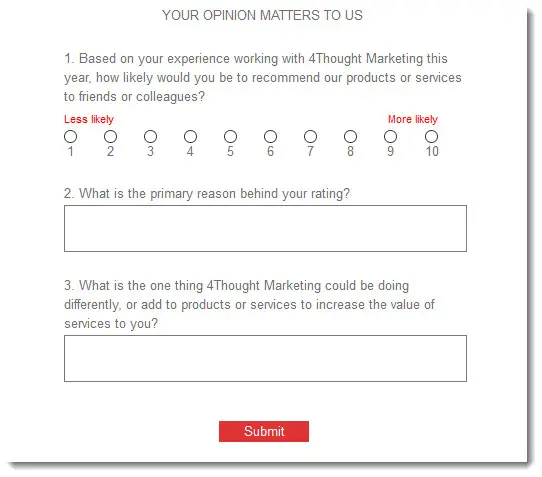
Any survey is better than no survey. Even if most of the recipients simply delete the survey email, they will usually enjoy the thought that your company cares enough to send them a survey and that you value their opinion and state of mind regarding your products and services. In this case, “it’s the thought that counts”.

A Net Promoter Score survey can measure customer loyalty and identify potential areas of improvement for your business.

Net Promotor Score Survey

The Critical Role of Customer Nurturing

The numbers speak for themselves: customer retention and nurturing not only cost less, but also bring in more profits. Constantly prioritizing new leads and new sales costs more money and doesn’t have as high of a return rate.

By carefully nurturing your customers and keeping your brand integrated with their lives, you can turn them into loyal, life-long purchasers. After all, if they bought from you once, they’re more likely to buy from you again. Someone who just learned your company exists isn’t nearly as likely to spend money with you yet.

If you aren’t yet using nurture campaigns, now is a good time to start them. If you already use them as part of your marketing strategy, remember that they need to evolve with your market and now is probably a great time for a message and content review.

Ready to take your customer nurturing strategy to the next level? Get in touch with our team of experts and start improving your profit margin today.


4Thought Marketing Logo   April 9, 2026 | Page 1 of 1 | https://4thoughtmarketing.com/articles/page/30