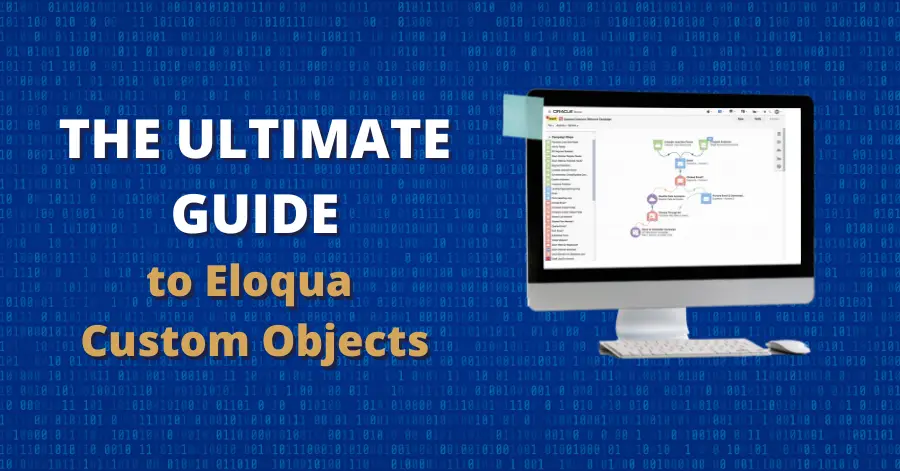
eloqua custom objects ultimate guide

Oracle Eloqua offers numerous tools to help businesses leverage their customer data and execute personalized marketing campaigns. Among these tools, custom objects (often abbreviated COs) stand out as a particularly powerful feature. Eloqua custom objects allow you to store important data points to use in more precise segmentation and customer targeting.

In this guide, we’ll explore what custom objects are, why they are crucial, and how you can maximize their potential to drive your marketing efforts.

What are Oracle Eloqua Custom Objects?

Custom objects are data tables that allow you to store information outside the standard contact and account fields. While Eloqua provides a robust set of default fields for contacts and accounts, these fields might not cover all your business needs, especially as your organization grows. Custom objects step in to fill this gap. You can add or remove columns in custom objects as needed, making connecting a single customer ID with multiple departments or product purchases easy.

Custom objects can store various types of data, including purchase history, areas of interest, transactional information, and more. They enable marketers to link multiple records to a single contact or account, providing a more comprehensive view of customer interactions and preferences. This flexibility makes COs a valuable segmentation, personalization, and campaign management tool.

What Can Eloqua Custom Objects Do?

Eloqua custom objects offer a variety of practical uses, some of which aren’t obvious at first glance. Just a few examples include:

Tracking Products or Services of Interest

Custom objects allow you to track customer interests, such as products or services they have shown interest in. You can store information like the original lead source, the most recent product of interest, and other relevant data. This helps you understand your customers’ preferences and tailor your marketing efforts accordingly.

Managing Leads

Custom objects are particularly useful for managing leads, especially when you need to associate multiple leads with a single contact or route different types of leads to various sales teams. By using COs, you can maintain clear connections between leads and contacts without overwhelming your team with unnecessary data.

Leveraging Purchase History

Storing purchase history in custom objects allows you to capture a complete record of products or services purchased, along with a timeline of customer activity. This information can be linked to a contact or account record, providing valuable insights for upselling, cross-selling, and personalized marketing campaigns.

Handling Shared Email Addresses

In some cases, multiple contacts might share a single email address, which can create issues since Eloqua uses email addresses as unique identifiers. Custom objects can solve this problem by associating multiple contacts with the same email address while maintaining distinct records for each contact.

Creating Subscription Centers

Custom objects can be used to manage subscription preferences, allowing contacts to update their communication preferences, preferred language, and products of interest. This data can be connected to the appropriate contact record and displayed accurately on the user’s preference center page.

Deleting Eloqua Custom Objects

As powerful as custom objects are, managing them effectively is crucial to avoid performance issues and data clutter. Over time, your Eloqua instance may accumulate a large number of custom object records that are no longer needed. Regularly cleaning up this old CO data should be a regular part of your routine to keep Eloqua running smoothly and streamline data management. Tools like the Mass CO Deleter Cloud App will let you automatically delete outdated or unnecessary custom object records.

eloqua custom objects

Why Use Eloqua Custom Objects over Contact & Account Fields?

When setting up your Eloqua instance, it might seem logical to store all customer data directly on contact or account records. However, this approach can lead to several challenges as your data needs expand. Custom objects offer several significant advantages, most notably:

  • Custom objects can hold significantly more data than contact and account fields. Eloqua’s default setup provides 62 contact fields and 18 account fields, with the option to create up to 250 custom fields each for contacts and accounts. Custom objects, on the other hand, can contain up to 1,024 fields each, with no limit on the number of custom objects you can create. The only restriction is the total number of records, capped at 25 million across all COs.
  • Custom objects let you easily associate a single contact or account with multiple data records. For example, a customer might purchase several products from your company, each with its own set of details. Storing this information directly in account fields can quickly exhaust the available custom fields. Custom objects allow you to link multiple records to a single contact or account, enabling you to efficiently manage and reference this data within your campaigns.
  • Custom objects can store both historical and dynamic data. Contact and account fields are ideal for storing relatively static information, such as contact details or business information. However, they are less suited for storing data that changes frequently or needs to be retained over time, such as campaign interactions or purchase history. Custom objects enable you to store this changing data, which can be invaluable for lead scoring, segmentation, and creating more targeted campaigns.
  • Custom objects easily scale as your data management needs grow. Custom objects offer a scalable solution that can adapt to your changing requirements. By setting up a custom object structure that aligns with your CRM’s data architecture, you can ensure that your data remains organized and accessible, even as your Eloqua instance becomes more complex.

Expanding Eloqua’s Functionality with Custom Objects

To fully leverage the power of custom objects, you might need to move data between different records or even between custom objects themselves. This is where cloud apps can be incredibly beneficial. These apps can help you manipulate data in ways that Eloqua’s out-of-the-box functionality does not easily allow.

A few of our favorite built-in-house Eloqua cloud apps for custom objects include:

  • Account CO to Contact CO Updater: Easily update all Contact COs associated with an account with data from the appropriate Account CO or static values.
  • CO Cloud Feeder: Eloqua currently only allows standard, out-of-the-box filters on the program canvas. However, the CO Cloud Feeder app adds this ability to the program canvas.
  • CO Count: Search for matching CO records and store count in the contact field using the campaign or program canvas.
  • CO Date Calculator: Add or subtract days, weeks, months, or years in a date field and store the results in a custom object (CO) field in a CO program.
  • CO Deleter with Archive: As the number of Eloqua custom objects (CO) increases, the more challenging it can be to maintain accuracy and peak performance. The CO Deleter with Archive allows you to delete large or small quantities of COs quickly and easily. (A version of this app for the campaign canvas can be found here.)
  • CO Form Submitter: Automate form submission on the program canvas for contacts or custom objects.
  • CO Lookup to Contact Record: Update contact records from custom objects matching your search criteria.
  • CO to CO Lookup Multiple Match: Find matching CO records and copy data to the source CO.
  • CO to CO Updater: Move data from one custom object to another on the program canvas smoothly.
  • CO to Contact Mapper: Map custom object records to contacts based on a designated contact field.
  • CO to Contact Updater: Update a contact record from a custom object on the campaign or program canvas.
  • CO to Contact Updater (CO based): Enhance your Eloqua program canvas functionality to modify contacts from linked CO records easily.
  • Contact CO Deleter: Remove mapped custom object records from a contact in a contact program or campaign canvas.
  • Contact to CO Updater: Create or modify a custom object from a contact on the campaign canvas or program canvas.
  • Embed CO Records in Email Table: The Embed CO Records in Email Table Cloud App enables you to embed multiple rows of data from Eloqua custom objects (COs) into an email using HTML.
  • Mass CO Deleter: The Mass CO Deleter Cloud App can be configured to remove all mapped CO records, all unmapped CO records, or both. You can also specify which custom objects to exclude from this process.
  • Unlinked CO Mapper: The Unlinked CO Mapper matches orphaned Eloqua custom objects records with matching contact records to create a complete customer profile for your marketing campaigns.
  • Update All Contacts COs: The Update All Contacts COs Cloud App makes it easy to keep custom object (CO) data consistent across all mapped records with just a few clicks.

Unlocking the Full Potential of Oracle Eloqua with Custom Objects

Custom objects are a versatile and powerful feature in Oracle Eloqua that can significantly enhance your marketing automation capabilities. Whether you’re tracking purchase history, managing leads, or simply organizing data more efficiently, custom objects provide the flexibility and scalability you need to grow your business.

Ready to unlock the full potential of Eloqua custom objects? Contact our team today for expert assistance.



marketing automation platform migration

When Cetera Financial Group needed help completing their Eloqua to Marketo Migration project by the deadline, they turned to the team at 4Thought Marketing.

Cetera Financial Group is a leading financial services firm, overseeing and managing billions in assets, operating with the sole purpose of enabling the delivery of best-in-class financial advice to as many Americans as possible. Cetera proudly serves independent financial professionals, tax professionals, banks, and credit unions by providing wide-ranging financial planning and wealth management services.

Tasked with managing a prominent financial advisor community across multiple channels, the company recognized the need to revisit its MarTech stack and communication strategies. With that mindset, Cetera embarked on a digital transformation journey to remodel its marketing communications experience and capabilities.

Eloqua to Marketo Migration: A Strategic Move for Cetera

The Eloqua to Marketo Migration represents a pivotal shift in Cetera’s marketing strategy, aligning their tools and systems with contemporary market demands.

The company needed a fully standardized and integrated marketing automation process and a partner that understood its business. Fortunately for Cetera, their marketing automation partner, 4Thought Marketing, had knowledge of their business and both Eloqua and Marketo.

A migration project of this scale typically requires at least three months to plan and execute. Cetera had only half that time. But Cetera’s leadership team trusted 4Thought to make it happen. “A smooth transition was critical,” explains Ed Rayyis, Cetera’s MarTech and Architectural Manager. “The only way we accomplished that was with 4Thought Marketing providing invaluable training and support to our team.”

4Thought Marketing stepped in and took on a leadership role for the entire migration process. The 4Thought team created a transition schedule, managed internal announcements to Cetera employees, hosted regular training sessions, answered staff questions, responded to technical issues, planned for future integrations after the initial migration phase, and managed communications between our internal team and Cetera’s team. Our Senior Marketing Operations Consultant took on the role of project manager. Ultimately, Cetera completed the migration process by its deadline.

For now, Cetera employees continue learning Marketo with training materials created by 4Thought Marketing. Already-certified employees and newcomers can now take full advantage of their marketing automation platform to improve their output. Cetera expects enhanced adoption, utilization, and growth in the following phases due to the switch.

4Thought Marketing is proud to have had the opportunity to assume a leadership role in Cetera’s marketing automation platform migration. Whether a company migrates to Eloqua or a different platform, we have the know-how and experience to complete the project successfully. Contact us today to learn more if you’re considering your migration project.

Eloqua to marketo migration marketing automation platform migration

google third party cookies

In a surprising move, Google recently announced its decision to delay the elimination of third-party cookies in its Chrome browser. This represents a significant pivot from its previous stance. This shift has created a buzz in the marketing world, where anticipation of a cookie-less future has driven many recent strategies. Now, Google’s decision to maintain these tracking tools for the foreseeable future is causing marketers to once again reassess their approaches.

A Brief Recap: The Journey to a Cookieless World

For years, third-party cookies have been a cornerstone of digital marketing, enabling advertisers to track user behavior across multiple websites and deliver highly targeted ads. However, rising concerns over privacy have led to increased scrutiny of these practices. In response, Google initially announced plans to phase out third-party cookies in Chrome, joining other major browsers like Safari and Firefox, which had already moved in that direction.

Google’s proposed solution was the Privacy Sandbox, a set of technologies designed to protect user privacy while allowing targeted advertising. The phaseout of third-party cookies was slated for 2022 but was delayed to 2024. Now, Google has pushed the timeline even further, leaving marketers in limbo.

Why the Delay?

According to Google, the decision to delay the phaseout of third-party cookies was driven by the need for more time to refine and test Privacy Sandbox technologies. The company aims to strike a balance between user privacy and the needs of the advertising industry—a complex challenge that requires extensive collaboration and testing.

Google’s recent statement emphasized the importance of a gradual transition to ensure that the ecosystem can adapt effectively. The company highlighted its commitment to a privacy-first web but acknowledged that more time is needed to develop viable alternatives to third-party cookies that don’t compromise the internet’s economic foundations.

Implications for Marketers

For marketers, this delay presents both challenges and opportunities. The additional time provides a buffer to adapt and prepare for the eventual shift to a cookieless world, but it also raises questions about how to proceed in the interim.

In the meantime, what should marketers consider?

google third party cookies

1. Don’t Abandon Preparations for a Cookieless Future

While the timeline has been extended, the end of third-party cookies is still on the horizon. Marketers should continue to invest in first-party data strategies. Developing strong relationships with customers and gathering data directly through interactions on your own platforms will become even more valuable in a cookieless world.

2. Explore Privacy Sandbox Tools

Google’s Privacy Sandbox may eventually replace third-party cookies, so it’s essential to stay informed about its developments. Begin experimenting with Privacy Sandbox tools as they become available to understand how they can fit into your marketing strategy. This proactive approach will give you a competitive edge when the transition finally occurs.

3. Diversify Your Data Sources

In light of ongoing changes, diversifying data sources is more crucial than ever. Leverage a mix of first-party data, contextual targeting, and partnerships to reduce reliance on third-party cookies. This will not only help future-proof your marketing efforts but also improve your resilience against any sudden changes in the digital advertising landscape.

4. Enhance Transparency & Build Trust

Consumer trust is paramount, especially as privacy concerns continue to grow. Be transparent about your data collection practices and prioritize user consent. Building a reputation as a brand that respects privacy can differentiate you from competitors and foster long-term customer loyalty.

Conclusion

Google’s decision to delay the elimination of third-party cookies offers marketers a reprieve, but it’s not an invitation to become complacent. The digital marketing landscape is evolving, and the eventual phaseout of cookies is inevitable. By continuing to innovate, focusing on first-party data, and staying ahead of emerging technologies, marketers can navigate this transition smoothly and position themselves for success in a privacy-centric world.

Need help getting ready for a marketing future without third-party cookies? Contact our team today.


Window shopping is just as common online as in brick-and-mortar stores. If anything, window shopping may happen more often online, as an estimated 96% of potential customers don’t make a purchase when visiting a website for the first time.  This  makes sense—clicking off a website is much easier than walking out of a physical store.

Every marketer’s goal should be to keep website visitors engaged and encourage them to return to learn more. When they do, they can learn more about your solution and how it meets their needs. But they may not return right away, so you need to give them gentle encouragement through multiple touches to do so. This is where retargeting campaigns can help.

Retargeting Campaigns: How & Why They Work

Retargeting campaigns work by re-engaging potential customers who have shown interest in your product or service but haven’t yet converted. Personalized emails, text messages, or push notifications incentivize the customer to take the next step in their journey toward conversion. Naturally, they depend on whether a customer has opted to receive communications from your company.

Retargeting campaigns build brand recall and maximize your existing marketing efforts by converting customers. In fact, retargeted users are 70% more likely to convert than cold leads. Retargeting campaigns need to be managed thoughtfully, however, so that potential customers don’t feel like they are being stalked.

To run a successful retargeting campaign, you’ll want to follow five central strategies.

1. Know Your Visitors

It’s vital to know who is visiting your website and why. With only 3% of visitors turning into identifiable leads, the ability to capture other identifiers is vital to effective engagement. Use tools that allow you to collect and evaluate customer behaviors in real time.

Your marketing automation platform should determine the visitor identifier you use, whether it is RIID (Responsys System ID), RTP tags, or Eloqua first-party cookies. You also cannot afford to miss any first-party customer data—data that customers provide in exchange for something else. First-party data can come from providing an email address for a discount code, clicking a link in a marketing email, or shopping using a customer loyalty account. Any of these avenues allows you to collect valuable information without intruding on a customer’s privacy.

2. Engage Customers with Personalization

Companies cannot rely on impulse purchases or enterprising employees to convert potential buyers. Instead, they see better results when carefully guiding customers toward making decisions through superior customer service.

For example, think of a customer planning a vacation. Typically, their interaction on a travel website will let one know where they want to go, when, and their price range. A retargeting campaign can offer value by giving flight comparisons, suggesting an itinerary, offering applicable discounts and special offers, and finally allowing them to resume planning their journey where they left off. Leverage different platforms to keep customers engaged on their journey like videos about their chosen destination on social media, a discount coupon via email, or a customer service push notification for bookings.

customer retargeting

3. Use Data to Craft Compelling Campaigns

The KPIs of your existing campaigns can help you improve your future efforts. Explore and analyze visitor behavior to gain insights beyond simple open and click rates. Look at metrics like cart abandonment points, CTAs, and communication methods to uncover patterns in consumer behavior and analyze conversion rates. This can uncover pain points that need to be addressed.

This data should help you tailor your retargeting campaigns so that potential clients understand the value of your offerings, resulting in a positive customer experience

4. Test Your Campaigns

Treat all your campaigns as works in progress. Fine-tune your retargeting strategies by A/B testing your messaging, different formats, channels, and more. Go beyond experimenting with different CTAs. Try different actions, like testing user behavior against retargeting offers.

For example, if carts are abandoned when shipping costs are calculated, offering free shipping during your retargeting campaign may solve the problem. Discount codes for the entire order cost may also work. Know what your audience wants.

5. Streamline Your Approach

Prioritize your retargeting campaigns based on your long-term goals and audience segments. Avoid overwhelming consumers by including them in more than one campaign. Customer intent is another metric to consider. Prioritize those with a stronger impact on the customer journey—ones triggered by higher intent or actions further down the funnel.

Retargeting campaigns are all about creating a connection with and showcasing your value to a potential customer. Contact our team today to see how we can help you drive an effective retargeting campaign.


personalized customer service

In the golden age of advertising, long before computers and the internet, businesses relied on a fundamental principle: attract customers to their stores, provide an outstanding experience, and earn loyalty. This method was straightforward and human-centric. It was also, as history has shown, remarkably effective.

The rise of internet marketing changed this. Businesses shifted to relying on collected data to target and retain customers through online communications. This strategy still works. But as privacy laws become stricter and more common, exploiting data isn’t a guaranteed success anymore. It’s time to incorporate the classic marketing approach into modern methods.

The Rise of Privacy Regulations

Privacy concerns have surged in the last few years, leading to more stringent laws and regulations worldwide. The GDPR is the most famous example. But it’s far from the only one, with countless other privacy laws around the world directly or indirectly drawing upon it. All of these laws aim to protect consumers’ privacy and give them greater control over their personal information. As a result, these laws have significantly restricted how companies collect, store, and use personal data.

This obviously poses challenges for businesses accustomed to data-driven marketing strategies. Identity resolution, advertising IDs, and precise targeting have become increasingly tricky, pushing companies to seek alternative ways to connect with their audience. Luckily, businesses don’t have to develop an entirely new strategy. Classic marketing models are still effective. Let’s look at a few ways your company can get back to basics.

1. Personalized Interactions

In the pre-digital era, personalized customer service was the hallmark of successful businesses. Store owners and employees knew their customers by name, understood their preferences, and provided tailored recommendations. Today, whether in-store or online, companies can recreate this personalized touch. This can be achieved online through responsive customer support, customized email campaigns, and engaging social media interactions. Regardless of the platform, the goal is to make every customer feel known and valued.

2. Exceptional Personalized Customer Service

Outstanding customer service has always been a cornerstone of successful businesses. In a world where data-driven personalization is becoming more challenging, investing in training customer service teams to go above and beyond can set a company apart. Whether it’s through live chat on a website, prompt responses to emails, or attentive in-store or online service, the principles remain the same. Empathy, responsiveness, and practical problem-solving are essential.

3. Creating Memorable Experiences

Memorable experiences are the key to customer retention. Online or offline, businesses can create moments that resonate with customers. This could be through virtual events, interactive website features, unique packaging, or in-store events. The aim is to delight and surprise customers, ensuring they remember and prioritize the brand when purchasing.

4. Building Community & Trust

Community building was a natural outcome of the classic advertising model. Local businesses were integral parts of their communities, fostering trust and loyalty. Today, companies can leverage digital platforms to build and nurture communities around their brand. Engaging customers through social media, forums, and online communities brings a sense of belonging and trust. Similarly, in-store initiatives and local partnerships can strengthen community ties.

personalized customer service

5. Leveraging Feedback & Reviews

Customer feedback and reviews are invaluable in today’s marketplace. Businesses should actively seek and listen to feedback, using it to improve products and services. Online reviews and social media engagement are the modern-day equivalent of word-of-mouth recommendations. Addressing feedback promptly and effectively can turn dissatisfied customers into loyal online and in-store advocates.

6. Emphasizing Transparency & Integrity

Transparency and integrity are crucial in building trust with customers. Clear communication about business practices, product sourcing, and company values can help establish credibility. In an age where consumers are increasingly concerned about data privacy, transparency about how customer data is used and protected can build confidence and loyalty. This principle applies equally to e-commerce and brick-and-mortar operations.

The Digital Hybrid Approach

Embracing the personalized customer service and experience model doesn’t mean getting rid of digital tools entirely. For example, companies can use anonymized data to understand general trends and preferences, allowing them to make informed decisions without targeting individuals without compromising privacy. Digital platforms can also facilitate communication and engagement. Online and offline interactions provide a memorable customer experience when paired.

The Long-Term Benefits

Embracing a service-centric model in the face of increasing privacy regulations offers several long-term benefits. First, it fosters genuine relationships and trust, which are more resilient than those built on data-driven marketing alone. Customers tend to remain loyal to brands that consistently deliver value and memorable experiences.

Second, this approach aligns with the growing consumer demand for ethical and responsible business practices. As awareness of data privacy issues rises, customers are more inclined to support companies that respect their privacy and prioritize their well-being.

Finally, focusing on superior service and experience can lead to organic growth through word-of-mouth and positive reviews. Satisfied customers are likelier to recommend a brand to others, creating a virtuous cycle of loyalty and advocacy.

Conclusion

As marketing and advertising technology continues to evolve under the influence of new privacy laws, businesses must adapt to remain competitive. Incorporating traditional strategies alongside data-driven marketing offers an optimized, hybrid strategy. By prioritizing personalized service, exceptional customer experiences, community building, and transparency, companies can navigate the challenges of privacy regulations while building lasting relationships with their customers. In this era of heightened privacy awareness, it’s time to return to the basics and rediscover the power of genuine human connections.

4Thought Marketing assists companies in maximizing their marketing efforts while ensuring compliance with privacy regulations. If you struggle to balance the two, let our experts help you develop an effective strategy.


snooze option

Maintaining customer engagement is essential for your company’s long-term success. By consistently providing compelling, relevant, and timely information, you are more likely to elicit a response from your customers. However, your current offer, while interesting, may not address their current priorities.

When customers show signs of disengagement, offering them the option to control the type and frequency of content provides the best chance of retaining their interest in the long run. One possible option is adding a snooze feature to your email preference center, allowing customers to slow or pause communication instead of unsubscribing completely.

The Problem: Inactive Users

Our client was focused primarily on contact information gathered from live or one-time events. Their database contained tens of thousands of names. However, when those contacts stopped opening emails or clicking links, retaining all this inactive information became a problem. Time and money went into marketing emails that never got any engagement. By then, any form of engagement—even asking to pause communications—would turn an inactive contact into an active contact again. Our client was determined to do just that.

The Re-Engagement Campaign: A Fresh Approach

The initiative began with a clear objective: reach out to the tens of thousands of inactive users in the client’s database and determine if these users still wished to receive communications. More importantly, they wanted to give these contacts more options than continuing as is or opting out.  So, they decided to add a snooze option to their email preference center.

Crafting the User Experience

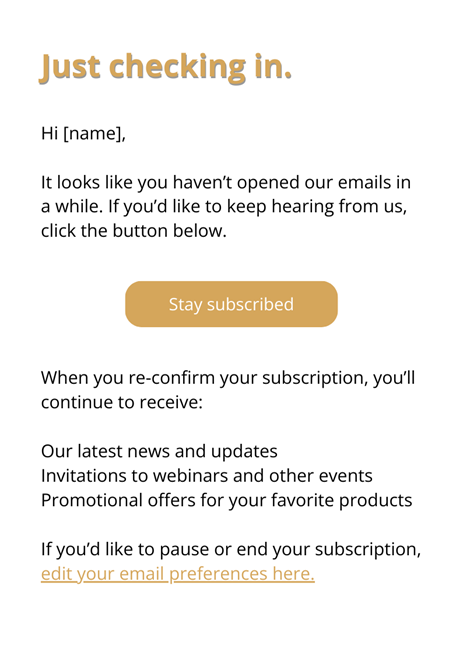
The process began with designing an email to the inactive contact.  The copy clearly showed the reason for this email and that they wanted to serve the customer according to their wishes.

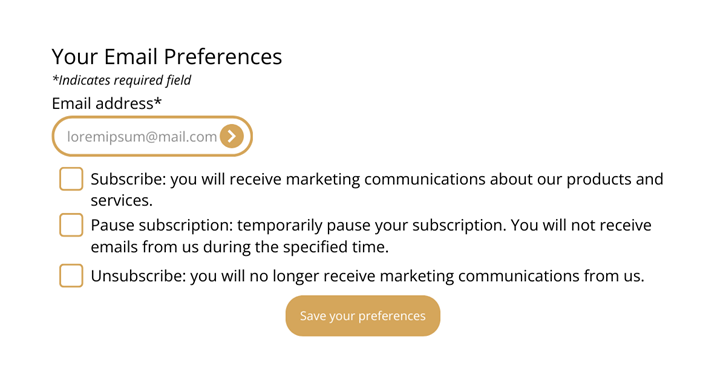
The email allowed customers to re-subscribe immediately or navigate to a redesigned email preferences page, where they could choose between three options.

Upon receiving the email, users found their email address pre-populated in the form. They could simply click a button to save their preferences. If they chose to adjust their subscription, they had two main options: pause their subscription or unsubscribe.

Subscription Pause: Offering Flexibility

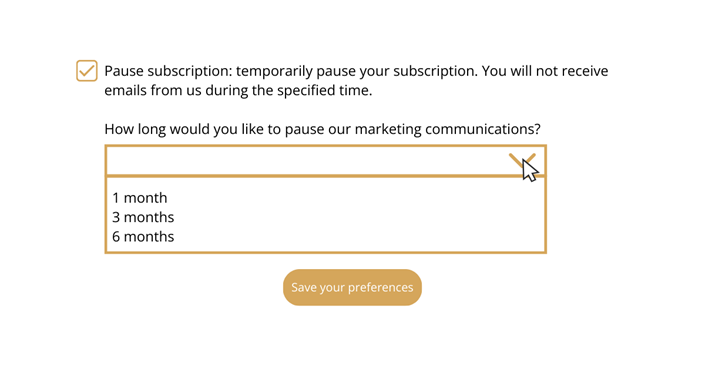
The pause option introduced a layer of flexibility that aimed to reduce permanent unsubscribes.

Users could pause their subscriptions for one, three, or six months. This feature was designed for those overwhelmed by emails or those taking a temporary break, such as a vacation. By providing this choice, they aimed to retain subscribers who might otherwise opt out permanently.

Our Client’s Results

Our client’s initial focus was re-engaging inactive users and managing event follow-ups. The snooze option allowed customers to select their own preferences. This strategy proved successful, as any interaction from previously inactive users was considered a win.

Adding a snooze option to your email preference is a simple option that added a valuable dimension to our client’s re-engagement campaign. By offering users the flexibility to pause their subscriptions rather than unsubscribe, they were able to retain a portion of the audience that might have otherwise been lost.

Do your inactive contacts need a break? Contact us today to implement a snooze option in your campaigns.


ai in marketing automation

Artificial intelligence has found its way into almost every industry now. Its impact cannot be overstated, and its popularity continues to grow. And for the marketing automation industry in particular, AI is poised to play an increasingly transformative role.

Incorporating artificial intelligence into marketing automation may help reshape how businesses interact with customers, optimize campaigns, and drive revenue growth. Today, we’re looking at several key areas AI might impact the most.

The Role of AI in Marketing Automation

As marketing experts take more advantage of artificial intelligence, we may see significant shifts in areas such as:

  • Hyper-personalization: AI can enable marketers to create highly personalized experiences at scale. AI can deliver tailored content, product recommendations, and communication timing by analyzing a wider range of customer data in detail, resulting in deeper customer engagement and improved conversion rates.
  • Predictive analytics: As AI-powered predictive analytics become more sophisticated, marketers can more effectively anticipate customer behavior and preferences, enabling them to address needs and concerns proactively. Predictive models can also help identify high-value leads and the best times to engage with them, improving lead nurturing and conversion rates.
  • Direct customer communication: chatbots with AI integration will answer customer queries and engage in meaningful conversations, troubleshoot issues, and facilitate transactions. This level of automation will improve customer support, reduce response times, and enhance the overall customer experience.
  • Marketing attribution: AI-driven attribution models may offer more accurate insights into the customer journey. Marketers can better understand the impact of each touchpoint on conversions, enabling data-driven decision-making and more efficient allocation of marketing budgets.
  • Augmented decision-making: AI will not replace human creativity, but will encourage it by providing data-driven recommendations and insights that lead to more effective strategies and campaigns.

But even as AI becomes more and more prominent in the marketing world, it can never fully replace humans. Surveys have provided valuable insights into customers’ thoughts on AI, most notably:

How to Approach AI in Marketing Automation

The future of AI in marketing automation appears poised to revolutionize customer engagement, campaign optimization, and data-driven decision-making. As AI technologies continue to evolve, businesses that embrace these innovations could gain a competitive edge in delivering personalized and seamless customer experiences.

It’s important to ensure that AI applications align with both business goals and customers’ expectations in an increasingly data-sensitive world. But don’t worry: we can help with both! Contact our team today and start taking advantage of all that AI has to offer your marketing strategy.

ai in marketing automation

July 25, 2024

Next-Level QA Tasks – Building Snooze Program – Office Hours

Join us to boost your Eloqua skills through real-world examples.   Learn how to take your QA testing to the next level, and nerd out on the details building a snooze program with all the essentials. Eloqua Office Hours is 4Thought Marketing’s monthly gathering for Eloqua users to share insider hacks, and clever tips, and address all your pressing questions. Expand your knowledge and connect with like-minded professionals.

We’ll discuss:

  • Next-level QA tasks to improve campaign performance
  • Building a snooze program in Eloqua, step by step

Customer nurturing is an essential part of the marketing process. After all, acquiring a new customer requires much more time, money, and effort than maintaining and growing with a current one. But marketing shouldn’t be the only department involved in nurturing. When marketing enables the sales team to participate and control nurturing to suit their needs, it opens the door to a new strategy: sales-influenced nurturing.

Understanding Sales-Influenced Nurturing

Sales-influenced nurturing focuses on supporting sales activities through tailored marketing efforts, ensuring that both current and potential customers receive relevant and timely information as they move through the sales funnel. This strategy is particularly crucial during the middle stages of the funnel, where nurturing can significantly impact qualification and opportunity management processes.

Sales Qualification

At the early stages of the funnel, sales teams engage in qualification activities to identify potential customers’ needs and determine if they are a good fit for the product or service. Marketing automation can support this by sending targeted emails, using page tagging to understand customer interests, and providing valuable content to help resolve qualification questions.

Opportunity Management

During the evaluation stage, the focus shifts to managing opportunities. This involves providing comparison criteria, offering social proof through testimonials, and avoiding content that might disrupt the sales process. Effective nurturing at this stage ensures that the customer feels understood and supported in their decision-making process.

Who Benefits from Sales-Influenced Nurturing?

Sales-influenced nurturing can benefit various roles within the sales team, each with its specific needs and challenges:

  • Sales development representatives (SDRs): SDRs often face long and challenging processes as they attempt to connect with leads. Nurturing can help maintain engagement, especially when initial contact attempts fail.
  • Inside sales teams: Typically handling smaller deals with a faster turnaround, inside sales teams can benefit from nurturing that aligns with their quick-paced environment, enhancing their ability to close deals efficiently.
  • Field sales representatives: Handling larger, more complex deals, field sales reps are often the most resistant to marketing interventions. However, when done correctly, sales-influenced nurturing can provide valuable support without risking disruption to their processes.
sales-influenced nurturing

Implementing Sales-Influenced Nurturing: Strategies for Success

To successfully implement sales-influenced nurturing, consider the following strategies:

  • Empower sales reps with control: Sales reps should be able to control the nurturing process. This can be achieved through simple on/off switches, pause functionalities, or allowing reps to select specific nurturing campaigns from a predefined list.
  • Leverage CRM integration: Integrate your CRM system with your marketing automation platform. This integration ensures that sales reps can update fields related to nurturing campaigns directly within the CRM, which then syncs with the marketing automation system.
  • Use activity-based triggers: Implement activity-based triggers to start nurturing campaigns when there is no sales activity for a specified period. This ensures that potential customers continue to receive valuable content, even when sales reps are unable to follow up promptly.
  • Phase implementation: Introduce nurturing controls in phases to ease the transition when you introduce sales-influenced nurturing. Start with basic controls and gradually introduce more advanced options as the sales team becomes comfortable with and have confidence in the process.

Overcoming Challenges and Gaining Buy-In

One of the most significant challenges in implementing sales-influenced nurturing is gaining buy-in from sales leadership. To address this:

  • Present data and narratives: Use success stories and data to demonstrate the positive impact of nurturing on sales outcomes. Highlight cases where nurturing helped re-engage prospects, maintain interest if the prospect becomes distracted, or close deals that were previously at risk.
  • Ensure sales rep autonomy: Emphasize what sales reps will retain control over in the nurturing process. This autonomy can alleviate concerns about marketing interfering with sales activities.
  • Address potential concerns: Be mindful of the political dynamics within the sales team. Collaborate with sales leaders to align nurturing strategies with sales goals and address any objections proactively.

Sales-Influenced Nurturing:

Sales-influenced nurturing offers a powerful way to enhance the collaboration between marketing and sales, ensuring that potential customers receive relevant and timely information throughout the sales process. By empowering sales reps with control, leveraging CRM integration, and implementing activity-based triggers, businesses can create a seamless and effective nurturing strategy that drives engagement, improves conversion rates, and ultimately boosts sales performance.

For a head start on your own sales-influenced nurturing strategy, get in touch with our team today.


Digital marketing relies on data—data provided by customers, collected by programs, or deduced from past customer purchases or behavior. However, the accuracy and quality of this data are paramount. Inaccurate or outdated data can lead to ineffective campaigns, poor customer experiences, and wasted resources.

Real-time data validation offers a solution to these challenges by ensuring that the information you collect is accurate and reliable from the moment it enters your system. Today, we’re exploring the concept of real-time data validation, its benefits, and practical implementation strategies in Eloqua.

The Importance of Data Quality

High-quality data is essential for effective marketing. It enables personalized communication, accurate targeting, and insightful analytics. Conversely, poor data quality can lead to:

  • Inaccurate targeting: Sending messages to the wrong audience.
  • Reduced engagement: Irrelevant content leading to low open and click rates.
  • Wasted resources: Time and money spent on ineffective campaigns.
  • Damage to brand reputation: Frustrated customers receiving incorrect or irrelevant information.

What is Real-Time Data Validation?

Real-time data validation is the process of verifying the accuracy and quality of data at the point of entry. This involves checking data against predefined rules and external databases to ensure it meets specific criteria before being stored or used. In Eloqua, real-time validation can be applied to various data points, such as email addresses, phone numbers, and postal addresses, ensuring they are accurate and deliverable.

Benefits of Real-Time Data Validation

  • Improved data accuracy: Ensures that only correct and valid data enters your system.
  • Enhanced user experience: Reduces the likelihood of sending incorrect or irrelevant messages to your audience.
  • Increased campaign effectiveness: Higher data quality leads to better targeting and more effective campaigns.
  • Cost savings: Reduces the need for costly data cleansing and correction processes.
  • Compliance and deliverability: Ensures compliance with data protection regulations and improves email deliverability rates.

With this in mind, let’s look at several key steps to implementing real-time data validation in Eloqua.

1. Identify Key Data Points for Validation

Start by identifying which data points are critical for your marketing efforts. Common fields for validation include:

  • Email addresses: Verify format and deliverability.
  • Phone numbers: Ensure correct format and check against carrier databases.
  • Postal addresses: Validate against postal databases for accuracy.

2. Choose the Right Validation Services

Select third-party validation services that integrate seamlessly with Eloqua. Some popular providers include Sureshot.io, FreshAddress, NeverBounce, and BriteVerify. These services offer APIs that can be integrated into your Eloqua forms and workflows to validate data in real-time.

real-time data validation

3. Integrate Validation into Forms

Incorporate real-time validation into your web forms using JavaScript. This ensures that data is validated as users enter it. For example:

  • Email validation: Check if the email follows the correct format and if the domain exists.
  • Phone validation: Verify the number’s format and whether it is a valid mobile or landline number.
  • Address validation: Confirm the address against postal databases.

4. Set Up Validation in Campaigns & Programs

Beyond forms, integrate validation into your Eloqua campaigns and programs. Use validation steps in your workflows to check and clean data before it is used in campaigns. For instance:

  • List uploads: Validate data when importing lists to ensure accuracy.
  • CRM integrations: Validate data flowing from CRM systems into Eloqua.
  • Ongoing data quality checks: Regularly validate data within Eloqua to maintain quality.

Practical Example: Real-Time Email & Phone Validation

Let’s explore a practical example of implementing real-time email and phone validation in an Eloqua form:

  1. Create the form: Develop a form in Eloqua for data capture.
  2. Integrate JavaScript: Use JavaScript to call third-party validation APIs. When a user enters their email or phone number, the script sends the data to the validation service.
  3. Display validation results: If the data is invalid, display an error message prompting the user to correct their input. For example:
    1. If the email is invalid, show: “Please enter a valid email address.”

    1. If the phone number is invalid, show: “Please enter a valid phone number.”

Monitoring & Optimizing Data Validation

Once implemented, it’s essential to monitor the performance of your validation processes:

  • Track error rates: Monitor how often users enter invalid data and adjust your forms or user instructions accordingly.
  • Analyze data quality: Regularly review the quality of your data to ensure validation processes are effective.
  • Optimize validation rules: Refine your validation criteria based on observed trends and user feedback.

Prioritizing Real-Time Data Validation

Real-time data validation is a powerful tool for enhancing data quality in Eloqua. By ensuring that only accurate and reliable data enters your system, you can improve campaign effectiveness, enhance user experiences, and save on costs associated with data cleansing. Implementing validation requires thoughtful integration and ongoing monitoring, but the benefits far outweigh the efforts. By adopting real-time data validation, you can maintain a high standard of data quality and drive more successful marketing outcomes.

If you have any questions about implementing real-time data validation in Eloqua or need help setting up your own validation system, contact 4Thought Marketing today.


In Eloqua, custom objects (hereafter COs) are excellent ways to store additional information about a contact. But sometimes, an integration, upload, or process adds COs without connecting them to Eloqua contact records. Even if a contact record already exists, Eloqua’s default behavior is to map contact records and COs by email address.  If you need to map COs with other contact fields, those records are not mapped and remain orphaned. This is obviously a problem.

This is where the Eloqua CO to Contact Mapper Cloud App comes in. This cloud action is designed to quickly and easily map a custom object to a contact record based on other fields besides email addresses. It expands Eloqua functionality to ensure COs are mapped to their respective contact records. Connecting data to the right person and segmenting accordingly has never been easier.

For more information on the CO to Contact Mapper Cloud App, get in touch with the 4Thought Marketing team today.

co to contact mapper cloud app


SORBS closure

The Spam and Open Relay Blocking System (SORBS), one of the oldest domain name system-based blackhole lists (DNSBLs), closed shop on June 5, 2024, after more than two decades online. The blocklist was acquired by Proofpoint Inc., in 2011 but continued operations as a free, standalone service until it was retired.

SORBS’ sudden closure with no real explanation other than the statement, “Please note that this service has been decommissioned and will no longer contain reputation data,” has ignited more than a few conversations about the future of free and open-source software and what the future may hold for the currently decommissioned SORBS. On a more practical level for email marketers, it’s a good reminder to monitor and improve your email deliverability.

SORBS: A History of Plaudits & Criticisms

In its heyday, SORBS allowed users to effectively block spam and malicious emails from more than 12 million host servers and counted several government organizations among its 200,000 patrons.

Widely regarded as a pioneer in the anti-spam industry, SORBS was praised by mail administrators for its ease of integration into mail server workflows as well as the ability to choose and reference blacklists at varying levels of strictness. It was SORBS’ transparent operating practices that won it the most praise.

Conversely, it faced criticism for being highly sensitive, overblocking IP ranges, and having issues accessing its databases. According to email anti-abuse expert Mickey Chandler, SORBS wasn’t particularly relevant in the email marketing industry and was mainly the domain of “hobbyist email administrators” in the years leading up to its closure. 

Will it be reinstated? The community hopes that SORBS will be taken over by legitimate sources instead of spammers who have expressed interest in acquiring the blocklist for years.

What Does This Mean for Email Marketing?

The closure of SORBS shouldn’t have an impact on most marketers. However, those who relied on SORBS for spam filtering will need to explore alternative blocklists. Spamhaus, SpamCop, Barracuda, and the Composite Blocking List (CBL) are a few that are already in existence while newer players like Data443, with Cyren, have been quick to jump onto the bandwagon.

The closure of SORBS is characteristic of the shift from open-source software to enterprise technology that leverages AI to recognize abnormal behavior patterns.

SORBS closure

How Should Marketers Ensure Email Deliverability?

The answer is simple. It is to continue implementing the best practices for, and optimizing email campaigns. Some of them include:

  • Monitoring your IP: Monitoring your IP reputation remains a crucial step to avoid blacklisting. It is vital that your sender score is checked, and emails comply with any applicable regulatory requirements and privacy laws.
  • Analyze spam scores: Conduct email preview tests to assess your spam scores and take corrective actions where necessary.
  • Implement authentication protocols: Configure your domain with your own SPF (Sender Policy Framework), DKIM (DomainKeys Identified Mail), and DMARC (Domain-based Message Authentication, Reporting, and Conformance to maintain control over your sender reputation. A fixed, static IP address can also help build reputation.
  • Consistent sending volumes are key: Spam filters monitor inconsistent behaviors, such as sudden spikes in email sending. Keeping your outgoing emails at consistent levels will help you avoid triggering these filters.
  • Maintain clean email lists: Old, outdated email addresses on your emailing lists can wreck your deliverability, resulting in higher bounce rates and raising red flags with spam filters.
  • High-quality content: What you send your subscribers matters. Creating high value content is a key factor in driving engagement and reaching your campaign goals.

Avoid Spam Filters by Maintaining Email Marketing Hygiene

Email marketing is an effective marketing strategy that offers robust ROIs. Integrated email marketing strategies can help maximize the impact of your email marketing campaign. Checking your sender reputation, analyzing your spam scores, effectively segmenting your subscriber list, adopting best practices, and addressing issues immediately are all ways you can keep your deliverability metrics on track.

Need some help? Contact our team today to get expert help optimizing your email campaigns to build trust and ensure they reach their intended users.


4Thought Marketing Logo   April 8, 2026 | Page 1 of 1 | https://4thoughtmarketing.com/articles/page/20