




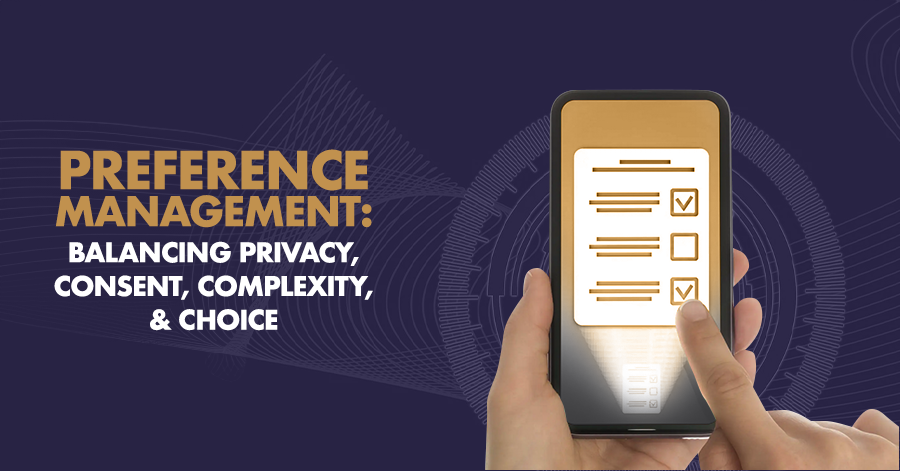
As consumers become increasingly aware of their data privacy rights and the options available to them, businesses need to adjust accordingly. Personalized marketing materials still work wonders, but how can your company collect enough data for personalization without violating privacy laws? What’s the balance between respecting user privacy and effectively using data?
The Evolution of Preference Management
In short, the answer lies in a practice called preference management. This allows customers to control exactly what data they provide to your company and how they allow your company to use the collected data. There are multiple ways to approach this. Today, we’ll be looking at ten levels of preference management, each building on the previous one.
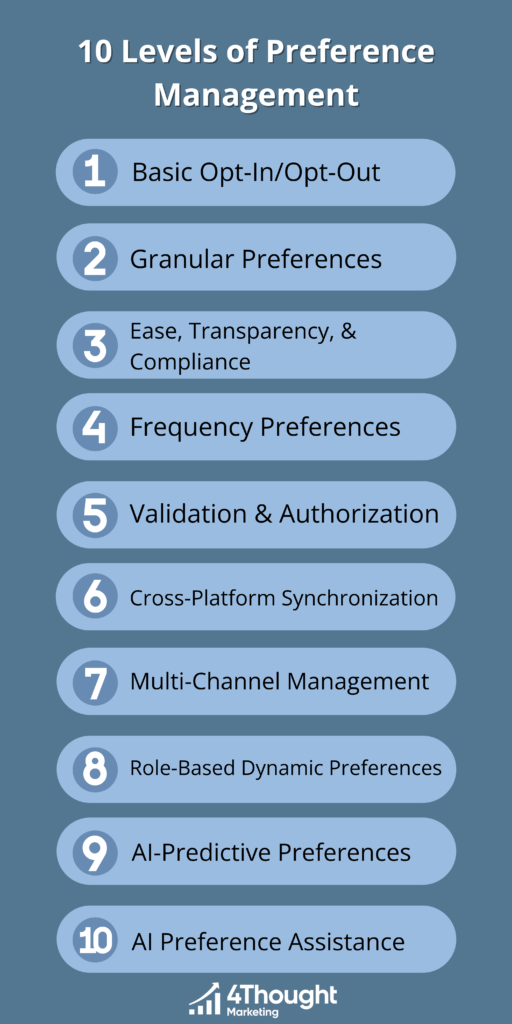
Level 1: Basic Opt-In/Opt-Out
At the most fundamental level, preference management begins with the ability for customers to opt in or opt out of communications. While this may seem elementary, providing a balanced choice like this goes a long way. A well-designed preference center not only offers an opt-out option but also encourages customers to opt back in by explaining exactly how and when their data will be used. This keeps contacts informed and ensures they feel in control of their choices.
Level 2: Granular Preferences
Granular preferences allow customers who have opted in to specify the types of communications they wish to receive. This can be segmented by product lines, content types, business units, or any number of other relevant categories. This choice assures customers that the communications they’ll receive will be both relevant and not overwhelming.
Level 3: Ease, Transparency, & Compliance
This level of preference management has three distinct levels of its own.
First, ease of use. Preference centers should be intuitive and straightforward. Too many options will overwhelm users and make them more likely to opt out of everything. Keep your dashboards scannable and simple.
Second, transparency. Being honest about your data collection and usage is crucial at this stage. Don’t ask for more data than you need. Explain how and when you’ll use the data you ask for, and stick to it. Make your privacy policy easily available for customers to review.
Third, legal compliance. It’s essential to prove that you’re honoring your customers’ requests. A customer’s preference submission is already connected to their email address. To be truly compliant, you must gather additional identifying data such as date, time, and form location, that show when and how the request was made. Returning only the most recent opt in or out state, if it’s a checked or unchecked box, is insufficient evidence if your compliance is ever challenged. You must provide a history of changes.

Level 4: Frequency Preferences
Some visitors who ask to unsubscribe might not want to completely stop communications—they may just want a break. Providing an ability to control how often they receive things -frequency preferences, makes this easy for both them and you.
Depending on your company’s exact marketing approach, frequency preference management can take different forms, such as:
- You may give visitors the option to pause all communications for a period.
- Alternatively, you may want to give them to control, for each preference they opt into a frequency option. For example they may want to get newsletters only quarterly, but product support information immediately.
- Finally, you may want to consider “fatigue analysis”, which slows down communications to customers who aren’t actively engaging with your messages anymore. Communications will pick back up when their participation does. This keeps messaging frequency at the customers’ comfort level without costing you a contact.
Level 5: Validation & Authorization
This level is fairly straightforward: making sure the customer is who they say they are. This can be accomplished with something as simple as an identity verification email. This adds an extra layer of security to the preference management process, ensuring that no one else can sign up a customer for unwanted communications or change their set preferences.
Level 6: Cross-Platform Synchronization
In large organizations, recorded customer preferences may be scattered across various systems and departments. This obviously makes managing these preferences harder for internal marketing and privacy professionals that must deal with making multiple systems legally compliant. It also makes submitting those preferences in the first place harder, as customers have to navigate multiple menus and webpages. Consolidating them into a single, unified view through cross-platform synchronization makes things far easier for the customer and for you. Some jurisdictions even legally mandate this.
Level 7: Multi-Channel Management
Email marketing may be the most lucrative form of online advertising, but it’s far from the only one. SMS, push notifications, and other communication channels are still effective ways to reach your audience. And different demographics will prefer different channels. For example, one age group may prefer SMS messages over email, while another group wants email communication and nothing else. This is another layer of choice that your preference center needs to offer.

Level 8: Role-Based Dynamic Preferences
Prospects, customers, and company partners will have different areas of focus when it comes to receiving communication from you. Offering a universal preference center can make those areas of focus harder to track. Consider creating one preference center for prospects, one for current customers, one for company partners, and others as required so you can offer each group a relevant set of choices. (You’ll also need to remember the validation step of level 5 as you do this.) This makes things easier for the users and, by extension, increases their engagement.
Level 9: AI-Predictive Preferences
This level uses artificial intelligence to predict and then pre-set customer preference settings based on historical data, behavior, and other inputs. Many companies do this with an algorithm today, but enabling an AI to set these is typically far more capable when preferences are many and complex.
While AI-predictive preferences should not replace customer-set preferences, they can provide a valuable starting point, especially for new customers or prospects.
Level 10: AI Preference Assistance
The most advanced level of consent management involves AI-powered systems that interact directly with customers to understand their preferences. Imagine typing into a preference page:
“Every two months, send me an update with hyperlinks for all content on everything happening regarding home appliances from this company only. However, I’d like product announcements to be sent to me immediately.”
“I’ve turned on the three preferences below that pertain to home appliances with a frequency of every two months, and also the preferences for product announcements to come as soon as available.”
These systems look and behave like your typical chatbot, except they are intentionally focused and pre-prompted to understand all the content a company creates and the concept of preferences. This futuristic approach can simplify the preference management process, making it more even intuitive and user-friendly.
Implementing Effective Preference Management
While understanding these levels is crucial, implementing them effectively requires strategic planning and execution. As you begin:
- Assess your current state: Identify which level your organization currently operates at. Are you still at basic opt-in/opt-out, or have you moved towards AI-predictive preferences?
- Prioritize ease and transparency: Regardless of the level, ensure your preference center is easy to navigate and transparent about what each option means. Use clear language and, where possible, visual aids.
- Take advantage of technology: Use technology to automate and streamline preference management. This includes using AI for predictive preferences and cross-platform synchronization to consolidate data from different systems.
- Focus on compliance: Stay up-to-date with legal requirements and ensure your preference management practices comply with relevant laws. This not only protects your organization from legal risks but also builds trust with your customers.
- Customize and personalize: Tailor your preference management to different user groups. Use role-based dynamic preferences to provide relevant options to prospects, customers, and partners.
- Stay flexible and adaptive: As new technologies and customer expectations evolve, be prepared to adapt your preference management strategies. Regularly review and update your practices to stay ahead of the curve.
Conclusion
Effective preference management is a dynamic and evolving process that requires a thoughtful approach and the right blend of technology and strategy. By understanding the different levels of preference management and implementing best practices, marketers can offer personalized experiences while maintaining compliance and building customer trust. The journey from basic opt-in/opt-out to AI-driven preference assistance is not just a technological upgrade. Rather, it is a strategic evolution that can significantly enhance customer engagement and satisfaction.
To take the next step in customer preference management and data privacy, contact 4Thought Marketing today.