Why a Huge Email List Performs Worse Than a Smaller, Healthier One
A huge email list can hurt more than help. Learn why email list quality, smarter batching, and pruning beat raw size and lift your total...


A huge email list can hurt more than help. Learn why email list quality, smarter batching, and pruning beat raw size and lift your total...

Marketo click tracking silently fails on dynamic URLs stored in lead fields. Learn the two-pass root cause and the Velocity fix that restores click data...
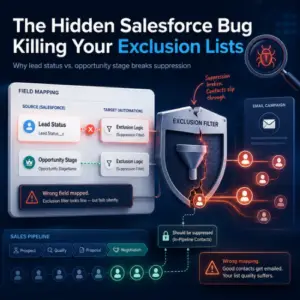
A Salesforce exclusion list fails silently when it reads the wrong field. Learn how lead status vs opportunity stage breaks suppression, and how to audit...

Double-tracking inflates your email tracking when UTM parameters and native platform IDs both count one click. Learn one clean rule to fix it before your...

Wondering how to start with AI agents in Eloqua? This 90-day Eloqua agentic AI rollout plan pilots one low-risk job under human oversight, measures it,...

Does Eloqua have agentic AI? Not natively. Here is what agentic AI in Eloqua really means today, and how to deploy, connect, and govern external...
A huge email list can hurt more than help. Learn why email list quality, smarter batching, and pruning beat raw size and lift your total...
Marketo click tracking silently fails on dynamic URLs stored in lead fields. Learn the two-pass root cause and the Velocity fix that restores click data...
A Salesforce exclusion list fails silently when it reads the wrong field. Learn how lead status vs opportunity stage breaks suppression, and how to audit...
Double-tracking inflates your email tracking when UTM parameters and native platform IDs both count one click. Learn one clean rule to fix it before your...
Wondering how to start with AI agents in Eloqua? This 90-day Eloqua agentic AI rollout plan pilots one low-risk job under human oversight, measures it,...
Does Eloqua have agentic AI? Not natively. Here is what agentic AI in Eloqua really means today, and how to deploy, connect, and govern external...