



Key Takeaways
- Business email addresses are not exempt from B2B email compliance.
- The contact’s location, not yours, decides which law applies.
- CAN-SPAM allows sending first; CASL and GDPR usually need permission first.
- CCPA governs the data behind the send, not the send itself.
- Opt-outs must reach every connected system, not just your platform.
- If you cannot prove consent, regulators treat it as missing.
Table of Contents
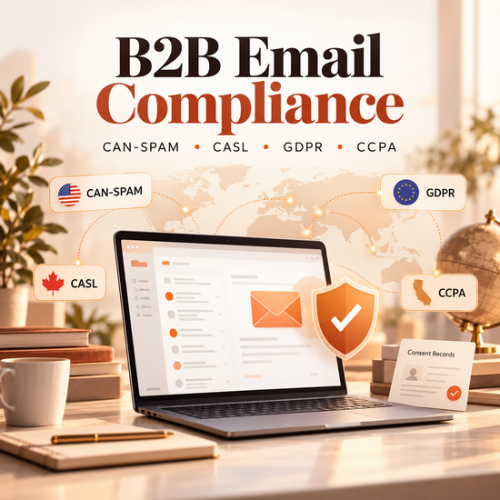
Your next campaign will probably reach a buyer in Chicago, an IT lead in Toronto, a procurement manager in Munich and an analyst in London. One send, one unsubscribe link, four sets of rules. B2B email compliance is the work of meeting all of them at once, and most marketing databases were never built to tell those contacts apart.
Many teams still assume business email sits outside privacy and anti-spam law. It does not. CAN-SPAM, CASL, GDPR and CCPA each cover professional contacts, and each defines permission, opt-out timing and record keeping differently. A setup that satisfies one can quietly break another.
This guide explains what B2B email compliance requires, which law applies to which contact, the five requirements every program shares, and how to run them inside the platform you already use.
This post is for educational purposes only and does not constitute legal advice.
What Is B2B Email Compliance?
B2B email compliance is the practice of sending commercial email to business contacts in line with the anti-spam and privacy laws that cover each recipient. It spans permission to send, honest sender details, working opt-outs, provable consent records and the data rights people hold over their information.
The common myth is that a work address belongs to a company, so the rules do not apply. The US Federal Trade Commission states in its CAN-SPAM compliance guide for business that the law makes no exception for business-to-business email. Canada’s law covers any commercial electronic message sent to a Canadian address. Under GDPR, a named work address such as jane.smith@company.com is personal data.
Why it matters: B2B email compliance is not a legal side project. It decides who you can email, how fast you must stop, and what you must prove when someone asks.
What is at stake: Fines get the headlines, but the day-to-day cost of weak B2B email compliance is operational. Campaigns get paused while someone traces where a list came from. Sales loses access to contacts it relied on. A single complaint from a prospect who opted out and kept receiving email can damage a deal that took months to build.
Which Email Law Applies to Which Contact?
The recipient’s location decides which email marketing laws apply, not where your company is based. A US company emailing a contact in Germany is subject to GDPR, because the regulation covers organizations outside the EU that offer goods or services to people in the EU.
| Where the contact is | Main law for the send | Permission model | Opt-out deadline |
|---|---|---|---|
| United States | CAN-SPAM | Send first, honor opt-outs | 10 business days |
| Canada | CASL | Express or implied consent before sending | 10 business days |
| European Union | GDPR plus national email rules | Lawful basis, often consent | Stop direct marketing once the person objects |
| United Kingdom | UK GDPR plus PECR | Depends on contact type | Stop once the person objects |
| California residents | CAN-SPAM for the send, CCPA for the data | CAN-SPAM rules apply to the email itself | CCPA covers data rights, not unsubscribes |
For a law-by-law breakdown of consent models, penalties and scope, see our full comparison of CAN-SPAM, CASL and GDPR.
Some contacts fall under more than one law, such as a Canadian resident working for a company with EU offices. The safest approach to B2B email compliance is to apply the strictest rule that could cover the contact. In practice, many teams treat their whole database as opt-in, because one consistent standard is easier to run than five exceptions.
United States: CAN-SPAM
CAN-SPAM lets you send commercial email without prior permission, provided every message identifies the sender, includes a valid postal address and offers a working opt-out. The FTC states that each separate email in violation can carry a penalty of up to $53,088.
Canada: CASL
CASL is consent-first. You need express or implied consent before the first commercial message. Under the text of Canada’s Anti-Spam Legislation, implied consent from an existing business relationship is generally limited to two years after a purchase and six months after an inquiry. Penalties can reach $10 million per violation for a business. The CRTC’s CASL guidance explains how the regulator applies these rules.
European Union and United Kingdom: GDPR and Local Email Rules
The official GDPR text requires a lawful basis, such as consent or legitimate interest, for processing personal data, and it sets fines of up to €20 million or 4% of worldwide annual turnover, whichever is higher. Each EU country also has its own rules on electronic marketing, so email consent requirements can differ by country. Our guide on how GDPR applies to B2B campaigns covers lawful basis and legitimate interest in detail.
In the UK, the ICO’s electronic mail marketing guidance explains that companies and other corporate bodies can generally receive marketing email without prior consent, while sole traders and some partnerships are treated like individuals and need consent.
Where CCPA Fits
CCPA is a privacy law, not an anti-spam law. It does not decide whether you may send an email to a California contact; CAN-SPAM still does that. CCPA governs the personal data behind the send: what you collect, why, and what happens when a California resident asks to see or delete it.
The California Attorney General’s CCPA guidance confirms that the temporary exemptions for business-to-business data expired on December 31, 2022. California business contacts now hold the same data rights as consumers. If your database spans several US states, read what US state privacy laws change inside your platform.
The Five Requirements Every B2B Email Program Must Meet
The laws disagree on details, but they converge on five requirements. Meet all five and your B2B email compliance holds up in every market you send to.
1. Permission or a Lawful Basis Before You Send
Know, for every contact, why you are allowed to email them. Under CAN-SPAM that may simply be a valid business purpose. Under CASL it must be express or implied consent. Under GDPR it must be a documented lawful basis.
Protect that permission once you have it. A common failure is a registration form that writes a blank opt-in box to the consent field and erases valid consent. Our Eloqua Office Hours session shows how form logic can overwrite valid consent and how to stop it.
2. Accurate Sender Details and Honest Subject Lines
Every law expects the recipient to know who is emailing them. Use a real sender name, accurate routing information and a subject line that matches the content. CAN-SPAM requires a valid postal address in every message, and CASL requires sender identification and contact information.
3. Unsubscribe Requirements and Opt-Out Deadlines
Unsubscribe requirements are where the laws line up most closely. Every commercial email needs a free, working way to opt out. CAN-SPAM and CASL both set a maximum of 10 business days to act on the request, and CASL requires the unsubscribe mechanism to stay valid for at least 60 days after sending.
GDPR is stricter in practice. Once a person objects to direct marketing, their data can no longer be processed for that purpose. Build email opt-out requirements around the fastest standard, not the slowest, and process opt-outs in hours, not days.
4. Consent Records You Can Prove
Under CASL and GDPR, a consent you cannot prove is treated as one you never had. For each contact, record the source of the consent, the date, the wording shown, the method of capture and which law applies. Store it on the contact record, not in a spreadsheet nobody can find during an audit.
Treat list imports with the same care. A purchased or event list does not carry the vendor’s consent over to you, and email consent requirements still apply to every record you load. If a list arrives without source and consent data, hold it back until it has them. Good records are what turn B2B email compliance from a claim into evidence.
5. Data Subject Rights
GDPR and CCPA give people the right to access, correct or delete their data. GDPR expects a response within one month, extendable by two further months for complex requests. CCPA allows 45 calendar days, extendable by another 45. A request handled in one system but not the others is not fulfilled. Our guide to automating data subject requests walks through the intake, verification and fulfillment steps.
How to Run B2B Email Compliance Inside Eloqua or Marketo
Email marketing compliance becomes real inside your marketing automation platform. Policies written by legal only work when the platform enforces them on every send.
Consent fields on every contact: Store consent status, source, date and applicable regulation as fields on the contact record. Without them, you cannot segment by law or prove permission later.
Location-based rules: Capture country, and state for US contacts, at the point of entry. That single field decides which rules apply to the contact.
Suppression checked before the send: Evaluate permission at send time, not only at import. In Eloqua that check belongs on the campaign canvas; in Marketo it belongs in the smart list and flow logic of the program.
Opt-outs and deletions everywhere: An unsubscribe recorded in your platform must also reach your CRM, webinar tools and ad audiences. Test the sync, do not assume it.
Regular audits: Review your B2B email compliance setup at least once a quarter. Check which forms write to consent fields, confirm that opt-outs reached every system, and sample a handful of contacts to see whether you could prove their consent today.
Running this manually across four laws breaks as your database grows. 4Comply records when and how each consent was collected, checks permission in real time before a communication goes out, automates data subject requests and keeps an immutable audit trail. It integrates natively with both Eloqua and Marketo, so the rules run inside the platform your team already operates.
Conclusion
B2B email compliance is not four separate projects. It is one operating model that knows where each contact is, what permission you hold, and how fast you must act when that permission changes. The teams that get it right treat consent as data, check it before every send, and make opt-outs reach every system. If you want a second set of eyes on how your platform handles consent today, contact us and ask how 4Comply can support your B2B email compliance program.
About 4Thought Marketing
We're a B2B marketing automation and AI consultancy with a thing for getting complex tech to actually work. Since 2008, we've helped hundreds of organizations across financial services, technology, manufacturing, and real estate get more from Eloqua, Marketo, and their CRM integrations. We serve our clients across marketing automation strategy, lead lifecycle, AI, compliance, preference management, and more. Explore our services or get in touch.
Frequently Asked Questions
Does B2B email compliance apply to business email addresses?
Yes. CAN-SPAM makes no exception for business-to-business email, CASL covers any commercial message sent to a Canadian address, and GDPR treats a named work address as personal data. A business address changes some details, such as UK rules for corporate subscribers, but it does not remove the obligation to comply.
Which email marketing laws apply if my company is based in the US?
The recipient’s location decides. CAN-SPAM covers your US sends, CASL applies to Canadian recipients, GDPR applies to contacts in the EU, and UK GDPR with PECR applies to UK contacts. California residents add CCPA data rights on top of CAN-SPAM.
What are the unsubscribe requirements for B2B email?
Every commercial email needs a free, working opt-out. CAN-SPAM and CASL require you to act on opt-outs within 10 business days, and CASL requires the mechanism to stay valid for at least 60 days. Under GDPR, you must stop direct marketing once a person objects.
Does CCPA require consent before sending B2B email?
CCPA does not set the rules for sending commercial email; CAN-SPAM does. CCPA governs the personal data behind the send, including the right to know, delete and correct data and to opt out of its sale or sharing. B2B data has been fully in scope since January 1, 2023.
Is CAN-SPAM compliance enough for a global B2B database?
No. CAN-SPAM lets you send before receiving permission, while CASL and GDPR generally require consent or a documented lawful basis first. A database built only to CAN-SPAM standards usually lacks the consent records CASL and GDPR expect.
How do I prove email consent if a regulator asks?
Keep a record for each contact showing where consent came from, when it was given, the wording shown, how it was captured and which law applies. Store it on the contact record in your marketing platform so it travels with the contact. Those records are the evidence that your B2B email compliance program works.