







Quick Takeaways
- Eloqua content blocks are reusable, drag-and-drop email layout components.
- Build a layout once and reuse it across emails and landing pages.
- Save any Design Editor section as a block in under a minute.
- Multi-region teams use shared blocks to maintain brand consistency.
- All content blocks are automatically responsive with no coding required.
- Unlike Shared Content, blocks copy into each email on insert.
Every Eloqua user building email campaigns knows the routine. You open a new email, start from a blank canvas, and spend the first stretch recreating the same header, the same two-column content row, the same CTA layout you built in the last campaign. And the one before that.
Without a system for saving and reusing those layouts, every build becomes a manual assembly job. Inconsistencies accumulate. Teams across regions rebuild the same components independently, and brand standards drift in ways that are slow to catch and costly to fix.
Eloqua content blocks solve this problem at the source. Built directly into the Design Editor, they let you save any layout section as a reusable component and drag it onto any email or landing page in seconds. This guide walks through how they work, how to create and manage them, and where they deliver the most value.
What Are Eloqua Content Blocks?
Eloqua content blocks are groups of layout containers and cells saved within the Design Editor’s block library for repeated use. Think of them as purpose-built modules: a two-column image-and-text section, a footer row with social icons, a single-button CTA layout. Once saved to the library, any of these can be dragged into a new email or landing page with a single action.
Per the Oracle Eloqua documentation, blocks can include any combination of cell types: text, images, dynamic content, shared content, and more. Because they are built and stored within the Design Editor, all content blocks are automatically responsive, rendering correctly across email clients and mobile devices without any additional coding.
How Eloqua Content Blocks Differ from Shared Content
Knowing the distinction between content blocks and Eloqua’s Shared Content feature prevents a common source of confusion.
Shared Content: A live asset. When you update a Shared Content item, that change propagates immediately to every email and landing page actively using it. It is the right choice for legal disclaimer copy, unsubscribe language, or boilerplate that must stay synchronized across live campaigns.
Content blocks: Layout templates. When you drag a block from the library into an email, Eloqua copies that layout into that email at that point in time. Edits made to the source block later do not retroactively update emails that have already used it.
The choice depends on your need: layout consistency points to blocks, live content synchronization points to Shared Content.
How to Create a Content Block in the Eloqua Design Editor
The Design Editor is the native home for content blocks, and the creation process takes under a minute once you know where to look. For a full overview of the Design Editor’s capabilities, see our guide: Eloqua Design Editor: Your Complete Guide to Streamlined Email Creation.
Saving Your First Block
Open any email or landing page in the Design Editor. Build or locate the layout section you want to save. When you hover over a layout row, a small action menu appears on the right side. Click the block icon in that menu.
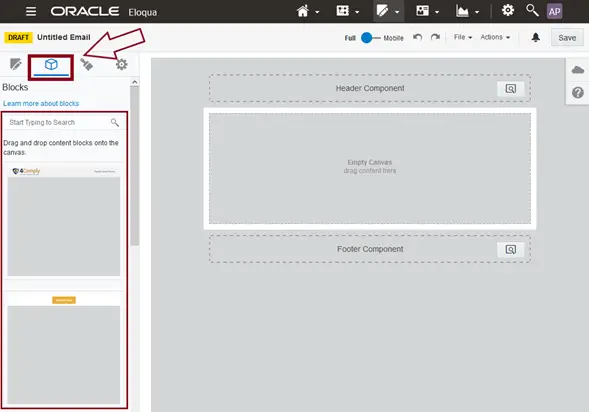
Eloqua will prompt you to name the block before saving. Use a descriptive name. “2-Col Image Left Text Right” is more useful than “Block 1” when your library holds fifty entries. The steps below show a two-column layout being selected and then named before saving.
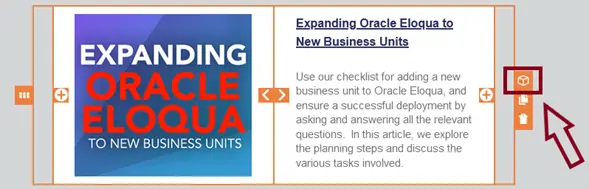
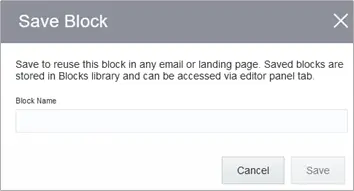
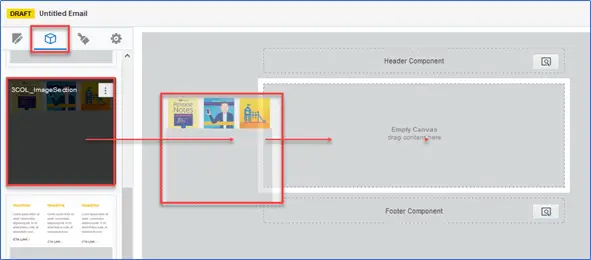
Once named and saved, the block appears in the library and is immediately available for drag-and-drop use on any Design Editor canvas.
Organizing Your Block Library
As the library grows, searchability becomes the practical constraint. The block library includes a search function, so consistent naming conventions pay dividends early. A prefix-based approach works well: “Header – Standard,” “Footer – Legal,” “CTA – Single Button,” “2-Col – Image Right.” This keeps related blocks grouped alphabetically in search results and simplifies onboarding when new team members start building.
Editing Blocks and Governing Your Library
Making Changes to an Existing Block
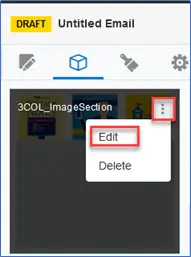
To edit a saved block, open its options menu in the library and click Edit. This opens the Edit Block screen, a standalone workspace where you can adjust layouts, change cell types, update padding and spacing, and refine the block’s structure.
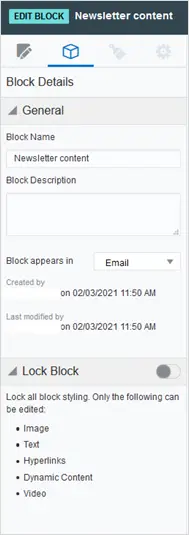
Changes made here update the block in the library for future use. Emails and landing pages that have already used the block are not affected. If you need those assets to reflect the update, you will need to manually replace the block in each affected email.
Governance Considerations as Your Library Scales
When a brand refresh or template update occurs, a light governance practice around your block library pays off. Appending a version marker to updated block names (“Header – Standard v2 2026”) prevents confusion when multiple team members build simultaneously. This naming discipline is one of the markers covered in the broader guide to marketing template standardization, which is worth reading if your team manages high-volume campaigns.
When Content Blocks Deliver the Most Value
The Use Cases Worth Prioritizing
Content blocks return the highest value in three scenarios.
High-volume production: Teams running weekly or bi-weekly campaigns benefit immediately. Pulling from a block library instead of rebuilding from scratch shaves meaningful time off every send cycle.
Multi-region or multi-team builds: When marketers in different regions or business units build independently, layout divergence is almost inevitable. A shared block library acts as a lightweight governance layer, ensuring every team starts from the same approved components.
Brand compliance and legal accuracy: Legal disclaimer footers, physical address blocks, and unsubscribe layout sections are high-risk areas for manual error. Saving these as approved, tested blocks removes the chance a time-pressured marketer omits or modifies required copy.
For a broader look at how template libraries intersect with email production efficiency and brand consistency, Custom Email Templates: Turning Brand Vision into Inbox Reality covers the full picture.
Eloqua content blocks are one of those platform features that compound in value the more consistently they are used. Build the right components once, name them clearly, and a team of any size can produce brand-consistent emails and landing pages without rebuilding from scratch. The key is understanding where blocks fit alongside tools like Shared Content, maintaining naming conventions as the library grows, and prioritizing block types that carry the most compliance or brand risk. If your team is ready to build a more structured Eloqua setup, contact 4Thought Marketing for hands-on support tailored to your workflow.
Frequently Asked Questions
What are Eloqua content blocks used for?
Eloqua content blocks are reusable layout components saved in the Design Editor’s block library. They let marketing teams save any email or landing page layout section, such as a two-column content row, a CTA button block, or a branded footer, and reuse it across campaigns with a simple drag-and-drop.
How do Eloqua content blocks differ from Shared Content?
Content blocks are layout templates. When you insert a block into an email, Eloqua copies the layout into that email, and later edits to the source block do not affect emails that have already used it. Shared Content is a live asset that updates across all active emails and landing pages when changed. Use blocks for layout reuse and Shared Content for copy that must stay synchronized.
Are Eloqua content blocks automatically responsive?
Yes. Because content blocks are created and managed within the Design Editor, they inherit the editor’s responsive output. Blocks render correctly across email clients and mobile devices without any additional coding or configuration.
Can content blocks be used on landing pages as well as emails?
Yes. Eloqua content blocks work in both the email and landing page environments within the Design Editor. Any block saved to the library is available for use in either context, making them useful for maintaining consistent layout elements across both channels.
What is the best way to organize the Eloqua content block library?
Use a prefix-based naming convention that groups blocks by type and purpose. Examples include Header Standard, Footer Legal, CTA Single Button, and 2-Col Image Left. Consistent naming makes the library searchable and reduces the time new team members need to find the right component.