




Quick Takeaways
- Content affinity scoring tracks which topics a lead actually favors.
- Engagement volume alone hides what buyers genuinely care about.
- Topic-level intent signals predict readiness better than raw click counts.
- Nurture path personalization needs real content affinity data, not guesses.
- Dynamic content recommendations depend on accurate topic scoring, not assumptions.
- Most Eloqua and Marketo instances already hold the needed data.
Table of Contents
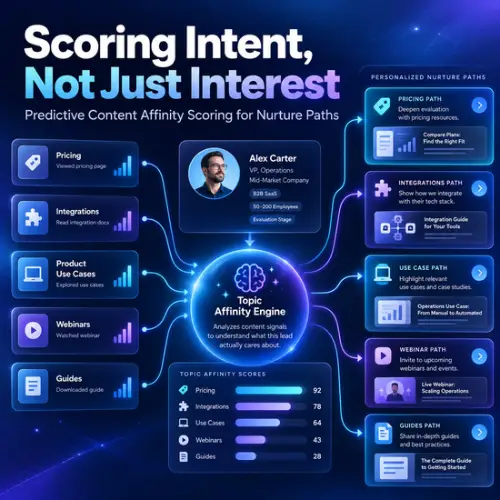
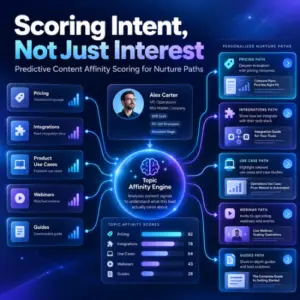
Content affinity scoring answers a question raw engagement scores can’t: which topics does this lead actually care about. A lead who reads three pricing pages and one integration guide is showing different intent than one who reads three blog posts and a webinar recap, but most scoring models grade the two identically, because they count clicks and opens, not subject matter.
That gap gets expensive fast. Sales gets handed a “hot” lead who happened to click a lot, then finds out on the first call that the person cares about a different product line, use case, or buying stage than the one Sales prepared to discuss. The engagement score said ready. The content itself said otherwise.
The fix isn’t a new scoring model bolted onto the old one. It’s reading the topic-level signals your platform is likely already collecting, whatever marketing automation stack sits underneath, and using content affinity scoring to route leads into nurture paths built around what they actually want to learn next, not just how loud their activity has been. For the broader model this fits into, see our pillar piece on how AI is rewriting lead scoring and grading for marketing ops.
What Content Affinity Scoring Measures That Engagement Scores Miss
Content affinity scoring measures which subject areas a lead consistently returns to, weighting topic overlap and repeat visits over raw click volume. A traditional engagement score adds points for every open, click, and form fill, regardless of what the content was about, so two leads with the same score can be interested in completely different things.
Volume vs. Topic: Two Different Questions
Why it matters: volume tells you a lead is active. Topic tells you what they’re active about, and only one of those helps Sales open a relevant conversation. A prospect who opens five emails about the same integration is a different opportunity than one who opens five emails about five different products.
Traditional lead scoring models, the kind most teams still run, were never built to separate the two. Marketo Lead Scoring: An Overview walks through how point-based models add up activity without distinguishing what any of it was actually about, which is exactly the gap content affinity scoring is built to close.
Where This Shows Up First: The MQL Handoff
The mismatch surfaces fastest at the MQL handoff, when a scored lead moves to Sales with no context beyond a number. A rep who opens the record expecting a buyer ready to discuss enterprise pricing, based on the score alone, and instead finds someone who has only ever engaged with entry-level content, loses the meeting before it starts. That’s the exact failure content affinity scoring is built to prevent: giving Sales the topic, not just the temperature.
Reading What Topic-Level Interest Actually Looks Like
Topic-level intent signals live in data most platforms already capture: which pages, assets, and email links a lead touches, grouped by subject rather than by date. The raw data usually exists. What’s usually missing is the step that tags each piece of content by topic and rolls that tagging up into a profile.
Content Signals Worth Tracking
Content engagement signals worth building a topic profile from include repeat visits to the same content category, time spent on specific resource pages, and which webinar or guide topics a lead chooses when given options. A single click on a pricing page means less than three visits to the same product’s use-case content across two weeks.
How Marketing Audits Expose Nurture Campaign Architecture Problems covers a related audit step: checking whether a nurture path’s existing branching logic was ever built to read this kind of topic data in the first place, or whether it was bolted on after the campaign was already live.
In Eloqua specifically, engagement criteria can be configured at the campaign level to weight specific content interactions differently, documented in Oracle’s guide to Configuring Engagement Criteria, which is where topic weighting for content affinity scoring typically gets set up first.
Turning Page-Level Activity Into a Topic Profile
Turning that activity into a usable profile takes one deliberate step most teams skip: tagging content by topic before scoring anything. Without that tagging layer, a marketing automation platform has plenty of engagement data and no way to group it, which is the difference between activity tracking and a usable topic profile.
Building Nurture Paths Around Affinity, Not Volume
Nurture path personalization built on content affinity scoring routes a lead into the track that matches what they’ve actually shown interest in, not the track that matches their score bracket. A lead scored high on volume but genuinely interested in one narrow use case gets content about that use case first, not a generic top-of-funnel sequence.
Branch by Topic, Not Just by Score Threshold
Why it matters: most nurture paths branch on score thresholds alone, moving a lead from one stage to the next once they cross a point total. Branching on topic affinity as well means two leads at the identical score can land in different tracks, because the platform is reading what they engaged with, not only how much.
B2B Personalization Without a CDP: What Your MAP Can Already Do covers the mechanics most teams need for this: rule-based branching inside Eloqua, Marketo, or another platform, using data the MAP already holds, no separate data platform required.
Swapping Content Inside the Path Itself
Dynamic content recommendations extend the same idea inside a single nurture email or landing page, swapping the featured asset based on the topic a lead has shown affinity for rather than sending everyone the same next-best-content block. A recorded walkthrough of this exact setup, covering both dynamic content rules and the nurture logic around them, is in Sales-Personalized Nurture Paths, Dynamic Content for Personalization.
Adobe’s guide to Understanding Predictive Content covers a comparable approach on the Marketo side, surfacing content based on modeled topic interest rather than a fixed content calendar.
Setting This Up Without Assuming One Platform
Content affinity scoring doesn’t require a new tool bolted onto Eloqua, Marketo, or another platform. It requires using data those platforms already collect in a more deliberate way. The starting point is almost always the same: pick a small set of topics that map to real buying decisions, tag existing content against them, and start reading engagement by topic instead of only by total activity.
What Eloqua, Marketo, or Another Platform Already Gives You
Predictive content scoring models, where available, can accelerate this by ranking which topics correlate most with conversion, but the underlying tagging and tracking work has to exist first, or there’s nothing for a predictive model to learn from. Teams that skip the tagging step and jump straight to a predictive layer usually end up with a model scoring noise instead of content affinity scoring done properly.
Where This Fits Into Broader Automation Strategy
This isn’t a standalone project. It sits inside the same campaign-planning discipline covered in The Go/No-Go Gate: Predicting Campaign ROI Before a Single Asset Gets Built, where topic-level data about what leads actually want becomes an input into which campaigns get built at all. For teams building this out as part of a wider rollout, B2B Marketing Automation Strategy: A Practical Playbook for Scalable Growth lays out where this kind of topic-aware scoring fits into the broader nurture and lifecycle program.
Conclusion
The gap between a standard engagement score and content affinity scoring is the gap between knowing a lead is active and knowing what they actually want next. Most Eloqua, Marketo, and other MAP instances are already collecting the raw data; the piece almost every team is missing is the topic tagging and branching logic that turns that data into nurture paths built around real interest instead of raw volume. Sales stops getting leads that are technically hot and practically unprepared for the conversation, and nurture paths stop guessing. If your current nurture program is still branching on score alone, contact us at 4Thought Marketing to talk through what a topic-aware rebuild would actually take for your environment.
About 4Thought Marketing
We're a B2B marketing automation and AI consultancy with a thing for getting complex tech to actually work. Since 2008, we've helped hundreds of organizations across financial services, technology, manufacturing, and real estate get more from Eloqua, Marketo, and their CRM integrations. We serve our clients across marketing automation strategy, lead lifecycle, AI, compliance, preference management, and more. Explore our services or get in touch.
Frequently Asked Questions
What is content affinity scoring?
Content affinity scoring is the practice of tracking which topics a lead consistently engages with, not just how many times they engage, so a marketing team can see what subject matter is actually driving their interest. It uses signals like repeat visits, resource choices, and time spent per topic category rather than a single aggregate point total.
How is this different from a standard engagement score?
A standard engagement score adds points for activity regardless of subject matter, so a lead who opens ten unrelated emails scores the same as one who opens ten emails on a single topic. Affinity data separates the two by grouping engagement into topic categories before it ever gets scored.
Do I need a CDP or separate data platform to do this?
No. Most of this can run inside Eloqua, Marketo, or another platform using data those systems already capture, as long as content gets tagged by topic and engagement rules get built around those tags. A CDP can add value at scale, but it isn’t a prerequisite for the first version of this.
What counts as a topic-level intent signal?
Repeat visits to the same content category, time spent on specific resource pages, and topic choices made when a lead selects between multiple webinar or guide options all count. A single click on one page is weak evidence; a pattern across several pieces of content on the same subject is much stronger.
How do dynamic content recommendations fit into a nurture path?
They swap the featured asset inside an email or landing page based on the topic a lead has shown the strongest affinity for, instead of sending the same next-best-content block to everyone in that stage. It’s the same topic data used for branching, applied inside individual sends rather than at the path level.
Where should a team start if none of this exists yet?
Start by tagging a small set of existing content, five to ten topics tied to real buying decisions, then build one branching rule based on topic engagement before touching anything else. Trying to do this across the entire content library on day one usually stalls the project; a single working topic branch proves the concept faster.