AI, AI team readiness, AI collaboration culture, Human-AI teamwork practices, AI onboarding for marketing teams, Marketing team AI alignment,

No one noticed exactly when it slipped in.

Perhaps it arrived between a rushed campaign launch and someone whispering that the CRM was “acting strange again.” Or maybe it wandered in when the content team was arguing about subject lines. However it happened, one day a curious creature appeared in your marketing department — quiet, watchful, undeniably clever.

Its name, of course, is AI.

It didn’t knock. It didn’t wait. It simply arrived, settling itself among your dashboards as if it had always belonged there. And now the team must decide what to make of this visitor — whether it becomes a trusted companion or a misunderstood mystery.

This manifesto is a guide for every team learning to live, work, and grow alongside this new creature.

Begin by Observing the Creature — It Reveals More Than You Expect

Like any newcomer, AI behaves strangely until understood, especially when teams are still exploring how AI fits into their marketing rhythm. The first instinct may be to assign it tasks immediately: “Write this.” “Score that.” “Fix my workflow, dear creature.”

But the creature responds best when people pause and watch how it thinks. You’ll see it spark when given clarity. You’ll see it stumble when fed vague direction. You’ll see it offer brilliance without ego, and errors without shame. Understanding comes before training — and once your team sees its true nature, alignment begins almost effortlessly.

And when the fear softens, curiosity takes its place.

Let the Creature Wander Through Real Work — That’s Where It Learns Your Rhythm

AI doesn’t align with theoretical strategies; AI learns best from the real, everyday work your team navigates. It aligns with your day-to-day reality.

Invite it to the corners of work where repetition has dulled creativity: the endless A/B tests, the segmentation housekeeping, the “quick copy tweak” that was never quick. Let the creature sit beside the writer shaping 20 variants. Let it hover near the analyst wrestling with data chaos. Let it peek over the shoulder of the automation specialist navigating rules older than the office furniture.

When AI sees the real problems, it offers real relief.

And when the team sees the relief, trust takes root — gently, naturally.

Notice Who Connects With the Creature First — They Hold the Early Clues

In every team, someone speaks the creature’s language instinctively, often sensing how AI responds before anyone else does.

Maybe it’s the content writer who enjoys experimenting with prompts in secret. Maybe it’s the operations manager who treats workflows like puzzles. Maybe it’s the analyst who treats data like poetry.

These early connectors are not “champions” because of a title. They are champions because the creature chooses them first.

Give them room to explore. Let them share the little wins that make the creature feel less foreign to everyone else.

Their stories carry far more influence than any formal training plan.

Introduce the Creature Gradually — Too Much Noise Makes It Hide

Overloading AI with tasks is like surrounding a shy animal with loud voices, and AI retreats when overwhelmed. It gets confused. Your team gets frustrated. Everyone retreats.

Instead, begin with a few intentional responsibilities — ones that are meaningful but safe.

Let the creature automate a small part of the nurture program. Let it suggest optimizations for an upcoming campaign. Let it flag anomalies in your data before anyone else notices.

Small successes create shared confidence. Confidence creates alignment. Alignment creates momentum.

And momentum makes the creature braver — and more helpful.

Listen Closely to Its Signals — They’re Softer Than You Expect

The creature doesn’t speak in words. It speaks in behaviors, the quiet cues AI offers when it needs clarity or direction.

When adoption is going well, the creature becomes attentive and precise. When alignment slips, it grows repetitive or oddly literal — its version of a sigh.

Build rituals where your team can reflect:

  • “What felt easier this week?”
  • “What surprised us?”
  • “What confused the creature?”
  • “What did the creature help us see?”

These conversations become the invisible threads that tie your team together.

And the creature thrives when it feels the team thinking collectively.

Let Leadership Approach the Creature First — Their Courage Shapes the Culture

Every creature watches the leader before anyone else, including AI, which adapts quickly when leadership models curiosity. If leaders pet it — metaphorically — others follow.

When leadership uses AI dashboards in meetings, or asks the creature for input before making a decision, it sends a quiet message:

“It’s safe to try.”

This permission, subtle yet powerful, unlocks alignment faster than any mandate.

When curiosity becomes cultural, not personal, the creature settles into its new home.

Treat the Creature as a Companion — Not a Replacement, Not a Threat

is a creature of cooperation. It carries no ambition. It seeks no promotions. It has no desire to replace the people who feed it context and clarity.

thrives when the team sees it as a partner: one that lifts the burdens of repetition, one that sharpens insights, one that multiplies the impact of human imagination.

The creature cannot do your job. It can only help you do it better.

And once the team accepts this truth, alignment is no longer a goal — it becomes the natural way of working.

A Final Whisper

The arrival of AI is not a disruption. It is an invitation.

An invitation to work smarter. To collaborate more freely. To free humans from the mundane so creativity can breathe again. To build marketing automation that feels less mechanical and more intuitive.

If your team welcomes the creature with patience, curiosity, and shared ownership, it will return the favor with insight, efficiency, and unexpected moments of brilliance. The creature is already here — bright-eyed, alert, ready.

The real question is:
Are you ready to walk alongside it? Chat with us.


chatbot privacy compliance, chatbot consent, chatbot DSAR, AI chatbot privacy, purpose limitation, data minimization, privacy policy, access controls, chat logs, encryption, DPIA, vendor DPA,
Key Takeaways
  • Chatbot privacy compliance extends core data protection laws.
  • Consent must be explicit, clear, and auditable within chats.
  • Data-subject rights include chat log deletion and exports.
  • AI cannot replace humans for high-impact legal decisions.
  • Security hardening and vendor governance protect customer trust.

What is Chatbot Privacy Compliance and Why Does it Matter?

Chatbot privacy compliance refers to the application of existing privacy laws and principles—such as consent, data minimization, purpose limitation, and rights fulfillment—to conversational AI platforms. While chatbots are often seen as a convenience layer for customer engagement, they also serve as powerful data collection channels. Every email address, purchase history, or personal detail shared through a chat window is subject to privacy regulation.

Marketers need to understand that compliance is not optional. Regulatory bodies worldwide—from the GDPR in Europe to emerging AI-focused laws in the US and Asia—expect chatbots to follow the same standards as forms, cookies, or CRM entries. A compliant chatbot doesn’t just prevent fines. It creates a foundation of trust where customers feel confident sharing information. Success means delivering a seamless experience that respects user rights while still enabling marketing teams to meet their goals.

Why Should Businesses Prioritize Chatbot Privacy Compliance?

The business case for chatbot compliance goes beyond avoiding penalties. Customers are increasingly aware of how their data is handled, and companies that visibly respect privacy enjoy stronger loyalty and brand credibility.

Non-compliance, on the other hand, can lead to significant risks:

  • Financial penalties: Regulators have the authority to issue heavy fines for violations.
  • Reputational damage: Customers lose trust quickly when personal data is mishandled.
  • Operational disruption: Responding to breaches or non-compliance notices can divert resources away from marketing priorities.
By contrast, chatbot compliance unlocks clear advantages:

  • Trust and transparency: Customers engage more when they know their data is safe.
  • Legal assurance: Compliant practices minimize exposure to audits and litigation.
  • Competitive edge: Demonstrating responsible AI use differentiates your brand in crowded markets.

Ultimately, prioritizing compliance is about aligning business value with ethical responsibility. Companies that embed compliance into chatbot operations show customers that privacy is not an afterthought but a core part of their promise.

How Can Marketing Teams Implement Chatbot Privacy Compliance?

Rolling out a compliant chatbot requires a mix of legal awareness, technical safeguards, and process alignment. Here’s a step-by-step guide:

  1. Map Data Flows
    Begin by charting every type of data the chatbot collects. This includes structured data (names, emails) and unstructured data (chat text that may include sensitive details). Mapping ensures you know where data resides and how it moves across systems.
  2. Define Lawful Basis
    Each data flow must have a clear lawful basis. Common options include consent for marketing data, contract for customer service interactions, or legitimate interest for operational use. Document these choices for audits.
  3. Capture Clear Consent
    Add explicit consent requests inside the chat flow, especially for marketing subscriptions. Consent text should be clear, unambiguous, and avoid manipulative design. Keep audit trails with timestamps and consent versions.
  4. Enable Data-Subject Rights
    Build pathways that let users exercise their rights to access, correct, export, or delete data. Importantly, deletion requests must extend to chat logs, not just CRM databases.
  5. Purge Chat Transcripts
    When handling “right to be forgotten” requests, remember to search chatbot logs. This prevents residual data from remaining accessible long after deletion in other systems.
  6. Secure Storage and Logs
    Apply encryption for data in transit and at rest. Limit access to logs with role-based permissions. Conduct regular penetration tests and patching routines to maintain security.
  7. Manage Vendors Carefully
    Review vendor contracts and ensure they include Data Processing Agreements (DPAs), sub-processor transparency, and retention commitments. Vendors should never use your chat data to train their models unless explicitly approved by you and the user.
  8. Maintain Human Oversight
    For any decisions with legal or personal impact, keep humans in control. Chatbots should never be allowed to approve loans, insurance claims, or other critical outcomes on their own.

By combining governance, security, and human oversight, marketing teams can operate chatbots that are compliant by design rather than patched after a violation.

What Are the Best Practices for Keeping Chatbots Compliant?

Best practices translate regulatory requirements into daily operations. These principles help ensure that chatbot compliance remains sustainable over time:

Do:

  • Keep your privacy policy updated with chatbot-specific language.
  • Provide clear just-in-time notices within the chat when data is collected.
  • Schedule periodic audits to review compliance readiness.
  • Use anonymization and redaction to reduce unnecessary retention of PII.
  • Train your marketing and support teams on privacy-safe chatbot practices.
Don’t:

  • Collect more data than you need for the stated purpose.
  • Allow vendors to repurpose chat data without user opt-in.
  • Store chatbot logs indefinitely without a clear retention policy.
  • Over-rely on automation for sensitive or rights-impacting decisions.

Best practices ensure that compliance is not just a legal checkbox but a continuous commitment to respecting customer data.

How Can Businesses Use Chatbots Without Compromising Privacy?

Businesses can embrace chatbots as effective tools for customer engagement while still meeting compliance obligations. The key is balance. Design chat experiences that feel natural and convenient, but never at the expense of privacy. For example, when a chatbot asks for an email address to follow up, it should also explain why the email is needed, how it will be used, and how long it will be stored.

When organizations harden chatbot security, update policies, and align vendor contracts, they not only reduce legal risk but also gain a reputation for being proactive about privacy. Customers increasingly choose companies they trust. By showing that your chatbot respects their data, you turn compliance into a differentiator that strengthens customer relationships.

Conclusion with CTA

Chatbots represent one of the fastest-growing engagement tools in modern marketing. They streamline conversations, capture leads, and improve service efficiency. Yet these benefits come with obligations. Regulations worldwide already apply to chatbot interactions, and more AI-focused laws are on the horizon. Companies that ignore compliance risk both financial penalties and long-term erosion of customer trust.

Marketers that bake privacy into their chatbot strategy gain more than compliance—they gain credibility, loyalty, and resilience. A compliant chatbot becomes a brand asset rather than a liability. If your team is rolling out or scaling chatbot use, 4Thought Marketing can help assess your risks, design consent flows, and operationalize privacy governance so you can innovate responsibly.

Frequently Asked Questions (FAQs)

Do all chatbots need to comply with privacy laws?
Yes. Any chatbot that collects or processes personal data is subject to privacy laws, regardless of whether it is used for marketing, support, or transactional purposes.
How do I know if my chatbot needs consent prompts?
If your chatbot collects personal data, especially for marketing or lead generation, explicit consent is required. For service-only interactions, other lawful bases may apply but transparency is still essential.
What should I include in a chatbot-specific privacy policy update?
To explain what data the chatbot collects, why it collects it, how it is stored, and how users can exercise their rights. Always address retention and vendor involvement.
How can companies handle deletion requests involving chat logs?
In addition to removing records from CRMs and databases, companies must also search and purge personal data from chatbot transcripts to fulfill deletion requests fully.
Can chatbot vendors use collected data to improve their models?
Not without explicit user consent and contractual agreement. Companies must ensure their DPAs restrict vendors from reusing or training on chatbot data without permission.
What steps should businesses take first to secure chatbots?
Start with encryption, limit access to logs, conduct audits, and review vendor contracts. Adding clear consent mechanisms is also a critical first step for compliance readiness.

Marketing automation integration, Future of AI, Predictive analytics, Prescriptive analytics, Conversational marketing, Cross-channel orchestration, Lead scoring models, Propensity modelling, Model monitoring, Bias mitigation, Privacy by design, Marketing ROI, Human-in-the-loop, Data lineage.
Key Takeaways
  • Integrate intelligence directly into automation decisions.
  • Start governed pilots tied to one measurable metric.
  • Use consented data and documented lineage from start.
  • Monitor models, bias, and enable human override paths.
  • Scale proven patterns into reusable playbooks and templates.

Marketing automation integration is how teams turn the Future of AI into everyday outcomes. And while automation keeps campaigns shipping on time, experiences still feel stitched together because decisions about who to engage, what to say, and when to say it often live outside the systems that deliver them.

But when marketing automation integration moves those decisions into the stack itself—at the segment, trigger, and content‑assembly layers—the Future of AI becomes practical: journeys feel personal without being creepy, measurable without being brittle, and respectful of consent by design. Therefore, the real opportunity isn’t adding another tool; it’s operationalizing intelligence where activation happens, with clear guardrails, so every send learns and the entire program compounds.

What this looks like in real life

Marketing automation integration means embedding machine learning, natural language, and decision logic inside the rules, triggers, and dynamic content that power journeys—grounded in the Future of AI capabilities that can evaluate context in real time. The goal isn’t another dashboard; it’s better decisions at the exact point of activation. This approach serves marketing operations leaders, demand gen teams, and lifecycle owners who want more than static rules. Success looks like faster learning cycles, lift in revenue metrics, and clear governance—every decision is logged, explainable, and aligned with consent.

Why this matters now (and what could go wrong)

The value shows up quickly:

  • Revenue and efficiency: smarter audience selection and timing reduce waste and raise conversion while shrinking manual build work.
  • Clarity: integrated decisioning improves visibility across cross‑channel orchestration and downstream marketing ROI.
  • Momentum: reusable templates let teams scale what works without new tech debt.
  • There are real trade‑offs: consent obligations, bias risk, and integration complexity with legacy tools. You’ll balance personalization against brand safety and legal requirements. That’s why privacy by design and clear escalation paths matter from day one.

How to roll it out—without breaking trust

  • Fix the target and the guardrails. Pick one business metric (e.g., qualified pipeline from nurtures) and write down constraints—purpose‑based processing, retention periods, fairness thresholds, and review cadence.
  • Harden the data layer. Map where profiles live (CRM, customer data platform) and how events arrive. Improve hygiene: dedupe keys, standardize fields, and record consent states. Capture both first‑party data and declared preferences from forms (your zero‑party data).
  • Select two pilot journeys. Choose high‑impact, low‑risk cases—onboarding nudges, churn prevention, or product‑qualified follow‑ups. Define “done”: a target uplift, minimum sample sizes, and stop rules.
  • Embed models where work happens. Use predictive analytics to rank leads, prescriptive analytics to pick next actions, and dynamic content to assemble copy and images per contact. Add conversational marketing on key pages with clear handoff to humans.
  • Instrument controls and visibility. Add model monitoring for drift, bias checks, and human‑in‑the‑loop overrides. Log inputs, outputs, and rationales for audits and internal QA. Keep a simple feature registry so decisions can be reproduced.
  • Automate testing and learning. Establish an experiment template with guardrails for sample sizing and exposure. Run lightweight A/B testing automation with traffic allocation that favors proven variants, then periodically reset to explore.
  • Standardize and scale. Turn proven patterns into playbooks: segmentation snippets, decision nodes, and creative templates. Document handoffs between MOPs and RevOps, and schedule quarterly model reviews.

Field‑tested habits that keep you on track

Do

  • Use purpose‑limited consent and verify it at activation (consent management).
  • Keep a small set of explainable features, then expand once value is proven.
  • Track “decisions shipped” and “time‑to‑learning” as capability KPIs.
  • Maintain fallback logic and a rapid escalation path to a human.
  • Align on a lightweight ethics rubric and schedule fairness reviews (bias mitigation).
Don’t

  • Don’t let tools dictate strategy; start with outcomes and constraints.
  • Don’t rely only on vanity metrics; report incremental lift and retention.
  • Don’t over‑personalize sensitive segments without brand and legal review.
  • Don’t skip documentation—lineage and approvals protect speed later.

Where to start (and how we can help)

Marketing automation integration and the Future of AI together make every touch more relevant and respectful. But durable gains come from tight governance, clean data, and steady experimentation—not from chasing features. Therefore, if you’re ready to build pilots that prove lift and keep you compliant, 4Thought Marketing can help you map use cases, embed decisioning in Eloqua or Marketo, and scale what works without slowing your team. Let’s pick your first two journeys and get measurable results in weeks.

Frequently Asked Question (FAQs)

Q1. Do we need a CDP to start?
Not strictly. A lean profile store with consent status is enough for pilots; a CDP helps once you scale audiences and channels.
Q2. Which use cases show quick wins?
Onboarding sequences, churn‑prevention nudges, and pricing‑page chat assistance typically prove lift fast with low risk.
Q3. How do we prevent biased outcomes?
Limit sensitive features, run fairness checks, and keep human overrides. Review model performance by cohort quarterly.
Q4. What changes in team skills?
You’ll need strong marketing ops, a data engineer for pipelines, and an analyst for testing. Data science can be in‑house or a partner.
Q5. How do we measure success?
Use lift‑based metrics (incremental conversions, retention) plus operating metrics like time‑to‑learning and percent of decisions covered by models.
Q6. How risky is channel expansion?
Safer once controls are in place. Start with email and web, then extend to ads and in‑app once consent checks and monitoring are stable.

AI governance for privacy programs, AI governance policy, Privacy-preserving AI, Data minimization, Data hygiene best practices, Consent management for AI, Ethical AI practices, 4Thought Marketing, 4Comply
Key Takeaways
  • Embed ethical AI into privacy programs before regulations tighten
  • Prioritize data minimization — set retention limits and restrict access
  • Use differential privacy and federated learning to protect identities
  • Document fairness transparency accountability — train teams companywide
  • Offer clear notices and consent for AI data use

AI Governance for Privacy Programs: A Practical Guide

AI now powers everything from segmentation and lead routing to customer service and forecasting. Teams want that velocity—faster analysis, smarter targeting, fewer manual steps—while customers and regulators want proof that their rights are respected. The tension is real: innovative use cases can stumble on unclear ownership, vague reviews, or excessive data collection. Trust erodes quickly when models are trained on information people didn’t expect you to use, when consent is hard to verify, or when privacy controls exist only on paper.

This guide shows how to turn values into working guardrails with AI governance for privacy programs. You’ll translate principles into a clear AI governance policy, apply data minimization and data hygiene best practices from intake through retention, adopt privacy-preserving AI patterns where they make sense, and operationalize consent management for AI so approvals are auditable across systems. The result is a program that helps product, marketing, legal, and security move faster together—shipping responsibly, proving accountability, and protecting people without slowing the business.

What Is Responsible AI Governance in Privacy?

Responsible AI governance aligns how your organization designs, builds, and operates AI with your privacy obligations. It clarifies ownership, guardrails, and accountability so product and marketing teams can innovate responsibly. A well-structured AI governance policy translates principles into actions—roles, workflows, approvals, and audits—so compliance is not an afterthought.

Why It Matters Now

Customers expect control. Regulators expect proof. Executives expect safe speed. Strong governance creates a common language across legal, security, marketing, and data teams to reduce risk and accelerate delivery. It turns values into repeatable practices and helps demonstrate ethical AI practices without slowing teams to a crawl.

How to Implement (Step-by-Step)

  1. Establish ownership and scope
    Create an executive sponsor and a cross-functional working group. Define which models, vendors, and processes are in scope for review and monitoring.
  2. Translate principles into policies
    Use your privacy framework to define rules for fairness, transparency, and accountability. Document a durable AI governance policy with decision gates—use cases allowed, restricted, or prohibited—and approvals for new data sources or model changes.
  3. Build privacy by design into data
    Apply data minimization from the start: collect only what’s necessary, with clear purpose and retention. Complement with data hygiene best practices such as access controls, encryption, and routine audits.
  4. Apply privacy-preserving techniques
    Adopt privacy-preserving AI approaches where feasible: de-identification, aggregation, and testing for re-identification risk. When appropriate, consider techniques like differential privacy or federated training; when these are out of scope, document why and the compensating controls.
  5. Operationalize consent and transparency
    Operationalize consent management for AI so people know when and how their data may train or inform models. Provide layered notices, easy opt-outs, and auditable records of consent across systems.
  6. Measure, monitor, and improve
    Define review cadences for model performance, drift, and incidents. Track both technical metrics and program metrics such as approval cycle time and issue closure rate. Close the loop with training and playbooks.

Best Practices

Do

  • Use a clear intake process and risk tiering so higher-risk use cases get deeper review.
  • Document data flows and vendors so you can prove how information moves.
  • Pilot privacy-preserving AI patterns in limited scopes before scaling.
  • Keep policies concise and actionable; pair them with checklists.

Don’t

  • Treat governance as a one-time project or a blocker owned by “legal.”
  • Collect data “just in case”—data minimization reduces risk and cost.
  • Launch models without monitoring plans or incident procedures.

Conclusion

If you’re ready to operationalize governance that protects privacy and enables growth, 4Thought Marketing can help align policy, process, and platforms. Our 4Thought Marketing team dedicated with 4Comply; designs consent workflows, review checkpoints, and reporting that fit your stack—so responsible AI becomes a habit, not a hurdle. Responsible AI isn’t about saying “no”—it’s about building confidence to say “yes” safely. And organizations want to innovate with data. But trust is fragile and oversight is complex. Therefore, AI governance for privacy programs gives teams practical rules, privacy-preserving AI patterns, and clear consent pathways so you can scale impact without compromising people’s rights.

Frequently Asked Questions (FAQs)

What is the difference between a principle and a policy?
A principle states intent (e.g., fairness). A policy specifies enforceable rules and owners—what’s allowed, required, and prohibited.
How does privacy-preserving AI affect model quality?
Handled thoughtfully, techniques like aggregation and de-identification can protect individuals with minimal impact on accuracy. Pilot, measure, and iterate.
Where does minimizing data fit in existing projects?
Bake it into intake and design reviews: define purpose, fields required, sources allowed, and retention up front. Remove or mask anything unnecessary.
Who should own consent management for AI?
Usually privacy and marketing operations co-own it, with engineering support. The key is shared KPIs and auditable records.

AI adoption in marketing operations, marketing operations AI, AI deployment, change management, data governance, model governance, privacy compliance, consent management, Eloqua integration, Marketo integration,

Key Takeaways
  • Pilot first to de-risk AI adoption in marketing operations.
  • Harden data contracts and consent to protect decisions.
  • Explainability earns trust—log features, sources, and outcomes.
  • Instrument success: time-to-value, reuse rate, measurable lift.
  • Train roles, not people: playbooks, guardrails, reviews.

Marketing operations teams are under pressure to prove impact quickly, and AI promises gains in targeting, orchestration, and productivity. And most organizations already have data, platforms, and motivated teams. But pilots stall when foundations are shaky, trust is fragile, and responsibilities are unclear. Therefore, treat AI as an operating capability with governance, measurement, and change enablement—not as a side project.

What problems actually slow adoption?

AI initiatives in marketing ops typically stall for a small set of predictable reasons. In practice, the blockers cluster into eight buckets: unclear outcomes, brittle data and consent posture, integration bottlenecks, privacy/security ambiguity, low explainability, change saturation, fuzzy ownership, and weak measurement. Here’s the short list you can diagnose against:

  • Unclear outcomes. Requests start as “add AI” instead of a defined decision, metric, and user.
  • Brittle data & consent. Inconsistent IDs, missing consent, and weak lineage make models fragile.
  • Integration bottlenecks. Legacy flows and custom fields block real-time triggers and enrichment.
  • Privacy & security ambiguity. Obligations and vendor controls aren’t explicit; unmanaged prompts raise risk.
  • Low explainability. No model cards, test harnesses, or business-readable justifications undermine trust.
  • Change saturation. More tools without fewer steps; the day-to-day job doesn’t actually get easier.
  • Fuzzy ownership. No clear owners for training data, model governance, and quality; drift follows.
  • Weak measurement. Teams track clicks, not cycle time, effort saved, or incremental lift.

Why do these frictions persist?

Three patterns keep resurfacing:

  1. Misaligned incentives. Leaders want innovation; front-line teams prioritize stability. If incentives reward throughput over learning, experiments lose oxygen.
  2. Martech sprawl. Years of point tools created overlapping data flows and unclear ownership, so new initiatives must route through brittle automations before value appears.
  3. Risk without guardrails. Without clear policies for data retention, prompt safety, and audit logging, teams fear compliance issues and delay decisions.

How can marketing operations unblock adoption?

AI progress accelerates when you treat it like a product with guardrails, clear ownership, and an evidence loop. Start small, connect outcomes to live systems, and measure what changes for customers and operators. Use this sequence to move from slideware to shipped value:

  • Run a readiness assessment. Score data quality, consent posture, lineage, access, integration maturity, and risks.
  • Prioritize a use‑case backlog. Define 6–10 opportunities; size impact vs. effort; pick two to pilot.
  • Define guardrails & ownership. Set consent policies, prompt safety, and logging; assign owners for data, model governance, and rollout.
  • Design the target architecture. Standardize IDs and event schemas; build real‑time pipes; plan Marketo/Eloqua connections to activate decisions.
  • Pilot like a product. Ship a thin slice to a real team; publish runbooks and acceptance criteria; hold weekly reviews.
  • Enable the change. Provide role‑based training, prompts, checklists, and quick‑reference guides; ensure fewer steps than before.
  • Instrument and iterate. Track time‑to‑value, reuse rate, assist rate, and incremental revenue; harden, then scale.

Best practices that consistently work

  • Start with a target decision: the precise moment AI helps and who benefits.
  • Standardize data contracts with deterministic keys, event schemas, and SLA monitoring.
  • Prove safety early by demonstrating consent filtering and PII minimization.
  • Design for explanation with business-readable justifications, confidence, and fallbacks.
  • Automate review loops to capture human feedback and update playbooks.
  • Productize onboarding so each model has an owner, roadmap, and support.

Call to action

If your roadmap is long on ambition but short on wins, focus on the conditions that make value repeatable. 4Thought Marketing can help stand up the essentials—consent and data guardrails, working integrations, and a pilot-to-production motion—so teams see value quickly. Ask about our AI Readiness Sprint, consent orchestration with 4Comply, and packaged integrations for Marketo and Eloqua.

Conclusion

AI can deliver outsized gains, and the conditions for success are within reach. But without ownership, guardrails, and measurement, even good ideas stall. Therefore, build a thin slice of the future—complete with governance and change management—then scale the patterns that work.

Frequently Asked Questions (FAQs)

What is AI adoption in marketing operations?

A structured rollout of models, prompts, and automations that improve marketing decisions and execution across the funnel. Success depends on data quality, integrations, and governance—not just tools.

Which data issues most often block progress?

Inconsistent IDs, missing consent, weak lineage, and manual handoffs. Strong data governance and event standards reduce rework and accelerate launches.

How does privacy compliance affect deployment?

Privacy and consent management set guardrails for training data, prompts, and outputs. Clear policies and automated filtering enable faster approvals and safer experiments.

Where should we start to accelerate adoption?

Begin with a readiness check, then pilot two high-impact use cases. Prove value with cycle-time and revenue lift, then expand using documented patterns.

How do Eloqua and Marketo integrations help?

They connect predictions and content to campaigns, segments, and routing so insights change real experiences—not just reporting.

What change management steps matter most?

Role-based training, clear ownership, visible explainability, and published runbooks with dashboards that show what changed, why, and how to override.

AI email summaries, Apple Mail AI summaries, Gmail AI features, email marketing AI, Eloqua AI Email optimization, Marketo Engage AI features, 4Thought Marketing
Key Takeaways
  • Design your opener so AI email summaries echo intent.
  • Lead with the ask — owner and deadline immediately.
  • Add a TLDR on line two with decision.
  • Front load first 140 characters with facts and amounts.
  • Use descriptive links — label attachments clearly before sign off.

You want messages that are quickly understood across inboxes and time zones, and AI email summaries promise to help busy readers scan your note in seconds. But these systems can flatten nuance, miss intent, or clip crucial details—especially when formatting, links, or tone get in the way. Therefore, write with summary engines in mind so human readers—and the machines that assist them—both get the right message the first time. When you design for AI email summaries, your first line becomes your most valuable real estate.

What is actually happening to your emails?

  • Two things shape understanding before anyone reads deeply: the message preview (first 1–3 body lines) and AI summaries (Outlook Copilot / Gmail Gemini) that condense long threads.
  • Outlook (Microsoft 365 + Copilot): Shows a summary card at the top of long threads with citations back to specific emails; can summarize common attachments. Won’t summarize encrypted or certain sensitivity‑labeled messages; scoped to the primary mailbox.
  • Preview lines: Outlook’s list view pulls the start of the body. Layout/density settings change how many lines display, but the first ~140 characters do the heavy lifting.
  • Gmail for Workspace: Offers “Summarize this email” on long threads. Same rule: clear, factual line one and descriptive links get surfaced.
  • Bottom line: Subject + first 1–3 lines + a TL;DR determine what humans and models act on. Make that area the single source of truth.

Why should you make your emails Summary-proof?

  • Misreads cost money: A clipped CTA or truncated price can delay approvals or stall deals.
  • Time zones amplify confusion: When recipients read on the go, they decide from the Summary whether to open or snooze.
  • Compliance risk is real: Regulated teams need clear disclaimers and auditable wording; hallucinated highlights are a problem.
  • Marketing efficiency depends on clarity: If your team relies on email marketing AI to prioritize replies, the wrong Summary means the wrong follow-up. Many marketing teams now route escalations using email marketing AI, so precision in your opening lines matters twice.

How to write emails that survive AI readers

  1. Start with the ask in sentence one. State the action, owner, and deadline. For example, “Please approve the Q3 budget by Friday at 18:00 IST so we can place the order.”
  2. Front-load vital details in the first ~140 characters. That’s the fragment most summarizers weigh heavily, and it’s the snippet AI email summaries often quote verbatim.
  3. Use a Summary after line one. Example: “Sum Up — 2 options, I recommend Option B; need a yes/no today.” This boosts the chance that AI email summaries echo your real message.
  4. Keep subjects’ machine-scannable. Pattern: [Action] + [Object] + [When]. Example: “Approve vendor contract — ACME — by Aug 22.” Avoid jokes or wordplay in the subject.
  5. Format for extraction. Use short paragraphs, simple bullets, and plain punctuation. Avoid nested tables and tiny fonts from pasted docs.
  6. Name things consistently. Use canonical project names, currency codes (USD, INR, EUR), and ISO-style dates (2025-08-22) to reduce misreads.
  7. Make links descriptive. Replace “here” with “Statement of Work (PDF)” so a model knows what the link represents.
  8. Don’t hide the CTA in signatures or banners. Place it in body text near the top.
  9. State privacy and sensitivity explicitly. Example: “Internal use only; do not forward outside ACME.”

Best practices checklist (copy/paste into your template)

  • Subject = intent first: Approve/Review/Decide.
  • First line = ask + owner + date.
  • Summary within line two (or a bold label in rich text; include the plain words “Summary” in the text version).
  • One idea per paragraph; bullets ≤ 6 items.
  • Call out numbers, dates, and amounts with units (₹, $, %, days).
  • Use direct verbs; avoid sarcasm and double negatives.
  • Put decisions and next steps above threads and signatures.
  • Provide a plain-text version if you send HTML.
  • Before sending, skim the auto-generated preview your client shows; adjust line one if the preview buries the ask.
  • For marketers, pre-flight test with common tools; check how Apple Mail AI summaries, Gmail AI features, and mobile lock-screen previews render your first two lines.
  • Pilot with AI readers internally and capture what AI email summaries display so you can tune your first 140 characters.

Compliance and brand protection

  • Include necessary disclaimers in plain language, not images.
  • Avoid sensitive data in subjects. Put IDs and account numbers only in the body if required, and mask where possible.
  • Log what changed: “Updated pricing from ₹1.2M to ₹1.15M based on volume.” Machines latch onto numerals—use that to your advantage.
  • For automation teams, align email templates with review workflows so audits can show exactly what was requested and when.

GEO optimization tips (works for US, EU, and India recipients)

  • Normalize dates to YYYY-MM-DD and include local day names when timing matters: “Mon, 2025-08-25 (US morning, EU afternoon, India evening).”
  • Offer local currency equivalents if the amount is material.
  • Keep idioms neutral; prefer globally understood verbs (“confirm,” “approve,” “ship”).
  • If sending multilingual, put the primary language first and keep the first 140 characters semantically equivalent across versions.

Conclusion

You can’t control how every model compresses text, and inbox features will keep evolving. But by structuring your subject, line one, and TL;DR for extractive and abstractive systems, you reduce misreads and speed up decisions. Therefore, treat summary-readability as a design constraint—your emails will work harder for humans and machines alike, and your team will move faster regardless of client or platform. When in doubt, write your opener so AI email summaries would faithfully echo your CTA, and remember that 4Thought Marketing can help you operationalize this standard across teams.

For structured implementation, 4Thought Marketing’s Email Summary‑Readability Audit provides diagnostics, a practical playbook, and pre‑flight guardrails for Outlook and Google Workspace; if desired, we can also produce exemplar first‑line and TL;DR patterns to jump‑start adoption.

Frequently Asked Questions (FAQs)

How do I make summaries show my CTA?

Put the ask, owner, and deadline in your first sentence, then add a TL;DR on line two.

Do Apple Mail AI summaries and Gmail AI features read images?

Rely on text. Use descriptive links and avoid image-only disclaimers.

How should I format dates and amounts for global teams?

Use yyyy-mm-dd and currency codes (INR, USD, EUR) with units and percentages.

Will email marketing AI route replies better if I change my opener?

Yes. Clear first lines improve priority scoring and reduce misrouted follow-ups.

How do Eloqua AI email optimization and Marketo Engage AI features fit?

Align templates and first-line patterns so scoring and routing models capture intent consistently.

content, marketing, AI content

Artificial intelligence (AI) content is no longer a novelty—it’s become the engine that powers modern marketing. From automated copy and visuals to data-driven campaign insights, AI tools are reshaping every stage of the lifecycle. We asked a dozen industry leaders: “Where has AI had the most positive impact on your marketing efforts?” Below, you’ll find each expert’s full answer—along with links to their profiles and organizations—plus ideas for where you might apply AI next.

AI Boosts Speed Across Multiple Channels

“Simple: a dramatic increase in speed.

We are using it for nearly every aspect of our marketing. We’re replacing stock photos with custom AI-generated images, we’re producing content at a record pace and we’re receiving deep research reports by uploading our customer data for AI analysis. We also capture 60 million IP addresses every month and we’re using AI to help us find fraud faster and more efficiently.”
Mike Schrobo, CEO & Founder at Fraud Blocker

AI Content Optimization Drives 23% Lead Increase

“At Vitanur, we support clients in the real estate, construction, and healthcare industries where content has to do more than just ‘sound good.’ … Take a real estate client, for instance: we used AI tools to fine-tune their property listing, just tweaking copy length, tone, and keywords based on how users behaved on the site. Within two weeks, their lead form submissions jumped by 23%.”
Afruz Fatulla-zada, Project Manager | Growth Marketer at Vitanur

AI Cuts Production Time in Half

“AI has made the biggest difference in content production workflows. We now use AI to turn outlines into first drafts, repurpose long-form into social snippets, and tailor messaging by persona and funnel stage. This has cut time-to-publish in half, letting our team focus more on strategy, distribution, and performance…”
Bryan Philips, Head of Marketing at In Motion Marketing

Writer Reduces Project Time 50% With AI

“As a writer for a digital marketing agency… I create online content for clients in the home services, HVAC, and energy sectors. … I’ve managed to reduce the billable time on individual writing projects by between 25% and 50% (or more), while preserving the same quality and results.”
Luke Enno, Content Writer at Art Unlimited

AI Reveals Critical Emotional Gaps in Messaging

“Our LinkedIn messaging had a confident, upbeat tone, but the audience we were targeting was navigating layoffs and uncertainty at the time. That mismatch dulled the message’s impact… AI helps us catch that tension before it becomes a missed opportunity.”
Nirmal Gyanwali, Founder & CMO at WP Creative

AI Speeds Creation, Human Touch Prevails

“AI has had the biggest positive impact on our content creation… It speeds up almost every writing-related task and even enables things like text-to-voice. Overall… content production has become much faster, but quality now matters more than quantity. A human touch is still needed.”
Heinz Klemann, Senior Marketing Consultant at BeastBI GmbH

AI Personalization Boosts Performance 25%

“Through machine learning, we have been in a better position to analyze customer data and segment our audience… We have already observed an increase in content performance by 25% … simply applying AI to change the headlines and images to adapt to users’ preferences in real-time.”
Joe Reale, CEO at Surplus Solutions

AI Automates Menial Tasks, Unlocks Creative Time

“AI has contributed… by far the automation and acceleration of menial tasks, allowing the team more time to focus on creative and strategic tasks… generating UTM tags for an extensive campaign can take a long time… ChatGPT turns this task… from potentially multiple hours, to less than 30 minutes.”
Alex Myers, Head of Marketing at The SEO Works

Five AI Tools Transform Performance

  1. Content Generation at Scale – Speeds up production while maintaining brand voice (with a good content style guide).

    • Use case: Blog posts, product descriptions, ad copy, emails.
      Tools: ChatGPT, Jasper, Copy.ai.

  2. Predictive Audience Targeting & Segmentation – Higher ROAS, lower CAC.

    • Use case: AI finds patterns in customer data to streamline ad targeting and lifecycle marketing.
      Tools: Meta Ads, Google Performance Max, Salesforce Einstein.

  3. Personalized Email & Web Experiences – Higher engagement and conversion rates.

    • Use case: Dynamic email content, product recommendations, AI chat on websites.
      Tools: Klaviyo, ActiveCampaign, Dynamic Yield.

  4. Performance Forecasting & Creative Testing – Eliminates wasted time and money on underperforming assets.

    • Use case: AI predicts high-performing creatives or titles before going live.
      Tools: Meta’s Creative AI, Marpipe, Pencil.

  5. SEO & Keyword Strategy – Organic traffic in less time.

    • Use case: AI identifies gaps in content, keyword clusters, and topic ideas.
      Tools: SurferSEO, Clearscope, SEMrush AI.

Xi He, CEO, BoostVision

AI Personalization Increases Email Opens 30%

“Our AI system can identify that a client is interested in sustainable design… and automatically generate an email… In the first 6 months… we have increased email open rate by 30 percent and a 20 percent lead conversion enhancement…”
Alex Smith, Manager & Co-owner at Render 3D Quick

AI Targeting Boosts E-Commerce Conversions 15%

“AI permitted us to find those consumers who habitually viewed product review videos… Then we applied AI… This produced a 15 percent growth in conversion rates of the targeted campaigns.”
Spencer Romenco, Chief Growth Strategist at Growth Spurt

AI Creative Tools Lift Click Rates 35%

“We used ChatGPT to generate ad copy variants… Created visuals with Midjourney and Canva… The result: faster A/B testing… and a 35% increase in CTR within the first two weeks.”
Maksym Zakharko, CMO at maksymzakharko.com

Conclusion

AI is transforming the marketer’s role—automating routine tasks, speeding up creation, and uncovering insights that human teams might miss. Whether you’re just starting or want to deepen your AI practice, choose one of these twelve areas, run a quick pilot, and measure the results. Are you curious about how ready your organization is to work alongside AI?

4Thought Marketing can assess your current setup—your data, systems, team processes, and policies—and provide practical suggestions to help you advance confidently. We’d be happy to connect if you’d appreciate an outside, helpful perspective.


AI coworker, AI collaboration, AI-Forward organization, human–AI partnership,

Imagine stepping into a dynamic control center where data streams flow in real time and intelligent assistants stand ready to streamline routine tasks. Beside every team member is an AI coworker: a reliable partner that handles data aggregation, preliminary analysis, and first-draft creation—so that human experts can focus on strategy, critical judgment, and creative innovation.

In this model, “AI-First” doesn’t mean “AI instead of people.” It represents a collaborative shift toward an AI-Forward organization, where AI coworkers are embedded teammates rather than standalone replacements. From generating initial content outlines and uncovering hidden trends to suggesting live optimizations, the AI coworker accelerates and enhances every phase of work. Built-in checkpoints—clear prompt guidelines, review stages, and dual-approval processes—ensure that people remain firmly in the decision-making seat.

Over the following sections, we’ll outline a clear roadmap for integrating AI coworkers into your organization: establishing a solid data foundation, deploying the right technology, empowering your teams with AI skills, embedding AI into daily workflows, and setting up robust quality-control measures. Let’s get started on unlocking higher efficiency and innovation together.

Roadmap to AI-Forward Organization & Co-Worker Readiness

Every transformation begins with a thoughtful plan. Here are the five essential steps to set up your AI coworker for success:

1. Inventory Your Data Sources
Start by cataloging all the places data lives—CRM records, web analytics, campaign performance logs, customer feedback—and documenting who owns each source and how frequently it’s updated. This “data inventory” gives you visibility into coverage gaps, quality issues, and compliance requirements. From there, you can prioritize which datasets to onboard first and define clear stewardship policies so that, over time, you build a consolidated, governed repository feeding reliable inputs into your AI models.

2. Deploy the Right Technology Stack
Choose AI platforms or machine learning operations (MLOPs) tools that integrate seamlessly with your existing systems—whether that’s your marketing automation software or data warehouse. Set up transparent dashboards and model registries to track performance metrics like accuracy, speed, and drift, so you can address issues before they affect operations.

3. Develop AI Fluency Across Teams
Host interactive workshops on crafting effective AI prompts, evaluating model outputs for bias or errors, and interpreting performance dashboards. Simulate real projects—have teams brief the AI, review its work, and iterate on prompts—so everyone gains confidence in collaborating with AI.

4. Embed AI into Everyday Decisions
Move beyond post-project reports by weaving AI suggestions into live workflows. For instance, if your AI flags a recommended budget adjustment midway through a campaign, present that insight alongside your performance dashboard so strategists can review and act immediately.

5. Implement Quality-Control Protocols
Set up automated checks to scan AI-generated assets for compliance, consistency, and ethics before any release. Pair these with a human review step: designate “AI champions” who validate high-impact outputs, ensuring speed doesn’t compromise quality. These safeguards not only protect brand and compliance, they also formalize AI collaboration best practices—so every team member understands how to co-author work with their AI coworker.

Elevating Marketing Operations with AI coworkers through AI Collaboration

When marketing teams embrace AI as a collaborative partner, they unlock new levels of efficiency and creativity:

Why Agencies Benefit

Tasks that once took days—segmenting audiences, drafting content variations, building reports—can now be completed in hours. That frees your team to concentrate on customer insights, innovative campaign ideas, and personalized experiences.

Illustrative Use Cases

  • Predictive Lead Scoring: AI analyzes engagement patterns and external signals to rank prospects. Sales reps then review edge cases and craft targeted outreach, refining the model with their feedback.
  • Programmatic Bidding: An AI service adjusts bids in real-time based on defined objectives. Strategists set overall goals, monitor performance flags, and fine-tune parameters weekly.
  • Creative Testing: Overnight, AI generates dozens of headline and image combinations, tests them on small segments, and ranks the top performers. Designers then polish the winners, infusing them with brand voice and nuance. This iterative AI collaboration cycle ensures every creative asset benefits from both machine scale and human artistry.
  • Content Personalization: AI assembles customized copy snippets tailored by industry, stage, or preference. Brand managers spot-check samples to ensure alignment with tone guidelines and compliance standards.

From One-Off Campaigns to Continuous Improvement

Rather than launching a campaign and waiting for results, teams receive ongoing AI-driven recommendations, confirm them quickly, and watch the campaign evolve in real time. This continuous loop maximizes performance while keeping human creativity at the forefront.

Measuring Co-Pilot Maturity

AI coworker, AI collaboration, AI-Forward organization, human–AI partnership,

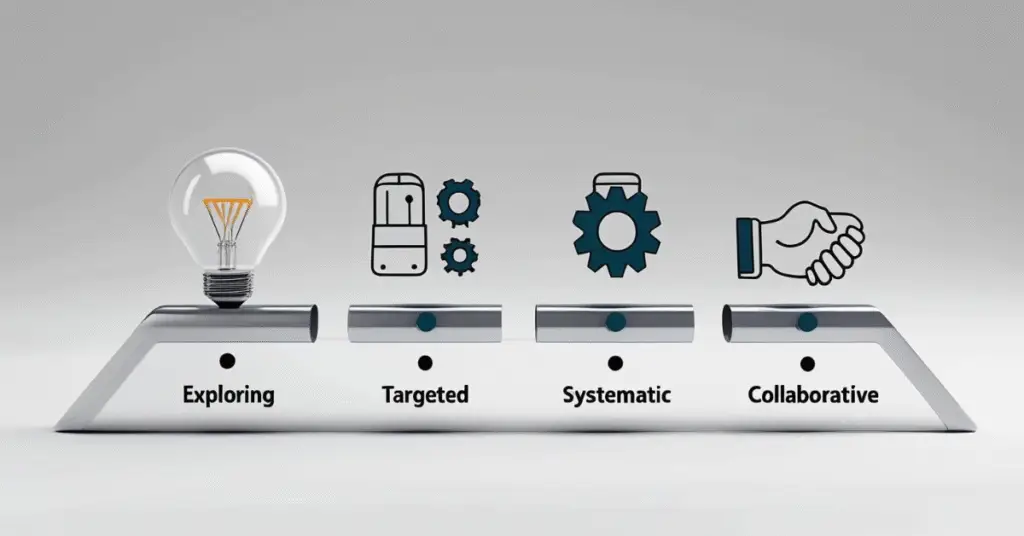
Organizations progress through four stages as they integrate AI coworkers more deeply:

Stage Description AI’s Role Human’s Role
0 Exploring Possibilities Sporadic tests and experiments Manually review every AI suggestion
1 Targeted Adoption AI supports specific tasks Teams integrate AI into select workflows
2 Systematic Integration AI woven into core platforms Teams manage models, prompts, and alerts
3 AI-First Collaboration AI underpins daily operations Humans steer strategy, governance, innovation

  • Leadership Engagement: Executives define the vision, allocate resources, and track ROI on AI initiatives.
  • Center of Excellence: Central teams build shared models, best practices, and monitoring tools.
  • Operational Teams: Line teams craft prompts, interpret AI suggestions, and continuously refine both models and workflows.

Knowing your stage helps you plan targeted next steps—whether piloting a single-use case or scaling to enterprise-wide AI collaboration.

Integrated Architecture: How Data, Models, and Tools Work Together

To make your AI coworker truly seamless, you need an architecture where every component feeds the next in a governed, transparent way:

Data Foundation

All your customer, campaign, and operational data should flow into a single, well-managed repository (e.g., a data lake or CDP). Real-time streams—from CRM updates to web events—are ingested automatically, and data governance policies (catalogs, stewards, privacy checks) ensure that everything feeding your AI models is accurate, compliant, and auditable.

Model Management

Once data is centralized, you need a robust machine learning operations environment: a versioned model registry, automated training pipelines, and monitoring dashboards. Whenever performance dips or new data patterns emerge, retraining jobs kick off, and alerts notify your team of any anomalies. This layer keeps your AI coworker up-to-date and reliable.

Application Integration

Rather than stand-alone tools, AI services should plug directly into the systems your teams already use—marketing automation, ad platforms, content editors, reporting dashboards. Inline suggestions (e.g., budget recommendations next to spend charts, draft headlines inside your email builder) make it easy for people to accept, tweak, or reject AI output without switching contexts.

People & Process

Technology alone isn’t enough. Establish ongoing training (hands-on workshops in prompt design and model review), simulation exercises (practice projects under controlled conditions), and standard operating procedures (a clear human-review step for every high-impact AI recommendation). These practices ensure that AI contributions meet your quality, ethical, and brand standards every time.

Let’s hear from Heinz Klemann, Senior Marketing Consultant, BeastBI GmbH

AI Speeds Content Creation, Human Touch Prevails

AI has had the biggest positive impact on our content creation—especially for blogs and SEO content, but also on web or landing pages, ad copy, keyword research, and email texts. It speeds up almost every writing-related task and even enables things like text-to-voice, which we’re starting to use more often. Overall, content production has become much faster, but we’re also seeing that quality now matters more than quantity. To truly stand out or rank for competitive keywords, a human touch is still needed. Most “AI only” content feels generic and can be detected easily.

In the long run the LLM and/or Google will not prioritize or even allow content like that. This goes hand in hand with better AI content detection. Therefore, AI should be used as a support to create content but not something that does everything on its own.

Conclusion & Next Steps: Embracing Human–AI Partnership

Empower, Don’t Replace

True human–AI partnership means augmenting human talent, not displacing it. You are being AI-Forward, by offloading repetitive, data-intensive tasks to AI, your teams gain the freedom to innovate, strategize, and build deeper customer relationships.

Readiness Checklist

  • Have you inventoried your key data sources and begun applying governance policies?
  • Do you have end-to-end model pipelines with automated retraining and monitoring?
  • Are AI insights surfaced directly within the tools your teams already use?
  • Have you trained core “AI Champions” and codified human-review steps?
  • Are compliance, bias, and brand checks integrated into every AI output?

Your First Coworker Project

Pick one high-volume, repeatable task—such as drafting email subject lines, adjusting ad bids, or generating weekly performance summaries. Pair a small team member with the AI “co-worker”, define clear review guidelines, and measure both time saved and quality uplift. Iterate on your prompts and process until the AI reliably delivers value.

When you see the first real gains (and you will), scale that pattern across additional use-cases, continually refining your architecture, training, and governance. That’s how you’ll transform from “experimenting” to “AI-Forward Collaboration”—and unlock your organization’s next wave of productivity and innovation.

Need Some Help!

Are you curious about how ready your organization is to work alongside AI? 4Thought Marketing can examine your current setup—your data, systems, team processes, and policies—and offer practical suggestions to help you move forward with confidence. We’d be glad to connect if you’d find an outside helpful perspective.


oracle Eloqua advanced intelligence, Eloqua advanced intelligence features, fatigue analysis Eloqua, account intelligence Eloqua, send time optimization Eloqua, subject line optimization Eloqua, predictive lead scoring Eloqua, Eloqua dynamic segmentation, generative AI prompts Eloqua, Eloqua campaign workflow automation, marketing automation, AI in marketing, predictive analytics, lead scoring software, email personalization tools, B2B marketing automation, AI-powered email marketing, customer engagement platform, marketing intelligence solutions, real-time analytics for marketing,

Imagine having a marketing sidekick that whispers exactly when to reach out, what to say, and which accounts are most eager to hear from you. Oracle Eloqua Advanced Intelligence does just that—transforming raw data into predictive insights so you can ditch guesswork and score big every time. By weaving in powerful features like Fatigue Analysis, Account Intelligence, Send Time Optimization, Subject Line Optimization, predictive lead scoring, dynamic segmentation, and even Generative AI prompts, this add-on makes your campaigns smarter, faster, and more fun to run.

Eloqua Advanced Intelligence Features

Fatigue Analysis

Think of Fatigue Analysis as your contact’s personal email fitness tracker. It gauges whether someone is under-emailed or drowning in messages, then flags burnout risks before they hit unsubscribe. Behind the scenes, Oracle Eloqua Advanced Intelligence crunches engagement metrics—opens, clicks, complaints—to assign a fatigue score.

Account Intelligence

Zooming out from individual inboxes, Account Intelligence paints a heat map of entire organizations. Each account earns an Engagement Score based on aggregated behavioral signals—web visits, form fills, and email interactions. Marketing and sales teams unite around the hottest opportunities, focusing efforts where they’ll have the most impact. With Oracle Eloqua Advanced Intelligence, you’ll never chase lukewarm leads again.

Send Time Optimization

Timing is everything: an email that lands during peak attention windows can double your open rate. Send Time Optimization (STO) analyzes each contact’s historic engagement to deliver messages at their personal “golden hour.” Whether it’s lunchtime in New York or late afternoon in London, Oracle Eloqua Advanced Intelligence ensures every send is perfectly timed—no more one-size-fits-all blasts.

Subject Line Optimization

Even a perfectly timed email needs a killer headline. Subject Line Optimization (SLO) in Eloqua AI runs mini-A/B tests on a subset of contacts, selects the top performer, and unleashes that champion on the rest. It’s like hosting a talent show for your subject lines—only the best get prime billing in your subscribers’ inboxes.

Generative AI Prompts in Oracle Eloqua Advanced Intelligence

Imagine having a brainstorming buddy that crafts copy on demand. The generative AI prompts feature empowers you to conjure up creative copy on demand, but it’s currently in “Controlled Availability” status under the upcoming 25B (CX Apps 25.05) release, now slated for general rollout on May, 2025. That means you can’t self-enable it just yet, but you can join the early-access program:

  1. Join Controlled Availability: Visit the Oracle Eloqua Customer Connect page for the 25B Customer Overview and click “Interested in joining? Complete your registration by providing Areas of Interest here.”
  2. Submit a Request: After registering, fill out the Controlled Availability request form—specify you’d like access to “Generative AI in Redwood editors” under the Advanced Intelligence add-on.
  3. Get Provisioned: Oracle will review your submission and grant access to the generative AI module in your Eloqua sandbox. Once approved, you’ll see new “AI Prompt” options in both dynamic content and shared content editors.

With early access secured, you can experiment with prompts like “Generate five witty subject lines for a summer webinar” or “Write a playful email intro for our new product”—and watch Eloqua spit back polished, campaign-ready copy. Then, when the 25B release goes GA in May, 2025, this capability becomes part of your standard toolkit—no extra approvals needed. Here are a few prompt examples and their outputs:

Prompt:

“Generate five witty subject line variations for a summer webinar invitation.”

Response:

  • “☀️ Beat the Heat: Join Our Summer Marketing Webinar!”
  • “Your Coolest Campaign Tips—Live This Thursday”
  • “Surf’s Up on Marketing Strategies—RSVP Now!”
  • “Heat-Proof Your Next Campaign with These Hacks”
  • “Catch the Marketing Wave—Webinar Seats Filling Fast!”
Prompt:

“Write a playful email intro for a product launch.”

Response:

“Hey [Name],
Grab your party hat—our newest feature just hit the stage! It’s like confetti for your campaigns, sprinkling AI magic where you need it most.”

Prompt:

“Suggest three call-to-action lines that feel urgent but not pushy.”

Response:

  • “Unlock Your Free Trial Today”
  • “Claim Early Access While Spots Last”
  • “Reserve Your Demo in Seconds”
  • With Oracle Eloqua Advanced Intelligence’s generative AI, you’ll never start with a blank screen again.

Roadmap for implementing Eloqua Advanced Intelligence

  • Exclude Burnout Risks – Begin by running Fatigue Analysis to identify and exclude contacts nearing saturation. This ensures your message lands with fresh eyes. When contacts near saturation, you get alerted to dial back the volume, keeping your audience fresh and engaged.
  • Focus on High-Value Accounts – Leverage Account Intelligence to build a list of top-engaged organizations. Hand off this list to sales for priority outreach.
  • Personalize Send Windows – Activate Send Time Optimization to schedule emails at each contact’s peak attention moment—no manual scheduling needed.
  • A/B Test & Deploy Winning Headlines – Use Subject Line Optimization to test variations, select the winner, and maximize open rates.
  • Prioritize Follow-Ups – Apply predictive lead scoring to rank responses. Sales teams can focus on the hottest leads first, accelerating pipeline velocity.
  • Keep Content Fresh – Tap into Generative AI prompts for on-the-fly copy suggestions—headlines, body text, CTAs—to maintain creative momentum.

Measuring Success and Next Steps

Track lift in open rates, click-throughs, and MQL-to-SQL conversions directly within Eloqua dashboards. Watch unsubscribe rates drop as fatigue scores improve. Ready to unlock the full power of Oracle Eloqua Advanced Intelligence? Download our free whitepaper, “Mastering AI-Driven Marketing with Eloqua Advanced Intelligence,” for implementation guides, checklists, and real-world case studies.

Sum-Up!

In wrapping up, Oracle Eloqua Advanced Intelligence isn’t just another add-on—it’s your secret weapon for turning every campaign into a precision-guided, data-fueled masterpiece. By combining fatigue insights, account heat maps, send-time genius, headline championships, predictive scoring, dynamic segments, and AI-powered copy prompts, you’ll boost engagement metrics and free your team to focus on strategy and creativity.


: AI transforming websites, AI in webpages, Artificial intelligence web, Personalized web experience, AI chatbots for websites, Website performance optimization AI, AI enhanced visual content, AI for SEO, AI content creation, Dynamic web pages, Machine learning for websites, Intelligent web experiences, Automated personalization, Virtual assistants for websites, Website speed optimization AI, Generative AI for web, AI in digital content, SEO automation AI, Content strategy AI,

Artificial intelligence has transformed the landscape of possibilities and is a dynamic force fundamentally reshaping how we engage online. One major innovation is AI transforming webpages, enabling websites to intuitively adapt to your individual needs, offering personalized experiences that feel uniquely tailored. From intelligent chatbots providing instant support to AI-driven systems optimizing website performance for lightning-fast loading times, artificial intelligence is weaving its way into the very fabric of the web.

This evolution encompasses the visual elements we encounter and the content we engage with, as AI facilitates richer, more engaging digital experiences. Join us as we explore how AI transforms web pages, crafting a more intuitive, efficient, and personalized online landscape.

The Power of Personalization: A Tailored Web Experience

At the forefront of the impact of AI transforming webpages is personalization. Imagine a website that intuitively understands your needs, presenting information and products tailored precisely to your interests. This isn’t science fiction; it’s the reality powered by machine learning algorithms. These sophisticated systems analyze a user’s digital footprint – their browsing history, purchase patterns, time spent on specific content, and even explicitly stated preferences – to adapt the webpage dynamically.

For instance, an e-commerce platform might showcase products you’re likely to buy based on past activity, demonstrating how AI transforming webpages enhances the shopping experience. Similarly, a news portal could prioritize articles aligning with your reading habits, illustrating the power of AI transforming webpages into a more relevant information source. This level of personalization elevates user satisfaction and significantly boosts engagement, making the online experience feel uniquely relevant.

AI-Powered Chatbots: Your Instant Digital Assistant

The integration of AI transforming webpages is also evident in the rise of intelligent chatbots. These virtual assistants are now an indispensable part of customer service strategies. Unlike their rule-based predecessors, AI chatbots can understand natural language, providing instant, tailored assistance and gathering crucial customer data. Think of a website where a chatbot seamlessly answers your queries about shipping policies or helps you track an order, showcasing how AI transforming webpages leads to more efficient customer support.

This immediate support not only enhances the user experience, a key aspect of AI transforming webpages, but also allows businesses to operate more efficiently by handling routine inquiries and collecting valuable insights into customer needs.

: AI transforming websites, AI in webpages, Artificial intelligence web, Personalized web experience, AI chatbots for websites, Website performance optimization AI, AI enhanced visual content, AI for SEO, AI content creation, Dynamic web pages, Machine learning for websites, Intelligent web experiences, Automated personalization, Virtual assistants for websites, Website speed optimization AI, Generative AI for web, AI in digital content, SEO automation AI, Content strategy AI,

Boosting Website Performance with Intelligent Automation

Beyond user-facing features, the influence of AI transforming webpages extends to performance optimization. By continuously analyzing user interactions and website metrics, AI identifies areas for improvement that might otherwise go unnoticed. This includes fine-tuning website elements, optimizing load times, and enhancing accessibility. For example, AI transforming webpages can analyze traffic patterns to allocate server resources dynamically, ensuring consistent performance even during peak usage. By minimizing bounce rates and maximizing site responsiveness, the impact of AI transforming webpages is directly felt in better user engagement and improved search engine rankings.

Enhancing Visual Content Through AI-Driven Innovation

What users see on websites is also evolving significantly due to AI transforming webpages. Tools leveraging computer vision and generative AI enhance and even create visuals tailored to specific audiences. Consider how automated image tagging, a result of AI transforming webpages, improves the searchability of products on an online store, or how AI can moderate user-generated content to maintain a safe and appropriate environment. Furthermore, the emergence of AI-generated imagery, another facet of AI transforming webpages, opens up exciting possibilities for creating unique and engaging visual content without relying solely on traditional photography or design processes, leading to richer and more captivating online experiences.

Smarter SEO and Content Creation in the Age of AI

Finally, AI is transforming webpages, significantly impacting SEO and content creation. Advanced AI tools can analyze vast datasets to predict successful content strategies and automate essential tasks like keyword research. Imagine a content creator using AI to identify trending topics and then receiving help in drafting initial content versions, demonstrating how AI is transforming webpages to empower content creation. AI’s role in transforming webpages by providing data-driven insights and automating repetitive tasks allows content creators to develop more effective and discoverable online content.

Conclusion

You now understand how AI transforms webpages, making them more personalized, efficient, and visually appealing, ultimately leading to better user experiences and business outcomes. However, the challenge we may face is that implementing these advanced AI technologies and strategies can feel complex and overwhelming, potentially hindering your ability to fully leverage the benefits of AI in transforming webpages. Therefore, a strategic and expert approach is essential to truly harness the power of AI to transform webpages and achieve significant improvements in user engagement, conversion rates, and overall online success.

Contact Us…


ai in email marketing

More and more marketing tools incorporate AI now. But despite its usefulness, AI is still not a complete solution. While you may find claims that AI can build your marketing emails without human intervention, it is wise to be cautious. The consensus is that high-quality email campaigns need human oversight and should use AI to assist with tasks.


One place AI tools excel is in completing the busywork – those time-prohibitive tasks that are so labor-intensive or complex that completing them manually is much less productive. AI can transform these tasks by automating processes and leveraging large amounts of data to generate insights quickly. Examples include:

  • Advanced personalization: AI tools can analyze customer preference data and behaviors to create hyper-personalized content for each individual recipient.
  • Predictive analytics: AI can process significant amounts of complex customer data and provide accurate predictions when it comes to customer behavior to inform email strategies.

AI in Email Marketing

AI can play a critical role throughout your email campaign, helping you save time and identify trends that can shape its flow. However, it’s important to remember that AI is meant to assist, not take over the role of a human being.

AI technology varies depending on the stage of the email production process you use it for.

Creative Processes

Generative AI is particularly useful in email production’s early, creative stages, such as conception, copywriting, design, and development. It can assist in generating creative content, designing visuals, and even coding interactive elements.

  • Conception: Once you know your campaign’s audience and goals, AI can help analyze data to identify trends, predict audience preferences, and suggest campaign ideas. Marketers can use it to identify themes, develop variations, and build personas.
  • Copywriting: Given the right prompts, AI can help copywriters craft compelling subject lines, preview and body text that will resonate with target audiences. AI can also be used to tweak text to fit different audience segments to offer personalized messaging. AI can also automate the testing process by conducting A/B tests quickly, identifying the most effective variations.
  • Design: The visual elements of an email need to be attention-grabbing. AI-powered design tools can be used to create the wireframe for your email campaign, suggest images, and insert interactive elements where necessary.

Analytical & Optimization Processes

Machine learning is highly effective in the audience select and send stages as well as for providing in-depth insights into campaign performance. It can optimize send times, segment audiences more accurately, and even predict the best times to send emails to maximize engagement.

  • Development: AI tools can carry out much of the heavy lifting in the development stage by generating code snippets and templates that are optimized for different email clients and devices. It can also be used to run tests for rendering, accessibility, and more and suggest changes as necessary before your campaign even launches. This can provide a seamless experience for recipients once your campaign is launched.
  • Audience selection: Segmenting email lists and targeting specific audience segments based on various criteria can take a lot of time. AI-powered segmentation tools consider factors like past behavior, preferences, and demographics to identify audience segments. Predictive analytics are used to forecast customer behavior and preferences, allowing marketers to anticipate needs or the potential for customer fatigue and tailor their campaigns accordingly. This targeted approach increases the likelihood of engagement and conversion.
  • Pre-launch checks: AI can provide automated quality checks and compliance assessments.
  • Send stage: Instead of manually inputting send times for various demographics, AI can trigger optimum send times for emails by analyzing historical open and click data. It can also be used to streamline the creation and sending of triggered emails, such as welcome emails, abandoned cart reminders, and personalized follow-ups. Omnichannel integration can provide a cohesive customer experience from email to in-store interactions and beyond.
  • Campaign analysis: AI-driven analytics tools can provide in-depth insights into key campaign performance metrics such as open rates, click-through rates, and conversions. Marketers can use these analyses to drive future campaigns.

Get in touch with our team to discover AI tools that can help you optimize your email campaigns.

ai in email marketing

marketing challenges 2025

What can the marketing industry expect next year?

When we submitted this question to various thought leaders, we received an overwhelming response—enough to make this one of our favorites. Everyone’s contributions provide valuable insight into what’s to come in 2025. Let’s take a look at what marketing challenges are on the horizon.

Rising Cost of Quality Content Creation

Lisa Benson, Marketing Strategist, DeBella DeBall Designs

At DeBella DeBall Designs, we’re looking ahead to 2025 with both excitement and strategic caution. Here’s what’s keeping me up at night – and why it should matter to you too.

The rising cost of quality content creation is becoming a significant hurdle. With AI-generated content flooding feeds, standing out requires increasingly sophisticated, human-crafted storytelling. We’re seeing this firsthand with our coaching clients – they’re having to invest more in authentic, deep-dive content that genuinely resonates. Those beautiful deep purple carousel posts don’t just happen by themselves anymore!

But here’s the opportunity: brands that master the balance between efficiency and authenticity will win big. We’re already helping our clients build content ecosystems where one premium piece can be thoughtfully adapted across platforms, maintaining quality while managing costs.

The real challenge? It’s not just about creating content – it’s about creating content that converts in an increasingly skeptical market. The brands that will thrive are those brave enough to show their real work, share genuine client transformations, and build true community engagement beyond surface-level metrics.

Mark my words: 2025 will separate the authentic storytellers from the noise makers.

Emphasize Authenticity Over AI

Authenticity has always been important in content marketing, and it will become even more critical with so much generic and robotic content being generated with ChatGPT, etc. Consumers are becoming increasingly discerning, and they can quickly identify content that feels forced or inauthentic. Who would have thought that the killer application would be authentic interactions, not Artificial Intelligence? While your competition generates robotic messages that sound generic, you can stand out and break through the sea of sameness with personalized, thoughtful communication serving their specific needs. So don’t get distracted by dreading the latest shiny AI object; to win in the future, authenticity is what people remember. Building connections and relationships with your audience and showing your humanity is more important than ever!

We’re more time-starved than ever. Attention spans keep shrinking as Internet time accelerates with all the new technologies. The world is becoming more visual when it comes to consuming content which has made visual-driven platforms like YouTube/Instagram/TikTok gain popularity in selling. With the rise of a generation that would much rather watch/look at something vs sit/read, there is going to be a growing trend of more visual content, including pictures/videos (long and short form)/memes/diagrams /infographics. As more people shifted online during the pandemic, live streams will be increasingly used to host public events/meetings on platforms like Twitch.

Address Ethical Challenges of AI Adoption

Jason Stelle, Digital Marketer, Filterbuy

Probably one of the most significant challenges for marketers in 2025, I think, is dealing with the ethical challenges associated with increasing AI adoption in campaigns. AI has great potential for personalization and efficiency, but it also poses issues of privacy and transparency. For instance, AI-based consumer behavior insights can generate extremely precise campaigns, but you can easily hit a plateau where users perceive their data as being misused in ways they did not consent to. For me, the most important thing for marketers is to be transparent with consumers about the way that data is collected and used so that consumers don’t feel victimized. This balance will require intelligent plans and transparent messaging to bolster a brand’s authenticity.

SEO Focus on User Experience

In 2025, SEO will present exciting challenges and opportunities as technology and user behavior continue to evolve. User experience will remain a key focus, with Google prioritizing speed, mobile-friendliness, and visual stability. My goal will be to ensure my clients’ websites are fast, mobile-optimized, and easy to navigate, offering a seamless experience that drives higher rankings and conversions.

AI-driven algorithms are reshaping how search engines rank content. In 2025, it won’t be enough to write great content; it must be structured to align with AI’s understanding of user intent. Focusing on clarity, relevance, and smart keyword usage will be crucial for businesses to stay competitive in 2025.

With the rise of zero-click searches, voice searches, and rich snippets, I’ll fine-tune content to capture visibility in these high-traffic spots without requiring a click. Structured data, conversational keywords, and image optimization will be key strategies.

As emerging trends like augmented reality and AI-driven personalization take off, I’m preparing to leverage these innovations to keep clients ahead of the curve. By staying agile, embracing new technologies, and delivering high-quality, user-focused content, we’ll drive organic traffic’s competitive edge in 2025.

AI’s “Good Enough” Backlash

Marketing leaders already expect a surge in the use of AI for everything from creating assets to planning and strategy. They are experimenting with it and responding to questions from other leaders in their business. It’s even affecting some 2025 budgets.

But the AI backlash is just around the corner. By the second half of 2025, many will begin seeing that AI excels at being “good enough.” That’s it. The output looks fine at first because it’s better than what people expect. However, it falls short when it comes to a strong brand voice, barrier-breaking creativity, deep customer insights, and other aspects of what allows a brand to differentiate itself.

When those shortcomings become more apparent, “good enough” won’t actually seem good enough at all. AI-generated marketing assets and strategies will seem too homogenous. Because of that, the pendulum will swing the other way for leading brands. Many will back away from AI in order to separate from the pack. AI usage will eventually settle somewhere in the middle, but it will take a few of these swings, along with advances in AI models, before it becomes a part of the standard marketing toolkit.

Emphasize Value Amid Economic Volatility

Kate Dzhevaga, CMO, Head of Growth, SYMVOLT

I’m pretty sure the global economy is likely to remain volatile, influenced by factors like inflation and geopolitical tensions. This unpredictability can lead to tighter budgets and reduced consumer spending. Marketers will need to emphasize value in their messaging and promotions to attract cost-conscious consumers. For instance, brands may focus on highlighting the long-term benefits of their products rather than just immediate savings.

AI will be at the forefront of marketing strategies. By 2025, AI tools will enable hyper-personalization, allowing businesses to tailor content and customer experiences with remarkable precision. However, marketers must balance this automation with the need for genuine human connection. These days chatbots can handle customer inquiries efficiently, so brands should ensure that human representatives are available for more complex issues.

At the same time, consumers will expect seamless interactions across all channels-whether online or offline. An omnichannel approach will be essential, requiring brands to deliver consistent messaging and personalized experiences across platforms like social media, websites, and physical stores. Companies that invest in customer journey mapping and experience management tools will likely see enhanced satisfaction and loyalty.

As competition for digital ad space intensifies, costs are expected to rise significantly. This trend could push marketers to explore alternative strategies such as organic content marketing or partnerships with micro-influencers, who often yield higher engagement rates compared to larger influencers.

Navigate Data Privacy Regulations

Mahesh Singh, Chief Marketing Officer, NimbleWork

As we look toward 2025, one of the primary challenges marketing professionals will face is navigating the increasing importance of data privacy regulations. With frameworks like GDPR and CCPA evolving, and new regional regulations anticipated, marketers will need to strike a delicate balance between personalization and compliance. This means investing in privacy-first technologies and adapting strategies to use first-party data effectively. Additionally, the deprecation of third-party cookies will force a shift toward contextual advertising and stronger reliance on direct customer relationships through email marketing, loyalty programs, and community-building efforts.

Another key development will be the proliferation of AI-powered marketing tools. While these technologies promise enhanced efficiency and deeper customer insights, their rapid adoption presents a learning curve. Professionals will need to upskill to leverage AI effectively while ensuring transparency and ethical use of such tools. Beyond AI, immersive experiences powered by AR/VR are set to become integral to customer engagement strategies, presenting both opportunities for innovation and challenges in execution. Adapting to these changes will require agility, a strong focus on customer-centricity, and continuous investment in cutting-edge technologies.

Adapt to AI-Driven Tools and Platforms

The potential breakup of Google is a hot topic, and for good reason. It could significantly reshape the digital marketing landscape as we know it. If Google’s various businesses are forced to operate independently, marketers will need to adapt to a whole new set of challenges and opportunities.

Imagine a world where search, advertising, and analytics are no longer seamlessly integrated. We might see increased costs, more complex campaign management, and a greater need for cross-platform expertise. On the flip side, this fragmentation could also foster innovation and competition, leading to new tools and strategies that benefit marketers. In this evolving landscape, agility and adaptability will be key. Marketers who can quickly adjust to the changing dynamics, embrace new technologies, and diversify their strategies will be best positioned to thrive in a post-Google breakup world. It’s a challenge, no doubt, but also an exciting opportunity to redefine the future of digital marketing.

Balance AI and Human Connection

Judaea Morris, Marketing Consultant, Bibe Media Group

Looking ahead to 2025, I think one of the biggest challenges for marketers will be keeping up with how fast everything’s changing. Technology like AI and automation is growing like crazy, which is exciting, but if we’re not careful, it can make marketing feel cold and disconnected. Finding that sweet spot between using tech to work smarter and still creating personal, human connections will be key.

Another big thing is standing out in the flood of content out there. Everyone is posting, sharing, and creating, so it’s going to take some real focus on storytelling, targeting the right audience, and creating experiences people actually remember.

And let’s not forget sustainability and social responsibility. Consumers aren’t just buying products anymore – they’re looking for brands that align with their values. If marketers can’t show they’re authentic and transparent, they’ll lose trust. It’s not just about selling; it’s about connecting on a deeper level.

Leverage AI for Targeted Personalization

Joanna Hughston, Head of Marketing (UK/US), The Goat Agency

As we approach 2025, we anticipate two major developments shaping the marketing landscape: the growing influence of AI-driven tools and the increasing importance of authentic content. AI tools will enhance targeting precision and predictive analytics, enabling more efficient campaign planning.

However, the challenge will lie in integrating these tools without losing the human touch that makes content resonate.

We also foresee a shift towards decentralised platforms and community-driven marketing. Platforms like Discord or Web3-based social networks are becoming spaces where brands can build direct relationships with audiences.

The challenge will be adapting strategies to these emerging ecosystems while maintaining relevance on established platforms like Instagram and TikTok.

AI’s Impact on Digital Marketing

Even Fusdahl Hulleberg, Chief Marketing Officer, Recharge Health

In 2025, there are two challenges I expect marketers will face. First, the rapid rise of AI and automation will mean that we need to apply these tools to improve the customer experience without abandoning the human touch. It will be crucial to strike a balance between effectiveness and personal connection as more and more processes become automated.

Secondly, privacy is still going to be a major issue. In an era of increasing regulation and increasing expectations regarding data security, marketers will need to prioritize transparency and establish trust by demonstrating how they safeguard user data. Anyone who isn’t ready to implement data privacy best practices is going to struggle.

Ethical Use of AI in Marketing

Iryna Melnyk, Marketing Consultant, Jose Angelo Studios

Looking toward 2025, marketing professionals will face the challenge of increasing demand for personalized content, driven by advances in AI and data analytics. Consumers expect more tailored experiences, requiring strategic use of data for hyper-personalized interactions. Balancing personalization with ethical data usage will be crucial as privacy regulations evolve.

Video content’s role in consumer engagement will grow, with platforms like YouTube thriving. A strategy leveraging both short and long-form video will be essential for capturing attention and enhancing brand loyalty.

As e-commerce rises, we must adapt to new consumer behaviors, optimizing online shopping with integrated marketing channels. Effective omnichannel approaches that blend online and offline experiences will be key to maintaining a competitive edge.

Effectively Use AI to Secure Leads

We are focusing on the impact AI will have in the marketing space. With AI it has a strong ability to generate content for us, but we are finding that the accuracy of the information is not ideal yet and it is lacking the human touch. We have found some AI that is useful in our day to day operations and it has saved our team time and money but we are still focused on how it will affect our business in the future. It’s like testing the water before you dive in. We like the human nature of writing blogs and content but AI is catching up for sure. Google has also updated its core and we are finding that some older AI is now putting website rankings lower. So we all have to be careful with how we use AI because our customers are in the balance here. I’d say tread lightly.

Shift to First-Party Data Collection

Perryn Olson, Fractional Chief Marketing Officer, AltCMO

B2B marketers must include AI search in their SEO planning because potential buyers use AI tools like ChatGPT and Gemini to find solutions, vendors, and service providers.

At the very least, ask an AI tool what they know about your brand to ensure it’s accurate. Ideally, it’ll pick up on your desired messaging, but since AI pulls from so many sources, it may include negative aspects about your brand that are old, false, or misleading.

Balance Personalization with Privacy

One of the most profound impacts I believe will accelerate in 2025 is how AI will change digital “marketing”. Let’s start with SEO. When a user performs a search, they are looking for an answer to their question, not a list of links. Traditional SEO will fade and value proposition focused on-page content will prevail. Search will return answers not resources and the more authentic, value focused a brand is the more they will be part of the answer to the user’s question.

Adapt to Stricter Privacy Laws

Lindsey Tague, Fractional Content Marketing Consultant

The challenges and developments we will continue to see in 2025 are if and how to incorporate AI tools into marketing processes. Questions that are inevitably being raised such as is it ethical to use AI generated content without disclosing it? With the rate of speed that this technology is moving, many businesses should be exploring its value and how it could benefit them – from saving time and money to optimizing their marketing processes. Those companies who fail to experiment with AI will be at risk of being left behind.

Integrate AI Without Losing Authenticity

Charles W, Marketing Expert

Effectively using AI to secure leads. I feel that so many marketers have poorly incorporated AI into their marketing campaigns (particularly in content creation), which might backfire in 2025. AI is good, don’t get me wrong- it creates a whole lot of opportunities for content creation. However, it is not perfect and when poorly used in an era where customers require personalized messaging, it might negatively impact markets’ leads.

Explore Advanced Marketing Strategies

Ashwin Thapliyal, Head of Marketing, Exemplifi

In 2025, one of the most significant challenges marketing professionals will face is navigating the evolving landscape of consumer privacy and data regulation. It is inevitable that as third-party cookies phase out, marketers will need to shift towards first-party data collection strategies. This transition requires not only technological adaptation but also a strong focus on transparency and ethical practices to build and maintain consumer trust. Ensuring compliance with stricter privacy regulations will be crucial, as will finding innovative ways to deliver personalized experiences without infringing on user privacy. This balancing act will demand strategic thinking and a commitment to ethical marketing practices, making it a central focus for the industry.

Balance Privacy with Hyper-Targeted Strategies

Adnan Jiwani, Assistant Manager Digital Marketing, PureVPN

In 2025, I expect the biggest challenge to be keeping up with rapidly evolving technology and the increased demand for personalization. With AI and automation continuing to grow, marketers will need to find ways to use data effectively without overwhelming their audience. For example, crafting personalized experiences that feel authentic rather than intrusive will be key. Another challenge will be maintaining trust, as privacy concerns around data collection and usage will only intensify. I believe the focus will be on striking the right balance between personalization and respect for user privacy.

Adapt to Gen Z Preferences

Aman Chopra, Marketing Manager – Lead SEO, Stallion Express

As the Marketing Manager at Stallion Express, I look forward to big problems and chances in 2025. As privacy laws worldwide get stricter, finding a balance between personalized marketing and following the rules will be significant. Now that third-party cookies are being phased out, we must rely more on first-party data and new AI-powered tools to learn more about our audience.

Another problem is that Gen Z is becoming a larger group of buyers. Because they want brands to be real and have a reason, marketers need to rethink their messages and focus on real, value-driven content.

From what I’ve seen in SEO and SEM, tactics will change as voice search and AI-enhanced search algorithms become more important. For example, our rankings have increased by 15% since we started optimizing for conversational searches. To do well in a modern world that is changing quickly, you must stay flexible and welcome these changes.

Balance AI and Creativity in Marketing

Rachel Hernandez, Senior Director of Content, The HOTH

One of the biggest challenges facing marketing professionals in 2025 is the effective integration of AI into their content, SEO, and branding strategies. While AI tools can enhance efficiency and deliver valuable insights, the challenge lies in using them without losing the authenticity and creativity that define strong branding. Marketers must also adapt to shifting SEO landscapes, where search engines increasingly reward high-quality, AI-informed but human-driven content. Success in 2025 will require balancing innovation with strategy, ensuring AI complements-not replaces-the emotional resonance and storytelling that connect with audiences.

Combine AI with Human Touch in Marketing

All marketers seem to have caught up to each other recently, so those who wish to stand out must differentiate themselves by exploring advanced, harder-to-implement strategies like server-side tagging and adopting more robust analytical approaches, such as marketing mix modeling, to move beyond buzzwords and deliver measurable results. Additionally, rising wages and the shortage of quality marketing talent in the local job market will drive companies and agencies to adopt AI solutions to streamline operations. They will also increasingly look to international talent pools, seeking professionals who can be client-facing while fluently communicating in the company’s local language. This combination of innovation and global reach will be key to staying competitive in a challenging market landscape.

Focus on Authentic Storytelling

Kevin Shoffner, Marketing Manager

The marketing landscape in 2025 will test even the most seasoned professionals as they continue to move through a rapidly evolving digital ecosystem. The rising demand for personalized and authentic experiences, fueled by advancements in AI and data analytics, presents both an opportunity and a challenge lots of industries will have: how to balance customer privacy with hyper-targeted strategies. Additionally, marketers must adapt to consumer expectations around sustainability and inclusivity, ensuring their campaigns speak authentically. Marketing has always needed to be authentic, but now more so than before, in a growth influence from social media content creators, it needs to be even more so. To succeed, marketers in 2025 must embrace agility, deepen their understanding of emerging technologies, and foster cross-disciplinary collaboration to stay ahead. Without this understanding, marketing dollars will be wasted and ROI will be dismal.

Ready to start 2025 off on the right foot? Get in touch with our team today to future-proof your marketing strategies.


4Thought Marketing Logo   April 3, 2026 | Page 1 of 1 | https://4thoughtmarketing.com/artificial-intelligence/