Key Takeaways
- Native program feeders execute only once daily
- Listener steps offer limited filtering flexibility
- Cloud feeders schedule feeds every few minutes
- Advanced filter criteria enable precise targeting
- Frequent feeding accelerates lead response times
Eloqua Program Canvas delivers powerful automation for contact management and custom object processing. Marketing operations teams rely on program feeders to route contacts through workflows based on lead stage changes, form submissions, and database updates. But native Eloqua program feeders impose a significant constraint: they only evaluate and feed Eloqua programs once every 24 hours. This limitation creates delays when your automation demands real-time responsiveness, such as immediately routing MQLs to sales or triggering custom object updates within minutes of a status change. Cloud-based solutions now enable marketers to bypass these restrictions, feeding contacts and custom object records to programs multiple times per day with flexible scheduling and advanced filtering that native listeners cannot provide.
Why Are Eloqua Program Feeders Limited to Daily Execution?
Eloqua’s native program feeder architecture evaluates segments and shared filters on a 24-hour cycle to balance system performance across large contact databases. While listener steps offer real-time triggers for specific events like lead score changes or new contact creation, they support only a narrow set of data sources. If you need to feed Eloqua programs based on custom field changes, specific lead stage transitions, or complex filter criteria involving custom objects, native listeners fall short.
For example, a listener can monitor when a contact’s lead score increases, but it cannot trigger on a lead stage field changing from “Inquiry” to “MQL” unless you configure contact field tracking (limited to three tracked fields per instance). Similarly, segment-based program feeders provide robust filtering capabilities but refresh only once daily. This gap leaves marketing operations teams unable to respond immediately to critical pipeline events without workarounds.
The technical reason behind these limitations lies in database query load. Continuously evaluating complex filter criteria against millions of contact records in real time would strain system resources. Oracle designed the daily cycle to maintain platform stability, but this design choice creates friction for teams running time-sensitive automation workflows.
What Happens When You Need Real-Time Program Feeding?
Consider two common scenarios where daily program feeds create operational bottlenecks:
Use Case 1: Lead Stage Progression
Your demand generation team runs campaigns that move contacts from “Inquiry” to “MQL” status based on form submissions and engagement scoring. When a contact crosses the MQL threshold, you want them routed immediately to a Program Canvas that assigns account ownership, syncs to CRM, and triggers a sales alert. With a native segment feeder running once daily, newly qualified leads wait up to 24 hours before entering the program. This delay reduces speed-to-lead and impacts conversion rates.
Use Case 2: Custom Object Updates
You maintain a custom object that tracks product interest by account. When a custom object record updates to reflect a customer requesting a demo for a specific product line, you need that record processed immediately through a program that updates account scoring and notifies the relevant sales rep. Native custom object program feeders evaluate once daily, meaning demo requests sit unprocessed for hours.
In both scenarios, the inability to feed Eloqua programs on demand creates missed opportunities. Marketing automation should accelerate pipeline velocity, not introduce delays. Teams need the flexibility to schedule program feeds based on business requirements rather than platform constraints.
How Do Cloud Feeders Solve Eloqua’s Program Feeding Limitations?
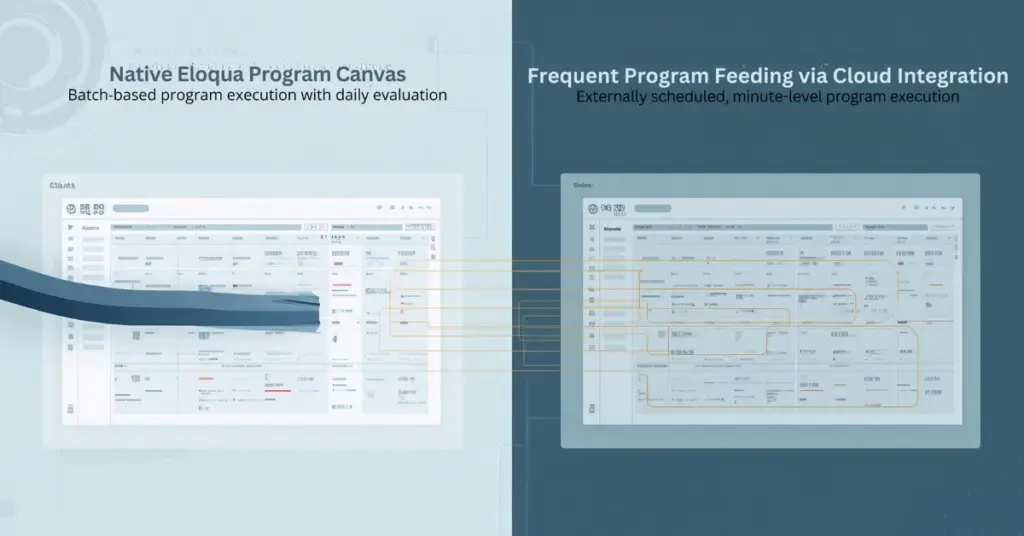
Cloud-based feeder applications integrate with Eloqua Program Canvas as custom data sources, enabling marketers to feed contacts and custom object records to programs on flexible schedules. Unlike native segment feeders that run once daily, cloud feeders can execute every few minutes, providing near-real-time program feeding without the limitations of listener steps.
The Contact Cloud Feeder and Custom Object Cloud Feeder from 4Thought Marketing address this gap by offering:
- Advanced filtering with segments or shared filters: Use the full power of Eloqua’s filtering logic, including complex criteria based on contact fields, custom object data, and activity history
- Customizable execution frequency: Schedule program feeds to run every 5, 10, or 15 minutes instead of waiting 24 hours
- On-demand triggering: Push contacts or custom object records into programs immediately when needed
- No listener limitations: Bypass the restricted data sources available to native listener steps
Comparison: Native vs. Cloud Feeder Capabilities
| Feature | Native Segment Feeder | Native Listener Step | Cloud Feeder |
|---|---|---|---|
| Execution Frequency | Once per 24 hours | Real-time (specific triggers) | Every few minutes (customizable) |
| Filter Flexibility | Full segment/filter logic | Limited to lead score, contact creation, field tracking (max 3 fields) | Full segment/filter logic |
| Custom Object Support | Limited to daily feeds | Not supported | Full support with flexible scheduling |
| Use Case Fit | Batch processing, periodic updates | Specific real-time triggers | Time-sensitive workflows requiring custom filtering |
Cloud feeders combine the filtering power of segments with the responsiveness teams need for modern marketing automation workflows.
How to Set Up Frequent Program Feeding with Cloud Apps
Configuring a cloud feeder to feed Eloqua programs follows a straightforward process within Program Canvas:
Step 1: Configure Your Filter Criteria Determine which contacts or custom object records should enter the program. Cloud feeders accept either an Eloqua segment or a shared filter as the source. If you need to feed contacts when their lead stage changes to “MQL,” create a segment that includes contacts where Lead Stage equals “MQL” and Date Modified is within the last hour. This ensures only recently updated records enter the program.
Step 2: Set Execution Frequency Instead of accepting the default 24-hour cycle, specify how often the cloud feeder should evaluate your filter criteria. For time-sensitive workflows, configure the feeder to run every 5 or 10 minutes. The execution frequency field supports minute-based intervals, enabling near-real-time program feeding without manual intervention.
Step 3: Connect to Your Program Canvas Add the cloud feeder as a data source in your contact or custom object program. The feeder appears in the Program Canvas alongside native segments and listeners. Once connected, activate the program. The cloud feeder begins evaluating your filter criteria according to the schedule you defined, automatically feeding matching records into subsequent program steps.
Step 4: Monitor and Optimize After activation, monitor program member counts and processing times. If records aren’t entering as expected, verify your filter criteria and execution frequency settings. Adjust the schedule based on volume—high-volume workflows may benefit from slightly longer intervals to balance throughput with system performance.
What Are the Benefits of Feeding Programs Every Few Minutes?
Frequent program feeding delivers measurable improvements across multiple dimensions of marketing operations performance:
Faster Response to Buyer Signals When a contact downloads a high-value asset or requests a demo, immediate program entry enables instant lead routing and sales notification. Instead of waiting hours for the next segment refresh, your team responds while the buyer’s interest peaks. This reduces time-to-contact from 24 hours to minutes.
Improved Lead Routing Speed Speed-to-lead directly impacts conversion rates. Studies consistently show that contacting leads within five minutes of their inquiry produces significantly higher connect and conversion rates than waiting an hour or longer. Frequent program feeding ensures qualified leads reach sales queues immediately after crossing qualification thresholds.
Enhanced Program Personalization Real-time custom object processing enables dynamic content personalization based on the latest account data. When a custom object record updates with new product interest information, feeding that record into a program within minutes allows you to trigger personalized follow-up campaigns while context remains fresh.
Real-Time Custom Object Processing For organizations leveraging custom objects to track complex account relationships or product configurations, frequent feeding transforms custom object programs from batch processors into responsive automation engines. Demo requests, renewal triggers, and support escalations can all flow through programs as they occur rather than accumulating for daily processing.
How to Choose Between Contact and Custom Object Cloud Feeders
Selecting the appropriate cloud feeder depends on your automation workflow and data model:
Use Contact Cloud Feeder When:
- Your program processes individual contacts through nurture streams, lead routing, or data enrichment
- Filter criteria focus on contact fields, lead scores, or email activity
- You need to trigger programs based on lead stage changes, form submissions, or campaign responses
- The program updates contact records or adds contacts to campaigns and shared lists
Use Custom Object Cloud Feeder When:
- Your program processes custom object records representing opportunities, product interests, or account relationships
- Filter criteria evaluate custom object fields or linked contact data
- You need to trigger workflows when custom object records are created or updated
- The program performs actions on custom object data, such as updating fields or deleting records
Can You Use Both Together?
Yes. Many sophisticated automation workflows combine both feeder types. For example, a custom object program might process product interest records and use the “Add Linked Contact to Program” action to push the associated contact into a separate contact program. This enables you to process custom object logic at high frequency while maintaining clean separation between object-level and contact-level automation.
When architecting multi-stage workflows, consider which data entity (contact or custom object) serves as the primary trigger, then design your program canvas and feeder configuration accordingly.
Conclusion
Native Eloqua program feeders limit automation responsiveness by restricting segment evaluation to once-daily cycles, while listener steps provide real-time triggers for only a narrow set of use cases. Cloud feeders eliminate these constraints, enabling marketing operations teams to feed Eloqua programs multiple times per day with full access to segment and shared filter criteria. This flexibility transforms program canvas from a batch processing tool into a dynamic automation engine capable of responding to pipeline events within minutes.
Whether routing MQLs immediately after qualification or processing custom object updates in near-real-time, frequent program feeding accelerates marketing operations and improves buyer experience. Explore how Contact Cloud Feeder and Custom Object Cloud Feeder can reduce your response times and enhance workflow precision.
Frequently Asked Questions (FAQs)
u003cstrongu003eCan you feed Eloqua programs more than once per day?u003c/strongu003e
Yes, cloud feeders enable program feeds to run every few minutes instead of the native 24-hour cycle, providing near-real-time automation.
u003cstrongu003eHow often can cloud feeders run?u003c/strongu003e
Cloud feeders support execution frequencies as short as every 5 minutes, allowing you to balance responsiveness with system performance based on your workflow requirements.
u003cstrongu003eWhat filtering options are available with cloud feeders?u003c/strongu003e
Cloud feeders accept any Eloqua segment or shared filter, providing full access to contact fields, custom object data, activity history, and complex Boolean logic.
u003cstrongu003eDo frequent program feeds impact Eloqua performance?u003c/strongu003e
When configured appropriately, frequent feeds have minimal performance impact. Start with 10-15 minute intervals and adjust based on contact volume and program complexity.
u003cstrongu003eCan I schedule feeds to run every 5 minutes?u003c/strongu003e
Yes, cloud feeders support minute-based scheduling, enabling you to configure execution frequencies as short as every 5 minutes for time-critical workflows.
u003cstrongu003eIs this compatible with all Eloqua program types?u003c/strongu003e
Cloud feeders integrate with both contact programs and custom object programs in Eloqua Program Canvas, supporting the full range of program automation capabilities.