Key Takeaways
- A data privacy program needs policy and provable evidence.
- Name an owner and set scope before you map anything.
- Map every form, pixel, chatbot, and email platform.
- Run a DPIA where processing is likely high risk.
- Record consent and rights requests and keep dated evidence.
- Privacy decides what you collect; security protects it.
Table of Contents

Your data privacy program is only as strong as the proof behind it. Anyone can write a policy, but far fewer marketing teams can show what they collect, why they collect it, and who approved it. If a regulator, a customer, or your own legal team asked tomorrow, could you show your work?
This guide shows you how to build a data privacy program for marketing in five steps, from scope to evidence. It is written for marketing ops practitioners who run forms, pixels, chatbots, and email platforms every day. This post is for educational purposes only and does not constitute legal advice.
What a Data Privacy Program Means for Marketing
A data privacy program is the set of owners, rules, and records that control how your team collects and uses personal data. Policy says what you intend to do. Proof shows what you actually did.
Privacy program management is the ongoing work of keeping the two matched: you set rules, check that campaigns follow them, and fix the gaps. A privacy program framework gives that work a shape, so everyone knows the steps and who owns each one. Without it, privacy lives in one person’s head and leaves when they do.
Step 1: Set Scope and Ownership for Your Data Privacy Program
Start by deciding what the program covers and who answers for it. List the regions you market to, the brands involved, and the systems that hold personal data. Then name one accountable owner, plus a backup, across marketing ops, legal, IT, and security.
Keep this to one dated, approved page, and write down which decisions each owner can make so nothing waits on a meeting. If you are wondering how to build a privacy program from nothing, our guide to Establishing a Baseline Privacy Program covers what to put in place first.
Why it matters: when a request or incident lands, a named owner answers in hours, and your records show who decided what.
Step 2: Map Your Marketing Data
You cannot protect or explain data you have not found. Walk through every place your team collects personal data and write down what it collects, why, where it goes, and who can see it.
- Web forms: the fields you collect, the stated purpose, and where submissions land.
- Ad pixels: which vendors receive visitor data, and what triggers them.
- Chatbots: what visitors type, where transcripts are stored, and who can read them.
- Email platform: your lists, your segments, and the source of each contact’s consent.
Our guide to Chatbot Privacy Compliance covers the chatbot questions, and The Essential Privacy Compliance Checklist for Marketing Teams helps you check the rest of your stack. Keep the output as a simple table. It becomes the backbone of your data privacy program, and you will reuse it in every later step.
Step 3: Assess the Risks
With the map in hand, decide which activities need a closer look. Under UK GDPR, ICO guidance says a data protection impact assessment (DPIA) is required where processing is likely to result in a high risk to people. ICO marks this guidance as under review. Article 35(3) of the GDPR lists three cases where one is required, according to UK regulator guidance from the ICO:
- Systematic and extensive automated profiling with significant effects on people.
- Large-scale use of special-category or criminal offence data.
- Large-scale systematic monitoring of a publicly accessible area.
Check your ad targeting, profiling, and chatbots against that list. Our overview of 5 Types of Data Privacy Assessments explains five common assessment types and when each is used. Record every decision, including a decision not to run a DPIA, and the reason for it. Do this before you launch a new tool or campaign type, not after.
Step 4: Put Consent and Records in Place
Now make your choices enforceable. If the CCPA applies to your business, it gives California residents the right to know what you collect, to delete it, to opt out of the sale or sharing of their information (including through Global Privacy Control), and to non-discrimination for using those rights, among others.
You also need a notice at collection that lists the categories of personal information and the purposes, and a link to your privacy policy. If you sell or share personal information, add a clear “Do Not Sell or Share My Personal Information” link.
Records are where policy stops being a promise. Rights only work if you can honor them and show you did. 4Comply captures and honors consent and processes data rights requests, and works with Eloqua and Marketo. For the wider case, read Why a Consent Management Platform Is Now a Marketing Must-Have.
Where Privacy Ends and Security Begins
Teams blur the two, and the blur creates gaps. Three points keep them apart.
- Different jobs: privacy decides what you may collect and use, and why. Security protects that data from misuse.
- Different owners: you need both, and different people own them.
- One meeting point: a breach is where the two meet. Security failed to protect the data, and your privacy records show what data was involved.
Read How Cybersecurity Intersects with Data Privacy for more, and keep the Data Breach Response Checklist close so your first moves are already written down.
Step 5: Prove Your Data Privacy Program Works
Proof is what separates a program from a document. Keep evidence that someone else could check without asking you:
- Records: your data map, assessments, and consent records, dated and stored in one place.
- Reviews: a scheduled review each year, plus one after any new tool, region, or campaign type.
- Audit trail: a log of who changed what, and when, in consent and request handling.
- Fixes: a list of gaps found and the date each one was closed.
The NIST Privacy Framework is a voluntary tool for managing privacy risk and can serve as a reference point. Put the first review date on the calendar of the owner you named in Step 1. For ways to keep improving over time, read Privacy Program Improvement.
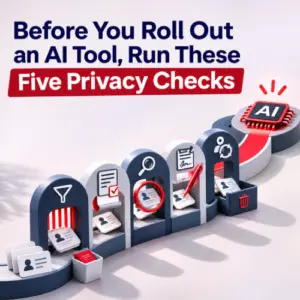
If AI tools touch your marketing data, add them to your map and your reviews. Is Your AI Privacy-Safe? covers the consent and data request questions to ask, and our guide to AI and privacy checks goes deeper on the five checks to run before you roll out an AI tool.
Conclusion
A data privacy program works when your policy and your proof tell the same story. Set scope and ownership, map your data, assess the risks, put consent and records in place, then keep the evidence and review it. Do that, and you can answer a regulator, a customer, or your own leadership with records instead of promises. To put consent and rights requests on firmer footing, contact 4Thought Marketing and ask about 4Comply.
About 4Thought Marketing
We're a B2B marketing automation and AI consultancy with a thing for getting complex tech to actually work. Since 2008, we've helped hundreds of organizations across financial services, technology, manufacturing, and real estate get more from Eloqua, Marketo, and their CRM integrations. We serve our clients across marketing automation strategy, lead lifecycle, AI, compliance, preference management, and more. Explore our services or get in touch.
Frequently Asked Questions
What is a data privacy program for marketing?
It is the set of owners, rules, and records that control how your team collects and uses personal data. It covers forms, tracking, chatbots, and email, and it includes proof that your rules are followed.
Who should own the program?
Name one accountable owner with a backup, often in marketing ops or legal. Security and IT own the protection side, so agree where privacy ends and security begins.
When do you need a DPIA?
Under UK GDPR, ICO guidance says a DPIA is required where processing is likely to result in a high risk to people. Article 35(3) of the GDPR lists three cases: automated profiling with significant effects, large-scale special-category or criminal offence data, and large-scale monitoring of a publicly accessible area.
What does a CCPA notice at collection include?
It lists the categories of personal information you collect and the purposes, and it links to your privacy policy.
What is the difference between privacy and security?
Privacy decides what you may collect and use, and why. Security protects that data from misuse. You need both.
What belongs on a privacy program checklist?
Start with a dated data map, assessments, consent records, review notes, and a list of fixes. A data privacy program is real when you can produce each item on request.