

Key Takeaways
- Marketing asset naming conventions provide quick asset discovery across platforms.
- Structured naming enables accurate sorting for strategic reporting.
- Consistent protocols trigger automation for common use cases.
- Visual age indicators in names simplify archiving decisions.
- Standardized frameworks prevent chaos as teams scale operations.
It’s 4 PM on a Friday, and you need to pull reporting on last quarter’s webinar campaigns. You open your marketing automation platform, search for the program, and find seventeen variations: “Webinar_Q3,” “Q3-Webinar-Final,” “2024_Webinar_Series,” and “WEBINAR Q3 (Updated).” Thirty minutes later, you’re still hunting. This scenario plays out daily in marketing operations teams that lack standardized marketing asset naming conventions. What seems like a minor administrative detail becomes a compounding drag on efficiency, reporting accuracy, and team productivity. The solution isn’t complex, but it requires intentional design and consistent enforcement across your entire marketing systems.
Why Do Marketing Asset Naming Conventions Matter?
Marketing asset naming conventions serve as the foundational infrastructure for operational efficiency. Without them, teams face four critical challenges that compound over time.
Quick Reference and Asset Discovery
When every team member names assets according to personal preference, finding what you need becomes archaeological work. A standardized convention acts as a universal language, reducing search time from minutes to seconds.
Impact of Poor Naming:
- Adds unwanted extra time
- Duplicate assets created because existing ones can’t be found
- Delayed campaign launches waiting for asset location
- Frustrated team members and decreased productivity
Reporting and Data Organization
Marketing operations leaders need clean data to demonstrate ROI and optimize strategy. Inconsistent naming breaks reporting logic and forces manual data manipulation.
Common Reporting Challenges:
- Cannot aggregate performance by campaign type
- Manual filtering required for date-range analysis
- Inconsistent regional or business unit grouping
- Executive dashboards showing incomplete data
Well-designed marketing asset naming conventions enable automatic grouping by campaign type, business unit, date range, or channel, making strategic reporting straightforward rather than painful.
Automation Triggers and Smart Lists
Platforms like Marketo allow you to build smart campaigns triggered by naming patterns. These automation shortcuts only work when naming follows a predictable structure.
Automation Use Cases:
- Webinar programs automatically adding registrants to nurture streams
- Contact request forms triggering immediate sales notifications
- Regional campaigns routing to appropriate sales territories
- Content type tags enabling dynamic personalization
Visual Age Indicators for Archiving
Including date stamps in asset names creates instant visual context. When you see “2021_ProductLaunch_Email,” you immediately know it’s three years old and likely due for archiving.
Archiving Benefits:
- Instant visual scanning without opening assets
- Quick identification of outdated content during audits
- Streamlined instance maintenance across platforms
- Reduced storage costs and improved system performance
What Makes a Great Naming Convention?
Effective marketing asset naming conventions share four core characteristics that balance human readability with system logic.
| Characteristic | What It Means | Why It Matters |
| Consistency | Same logic across all asset types | Easier adoption and universal understanding |
| Hierarchy | Information flows broad to specific | Mirrors natural search and filter behavior |
| Scalability | Accommodates future growth | Prevents painful system migrations later |
| Readability | Balances human and machine needs | Works in dashboards and conversations |
Consistency Across Asset Types
Your convention should apply universally, whether you’re naming programs, emails, landing pages, or workflows. The underlying logic should remain constant even if formats vary slightly by platform.
Consistency Checklist:
- Date formats match across all platforms
- Separator conventions (underscores, hyphens) are uniform
- Asset type abbreviations follow a master list
- Regional or business unit codes standardized
Logical Hierarchy and Order
Information should flow from broad to specific: date, campaign type, specific descriptor, and version.
Example Structure:
2024_Webinar_DataPrivacy_V2
This tells you:
- When: 2024
- What type: Webinar
- Topic: Data Privacy
- Version: Second iteration
Scalability for Growth
Build in fields you might need later—business unit, region, product category—even if you don’t populate them immediately.
Future-Proofing Elements:
- Business unit codes (even for single-unit companies)
- Regional identifiers (before international expansion)
- Product line categories (before diversification)
- Channel indicators (as Martech stack grows)
Human Readability Without Sacrificing Machine Logic
Strike a balance that works in both reporting dashboards and human conversation.
| Too Cryptic | Too Verbose | Just Right |
| 24Q3WbDG | 2024_Third_Quarter_Webinar_Series_About_Data_Governance_Best_Practices | 2024_Q3_Webinar_DataGovernance |
How Do Platform-Specific Naming Conventions Work?
While universal principles apply everywhere, each platform has unique quirks that influence naming strategy.
Marketo Program and Marketing Asset Naming Conventions
Marketo’s program structure benefits from prefixes that indicate program type and channel.
Marketo Naming Formula:
[Type]_[Year]_[Quarter]_[Campaign]_[Descriptor]
Examples:
- EM_2024_Q4_Newsletter_October
- WB_2024_Q3_Webinar_DataPrivacy
- NR_2024_Lead_Nurture_Trial_Users
Key Considerations:
- Assets within programs need full context (appear in global searches)
- Form names drive automation trigger logic
- Nested folders allow slightly more concise program-level names
- Smart campaign triggers rely on consistent naming patterns
HubSpot Workflow and Content Naming
HubSpot’s interface displays asset names prominently, making readability especially important for team collaboration.
HubSpot Best Practices:
- Workflows: Use descriptive internal names (2024_Workflow_Lead_Scoring_Enterprise)
- Landing pages: Balance SEO and internal organization (2024_LP_Product_Demo_Request)
- Blog posts: SEO-optimized titles (auto-generate URLs)
- Lists: Include purpose and update frequency (Active_Customers_Updated_Daily)
Critical Elements:
- Multiple marketers often manage overlapping workflows
- URLs auto-generate from content titles
- Internal vs. public-facing naming requirements differ
Salesforce Campaign Naming
Salesforce campaigns appear in reports viewed by sales and executive teams, requiring immediate clarity for non-marketers.
Salesforce Naming Formula:
[Year]_[Quarter]_[Channel]_[Campaign_Name]
Examples:
- 2024_Q3_Webinar_Data_Governance_Series
- 2024_Q4_Trade_Show_DreamForce
- 2024_Event_User_Conference_Boston
Sales Leadership Perspective:
- Names must be self-explanatory without marketing translation
- Standard fields (Campaign Type, Status) handle some categorization
- Attribution tracking requires consistency with external platforms
- Executive dashboards display campaign names directly
How Do You Audit and Fix Your Naming Conventions?
Implementing standardized marketing asset naming conventions requires a methodical approach, especially if you’re correcting years of inconsistency.
Step 1: Assess Your Current State
Begin with a comprehensive audit across all platforms.
Audit Checklist:
- Export asset lists from each platform (programs, campaigns, workflows, forms, emails)
- Review 50-100 examples per platform
- Document naming patterns by team member or department
- Identify assets impossible to categorize without opening
- Flag naming that breaks reporting filters
- List orphaned assets with no clear owner
Red Flags to Watch For:
- Same campaign named differently across platforms
- Date formats varying (2024-01, Jan-2024, 012024, 2024_January)
- Inconsistent separators (underscores, hyphens, spaces, camelCase)
- No version control indicators
- Missing or inconsistent asset type identifiers
Step 2: Define Your New Standard
Create a comprehensive written guide that becomes your team’s single source of truth.
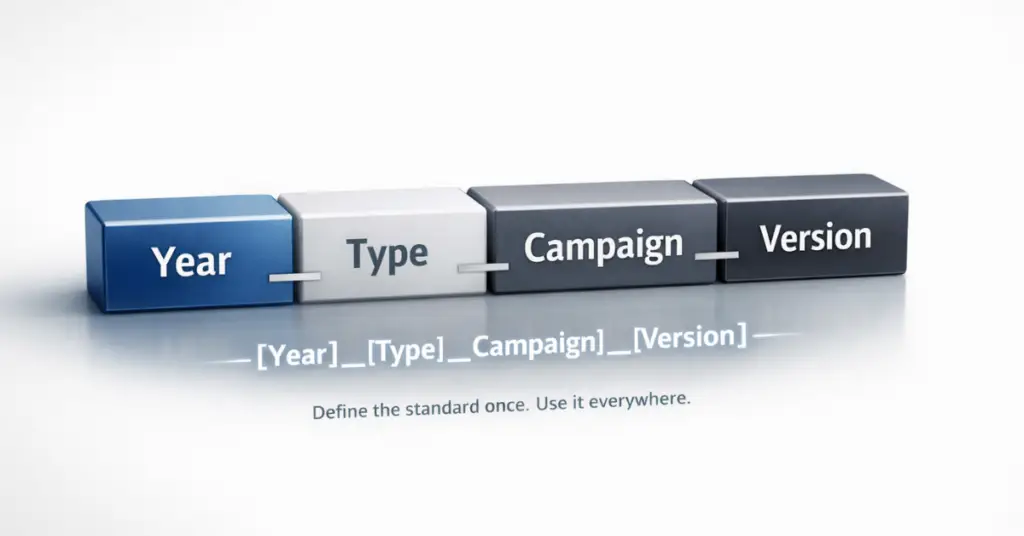
Documentation Requirements:
| Element | Details | Example |
| Naming Formula | Exact structure with fields | [Year]_[Type]_[Campaign]_[Version] |
| Required Fields | Must-have components | Year, Asset Type, Campaign Name |
| Optional Fields | Context-dependent additions | Region, Business Unit, Channel |
| Separators | Consistent delimiters | Underscores only |
| Date Format | Standardized approach | YYYY or YYYY_QX or YYYY_MM |
| Abbreviations | Approved shorthand list | EM=Email, WB=Webinar, NR=Nurture |
| Examples | 10-15 across asset types | Cover all common scenarios |
Step 3: Prioritize and Rename Strategically
Don’t attempt to rename everything at once. Use a phased approach that delivers quick wins.
Prioritization Framework:
Phase 1 (Week 1-2): Active Campaigns
- Anything launching in the next 60 days
- Currently running programs
- High-visibility executive reporting items
Phase 2 (Week 3-4): Recent Assets
- Created in the last 6 months
- Frequently referenced templates
- Core automation workflows
Phase 3 (Month 2-3): Strategic Archive
- Rename only what you’ll reuse
- Archive outdated content
- Delete duplicates and unused assets
Phase 4 (Ongoing): Maintenance
- All new assets follow the convention
- Weekly audits of recent additions
- Quarterly reviews for edge cases
Step 4: Document and Train
Make compliance easy by embedding the convention into daily workflows.
Training Components:
- Add naming guide to marketing operations documentation
- Include in onboarding materials for new hires
- Create platform-specific templates with pre-filled naming
- Build quick-reference posters or Slack bots
- Record video walkthroughs for each platform
Template Examples:
- Marketo program templates with naming structure
- HubSpot workflow naming generator
- Salesforce campaign naming form
- Email template naming checklist
Step 5: Enforce and Iterate
Assign ownership and build accountability into your processes.
Enforcement Mechanisms:
- Designate a naming convention owner
- Weekly audits of new assets (15-minute review)
- Platform permission settings requiring approval
- Naming validation in approval workflows
- Quarterly team refreshers
Iteration Schedule:
- Month 1-3: Weekly reviews and adjustments
- Month 4-6: Bi-weekly reviews
- Month 7-12: Monthly reviews
- Year 2+: Quarterly reviews (unless major org changes)
Step 6: Leverage Automation
Where possible, remove human error by automating convention enforcement.
Automation Opportunities:
- Platform naming templates with locked fields
- Validation rules that prevent saving incorrect formats
- Slack/Teams bots that generate compliant names
- Form submissions that auto-create properly named assets
- Scripts that flag non-compliant assets for review
Conclusion
Marketing asset naming conventions transform from administrative burden to competitive advantage when implemented thoughtfully. Teams that invest in standardized naming systems reclaim hours spent searching for assets, produce more accurate reporting with less manual effort, and build automation that scales as their operations grow. The upfront work of designing a convention and migrating existing assets pays dividends in efficiency, clarity, and operational maturity. If your current naming landscape feels overwhelming, or if you’re building a convention framework from scratch, 4Thought Marketing specializes in marketing operations optimization that creates sustainable systems for growing teams.
Frequently Asked Questions (FAQs)
u003cstrongu003eWhat is the best format for marketing asset naming conventions?u003c/strongu003e
The best format depends on your specific needs, but most effective conventions follow a hierarchical structure: date or year first, followed by asset type, campaign name, and version number, separated by consistent delimiters like underscores or hyphens.
u003cstrongu003eHow do naming conventions improve marketing reporting?u003c/strongu003e
Standardized names allow you to filter and group assets automatically in reports. When all webinar programs start with u0022Webinar_,u0022 you can pull aggregate performance data instantly rather than manually selecting each program variant.
u003cstrongu003eShould I rename all existing marketing assets?u003c/strongu003e
No. Focus on active and recently created assets first. Rename older assets only if you’ll actively use them in upcoming campaigns. Archive or delete outdated content rather than spending time renaming items you’ll never touch again.
u003cstrongu003eWhat happens if team members don’t follow the naming convention?u003c/strongu003e
Inconsistent adoption undermines the entire system. Designate a naming convention owner to audit new assets weekly, implement approval workflows where possible, and include convention training in onboarding for new team members to ensure consistent enforcement.
u003cstrongu003eCan naming conventions work across multiple marketing platforms?u003c/strongu003e
Yes. While each platform has specific considerations, your underlying logic should remain consistent. Use the same date formats, separator conventions, and hierarchical structure everywhere, adapting only for platform-specific constraints like character limits or special requirements.
u003cstrongu003eHow often should I update my naming convention framework?u003c/strongu003e
Review your convention quarterly during the first year of implementation to catch edge cases and refine based on real usage. After the system stabilizes, annual reviews are typically sufficient unless you experience major organizational changes like mergers or new product launches.