






Key Takeaways
- Custom objects support flexible data models for complex marketing operations.
- Native features now allow cleaner governance and more efficient management.
- Advanced data manipulation requires thoughtful structure and automation.
- Program Canvas and the REST API expand transformation capabilities.
- A scalable custom object architecture strengthens long-term data quality.
Oracle Eloqua custom objects offer a flexible data layer that enables marketers to store structured information that does not fit within standard contact fields. They support detailed behavioral history, recurring events, and multistep journeys that require reliable tracking. As more campaigns rely on personalization, these structures become essential to Eloqua data management and long-term program accuracy.
As the number of custom objects grows, their behavior, automation paths, and update rules require thoughtful planning to ensure stability. Without a clear strategy, teams’ risk inaccurate segments, broken journeys, and inconsistent records. This blog explains how to utilize modern Eloqua custom objects best practices to manage data at scale, approaches advanced custom objects data manipulation, and outlines the design of an Eloqua data architecture that supports both daily operations and future growth.
What is Custom Objects and Why Do They Matter?
Oracle Eloqua custom objects are multi-record tables linked to a contact or account, used when a single person or company can have many related interactions. They matter because most marketing data changes frequently and needs historical tracking that standard contact fields cannot support.
These structures enable teams to manage renewals, subscriptions, transactions, and product usage within a single relational layer. When used thoughtfully, custom objects enhance segmentation accuracy, support personalized journeys, and provide Program Canvas automation with a deeper foundation to work with. For example, a subscription-based business may track every renewal date inside a custom object rather than storing only the most recent version. This supports more accurate reminders, personalized upsell workflows, and long-term customer lifecycle automation.
Custom objects become even more valuable when organizations manage multiple product lines or maintain ongoing customer interactions. Each row tells a story about a behavior, purchase, or action, which helps marketers understand trends that individual fields cannot capture. This is why strong custom object governance in Eloqua is crucial for both operational reliability and strategic decision-making.
What Can Eloqua do with Custom Objects and Where Are the Limits?
Standard Eloqua features include storing records, updating fields, routing data through Program Canvas, and triggering Eloqua marketing automation workflows. These functions support most basic use cases but fall short when teams require multirow calculations or conditional transformations.
Native features cannot compare multiple records, calculate new values, or perform structured Eloqua CO transformation across large datasets. If a renewal date needs to be advanced, if multiple usage rows must be aggregated, or if conditional logic depends on historical interactions, standard tools cannot execute these steps alone. As a result, advanced operations rely on a combination of Program Canvas automation and Eloqua REST API updates to fill these gaps.
A related limitation appears when cleaning Eloqua custom object data. Basic updates can correct small inconsistencies, but they do not support the systematic cleanup that high volume environments require. Data imported from multiple systems may contain inconsistent formats, spacing errors, or missing link fields. These issues can block segmentation or cause workflows to misroute contacts. For these reasons, advanced manipulation becomes a structured practice rather than an occasional task.
What Data Manipulation Needs Do Marketing Teams Commonly Encounter?
Most manipulation needs come from recurring business processes that depend on accurate, timely custom object data. As personalization increases, Eloqua custom objects data manipulation becomes central to keeping campaigns consistent and meaningful.
Many organizations track ongoing events such as renewals, product usage milestones, support interactions, or purchase cycles. Each of these events becomes a row within the custom object. When rules change or lifecycle programs expand, hundreds or thousands of rows may need recalculations. Program Canvas can detect new activity but cannot fully execute transformations, which is where external logic becomes necessary.
Another common scenario involves synchronizing multiple objects. A contact may have usage data in one object and entitlement data in another. If one changes, the other must remain aligned to prevent errors during segmentation. Integrations also introduce challenges. When two systems send data into Eloqua, formatting inconsistencies appear. Cleaning Eloqua CO data becomes essential before the information can enter active campaigns.
These patterns highlight the practical need for advanced manipulation techniques and a predictable data management process inside Eloqua.
How Can Advanced Custom Object Manipulation Be Achieved Effectively?
Advanced manipulation is best supported by combining Program Canvas automation with REST API powered logic. Program Canvas manages routing, identifies new activity, and triggers specific processes. The Eloqua REST API updates record in batches, performs calculations, and supports deeper transformations that Program Canvas cannot execute alone.
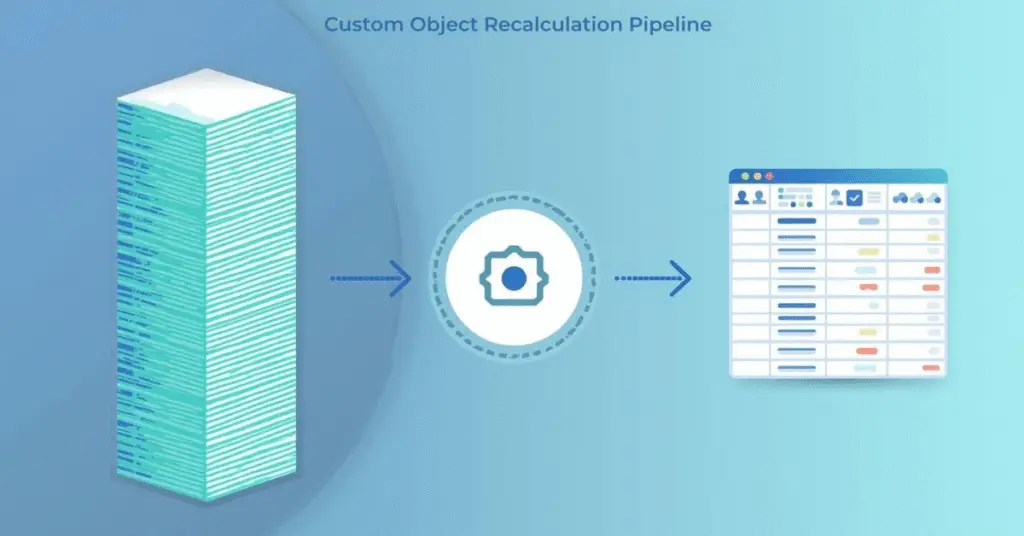
In practice, Program Canvas identifies new rows in a custom object, checks relevant conditions, and routes them into the appropriate Eloqua marketing automation workflows. The API then performs tasks such as multirow comparisons, recalculations, synchronized updates, or large-scale cleanup. This approach divides responsibilities clearly. Program Canvas handles orchestration, while the API performs heavy lifting.
Some teams opt to utilize cloud apps to streamline these operations. Cloud apps can streamline conditional logic, validate incoming data, or automate structured updates. They eliminate the burden of manual scripting and make processes easier to maintain. This combination of tools creates a reliable environment where Oracle Eloqua custom objects remain accurate even as campaigns evolve.
What Are the Best Practices for Building a Scalable Custom Object Architecture?
A scalable custom object architecture ensures long-term performance, predictable automation, and consistent data quality. The first best practice is to define a clear purpose for each custom object. When multiple unrelated concepts are stored in the same table, workflows become harder to maintain. A single-purpose structure minimizes complexity.
Naming conventions strengthen readability and simplify troubleshooting. When multiple system owners work in Eloqua, clear naming makes relationships obvious and reduces onboarding time for new team members. Link fields should be validated regularly. Without a reliable link between a custom object and its contact or account, programs cannot function correctly.
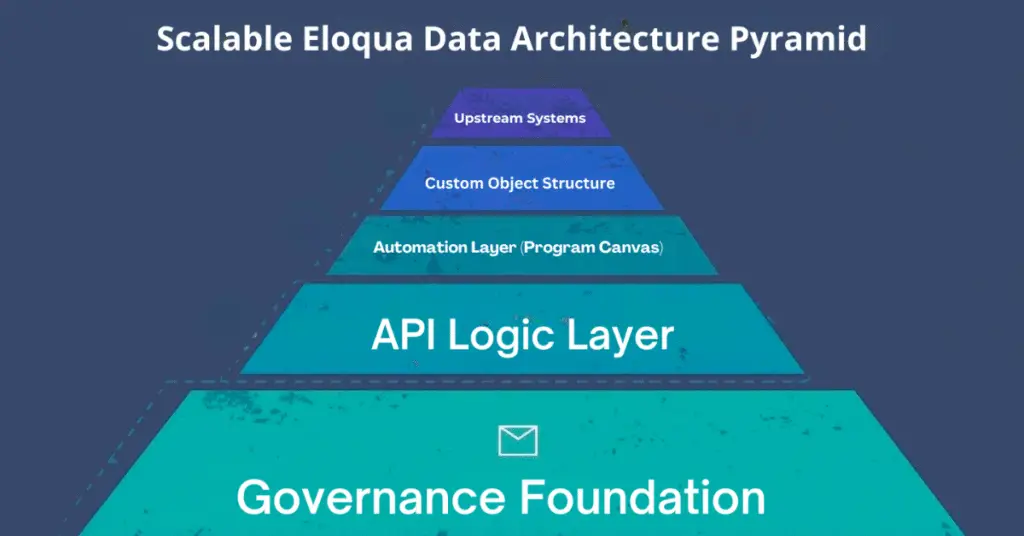
Performance must also be considered. Large updates should be executed through Eloqua REST API updates and broken into batches to avoid failures. Regular cleanup prevents bloated datasets that slow performance. Teams should avoid creating unnecessary objects and instead align new data with the existing architecture. Each object added introduces new relationships, and without a plan, the environment becomes difficult to manage.
Finally, teams should define which tasks belong to Program Canvas automation, which belong to API based transformation, and which belong to upstream systems. This separation creates cleaner workflows and a more predictable Eloqua data architecture overall.
Conclusion
Advanced data management using Oracle Eloqua custom objects helps marketing teams build stronger, more reliable customer experiences. As organizations scale, better structure, cleaner automation patterns, and consistent transformation practices become essential. When data stays accurate and workflows remain stable, campaigns perform more effectively and personalization becomes easier. If your team wants to strengthen its custom object architecture, improve transformation processes, or build more scalable workflows, 4Thought Marketing can help you create a structure that remains strong as your programs grow.
Frequently Asked Questions (FAQs)
1. What are the common limitations of custom objects?
Native features cannot perform multirow calculations or deep conditional logic without using the REST API or cloud apps.
2. Can custom objects be updated automatically?
Yes. Program Canvas automation and the REST API can work together to trigger updates and transformation workflows.
3. How do custom objects link to contacts?
They use a link field that stores the contact’s unique identifier, which must remain accurate for segmentation and automation.
4. Are there limits to how many records can be updated at once?
Yes. Bulk updates require batching through the REST API to ensure stable performance.
5. When should a custom object be used instead of a contact field?
When one contact requires multiple related records, or when data needs to be tracked historically.
6. What types of tasks require advanced manipulation?
Calculations, synchronization tasks, cleanup activities, and multi-row comparisons typically require API support or cloud applications.