



Quick Takeaways
- Answer engine optimization wins citations inside AI generated answers.
- The citation is the new click for B2B buyers.
- Most AI citations come from brand-controlled sources.
- Lead every answer with a direct, quotable sentence.
- Buyers now shortlist vendors inside AI answer engines.
- Track your citation share to prove AEO progress.
Table of Contents
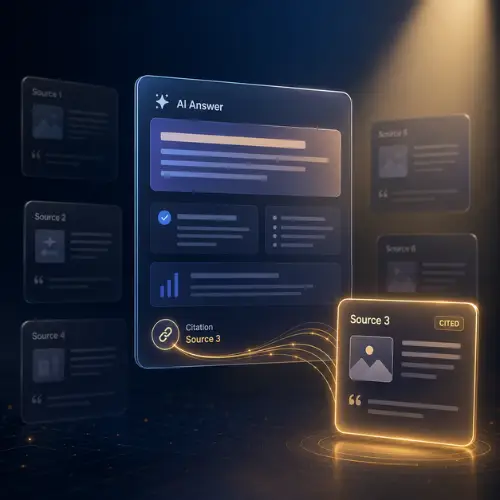
More than half of B2B buyers now begin product research not in a search engine but inside an AI chatbot, typing a question into ChatGPT, Perplexity, or Google’s AI Overviews and reading the answer it assembles for them. For marketing operations teams who spent a decade mastering search rankings, that shift is a quiet earthquake. Answer engine optimization is the discipline of earning a place inside those AI generated answers, and it is quickly becoming a core competency for B2B teams rather than a fringe experiment.
The problem is that the old playbook does not translate cleanly. Ranking first on a results page no longer guarantees that you get cited by AI, because the systems assembling those answers do not simply reward the pages that rank highest. They read, synthesize, summarize, and then attribute a handful of sources. A brand can dominate traditional search and still be nearly invisible in AI search, and that gap is exactly where AI search visibility is now won or lost.
There is also a structural reason this work is landing on marketing operations. Historically, many large B2B organizations kept marketing operations separate from the digital marketing group that owned the website and customer experience, but shrinking teams are blurring that line, and even large enterprises now consolidate both functions under a single leader. Because AEO sits at the intersection of content, web, and operations, it increasingly becomes the marketing operations team’s job, and that convergence between digital marketing, web teams, and marketing operations is why we frame AEO for a MOps audience.
This guide defines answer engine optimization for a marketing operations audience, explains why it matters right now, breaks down how these systems actually decide who to cite, and lays out a practical playbook your team can start this quarter. Along the way it draws on 4Thought Marketing’s own AEO scanning work and first party observations of how citation patterns are shifting for the vendors we watch. None of it requires abandoning the search fundamentals you already know; it asks you to point them at a new destination.
What Answer Engine Optimization Means for B2B Marketing
Answer engine optimization is the practice of structuring and publishing content so AI tools quote your brand as a source when someone asks a question in your category. Where traditional SEO competes for a ranked link, answer engine optimization competes for a citation inside the generated answer itself.
AEO, GEO, and SEO Are Not the Same Thing
It helps to separate three terms that often get blurred. Traditional SEO optimizes for ranked links on a results page. Generative engine optimization is the broader effort to influence how generative models represent your brand across their outputs. Answer engine optimization is the sharpest edge of that work: earning the citation at the exact moment a buyer asks a specific question. For most marketing operations teams, AEO for B2B marketing is the version that maps most directly to pipeline, because it targets high intent questions rather than general awareness. We break the contrast between the two disciplines down further in AEO vs. SEO: what changes for MOPs landing page content.
Why the Citation Is the New Click
In an AI answer, there is often no page of blue links to scroll. There is a synthesized paragraph and, if you are fortunate, a short list of cited sources. Being named in that answer is therefore not a vanity metric. The citation is the new click, because it is the only real estate left where your brand name reaches the buyer. When 4Thought Marketing runs its scanner across a category, the pattern is consistent: a small set of vendors earn most of the citation share, and everyone else is functionally absent from the answer entirely.
Why AEO Matters Now for Marketing Operations Teams
Answer engine optimization matters now because buyer behavior has already moved, and the vendors who adapt first are compounding an advantage that is hard to reverse. Waiting for the technology to mature is a decision to cede AI search visibility to whoever shows up early.
Buyers Are Starting in AI Answer Engines
Marketing operations professionals who run Eloqua and Marketo are themselves part of this shift. When they evaluate a new integration, a data enrichment tool, or a consent platform, many now open a chatbot first and ask it to compare options. AI answer engines return a shortlist, and vendors that were never cited never make the consideration set. That is a top of funnel problem with very concrete pipeline consequences.
First Mover Advantage Is Real
The competitive picture reinforces the urgency. Some analyst and agency players are already moving aggressively on the AEO keyword and positioning, while most B2B vendors have not started. 4Thought Marketing built its own scanning tooling precisely because we could see this gap opening, and our first party read is qualitative but clear: categories consolidate around early citations, and answer engine optimization rewards the brands that publish structured, quotable answers before their competitors do. The vendors most exposed are the ones with strong traditional rankings and thin, unstructured content, because a good position on a results page does nothing to earn a mention in a synthesized answer.
How AI Answer Engines Decide Which Vendors to Cite
The systems behind AI answers cite sources that are structured to be quoted, demonstrably authoritative, and consistent across the wider web. Understanding those three signals is the foundation of any serious answer engine optimization program, and it is where research from independent sources becomes useful. For a deeper look at the selection logic itself, see our companion article on how AI answer engines decide which sources to cite.
Brand Controlled Sources Carry Surprising Weight
The most encouraging finding for marketers is how much of this is within your control. Yext analyzed 6.8 million citations across ChatGPT, Gemini, and Perplexity and found that 86% of AI citations come from brand managed sources, with first party websites alone accounting for 44%. In plain terms, the pages you own and publish are the single largest lever on whether you get cited by AI. That reframes answer engine optimization from a mysterious algorithm chase into a content and structure problem you can actually work on.
Structure, Clarity, and Extractability
Answer systems favor content they can lift cleanly. That means direct answers stated in the first sentence of a section, clear definitions of key terms, question style headings, and self contained sentences that make sense pulled out of context. Google’s own AI optimization guidance reinforces the same fundamentals: publish helpful, people first content with clear structure and sound technical hygiene. Content built this way improves both AI search visibility and traditional rankings at once.
Authority and Corroboration Across the Web
The third signal is corroboration. Research into how models choose sources consistently shows that they trust claims echoed across multiple credible places, not just asserted once on a single page. Mentions in respected publications, consistent descriptions of your brand across directories and profiles, and citations by other sites all raise the odds that the models treat you as a reliable source worth quoting.
A Practical AEO Playbook for MOps Teams
A practical answer engine optimization program has four moving parts: pick the questions, structure the answers, build corroboration, and measure citations. None of these require a new platform, and all of them fit inside the content operations a marketing team already runs.
Step One: Map the Questions Buyers Actually Ask
Start by listing the real questions your buyers type into AI tools, not the keywords you wish they searched. For a MOps audience that means questions like how to sync Marketo with Salesforce cleanly, or how to manage consent across regions in Eloqua. Group those questions by buying stage, and prioritize the ones a prospect asks while actively shortlisting vendors, since those are the moments a citation converts into a real opportunity. AEO for B2B marketing lives or dies on choosing questions with genuine buying intent behind them.
Step Two: Publish Answer First, Quotable Content
For each question, publish a page that answers it completely and leads with the answer. State the direct response in the first one or two sentences, define the key term early, use headings phrased as questions, and keep sentences self-contained so a model can quote one without the surrounding paragraph. This single discipline does more for AEO than any technical trick, and it is how you earn citations reliably rather than occasionally. Our companion guide to the five components of an AI-citable answer breaks down how to build a passage like that. It is also the through line in our companion guide on LLM optimized content for B2B websites, which goes deeper on the content mechanics.
Step Three: Build Corroboration Beyond Your Own Site
Because brand-controlled sources carry most of the weight, keep your owned pages accurate and consistent, then extend the signal outward. Ensure your descriptions match across your site, your profiles, and third-party directories, and earn mentions in credible industry publications. Consistent, corroborated information strengthens your presence in AI results and makes answer engine optimization compound in your favor over time.
Step Four: Measure Whether You Actually Get Cited
Finally, treat AI citation as a metric you track, not a hope. Periodically ask the major answer engines your priority questions and record whether your brand appears and how it is described. This is the exact loop 4Thought Marketing automates with its scanner, and even a manual version done monthly will tell you whether your answer engine optimization work is moving the needle in the right direction.
Conclusion
Buyer research has moved into AI answer engines, and the brands that structure quotable, corroborated answers today are the ones the models will cite tomorrow. Answer engine optimization is not a rebrand of SEO; it is a distinct discipline focused on winning the citation rather than the click, and it rewards marketing operations teams who act while their category is still unsettled. Start by mapping the questions your buyers ask, publish answer first content that is easy to quote, and measure your AI citation share over time. If you want a partner to build answer engine optimization into your content and operations, contact 4Thought Marketing and we can help you turn early citations into pipeline.
About 4Thought Marketing
We're a B2B marketing automation and AI consultancy with a thing for getting complex tech to actually work. Since 2008, we've helped hundreds of organizations across financial services, technology, manufacturing, and real estate get more from Eloqua, Marketo, and their CRM integrations. We serve our clients across marketing automation strategy, lead lifecycle, AI, compliance, preference management, and more. Explore our services or get in touch.
Frequently Asked Questions
What is answer engine optimization?
Answer engine optimization is the practice of structuring and publishing content so AI answers cite your brand as a source when someone asks a question in your category. It targets the citation inside a generated answer rather than a ranked link on a results page.
How is answer engine optimization different from SEO?
SEO competes for a ranked link on a search results page, while answer engine optimization competes for a citation inside a generated answer. The two share fundamentals like clear structure and authority, but AEO optimizes for being quoted rather than clicked.
Is AEO the same as generative engine optimization?
They overlap but are not identical. Generative engine optimization is the broad effort to shape how generative models represent your brand, and answer engine optimization is the focused practice of earning a citation when a specific question is asked. Most teams treat AEO as the highest intent slice of that work.
How do I get cited by AI?
Publish content that answers a specific question completely, leads with the answer, defines key terms, and uses self-contained, quotable sentences. Because most AI citations come from brand managed sources, keeping your own pages clear and accurate is the single biggest lever you control.
Does AEO for B2B marketing actually drive pipeline?
Yes, because buyers increasingly build their shortlist from AI answer engines before they ever visit a vendor site. If your brand is not cited, it rarely enters the consideration set, so AI search visibility now sits at the top of the funnel with direct pipeline consequences.
How do I measure AI search visibility?
Ask the major answer engines your priority buyer questions on a regular cadence and record whether your brand is cited and how it is described. Tracking that citation share over time shows whether your answer engine optimization efforts are working.