Quick Takeaways
- What makes content AI-citable is construction, not luck.
- Lead every passage with a direct, standalone answer.
- Back claims with a specific number or named source.
- Keep passages extractable so they survive being copied out.
- Name brands, tools, and versions explicitly for context.
- Five components: structure, clarity, evidence, extractability, entity context.
Table of Contents
Your VP forwards an article about AI search and adds one line: make sure our content is the kind AI will actually cite. You nod, then realize you have no concrete definition to act on. Knowing what makes content AI-citable is now a real deliverable rather than a buzzword, and the usual advice to just write helpful content does not tell you what to change on the page.
The gap is specificity. Marketers are told to earn mentions on platforms like ChatGPT and Perplexity, but rarely shown the anatomy of an answer those tools will quote. Without that anatomy, what makes content AI-citable stays a guessing game, and the content you publish keeps getting passed over in the results buyers now trust.
This article gives you that anatomy. It defines what makes content AI-citable, then breaks a citable answer into five concrete components you can build on purpose. Each component is construction oriented, so you finish knowing exactly what to change in your next piece rather than nodding at another abstraction.
What Makes Content AI-Citable, in One Definition
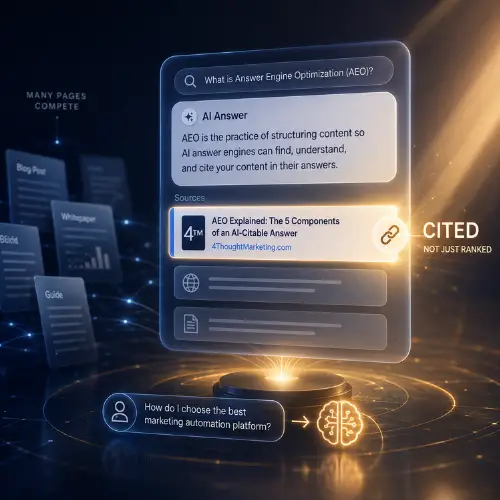
What makes content AI-citable is straightforward to state: it is content structured so an AI answer engine can find one self contained passage, understand it without the surrounding page, and quote it as a source. The shift is that you are no longer writing pages to be read top to bottom, you are writing passages to be lifted.
Answer engine optimization, or AEO, is the broader discipline of earning those citations, and this piece is the anatomy sub-article beneath it. For the full definition and the four step playbook, our pillar guide to answer engine optimization is the place to start, so this article stays focused on the answer itself. Getting cited by ChatGPT or Perplexity begins with that focus.
One clarification keeps this article in its lane. What makes content AI-citable is about how you construct the passage, not about how an engine ranks competing sources on authority or freshness. Those selection signals are a separate topic covered in our sibling article on how AI answer engines decide which sources to cite.
The 5 Components of an AI-Citable Answer
An AI-citable answer has five construction components: structure, clarity, evidence, extractability, and entity context. Together, these five components are what makes content AI-citable in practice, and none of them requires new tooling. Build all five into a passage and you have removed most of the reasons a model would skip you. Keep each one deliberate and the rest of what makes content AI-citable falls into place.
1. Structure
Structure means one idea per section, led by the answer. Put a direct answer in the first sentence under a question style heading, then support it. This answer first ordering is the backbone of LLM-friendly content structure, and it is the single change that most improves a citable passage.
2. Clarity
Clarity means plain, unambiguous statements. Define the term, name the tool, and avoid pronouns that depend on an earlier paragraph. A clear passage reads as true whether it is the first thing a model sees or the only thing.
3. Evidence
Evidence means a specific, checkable claim rather than a vague assertion. A number, a named source, or a concrete example gives a model something it can attribute with confidence. Research from Yext, analyzing 6.8 million citations across ChatGPT, Gemini, and Perplexity, found that 86% of AI citations come from brand managed sources, which is exactly the kind of concrete claim that gets quoted.
4. Extractability
Extractability means the passage still makes sense once it is copied out. Use short sentences, do not lean on a table two scrolls up, and do not point with this or that to something elsewhere on the page. If a snippet loses its meaning when lifted, it is not an ai-citable answer yet.
5. Entity and Context
Entity and context means naming who and what explicitly. Name your own company, your product, and the specific platform or feature or version you are writing about (for example, your brand plus the exact tool it runs on), so a model can tie the claim to the right brand and topic. This is where ai-citable content connects your name to the right entity in the model’s map of the category.
Applying the 5 Components to Your Content
Seeing what makes content AI-citable inside a familiar workflow turns the abstract checklist concrete. Take a support style page titled how to sync Marketo with Salesforce without duplicate leads. Lead with the one sentence answer, define the terms, cite a specific setting, keep each step self contained, and name the platforms explicitly. That is how to structure content for AI answers without rewriting your whole library.
The same recipe fixes the most common failure mode. Much B2B content buries the answer under three paragraphs of context, which reads well for a human but strips extractability for a model. Reordering so the answer leads, then trimming pronouns, turns an existing article into an AI-citable answer with a light edit rather than a rewrite. That light touch is the practical heart of what makes content AI-citable. Google’s own AI optimization guidance reinforces the same fundamentals: clear structure, helpful specifics, and sound technical hygiene.
Standardize this as your AEO content format so every new piece you publish ships citable by default: a question style H2, a one sentence answer, a specific proof point, and explicit entity naming. If you are weighing this construction work against your existing search playbook, our sibling article on how AEO compares with SEO for your landing pages shows what actually changes. Our companion guide on LLM optimized content for B2B websites goes deeper on the underlying mechanics and pairs well with this checklist.
Conclusion
What makes content AI-citable is not a mystery once you see the anatomy: a well structured, clear, evidence backed, extractable, and explicitly named passage that a model can quote on its own. Build those five components into your content on purpose and you stop guessing at earning citations in ChatGPT or Perplexity. Start with one high intent page, reorder it answer first, and add a specific proof point today. If you want a partner to turn this into a repeatable content standard across your library, contact 4Thought Marketing and we can help.
About 4Thought Marketing
We're a B2B marketing automation and AI consultancy with a thing for getting complex tech to actually work. Since 2008, we've helped hundreds of organizations across financial services, technology, manufacturing, and real estate get more from Eloqua, Marketo, and their CRM integrations. We serve our clients across marketing automation strategy, lead lifecycle, AI, compliance, preference management, and more. Explore our services or get in touch.
Frequently Asked Questions
What makes content AI-citable in one sentence?
What makes content AI-citable is a self contained passage that leads with a clear answer, backs it with specific evidence, and names the entities involved, so a model can quote it without the surrounding page. It is a construction choice, not luck.
How is an AI-citable answer different from a normal blog paragraph?
A normal paragraph often builds context before the point, while an ai-citable answer states the point first and stands alone when lifted. That answer first, self contained shape is what lets a model quote it cleanly.
What are the five components of an AI-citable answer?
Structure, clarity, evidence, extractability, and entity context. Together they cover how the passage is ordered, how plainly it reads, what proof it carries, whether it survives being copied out, and whether it names the right brand and topic.
Does this help with getting cited by ChatGPT and Perplexity specifically?
Yes. Getting cited by ChatGPT or Perplexity depends on passages those tools can extract and trust, and the five components are built for exactly that. Structuring content for AI answers this way improves your odds across every major engine.
Do I have to rewrite everything to apply this?
No. Most pages become citable with a light edit: move the answer to the first sentence, trim pronouns for extractability, and name the platforms. Applying that format to your highest intent pages first delivers the fastest return.