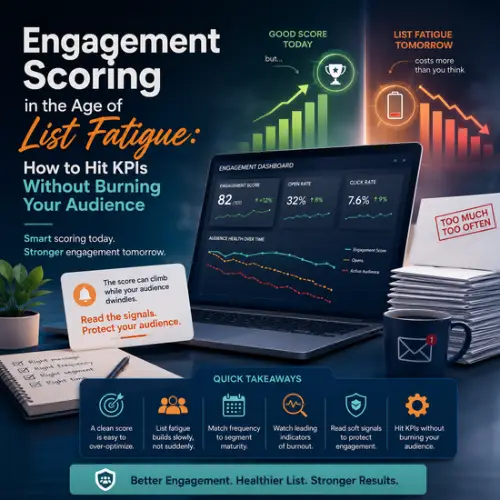
Quick Takeaways
- Engagement scoring gives a clean target that is easy to over-optimize.
- A rising score can mask a shrinking, tiring audience.
- List fatigue builds slowly, rarely as a visible unsubscribe spike.
- Match send frequency to segment maturity, not one blanket rule.
- Watch leading indicators of email engagement before attrition shows up.
- Protect subscriber engagement by reading soft signals, not just opt-outs.
Table of Contents
Your engagement score is climbing, the dashboard is green, and this quarter’s KPI looks safe. Engagement scoring is the practice of assigning each contact a value based on how they interact with your emails, giving you one clean number to rank and act on subscriber engagement.
But a metric that only moves up can hide a list that is quietly wearing out. The fastest way to lift your engagement scoring is often to mail the people who already open everything a little more each time, so the score improves while the audience behind it thins.
That is the trap. Engagement scoring is a genuinely useful metric, yet treated as the only metric it can burn the very subscribers it measures. The fix is to read it alongside the slower signals of fatigue, so you can hit your KPIs without spending goodwill you cannot quickly rebuild.
Engagement Scoring Gives You a Clean Target, and a Dangerous Blind Spot
A single engagement score is easy to game without meaning to. Engagement scoring rewards contact, and the simplest way to raise the average is to send more to the segment that already responds.
Picture a segment of loyal openers who reliably click your monthly note. Push them to weekly, then twice weekly, and the aggregate number ticks up for a while because the raw activity is there. Underneath, those loyal readers are being asked to absorb far more than they signed up for.
This is the blind spot: the score can look healthy while the audience depletes, the same way a bigger list can perform worse than a smaller, healthier one. Litmus reports that over-mailing is a leading driver of unsubscribes, which means the tactic that flatters your metric this month can quietly cost you contacts next month.
Why it matters: a number you can move by mailing harder is a number you can move right off a cliff. Read engagement scoring as a measure of willing attention, not raw volume, and make sure it tracks genuine interest rather than send counts.
Why List Fatigue Is Slow, Quiet, and Easy to Miss
List fatigue rarely announces itself. You expect a dramatic unsubscribe spike, but fatigue usually arrives as a slow drift instead.
The pattern looks like this: opens soften by a point or two, replies thin out, and more people mark your email as read without actually reading it. None of these cross an alarm threshold on their own, so week to week nothing looks wrong. The decline accumulates below the line where most teams would react.
Consider a segment that used to open at a comfortable rate and slips a little each month. No single send looks like a failure, yet two quarters later the segment is a shadow of what it was. By then the damage to email engagement is done, and goodwill takes far longer to rebuild than it took to lose.
Why it matters: because this decline is quiet, you cannot wait for it to become loud. If your only trigger is a hard drop in your engagement scoring or a jump in unsubscribes, you are reading lagging signals and reacting after the audience has already cooled.
Match Your Cadence to Segment Maturity, Not One Rule for All
One frequency rule for the whole database is almost always wrong. How much contact a segment can absorb depends on how mature it is.
A freshly engaged audience, people who just subscribed or converted, will happily take more email than a segment you have cultivated for years. Applying a single email cadence overspends the mature group while underspending the new one. The fix is to flex your rhythm with lifecycle stage rather than treating every contact the same. The same discipline applies across regions, where keeping global email campaigns coordinated across markets means matching cadence to each audience rather than sending to everyone at once.
New subscribers might sustain a weekly welcome and nurture rhythm, while a five-year-old segment may only tolerate a monthly touch before engagement starts to erode. Spamhaus recommends you shift less-engaged contacts from weekly to monthly, a simple maturity-aware adjustment to email cadence that protects the relationship.
You can also give the decision back to the reader. A preference center does this directly by giving subscribers control over frequency and topics, which lets each person self-select a sustainable rhythm instead of having one forced on them.
Why it matters: matching send frequency to segment maturity keeps your engagement scoring honest, because you are earning attention at a pace each group can sustain.
Watch the Leading Indicators of Burnout, Not Just the Lagging Ones
To protect the list, act on leading indicators, not the lagging ones. Unsubscribes and a falling number tell you what already happened; the early signals tell you what is about to.
Four leading signals deserve a standing place on your dashboard. First, declining open and click rates inside an otherwise stable segment, where nothing else changed. Second, a rising share of opened-but-not-clicked across successive sends, a sign attention is fading even when the email is still opened. Third, soft disengagement climbing before hard unsubscribes appear. Fourth, engagement concentrating in a shrinking core while the long tail goes quiet.
If your top decile still drives the numbers but the middle of the list stops clicking, your engagement scoring can hold steady on the strength of a few loyalists while most of the audience drifts away. That is a leading indicator flashing under a calm-looking metric.
Why it matters: leading indicators buy you time to rest a segment or adjust email cadence before attrition sets in. AI-assisted analytics increasingly surface these drifts automatically, flagging a softening segment before a human would notice, but the discipline is the same with or without the tooling: read the early signals and act on subscriber engagement while you still can.
Conclusion
Engagement scoring is worth keeping. It gives you a clean, shared target, and that clarity is exactly why it is so easy to over-optimize. Read engagement scoring in isolation and you can mail your best subscribers into fatigue while the number smiles back at you. Read it alongside segment maturity and the leading indicators of fatigue, and the same metric becomes a genuine guide to sustainable growth. Hit your KPIs by earning attention at a pace your audience can sustain, and if you want help building that discipline into your program, contact the 4Thought Marketing team.
About 4Thought Marketing
We're a B2B marketing automation and AI consultancy with a thing for getting complex tech to actually work. Since 2008, we've helped hundreds of organizations across financial services, technology, manufacturing, and real estate get more from Eloqua, Marketo, and their CRM integrations. We serve our clients across marketing automation strategy, lead lifecycle, AI, compliance, preference management, and more. Explore our services or get in touch.
Frequently Asked Questions
How does engagement scoring work in an email program?
Engagement scoring assigns each contact a value based on signals like opens, clicks, and recency, then uses that value to rank your audience. Those rankings help you decide who to mail, how often, and when to rest a contact. Treat it as a ranking tool, not a target to maximize at any cost.
Can improving my engagement score actually hurt my list?
Yes. If you lift your engagement scoring by mailing your most active contacts more often, you can tire them out while the metric still looks healthy. Because the score reflects the people who remain active, a shrinking, over-mailed core can keep it high even as the wider audience fades.
How do I know if my list is fatigued?
List fatigue usually shows as a slow drift rather than a spike: softening opens, thinning replies, and more messages marked read without being read. Watch for declining email engagement inside otherwise stable segments and a rising share of opened-but-not-clicked. These leading signals appear before unsubscribes climb.
Should every segment get the same send frequency?
No. A freshly engaged segment can absorb more contact than one you have mailed for years, so a single cadence overspends mature audiences and underspends new ones. Flex send frequency with segment maturity, and let a preference center give subscribers control where you can.
Why doesn’t list fatigue show up as an unsubscribe spike?
Most fatigued subscribers disengage quietly long before they opt out. They stop opening, skim without clicking, or archive on sight, none of which registers as an unsubscribe. By the time hard opt-outs rise, subscriber engagement has usually been sliding for a while.