




Quick Takeaways
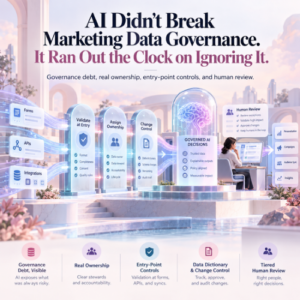
- An AI-ready MOPs instance starts with data, not with a tool purchase.
- Ungoverned segments turn AI agents into fast, confident, wrong decision-makers.
- Marketing data governance must define what an agent can touch first.
- People readiness means retraining scoring and QA habits, not replacing headcount.
- An AI-ready marketing operations instance needs an owner, not just a policy.
- Skipping the audit step is the single most common AI rollout failure.
Table of Contents

Your instance is about to get a new user, and it never sleeps, never asks permission twice, and can touch ten thousand records before your coffee is done. That is the real starting point for building an AI-ready MOPs instance: not the vendor demo, but the moment an agent gets write access to segments, scoring models, and campaigns your team spent years tuning.
Most Eloqua and Marketo teams are being asked to bring AI agents into their instance faster than they can answer basic questions about their own data. Which fields are actually trustworthy. Who owns the scoring model. What happens when an agent updates a segment definition at 2 a.m. and nobody notices until the next campaign send. These are not hypothetical governance debates; they are the operational gaps that turn a promising AI pilot into a cleanup project.
This post lays out the three-part framework behind every AI-ready MOPs instance: clean, well-documented data; governance that defines scope and ownership before access is granted; and a team that has been retrained, not just informed. Get these three right, and AI becomes a force multiplier. Get them wrong, and you are debugging an agent’s decisions instead of your own.
AI-ready MOPs Instance Data: The Foundation an AI Agent Actually Reads
What it means: An AI agent does not read your dashboards or your intentions. It reads field values, timestamps, and relationships, exactly as they exist in your instance today, flaws included. This is the layer where an AI-ready MOPs instance is either built or quietly broken before an agent ever runs its first query.
Audit Before You Automate
Why it matters: An agent trained on stale lead source values or duplicate contact records will make fast, confident decisions on bad information, and it will scale that mistake across every record it touches. Before any AI tool goes live in your instance, run a field-level audit: which fields are populated consistently, which are stale, and which have three different spellings of the same value. Include form-sourced records in that audit, because bot form submissions can quietly inflate the very scores an agent will learn from.
A practical starting point: Pull a sample of 500 records and check the fields your AI use case actually depends on, such as lead source, industry, and engagement score. If more than 10% of values are missing, inconsistent, or clearly wrong, fix the data pipeline before you connect an agent to it. Why Data Quality in RevOps Defines the Future of Revenue Performance walks through the connection between clean data and downstream revenue reporting in more depth, and the same audit logic applies directly to AI readiness.
Documentation Is Part of the Data Layer – AI-ready MOPs Instance
Why it matters: An AI agent cannot infer that “MQL” means something different in your instance than it does in the vendor’s default documentation. If your field definitions, scoring logic, and segment naming conventions only live in one person’s memory, the agent (and every new hire) is guessing.
What to build: A living data dictionary that defines every field an AI tool will touch, in plain language, alongside its source system and update cadence. Treat this as version-controlled documentation, not a one-time project. AI-ready marketing data is documented data, and an AI-ready MOPs instance depends on a data dictionary that stays current as fields change.
AI-ready MOPs Instance Governance
What it means: Marketing data governance is not a policy document that sits in a shared drive. It is the set of rules that determines what an AI agent can read, what it can write, and who is accountable when it gets something wrong. Get this layer right and access is earned in stages, not assumed on day one.
Scope Access Before You Grant It
Why it matters: The default instinct is to give an AI agent broad access so it can “learn faster.” That instinct is exactly backwards for a production marketing instance. Start every rollout with a scoped, read-only pilot: let the agent analyze and recommend before it can write to a live segment or campaign.
How to structure it: Define three access tiers, read-only analysis, recommend-with-approval, and autonomous action, and require a documented graduation process between them based on accuracy, not enthusiasm. Oracle’s engineering team frames this as governed execution rather than one-time certification, arguing that trustworthy AI depends on runtime policy enforcement and evidence records for every action an agent takes, not just a pre-launch review (Oracle, Building Trustworthy AI at Oracle). That framing applies just as directly to a marketing instance as it does to an enterprise database.
Privacy and Consent Do Not Pause for AI
Why it matters: An AI agent that reshuffles segments or personalizes content based on consent-restricted fields can create a compliance problem faster than a human ever could, simply because it moves faster and touches more records per hour. Data readiness for AI agents has to include a consent and minimization check, not just an accuracy check.
What to confirm: Before an agent can query or act on a field, confirm it respects the same consent flags, suppression lists, and minimization rules your human team already follows. Data Minimization in Marketing: A Leader’s Guide to Why and How covers the underlying principle: collect and expose only the data a given use actually requires, which is exactly the discipline an AI-ready marketing operations instance needs at the access-control layer. Adobe’s own governance model for its AI systems follows a similar structure, requiring an ethics and impact review before a new AI capability is deployed into production (Adobe, Responsible AI and Enterprise AI Governance).
The Team Has to Change Before the AI-ready MOPs Instance Does
What it means: The most overlooked part of AI governance for marketing teams is the retraining curve for the humans who used to do the work an agent now assists with, or does outright.
Retrain the Reviewers, Not Just the Users
Why it matters: A marketing ops analyst who spent years manually reviewing lead scores now has to review an agent’s scoring logic instead, which is a genuinely different skill: spotting when a model’s confidence does not match its accuracy, rather than spotting a manual data-entry error. AI Lead Scoring vs Rule-Based Scoring: What Every B2B MOPs Team Needs to Know breaks down exactly where a scoring model’s judgment can drift from a human’s, and that gap is precisely what your reviewers need to be trained to catch.
A concrete step: Run a two-week shadow period where a human reviews every AI-generated score or segment change before it goes live, and log every disagreement. Those disagreements are your training curriculum, not a sign the pilot is failing.
Address the Job Security Question Directly
Why it matters: Teams that are never told how AI changes their role will assume the worst, and that assumption shows up as quiet resistance, not open pushback. A marketing ops team that helped design the governance framework is a team that trusts the outcome, because they can see exactly where human judgment still sits in the loop.
What to say plainly: AI agents in a well-governed instance take over repetitive, high-volume tasks, campaign QA, list hygiene, first-pass scoring reviews, so your team can spend more time on strategy, exception handling, and the judgment calls a model still cannot make. That is not a talking point; it is the actual operating model behind a well-run rollout, and it is worth saying out loud to the team before the first agent goes live.
Conclusion
An AI-ready MOPs instance is not a single project with a finish line; it is a discipline built on three legs that have to hold weight together. Your data has to be clean and documented, your governance has to define scope and accountability before access is granted, and your people have to be retrained to review a model’s judgment, not just its output. Skip any one leg, and the other two cannot compensate for long. If your team is planning an AI rollout in Eloqua or Marketo and wants a second set of eyes on where your instance actually stands, contact us at 4Thought Marketing for an AI-readiness assessment before you flip the switch.
About 4Thought Marketing
We're a B2B marketing automation and AI consultancy with a thing for getting complex tech to actually work. Since 2008, we've helped hundreds of organizations across financial services, technology, manufacturing, and real estate get more from Eloqua, Marketo, and their CRM integrations. We serve our clients across marketing automation strategy, lead lifecycle, AI, compliance, preference management, and more. Explore our services or get in touch.
Frequently Asked Questions
What does it mean for a marketing operations instance to be AI-ready?
An AI-ready MOPs instance has three things in place before an AI agent gets access: clean, documented data; governance rules that define scope and ownership; and a team that has been retrained to review AI-generated decisions, not just approve them by default.
What is the biggest data risk when connecting an AI agent to Eloqua or Marketo?
The biggest risk is stale or inconsistent field values, because an agent reads exactly what is in the field and scales any error across every record it touches. A field-level audit before go-live catches this before it becomes a campaign-wide problem.
Should an AI agent get full write access to segments and scoring models right away?
No. Start with a read-only or recommend-with-approval tier and require a documented graduation process based on measured accuracy before granting broader write access, rather than expanding access based on enthusiasm or a short pilot window.
How is governing an AI agent different from general data governance?
General data governance covers who can access and edit data. Governing an AI agent adds a layer on top: it defines what the agent can decide on its own, what requires human approval, and how every agent action is logged and reviewed.
Does bringing AI agents into an instance mean fewer marketing operations roles?
Not in a well-governed rollout. Agents typically absorb repetitive, high-volume tasks like list hygiene and first-pass scoring review, which frees the team for exception handling, strategy, and the judgment calls a model cannot reliably make on its own.
What is a marketing ops AI readiness checklist supposed to cover?
At minimum, it should cover a data audit and documentation pass, defined access tiers with a graduation process, a consent and minimization check, and a retraining plan for the people who will review the agent’s output.