





Quick Takeaways
- A static fit score says who should matter in ABM.
- An engagement spike says who matters right now instead.
- AI account prioritization reads multi-contact spikes, not fit alone.
- Static ABM lists update slowly; buying committees move faster.
- AI-assisted scoring ranks spikes; it never replaces sales judgment.
- Feed sales the spike, not just the quarterly score.
Table of Contents
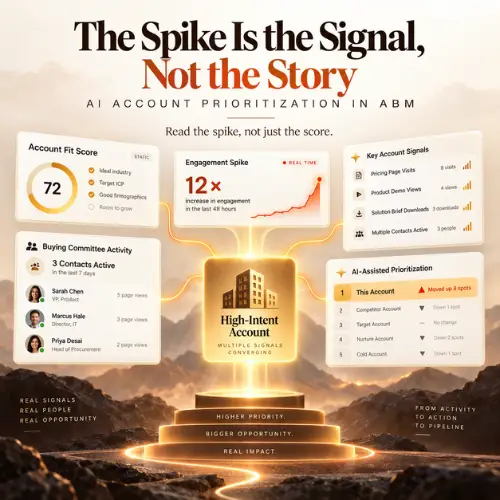
AI account prioritization exists because a target account can go quiet in the CRM and loud everywhere else in the same week. Three buying-committee contacts hit the pricing page, a champion pulls two competitor comparisons, and the static fit score sitting in Eloqua or Marketo has not moved. That gap between what the account list says and what the ABM account scoring on file shows is exactly where a quarter’s worth of ABM budget gets misdirected, and it is precisely the gap AI account prioritization is built to close.
Most ABM programs still rank accounts by a fit score built once and refreshed on a schedule: firmographic match, budget range, a handful of intent signals pulled in at setup. That score answers who should matter. It says nothing about who matters this week, and a buying committee that has gone from browsing to comparing pricing does not wait for the next scoring refresh to register the change. Without AI account prioritization built on real-time engagement spike detection, that movement sits invisible until the quarterly review catches up to it.
This piece walks through what AI account prioritization actually changes in an ABM motion: reading a multi-contact engagement spike through predictive account scoring instead of a static fit score alone, reprioritizing the account list in real time, and what AI account prioritization can honestly deliver today without pretending it replaces the sales team’s judgment call.
What AI Account Prioritization Actually Means in ABM
The Spike Versus the Score
A fit score is a static answer to a static question: does this account look like our best customers on paper. AI account prioritization asks a different, faster-moving question: is this account behaving like a buyer right now. It builds directly on the broader case made in AI-Powered Predictive Signals: What Marketing Ops Used to Miss, applied to the one ABM decision that AI account prioritization is meant to change: which accounts sales works this week.
Why it matters: A fit score updated last quarter is a record. A multi-contact engagement spike happening this week is a signal, and AI account prioritization is what turns that signal into a ranked, actionable list instead of a number nobody rechecks until the next planning cycle. A score built only on the static half of that equation misses the part that actually moves.
Why This Differs From a Fit-Score-Only List
A fit-score-only list tells a sales team which accounts are worth building a plan for under AI account prioritization. It says nothing about timing. AI account prioritization adds the missing half: which of those already-qualified accounts is showing real buying-committee movement this week, not last quarter. Salesforce’s own reporting on its account-based marketing tools describes the same mechanic directly, noting that companies can use AI to analyze CRM data and marketing engagement across the web to tier accounts in prioritized order, which is the underlying logic behind AI account prioritization.
Where Static ABM Lists Miss the Real Signal
Fit Scores Answer Who Should Matter
Firmographic fit, budget range, and industry match get an account onto the ABM list in the first place. Those criteria rarely change week to week, which is exactly why a fit score is a reasonable gate but a poor prioritization signal on its own. See Account Based vs Lead Based Marketing: Which Model Should You Use for how account-level scoring differs from individual lead scoring in the first place, since AI account prioritization depends on getting that distinction right, and AI account prioritization cannot work at all without it.
Multi-Contact Spikes Answer Who Matters Right Now
Predictive account scoring reads the signal a fit score cannot: three or more contacts at one account engaging inside a short window, a champion pulling competitor content, a buying-committee member returning to a pricing page they had ignored for months.
Why it matters: A single contact opening one email is noise. Three contacts at the same account moving in the same direction inside a week is a multi-contact engagement signal worth reprioritizing the list over, and it is exactly the kind of engagement spike detection AI account prioritization is meant to catch. See Engagement Scoring in the Age of List Fatigue for how the same over-reliance on one static number distorts prioritization on the individual-contact side of the funnel, not just the ABM account scoring side.
Reprioritizing the ABM List When a Spike Hits
Set the Threshold Before the Spike, Not After
AI account prioritization only works as a real-time account reprioritization list if the threshold for a spike is set in advance: how many contacts, what actions, inside what window, count as a reprioritization trigger. Decide that number before the first spike shows up, not while sales is already asking why an account jumped the queue. A predictive account scoring model behind AI account prioritization is only as trustworthy as the threshold set before the first spike hits.
Feed Sales the Signal, Not Just the Score
A reprioritized account needs to reach sales with context, not just a new rank. HubSpot’s own account-based marketing tools build this in directly: automated workflows score and surface target accounts, then route that context into a centralized dashboard the sales team can act on without digging through raw activity logs. See Lead Routing Strategies That Align Sales and Marketing for how the same routing discipline that gets an individual lead to the right rep applies to an ABM account jumping the priority queue through real-time account reprioritization built on AI account prioritization.
What AI Account Prioritization Cannot Do Today
The Honest Capability Line
It is worth being precise here instead of overselling the category. AI account prioritization today means AI-assisted predictive account scoring: using AI to sharpen and rank the engagement spikes and fit data already sitting in Eloqua or Marketo and the connected CRM, improving on a static, rule-based list. A fully autonomous model, trained end-to-end to independently predict which account will close without a human setting the scoring logic, is a more advanced, still-maturing capability for most marketing ops teams building AI account prioritization, 4Thought Marketing included.
Where to Start This Week
Start with the ABM segment that already has the most budget riding on it, usually the named-account list for the current quarter’s top vertical. Layer AI account prioritization and AI-assisted predictive account scoring onto the engagement and fit data already in Eloqua or Marketo before building anything custom. Prove real-time account reprioritization out on that one segment before expanding AI account prioritization to the rest of the ABM program.
Conclusion
ABM programs have spent years ranking accounts by a fit score that barely moves and missing the buying-committee spikes that move every week. AI account prioritization flips that: a multi-contact engagement spike reprioritizes the list before the quarterly refresh ever catches up, using data already sitting in Eloqua or Marketo. AI-assisted predictive account scoring makes that reprioritization realistic without a data science team, without promising more certainty than the technology can deliver. If your team is ready to build spike-based AI account prioritization into your ABM motion, contact 4Thought Marketing to talk through where to start. Most teams prove AI account prioritization out on one named-account segment before expanding it to the rest of the program.
About 4Thought Marketing
We're a B2B marketing automation and AI consultancy with a thing for getting complex tech to actually work. Since 2008, we've helped hundreds of organizations across financial services, technology, manufacturing, and real estate get more from Eloqua, Marketo, and their CRM integrations. We serve our clients across marketing automation strategy, lead lifecycle, AI, compliance, preference management, and more. Explore our services or get in touch.
Frequently Asked Questions
What is AI account prioritization in ABM?
AI account prioritization is the practice of ranking target accounts by real-time engagement signals, especially multi-contact spikes, instead of relying only on a static fit score. It layers AI-assisted predictive account scoring on top of the engagement and CRM data already sitting in Eloqua or Marketo to surface which accounts are showing buyer movement this week.
How is an engagement spike different from a fit score?
A fit score measures whether an account matches your ideal customer profile on paper, and it rarely changes week to week. An engagement spike measures whether multiple contacts at that account are actively engaging right now, which is a timing signal a fit score was never built to catch, and which AI account prioritization is built to surface.
Can AI guarantee which ABM accounts will close?
No. AI account prioritization and its underlying predictive account scoring can flag which accounts are showing a real buying-committee spike, but it does not guarantee an outcome. A fully autonomous model trained to independently predict which account will close is a more advanced capability still maturing across the industry.
What counts as a multi-contact engagement spike?
There is no universal number, which is why the threshold needs to be set before AI account prioritization starts scoring: how many contacts, which actions, inside what window, count as a spike worth reprioritizing the list over. Most teams start with three or more contacts engaging inside a short window.
Does AI account prioritization replace the sales team’s judgment?
No. It flags which accounts deserve attention this week; the sales team still decides how to act on that signal. The judgment call about how to approach a spiking account stays with a person, even inside a mature AI account prioritization program built on real-time account reprioritization.
Where should an ABM team start with AI account prioritization?
Start with the named-account segment carrying the most budget, usually the current quarter’s top vertical. Layer AI-assisted predictive account scoring onto the fit and engagement data already in Eloqua or Marketo before expanding AI account prioritization to the rest of the ABM program.