





Quick Takeaways
- Five-bullet executive summaries exist because of time, not because five is the right number
- AI executive reporting can surface anomalies analysts would otherwise miss by memory or habit
- Recycled bullets happen when building something sharper takes too long by hand each cycle
- AI anomaly detection changes what analysts can afford to look for every reporting cycle
- Sharper insight can surface uncomfortable findings executives did not expect to see
- Someone still has to decide how to frame what AI surfaces before it reaches leadership
Table of Contents
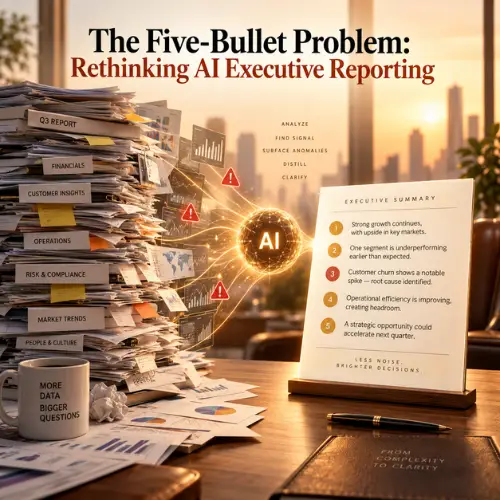
Every marketing operations analyst knows the ritual. The reporting period closes, the dashboards are full of movement, and the deliverable due to leadership is five bullet points. Not six, not a dashboard link, five bullets that fit in the time an executive has between meetings.
That constraint is not new, and it is not really about executives being impatient. AI executive reporting is starting to change one half of that equation: the analyst’s side. For years, the same five bullets got picked from memory, from last month’s report, or from whatever metric happened to move the most, because building something more precise by hand took longer than the reporting cycle allowed.
The result is a summary that is technically accurate and often unhelpful. It tells leadership what always gets mentioned, not what actually changed. That is the gap AI executive reporting is built to close: AI marketing insights tools now let analysts ask a different question before they write a single bullet, namely what in this month’s data is genuinely different, not just what is easiest to remember.
Why Five Bullets Became the Standard
AI executive reporting exists to solve a problem that predates AI entirely: the five-bullet executive summary was never a best practice anyone designed on purpose. It is a compromise between two time constraints that never got renegotiated.
Executive time is fixed: Leadership reviews marketing performance in the gaps between other priorities, not as a dedicated analysis session. A report that takes ten minutes to read gets skimmed in ninety seconds, so the format collapsed down to whatever fits that window: a handful of headline points.
Analyst time is fixed too: Building an executive summary from a full month of channel data, campaign performance, and pipeline movement takes hours if done by hand. Most marketing ops teams do not have hours to spare every single reporting cycle, especially when the summary is one of several competing deliverables. Marketing performance reporting became a triage exercise: pick the five things you can defend, ship it, move on. This is exactly the constraint AI executive reporting removes, because it takes the exhaustive part of the review off the analyst’s plate.
The two constraints reinforce each other. Because analysts cannot examine everything by hand, they default to metrics they already track closely, the ones that showed up last month or the ones that are easiest to pull. Executive summary marketing decks start to look the same every cycle, not because nothing else happened, but because nothing else got looked at closely enough to notice. Microsoft’s 2026 Work Trend Index, based on a survey of 20,000 knowledge workers, points to this same pattern at a broader scale: employees across functions report running out of time before they run out of things worth their attention, and marketing ops reporting is a clear example of that squeeze playing out cycle after cycle.
This is also why C-suite reporting so often misses the mark on relevance, and why AI executive reporting has to start with the right metrics, not just faster ones. If you have not already, it is worth reading Translating C-Suite Objectives Into Marketing Ops Metrics, which covers a related problem: analysts picking metrics that are easy to report on rather than metrics tied to what leadership actually cares about this quarter. The five-bullet habit and the metric-alignment problem usually travel together.
The Real Cost of Recycled Bullets
Why it matters: When the same five points repeat month over month, leadership stops treating the report as a source of new information and starts treating it as a formality. AI executive reporting only earns its place in the workflow if it breaks that cycle, not just automates it.
How AI Changes What’s Possible
AI anomaly detection removes the trade-off that created the five-bullet habit in the first place. This is the core mechanism behind AI executive reporting: an analyst no longer has to choose between examining the full dataset and hitting a deadline, because the tool can scan the complete set of channel, campaign, and funnel data every cycle and flag what is statistically unusual, not just what is familiar.
What this looks like in practice: Instead of an analyst manually scrolling through a dashboard looking for a story, AI executive reporting surfaces the outliers first. A channel that underperformed its own baseline by 20%, a segment that suddenly converted at double its usual rate, a campaign that quietly stopped generating pipeline three weeks before anyone noticed. Those are the findings a monthly marketing report should lead with, and they are exactly the findings a rushed manual process tends to miss.
Oracle’s Eloqua Advanced Intelligence Cloud Service is one concrete example of what AI executive reporting looks like in a live platform. It applies machine learning directly to engagement and campaign data to flag contact-level and campaign-level anomalies that would otherwise require an analyst to go looking for them by hand. The value is not that AI writes the report. It is that AI does the exhaustive first pass across the full dataset, so the marketing operations analyst can spend their limited time deciding what the anomaly means and how it should be framed, rather than spending that time just finding it.
This also changes what an early warning system can look like. How to Create Early Warning Reports That Prevent Revenue Loss walks through building reporting that catches problems before they show up in a quarterly review. AI executive reporting makes that kind of proactive reporting realistic on a monthly cadence instead of a rare deep-dive project.
From Manual Scanning to Directed Attention
Why it matters: The analyst’s job shifts from finding the signal to judging the signal. AI executive reporting is a better use of a marketing operations analyst’s expertise than manually re-scanning the same dashboards every month looking for something worth mentioning.
Teams rebuilding their reporting workflow around this shift often start with the dashboard itself. Building a Marketing Ops Dashboard That C-Suite Loves is a useful companion piece here: a dashboard built to highlight anomalies, not just display totals, gives AI executive reporting something structured to work from.
The Framing Problem AI Doesn’t Solve
More insightful reporting is not automatically more welcome reporting. This is the part of AI executive reporting that gets skipped in a lot of the enthusiasm around it.
The uncomfortable-finding problem: When AI executive reporting surfaces what is actually notable in the data, it does not filter for what leadership wants to hear. An anomaly might mean a channel leadership championed last quarter is now underperforming, or that a campaign a stakeholder personally approved is the outlier dragging results down. That finding is exactly as valid as a positive one, but it lands very differently in a five-bullet summary.
Delivery still requires judgment: A technically accurate insight, delivered without context or softened framing, can undermine trust in the entire report rather than build it. If a bullet reads as an accusation instead of an observation, leadership may push back on the finding instead of acting on it. AI executive reporting does not replace the analyst here, it makes the analyst’s judgment more important, because someone still has to decide how to present what the tool surfaces, in what order, with what context, and with what recommended next step attached.
What responsible use looks like: Treat AI executive reporting as the research phase, not the final draft. Let it flag every candidate worth mentioning, then apply the same judgment an experienced marketing operations analyst would apply to a manual finding: is this actionable, is this the right audience for it, and does the framing invite a conversation or shut one down.
Conclusion
The five-bullet executive summary was never a statement about how much information marketing performance actually requires. It was a workaround for two groups of people who never had enough time, and AI executive reporting is the first real change to that equation in years, because it lets a marketing operations analyst examine everything instead of guessing at what matters most.
The tradeoff is that AI executive reporting will sometimes surface findings that are harder to deliver than the safe, recycled bullets everyone got used to, which means framing and judgment matter more, not less. This piece is part of 4Thought Marketing’s ongoing look at where AI is taking over the manual work analysts used to do by hand — see AI as the New Marketing Operations Analyst — and if your team is ready to rethink how your monthly marketing report gets built, contact us to talk through what that could look like for your marketing operations function.
About 4Thought Marketing
We're a B2B marketing automation and AI consultancy with a thing for getting complex tech to actually work. Since 2008, we've helped hundreds of organizations across financial services, technology, manufacturing, and real estate get more from Eloqua, Marketo, and their CRM integrations. We serve our clients across marketing automation strategy, lead lifecycle, AI, compliance, preference management, and more. Explore our services or get in touch.
Frequently Asked Questions
What does AI executive reporting actually change about a monthly marketing report?
It changes what gets examined, not just what gets written. Instead of an analyst manually reviewing a handful of familiar metrics, AI anomaly detection scans the full dataset and flags what is statistically unusual, giving analysts a more complete starting point for the executive summary.
Why do executive summaries keep repeating the same five points every month?
Building a fresh, well-researched summary by hand takes more time than most reporting cycles allow, so analysts default to metrics they already track closely or that moved the previous month. AI executive reporting reduces that time pressure by automating the initial scan for what is actually different.
Can AI replace the marketing operations analyst in the reporting process?
No. AI executive reporting is strong at surfacing anomalies across large datasets, but deciding what an anomaly means, how urgent it is, and how to frame it for leadership still requires human judgment. The analyst’s role shifts toward interpretation and framing rather than manual data scanning.
What is the risk of relying on AI to build executive summaries?
The main risk is framing, not accuracy. AI-surfaced findings can include uncomfortable or complicated results that a purely manual process might have softened or omitted. Delivered without context, a technically correct insight can undermine trust in the report rather than strengthen it.
How is this different from a marketing dashboard with automated alerts?
A dashboard alert typically flags a single metric crossing a threshold. AI executive reporting is broader: it scans across channels, segments, and campaigns to identify what is unusual relative to normal patterns, then supports the analyst in building a narrative summary around those findings rather than a list of triggered alerts.
Where should a marketing ops team start if they want to modernize executive reporting?
Start with the dashboard structure, since AI executive reporting works best against data that is already organized around meaningful comparisons rather than raw totals. From there, introduce anomaly detection into the reporting workflow gradually, treating AI output as a research pass that an analyst still reviews and frames before it reaches leadership.