




Quick Takeaways
- AI attribution modeling traces the full customer journey, not a simplified version of it
- Traditional models force analysts to guess at gaps in the data
- Multi-touch attribution improved on last-touch but still relies on assumptions
- AI can process every email open, view, and rep interaction at scale
- A more honest attribution picture is often messier and harder to act on
- Someone still has to interpret the full picture and decide what to do next
Table of Contents
Pull up your attribution dashboard right now. It probably shows a clean line from first touch to closed deal, three or four channels getting tidy percentages of credit. That dashboard is lying to you, not maliciously, but because the model behind it was built to be readable, not accurate.
For years, marketing operations analysts have made peace with this tradeoff. Tracing a real B2B buyer’s path, every email open, every gated asset download, every rep call, across a sales cycle that can run months and involve a dozen stakeholders, was too labor-intensive to do by hand. So analysts picked a model (first-touch, last-touch, maybe a multi-touch blend) and accepted that it was an approximation, not a record.
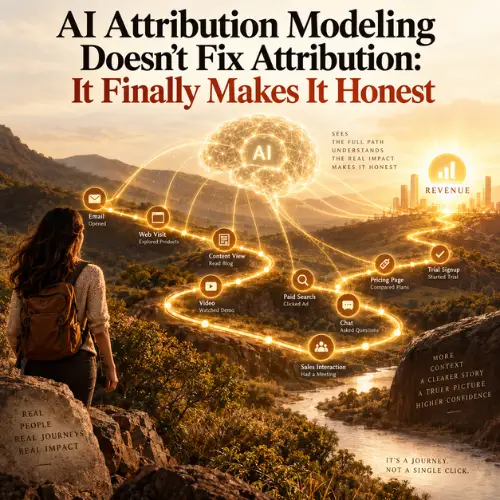
AI attribution modeling changes what’s actually possible here. It doesn’t make attribution smarter in some abstract sense, it makes attribution honest, because AI attribution modeling can finally handle the sheer volume of real touchpoint data that a human analyst never had the hours to reconstruct manually.
What’s Actually Wrong with Traditional Attribution Models
Every attribution model in use today, from first-touch to Marketing Attribution Models Compared: First Touch to Revenue-Based, was designed around a constraint: someone has to be able to calculate it by hand or in a spreadsheet formula. That constraint is exactly what AI attribution modeling was built to remove, and it shaped what the older models could measure, not what actually happened in the buyer’s journey.
The Judgment Calls Baked Into Every Model
The core problem: Attribution models don’t reflect reality, they reflect what a marketing operations analyst decided was reasonable to track given the tools and time available. First-touch attribution assumes the first interaction mattered most. Last-touch assumes the opposite. Neither claim is based on that specific buyer’s actual behavior; both are simplifying assumptions applied uniformly across every deal, which is the gap AI attribution modeling is designed to close.
According to Adobe’s own explainer on what attribution is, single-touch and multi-touch models exist precisely because B2B buying involves too many interactions to credit accurately without a defined framework. That framework, however useful, is still a compromise built for calculability rather than truth.
Why Multi-Touch Never Fully Solved It
Multi-touch attribution was supposed to fix this by spreading credit across several touchpoints instead of picking one winner. In practice, as we’ve covered in our breakdown of Marketo Measure attribution, even sophisticated multi-touch attribution models like W-Shaped or Full Path still rely on predefined weighting rules rather than what actually drove a specific buyer’s decision. This is the exact limitation AI attribution modeling addresses: it doesn’t need a predefined rule set because it works from the complete behavioral record instead.
Why it matters: A marketing operations analyst configuring a multi-touch model is still making a judgment call, just a more granular one. They’re deciding in advance how much credit a webinar attendance or an email click should get, before they’ve seen how that touchpoint actually correlated with revenue for this account. The model is more honest than last-touch, but it’s still built on assumptions, not on the full, actual record of what happened.
How AI Reconstructs the Real Touchpoint Sequence
This is where AI attribution modeling does something genuinely different, not by being clever about assigning credit, but by removing the need to simplify the underlying data in the first place.
From Sampled Data to Full Behavioral History
The shift: Instead of an analyst manually pulling a sample of touchpoints from a handful of systems, AI attribution modeling can ingest every email open, every content view, every chatbot interaction, and every rep touchpoint across the entire customer journey tracking record, then reconstruct the sequence as it actually occurred. Platforms like Oracle Eloqua’s Advanced Intelligence Cloud Service already use this kind of behavioral data, account engagement scoring and full activity history, to surface patterns no analyst could realistically track by hand across hundreds of accounts.
That’s the practical difference between full-path attribution built on a rule set and full-path attribution built on the complete, messy data itself. AI attribution modeling doesn’t need to compress the journey into four or five representative touchpoints. It can work with all of them.
Weighting Credit by What Actually Happened
Why it matters: Because AI attribution modeling is built from actual behavior data rather than predefined assumptions, credit gets weighted based on what genuinely correlated with a deal moving forward for that specific account, not a static rule applied to every deal the same way. A marketing operations analyst still sets guardrails and validates the output, but the model itself is grounded in the full record instead of a sampled approximation.
This is also where the piece connects back to the broader shift underway across marketing operations: as we cover in AI Marketing Operations Processes vs Classic Workflows, AI isn’t replacing the analyst’s judgment so much as removing the manual data-reconstruction work that used to force judgment calls earlier and more often than it should have.
The Uncomfortable Part: An Honest Picture Isn’t Always an Actionable One
Here’s the caveat that gets skipped in most AI attribution pitches: a more accurate picture of the customer journey is not automatically an easier one to work with.
When the Real Journey Contradicts the Story You’ve Been Telling
The tension: For years, teams have built their reporting, their budget justifications, and their channel strategy around a simplified attribution story. When AI attribution modeling shows that a channel your team has been defending for two years actually contributed a fraction of the credit it was assumed to carry, that’s not a comfortable finding, even though it’s a more accurate one. Attribution accuracy improves, but it can also complicate conversations that used to be settled.
This is the same tension we’ve seen play out in manual reporting more broadly. As covered in Marketing Operations: Data Analysis, analysts have often smoothed over inconvenient data gaps not out of laziness, but because reconstructing the full picture by hand simply wasn’t feasible. AI removes that excuse, and with it, some of the comfort of the simplified version.
Someone Still Has to Decide What to Do With It
Why it matters: A full-path, behaviorally accurate attribution model doesn’t tell you what to do next. It tells you, in granular and sometimes contradictory detail, what actually happened. A marketing operations analyst still has to interpret that fuller picture, reconcile it with sales feedback, and decide whether to shift budget, adjust messaging, or rebuild a nurture sequence. AI attribution modeling raises the quality of the input. It doesn’t replace the decision.
This is also worth saying plainly for anyone worried AI is coming for the analyst role: it isn’t. It’s removing the part of the job that involved reconstructing incomplete data by hand, so analysts can spend more time on the judgment calls that actually require a human, deciding what the honest picture means for the business.
Conclusion
Traditional attribution models were never wrong because analysts did sloppy work, they were limited by how much of the real customer journey a human could realistically trace by hand. AI attribution modeling doesn’t change the goal of attribution, it changes what’s finally possible: a full, honest reconstruction of the touchpoints that actually mattered, rather than the static, rule-bound approximation any multi-touch attribution model has to settle for. That honesty comes with a tradeoff, since a messier, more accurate picture is often harder to act on than a clean one, and it still takes a skilled marketing operations analyst to decide what that picture should change.
This is one piece of a broader shift in how marketing operations analysts do their jobs day to day, covered fully in AI as the New Marketing Operations Analyst. If your team is ready to see what a fuller, more honest view of your attribution data actually looks like, contact 4Thought Marketing to talk through what that would take for your stack.
About 4Thought Marketing
We're a B2B marketing automation and AI consultancy with a thing for getting complex tech to actually work. Since 2008, we've helped hundreds of organizations across financial services, technology, manufacturing, and real estate get more from Eloqua, Marketo, and their CRM integrations. We serve our clients across marketing automation strategy, lead lifecycle, AI, compliance, preference management, and more. Explore our services or get in touch.
Frequently Asked Questions
What is AI attribution modeling?
It uses machine learning to reconstruct a buyer’s complete touchpoint history, including every email open, content view, and rep interaction, rather than relying on a simplified rule-based model like first-touch or last-touch attribution.
How is AI attribution modeling different from multi-touch attribution?
Multi-touch attribution assigns credit across several touchpoints using predefined weighting rules set in advance. This approach instead builds its weighting from the actual behavioral data for each account, so credit reflects what really happened rather than a fixed formula applied to every deal.
Does AI attribution modeling replace the marketing operations analyst?
No. It removes the manual work of reconstructing touchpoint data by hand, but an analyst still has to interpret the results, validate them against sales feedback, and decide what changes to make.
Why can a more accurate attribution model create uncomfortable findings?
Because it reflects the full path instead of a simplified version of the journey, it can reveal that a channel or campaign your team has long credited with driving pipeline actually contributed far less than assumed, which complicates existing budget and strategy narratives.
Is full-path attribution accuracy always better than multi-touch attribution?
It’s more complete, since it’s built from the full customer journey tracking record rather than a sampled or rule-based approximation, but more complete also means more complex to interpret and act on, so teams still need clear processes for turning that detail into decisions.
What data does this kind of modeling need to work well?
The full behavioral record across channels, email engagement, content views, web activity, and sales interactions, ideally centralized in a platform like Oracle Eloqua or Adobe Marketo Measure, so it has the complete touchpoint sequence rather than fragments of it.