





Quick Takeaways
- An AI marketing operations analyst can flag anomalies instantly.
- Manual reporting shrinks as AI drafts recurring dashboards automatically.
- Root cause digging gets faster with AI pattern detection tools.
- Analysts shift toward judgment calls, not spreadsheet exports.
- AI agents are already absorbing repetitive watch-and-flag work.
- Start small: automate one manual report before scaling further.
Table of Contents
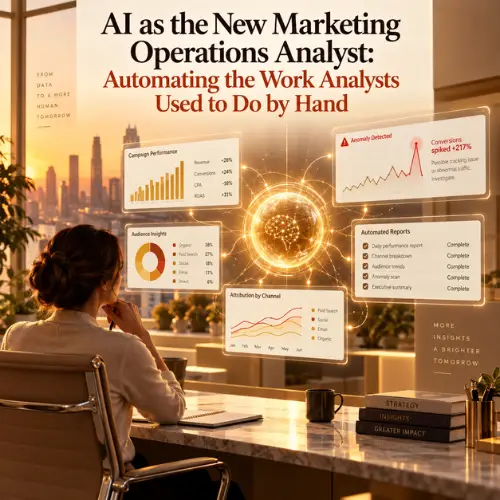
The AI marketing operations analyst is already flagging today’s anomalies while most human analysts are still opening their first dashboard. For over a decade, marketing operations analysts have started their mornings the same way: check the reports, cross-reference last night’s send stats, and go hunting for whatever number looks off. It’s part reporting, part detective work, done mostly by hand, the kind of manual marketing reporting most teams still rely on.
The problem is that the volume of data flowing through a modern martech stack has outpaced what any one person can manually watch. A three point drop in conversion rate can sit unnoticed for days, and without root cause analysis AI in place, tracing the cause by hand means the campaign budget tied to it is already spent. Teams are stretched thin, and the backlog of manual work keeps growing.
This is exactly the gap the AI marketing operations analyst is starting to close. Rather than replacing the person in the seat, it’s absorbing the repetitive watching, flagging, and reporting work, so analysts can spend their time on the judgment calls only a human can make.
The Manual Work Analysts Have Always Done
Before any AI marketing operations analyst tool entered the picture, marketing operations analysts quietly carried three kinds of work for years: pulling reports, watching for problems, and digging into why those problems happened. None of it shows up on a highlight reel, but all of it takes hours every week.
Reporting That Eats the Calendar
Why it matters: Every week, an analyst rebuilds the same performance summary for leadership, pulling numbers from Eloqua or Marketo, reformatting them into slides, and double-checking the math by hand. This is manual marketing reporting in its purest form, and as Marketing Operations: From Support Role to Strategic Driver points out, this kind of reporting used to define the entire job, even though it rarely required real analysis. Today, it can be produced in minutes instead of hours.
Monitoring for the Unexpected
Why it matters: Someone has to notice when a send volume spikes, a landing page conversion rate drops, or a segment stops receiving emails altogether. That job usually falls to whoever happens to be looking at the dashboard when it happens, which means problems are often caught late, not early. Platform limits make this worse over time, a pattern covered in Marketing Automation Capacity Planning. Without marketing ops automation in place, monitoring stays reactive instead of proactive.
Root Cause Digging After Something Breaks
Why it matters: Once a problem is spotted, the real work begins: cross-referencing send logs, checking for a broken workflow, ruling out a data sync issue, and finally tracing the actual cause. This process can take hours or days without root cause analysis AI in place, and it depends heavily on the analyst’s memory of what changed recently. These are exactly the marketing analyst tasks an AI marketing operations analyst is built to speed up.
What AI Actually Automates Today
This is where generative AI is making a real, practical difference, not in some future state, but in the tools an AI marketing operations analyst uses right now.
Auto-Generated Reports and Dashboards
Why it matters: AI reporting automation can pull data from Eloqua, Marketo, or a CRM and assemble a formatted report on a schedule, without a human touching a spreadsheet. This doesn’t just save time; it also removes the copy-paste errors that creep into manual reports done by hand. The Future of AI and Marketing Automation Integration covers how these integrations are being built into everyday martech stacks.
Anomaly Detection Before It’s a Crisis
Why it matters: Instead of waiting for a human to notice a dip, an AI marketing operations analyst can watch metrics continuously and flag a deviation the moment it happens, often before it affects revenue. Microsoft’s 2026 Work Trend Index, which surveyed 20,000 knowledge workers, found that AI agents are increasingly absorbing repetitive, watch-and-flag work across departments, and monitoring is one of the clearest places this shift is already showing up in marketing operations.
Natural-Language Answers Instead of Manual Queries
Why it matters: Analysts can now ask a plain-language question, such as “why did email opens drop last Tuesday,” and get an answer pulled directly from campaign data, instead of building a query or a pivot table from scratch. This is the same shift covered in How to Leverage AI to Build a Smarter, More Structured Marketing Automation Plan, applied specifically to the marketing analyst tasks an AI marketing operations analyst now handles.
Where Human Judgment Still Matters
None of this means the AI marketing operations analyst is replacing the human in the role. It means the role is changing, and it’s worth being honest about where AI still falls short.
AI Doesn’t Know Your Business Context
Why it matters: It can tell you that open rates dropped 12 percent. It cannot tell you that the drop coincided with a planned list cleanup, a sales team’s outreach push, or a seasonal dip your business sees every August. That context still lives with the human analyst. Isolated AI tools can generate plenty of activity, dashboards refreshed, alerts sent, reports drafted, but the real value only shows up when a human connects that activity back to business context.
Judgment Calls AI Can’t Make
Why it matters: Deciding whether a dip is worth escalating, which stakeholder needs to hear about it first, or whether a fix is worth the engineering time it will take, all of that is judgment, not pattern matching, and no amount of root cause analysis AI changes that. This is the same distinction drawn in How Marketing Audits Expose Nurture Campaign Architecture Problems, where finding a technical problem is only half the job; deciding what to do about it is the other half.
It’s fair for analysts to wonder what an AI marketing operations analyst means for their job security. The honest answer is that the manual, repetitive parts of the job are shrinking, but the parts that require context, prioritization, and communication are becoming more valuable, not less.
How to Start Shifting the Analyst Role
Adopting an AI marketing operations analyst approach doesn’t require an overhaul. It requires a starting point.
Pick One Manual Report to Automate First
Why it matters: Choose the report that eats the most time each week, not the most complex one, and automate that first. Early wins build trust in the tool and free up hours immediately. The audit approach in The Marketing Automation Audit: 5 Critical Health Factors Leaders Miss is a useful starting checklist for spotting where manual marketing reporting is piling up.
Build the Root Cause Playbook AI Will Follow
Why it matters: Root cause analysis AI is only as good as the logic it’s given. Documenting how your team currently traces a problem back to its source, step by step, gives an AI marketing operations analyst a framework to follow and improve on.
Redefine What “Good Analyst Work” Looks Like
Why it matters: As reporting and monitoring shift to marketing ops automation, the analyst role should shift toward interpreting results, flagging what actually matters to the business, and making recommendations. That’s a more strategic version of the same job, not a smaller one.
This piece is the first in a series exploring exactly how the AI marketing operations analyst shift plays out in practice. Three companion pieces are already live: Segments Without the Syntax, on how natural-language segmentation is changing marketing ops; AI Attribution Modeling, on why AI makes attribution honest instead of just faster; and The Five-Bullet Problem, on rethinking executive reporting with AI. For a broader look at how AI is reshaping marketing operations processes overall, see Classic Marketing Operations Processes vs. the New AI World, which covers repetitive task automation more broadly across marketing ops.
Conclusion
The manual side of marketing operations, the reporting, the monitoring, the root cause digging, has always taken up time analysts would rather spend on strategy. An AI marketing operations analyst can now handle much of that manual marketing reporting, not by replacing the analyst, but by absorbing repetitive marketing analyst tasks so the human can focus on judgment, context, and communication. Teams that start small, automating one report or one monitoring task at a time, will be better positioned as this shift accelerates. If you’re not sure where to begin, contact us at 4Thought Marketing, we help marketing operations teams figure out exactly where AI can take over the manual work first.
About 4Thought Marketing
We're a B2B marketing automation and AI consultancy with a thing for getting complex tech to actually work. Since 2008, we've helped hundreds of organizations across financial services, technology, manufacturing, and real estate get more from Eloqua, Marketo, and their CRM integrations. We serve our clients across marketing automation strategy, lead lifecycle, AI, compliance, preference management, and more. Explore our services or get in touch.
Frequently Asked Questions
Will AI replace marketing operations analysts?
No. An AI marketing operations analyst automates manual, repetitive tasks like pulling reports and flagging anomalies, but it can’t replace the business context and judgment calls human analysts bring. The role is shifting toward more strategic work, not disappearing.
What tasks can an AI marketing operations analyst handle today?
Current tools can generate recurring reports automatically, detect anomalies in campaign performance in real time, and answer plain-language questions about marketing data without a manual query.
How does AI detect anomalies in marketing dashboards?
These models continuously monitor metrics like open rates, conversions, and send volumes, comparing current performance against historical patterns, and flag anything that deviates enough to warrant attention.
What skills should a marketing ops analyst build to work alongside AI?
Analysts should focus on interpreting AI-generated findings, understanding business context AI can’t see, and communicating recommendations clearly to stakeholders.
Can root cause analysis AI work on its own without a human?
Not fully. It can narrow down where a problem likely started, but confirming the cause and deciding what to do about it still requires a human familiar with the business.
What’s the first step to automating manual marketing reporting?
Start with the single report that takes the most time each week, automate that one first, and use the time saved to build confidence before automating anything more complex.