





Quick Takeaways
- AEO vs SEO is expansion, not a replacement of your playbook.
- SEO earns the ranked click; AEO earns the AI citation.
- Both goals can live on one well-structured page.
- Structure the content you publish so AI models can quote it.
- Upgrade top-ranking pages with direct answers and FAQ blocks.
- Track AI citations and share of answer, not just rankings.
Table of Contents
Your marketing operations team just wrapped a strong quarter of SEO work, and now the AEO vs SEO question has landed on your desk. Your landing pages rank, your nurture emails pull steady referral traffic, and the playbook feels settled. Then someone forwards a ChatGPT answer that names a competitor instead of you.
So you ask the fair question: do you scrap the SEO playbook and start over for AI search? The short answer is no. The AEO vs SEO conversation is not a replacement story, it is an expansion story. Answer engine optimization builds on the SEO work you already do.
This guide lays out the AEO vs SEO differences in plain terms, then translates them into what actually changes for the content you publish.
What Is SEO
Search engine optimization structures content so a search engine like Google ranks your page and sends a human a click. That has held for twenty years; for the full breakdown, see our pillar guide to answer engine optimization.
For the AEO vs SEO comparison, what matters here is the SEO end state: a person scans a ranked list and picks one link, so you earn a top position and the click. That click-first assumption is exactly what answer engines break.
What Is AEO
Answer engine optimization structures content so an AI answer engine like ChatGPT, Perplexity, or Google AI Overviews cites your page inside its answer. For the full definition, see our pillar guide to answer engine optimization.
The AEO vs SEO break is the point: often there is no ranked list and no click at all. The engine reads sources, synthesizes them, and quotes only the ones it trusts, so your brand is either cited in that answer or invisible. This is where optimizing content for AI search diverges from ranking for clicks, which is why Yext research found most AI citations point to brand-managed sources, so the content you control still shapes what these engines say. For how to build a passage an engine can lift cleanly, see our sibling article on the components of an AI-citable answer.
Core Differences: AEO vs SEO
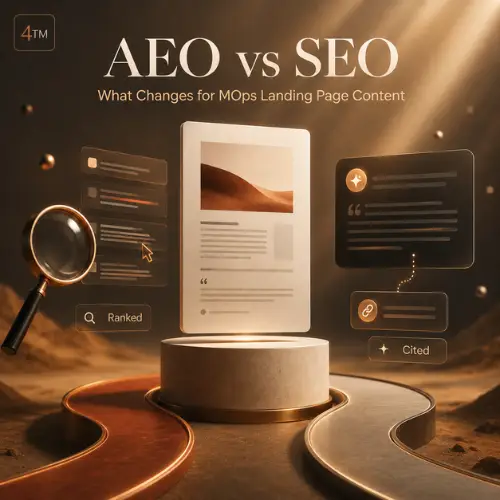
The AEO vs SEO differences come down to what each channel optimizes for. Framed as SEO vs answer engine optimization, the split is simple: SEO optimizes for a ranked position and a click, while AEO optimizes for a citation inside a generated answer. Once you see that, the rest of the AEO vs SEO differences fall into place. The table below captures the core AEO vs SEO differences at a glance.
| Attribute | SEO | AEO |
|---|---|---|
| Primary goal | Rank a link | Earn a citation |
| Unit of success | A click | A mention in the answer |
| Optimizes for | Keywords and backlinks | Extractable, quotable passages |
| Key metrics | Rankings, sessions, click-through rate | Citations and share of answer |
| User sees | A ranked list of links | One synthesized answer |
| Content shape | A full page for a reader | Self-contained passages for a model |
A few AEO vs SEO points deserve attention. SEO success is measured in rankings, sessions, and click-through rate. AEO success is measured in citations, mentions, and share of answer, metrics your current analytics were never built to track. The generative engine optimization vs SEO question fits here too: generative engine optimization is often used interchangeably with AEO, and it lands in the same place, be the quoted source, not just the ranked link.
The one thing the AEO vs SEO framing should never imply is a trade-off. The same authoritative, well-structured page can rank in Google and get cited by ChatGPT. Exactly how an engine picks which source to cite is its own topic, covered in our sibling article on how AI answer engines choose which sources to cite.
When to Use Each: What to Do With Your Content
Here is the practical AEO vs SEO answer for a marketing operations team: do both, and let the content type decide where you lean. You are not choosing one or the other, you are tuning the content you publish for AI while protecting everything that already ranks. That, in short, is how AEO changes your content strategy.
Lead with SEO when the page exists to capture demand you measure by clicks, such as a gated landing page or a form built to convert organic traffic. Keep the keyword targeting, the meta tags, and the internal links.
Lead with AEO when the page exists to answer a question a buyer would ask an AI, such as an educational blog, an FAQ, or a definition-heavy explainer. This is the heart of optimizing content for AI search: structure it so a model can lift a clean, quotable answer without guessing.
Make existing content do double duty, the highest-value AEO vs SEO move for most teams. Take a strong page that already ranks, add a one-sentence direct answer at the top of each section, tighten the definitions, and add an FAQ block. You have now optimized the same page for both channels at once. Google’s own AI optimization guide confirms that the fundamentals of helpful, well-structured content carry straight over to AI features, so this is expansion, not rework.
For a fuller walkthrough of structuring pages this way, see our guide to LLM-optimized content for B2B websites, and use our answer engine optimization pillar as the map for the whole shift.
How to Tell If It Is Working
Measuring your AEO vs SEO progress looks a lot like SEO measurement, just aimed at citations instead of clicks. A few kinds of checks tell you if it is working:
- A recurring check where you pose your buyers’ top questions to the major answer engines and log whether you are cited and how you are described.
- A simple citation scorecard that trends your share of answers over time, the way a rank tracker trends keyword positions.
- A side-by-side of AI citations against your search rankings, to see where AI visibility and search visibility diverge.
- A watch on which of your pages get pulled into answers, so you know what is landing.
This is very measurable, and it is exactly the kind of setup 4Thought Marketing can help you stand up and interpret, so reach out if you want expert eyes on it.
Conclusion
The AEO vs SEO shift is not a reason to tear up a playbook that still works. Search engine optimization earns the click, answer engine optimization earns the citation, and the content you publish can do both from one page. That is the whole point of optimizing content for AI search: treat AEO as the next layer on top of solid SEO, start with the content that already performs, and you protect organic traffic while showing up in the answers buyers now trust.
About 4Thought Marketing
We're a B2B marketing automation and AI consultancy with a thing for getting complex tech to actually work. Since 2008, we've helped hundreds of organizations across financial services, technology, manufacturing, and real estate get more from Eloqua, Marketo, and their CRM integrations. We serve our clients across marketing automation strategy, lead lifecycle, AI, compliance, preference management, and more. Explore our services or get in touch.
Frequently Asked Questions
What is the main difference in the AEO vs SEO comparison?
SEO optimizes your page to rank as a link and earn a click, while AEO optimizes it to be cited inside an AI-generated answer. The clearest way to hold the AEO vs SEO differences in your head is rank the link versus earn the citation. Both can be true for the same page.
Does AEO replace SEO?
No. In the AEO vs SEO relationship, answer engine optimization builds on search engine optimization, it does not replace it. The same authoritative, well-structured content can rank in Google and be quoted by ChatGPT, so the relationship is additive, not either-or.
What is the difference in generative engine optimization vs SEO?
Generative engine optimization is largely another name for AEO, so the generative engine optimization vs SEO question mirrors the AEO vs SEO one. SEO targets ranked links and clicks; generative engine optimization targets citations inside generated answers.
How do I start optimizing content for AI search?
Start with a page that already ranks. Add a one-sentence direct answer at the top of each section, tighten your definitions, and include an FAQ block. That single pass tunes the content you publish for AI without touching what already works.
Which metrics show whether my AEO work is paying off?
SEO metrics like rankings and sessions still matter, but AEO adds citations, brand mentions in AI answers, and share of answer. Pair your existing reporting with AI-answer monitoring on a regular cadence.
Do I need new tools to handle AEO vs SEO?
Not to begin. Your existing CMS and marketing automation platform can produce AEO-ready content today through better structure and clearer answers. New monitoring tools help you measure citations later, but the AEO vs SEO groundwork is mostly a content-structure change.