Key Takeaways
- Govern an AI agent like a powerful new team member.
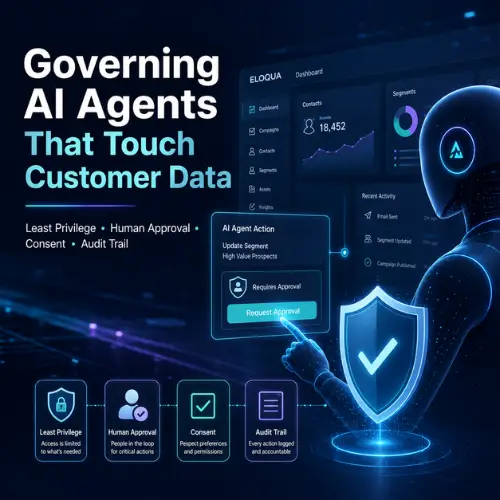
- Governing Eloqua AI agents starts with least-privilege access.
- Keep a human approving anything that reaches a person.
- Set guardrails: data minimization, read-only first, respect consent.
- Log every action for a complete, reviewable audit trail.
- An agent inherits the obligations of the records it touches.
Table of Contents
The moment an AI agent can act inside Eloqua, it stops being a clever tool and becomes a new actor in your stack, one that reads records, changes fields, and takes steps on its own. That shift is exactly why governing Eloqua AI agents deserves its own playbook, separate from the excitement of what an agent can do.
Here is the uncomfortable part. An assistant that only suggests copy is low-stakes; an agent that acts on the personal information in your database can make a real mistake at machine speed. The risk is not the intelligence; it is the combination of autonomy and access.
The good news is that you already know how to handle this. You govern an agent the way you would onboard a powerful new team member: give it only the access it needs, require sign-off on anything that reaches a person, set clear boundaries, and keep a record of everything it did. This article turns that instinct into a practical, plain-English playbook.
Why Governing an AI Agent Is Different
The core difference is simple: an agent acts, it does not just advise. A recommendation engine that suggests a segment cannot hurt anyone until a human acts on it. An agent that can write to a contact record can send the wrong message to real people before anyone notices. That is why governing Eloqua AI agents is a distinct discipline, not a footnote to your existing AI policy. In risk terms, you are managing autonomy and access together, and that combination is exactly what a sound AI agent risk management approach is built to contain.
This is the govern stage of the wider picture we set out in our overview of agentic AI in Oracle Eloqua. It builds directly on the earlier stages of launching an AI agent pilot in Eloqua and connecting AI agents to Eloqua via REST API and MCP. If you already run a formal control structure, this fits neatly inside a marketing ops governance model that sticks, rather than replacing it.
Permissions: Least-Privilege by Default
Start every agent with the least access it can possibly use to do its job, and add more only when a specific need is proven. Least privilege is the single most effective control you have because an agent cannot misuse information it was never allowed to see.
Scope tightly: grant access to the specific objects the task requires, not the whole instance. A hygiene agent that standardizes fields does not need to read email engagement history.
Use a dedicated identity: give each agent its own service account with its own permissions, never a shared human login, so its access can be reviewed and revoked independently.
Prefer read over write: a great many useful jobs only need to read. Keep the ability to change subscriber records behind a higher bar than the ability to look at them.
Human-in-the-Loop: Approval Gates
The firmest rule in the playbook: a person approves anything that reaches a real individual. Human-in-the-loop is not bureaucracy; it is the checkpoint that keeps a fast agent from turning a small error into a public one.
Decide in advance which actions require sign-off. Sending, publishing, or altering a live campaign should be subject to an approval gate. Internal, reversible work such as drafting or flagging duplicates can run more freely. This tiered approach is the same human-oversight spine recommended by the NIST AI Risk Management Framework, which treats human review as a core control rather than an optional extra.
Guardrails: Boundaries on Data and Actions
Guardrails are the standing rules that hold whether or not a human is watching. Three matter most for an agent working near the people in your database.
Data minimization: let the agent handle only the fields it genuinely needs. The less personal information it touches, the smaller the blast radius if something goes wrong.
Respect consent: an agent must honor the same permission and preference rules your campaigns do, so it never contacts someone who opted out. Building those checks into your data is exactly the discipline we cover in managing consent and permission fields in Eloqua and Marketo.
Know the privacy stakes: treat the information an agent reaches with the same care as any regulated record. The distinction between protecting it and securing it is worth understanding, as we explain in our article on data privacy vs. data security in the age of AI.
Audit Trails: Traceability and Accountability
If you cannot say what an agent did, you cannot govern it. An audit trail, a complete, tamper-resistant log of every action, is what turns trust into evidence and makes accountability real, the same principle of accountability and traceability set out in the OECD AI Principles.
Log everything: record each read and write, the time, the records involved, and the outcome, so any action can be reconstructed and, if needed, reversed.
Make it audit-ready: keep those logs in a form you can actually show a reviewer on demand. The value of audit-ready evidence and immutable activity logs is that when a question arises, you answer with a record rather than a guess.
A Practical Governance Checklist for MOps
The whole of governing Eloqua AI agents comes down to a short checklist you can apply before any agent goes near live records:
- Scope: least-privilege access, dedicated service account, read-only unless writing is justified.
- Approval: a human signs off on anything that reaches a real person.
- Consent: the agent honors every opt-out and preference rule.
- Minimization: only the fields the job truly needs, nothing more.
- Audit: every action logged, reviewable, and reversible.
- Ownership: one named person accountable for the agent and its outcomes.
Conclusion
Governing Eloqua AI agents is not about slowing innovation, it is what lets you move quickly without betting the trust of the people in your database. Give the agent the least access it needs, require human sign-off on anything customer-facing, set guardrails that respect consent, and log every action so accountability is provable. Do that, and an agent becomes a dependable colleague rather than a liability. If you would like help building the guardrails for your own instance, 4Thought Marketing can help.
About 4Thought Marketing
We're a B2B marketing automation and AI consultancy with a thing for getting complex tech to actually work. Since 2008, we've helped hundreds of organizations across financial services, technology, manufacturing, and real estate get more from Eloqua, Marketo, and their CRM integrations. We serve our clients across marketing automation strategy, lead lifecycle, AI, compliance, preference management, and more. Explore our services or get in touch.
Frequently Asked Questions
How do I stop an AI agent from touching data it should not?
Use least-privilege access. Give the agent its own service account scoped only to the fields and actions its job requires, and keep writing to records behind a higher bar than reading. It cannot misuse information it was never granted.
What is least-privilege for AI agents?
Least-privilege means the agent starts with the minimum access it needs and gains more only when a specific need is proven. In practice that is a dedicated identity, tightly scoped permissions, and read-only defaults wherever possible.
Do I need a human to approve agent actions?
For anything that reaches a real person, yes. Sending, publishing, or changing a live campaign should sit behind an approval gate. Internal, reversible tasks such as drafting or flagging duplicates can run with lighter oversight.
How do I audit what an AI agent did?
Log every action, the read or write, the time, the records involved, and the result, in a tamper-resistant trail. Keep those logs audit-ready so you can show a reviewer exactly what happened on demand rather than reconstructing it later.
Is agentic AI safe for consent and privacy?
It can be, if the agent honors the same consent and preference rules your campaigns follow and touches the minimum personal information needed. Treat the records it reaches with the same care and obligations as any regulated data.
Who should own governance of an AI agent?
One named person should be accountable for each agent, its guardrails, and its outcomes. Marketing operations owns the day-to-day controls, partnering with security and privacy teams on anything that touches regulated records.