Key Takeaways
- An AI agent lives outside Eloqua and reaches in through its API.
- To connect AI agents to Eloqua, you use its first-party REST API.
- The open Model Context Protocol wraps that API for AI tools.
- Oracle sells no native agent or native MCP for Eloqua.
- Every agentic action authenticates, acts, and returns a result.
- Keep a human checkpoint on anything that reaches a customer.
Table of Contents
An AI agent does not live inside Eloqua. It runs somewhere else and reaches in from outside, which means the real question for a marketing operations team is not whether an agent can do the work, but how you actually connect AI agents to Eloqua in a way you can see and control.
That gap trips up a lot of teams. The demos make it look like the agent simply lives on the platform, so the underlying architecture remains a mystery. You cannot govern a connection you do not understand.
The path is more concrete than it looks. An agent reaches Eloqua through a legitimate, controlled channel: Eloqua’s first-party REST API, increasingly wrapped by the open Model Context Protocol standard. This article explains that architecture in plain terms for a technically literate MOps reader, without turning into a developer manual.
What “Connect AI Agents to Eloqua” Actually Means
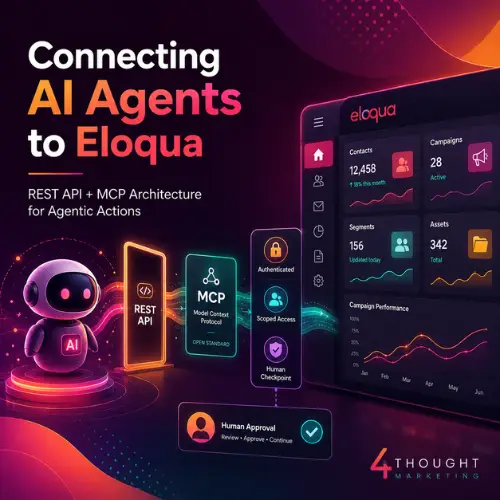
Start with the mental model, because it makes everything else click. The agent is a separate piece of software with a goal. Eloqua is the system of record it needs to read from or act on. To connect AI agents to Eloqua is simply to open a secure, permissioned doorway between the two, so the agent can request data or trigger an action and receive a result.
This is the connect stage of the wider picture we set out in our overview of agentic AI in Oracle Eloqua. It sits between two neighbors: the practical work of launching an AI agent pilot in Eloqua, and the discipline of governing AI agents that touch Eloqua customer data. If you are still deciding which agentic jobs are worth wiring up at all, our primer on AI use cases for Eloqua and Marketo teams is the right place to sort them by value and risk.
The Foundation: Eloqua’s REST API
Everything to connect AI agents to Eloqua rests on one fact: Eloqua has a real, first-party REST API, and it is the legitimate front door any agent uses. It is documented, supported, and available today. An agent does not get special backstage access; it makes the same kind of authenticated requests that any approved integration makes. You can read the specifics in Oracle’s official Eloqua REST API documentation.
What it exposes: the REST API lets approved software read and write the core objects a marketer cares about, contacts, segments, campaigns, and assets, within the permissions granted to it. For a plain-English tour of how Eloqua’s interfaces differ and when each applies, see our guide to Eloqua’s REST and Bulk APIs.
Authentication, at concept level: access is gated by credentials, typically an OAuth-based sign-in that proves who the caller is and what it may do. You do not need to master the mechanics, but you do need to insist that every agent connection is individually authenticated and scoped, never a shared master key.
The Open-Standard Layer: MCP
The newer piece is the Model Context Protocol, or MCP, an open standard for AI integration that gives agents a consistent way to discover and use a system’s capabilities. Think of the REST API as the door and MCP as a common, well-labeled handle that many AI tools already know how to turn.
Why “open standard” matters: an open standard is not owned by any single vendor, so tools built to it can interoperate without custom glue for each one. That lowers the cost of change and reduces lock-in. For a fuller walkthrough, see our guide to using MCP with your marketing automation platform.
Two honest caveats belong here. Oracle does not currently offer a native MCP capability for Eloqua, nor does it sell a native AI agent for Eloqua. Third-party connectors do exist that wrap Eloqua’s REST API in an MCP-style layer, but any such connector comes from outside the platform and should be judged on its own security and support merits.
How an Agentic Action Actually Flows
Strip away the jargon and a single agentic action follows four steps. Knowing this flow lets you reason about where the risk lies.
- Request: the agent decides it needs to read or change something and forms a call to the API.
- Authenticate: Eloqua checks the agent’s credentials and confirms it is allowed to do that specific thing.
- Act: the permitted action runs, reading a record or writing an update within its scope.
- Return: a result comes back to the agent, which decides its next step.
The critical addition is a human checkpoint: for anything that reaches a customer, a person approves before the action commits. That human oversight on agent actions is the same control spine recommended by the NIST AI Risk Management Framework, and it is what separates a safe design from a risky one. For a sense of how this pattern is maturing elsewhere, it is worth seeing how agentic AI is taking shape in Marketo.
Practical Constraints to Design For
A connection that works in a demo can still break at scale. Design for the real limits from the start.
Rate limits: APIs cap how many calls you can make in a window. An eager agent can hit that ceiling fast, so plan for pacing and retries rather than assuming unlimited access.
Read versus write: reading data is far lower risk than writing it. Many first connections should be read-only, earning the right to write only once oversight is proven.
Scope per endpoint: grant access to the specific objects the job needs, not the whole instance, so a mistake stays contained.
Confirm what is live: AI capabilities and connector features move quickly and vary by environment. Before you build a process around any capability, confirm what is actually available on your own Eloqua instance rather than trusting a general claim.
Safe by Design
A good connection is secure before it is clever. Individually authenticate every agent, scope it to the minimum it needs, log every action, and keep the human checkpoint on anything customer-facing. Those four habits turn a powerful capability into a controllable one.
The connection is only half the story. Once an agent can act on real records, the deeper questions of permissions, auditing, and accountability fall within the practice of governing AI agents that touch Eloqua customer data.
Conclusion
You do not need to write code to reason well about how you connect AI agents to Eloqua. The architecture is knowable: a first-party REST API as the front door, the open MCP standard as a shared handle, authenticated and scoped access, and a human checkpoint on anything that reaches a customer. Understand that path, and you can approve, secure, and design agent connections with confidence rather than guesswork. If you would like help mapping the right architecture for your instance, 4Thought Marketing can help.
About 4Thought Marketing
We're a B2B marketing automation and AI consultancy with a thing for getting complex tech to actually work. Since 2008, we've helped hundreds of organizations across financial services, technology, manufacturing, and real estate get more from Eloqua, Marketo, and their CRM integrations. We serve our clients across marketing automation strategy, lead lifecycle, AI, compliance, preference management, and more. Explore our services or get in touch.
Frequently Asked Questions
How does an AI agent connect to Eloqua?
It connects from outside through Eloqua’s first-party REST API. The agent sends an authenticated request, Eloqua verifies its permissions, the action runs within scope, and a result returns. A human approves anything that reaches a customer.
What is MCP and does Eloqua support it?
MCP, the Model Context Protocol, is an open standard that gives AI tools a consistent way to use a system’s capabilities. Oracle does not sell a native MCP for Eloqua, but third-party connectors can wrap the REST API in an MCP-style layer.
Do I need the REST API to connect an agent?
Yes. The REST API is the legitimate, first-party doorway into Eloqua, and any well-built agent uses it. Even an MCP-based connector ultimately relies on that same API underneath.
Do I need developers to connect an agent?
For building and securing the connection, yes, that is developer work. But a marketing operations lead owns the decisions that matter: what the agent may access, whether it can write, and where the human checkpoints sit.
Is connecting an agent safe for customer data?
It can be, if you design for it. Individually authenticate each agent, scope it to the minimum data it needs, keep writes gated behind human review, and log every action so it can be audited and reversed.
Does Oracle sell a native AI agent or MCP for Eloqua?
No. Oracle offers assistant-level AI and a real REST API, but no native autonomous agent and no native MCP for Eloqua. Any agentic connection is assembled from the API plus tooling that lives outside the platform.