





Quick Takeaways
- Bot form submissions are quietly inflating your MQL counts.
- Traditional lead scoring rules were never built to catch bots.
- Submission timing and field patterns expose most automated form fills.
- AI agents now browse and complete forms like real buyers.
- A lightweight verification gate should sit before any lead scores.
- Score decay alone will not fix a bot contamination problem.
Table of Contents
Bot form submissions are already sitting inside your MQL queue, and your scoring rules have no idea. Every demo request, whitepaper download, and gated content fill still earns points the moment it lands, the same way it did five years ago.
Marketing automation platforms like Eloqua and Marketo built lead scoring around a simple assumption: a form fill means a real person, with a real job, took a real interest in your product. For years that assumption held up well enough to trust without much scrutiny. That assumption is breaking down now. AI agents, scraper bots, and automated testing tools now browse websites and complete forms as fluently as any prospect, which is exactly how fake form fills slip past a scoring rule built for a slower, more human internet.
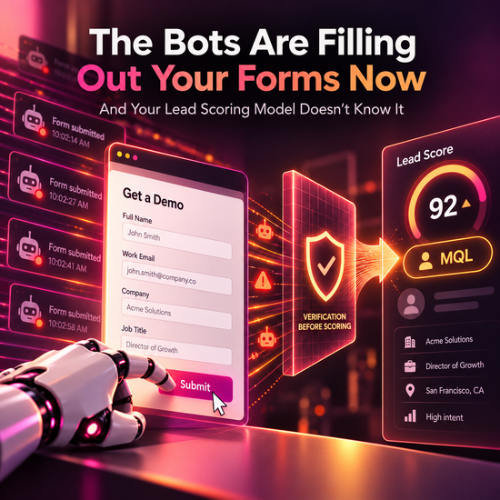
The fix is not to abandon lead scoring. It is to add a verification layer in front of your scoring model, and to know which signals separate a synthetic submission from a real one before automated submissions ever reach your sales team.
Why Bot Form Submissions Are Rising Now
Agentic AI Changed the Traffic Mix
Web traffic used to split cleanly into “people” and “crawlers you could name,” like search engine indexers. That split no longer holds. AI browsing agents, built to research vendors, compare pricing, and even fill out forms on a user’s behalf, now move through the same pages your prospects do, generating form fills your team never sees coming.
Why it matters: An AI agent completing your demo request form on behalf of a curious researcher, a competitor, or a test account looks identical to your scoring model as a real buyer clicking submit.
Who’s Actually Filling Out Your Forms
Beyond AI agents, the traffic mix includes scraper bots harvesting content for AI training sets, lead-generation fraud rings selling fabricated leads to agencies, and your own QA and monitoring tools running automated checks against production forms. None of them are buyers, and all of them can trigger your scoring rules long before any detection step gets a chance to catch them.
How Bot Form Submissions Corrupt Your Lead Scoring Model
Score Inflation Without a Real Buyer
A rule-based scoring model assigns fixed points for actions like a whitepaper download or a pricing page visit, regardless of who performed them. Bot form submissions collect those same points, which means your scoring model treats a scripted submission exactly like a director-level prospect who spent ten minutes on your site.
Why it matters: Negative scoring and score decay, the usual tools for cleaning up bad data, were designed to catch disengaged humans, not synthetic activity that never engages at all. Bot traffic also stacks on top of the slower scoring model drift most teams already miss.
The MQL Quality Problem Sales Feels First
Scoring corruption does not show up as a scoring problem. It shows up as an MQL-to-SQL handoff problem, when sales reports a rising rejection rate on leads that technically cleared your threshold.
Detection Signals Your Team Can Act On Today
Catching bot form submissions early keeps your scoring model honest, and most of the signals below require no new tooling to start using.
Behavioral and Timing Signals
Real prospects hesitate, backspace, and take seconds to complete a form. Bots do not. A submission completed in under two seconds, multiple submissions from the same IP address within minutes, or a cluster of form fills at 3 a.m. local time are all detection signals worth building into your real-time data validation rules. Treat those rules as part of your AI data governance framework, so they have an owner and get reviewed as bots evolve.
Field-Level Red Flags
Disposable email domains, mismatched postal codes and cities, and identical free-text answers across multiple submissions are strong field-level tells. Platforms including Salesforce’s Account Engagement forms now ship built-in bot protection that screens submissions before a lead ever reaches your database, catching many scripted entries before they can distort a single score, and Google’s reCAPTCHA v3 works the same way, scoring every interaction invisibly instead of interrupting the visitor with a puzzle.
For the ambiguous entries that clear every rule, AI classification can act as a second pass, as our May Office Hours junk-form experiment showed.
Adjusting Your Scoring Model and Forms for a Bot-Aware Instance
A bot-aware scoring model needs two things working together: a verification step before scoring, and forms designed to be harder for a script to complete. It also protects the fit data behind AI-driven lead scoring and grading.
Add a Verification Gate Before Scoring
The most direct fix is procedural, not technical: hold new submissions in a pending state until a verification check clears, then release them into your normal scoring flow. This single change keeps synthetic submissions out of your MQL count without touching your existing scoring rules. Pairing that gate with the broader data hygiene practices your team already runs on the rest of the database closes most of the remaining gap. For the broader data, governance, and people groundwork behind it, see our guide to building an AI-ready MOPs instance.
Redesign Forms to Repel Automation
Form design itself is a defense. Honeypot fields invisible to human visitors but irresistible to scripts, required fields that need real judgment to answer, and the structural choices covered in best practices for building marketing forms all raise the cost of a scripted submission, stopping bot form submissions before they ever reach your scoring model.
Conclusion
Bot form submissions are not a future risk to plan around. They are already inside most B2B scoring models, quietly inflating MQL counts and setting sales up to reject leads that never should have qualified in the first place. The instances that stay ahead of this will treat verification as a required step before scoring, not an optional cleanup task after the fact. If you want help auditing your own instance for bot contamination and rebuilding a scoring model that accounts for it, contact us at 4Thought Marketing.
About 4Thought Marketing
We're a B2B marketing automation and AI consultancy with a thing for getting complex tech to actually work. Since 2008, we've helped hundreds of organizations across financial services, technology, manufacturing, and real estate get more from Eloqua, Marketo, and their CRM integrations. We serve our clients across marketing automation strategy, lead lifecycle, AI, compliance, preference management, and more. Explore our services or get in touch.
Frequently Asked Questions
What are bot form submissions?
They are website form entries completed by automated scripts, AI browsing agents, or scraper tools instead of a real prospect. They can look identical to a genuine submission in your CRM or marketing automation platform.
How does this affect lead scoring accuracy?
Automated entries earn the same points a real prospect would for actions like form fills or content downloads. Over time this raises your MQL volume without a matching rise in real buying intent, which drags down lead quality and sales trust in the scores.
Can a rule-based model detect bots on its own?
Not on its own. Rule-based scoring assigns fixed points for specific actions and does not evaluate whether the action was performed by a human, so it has no built-in way to flag automated entries.
What is the fastest way to start detecting bot form submissions?
Start with timing and field-level signals: submissions completed in under two seconds, repeated entries from the same IP, and disposable email domains are the easiest wins to implement without new tooling.
Should we use CAPTCHA to stop automated form fills?
A frictionless option like reCAPTCHA v3 is usually a better starting point than a traditional CAPTCHA puzzle, since it scores risk in the background without adding steps for real visitors.
Will adding bot detection slow down our lead flow?
It should not, if implemented as a brief verification gate rather than a manual review step. Most submissions clear instantly, and only flagged records need a closer look before they enter your scoring model.