Key Takeaways
- B2B preference management turns subscriber data into a personalization engine.
- Zero-party data is the most trustworthy signal in a privacy-first world.
- Most preference centers are compliance tools masquerading as personalization.
- Eloqua and Marketo both support preference-driven segmentation natively.
- A well-designed preference center reduces opt-outs and increases relevance.
- AI can now predict preference drift before contacts opt out.
Table of Contents
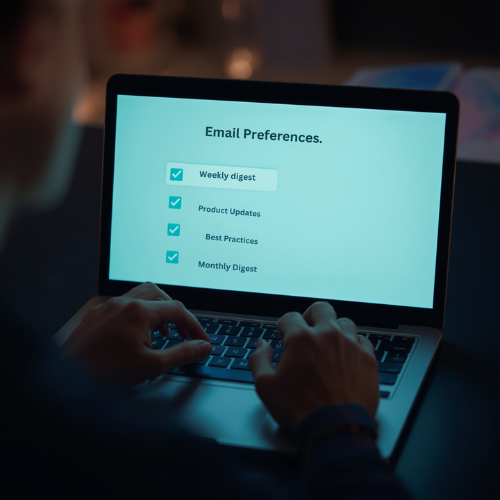
A preference center is the only asset in your marketing stack where your contacts have already told you exactly what they want — and most teams never use that data to personalize anything.
Most B2B marketing teams treat their email preference center as a legal necessity: a page buried in the footer, built to satisfy unsubscribe requirements and nothing more. The boxes get checked. The compliance team is satisfied. And then the data sits untouched in a field no one ever segments by.
That is the wrong frame entirely. Your preference center is the most direct line you have to your subscribers’ declared intent. This article breaks down why that data is more valuable than anything your behavioral tracking can produce, and exactly how to wire it into your personalization strategy in Eloqua and Marketo.
Why Your Preference Center Is Sitting on a Personalization Gold Mine
Think about the last time a contact updated their preferences. They told you which topics interest them, how often they want to hear from you, and sometimes which role or industry they represent. That is not passive data collected by watching someone click around your site. That is an active declaration of what they value.
The problem is that most organizations’ approach to B2B preference management stops at the collection step. The data exists. The subscriber preference data populates a field. And then it goes nowhere because no one has mapped it to a segment, a nurture stream, or a content rule.
Consider what a subscriber who selects “Marketing Automation Best Practices” and “Monthly Digest” has just told you: they are an engaged professional who wants strategic content delivered at a measured pace. A subscriber who selects “Product Updates” and “Weekly” is signaling an entirely different relationship. Sending both contacts the same generic email is not neutral. It is a deliberate waste of the data they handed you.
The retention argument: Topic-level unsubscribe consistently outperforms global unsubscribe for retention. When a contact can say “stop sending me webinar invites but keep the newsletter,” they stay in your database. A global unsubscribe is your only alternative. One of these keeps the relationship alive. The other ends it.
AI is beginning to add another layer here. Platforms can now analyze preference center engagement patterns to predict when a subscriber is drifting toward disengagement, before they opt out. That kind of early warning is only possible if preference data is being treated as a live, actionable signal rather than a static compliance record.
Zero-Party Data vs. Behavioral Data: Why Declared Wins
Behavioral data tells you what someone did; preference data tells you what they asked for — and in a world of tightening privacy regulations, what they asked for is the only signal that holds up over time.
Behavioral data is inferential. When someone opens three emails about lead scoring, you can guess they care about lead scoring. But you can also guess wrong. Maybe they opened because the subject line was compelling. Maybe a colleague forwarded it. Behavioral signals are probabilistic. Declared preference data is not.
Zero party data personalization is built on this distinction. Zero-party data is information a contact gives you deliberately and proactively. It does not need to be inferred, modeled, or scored. It just needs to be used. The challenge is that many B2B teams invest heavily in behavioral scoring models while leaving their declared preference data completely idle. For a deeper look at how declared intent connects to privacy frameworks, see Preference Management: Balancing Privacy, Consent, Complexity & Choice.
The durability of zero-party data also matters for consent-based marketing. Cookie deprecation, iOS privacy changes, and evolving GDPR enforcement are all narrowing the window on behavioral tracking. Preference data does not depend on third-party cookies or device identifiers. It is first-party, explicitly granted, and defensible under every major privacy framework.
If you are building a personalization strategy that needs to hold up in 2027, subscriber preference data is the foundation. You can also explore How to Discover Customer Preferences for a broader look at the research methods that complement a preference center.
The practical gap: The teams that do this well are not doing anything exotic. They are simply closing the loop between what their preference center captures and what their segmentation engine consumes. The teams that do not are leaving a direct line to their subscribers’ intentions completely dark.
What a Personalization-Ready Preference Center Actually Includes
There is a meaningful difference between a preference center that satisfies compliance requirements and one that is built to feed a personalization engine. Most preference centers are the former. Building the latter requires getting specific about what data you actually need to segment and personalize, then designing the experience around capturing it.
Topic subscriptions
This is the most commonly implemented element, and also the most often underdeveloped. A topic list that only offers “Marketing Emails” and “Product Announcements” is too blunt to drive meaningful segmentation. A topic list that maps to your actual content pillars, by use case, buyer stage, or product line, gives you a field that directly drives nurture enrollment.
Frequency and cadence preferences
Not every subscriber wants to hear from you at the same pace. Offering frequency options (daily, weekly, monthly) and allowing contacts to self-select is one of the simplest retention moves available. A contact who is fatigued by daily sends will tell you that if you give them the option. Without it, they unsubscribe.
Role or persona signals
Adding a “What best describes your role?” field to your preference center gives you a self-declared persona signal that no behavioral model can reliably replicate. A VP of Marketing and a Marketing Operations Manager may click the same emails, but they need different content.
Channel and format preferences
If your program includes events, SMS, or direct mail alongside email, let contacts tell you which channels they prefer. This data is especially useful for high-volume programs where channel fatigue is a real retention risk.
For detailed guidance on structuring these elements in a user-friendly way, see Preference Center Design and Best Practices for Email Preference Centers. Both cover the subscriber-facing design decisions that affect completion rates.
One pattern to avoid: the single-field global preference center that offers only “Unsubscribe from all” or “Keep receiving emails.” This design gives you no personalization data and no middle ground for a subscriber who wants fewer emails, not zero emails. It turns every frustrated contact into a full opt-out.
Building It in Eloqua: How Preference Data Drives Segmentation
Eloqua’s subscription management framework is purpose-built for topic-level preference capture. Email groups function as subscription categories that contacts can opt into or out of independently, meaning a contact can remain subscribed to your newsletter while opting out of event invitations. The Oracle Eloqua subscription management documentation outlines the full architecture, including how global unsubscribe interacts with group-level subscriptions.
Mapping preference fields to segments
The most direct use of preference data in Eloqua is contact field segmentation. When a contact selects a topic category on your preference center, that selection should write to a contact field. That field then becomes a segment filter. A segment that says “Topic Interest = Marketing Automation” and “Cadence = Monthly” is more targeted than anything a behavioral score alone produces.
Using preference data in program canvas
Preference-captured fields can drive program canvas decisions directly. A contact who selects “Strategic Content” at a monthly frequency should enter a different nurture stream than a contact who selects “Product Updates” weekly. Wiring these fields into your entry criteria and decision steps is where Eloqua preference center data moves from passive storage to active orchestration. For a current look at how this plays out in practice, see Preference-Led Personalization: Eloqua Insights 2026.
Connecting to consent and compliance
Preference center data in Eloqua also connects directly to your consent management architecture. For organizations operating under GDPR or CASL, preference fields can serve dual duty: they record what a contact wants to receive and document the basis for sending. See Irresistible Consent Management Automation for guidance on how to structure that connection.
If your current Eloqua preference center is functioning more as a compliance checkbox than a segmentation engine, 4Preferences is the fastest path to closing that gap. It is built specifically to turn preference capture into a data asset that drives downstream personalization, without requiring a full platform rebuild. Learn more at 4thoughtmarketing.com/products/4preferences/.
Building It in Marketo: Subscription Centers That Feed Smart Lists
Marketo’s equivalent to the Eloqua email group is the subscription center, a landing page and form combination that allows contacts to manage their communication preferences at the topic level. When structured correctly, a Marketo subscription center captures preference data as person field values that feed directly into Smart Lists. The Adobe Experience League subscription center tutorial covers the setup fundamentals.
Smart Lists built on preference fields
The practical power of Marketo preference data lives in Smart List filters. A Smart List that filters on “Content Interest = Demand Generation” and “Email Frequency Preference = Weekly” creates a precisely defined audience for your demand generation content track. The contact self-selected into that definition. You did not have to infer it from click behavior.
Preference fields in engagement programs
Marketo engagement programs support stream switching based on data value changes. When a contact updates their preferences, a trigger can move them to the appropriate content stream automatically. A contact who upgrades from “Monthly” to “Weekly” frequency preference is signaling increased engagement intent. Your program should respond to that signal, not ignore it.
Avoiding the global unsubscribe trap
Marketo’s default unsubscribe field is an all-or-nothing mechanism. A subscription center that supplements this with topic-level boolean fields gives you the granularity to honor a “reduce my emails” request without triggering a full opt-out. This is the structural difference between a compliance tool and a retention tool.
The same principle that applies in Eloqua applies here: 4Preferences can accelerate the build for Marketo programs as well. Rather than constructing preference capture infrastructure from scratch, the product provides a framework that connects preference data to your existing segmentation and engagement logic. Details at 4thoughtmarketing.com/products/4preferences/.
Conclusion
Your contacts have already done the hard part. They visited your preference center, selected the topics that matter to them, and told you how they want to hear from you. The gap is not data; it is the connection between that data and your segmentation logic. B2B preference management done right turns your preference center from a compliance page into the most reliable personalization signal in your stack. If you are ready to close that gap in Eloqua or Marketo, 4Preferences is built for exactly that. Reach out to 4Thought Marketing to see how it works in your environment.
About 4Thought Marketing
We're a B2B marketing automation and AI consultancy with a thing for getting complex tech to actually work. Since 2008, we've helped hundreds of organizations across financial services, technology, manufacturing, and real estate get more from Eloqua, Marketo, and their CRM integrations. We serve our clients across marketing automation strategy, lead lifecycle, AI, compliance, preference management, and more. Explore our services or get in touch.
Frequently Asked Questions
What is B2B preference management and why does it matter?
B2B preference management is the practice of collecting, storing, and acting on subscriber-declared communication preferences, including topics, frequency, and channel. It matters because it is the most direct signal a marketer can have about what a contact actually wants to receive, which drives both relevance and retention.
How is zero-party data different from first-party behavioral data?
Zero-party data is information a contact provides directly and intentionally, such as selecting topics on an email preference center. First-party behavioral data is inferred from observed actions like clicks and page visits. Zero-party data is more reliable for personalization because it reflects declared intent rather than interpreted behavior.
How do I use preference center data for segmentation in Eloqua?
In Eloqua, preference center selections should write to contact fields. Those fields become segment filters that drive nurture enrollment and program canvas decisions. An Eloqua preference center built this way produces segments based on what contacts asked for, not just what they clicked on.
Can a Marketo subscription center replace behavioral scoring for personalization?
It does not replace behavioral scoring; it complements it. Marketo subscription center preference fields feed Smart Lists that define audiences based on declared interests. Combined with engagement scoring, preference data adds a declared-intent layer that behavioral models cannot replicate on their own.
What is the difference between a global unsubscribe and a topic-level preference center?
A global unsubscribe removes a contact from all communications. A topic-level preference center lets contacts opt out of specific communication types while staying subscribed to others. Topic-level consent-based marketing consistently reduces full opt-outs because it gives contacts a middle option between too many emails and none at all.
How does an email preference center help with GDPR and consent compliance?
An email preference center creates a documented record of what a contact consented to receive. When preference fields are tied to your consent management architecture, each selection serves as both a personalization input and a compliance record. This dual function is one of the strongest arguments for investing in a well-structured preference center.