





Key Takeaways
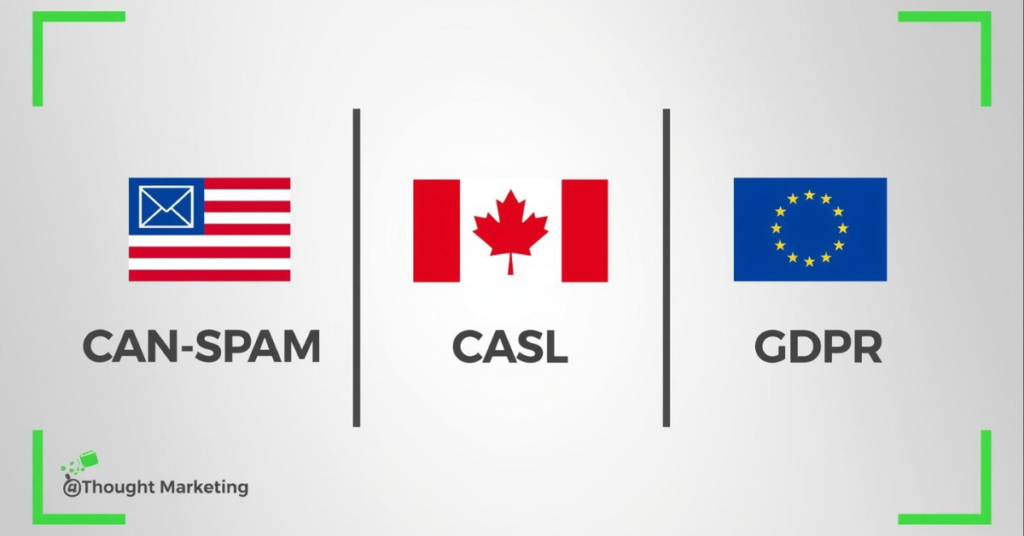
- CAN-SPAM CASL GDPR each use a different consent model.
- CAN-SPAM allows sending commercial email without prior consent.
- CASL requires opt-in consent before any commercial message is sent.
- GDPR demands a documented lawful basis for processing contact data.
- Penalties range from $53,088 per email (CAN-SPAM) to CA$10M per violation (CASL).
- Your MAP consent architecture must reflect which law applies per contact.
Most B2B marketing databases contain contacts from the United States, Canada, and the EU, often sitting in the same segment, governed by the same unsubscribe flag, treated as a single list. That is where compliance exposure accumulates.
CAN-SPAM, CASL, and GDPR govern commercial email across three different jurisdictions, and they are built on fundamentally different legal principles. CAN-SPAM allows you to send without prior consent; CASL requires consent before the first commercial message; GDPR requires a documented lawful basis for processing personal data, which may or may not take the form of consent depending on your sending context. The stakes are concrete.
The FTC confirms that each non-compliant email under CAN-SPAM can carry a penalty of up to $53,088, a figure last adjusted for inflation in January 2024. The CRTC sets the corporate maximum under CASL at CA$10 million per violation. Under Article 83 of the GDPR, the most serious breaches carry fines of up to €20 million or 4% of an organization’s global annual turnover, whichever is higher.
This guide breaks down how CAN-SPAM, CASL, and GDPR differ at the consent level, what each law requires in practice, and what those distinctions mean for the way your marketing automation platform is configured.
What Is CAN-SPAM?
The Controlling the Assault of Non-Solicited Pornography and Marketing Act was enacted in the United States in 2003 and is enforced by the Federal Trade Commission. Despite its name, CAN-SPAM does not apply only to bulk email. The FTC’s compliance guidance makes clear that the law covers all commercial email whose primary purpose is the advertisement or promotion of a product or service, including B2B messages, with no exception for business-to-business communication.
Consent Model
CAN-SPAM operates on an opt-out model. Organizations are permitted to send commercial email to any recipient without obtaining prior consent, provided each message includes a clear, functioning mechanism to opt out. Once a recipient exercises that right, the sender has 10 business days to honor the request and cease sending.
Key Requirements
- Accurate sender identification: “From,” “To,” and routing information must correctly identify the person or business sending the message.
- Honest subject lines: Subject lines must not misrepresent or deceive recipients about the content of the email.
- Physical postal address: Every message must include a valid street address, P.O. box, or registered private mailbox for the sender.
- Functional opt-out mechanism: The unsubscribe link or reply option must remain active for at least 30 days after the message is sent.
- Ad identification: Messages must be clearly identified as advertisements where the commercial nature is not otherwise obvious.
What Is CASL?
Canada’s Anti-Spam Legislation came into force in July 2014. It is enforced primarily by the Canadian Radio-television and Telecommunications Commission (CRTC), with additional responsibilities shared between Canada’s Competition Bureau and the Office of the Privacy Commissioner. CASL applies to all commercial electronic messages sent to Canadian electronic addresses, including email, text messages, and social media direct messages. It is widely regarded as one of the strictest anti-spam laws in the world.
Consent Model
CASL operates as an opt-in regime. You must hold either express or implied consent before sending the first commercial electronic message. Express consent requires a clear, affirmative action from the recipient, such as completing a sign-up form with an unchecked opt-in box. Implied consent applies in defined circumstances, including an existing business relationship within the preceding two years, but it is time-limited and not a substitute for a properly consented database.
Under CASL, the absence of a prior send history does not establish implied consent. For more on building effective opt-out and preference management systems that satisfy both CASL and GDPR requirements, see our guide on best practices for email preference centers.
Key Requirements
- Prior consent: Express or implied consent must be obtained and documented before any commercial electronic message is sent.
- Sender identification: Each message must include the sender’s name, mailing address, and either a phone number, email address, or web address.
- Unsubscribe mechanism: A functioning opt-out must appear in every message and be honored within 10 business days.
- Consent records: Organizations must be able to demonstrate that consent exists for each contact, including when and how it was obtained.
What Is GDPR?
The General Data Protection Regulation came into force in May 2018 and applies to any organization that processes the personal data of EU residents, regardless of where that organization is based. This extraterritorial scope is one of the most consequential and most frequently misunderstood aspects of the regulation. A US-headquartered B2B company that markets to contacts at European firms is subject to GDPR if those individuals are EU data subjects. A named professional email address qualifies as personal data under the regulation.
For a detailed breakdown of how GDPR applies specifically to B2B campaigns and MAP workflows, see our guide on GDPR for B2B marketers, which covers lawful bases, data subject rights, and practical audit steps for marketing operations teams.
Lawful Basis
GDPR does not operate on a single consent model. It requires a documented lawful basis for each processing activity involving personal data. For marketing email, the two most relevant bases are consent and legitimate interest. Consent under GDPR must be freely given, specific, informed, and unambiguous. Pre-ticked boxes and assumed agreement do not qualify. Legitimate interest is available in some B2B sending contexts but requires a documented balancing test and can be challenged or withdrawn by the individual at any time.
Key Requirements
- Documented lawful basis: Each processing activity must map to one of the six lawful bases defined under GDPR Article 6.
- Privacy notice at collection: Contacts must be informed of how their data is used, by whom, and for how long at the point of collection.
- Data subject rights: Individuals have the right to access, rectify, erase, and port their personal data. Requests must be fulfilled without undue delay.
- Data minimization: Only the personal data necessary for the stated purpose may be collected and retained.
- Records of processing activities: Controllers must maintain documentation of all processing activities under Article 30 of the regulation.
CAN-SPAM, CASL, GDPR: Core Differences
The following table compares each framework across the dimensions that matter most for email marketing operations and platform configuration.
| Dimension | CAN-SPAM (US) | CASL (Canada) | GDPR (EU) |
|---|---|---|---|
| Consent model | Opt-out | Opt-in (express or implied) | Opt-in or documented lawful basis |
| Prior consent required | No | Yes | Yes (for consent-based sending) |
| B2B email covered | Yes | Yes | Yes (EU data subjects) |
| Max penalty (businesses) | $53,088 per email (FTC, Jan 2024) | CA$10M per violation (CRTC) | €20M or 4% global turnover (Art. 83) |
| Opt-out processing window | 10 business days | 10 business days | Without undue delay |
| Data subject rights | None | Limited | Full (access, erasure, portability, rectification) |
| Enforced by | FTC (United States) | CRTC (Canada) | National DPAs (EU member states) |
| Extraterritorial reach | Limited (US senders primarily) | Messages to Canadian addresses | Any org processing EU resident data |
| Consent documentation required | No | Yes | Yes |
What This Means for Your Marketing Automation Stack
Understanding how CAN-SPAM, CASL, and GDPR differ conceptually is the starting point. The compliance work itself happens inside your platform. For MOps practitioners, each of these frameworks translates into specific requirements at the system level, particularly around how you store consent, structure suppression logic, and process opt-outs.
Consent Fields and Contact Segmentation
Your marketing automation platform needs to capture and store consent data at the individual contact record level. At minimum, each record should document what consent was given, when it was obtained, through which mechanism, and which regulation governs that contact based on geographic location. Running a multi-region database under a single unsubscribe field is insufficient under both CASL and GDPR, where consent must be scoped to the type of communication and, in some cases, the channel.
For teams using Eloqua or Marketo, this means building custom fields for consent source, consent date, applicable regulation, and communication type permissions. Without that structure, you cannot demonstrate compliance to a regulator, and you cannot automate compliant sends at scale.
Suppression Architecture
Under CAN-SPAM, a global suppression list satisfies the minimum legal requirement. Under CASL, suppression logic must also account for the natural expiry of implied consent windows. Under GDPR, withdrawal of consent or an objection to legitimate interest processing requires an immediate pause, not a 10-day processing queue.
If your contact database spans all three jurisdictions, your suppression logic needs to evaluate which law applies to a given contact before any send executes, not after a complaint arrives. For practical guidance on building this architecture inside your MAP, see our guide to privacy in marketing automation workflows.
The Strictest-Standard Principle
When a database includes US, Canadian, and EU contacts, the operationally sound approach is to default to the most restrictive requirements across the board. In practice, this means treating the entire list as an opt-in list, documenting consent provenance for every record, and processing opt-outs without delay. This principle also reduces exposure as US state-level privacy laws continue to expand. As of 2025, eight additional comprehensive state privacy laws took effect, each with its own consent and opt-out provisions for email data.
Tools like 4Comply are purpose-built for this kind of multi-jurisdiction consent architecture, enabling marketing teams to apply regulation-specific rules at the contact level without maintaining separate manual compliance workflows for each geography. For teams managing these requirements inside Eloqua or Marketo, 4Comply integrates directly with both platforms to automate consent checks before sends and maintain an auditable record of every consent event.
Conclusion
CAN-SPAM, CASL, and GDPR each define the right to email someone differently, and those definitions carry real operational consequences for any team with a multi-region contact database. The consent model, documentation requirements, suppression logic, and data subject rights obligations all diverge in ways that a single global unsubscribe list cannot address. The compliance work belongs inside your marketing automation platform. If your team is building or auditing a consent architecture that accounts for all three, 4Thought Marketing can help. Contact us to explore how 4Comply can be configured to your platform, your regulatory profile, and your sending program.
Frequently Asked Questions
Does CAN-SPAM apply to B2B email marketing?
Yes. The FTC’s compliance guidance is explicit that CAN-SPAM covers all commercial email, with no exception for business-to-business messages. Any email whose primary purpose is the commercial advertisement or promotion of a product or service must comply with CAN-SPAM requirements, regardless of whether the recipient is a consumer or a business contact.
What is the difference between CASL express consent and implied consent?
Express consent is a clear, affirmative action by the recipient, such as checking an unchecked opt-in box at a defined point of data collection. Implied consent exists in specific circumstances defined by CASL, such as an existing business relationship established within the prior two years, or a contact who has publicly posted their electronic address alongside their business role. Implied consent has a fixed time limit and is not a substitute for a properly opted-in list. Organizations relying on implied consent must track when it was established and stop sending once it lapses.
Does GDPR apply to US companies sending B2B email to European contacts?
Yes. GDPR applies to any organization that processes the personal data of EU residents, regardless of where that organization is headquartered. A named professional email address is personal data under the regulation. US-based companies with EU data subjects in their marketing database are subject to GDPR requirements for lawful basis documentation, data subject rights fulfillment, and records of processing activities.
What happens if a single contact is covered by more than one email compliance law?
It is possible for a contact to fall within the scope of multiple regulations simultaneously, for example a Canadian resident working at a company with EU operations. The safest approach is to comply with the most restrictive requirements that apply. This strictest-standard principle means following CASL or GDPR opt-in requirements even where CAN-SPAM’s opt-out model would technically permit a send.
How should marketing automation teams manage consent across CAN-SPAM, CASL, and GDPR?
At the contact record level, teams should store the source and date of consent, the applicable regulation based on geography, and the scope of communication the consent covers. Suppression logic should evaluate those fields before any commercial message is sent. Platforms such as 4Comply are designed to automate this process within Eloqua and Marketo, enabling compliant sends at scale and creating an immutable audit trail for each consent event.
Is CAN-SPAM compliance sufficient for Canadian and EU recipients?
No. CAN-SPAM compliance does not satisfy CASL or GDPR requirements. CAN-SPAM is an opt-out framework. Both CASL and GDPR require prior consent or a documented lawful basis before the first commercial message is sent. A database built under CAN-SPAM standards will typically lack the consent records, geographic segmentation, and documentation that CASL and GDPR compliance requires.