
Quick Takeaways
- A global email campaign is really a matrix of regional variants.
- Language, region, and legal cells each drift without deliberate structure.
- Use dynamic content when variation is modest and structure is shared.
- Choose separate assets when layout or legal structure diverges too far.
- Centralize compliance footers so one update propagates to every asset.
- Give regional marketing teams guardrails, not a single approval bottleneck.
Table of Contents
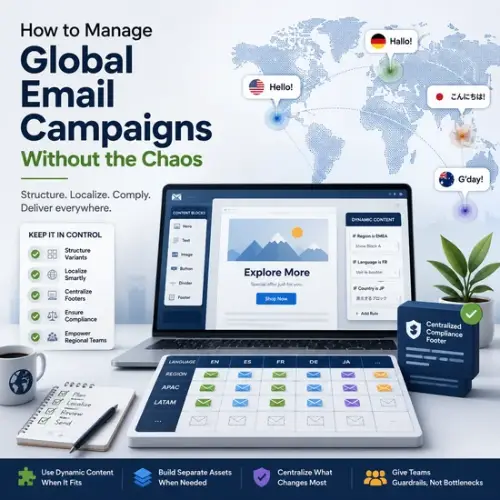
A global email campaign looks like one clean thing on the brief: a single message, sent everywhere, at once. Underneath that tidy label, it is a polite fiction. What you are actually running is a matrix of variants, one cell for every combination of language, region, and legal requirement.
That matrix is where the trouble starts. Each cell drifts on its own schedule. The German version quietly picks up last quarter’s footer while the French version is current, and no one can say with confidence which is right. Offers change in one region and not another. Multiply a few languages by a few jurisdictions and the ad hoc approach breaks.
The fix is not more effort. It is deliberate structure: deciding where variation lives, centralizing what changes most, and letting regional teams move without waiting on one person. Structure is what keeps a global email campaign coherent as it scales.
Why One Global Campaign Is Really Many
A global email campaign is many campaigns wearing one name. The moment you localize, you create a grid: languages across the top, regions down the side, and legal requirements layered on both. Every cell is a distinct asset with its own copy, imagery, offer, and legal footer.
Concrete scenario: your team briefs one promotion for EMEA, APAC, and LATAM. By send day, that single brief has become nine or ten live variants. The Spanish LATAM version runs a different offer than the Spanish EMEA version. One footer still references an old mailing address. Without campaign version control, you cannot tell which cell is current and which is stale.
Why it matters: drift is not a failure of care, it is the default behavior of an unmanaged matrix. Treating a global email campaign as one asset guarantees that some cells fall behind. Treating it as a managed set is the first step toward real control.
Dynamic Content vs. Separate Assets: How to Choose
The core architectural decision in any global email campaign is whether to serve variants through dynamic rules inside one template, or to build separate assets for each region. Get this right and maintenance across the entire global email campaign stays sane. Get it wrong and you either drown in duplicate files or build one template so complex that no one dares edit it.
Use dynamic content when variation is modest and the underlying structure is shared. A swapped headline, a localized call to action, or a region-specific promotional block are ideal for dynamic content that adapts per subscriber, because the layout never changes. This is also where email localization is cheapest to maintain, since you translate strings inside a stable frame.
AI-assisted translation is making email localization faster and cheaper, which only raises the stakes on structure: the more variants you can generate, the more disciplined your email template management has to be.
Use separate assets when layout, legal structure, or language length diverge enough that one template becomes fragile. Right-to-left languages, jurisdictions that demand a different footer arrangement, or copy that expands in translation can overload a single design. In those cases, reusable, modular content blocks let you assemble region-specific emails from shared, tested pieces without cloning an entire file each time. Sound email template management is what keeps those blocks consistent as the library grows.
Avoid the worst case: the single asset stuffed with so many conditional rules that editing it safely becomes impossible. When your conditional logic needs a documentation page of its own, that is the signal to split into separate assets. For a deeper primer on building maintainable templates, see how to develop an effective marketing email template.
Centralize the Footers and Legal Blocks That Change Most
Centralize the content that changes most often, and in a global email campaign that is almost always the legal language in the footer. Addresses, entity names, unsubscribe wording, and jurisdiction-specific notices update more frequently than teams expect, and they update per region.
Here is the trap: when a compliance footer is copied into dozens of assets, a single change becomes a hunt-and-replace across every file. Miss three assets and you have three variants quietly serving outdated language. This is a version control problem, not a legal one: the wording itself comes from your legal team, but keeping it identical everywhere is an asset-management job.
The fix: store the footer once as shared, referenced content that every asset pulls from. Update the source, and the change propagates everywhere at the same moment. A change that once took hours of manual editing across the matrix can take minutes, with far less risk of a missed cell. In a global email campaign, that single source of truth is what prevents footers from drifting. Stale footers and drifting variants ultimately hurt deliverability, which is why global-campaign hygiene is inseparable from overall email list quality and health. Pairing this with campaign version control means you always know which footer is live in which region.
Align Regional Teams Without Creating a Bottleneck
Scale regional execution by sharing standards and delegating the work, not by routing every send through one person. Funneling an entire global email campaign through a single central approver feels safe at low volume, but it collapses the moment volume rises. The gatekeeper becomes the bottleneck, and deadlines slip while everyone waits.
The scalable pattern separates ownership from execution. The central team owns the templates, the legal blocks, the naming conventions, and the version control system. Regional marketing teams execute within those guardrails: they localize copy, swap approved imagery, and launch on their own schedule without asking permission for every routine change.
Why it matters: quality across the global email campaign is enforced by structure, not by one overloaded reviewer. When the shared template and centralized footer are correct, regional marketing teams cannot easily ship something off-brand, because the guardrails travel with the assets. That is how a global email campaign stays consistent while still moving fast in every market. Consistent coordination also keeps regions from over-mailing shared subscribers as volume ramps, the kind of pressure that fuels list fatigue and skewed engagement scoring when sends outpace what an audience can absorb.
Conclusion
A global email campaign is never really one campaign, and pretending otherwise is what lets variants drift and footers go stale. When you decide deliberately where variation lives, centralize the content that changes most, and give regional teams guardrails instead of a gatekeeper, the chaos gives way to a system that scales. The structure does the work that heroics used to do. If you want help designing that structure for your own markets, contact us at 4Thought Marketing.
About 4Thought Marketing
We're a B2B marketing automation and AI consultancy with a thing for getting complex tech to actually work. Since 2008, we've helped hundreds of organizations across financial services, technology, manufacturing, and real estate get more from Eloqua, Marketo, and their CRM integrations. We serve our clients across marketing automation strategy, lead lifecycle, AI, compliance, preference management, and more. Explore our services or get in touch.
Frequently Asked Questions
When should I use dynamic content versus separate assets?
Use dynamic rules when variation is modest and the layout is shared, such as a swapped headline or a localized call to action. Switch to separate assets when layout, legal structure, or language length diverge enough that a single template becomes fragile. The deciding question is whether one template can hold the variation without a maze of conditional rules.
How do I keep legal footers from going out of date across regions?
Store each compliance footer once as shared, referenced content instead of copying it into every asset. When you update the source, the change propagates to every email that references it, so no region is left serving stale language. This turns a footer update from an hours-long hunt-and-replace into a task that takes minutes.
How can regional teams move fast without losing control?
Separate ownership from execution. A central team owns the templates, legal blocks, and campaign version control, while regional marketing teams localize and launch within those guardrails. Quality stays high because it is enforced by structure, not by one person approving every send.
What is the biggest mistake teams make when scaling a global email campaign?
Treating a global email campaign as a single asset instead of a managed matrix of variants. That mindset lets individual cells drift until footers, offers, and translations fall out of sync. The fix is deliberate structure: decide where variation lives and centralize what changes most.
Is running a global email campaign a list health issue?
Yes. Inconsistent footers, stale offers, and drifting variants damage deliverability and subscriber trust, which are core list health concerns. Managing a global email campaign as a structured system keeps the mailings your subscribers receive accurate and compliant.