




Quick Takeaways
- Your governance debt stays invisible until AI starts spending it.
- Confident wrong AI answers cost more, because nobody double-checks them.
- An AI data governance framework is infrastructure, not a cleanup.
- Stop bad data at forms, APIs, and syncs, not downstream.
- Treat your data dictionary like a schema: changes need approval.
- Tier AI decisions by consequence and reversibility before automating anything.
Table of Contents
Your database has spent a decade quietly absorbing everyone’s shortcuts. The first AI feature you switch on is where that bill comes due, and an AI data governance framework is how you pay it down on your terms instead of the model’s.
For years, governance in marketing operations meant an annual dedupe pass in Eloqua or Marketo Engage, a naming convention document three people read, and a database that grew messier but still worked. That worked because people absorb ambiguity. A scoring model or a generative email tool cannot. It takes your data at face value, at scale.
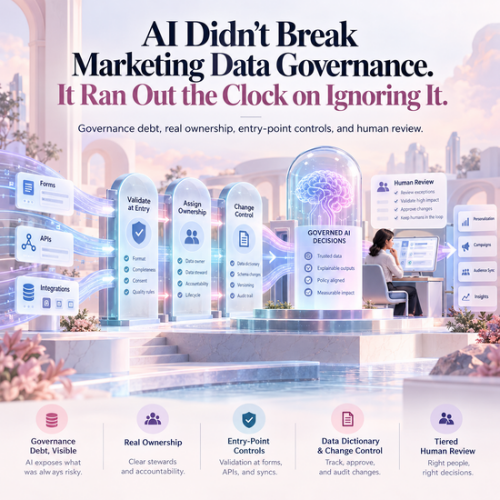
The fix is not a bigger cleanup project. It is governance treated as infrastructure, built before the automation arrives rather than after it goes wrong. Below are the four parts that make it hold: naming the debt, assigning real ownership, enforcing standards where data enters, and deciding which AI decisions still need a human.
What Governance Debt Looks Like Inside Your Instance
It is the residue of years of campaigns, integrations, acquisitions, and uncoordinated admin decisions that nobody budgeted to fix. It is rarely negligence. It is what any mature instance looks like when nobody owns the data model full time.
Where the Debt Hides
Custom objects carry two or three schemas, depending on which integration wrote last. Lead source stayed free text for two years before anyone added a picklist. Duplicate contacts sit across business units, each holding partial engagement history, neither authoritative.
Why AI Raises the Cost of Skipping It
AI does not need better data than you had before. It needs your existing data to mean what you think it means, consistently. As the September Eloqua Office Hours recap explains, a rule that hits bad data stops and tells you, while a model fills the gap with a confident guess.
Picture a hypothetical segment with a 15% duplicate rate. A campaign manager moves on. A model prompted against that segment bakes the duplication into its output, and nobody traces it back until results look wrong weeks later.
Treat AI inference as a tool inside governance, never a substitute. A model that silently reclassifies your mid-market segment is a business problem, not a data quirk.
Who Owns an AI Data Governance Framework?
Marketing operations should own it, because MOps sits where platform configuration, the data model, and campaign logic meet. An AI data governance framework is the set of owners, standards, entry-point controls, and review rules that decide what your data is allowed to mean before any AI feature acts on it. It is one of the three layers of an AI-ready MOPs instance, alongside clean data and a retrained team.
Move From Ticket Queue to Operating Layer
Most teams still govern reactively: a report looks wrong, someone files a ticket, a rule gets patched. That loop is too slow for AI-assisted marketing automation. A generative send that pulls the wrong personalization token does not throw an error. It just goes out slightly wrong, to real people.
What to change: Fold AI data rules into your existing marketing ops governance model instead of starting a parallel process. Field, source, and AI-use decisions should share one owner and one approval path.
Give Stewards Real Authority
Data stewardship for AI only works if stewards can enforce field standards across integrations, not just document them. That means the authority to reject a new integration mapping, freeze a field, or send an import back.
Our breakdown of how a data steward improves marketing covers the role in depth. Adobe’s data governance overview for Experience Platform models the same split: stewards label data and define usage policies, and marketers work within them.
Enforce Standards Where Data Enters
The cheapest place to govern a record is the moment it arrives. After five automated programs, a bad record’s lineage is nearly impossible to untangle.
Validate at Forms, APIs, and Sync Rules
Data validation at the point of entry means every door into your database applies the same standards: form processing, API integrations, list imports, and CRM sync rules. That now includes screening out bot form submissions before they ever reach your scoring model.
In Eloqua: Oracle’s guide to processing form data shows how form processing steps control what a submission writes to the contact record. Pair those steps with real-time data validation in Eloqua so malformed values never land.
In Marketo Engage: Adobe documents how to block updates to a field from selected input sources, so a value like Person Source is written once and protected from untrusted imports or syncs.
Put the Data Dictionary Under Change Control
Treat your data dictionary as a governed asset, the way an engineering team treats a schema migration. Data dictionary change control means nobody adds, renames, or repurposes a field an AI feature reads without a logged request, an owner’s approval, and an updated definition.
This is where an AI data governance framework earns its keep, because many silent AI errors trace back to a field whose meaning drifted. Our guide to keeping a data dictionary up to date covers the habits that make this sustainable.
How Should You Tier AI Decisions for Human Review?
Place human review where consequence is highest and reversibility is lowest. In a well-governed rollout, human judgment is the control, not the bottleneck, which is also why AI changes MOps roles rather than erasing them.
Sort by Consequence and Reversibility
Risk-based human review sorts every AI-assisted decision into one of three tiers, defined in advance.
Human sign-off: High consequence, hard to reverse. A predictive score that decides whether a lead reaches sales, or a generated asset going to a regulated audience.
Sampled audit: Moderate consequence, easy to correct. Enrichment updates or segment suggestions, spot-checked weekly.
Unsupervised: Low stakes and reversible. A subject line variant generated for an A/B test.
The NIST AI Risk Management Framework gives you a vendor-neutral vocabulary for AI risk when you need to align with IT or legal. Map tiers to the AI features your edition and license actually include.
Revisit the Tiers on a Schedule
An AI data governance framework that never updates its tiers goes stale fast. Review tiers quarterly and whenever a model, feature, or data source changes, and move a decision class to a lighter tier only when its error rate earns it.
If AI agents are on your roadmap, our guide to governing AI agents that touch Eloqua’s customer data covers permissions and audit trails for that layer.
Conclusion
AI did not break marketing data governance; it removed your ability to keep postponing it. The teams that win with AI won’t be the first to switch features on. They will be the ones who named their debt, gave it an owner, guarded the door, and decided where a human stays in the loop. Build that AI data governance framework now, and every AI feature you add inherits a foundation you trust. If you want a second set of eyes on where your instance stands, contact us at 4Thought Marketing.
About 4Thought Marketing
We're a B2B marketing automation and AI consultancy with a thing for getting complex tech to actually work. Since 2008, we've helped hundreds of organizations across financial services, technology, manufacturing, and real estate get more from Eloqua, Marketo, and their CRM integrations. We serve our clients across marketing automation strategy, lead lifecycle, AI, compliance, preference management, and more. Explore our services or get in touch.
Frequently Asked Questions
What is an AI data governance framework in marketing operations?
It is the set of owners, standards, entry-point controls, and human review rules that determine what your marketing data means before AI features act on it. It covers field standards, stewardship, entry-point validation, and tiered approval for AI-driven decisions.
Why does AI make poor data governance more expensive?
A rule that hits bad data usually fails visibly; an AI model fills gaps with confident, plausible answers. Those answers get trusted at scale, so a small data problem can shape segments, scores, and content before anyone notices.
Who should own AI data governance on a marketing team?
Marketing operations is usually the natural owner, because it manages platform configuration, the data model, and campaign logic. Its data stewards need authority to enforce field standards, not just document them.
Can AI clean up our marketing data for us?
AI can help at the margins, such as suggesting normalized values or flagging likely duplicates. Keep it inside your governance process with human review, because it produces confident answers even when source data conflicts.
Which AI decisions in Eloqua or Marketo should require human approval?
Decisions with high consequence and low reversibility, such as predictive scores that route leads to sales or generated content going to regulated audiences. Lower-stakes actions, like A/B subject line variants, can run under sampled audits or unsupervised.
How often should an AI data governance framework be reviewed?
Review it quarterly, and whenever a model, AI feature, integration, or major data source changes. Adjust decision tiers based on observed error rates, not enthusiasm for the tool.