






Quick Takeaways
- An AI use policy for marketing closes company memo gaps.
- Name the review role, not just the review step.
- Unapproved tools win when the request path is too slow.
- Govern the decision to enable features, not the feature list.
- AI agents need stricter rules than tools that only draft.
- Review quarterly and whenever platforms, contracts or rules change.
Table of Contents
Does your team have an AI use policy for marketing, or just a company memo that says not to paste confidential data into a chatbot? That memo says nothing about who approves an AI-drafted nurture email before it reaches 40,000 contacts, or which AI features in your platform anyone may switch on.
Most marketing teams already use AI every week. But the rules live in people’s heads, and when something goes wrong, nobody can show what the rule was or who signed off.
The fix is a short, written policy your own team owns. This guide covers what to put in it, who approves it and how to make it stick, with a one-page template at the end.
This post is for educational purposes only and does not constitute legal advice.
Why Does Marketing Need Its Own AI Use Policy?
Company-wide AI rules stop at general acceptable use, while marketing’s risks sit inside the platforms that send to real contacts. A rule that never becomes a setting or a step inside Eloqua or Marketo is a wish, not a policy.
Where the Company-Wide Policy Stops
Enterprise AI policies cover the basics: protect confidential data, check AI output and disclose where required. They rarely say who reviews AI-drafted copy before a send, which platform AI features are on, or how brand voice survives AI drafting at volume. Your marketing policy fills that gap and defers to the company policy for everything else.
What This Policy Is Not
It is not your governance framework. Data ownership, steward roles and review tiers belong in your AI data governance framework, and your marketing policy sits underneath it.
It is also not the place to re-explain how personal data, consent and data subject rights work with AI. Our guide to the three checks behind privacy-safe AI covers that, and your policy simply requires the team to follow it.
What Should an AI Use Policy for Marketing Teams Include?
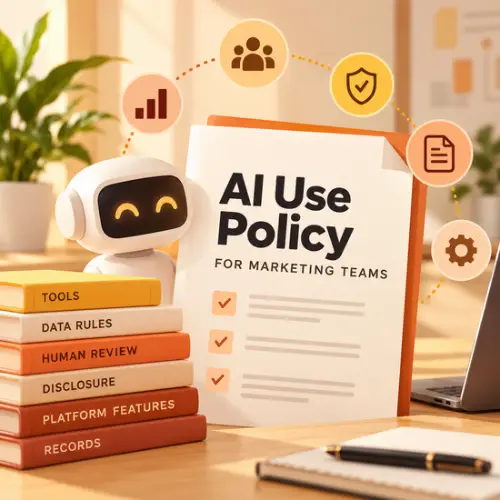
A working AI use policy for marketing covers six clauses: tools, data rules, human review, disclosure and brand voice, platform features and agents, and records. Keep each clause short enough that a new hire can follow it on day one.
Which Tools Are Allowed, and How a New One Gets Added
List the approved AI tools by name, the account type your team must use and the tasks each one is cleared for. A tool used on a personal account is not cleared, even if the product is on the list.
Add a fast request path for new tools: who asks and who reviews the terms. If the path is slow, people use unlisted tools anyway. For ideas on where to start, see these practical AI use cases for Eloqua and Marketo teams.
Data Rules, by Reference
Do not rewrite your data rules into the AI use policy for marketing. State which data classes may go into which tools, and point to the single source where the full rules live. One source of truth beats two documents that drift apart.
Human Review Before Anything Ships
Require human review of AI content before it reaches a send queue, a landing page or a live segment. Name the review role, not just the step, and build it into the workflow as a required approval rather than a verbal expectation that disappears under deadline pressure.
An AI-assisted check supports that sign-off but never replaces it, as this guide to AI campaign QA in Eloqua shows. If your team drafts with built-in editor features, AI-generated content in Eloqua editors covers what to check before you publish.
Disclosure and Brand Voice Guardrails
Write down when your team discloses AI involvement as your AI disclosure policy. For example, always disclose synthetic images or voices, and set one clear rule for lightly edited copy so writers are not deciding case by case. Then list the brand terms and claims AI drafts must never change without review.
The U.S. Copyright Office’s work on copyright and AI addresses whether AI-generated output can be protected by copyright, so name who reviews AI-heavy assets your team expects to own.
Rules for AI Features Inside Your Platform and for AI Agents
Name who may switch on AI features inside your marketing automation platform, and require a review before any new feature touches live contacts. Capabilities vary by edition, so govern the decision to enable a feature, not a feature list.
AI agents that can write to records or trigger sends need stricter rules: narrower permissions, an approval gate and a named owner. Governing AI agents that touch Eloqua customer data covers those controls.
What the Team Must Record
Require a simple record of which sends, segments and assets involved AI, who reviewed them and when. When anyone asks how a decision was made, the answer should be in the record, not in someone’s memory.
Who Signs Off, and How Do You Roll It Out?
Marketing ops owns the document, other teams approve their clauses, and rollout works when the rules live inside the workflow.
Sign-Off: One Owner, Several Approvers
Give the policy one owner in marketing ops who keeps it current. Legal approves disclosure and claims, privacy approves the data rules and IT security approves the tool list. The NIST AI RMF Playbook’s Govern function, a voluntary reference, calls for building trustworthy AI into organizational policies, documenting roles and responsibilities, and setting policies for third-party AI systems.
Put the Rules in the Workflow, Not a PDF
A policy that lives only in a shared drive is ignored by the second busy week. Turn each clause into a required approval step, an intake checklist item or a pinned tool list. Building a marketing ops governance model that sticks covers how to win buy-in and develop champions.
Train for Judgment, Not Just Compliance
Teach the reason behind each rule. A specialist who lets AI build every segment without understanding the logic is one edge case away from a mistake nobody catches.
Review on a Schedule and on Triggers
Review your AI use policy for marketing every quarter, and also when your platform adds an AI feature, an AI tool contract renews or a new regulation applies. AI-specific rules are expanding in several jurisdictions, including the European Union, so the trigger matters as much as the calendar. Every guardrail costs some speed, so keep the ones that protect contacts, brand and claims.
A One-Page AI Use Policy Template
Use this AI policy template as the starting point for your own document. Anything longer than three sentences belongs in a linked procedure.
Purpose and scope: Teams, tools and content covered, and the company policy it sits under.
Tools: The tool list, account types, cleared tasks and the request path.
Data rules: Which data classes may go into which tools, linked to the full rules.
Human review: The review role required before AI-assisted work ships, by asset type.
Disclosure and brand voice: When AI involvement is disclosed, and which terms and claims need review.
Platform features and agents: Who may enable AI features, and the extra controls for agents.
Records: What gets logged about AI-assisted work, and where.
Owner and approvers: The policy owner, and who approves each clause.
Exceptions: How to request one, who decides and how it is recorded.
Review date: The next scheduled review, and the triggers for an early one.
Conclusion
AI is already part of how your team drafts and ships campaigns. But without written rules, every decision depends on who is working that day. A one-page AI use policy for marketing gives your team cleared tools, clear review steps and a record that answers questions before they become problems. For help turning these clauses into steps inside your own instance, contact us at 4Thought Marketing.
About 4Thought Marketing
We're a B2B marketing automation and AI consultancy with a thing for getting complex tech to actually work. Since 2008, we've helped hundreds of organizations across financial services, technology, manufacturing, and real estate get more from Eloqua, Marketo, and their CRM integrations. We serve our clients across marketing automation strategy, lead lifecycle, AI, compliance, preference management, and more. Explore our services or get in touch.
Frequently Asked Questions
What should an AI use policy for marketing include?
It should cover tools, data rules, human review, disclosure and brand voice, platform AI features and agents, records, an owner and a review date. Start from a one-page AI policy template and link out to detailed procedures.
How is a marketing AI policy different from a company-wide AI policy?
A company-wide policy sets general acceptable use, such as protecting confidential data. A marketing policy applies those rules to marketing work: copy review, platform AI features, brand voice and claims.
Who should approve the marketing AI policy?
Marketing ops should own and maintain it. Legal approves disclosure and claims, privacy approves the data rules and IT security approves the tool list.
Should AI-generated marketing content be disclosed?
It depends on the content, the channel and the rules that apply to your audience, so write the decision into your policy instead of deciding case by case. Confirm the standard with your legal team.
How often should the policy be reviewed?
At least quarterly, and also when your platform adds an AI feature, a tool contract renews or a new regulation applies. Trigger-based reviews catch changes a calendar review would miss.
Do AI agents need separate rules?
Yes. Agents that can update records or trigger sends need narrower permissions, an approval gate and a named owner. Drafting tools can follow lighter rules, because a person still decides what ships.