
Quick Takeaways
- List size is a vanity metric, not a real result.
- Email providers reward engagement, not raw sending volume.
- Most deliverability problems start with your list quality.
- Batching your sends protects your sender reputation over time.
- Pruning unengaged contacts often raises your total engagement.
- Strong email list quality beats a bigger contact count.
Table of Contents
You have spent years building your email list. The number in your platform dashboard climbs every quarter, and that growing figure feels like proof the program is working.
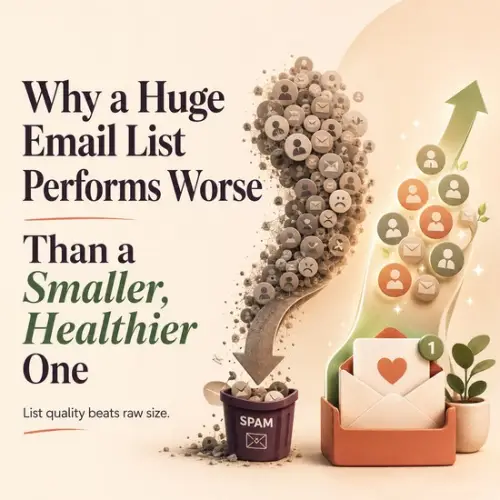
But raw size is a weak predictor of results, and email list quality is what actually decides whether your messages reach the inbox. Past a certain point, a large, poorly maintained list stops helping you and starts working against you. It quietly drags down delivery to the very contacts who want to hear from you.
The good news: the levers that reverse this are entirely in your control. Improving email list quality, changing how you send, and removing the contacts who never engage will do more for your results than any push to inflate the total count. Here is why smaller and healthier almost always beats bigger and heavier.
Bigger Isn’t Better: Why List Size Is a Vanity Metric
Email list size is the number you show off; email list quality is the number that pays you back. A large list only helps if the people on it actually open, click, and want your email. Once it fills with dormant, invalid, or uninterested addresses, email list size becomes a vanity metric that hides a shrinking real audience.
What list quality actually means
List quality: the share of real, engaged, permission-based contacts on your list relative to the dormant, invalid, or uninterested ones. High email list quality means most of your contacts still want what you send.
Mailbox providers do not reward you for how many addresses you own. They reward engagement. When you send to a padded list, a large slice of that send lands with people who ignore you, and providers read that indifference as a signal that your mail is not wanted. That single behavior pulls down inbox placement for everyone on the list, including your best contacts. In other words, low email list quality taxes the people you can least afford to lose.
This is where measurement discipline matters. If you judge the program by total contacts, you will keep optimizing the wrong number. Judge it by email list quality, and the picture changes. AI-assisted engagement scoring now makes it far easier to see which contacts are genuinely active versus merely counted, so the health of the list stops being a guess.
Your Deliverability Problem Probably Isn’t a Platform Problem
When inbox placement drops, the instinct is to blame the platform. In practice, the cause is almost always upstream: your list quality and your send behavior, not your email service provider. Your ESP is the tool carrying the mail, not the reason it lands in spam.
The usual culprits are unengaged segments you keep mailing, no list hygiene to remove people who never respond, and mass blasts that spike your volume without warning. Each of these tells mailbox providers that your sending is risky, so they start routing your mail to the spam folder, including the messages your most loyal contacts actually asked for. Weak email list quality is what turns a normal send into an email deliverability incident.
Before you open a support ticket, audit the list and the send pattern first. Routine list hygiene, removing invalid and unresponsive addresses on a schedule, prevents most of these problems before they start. For a fuller walkthrough of the technical and email deliverability fundamentals, see our guide to email deliverability best practices. Nine times out of ten, the fix lives in your data and your habits, not in the platform.
Why Batching Your Sends Beats One Big Blast
Ramping your sends in measured batches over several days protects your sender reputation far better than firing one giant blast. This matters most on large, multi-region sends, where running global email campaigns across many markets at once multiplies the volume landing in the inbox at the same time. A single mass send spikes your volume abnormally, and an abnormal spike from a sending identity without a steady pattern is exactly what mailbox providers treat as suspicious.
Sender reputation: the trust score mailbox providers assign to your sending identity based on how recipients react to your mail over time. A stable, positive sender reputation is what keeps you in the inbox.
Batching produces four healthy signals that a blast cannot:
- Your volume looks consistent and human, not like a sudden flood.
- Early engagement on the first batches builds reputation that carries the later batches.
- Any problem surfaces on a small slice first, so you can stop before it spreads.
- Your sender score stays stable, instead of taking a lingering one-day hit.
This behavior is exactly what large providers now expect. Google spells out the same logic in its own email sender guidelines, which reward steady, engaged sending and penalize sudden, unwanted volume. Batching is simply the operational habit that keeps your email list quality and your reputation working together rather than against each other.
How Pruning Your List Can Raise Total Engagement
List pruning can increase your total engagement, not shrink it. When you suppress the chronically unengaged, your aggregate open and click rates rise, because the dead weight is no longer diluting them. Higher aggregate engagement improves how providers treat you, which improves inbox placement for everyone who remains.
The chain is worth stating plainly: list pruning raises email list quality, which leads to better engagement rates, which leads to better provider treatment, which leads to better inbox placement for the whole list. This is why email list size is the wrong thing to optimize. A smaller, healthier list often delivers more total engagement than a larger, decaying one, because more of its messages actually arrive where people will see them.
Suppress and offer a choice, not just delete
Pruning does not have to mean deleting people outright. Before you suppress a contact for good, give them a way to stay on their own terms. A well-built preference center lets a fading subscriber dial down frequency or pick fewer topics instead of disappearing, which protects both email list quality and the relationship. Our look at why unsubscribe wins when preference management fails covers how to give that middle option.
Conclusion
The number in your dashboard was never the goal; reaching the people who want your email is. Chasing size adds contacts who quietly erode your email list quality, while improving email list quality, batching your sends, and pruning the unengaged compounds in your favor. Bigger feels like progress, but healthier is what actually lands in the inbox. If you want help turning a bloated list into a high-performing one, contact 4Thought Marketing and we will help you build the plan.
About 4Thought Marketing
We're a B2B marketing automation and AI consultancy with a thing for getting complex tech to actually work. Since 2008, we've helped hundreds of organizations across financial services, technology, manufacturing, and real estate get more from Eloqua, Marketo, and their CRM integrations. We serve our clients across marketing automation strategy, lead lifecycle, AI, compliance, preference management, and more. Explore our services or get in touch.
Frequently Asked Questions
Does a bigger email list mean better performance?
Not on its own. Performance follows engagement, not raw size, so a bigger list only helps if most of its contacts still open and click. Once a list fills with unengaged addresses, its email list quality falls and results drop even as the total climbs.
Why did my email deliverability suddenly drop?
A sudden drop is usually caused by list quality and send behavior, not the platform. Mailing unengaged segments, skipping suppression, or sending an abnormally large blast all signal risk to mailbox providers. Audit your list and your send pattern before assuming the tool is at fault.
Should I send to my whole list at once or in batches?
Batch your sends. Ramping volume in measured increments over several days looks consistent and human, builds reputation on the early batches, and surfaces any problem on a small slice first. A single mass blast spikes your volume and can take a lingering hit to your sender reputation.
Will deleting inactive subscribers hurt my reach?
Usually the opposite. Suppressing chronically unengaged contacts raises your aggregate open and click rates, which improves how providers treat you and lifts inbox placement for everyone who remains. A smaller, healthier list often reaches more real people than a larger, decaying one.
What is a good email list size for B2B?
There is no ideal number, and chasing one is the wrong goal. Health beats size: a list where most contacts are real, engaged, and opted in will outperform a much larger list full of dormant addresses. Measure email list quality, not the raw count.