Quick Takeaways
- Marketing ops team roles shrink in production, grow in review.
- Judgment, data stewardship and platform administration stay human.
- AI reviewer and agent owner are suggested new responsibilities.
- Build skills by role, tied to real work.
- Give every AI decision one named owner, never a group.
- Name who signs off every AI-drafted send before launch.
Table of Contents
Someone on your team switched on an AI feature last month, and nobody can say who approved it. That gap is why marketing ops team roles need a rewrite for the AI era, before the next agent or AI-drafted send goes live.
Your team runs Eloqua or Marketo well, and the platforms now ship AI faster than your org chart changes. But the job descriptions, marketing operations skills, and sign-offs were written for a team that builds and sends everything by hand, so decisions land on whoever clicks first. Who owns AI in marketing? Today the honest answer is often nobody.
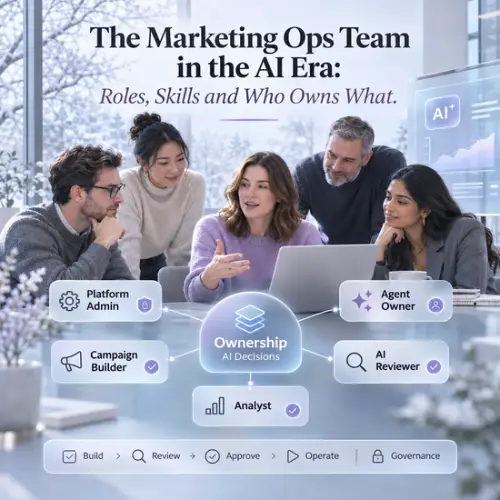
Therefore, treat your marketing ops team roles as three decisions: the roles you keep and add, the skills each person needs, and one named owner for each AI call. Together they define your AI marketing operations team.
Marketing Ops Team Roles: What Shrinks, What Stays and What Is New
AI changes the work inside marketing ops team roles more than it changes headcount. Your team is not being replaced. The tasks move, and a few new responsibilities appear. A useful test for each task: if a wrong answer is cheap to spot and fix, it moves toward AI. If a wrong answer reaches a customer or a database, a person stays in charge.
What shrinks
Repetitive production shrinks first: first-draft email copy, routine QA passes, list pulls and report assembly. These tasks are rule-based, easy to check, and slow by hand, so they are often the first you hand to AI. The hours do not vanish. They shift to checking the output.
What stays
Judgment stays human. Data stewardship, platform administration, campaign architecture, and the final call on what reaches your audience remain people jobs, because they carry accountability that a tool cannot hold. The admin who knows why an Eloqua segment or a Marketo smart list is built the way it is becomes more valuable, not less, once your AI marketing operations team starts reviewing agent output.
AI roles in marketing operations that are new
Two responsibilities are worth naming. These are our suggestions, not industry-standard job titles, so adapt the labels to your team.
- AI reviewer: Checks AI-drafted copy, audiences, and reports against your brand voice and your facts before anyone uses them.
- Agent owner: Owns one AI agent or feature end to end, including what it may do and when it gets switched off.
AI roles in marketing operations work best when they attach to people who already know your instance. A trusted campaign builder often makes the best AI reviewer, and your senior platform admin is the natural agent owner. Name them internally before you consider hiring for them.
On a small team, one person can wear both hats. What matters is that each responsibility has a name. For the wider case for this kind of hybrid role, see our look at the critical role of the marketing technologist.
Marketing Operations Skills Each Role Needs for AI Work
Marketing operations skills for AI work are less about clever prompts and more about judgment. AI roles in marketing operations need their own skills, and each of your marketing ops team roles needs a different mix.
Skills by role
- Platform admins: Permissions, audit trails, and knowing which AI settings exist in Eloqua or Marketo.
- Campaign builders: Writing clear instructions for AI, then testing the output before it reaches a live campaign.
- Analysts: Questioning AI-generated insights, checking the source data and explaining a number’s limits. Our piece on the AI marketing operations analyst goes deeper.
- AI reviewers: Spotting wrong claims, off-brand tone, and personal data that should not be there.
- Team leads: Deciding what to try, what to stop, and when a result is good enough to trust.
One email, four skills
Take an AI-drafted nurture email in Eloqua or Marketo. The campaign builder writes the instruction and tests it, the AI reviewer checks claims and tone, the analyst later checks whether the results are real, and the platform admin confirms the sending account has only the access it needs. Four skills touch one email, which is why one shared checklist fails and one list per role works.
How the team builds them
Pick one skill per person per quarter and attach it to real work, such as reviewing every AI-drafted email for a month. Structured learning helps too, and 4Thought Marketing offers custom training built around your platform and your team. Either way, write the target skills down, because marketing operations skills you never name are never assessed.
Marketing Ops Ownership: One Named Owner for Every AI Decision
Marketing ops ownership fails when a decision belongs to a group. The question of who owns AI in marketing gets a real answer only when each decision has one name beside it. The NIST AI Risk Management Framework points the same way: it expects roles and responsibilities for managing AI risk to be documented, and policies that separate the responsibilities of people and AI working together. Three decisions cover most of the risk.
Which AI features to enable
Someone must decide whether an AI feature is switched on at all. Name one owner, usually your platform admin or marketing ops lead. Access is the lever. Oracle documents that Eloqua security groups control what users can do through interface access, action permissions and asset permissions, and Adobe documents built-in roles and custom user roles in Marketo with selected permissions. Use those controls so the owner’s decision is enforced, not just agreed.
What an AI agent may touch
Name an agent owner for every agent. That person decides which data, assets and audiences it can reach and signs off on any change. The access tiers and data audit behind this decision are covered in our guide to an AI-ready MOPs instance. Use it as the technical reference, and keep the decision on one person’s list.
Who signs off an AI-drafted send
Pick a named person who approves any AI-drafted email before it goes out. That is not the tool and not “the team”. Your AI use policy for marketing should state the rule, and this owner applies it on every send.
How to record the owners
Keep a one-page table with one row per decision, the owner’s name, a backup and the date last reviewed. List which of your marketing ops team roles holds each row. Review it every quarter and whenever someone changes jobs. Marketing ops ownership that lives only in people’s heads disappears when they leave.
Marketing ops ownership on a small team
On a team of three, one person may own all three decisions. That works if the names are written down and a second person checks the sends. For the formal version, our RACI matrix for marketing roles and marketing operations governance model show how to document it.
Once ownership is clear, two questions follow: whether to build or buy your AI tooling, and how to move AI experiments into production. Follow-up articles cover both, and each depends on the owners named here.
Where AI Fits in Your Marketing Ops Team Structure
Where AI fits in your marketing ops team structure comes down to one question: who owns an AI agent in your Eloqua or Marketo instance when something goes wrong? The short answer to who owns AI in marketing is a named agent owner inside marketing ops, not the vendor and not a shared inbox.
In Eloqua, we recommend the owner configure the agent, limit what its security group can reach and review what it produces. In Marketo, the same person reviews what AI generates for a program or smart campaign and decides who may use it. In both, the owner reports to the marketing ops lead, who holds the final sign-off. Our guide to governing Eloqua AI agents covers the controls in more detail.
A practical marketing ops team structure for a small AI marketing operations team is a lead, an admin, a builder and an analyst, with the reviewer and agent owner roles assigned to people you already have. Larger teams can split the roles, but ownership stays singular.
Be honest about the limit: AI will not tell you it is wrong, so a human owner has to. That is why marketing ops team structure should add review capacity, not remove it.
Conclusion
Marketing ops team roles are changing because the work is moving, not disappearing. Decide which roles shrink, stay and appear, name the marketing operations skills each person needs, and settle marketing ops ownership with one name per AI decision. Your AI marketing operations team will then know who answers when an agent or an AI-drafted send goes wrong. If you want help mapping roles and readiness for your Eloqua or Marketo team, contact 4Thought Marketing for a conversation.
About 4Thought Marketing
We're a B2B marketing automation and AI consultancy with a thing for getting complex tech to actually work. Since 2008, we've helped hundreds of organizations across financial services, technology, manufacturing, and real estate get more from Eloqua, Marketo, and their CRM integrations. We serve our clients across marketing automation strategy, lead lifecycle, AI, compliance, preference management, and more. Explore our services or get in touch.
Frequently Asked Questions
What are the key marketing ops team roles in the AI era?
Platform admin, campaign builder, analyst and team lead stay. Add two responsibilities: an AI reviewer who checks output and an agent owner who runs each AI agent. These AI roles in marketing operations are suggested labels, not standard titles.
Who owns AI in marketing?
Give each AI decision one named owner: who enables features, what an agent may touch and who signs off an AI-drafted send. On a small team, one person can hold all three if the marketing ops ownership is written down.
What marketing operations skills do teams need for AI?
Permission management, testing AI output before it goes live, questioning AI-generated analysis and spotting wrong claims or personal data. Judgment matters more than prompt writing.
Will AI replace the marketing ops team?
No. AI takes over repetitive production, but marketing ops team roles still carry accountability, data stewardship and platform administration stay with people. The work shifts toward reviewing and deciding.
What does NIST say about roles for AI?
The NIST AI Risk Management Framework expects roles and responsibilities for AI risk to be documented, and policies that define the roles of people working with AI. Use it as a reference for your own documentation.
How should marketing ops team structure change for AI?
Add review capacity, not just output. Keep one marketing ops lead with final sign-off, and name an owner for every agent and AI feature in your AI marketing operations team.