Key Takeaways
- Oracle Eloqua ships assistant-level AI, not autonomous agents today.
- Agentic AI in Eloqua means connecting external agents responsibly.
- An AI agent acts on a goal; an assistant only helps a human.
- Marketo has built-in agents; Eloqua currently has not.
- Eloqua’s established REST API is the legitimate path in.
- Deploy, then connect, then govern, in that exact order.
Table of Contents
If you have gone looking for agentic AI in Eloqua, you have probably come away confused. The phrase is everywhere, the demos look impressive, and every vendor deck implies your platform is one click away from running itself. So it is worth being direct about where things actually stand.
Here is the honest picture. Oracle Eloqua does not ship autonomous AI agents the way some other platforms now do. What Eloqua offers today is assistant-level AI that helps a person write faster, not software that pursues a goal on its own. That gap is not a failure to plan around; it is simply the current reality.
Therefore this article does something more useful than a product tour. It defines what the term really means right now, and lays out how a marketing operations team would responsibly deploy, connect, and govern an external agent alongside Eloqua. Think of it as a current-state report with practical guidance, not a prediction and not a how-to.
What “Agentic AI in Eloqua” Actually Means
An AI agent is software that takes a goal and carries out multi-step work toward it on its own, deciding what to do next and acting inside the limits you set. An AI assistant, by contrast, waits for a person and helps with a single task, such as drafting an email. That one distinction is the whole story: an agent acts, while an assistant helps. When people ask whether agentic AI in Eloqua exists, this is the line that matters.
Where Eloqua sits: Eloqua’s native AI is assistant-level. It helps a marketer produce a first draft or subject-line options, and a human still owns every decision and every send. It does not set its own goals or execute a sequence of actions unsupervised. We covered that assistant-level capability in depth in our look at AI-generated content in Eloqua’s editors, so this piece will not repeat that ground.
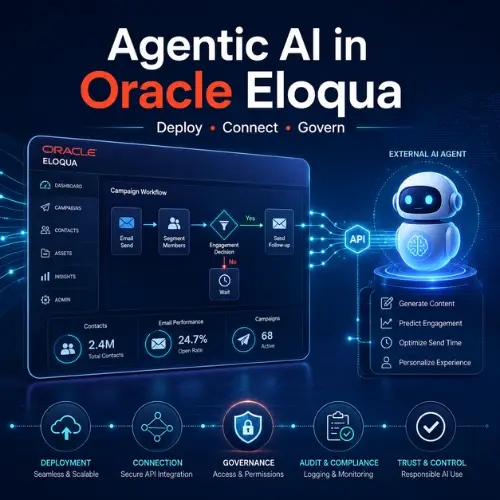
So in practical terms, this is not a switch inside the platform. Agentic AI in Eloqua means an external AI agent, one that lives outside Eloqua, reaching into your instance to read and act on data through a legitimate connection you control. That framing keeps your planning grounded in what is real rather than what is marketed.
Where Eloqua Stands Today Versus Marketo
The clearest way to see Eloqua’s position is to contrast it with Marketo. Adobe has been building autonomous agents directly into Marketo, with callable agents and an agent-building layer that run tasks inside the platform. We documented that shift in our guide to Marketo’s agentic AI. Oracle has not done the same for Eloqua.
That is the factual state of play: one platform has started shipping agents in the box, and the other has not. This is not a criticism of either product, and not a hint about what Oracle will do next. It simply tells you that if you run Eloqua and want agentic behavior now, the agent comes from outside the platform, not from a native feature you enable. So, agentic AI in Eloqua is external not internally built in.
One more caution: AI feature availability moves fast and varies by instance. Before you plan around any capability, confirm what is actually live on your own Eloqua environment rather than assuming a demo reflects general availability. If you are still deciding which AI work to tackle first at all, our primer on practical AI use cases for Eloqua and Marketo teams sorts the options into the right buckets.
Deploy: Where an AI Agent Could Fit Your Stack
Start by deciding where an agent would earn its place, because an agent is only worth connecting if it removes real, repetitive work. The strongest early candidates are the unglamorous, high-volume tasks your team does by hand every week.
Data hygiene: An agent could standardize inbound contact fields, flag duplicates, and tidy records before they flow into segments and campaigns, the kind of cleanup that quietly drains hours.
Campaign QA: An agent could check a campaign build against your own best-practice rules and surface problems before launch, acting as a tireless second reviewer.
Reporting and monitoring: An agent could watch for anomalies in engagement or delivery and assemble a plain-language summary your team reads instead of building by hand.
The discipline here is to pick one narrow, well-bounded job first rather than handing an agent the run of your instance. A tightly scoped pilot is how you learn what an agent can safely own before you widen its remit. We walk through the full approach in our dedicated guide to launching an AI agent pilot in Eloqua.
Connect Agentic AI in Eloqua: How an Agent Reaches Eloqua
An external agent talks to Eloqua through its application programming interface, or API, the established, documented doorway that lets approved software read and write data in your instance. Eloqua’s REST API is real, mature, and available today, and it is the legitimate, accessible path any well-built agent would use. You do not need a special new product for the connection to exist; you need the discipline to use the existing one carefully.
You will also see references to newer connection standards for AI tools, and to third-party connectors that promise to link platforms to agents more quickly. Those third-party connectors do exist, and the open Model Context Protocol standard that some of them build on is publicly documented. The point for planning is simply that Eloqua does not offer a native agent-connection product of its own, so any such bridge comes from outside the platform and should be evaluated on its own security merits.
Keep it plain here: the deep technical architecture belongs to your developers and to our deep dive on connecting agents to the Eloqua API, not to this overview. What a marketing operations lead needs to know is that the connection is possible, it runs through a known and controllable channel, and it is a decision to make deliberately.
Govern: Permissions, Human Oversight, and Audit Trails
Governance is the part that turns a risky experiment into a durable capability, and it is non-negotiable the moment an agent can touch a real customer record. The core principle is simple: an agent that acts on your data inherits the same obligations as the database it reaches into.
Least-privilege permissions: Give the agent access only to the specific data and actions its job requires, never blanket access to your whole instance.
Human in the loop: Keep a person approving anything that reaches a customer, so the agent proposes and a human confirms on send-facing work.
Audit trails: Log what the agent did, when, and to which records, so you can review and, if needed, reverse its actions.
These are the same instincts good marketing operations teams already apply to consent and data handling, extended to a new kind of actor. Getting an agent right is far more a governance question than a technology one, which is why we give it a full treatment in our guide to governing agents on customer data.
A Practical Sequence: Deploy, Connect, Govern
Take these three in order, because reversing them is where teams get hurt. First deploy: decide the single narrow job an agent should own and confirm it is worth automating. Second connect: establish the controlled API connection for that one job, nothing wider. Third govern: set the permissions, the human checkpoints, and the audit logging before the agent ever runs against live data.
Done in this sequence, the work becomes a manageable, staged addition to your stack rather than a leap of faith. Pick the job, build the smallest possible connection, wrap it in governance, and only then expand. That is how you capture the speed without inheriting the risk.
Conclusion
The honest answer is that agentic AI in Eloqua is not a native feature you switch on today; it is an external agent you connect and control responsibly. Eloqua gives you assistant-level help inside the platform and a mature API to reach it from outside, and that combination is enough to deploy real agentic value if you sequence it well. Define the narrow job, connect through the established channel, and govern every action that touches customer data. Do that, and you get the productivity without the exposure. If you would like help mapping this to your own instance, 4Thought Marketing can help you build the roadmap.
About 4Thought Marketing
We're a B2B marketing automation and AI consultancy with a thing for getting complex tech to actually work. Since 2008, we've helped hundreds of organizations across financial services, technology, manufacturing, and real estate get more from Eloqua, Marketo, and their CRM integrations. We serve our clients across marketing automation strategy, lead lifecycle, AI, compliance, preference management, and more. Explore our services or get in touch.
Frequently Asked Questions
Does Eloqua have agentic AI?
Not natively. Oracle Eloqua ships assistant-level AI that helps a person write, not autonomous agents that act on their own. Agentic AI in Eloqua today means connecting an external agent to your instance through its API, under your control.
Can you connect AI agents to Eloqua?
Yes. An external agent can reach Eloqua through its established REST API, the same documented channel other approved software uses. Third-party connectors also exist to help bridge agents to platforms, though none of that connectivity is a native Eloqua product.
Agentic AI versus AI assistant, what is the difference?
An AI assistant helps a human with a single task and waits for instructions. An AI agent takes a goal and carries out multi-step work toward it on its own, inside limits you set. In short, an assistant helps and an agent acts.
Is it safe for customer data?
It can be, if you govern it. Give the agent least-privilege access, keep a human approving anything customer-facing, and log every action for audit. An agent that touches a contact record inherits the same obligations as the database it reaches into.
Do I need developers to deploy an AI agent in Eloqua?
For the connection itself, yes. Reaching Eloqua through its API and securing that link is developer work. A marketing operations lead owns the decisions: which job to automate, what data the agent may touch, and where the human checkpoints sit.
Does Oracle sell agentic AI for Eloqua?
No. Oracle does not offer native autonomous agents for Eloqua, and this article makes no prediction about future releases. Always confirm what is actually live on your own instance before planning around any AI capability.