



Frequently Asked Questions

AI Marketing Mistakes & Best Practices

What are the most common mistakes marketers make when using AI?

Common mistakes include overestimating AI's capabilities, jumping in without a plan, ignoring data quality, getting too personal with data, making customer interactions robotic, not supervising AI, ignoring ethical and privacy concerns, and expecting immediate results. Each of these can undermine marketing effectiveness and damage brand trust. (Source)

Why is it risky to overestimate what AI can do in marketing?

AI is powerful for analyzing data and identifying patterns, but it cannot process nuance or create original content like humans. Overestimating AI can lead to errors, misleading information, and campaigns that lack creativity. Always supplement AI with human insight. (Source)

How should companies plan their AI marketing strategy?

Companies should align AI initiatives with clear marketing goals, such as increasing engagement or boosting conversions. Identify which AI tools support these objectives and integrate them into proven strategies rather than rebuilding everything around AI. (Source)

Why is data quality important for AI marketing success?

AI relies on high-quality, relevant, and up-to-date data. Poor data leads to inaccurate insights and misguided strategies. Marketers should clean, organize, and verify data before using it in AI tools. (Source)

How can marketers avoid being intrusive with AI personalization?

Marketers should use personalization thoughtfully, focusing on relevant content and recommendations rather than hyper-specific details. Avoid using confidential or sensitive data and ensure all data usage complies with privacy laws. (Source)

What is the best way to combine AI and human support in customer interactions?

Use AI to handle routine inquiries and FAQs, but ensure complex or sensitive issues are managed by human representatives. Make it easy for customers to reach a human and be transparent about AI involvement. (Source)

Why does AI in marketing require ongoing supervision?

AI algorithms need regular review and adjustment as business needs and customer preferences change. Monitoring performance metrics and refining strategies ensures AI remains effective and relevant. (Source)

How should marketers address ethical and privacy concerns with AI?

Marketers must be transparent about AI and data usage, obtain proper consent, and use data responsibly. Address potential biases in AI algorithms to avoid perpetuating stereotypes or excluding groups. (Source)

What should marketers expect when implementing AI solutions?

AI requires time to learn and adapt; significant improvements may take weeks or months. Set realistic expectations, start with pilot projects, and scale as confidence grows. (Source)

How can AI be used wisely in marketing?

AI should enhance marketing efforts, not replace human creativity. Use AI for data-driven insights and supplement with human intuition to craft compelling campaigns. (Source)

Features & Capabilities

What products does 4Thought Marketing offer for marketing automation?

4Thought Marketing offers products such as 4Comply (privacy compliance software), Cloud Apps (innovative solutions for marketing automation platforms), 4Preferences (centralized preference management), 4Segments (visual segmentation for marketers), and 4Bridge (integration solutions for Eloqua, Marketo, CRM, and other systems). (Source)

What is the String Deleter Cloud App and how does it help marketers?

The String Deleter Cloud App improves data quality by removing unwanted character strings, such as honorifics, name prefixes/suffixes, company suffixes, or special characters. This helps marketers maintain clean and accurate data for campaigns. (Source)

How does the Custom Object Kitchen Sink Pack benefit marketing teams?

The Custom Object Kitchen Sink Pack offers a collection of cloud apps designed to delete contact or custom object data, helping teams save 50% when purchased together and streamline data management. (Source)

What is 4Comply and what does it do?

4Comply is software for maximizing marketing while ensuring privacy compliance. It helps organizations adhere to privacy laws and regulations in their marketing operations. (Source)

What is 4Preferences and how does it help organizations?

4Preferences centralizes preference management across an organization, allowing marketers to efficiently manage customer preferences and improve personalization. (Source)

What is 4Segments and what does it offer marketers?

4Segments provides visual segmentation tools for marketers, enabling them to create and manage audience segments more effectively for targeted campaigns. (Source)

What is 4Bridge and how does it support integration?

4Bridge offers integration solutions for Eloqua, Marketo, CRM, and other systems, helping organizations connect their marketing platforms for seamless data flow and campaign execution. (Source)

Use Cases & Benefits

Who can benefit from 4Thought Marketing's AI and automation solutions?

Organizations seeking to improve marketing automation, data quality, privacy compliance, customer segmentation, and campaign integration can benefit from 4Thought Marketing's products and services. (Source)

How does 4Thought Marketing help with privacy-first marketing?

4Thought Marketing provides tools and consulting to ensure compliance with privacy laws, such as 4Comply and Data Privacy Consulting, helping organizations protect customer data and build trust. (Source)

How can 4Thought Marketing improve campaign production and deliverability?

4Thought Marketing offers campaign production services, including email, form, and landing page execution, deliverability optimization, and reporting to enhance campaign outcomes. (Source)

What are the benefits of using 4Thought Marketing's segmentation tools?

Segmentation tools like 4Segments help marketers visually create and manage audience segments, enabling more targeted and effective campaigns. (Source)

Technical Requirements & Integration

Which marketing platforms does 4Thought Marketing support?

4Thought Marketing supports platforms including Adobe Marketo, Oracle Eloqua, PathFactory, Microsoft Dynamics, Salesforce, and various AI platforms such as n8n, ChatGPT/OpenAI, Anthropic, and Gemini. (Source)

Does 4Thought Marketing offer system integration services?

Yes, 4Thought Marketing provides system integration options using connectors and custom APIs to connect marketing platforms and CRMs for seamless data flow. (Source)

What technical services does 4Thought Marketing provide?

Technical services include platform installation, change management, success planning, data management and stewardship, system integration, and custom web/app development. (Source)

Support & Implementation

Does 4Thought Marketing offer training for marketing teams?

Yes, 4Thought Marketing provides custom online training and videos to improve skills and productivity for marketing teams. (Source)

What help desk services are available from 4Thought Marketing?

4Thought Marketing offers help desk services with Eloqua and Marketo specialists to support campaign execution and troubleshooting. (Source)

How does 4Thought Marketing evaluate email efficacy?

4Thought Marketing provides expert analysis to enhance email impact, including deliverability and reporting, through its Email Efficacy Evaluation service. (Source)

What health check and analysis services does 4Thought Marketing offer?

Health Checks & Analysis services uncover opportunities to improve performance and outcomes in marketing operations. (Source)

Product Information

What is the Account CO to Contact CO Updater Cloud App?

This app updates contact custom objects with data from an account custom object or static values, streamlining data updates for marketers. (Source)

What does the Campaign Contact Remover Cloud App do?

The Campaign Contact Remover simplifies management of campaign canvas filters and decision steps, ensuring contacts are only in the correct nurture and can be removed from campaigns easily. (Source)

Knowledge Base Insights

How does 4Thought Marketing address AI hallucinations in marketing?

4Thought Marketing recommends double-checking AI outputs and supplementing AI-driven insights with human review to avoid errors and misleading information, as AI models can produce hallucinations. (Source)

What is the importance of data hygiene in AI marketing pilots?

Data hygiene is foundational for AI marketing pilots. Teams must clean and organize data to ensure AI delivers results rather than amplifying chaos. Skipping data cleanup leads to poor ROI. (Source)

How does personalized onboarding improve customer retention in the AI era?

Personalized onboarding delivers role-specific experiences in the first 90 days, accelerating value realization and reducing churn. AI adapts onboarding in real time based on behavioral signals. (Source)

What is account-based marketing and how does it drive B2B growth?

Account-based marketing aligns sales and marketing teams around high-value target accounts using personalized strategies, comprehensive frameworks, and revenue-focused metrics to drive measurable business outcomes. (Source)

How can compliance be aligned with corporate goals for strategic success?

Compliance can be transformed from a cost center into a strategic enabler by integrating planning and collaboration, reducing risk, and accelerating growth. (Source)

Why is strategic B2B marketing documentation important?

Strategic B2B marketing documentation reduces cognitive load, accelerates execution, and preserves institutional knowledge, compounding value over time. (Source)

How can marketers build sales trust with high-value response signals?

Aligning sales and marketing teams and using high-value response signals helps deals close faster and builds trust. (Source)

What is the impact of data breaches and privacy scandals on AI marketing?

Data breaches and privacy scandals highlight the importance of ethical data collection and transparency in AI marketing. Mishandling data can lead to loss of trust and reputational damage. (Source)

How can marketers address AI bias in their campaigns?

Marketers should be aware of potential biases in AI algorithms, review outputs regularly, and take steps to avoid perpetuating stereotypes or excluding groups from marketing efforts. (Source)

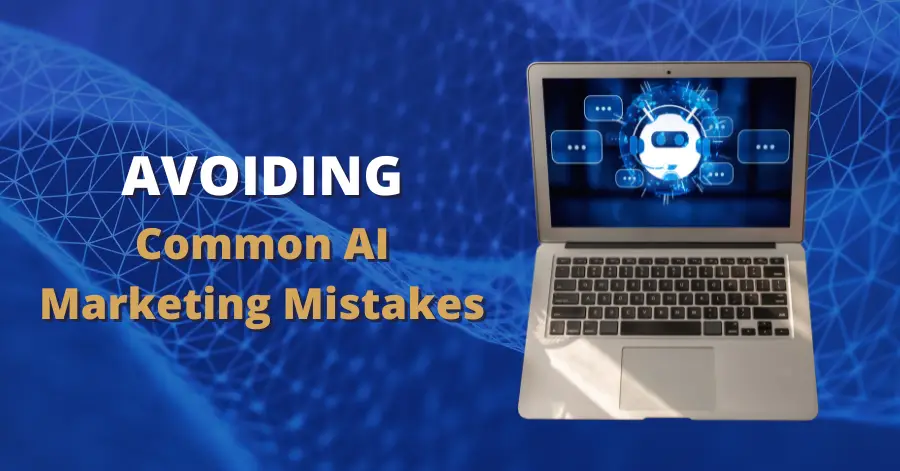
Avoiding Common AI Marketing Mistakes

ai marketing mistakes

Artificial intelligence has left an undeniable impact on the marketing landscape today. From personalized campaigns to predictive analytics, AI influences our approach to almost every aspect of online marketing.

However, just like any other tool, AI used incorrectly does more harm than good. Are you making any of these AI marketing mistakes?

1. Overestimating What AI Can Do

While AI is powerful, it’s neither a magic bullet nor a replacement for human insight and creativity. AI excels at analyzing vast amounts of data, identifying patterns, and making predictions. However, it cannot process nuance the way people can. It also can’t create something entirely original.

Perhaps most importantly, AI can and will make mistakes. Even the most sophisticated models still produce inaccurate or misleading information. The internet has collectively begun referring to these responses as “hallucinations”. People who assumed tools like ChatGPT knew what they were talking about have been proven wrong in hilarious fashion many times by now.

What to Do Instead: Use AI to supplement your marketing efforts, not replace them. Combine AI’s data-driven insights with your team’s creativity and intuition to craft campaigns that resonate with your audience. For instance, your AI tools can identify which content performs best at different stages of the customer journey. However, human employees are better at crafting a compelling narrative that engages and converts. Your AI’s insights can guide your actions, but cannot and should not perform them all for you.

Additionally, remember to double-check anything your AI produces. The last thing you want is a glaring error in your output.

2. Jumping on the AI Bandwagon Without a Plan

AI may be the hottest new thing, but if your company rushes to implement your own AI approach without a concrete plan, you’ll likely struggle. AI needs to align with your overall marketing strategy—and you need to know how it aligns. Without a plan, you can end up wasting resources, creating inconsistent messaging, and creating marketing campaigns with abysmal conversion rates.

What to Do Instead: Clearly define your marketing goals and determine how AI can help achieve them. Are you trying to increase engagement, boost conversions, or improve customer retention? Once you have a clear objective, identify the specific AI tools and techniques that can support your goals. In other words, fit AI into the marketing strategy that you know works, rather than rebuilding your entire strategy just to include AI.

3. Ignoring Data Quality & Quantity

AI thrives on data—that’s no surprise by now. But it can’t work with just any data. Poor-quality or irrelevant data can lead to inaccurate insights and misguided marketing strategies. You also need to consider where your data is coming from. Is it your own? If it originates from outside your company, are you even allowed to use it?

What to Do Instead: Invest time in collecting, cleaning, and organizing your data before feeding it into your AI tools. Ensure your data is relevant, up-to-date, and representative of your target audience. This means removing duplicate entries, correcting inaccuracies, and filling in missing information. You also need to be absolutely sure that any data you don’t create yourself comes from willing sources.

4. Getting Way Too Personal

Personalization is one of AI’s most celebrated capabilities, but there’s a fine line between providing personalized experiences and coming off as intrusive. It’s tempting to give AI every bit of data you can. But as experts have pointed out, AI lacks the emotional intelligence of a human, so it doesn’t know when it’s being insensitive or invasive.

What to Do Instead: Use personalization thoughtfully and avoid being overly familiar with your audience. Aim to add value by providing relevant content, offers, or recommendations rather than trying to showcase how much you know about your customers. For example, instead of using hyper-specific details like mentioning a customer’s recent purchase in an email subject line, focus on recommending products or content based on their broader preferences.

Above all, do not give your AI marketing tools confidential or sensitive data. Not only is this a serious violation of privacy principles, but it will only harm your reputation in the public eye. Collect and use only the data you’re legally permitted to have.

ai marketing mistakes

5. Making Customer Interactions Robotic

AI-powered chatbots and automated responses can handle many customer inquiries, but relying solely on AI for customer interactions can backfire. AI tools don’t always understand what a customer is asking for. Other times, when dealing with complex or sensitive issues, an AI’s lack of emotion can lead to upsetting responses. It’s no secret that when many customers call a helpline or use an online chatbot, many try to get the robot to send them to a human representative as fast as possible.

What to Do Instead: Implement a hybrid approach that combines AI with human support. Use AI to handle routine inquiries, tasks, or FAQs. Meanwhile, your actual employees should handle more complex or sensitive issues. This improves efficiency and ensures that customers feel valued and understood.

If your system defaults to an AI at the beginning of a conversation, state that upfront.  Also, make it easy to get to a human representative. Your customers shouldn’t have to navigate a complex menu to talk to a real person.

6. Not Supervising Your AI

AI needs near-constant supervision and performance review. Algorithms can save your team a lot of work—but your company’s needs will change. Your customers’ preferences will change. And if you don’t ensure that your algorithms change with them, you’ll continue to churn out campaigns that fail to deliver the desired results.

What to Do Instead: Regularly review your AI-driven campaigns and strategies to identify areas for improvement. Use metrics such as engagement rates, conversion rates, and customer feedback to gauge performance. AI learns over time, so the more you monitor and refine it, the more effective it becomes.

7. Ignoring Ethical Considerations & Privacy Concerns

In the age of data breaches and privacy scandals, ethical considerations are more important than ever. Too many marketers make the mistake of using AI to collect and analyze data without fully considering the ethical implications, which can lead to a loss of trust and damage to your brand’s reputation.

This invasive type of data collection is painfully obvious in cases like that of Eli Stein. He and his wife discovered they were expecting a child, but chose to hold back on making the announcement online. That didn’t stop a presumably AI-powered algorithm from flooding his social media feeds with ads for new baby supplies. And personal life events aren’t the only thing to consider. AI is trained on human-created data—and unfortunately, that data can reflect biases that the AI then perpetuates.

What to Do Instead: Be transparent about how you’re using AI and data. Ensure you have the proper consent from your customers before collecting their information, and respect their privacy by using data responsibly. Additionally, be aware of potential biases in your AI algorithms and take steps to address them to avoid perpetuating stereotypes or excluding certain groups from your marketing efforts.

8. Assuming AI is Good to Go Right Away

Many marketers expect immediate results once they implement AI solutions. It’s hard to blame them—AI’s capabilities are praised to high heaven. The reality is that AI requires time to learn and adapt, and it often takes weeks or even months to see significant improvements in performance.

What to Do Instead: Set realistic expectations and timelines for your AI projects. Understand that AI is a long-term investment, and be prepared to invest the necessary time and resources to see tangible results. Start with small pilot projects, gather insights, and gradually scale your AI initiatives as you gain confidence in their effectiveness.

Using AI Wisely in Marketing

AI is a tool that can enhance your marketing efforts when used correctly. It is not a one-size-fits-all solution. It is also no substitute for human intervention. But neither is it inherently a net negative. Using AI with human creativity and insight can help you create marketing strategies that produce worthwhile returns.

Ready to improve your AI marketing strategy? Contact us today.

[Sassy_Social_Share]

Related Posts